
A to Z Album Reviews
The third studio album from this award-winning Scottish traditional group comes a mere two years down the line from their well-received second, Fortune's Road, and as you might by now expect brings another sparkling, well-chosen and admirably even-handed collection of songs and tunes (six of each). But there's much more to the CD than that, for good though Fortune's Road was, Luminosity brings a significant advance in maturity and insight that's almost comparable to that between Crucible's first and second CDs. Unlike some of the young trad-based ensembles on the current scene, Back Of The Moon have a major selling-point in that they have within their ranks no less than three very good singers who are all more than capable of taking the lead - fiddler Gillian Frame, pianist Hamish Napier and guitarist Findlay Napier (the latter's a pretty good songwriter too, if his Ship In A Bottle, a CD highlight, is anything to go by). And there's something rather special about the spark and rapport between the musicians and their attitude to and respect of each other's abilities, whereby the lineup's instrumental complement never resorts to auto-pilot or a formulaic "arrangement by numbers" but brings an imaginative and thoroughly delicious spontaneity to each track. The band's fourth member, whistle & pipes (and bodhrán) man Ali Hutton (only not mentioned earlier because he doesn't sing - and hey, no offence intended!), brings a full-bodied tone to the group sound and arrangements with his forthright playing that in its intelligence ideally matches the contributions of the others. Each of the four bring some self-penned tunes to the mix to counterpoint examples both traditional and by the likes of Gordon Duncan and Phil Cunningham. The songs range widely for their sources too, with a dramatic rendition of the "happy ending" ballad Glenlogie sitting well alongside the Scott-collected murder ballad Nine Stone Rig (which Gillian credits to Linda and Teddy Thompson - hmm!) and Archie Fisher's pensive, bleak Final Trawl nicely contrasting with the upbeat tale of The Brewer's Lad. All the songs are blessed with effective arrangements that utilise both accompanying instruments and backing voices to best advantage. A handful of tracks (including Glenlogie and Hamish's fine slow air Joey Beauty's) see the band augmented by some more unusual sounds - the trombone of Rick Taylor and/or the cello of Christine Hanson - and the extra depth these elements bring to an already rich tapestry is quite remarkable. All told, though, and whether for songs or tune-sets, Back Of The Moon always demonstrate an innate and enviable understanding of texture and dynamics, and this canny and highly spirited collection is definitely their best yet.
www.backofthemoon.co.uk
www.footstompin.com
David Kidman
This talented young Scots four-piece brings a real smile to the visage and a tap to the toes on this neat selection of songs and tune-sets (six of each). Fortune's Road, the band's second studio set, proves if anything even more attractive than their debut, the playing even more accomplished after honing their performance skills much of late at prestigious festivals (including Cambridge) and a further tour of Canada (their third). The ensemble work is superb, credibly combining the instrumental accomplishments of front-liners Gillian Frame (fiddle) and Simon Mc Kerrell (border and uillean pipes, whistle) with the decidedly non-plodding sibling rhythm section of Hamish and Findlay Napier (piano and guitar respectively). As is the bright, clear recorded balance (a triumph for producer Jonny Hardie). Back Of The Moon easily show that they don't have to play fast to impress (for instance on the slow Karma Rules and the duet Skye Air), although their Mrs Maclean set is a tour de force on its own terms. As for the songs, again three out of the four group members contribute lead vocals, and the choice of songs is less mundane than before, thus scoring an extra welcome. Maybe I'll Be Married, which Gillian learnt from the singing of Alison McMorland, is probably the highlight among the songs, though Findlay's thoughtful rendition of the maritime song Heilan' Laddie also has considerable merit. The whole album has a commendable unity of purpose and achievement.
David Kidman
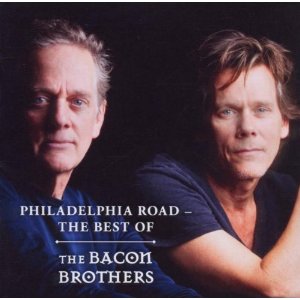
Comprising actor Kevin and his film and composer brother Michael and playing bluesy rock n roll filtered with Philly soul and country, the fact that they've made several albums and have gigged regularly since 1995 underlines that this is no movie star vanity project to distract from the boredom.
While touting itself as a best of collection, it only features material from three of their five albums, 2005's White Knuckles represented only by a reworked anthemic bluesy rock version of Unhappy Birthday for the 10th anniversary of 911 and absolutely nothing from 2008's New Year's Day, which seems a bit bizarre since Sprinsgteenesque Eye Of The Storm and the rootsy Architeuthis would both merit inclusion.
However, it's a useful retrospective snapshot and, for most UK ears, introduction with 19 tracks that, like the country rocking Old Guitars, Southern funky strut Grey Green Eyes, violin accompanied ballad Sooner Or Later and the TexMex flavours of 10 Years In Mexico all slip down easy.
They remind a little of the Bellamy Brothers, a similarity underlined by the fact they actually feature with them on Guilty Of The Crime, a track lifted from the BB's Anthology Vol 1 album.
Taken from 1997 debut album Foresco, the title of Boys In Bars pretty much musically sums them up, but there's little here you'd turn off on the radio and, at least it's not Bruce Willis or Russell Crowe.
Mike Davies November 2011
Liverpool's alt-country/roots supremo Mike Badger, founder member of the La's and The Onset, has just released this retrospective, which showcases the variety and versatility of his output since 1988 yet concentrates on the more country-flavoured examples of his work. Around half of the collection is directly sourced from the solo album Double Zero and the original Onset albums The Pool Of Life and The Pool Of Life Revisited, the rest being newish recordings from 2007 and 2008 aside from one live cut from 1991 (nothing from Volume or Lo-Fi Acoustic Excursions, though…) Mike's always had a clever way with lyrics, on which he employs curiously apt twists on themes that are the staple diet of country (barroom romances, cowboys, prison etc), while he also takes on ecological themes on They're Animals and Trees And Plants. Mike has a keen feel for the various modes of musical expression from solid twang, punk-country, steamin' rockabilly, honky-tonk and rock'n'roll. You can hear variously the spirits of the Mekons, Gram Parsons, Hank Williams, Steve Earle and Johnny Burnette in here, all affectionate and knowingly referenced, while Mike also turns in a neat cover of Roky Erickson's Clear Night For Love. I rather like the quirky, slightly ramshackle DIY ambience of Mike's music-making generally, which should not be taken as an adverse criticism but a positive quality. All in all, this disc is a useful catch-up vehicle for anyone not familiar with Mike's music.
David Kidman January 2009
Transfiguring punk classics into folk songs, those who hadn't actually heard the debut album by Adrian Edmondson, Maartin Allcock, Andy Dinan, and Troy Donockley might have thought it was a bit of a gimmick. Those who did take the time to lend an ear would have found it a find collection of Celtic influenced rearrangements that served to underline how punk was, by traditional definition of the form, essentially the folk music of its generation.
Certainly there was a novelty element involved but, no more say, than classical arrangements of heavy metal or jazz versions of pop tunes. Now, to prove they're serious but not without a sense of humour, comes a second re-imagining.
This time Allcock is absent from the line-up, and, rather than find a replacement, the remaining trio have dispensed with guitars entirely, but have invited double bassist Tim Harris along as guest.
Having closed the first album with God Save The Queen, they open this with Anarchy In The UK, Donockley's melancholic uilleann pipes backdropping a semi-spoken treatment that replaces the spat venom with a darker foreboding that's well suited to the times, closer to The Levellers than the Pistols.
Taking the pace and tone down too is Sound Of The Suburbs, transforming the Members' angry rant into a mandolin flecked portrait of suburban stagnation that might have been penned by Ray Davies.
I'm not entirely persuaded by the fiddle and mandolin arrangement of XTC's Making Plans For Nigel, but their world wearied treatment of Ever Fallen In Love With Someone (You Shouldn't Have) finds the sadness at the song's heart while the version of The Smith's Panic puts me in mind of Moving Hearts and, Andy Dinan's fiddle in fine sprightly fettle, Edmondson's delivery of Motorhead's Ace Of Spades substitutes laconic resignation for Lemmy's growled defiance.
The debut album interpolated several of the punk numbers with traditional gigs and reels, and they repeat that here. A mandolin backed Slim Chance-like rendition of The Specials' Friday Night, Saturday Morning also showcases Dinan's fiddle work on his self-penned Albion Street and trad tunes Humours of Ballyloughlin and Castle Kelly. Traditional Irish jig Humours Of Drinagh segues into White Riot which in turn gives way to a brief flurry through two reels, O'Rourkes and The Boyne Hunt.
However, the most inspired of these fusions has to be Ramones Medley where Trip To Athlone and Spike Island Lasses are sandwiched between fiddle driven arrangements of Now I Want To Sniff Some Glue, Gimme Gimme Shock Treatment and Blitzkrieg Bop. Hey nonny nonny ho, let's go, indeed.
Mike Davies November 2010
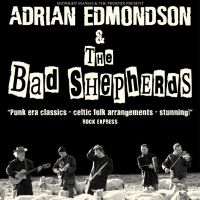
In recent years there's been a plethora of albums that have taken one genre of music and reinvented it in the style of another. Hayseed Dixie bluegrassed metal, Nouvelle Vague turned punk and new wave into bossa novas and most recently Hellsongs turned metal classics into lounge. Punk gets a makeover again here, recast (appropriately enough in sociological terms) as folk music from a line up featuring Fairport and Tull veteran guitarist Maartin Allcock, Toss The Feathers fiddler Andy Dinan, Iona's Uillean piper Troy Donockley and Ade Edmondson. Yes, that Ade Edmondson from The Comic Strip, The Young Ones and Bottom. But, as well as being a comedy actor whose most memorable past musical excursions have been as part of rock parody Bad News, he's actually an accomplished musician (his voice isn't bad but he plays mandolin better than he sings) with a clear interest in folk music. After all, his daughter is Ella Edmondson who recently made her own impressive debut.
So, what you have here is a collection of (mostly) punk classics performed in a Celtic folk stylee intercut or expanded with a hefty clutch of trad reels and jigs. Thus the opening I Fought The Law fires up on fiddle and launches into the Donockley-penned Cockers At Pockers while London Calling segues into Allcock's Manchster Calling,Teenage Kicks is sandwiched between three trad tunes, including Whisky In The Jar, and a mandolin sprung, spoken God Save The Queen heads out down the trad Mountain Road.
The songs lend themselves surprisingly well to the rearrangements and there's splendid interpretations of PiL's Rise, the Jam's Down In The Tube Station At Midnight (bringing out the bleakness of the lyrics), Once In A Lifetime and even Kraftwerk's The Model, transfigured here into a moody mandolin and pipes lament.
And, just to reaffirm they're not a one-trick novelty, the title track is their arrangement of a rousingly fiery set of four trad tunes that embraces Coppers & Brass and Rip The Calico in a manner guaranteed to get any folk fest crowd bouncing along. Apparently they also do a great version of All Around My Hat. As a punk number. The album title, by the way, comes from the traditional numeric phrase used to count sheep by shepherds in northern England and southern Scotland. Thought you'd like to know.
Mike Davies May 2009
How Sweet The Sound is the American Masters PBS TV documentary which celebrates Joan's 50-year career. An edited version is being broadcast on the BBC series Imagine on 8th December, but the DVD component of this package presents the complete film, along with bonus features.
The "main feature" is a straightforward and naturally conceived yet insightful 84-minute documentary, taking the form of the first comprehensive portrayal of both Joan's public career and her private life and conveying both the compelling presence and personality of Joan herself and the sheer strength of her political convictions. It contains some tantalising rare performance footage, as well as extracts from candid interviews with David Crosby, Bob Dylan, Roger McGuinn and Joan's ex-husband David Harris, and we do in fact get to know much of the inner Joan in the process of chronicling her journey through 40-odd years as, effectively, the conscience of a generation (indeed, she has often been content to let singing take the back seat to her activism).
We learn of Joan's early love of R&B preceding her discovery of folk (via Harry Belafonte, Odetta and Pete Seeger), and of her panic attacks during the formative years on stage (which comes as quite a surprise considering the assured and composed nature of those early performances); we also see and hear Dylan waxing lyrical about Joan's heart-stopping voice and that he especially admired her guitar playing. We also gain salutary reminders of just how different things were in the 60s, especially with regard to segregation, and of Joan's bravery and passionate conviction from a very early age; these observations are supplemented on the bonus segment of the DVD by a series of one-on-one conversations with other individuals (Vaclav Havel, Dar Williams, a particularly loquacious Steve Earle, and Bill Fegan & Bishop Ernest Palmer from "Alabama's most integrated living room"), and some interview outtakes offering further insights into early life and career choices.
Also on the bonus segment is a priceless pair of vintage-1958 performances by the teenage Joan at the Club 47 coffee-bar in Cambridge Mass. ... mesmerising is an understatement... Further archive footage involving Martin Luther King, film of Joan's controversial visit to North Vietnam during the period of heavy bombing of Hanoi, and a revisit to the location of Joan's 1993 Sarajevo trip: these are but three other crucial episodes within the Baez story that receive prominent coverage in this film.
The attendant audio CD is just fine as far as it goes, in that it presents - in their complete form - 15 songs from the soundtrack (although during the course of the documentary there are probably almost as many again that are unrepresented on the audio CD). Two-thirds of the 15 are of never-before-released status, and happily include the aforementioned 1958 Club 47 performances. Then there's a host of live concert recordings – three from a 1965 BBC broadcast, one from Dylan's 1976 NBC Hard Rain/Rolling Thunder show, followed by hauntingly intense recent accounts of Diamonds And Rust and Day After Tomorrow (from two different 2008 concerts) and finally two numbers (Love Song To A Stranger and Jerusalem) taken from a February 2009 gig in Durham, NC with a backing band (John Doyle, Dirk Powell, Todd Phillips and Gabe Harris). The five remaining cuts are taken (one apiece) from the existing albums One Day At A Time, Blessed Are…, Joan Baez In San Francisco, Carry It On and Live At Newport.
A fitting celebration of Joan's musical and political passions, then, from a variety of perspectives and all housed in a convenient package.
David Kidman December 2009
David Kidman June 2009
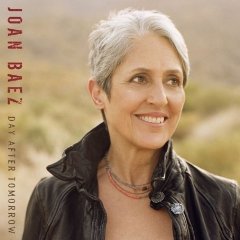
Fifty years on from beginning her residence at Boston's Club 47 and a career that's seen her at the front of the civil rights movement, organising resistance to the Vietnam War, inspiring Vaclav Havel, and standing next to Nelson Mandela for his 90th birthday celebrations, Baez arrives at her 24th studio album, and her first in five years. And while her mezzo soprano may have mellowed and grown lower and warmer, she's sounding as good now as when she sang We Shall Overcome, Silver Dagger or The Night They Drove Old Dixie Down, ably supported by musicians that include Tim O'Brian, Kenny Malone, Darrel Scott and Viktor Krauss. At 67, it's not too surprising to find her reflecting on matters of mortality and the beyond with songs veined with religious imagery and allusions alongside themes of hope and homecoming.
Indeed, the album opens with the statement of faith that is God Is God. Melodically it sounds like vintage Baez, but it's actually purpose written by Steve Earle who also takes masterful charge of the album's understated and sympathetic production as well as playing guitar.
He contributes two more, the all new mandolin tumbling folksy I Am A Wanderer and, from Washington Square Serenade, the closing Jericho Road, a handclap-accompanied a capella spiritual worksong that could have come straight out of the slave plantations.
In fact, a reminder of her impeccable good taste as musical curator ( she did, after all, introduce the world to Dylan), as with the previous Dark Chords On A Big Guitar, the whole album consists entirely of other people's songs which Baez invests with her own gravitas and passion and makes them completely her own.
Eliza Gilkyson provides two, the trad folk sounding Rose of Sharon and, in keeping with the Biblical notes and featuring Earl on harmonium, Requiem's hymn to the Virgin Mary. The stirring, martial beat acoustic anthemic call to resistance Scarlet Tide is penned by Costello and T-Bone Burnett, Patty Griffin contributes Christian allegory Mary and from country songwriter Diana Jones there's the haunting miner's deathbed farewell of Henry Russell's Last Words sounding like a slow Hebrew funeral march.
Reviewing Thea Gilmore's Liejacker album, I noted that The Lower Road could have been a Baez number. Appropriate then that, having duetted on Gilmore's version, she's recorded it herself here with Thea returning the compliment and providing harmony. It's almost the album's finest moment, only nudged into second place by the stripped back (Baez on acoustic guitar), emotionally tremulous cover of Tom Waits and Kathleen Brennan's title track letter from Iraq. "We all knew we were part of something special," says Earle of the recording. You should be too.
www.joanbaez.com
www.myspace.com/joanbaez
Mike Davies September 2008
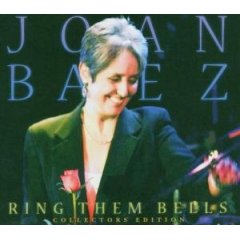
This long-deleted live album, vintage 1995, is now re-released in a special two-disc collectors' edition with the addition of six previously unreleased tracks and a much improved booklet containing brand new comprehensive liner notes by Arthur Levy and full personnel performing credits. The genesis of the original Guardian label issue was an occasion in April 1995 when Joan and her guests (Mary Black, Mary Chapin Carpenter, Joan's late sister Mimi Fariña, Tish Hinojosa, Janis Ian, the Indigo Girls, Kate & Anna McGarrigle and Dar Williams) "took over" the Bottom Line in Greenwich Village, NY for the recording of what turned out to be Joan's first live album in two decades.
1995 was an important staging point in Joan's career, coming three years after her studio album Play Me Backwards (on which she'd recorded songs by Mary Chapin Carpenter and Janis Ian, inter alia) and pre-dating her key Gone From Danger set. Around half of the songs on Ring Them Bells are performed by Joan as duets with one or other of the guests - and there are some wonderful moments here, not least the spellbinding combination with Kate and Anna on Willie Moore, the duet with Janis on Jesse and that with Mary Chapin Carpenter on Diamonds And Rust. Additionally poignant too is Joan's duet with Mimi on Swallow Song (her husband Richard's composition).
The extra six previously unreleased tracks are better than fillers; they include Mary's Stones In The Road and three fine solo performances by Joan alone (You Ain't Goin' Nowhere, Geordie and the rarely-outed Love Song To A Stranger), all well worth having in order to complete the record of what was a unique series of shows. Shows where all the songs she was performing self-evidently really spoke to Joan directly. The presentation and packaging of this re-release is superb too, and I suspect it won't just be "collectors" who'll want to own a copy.
David Kidman 2007

Instead of delivering a new studio set, Joan now brings us another in the parallel strand of live albums which she's taken to releasing at crucial moments in history as "critical barometers of our endlessly troubled times". Bowery Songs fulfils Joan's stated objective of spanning as much of her 40+-year career as possible, from her arrangement of the traditional Silver Dagger (which had appeared on her 1960 debut LP) to no less than three selections from Dark Chords On A Big Guitar (Joan's well-received 2003 opus). The "carrot" - and a juicy one, it turns out - is the inclusion of four songs never before recorded by Joan, including a very fine rendition of Dylan's Seven Curses (counterpointed by some very skilful guitar playing, incidentally) and an acappella rendition of Finlandia. There's also Dink's Song, which Joan had originally sung with Dylan on the 1976 Rolling Thunder Revue, and a stirring version of Steve Earle's Jerusalem. But probably more so than the shadow of Dylan, it's the spirit of Woody Guthrie that looms largest over the whole of this new live album (and not just in the obvious sense that it includes his Deportee, and the honourable mention in the lyric of Steve Earle's Christmas In Washington!). There's a freewheeling spontaneity, a genuine emotional and political response to contemporary events (here the 2004 Presidential election week), that marks this live set (compiled from two nights at the Bowery Ballroom, NYC). Generally speaking, Joan's on good form, and these performances won't disappoint her many fans, although not every one of the 14 selections comprises an essential performance that must be added to the existing Baez collection - a few are quite efficient but do not really add anything new to her interpretations. But Bowery Songs carries on, with credibility, Joan's deliberate policy - nay, tradition - of releasing good-quality, and representative, live recordings, and as such cannot be but welcomed.
David Kidman
Joan Baez - Dark Chords On A Big Guitar (Sanctuary)
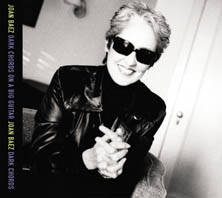
Her first album in six years finds the legendary folkie in excellent form, her keening voice as resonant and distinctive as ever, and while she may not have penned any of the material herself her choice of songs and writers is impeccable. With the vague exception of Natalie Merchant (the dark and potent America the lost number Motherland), all the songs are by Americana artists, Greg Brown providing both the opening track with Sleeper (a tale of putting wild flings behind in favour of a steady life, transformed into a classic Baez number evocative of her work in the 70s) and lost dreams lament Rexroth's Daughter, from which the title line comes.
Still sounding like If I Needed You, Ryan Adams's In My Time Of Need gets a simple yearning treatment while his former Whiskeytown cohort Caitlin Cary supplies Rosemary Moore, its encouragement to the widow to go out and grab another slice of life given a bluesy repetitive drone guitar mood by Duke McVinnie with George Javori's brushed drums accentuating the late night torchy mood.
A chugging train rhythm blues gospel approach to attempted rape murder ballad Caleb Meyer is the first of two songs by Gillian Welch and David Rawlings, the second an equally scratchy, shrugging swampy (as opposed to country) blues and twangy bass treatment of Elvis Presley Blues. Which leaves Joe Henry's King's Highway (an upbeat rocker reminiscent of Dylan's funkier periods), the spare acoustic cover of highly praised upcoming young Idaho singer-songwriter Josh Ritter's melancholic ballad Wings from his new album Starling and to close, reminding that Baez made her name getting the establishment hot under the collar, a gentle resigned and weary cover of Steve Earle's timely rueful political lament Christmas In Washington.
It's typical of Baez to choose to showcase so many of her talented - and in too many cases unsung - fellow artists while hitting the mood of the moment, and with this accomplished, often musically adventurous return to the recording scene, they, she, and most of all us, should be well satisfied beneficiaries.
Mike Davies
Vanguard have done a really good job with these enhanced reissues of Joan's earliest records, all six being generously topped up with interesting bonus material either recorded concurrently or closely thereon. Space doesn't permit detailed discussion of these, but suffice to say that together these six albums will furnish you with almost all the early Joan Baez you're likely to need (I for one can do without Noël), and probably rather more. Just as the traditional song repertoire has itself provided Joan with much of her source material for these records - especially on volumes 1 and 2 - so these albums themselves have formed the basic source material for generations of singers coming new to the folk scene. Forget that they've spawned countless imitators - everyone has to start somewhere… Recorded over 40 years ago (believe it!), the first two albums may be primitive in concept, but they still sound fresh today, and should be in your collection, if for no other reason than to revel in the gorgeous purity of Joan's soprano and its delicate throbbing vibrato (though I know there are some who find the latter trait infuriating). For many folkies, hers are pretty much the definitive versions of many of the songs she tackles here. This latter comment can also apply to the Dylan songs she recorded on Farewell, Angelina, and, on 5, classics such as Phil Ochs' There But For Fortune and Richard Fariña's Birmingham Sunday, both of which pre-dated the composers' own recordings by some time, also curiosities such as Villa Lobos' Bachianas Brasilieras No. 5, complete with ensemble of cellos. Finally, the pair of In Concert CDs were taken from recordings made at various live shows between October 1961 and Spring 1963 by Maynard Solomon, then co-owner of the record label, for the dual purpose of documenting material and testing its suitability for future studio releases. These albums contain some very fine performances, which form a useful addendum to the studio albums while duplicating less material than you might expect. Altogether, a very worthwhile set of reissues, which look set to become the definitive packages, hopefully remaining in print for some time to come.
David Kidman
Bag Of Rats is a five-piece folk-rock band based in the Somerset/Dorset area, who released this, their second album, back in April – but it took a while to percolate up to this part of the country! I'd been meaning to investigate the band since hearing of their deliciously punningly titled debut (Abbey Rodent!) – but somehow I never managed to get sent a copy, so I can't comment on how much Ever After Nothing represents a development from that debut. But taken on its own terms, it's a disc with lots to offer, and on this evidence Bag Of Rats is a band seriously worth getting to know. Formed back in 2005, BoR released the abovementioned debut CD in 2007, then proceeded to enthral festival crowds from Glastonbury to Priddy for four summer seasons before re-launching the verminous ship with this proud new album in April, in good time for this year's round of bookings.
It's no bad thing, but I get the feeling at times that the guys are trying hard to be an aural representation of the mean'n'dirty scrapyard cats posing on the inner sleeve – sorta MTCH or Oysterband image-wise – and sure their music has plenty of thrust, attitude and confidence, altho' with some unexpectedly light touches along the way too. The sound they make is a brilliantly full-toned plugged-in-acoustic racket (I use that word as a definite compliment!), with the feisty rockin' melodeon of Mary Gilmour well to the forefront, further boosting principal vocalist Mike Hall's alternately string-busting and deliquescent guitar or mandola with an intelligent rhythm section (Ian Olliver's strongly characterised, often bowed double bass and John Archer's jumping, teeming percussion), all of these elements wildly embellished and keenly interwoven with Simon Hester's "cider-fuelled" madcap, distinctively psychedelic violin (which, creatively, is played through guitar effects boxes) while John will occasionally cast his diabolic darabuka aside to contribute jazzy flute or wailing whistle or harmonica lines. A truly joyous racket then, typified by the opening ragbag (or should that be ratbag?!) medley on which a tune of Mary's (Badger In The Bread Oven) is sandwiched between two trad-arr tunes (Spancil Hill and Major Malley's).
The album's tour-de-force (and for me, its most persuasive highpoint) is The Rooky Wood, a workout-cum-mini-extravaganza that entwines itself out of a stormalongly-different version of Richard Thompson's Poor Ditching Boy. There's also a suitably power-punching retread of The Begging Song, and a full-on-oi in-yer-face rendition of Billy Bragg's There Is Power In A Union. Mike's own compositions (mostly songs, along with a couple of instrumentals) comprise around half of the disc's items, and some of these, while employing a more powered-down musical arrangement of the "thoughtful contemporary acoustic" variety and providing a contrast with the band's rowdier escapades, somehow don't quite fit with the image or make the same kind of lasting impression on the senses. Those which do best stick in the mind, perhaps, are the title track and In Your Dreams, which inhabit a kinda ethereal, enigmatically referential psych-folk milieu that's complemented by their tumbling, swooning instrumental backdrop, while elsewhere Zombie Song is well described by a phrase in the band's press handout: "toe-tappingly dark and cheerfully melancholic".
If I'm brutally honest, the covers (Hank Williams' Lonesome Whistle, Creedence's Have You Ever Seen The Rain?) let the side down a tad, and one or two of the other songs don't quite cut it in the context of the aforementioned highlights (maybe their only crime is being guilty of lowering the temperature too much), but still, let's make no mistake – Bag Of Rats at their most imaginative and storming are a band not just to watch but to keep your ears fixed firmly upon. Hell, they almost live up to the ultra-purple prose of their press handout!
David Kidman November 2011
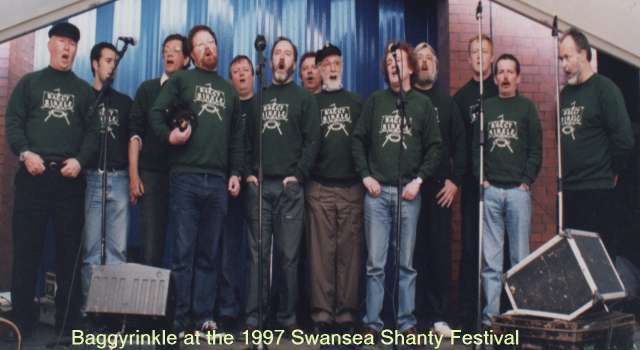
Baggyrinkle is the name given to the octet of Swansea-based shantymen led by Dave Robinson, who for the past few years have hosted the Swansea and Mumbles Festivals while gaining an increasing reputation at major shanty and maritime festivals throughout the UK and Europe. Their individual approach combines sufficiently lusty lead and chorus parts, with three-part harmony singing a particular speciality. As for those shanty enthusiasts who consider harmonies anathema to the spirit of those work-songs, I'd urge them to listen again without prejudice, for they may well be pleasantly surprised at the musicality of Baggyrinkle's renderings. This CD, a studio recording, complements the group's earlier tape release (A Pound And A Pint, which was recorded live), in capturing both the vitality and textural strengths of the crew's singing, although it must be said that you can't always feel the actual weight of eight voices even when they're all used together. The chosen leads are well varied and characterful in delivery, although one or two of the selections may possibly seem a little matter-of-fact when set alongside more celebrated recordings; however, taken on their own terms, virtually all of the selections are creditable versions worthy of a place in the collection of the maritime enthusiast. The choice of material is an enterprising one too, for classic shanties old and modern (from Roll Alabama Roll and the Irish/Negro Old Moke to Peter Bellamy's Roll Down and Tom Lewis's Last Shanty) are set alongside choice forebitters and a few sea-songs (including Bill Meek's Time Ashore, the Welsh-language Codi Angor and the traditional Pleasant And Delightful). And another plus - (unlike some shanty crews) Baggyrinkle don't need to force the pace to make an impact. That factor alone should enable their work to be appreciated by any lovers of folk music who are sitting on the proverbial quayside and considering dipping their ears into the maritime repertoire. Yes, this attractive and well-planned programme does Baggyrinkle credit.
www.baggyrinkle.freeservers.com
David Kidman
Believe this... last time I reviewed an album by this particular Mr Bailey (Ian), I coincidentally was also reviewing a CD by another Bailey. And by that same quirk of fate, here I am reviewing Ian's own followup CD at the same time as one by yet another different Bailey - Glyn ! But back to Ian: his followup is an even more assured effort than his eponymous debut, with equally fine production - again from his long-time friend and collaborator Gary Hall, a man with a super-keen ear for doing the material real justice. Again, the majority of Ian's songs are built up from a solid and interestingly scored acoustic base, and he displays a keen intelligence in arrangement. Stylistically, it might seem at first that Ian doesn't seem to quite make up his mind whether to aim for being a rocker or a balladeer, although he convinces on both counts - and more consistently so than on his debut. First off, he tries to remain One Step Ahead Of The Blues with a convincingly tough and catchy Lindisfarne-ish strum-and-slide-led opener, then shows his soulful passion on the sax-bedecked slowie You Stop Me From Falling. The deceptively gentle-sounding Communication has a distinctly Dylanesque demeanour - an impression reinforced no doubt by the melodic structure of the first half of each verse bearing such a marked resemblance to The Times They Are A'Changin'. The tender and winsome chamber-folk-pop of Don't Throw It All Away, Listen Closely and Love Song (replete with luscious yet understated string settings) and the mournful Late Night Lament together comprise another attractive facet to Ian's musical personality, and these moments contrast big-time with the pounding, angry rock gestures of The Big Lie, the strident, organ-led Satellite and the slightly pompous Walk Away (whose setting inescapably reminds me of Magazine's Permafrost). It's good, too that Ian's taken the hint from last time and included his perceptive lyrics of love and loss in the booklet (this is an attractive presentation, whose only, miniscule, fault is an incorrect juxtaposition in the tracklisting on the credits page). Ian's certainly a very gifted fellow, and this new album should bring him further into the limelight of recognition. And it's a bit of a grower too, which is always a good thing..
www.myspace.com/ianbaileymusic
David Kidman February 2009
By a strange and perplexing coincidence, two completely different CDs bearing just "Bailey" as the artist name have arrived in my review pile within a few weeks of each other. Even more coincidental is the fact that both cite both Nick Drake and Ray Davies among their respective influences! Hmm… Well, this resolutely eponymous CD is the work of singer/songwriter and multi-instrumentalist Ian Bailey, and was recorded under the guidance of Gary Hall; it appears on Preston-based independent label Northern Sun. Bare facts aside, though, it inhabits an altogether lusher musical world than the other Bailey CD mentioned, at least for parts of its 55-minute length. Ian Bailey seems determined to prove himself as a musical chameleon, but ends up ultimately, I feel, as more of a jack-of-all-trades and closer to being a true or complete master of none. That shouldn't imply creative or musical ineptitude – far from it – but Ian's diversity doesn't in my opinion include a distinctive enough individual voice (writing or singing), or musical identity, to carry the album as a unified whole. The musicianship is of a high standard though, and there are certainly plenty of moments to treasure here, although you have to pick around a bit to find them. The opening track Reach Out For Today is a luscious ballad, featuring some truly beautiful string playing from Richard Curran, but it's almost completely spoilt by some obtrusive and quite sickly keyboard-generated twittering noises; an overdose of synthy spacey sounds detracts from These Are Days too. However, track 4 (Unsteady Beat) proves that with a bit more restraint in the musical arrangement Ian can put across a ballad with real sensitivity and taste. Ditto with Autumn Leaves, where the Ray Davies namecheck came readily to mind (at least in the vocal tone and phrasing). Ian handles the thoughtful, stripped-down Clive Gregson-style acoustic ballad Behind Disguise and the standout folk-rock troubadour ballad Aching And Waiting with considerable credit too. Elsewhere there are some well, what I might term vaguely sub-Coldplay moments, but they don't offend the sensibilities at all. Punctuating the ballads, there's some brief moody instrumentals and a couple of defiantly "chalk & cheese" rockers – the Pettyesque Better Man (good) and the punk-metal thrash Suicide Bullet Train (makeweight) – and a neat Mex-inflected Be Here To Love Me (with some lovely guitar tracery from Mark Wilkinson). And then there's the distinctly strange Wounds Of Craving, which has a child's voice (José Bailey) reciting one of Gary Hall's poems against a psychedelic and partially programmed backbeat – a bit like "America is pregnant with promise and anticipation" in its impact, and quite impressive on its own terms. There's much to admire in Ian Bailey's work, and it really does repay investigation, but in my opinion he should ditch the synths and stop trying to prove too much. Oh, and it would've been nice to have the lyrics in the booklet.
David Kidman
This particular Bailey brings forth an album that's only just over half the length of the CD by the other Bailey I reviewed this week. David Bailey is described as a 26-year-old singer/songwriter from Cambridge who "performs his own songs in a soft (baritone) voice, complemented by his classical guitar playing". Sounds a bit dull from that tag, perhaps, but much of his work is actually rather attractive in a post-Nick-Drake kind of way (School and Song Of The Lighthouse Keeper probably stick in the memory most on initial acquaintance). The downside is that his quietly rippling guitar style gets a trifle monotonous after three or four tracks, and when it's almost the only instrumental accompaniment used on the CD you need a proportionally higher level of interest in the lyrics to compensate and keep the listener's attention. The problem here is that David tends to fall back on a kind of singsong metre and a rhyme scheme that's obvious to the point of seeming more trite than they actually are (Hospital Bed and the Smiths-like Could Have Been A Sign being particular cases in point). As the title track postulates, this may be self-evidently "the way that things are done", but there's insufficient dynamic or colour contrast between the individual songs for the most part, despite occasional judicious tinkering with piano, melodica, mellotron and glockenspiel. The somewhat Donovanesque (Gift From A Flower-inspired?) Princess Of The Sea, though wave-swamped, is a welcome contrast around halfway through the CD. Summing up then – a work of intermittent promise that doesn't quite succeed in capitalising on its laudable "lack of digital jiggery-pokery".
David Kidman
Very strange, especially coming from the Fylde (Lancashire) - one might well say! But this is a record that grabs attention right from the start, with its surfeit of invention, ideas and imagination. At various points Glyn invokes Scott Walker, Robyn Hitchcock, Nick Cave, Jacques Brel, Echo & The Bunnymen, Divine Comedy and Leonard Cohen, but most especially David Bowie (vintage early and pre-Scary Monsters)… and yet he remains a curiously original voice. Glyn's music is difficult to get a handle on at first, with so many first-impressions forming a bewildering headlong rush through the ears. The kinda spaghetti-western-smalltown image that might readily be conjured up by the album's title is one that translates into the slightly cheesy musical idiom Glyn adopts on Yahoo! And The Crow. And, in keeping with those tales of the old West too I suppose, Glyn's writing displays a strong sense of narrative too, as proved by the eight-minute epic Ballad Of Deano. Basically, Glyn can't resist drawing attention to himself by means of undeniably impressive, powerfully crafted musical settings and lyrics that passionately and eloquently embrace entirely justified criticism of the unforgivingly corrupt corporate world in which we try to survive. Also, you can't ignore Glyn's acute and well-developed feel for bright and bold instrumental colour and creative texturing: it seems that he plays almost everything himself (aside from electric and bass guitars, for which he drafts in Phil Senior, and there's a couple of guest musicians on The Crow). If you take things at sound-face value, there's quite a feelgood aura to the album generally, notably on the bouncy sunshine-pop of Down Amongst The Living and the iron-clad stompsome beat of School Reunion, and even on the more sinister numbers like The Doomed Ship Allegory and The Clown (a very Bowie-esque portrait of a paedophile). Payback-time comes (quite literally) on Groomed, an examination of coercion and abuse, which comes on like a breathless cross between The Cure's Love Cats and the Hustle theme tune. A first hearing of tracks like Kafkaesque World can be distinctly overwhelming, with its potent juxtapositions (lavish musical setting with smooth crooning delivery to voice the thoughts and words of a torturer). Elsewhere, perhaps, it can be all too easy to get the feeling that Glyn is deliberately setting out to make an Impact (capital "I"!) with his neo-rock-cabaret stance. Yet, just as with any situation where there's a definite brimming-over-surfeit of artistic creativity, this eventually involves an element of excess that needs trimming - or at least channelling: a process with which Glyn's still, clearly, feeling his way a bit. In addition, and in spite of the strong sense of integrity that permeates Glyn's lyrical and musical vision, I can't altogether escape a feeling that pastiche is lurking not too far away at times; and this can leave an often desperately unsettling taste. But then again, as with much music that unsettles, to whatever degree, it's perversely compelling, and against initial expectations I've found myself both returning to a good deal of this disc and keen to explore Glyn's two previous albums..
David Kidman February 2009
Roy's always had a penchant for education, in the truest sense of the word. Education should be fun, and a child's natural enjoyment of, and willing participation in music, can be both a vital element and a useful tool. And not just to prove the point, Roy has always included a short sequence of children's songs in his live sets, which have appealed every bit as much to the adults in his audience!
The first children's album Roy made was Oats And Beans And Kangaroos, back in the mid-60s, and as recently as nine years ago, the birth of his eldest granddaughter Jessica provided the impetus for the lovely Up The Wooden Hill collection. Now Roy has produced his final (oh yes!!) children's album, finally fulfilling a five-year-old promise to make a CD for his second (and third!) grandchildren. And of course it's a totally engaging disc, attractively packaged and entirely unpatronising (for a children's record doesn't have to be full of obvious childlike songs!) both in its friendly delivery and all-encompassing choice of material; as always, Roy infectiously combines the fun of singing with serious and important thoughts.
The key lies naturally in the CD's title - Tomorrow - which is shorthand for that all-important message for his own, and indeed all, grandchildren: "my hope is that you will make a better job of things than my generation has". The final two songs - Together Tomorrow and Tomorrow Lies In The Cradle (the latter penned by Fred Hellerman of the Weavers group) are not only practically unknown but turn out to be particularly moving, for they point this message into our consciousness ever so delightfully and leave us thinking.
The remainder of the disc draws on songs from all over the musical shop, including three that Roy had recorded circa half a century ago on the aforementioned Oats… (Carrion Crow, Peri Meri Dixi and Three Blind Mice/I Hear Thunder, the latter sung this time, and most beautifully too, by Jessica herself!). Peggy Seeger's One Plus One is a truly inspired choice, while the "glorious fun" quotient is made up of Arthur Askey's bee-witching Bee Song and two brilliantly witty John Kirkpatrick numbers, King Neptune and Jogging Along With My Reindeer (what a combination – only 65 shipping days to Christmas, you could say!). Closer to home, Molly's Garden is a thoroughly charming ditty penned by Kit (Roy's daughter and Molly's mum), while The Collier Brig (a favourite song of Molly's) even gets an unexpected airing.
And when the kids have been captivated and are almost ready for bed, Roy tucks them up with the poetic story of My Pet Dragon (by John Maguire), which is gently enhanced by atmospheric sea sounds created by that good Mr Kirkpatrick's accordion bellows! In addition to the welcomely omnipresent JK, the album's signature musical backing is provided largely by Martin Simpson, Chris Coe and Andy Seward, with contributions from Andy Cutting and David Bailey and occasional chorus vocals from the assembled Bailey clan. A family affair, but a marvellously inclusive and life-affirming one that we can all join in with, enjoy openly and unpretentiously over and again and share readily with our children – and their children, and ever onwards…
David Kidman October 2010
Well, Roy's "retirement" CD, Coda, was actually meant to be his last recording wasn't it?!… but then along came Sit Down And Sing… And then, as we all know, far from retiring into a frail shell, Roy's continued to stimulate and inspire us all through his passionate live performances, unflinchingly discovering and bringing onto stage (and thus into richly deserved wider circulation) great new songs that challenge and provoke in the best possible traditions of folk, confronting our preconceptions and beliefs for there are many lessons still to be learnt. So I guess a further release was inevitable! Hence the so-aptly titled new CD, which firmly casts the spotlight of destiny on folk songs which (in Roy's own brilliantly chosen words) "circulate unhindered by the formulaic demands of commercialism, their strength (lying) in their being outside the mainstream – from being below the radar". And let me say at the outset that it finds Roy on finest possible form: at 73, still singing with deep and natural compassion and a tremendous intensity and conviction. Roy's renewed vigour is the stuff of legend, but I could say it's right there in the grooves of this record for you to reach out and touch (Andy Seward has done a splendid job in capturing both the joy and strength of Roy's singing). And of course in his choice of songs: uncompromising and perennially relevant. Pride of place this time round goes to the four stunning songs from the pen of Seattle-based Jim Page, whose effective and resonant utilisation-cum-paraphrasing of borrowings from traditional and contemporary folk songs clearly strikes a chord in Roy (while also recalling the comparable skill of our own Ray Hearne). But Roy keenly embraces the sentiments of each and every song he sings, whether it's George Papavgeris's all-encompassing and life-affirming anthem Friends Like These or Ian Campbell's epic and darkly prophetic Old Man's Tale. Here Roy also brings us a contrasted pair of fine songs by David Ferrard: the charming love song Take Me Out Waltzing Tonight and the powerfully reflective album closer Visions Of Our Youth. Continuing Roy's own personal tradition, there's a song apiece by Si Kahn and Leon Rosselson (well, the latter's Leon's setting of Charles Causley's Timothy Winters), while "actual" tradition is represented by a lovely version of The Road To Dundee and a fine rendition of Handsome Molly, on which one of Roy's backing musicians is Martin Simpson, whose own recording of the song is considered a benchmark. Roy's other instrumental collaborators here - John Kirkpatrick, Andy Cutting, Donald Grant and Andy Seward - give of their very best, playing with spirit and commitment throughout in lovingly-contoured, full-toned yet light and sensitive arrangements. Every track is both memorable and relevant, a further demonstration of Roy's total integrity, and the whole set forms both a cause for celebration (of half-a-century of bringing folk music to a wide audience) and yet another high point in Roy's illustrious career.
David Kidman May 2009
These are affectionate, genial, commendably polished and admirably conservative (though not especially sedate) renditions which make a virtue out of their intrinsic Irish character and its lovable honesty. There are no discernible flaws in execution and no crass misjudgements or lapses in taste, but that's as far as it goes really, for equally there's not anything much to wildly excite herein (that's not to say that many of the actual songs themselves, or the conventional alternative – the rabble-rousing rough-house-rowdy approach of the Clancys/Dubliners school – would necessarily excite me much either). Apart, that is, from an empathic take on A Song For Ireland itself and a particularly thoughtfully-turned version of The Ould Triangle… these, more than any other tracks, make it clear that this project is rather a labour of love for Michael and Anthony, who are companionably accompanied on their worthy mission by guest musicians Paul Gurney, Noel Carberry, Aoife Kelly and Johnny Duffy (on piano, bass, accordion, fiddle, banjo, uilleann pipes and whistles) in straightforward and unfussy arrangements. Hereby refreshingly stripped of the customary layers of ages of grimy pub, club and showband sentimentality, these renditions of the songs that represent the Irish psyche together form a classy, and in the end likeable enough, tourist's-ear-view of popular Irish song, I'd say.
So if you want to hear, and own for posterity, these reliable, pleasing and sufficiently definitive versions of such hoary old traditional and composed "Irish standards" as I'll Tell Me Ma, Rocky Road To Dublin, Star Of The County Down, Peggy Gordon, The Wild Rover, Sullivan's John, Mountains Of Mourne, Black Velvet Band, Rare Ould Times, Fields Of Athenry, Spancil Hill, Raglan Road and Danny Boy, together with efficient renditions of songs which have been eagerly (if contentiously) adopted by the Irish as part of their own modern tradition (Fiddler's Green, Dirty Old Town)… then this generous 76-minute compendium will satisfy, to be sure.
David Kidman July 2009
Some of us have been waiting eagerly for this landmark documentary film to be made available for home consumption! Made for (UK) Channel 4 as a 1988/89 New Year Special, and beating over 30 other competitors to be screened for that occasion, it featured the killer combination of master Shetland fiddler Bain and a host of stars of cajun music, a genre which Aly was known to heartily espouse and for which he has always had a deep affection and affinity.
This film was a natural follow-on from the 1986 Channel 4 series Down Home, and later paved the way for key collaborations in the Transatlantic Sessions series. This celebration of cajun music and culture includes plenty of footage of musicians in their home environment, often in the same room as groups of dancers, and a tremendous feel of intense enjoyment permeates every second. From the classic cajun of the late Dewey Balfa to the unashamedly sassy "bean-feasts" of Queen Ida Guillory's Bon Temps Zydeco Band and Boozoo Chavis (the latter now sadly no longer with us), via the "renaissance cajun" of the wonderful Savoy-Doucet Band, this film covers the many and varied aspects of cajun music, and the musical extracts are spiced with conversations with the artistes unearthing often fascinating snippets of information regarding cajun culture – a way of life, indeed.
Other, arguably lesser-known artists appearing include charismatic fiddler Harry LaFleur, vibrant singer D.L. Menard (with his Louisiana Aces) and champion of progressive cajun, Wayne Toups; and Aly can be seen adding his trois sous to the musical gumbo by joining in enthusiastically at every session opportunity!
This 50-minute film is over way too soon, and fair exudes joie de vivre par excellence! As does the accompanying CD, which contains 16 full-length music tracks from the film's featured artists (9 of the cuts also involve Bain himself). These are presented in the same order as they occur on the documentary, although the audio CD omits two additional song performances (the rockin' Zydecajun Train by Wayne Toups and Raywood by Queen Ida respectively) which are exclusive to the DVD and otherwise would've conveniently slotted in after track 11 and before track 15 (total playing-time of the CD would easily have permitted their inclusion). While on the other hand, tracks 12, 13, 14 and 16 of the audio CD are exclusive to that format… But hey, laissez les bons temps rouler!
David Kidman March 2013
A natural title for these master musicians' sixth joint album for the label, the release celebrates 25 years of touring together. Inevitably it's a further sparkling illustration of everything they do best, and as such not an easy album to review without indulging in the well-worn superlatives. Equally inevitably though, any fan of these guys' fabulous musicianship will need a copy of this self-recommending record.
In the space of just a little over 42 minutes, the musical landscape turns from Ireland to Scotland and Canada and back again (albeit mostly viewed through a distinctively Scottish lens), characterised by sensitive and accomplished arrangements that for much of the time (with typical ingenuity) creatively revolve around just Aly and Phil themselves (gaining plenty of textural variety of course from Phil's own personal and highly enviable brand of instrumental versatility on accordion, piano, mandolin, cittern and whistles), but occasionally also bringing in simpatico fellow-musos Michael McGoldrick (flute), Jenn Butterworth (guitar), Ewan Burton (double bass), and Adam Brown (bodhrán), with Tom Orr and Gordon Smith appearing on isolated tracks.
It's probably invidious to single out individual tracks for special praise, since the duo are proven masters of so many different forms and styles of traditional music, and it's probably fair to say that I enjoyed specific tracks in specific moods. But, if pushed, I'd recommend first the stirring opening set of Irish slides that lights my candle every time, not least due to the extra buzz generated by McGoldrick's uilleann pipes. The fiddle-led set of wedding reels (track 8) packs a hefty drive yet with a lightness of touch, while there's an irresistible authentic ceilidh-band feel to the bouncy pipe-marches of the final track that won't fail to get your feet tapping.
Of the slower-paced tracks that are sensibly interspersed amongst the uptempo selections, the Rev. William Macleod's fine air Sitting In The Stern Of A Boat is the highlight for me, although the sequence also includes three gorgeous waltzes that prove perfect showcases for the musicians' inborn expressive elan.
Two abundantly fine musicians still at the top of their game after a quarter of a century - and showing no signs of decline whatsoever. now there's something to celebrate!
David Kidman November 2012
Aly Bain - The Best Of Aly Bain Volume 1 (Whirlie)
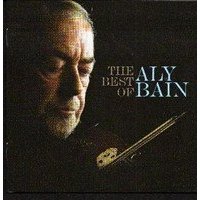
Now in his 40th year as a professional musician, Aly's one of those folks who's always been right there in the forefront of Scottish traditional music: both as an active front-line participant (one of the country's finest fiddle players, period), and as a significant contributor to (or at the very least beavering away in the background on) other artists' projects. So in many respects, the time is now ripe for a suitably comprehensive overview of Aly's career to date. And barring a Free Reed box-set, a goodly series of "best-of" discs should be the next best thing.
So here's volume 1(the title I hope being a genuine indicator of Whirlie's future plans), with 16 tracks carefully chosen by Aly himself. Although it's not sequenced strictly chronologically, the disc does begin sensibly with a typical set of reels from Aly's very first solo CD, recorded in Lerwick back in 1984, with Aly's dashing bow-strokes equally dashingly accompanied by the wonderfully sympathetic piano of Violet Tulloch and the guitar of Willie Johnson. And from even earlier, there's a track from The Silver Bow, the mid-seventies Topic disc with Tom Anderson which did so much to bring Shetland music into public consciousness after years of commercial obscurity. Elsewhere, the disc travels around (much like the itinerant Aly himself!) with a cavalcade of examples of Aly's instrumental dexterity, his mastery of many styles and traditions - many if not all of which can in context be heard to share a common wellspring if not exactly a common heritage - and, not least, Aly's enormous flair for getting the best out of fellow-musicians in a collaborative scenario, for he's been fortunate in getting to work with a great many of the world's finest. As an instance of this, we need look no further than the legendary Transatlantic Sessions projects, of course, and a sparkling Waiting For The Federals from Series 2 is included here; but then not everyone knows that the even more legendary Channel 4 series Down Home was TS's precursor, and this disc includes no fewer than four brilliant tracks from the recording sessions for the series (hopefully as a taster for the release of the whole shebang on disc soon, please!). Hearing Aly firing away in the company of illustrious fiddlers from anywhere on the planet is always one of the deepest joys that can be experienced, and for me the "session" could go on all night and into the next week and I'd still want more! So it's de rigeur to include tracks where Aly spars with such luminaries as Mark O'Connor, Tommy Jarrell and Buddy MacMaster, as well as a rollicking Shetland Sessions set featuring Hom Bru and Aly's long-term musical partner Phil Cunningham and a spicy Doucet-Savoy collaboration from Aly Meets The Cajuns.
Then, to balance these euphoric moments, the disc presents several of the thoughtfully considered slower compositions and arrangements in which Aly has also always excelled. One standout is his lovely 1997 treatment of Margaret's Waltz, hitherto only available on an obscure Norwegian release, whereas other heart-stopping moments come with the pair of beautiful Bear Waltzes from Skåne and from Aly's recordings with the Scottish Ensemble, notably the Follow The Moonstone piece Till Far. Finally, no Aly Bain collection would be complete without one of his many recordings of the traditional Shetland air Da Day Dawn, and he's chosen one of the very finest, the 1995 one with the BT Scottish Ensemble.
This is a cannily sequenced 48-minute collection that's pretty comprehensive in its own right and works well as an independent listening programme, but on the other hand it can't help but leave me with that niggling feeling of incompleteness. Because I just know there's so much more out there in Aly's impressively exhaustive discography, and many of the original albums aren't all that readily (or any longer) available. I suppose it's rather like the tip of an enormous iceberg floating in the ocean between Orkney and mainland Scotland, the catch being that the majority of the rest of that ice-floe may well be destined to remain beneath the surface. OK maybe I'm being needlessly pessimistic here - let's hope I'm proved wrong, and there now ensues a veritable flood of Aly Bain reissues!
David Kidman January 2009
Best known for Keep Your Hands To Yourself and Battleship Chains off their debut album, Southern barroom rock outfit The Georgia Satellites never really managed to capitalise on the initial impetus. Baird quit to go solo in 1990 but after the first two albums, Love Songs For The Hearing Impaired and Buffalo Nickel, his career's been somewhat patchy. However, batteries recharged and with Jason & The Scorchers guitarist Warner E. Hodges now onboard, this marks something of a return to form.
There's no envelope pushing going on, but what you do get is solid, beer-swilling, swaggering Southern country rock n roll with cranked up ringing guitars, rolling riff-packed melodies, throaty twang vocals and air punching choruses. You could hear a Faces era Rod Stewart belting out Damn Thing To Be Done and Well Enough Alone or Tom Petty sinking his teeth into Two For Tuesday and She Dug Me Up while Just Can't Wait is exactly the sort of number you'd imagine Dave Edmunds crawling from the wreckage to cover in his rock n boogie days. It won't change your life, but pour a cold one and crank the likes of Lazy Monday and Runnin' Outta Time up loud, and it could well make your evening.
www.danbaird.net
www.myspace.com/danbaird
Mike Davies November 2008
This is an unusual record by any standards. It's an intimate, by-request set of ten songs composed by Amazing Blondel's guitarist/songwriter Eddie Baird, and performed entirely solo by Eddie with just his trademark troubadour-style acoustic guitar for company. It can be considered doubly unusual, in fact, since Eddie's normally been responsible for the more spaciously arranged Blondel pieces - although it's not widely known that Eddie's been pursuing a parallel solo recording career for the past ten years (he's released four solo CDs including a compilation, but none have been nationally distributed). The first four songs on this disc are simply-conceived outings, initially displaying a quite jazzy demeanour, recorded close-up and live in front of an appreciative small club crowd by the sound of it. Best of this quartet are the gently reflective Memory Lane and the distinctly Tilstonesque Tramp. These are followed by a medley (Sailing/Young Man's Fancy) taken from a 2004 live Blondel concert, and finally a clutch of stripped-down-to-basics studio recordings. Listeners coming new to Eddie's work will wonder, on the strength of these songs, why wider commercial success continues to elude Eddie. Songs like Compromised and Funny Old Life carry a laconic laid-back feel comparable to classic John Martyn, and Almost Gone has a canny grasp of delicate melody-line that recalls Clive Gregson. Eddie's individual voice is exposed well on this brief set, ditto his deft guitar work, a talent which should be more widely appreciated too.
David Kidman January 2010
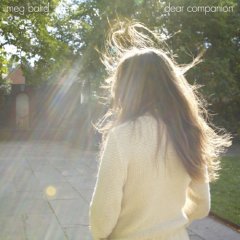
Dear Companion is a lovely, intimate album sung and arranged by nu-folk outfit Espers' vocalist and songwriter Meg Baird: a collection of songs that are very close to Meg's heart, it mixes original material from the early 70s with two of Meg's own compositions and a significant handful of traditional songs, though the overall mood of the set is very probably determined more by the latter than the former, at least in its early and late stages. The genesis of the actual project came in an invitation to create a solo release for Philadelphia's Tequila Sunrise label, out of which nothing but a 7" single appeared and the entire LP - recorded in spare moments during the sessions for Espers II - was never made available at the time... thank goodness Wichita have seen sense and are releasing it for public consumption now, for it's a wonderfully simple yet compelling listen. It's typically minimalist in terms of backing (just Meg's own guitar or Appalachian dulcimer in the main), and Meg's clear-toned singing has never sounded more truthful and beautiful - of that I'm convinced - for she gives her all in terms of passion and conviction in "doing a really good job" of communicating these songs which evidently mean so much to her personally. Forced to pick some highlights: well, Meg's own Riverhouse In Tinicum is outstanding, as is her folk-inspired Maiden In The Moor Lay and her appealingly fresh take on the traditional ballad Barbry Ellen. Add to that an enchanting version of Sweet William And Fair Ellen, an attractive, rippling waltz-time rendition of Willie O' Winsbury (and yes, it works!), and exquisite covers of Jimmy Webb's Do What You Gotta Do and John Dawson (NRPS)'s All I Ever Wanted. The final track is a gorgeous acappella rendition of the text of the opening (title) song (as learnt from the singing of Sheila Kay Adams), bringing the experience deliciously full-circle. This record is seriously sublime, and should (if there were any justice) be embraced wholeheartedly by the folk community as well as by Meg's Espers fanbase. It may be Meg's debut solo album, but I do so hope it's not her last.
David Kidman December 2007
Baka Beyond is the seminal world-music fusion outfit founded by Martin Cradick and Su Hart, which started out on its global music exchange some 10 years ago; Rhythm Tree can be seen as the culmination of their work to date, even though after all this time we're in danger of losing the power to surprise from the juxtaposition of seemingly unlikely musico-cultural bedfellows. The recurring constant context in which the various musics are brought together is the music of the Baka Pygmies of south-east Cameroon - hence the group name. The Baka tribe, who are masters of dance, bring an amazingly energetic spectacle to the BB live act, yet much of the uplifting quality and sheer exuberance of that collaboration also comes through on a purely audio level through the performances of the core eight-piece band you hear on this CD, notwithstanding its inevitable lack of visual distraction which as a bonus allows for greater concentration on the subtleties of the musical mix. Here, the heady brew of Celtic, Gaelic and West African musics is so persuasive that you often have to listen really carefully to separate the strands, and in this respect I'm convinced this is the Baka's most successful marriage to date. Musically, Rhythm Tree is a landmark in cohesive exploration of different musical cultures. I love the way in which the musical framework shifts continually withjn individual tracks, while at the same time I can appreciate the impact of specific textural or thematic elements which inform and characterise these tracks (eg Su Hart's rendition of the Gaelic waulking song which forms the basis for Sad Among Strangers, the and Paddy Le Mercier's weaving violin arabesques on several of the tracks). Distinctive African rhythms are to the fore on tracks like Bokissa and Kobo, but the music never gets stuck in one particular groove and there's always a keen sense of development - for instance, on La Londé, the way an indigenous Baka children's song transmutes into a fiddle reel is particularly enchanting, and on Shimina the relaxed sense of onward progression is enticing. Later on, the device of alternating the sung language on the version of Hush, Hush, enables Baka Beyond to intriguingly draw parallels between the plights of the different peoples; like the mélange of musical and ethnic flavours on the album as a whole, it's a mix that perhaps ought not to work - but it does. The Baka tribe's contributions to the album were recorded "in-house" either "in the field" or at the Music House, the purpose-built recording studio in the tribe's village (funds for which were raised by the band). One minor point, though, is that I'm not altogether convinced of the need to constantly reinforce the listener's sense of place quite so many times by interpolating natural sounds from the Baka rainforest, supremely evocative though the ululating quasi-yodel of the singer's Call Of The Forest (which frames the rest of the album) undeniably is.
David Kidman
Richard "Duck" Baker is on the face of it a musician of contradictions: he's one of the most highly-regarded fingerstyle guitarists of his generation, yet he considers his main influence ragtime piano stylings, is especially drawn to jazz yet unlike most jazz guitarists doesn't use a pick, and he prefers nylon to steel strings (he plays swing on a flamenco guitar). His expertise extends right across the fretboard of musical genres, and over the course of his 30-year recording career so far he's made a frightening number of solo albums, encompassing not only jazz and swing, but old-time and free improv, Irish and Scottish folk tunes, and O'Carolan to Christmas carols. Not to mention guitar instruction videos, and heaps of music criticism, and duo albums with all manner of respected musos from experimentalists John Zorn and Henry Kaiser through to fiddler Kieran Fahy and traditional singer Molly Andrews. His most recent CD, The Expatriate Game, a splendid collaboration with Maggie Boyle and Ben Paley, has proved difficult to wrench from the CD player whenever it's got back there (see review in the NetRhythms archive)! So you'll gather that Duck's latest recording is eagerly welcomed in this house. It's a project which has "been in the works for years", sort of evolving from a response to something people have been demanding for a while: a collection of early jazz and swing tunes. That means a scintillating trot through some immortal classics like Benny Goodman's Stompin' At The Savoy, Hoagy Carmichael's Georgia On My Mind, and the old spiritual Just A Closer Walk With Thee, by way of I'll See You In My Dreams, Scott Joplin's Pineapple Rag, Old Fashioned Love (from the pen of stride pianist James P. Johnson), and an elegant rendition of Take Me Out To The Ballgame on 12-string! And that's just the impeccably played, yet far from soulless, solo items on the disc, the remaining half of which is given over to some sparkling duet performances. Four of these are with Hawaiian steel guitarist/ukulele hot-lick maestro Ken Emerson (the pick of which for me is the delicious uke-rich Up A Lazy River, though the sublime steel-soaked title track runs it close and the gentle sparring on Do That Messin' Around proves a perfect showcase for the pair's keen sense of humour), and three with acoustic jazz guitar ace Will Bernard (there's some especially stimulating fingerpicking interplay amongst the gutsy pounding rhythms of the Django Reinhardt standard Honeysuckle Rose). An absolutely masterly set – and so what if a few numbers are revisits of stuff Duck's recorded before on long-deleted or obscure vinyl LPs, for they all come up totally fresh here. It's probably a very old joke by now, but if you don't respond to Duck's brilliant playing then hey, you must be "quackers"!
David Kidman December 2006
Duck Baker, Maggie Boyle & Ben Paley - The Ex[atriate Game (Day Job Records)
This under-promoted gem of a CD should need no recommendation if you know any or all of the three artistes involved. Its title is a clever wordplay on the well-known Dominic Behan song The Patriot Game suggested principally by the equally well-known tendency of musicians to carry their tunes to foreign shores. Its equally underselling subtitle (Traditional Irish And American Music) simultaneously reflects the performers and the repertoire. Should you need a quick pen-picture: American-born, London-based Duck is nothing less than a definitive premier-league fingerstyle guitarist, whereas both Ben and Maggie were born to families who emigrated to England (Ben's father's that celebrated old-timer Tom Paley, and Maggie was reared in the musically vibrant London-Irish community of the 60s and 70s). Ben's a fabulous young fiddle player who readily immerses himself in activities as diverse as Scandinavian music, revivalist oldtime (with his father in the New Deal String Band) and the vibrant acoustic thrash of McDermotts 2 Hours and the Levellers. And last but definitely not least, Maggie's a damnably fine flute player as well as quite simply one of the loveliest singers in the entire world. Further connectivity is assured when you realise that Duck, shortly after moving to London in the late 70s, had been responsible for introducing Maggie to Steve Tilston, sparking off one of the most wonderful collaborative partnerships of the British folk scene from the late 80s through to the mid-90s. So trust me, the aforementioned three musicians working together give us something truly special on this CD. Their empathy is remarkable; rarely do you hear such miraculous attunement between performers of ostensibly disparate musical disciplines or experience (though anyone with a deeper knowledge of the musics concerned would argue that qualification in any case). It's a heavenly partnership, which first trod the boards of a select few local West Yorkshire venues a mere 15 months or so back (if my memory serves me rightly), and just had to spawn a studio recording! They clearly have a real good time making their music too, as you'll see from the joyously nonchalant cover photo, and in their music-making much play is made with the tension between the Irish and American senses of rhythm. A specially noteworthy feature of the performances, though, is the way in which the extraordinary talents of each of the three musicians as individuals, normally utilised in a solo situation, are adapted so very naturally to the group situation. Duck's essentially soloistic approach, his tremendous facility for playing both melody and either countermelody or bass line, is given full rein in this unusual context of his arrangements of the tunes on this CD. And Maggie's use of the Irish flute on indigenous American old-time tunes is somewhat of a ?first? for that repertoire, while Ben's own facility for, and considerable experience of, different musical traditions informs his approach to playing or accompanying music originating on both sides of the pond. Ben's Swedish-style harmony playing on the well-travelled The Blackbird is an unusual but effective touch, while his intense accompaniment of Maggie's excellent rendition of A Youth Inclined To Ramble is a CD highlight. This is one of just five vocal items on this CD (happily, no fewer than four of these are Maggie's, yet the fifth, Rye Whisky, brings Duck out front on an all-too-rare excursion to the vocal mike). The faster tunes trip by abnormally lightly and fleet-footed - pieces like Poll Ha'penny (which many of us first encountered as the final leg-slapping tune of the original Fairport Dirty Linen set) and the closing banjo tune Robinson County are both vital and sprightly - while on the other hand the slower (well, more measured!) selections still manage to embody a joyful sense of pacing that, though relaxed, never gets the chance to rest long enough to become in the slightest bit ponderous. Finally a word of praise for the booklet, which manages to convey a lot of information on the tunes and songs and the performers' sources in a succinct and readable manner together with supplying the full song texts used. The recording, a homespun production by Mike Hockenhull, faithfully reflects both a deep feel for the music and a deep knowledge of, and trust in, the musicians and their capabilities. An exemplary release this, everywhere exuding a loving attention to detail alongside the equally exemplary musicianship. Do track it down, you'll not regret it.
David Kidman
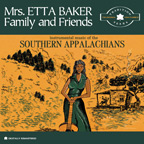
This is a long-overdue reissue of an important Tradition LP which presented field recordings, made in 1956, of the playing of Etta Baker and other talented musicians of the Southern Appalachians who had never previously been recorded. Obscure they may have seemed, but uncommonly fiery is the playing, with a raw edge and unbridled vitality for whom the word "enthusiasm" might have been coined. Since those heady days, when even specialist folkies hadn't heard anything like these musicians, other recordings have surfaced featuring fiddler Hobart Smith (notably those made for the Library Of Congress where he backed his sister, singer Texas Gladden), but the rest of the musicians on this collection have remained little more than names on a discography, although the influence of their playing has pervaded that of countless aspiring traditional-style guitarists, banjo players and Appalachian dulcimer exponents ever since. Even at a temporal remove of over 50 years, you can't fail to be moved by the tremendous power of many of the performances collected here, especially the fiddle tracks. And as well as fiddling vigorously, Hobart Smith also contributed one track on which he removed all the frets from a borrowed banjo before playing! The rest of the musicians were all recorded in their native North Carolina, and are drawn from the family and friends of guitarist Etta Baker; they play timeless popular tunes from the tradition such as Cripple Creek, Soldier's Joy and Shady Grove as well as a few less well-known pieces. Etta's rendition of John Henry (played with a jackknife blade!) is astounding by any standards, and her other four pieces on the disc are similarly invigorating. I also enjoyed Richard Chase's harmonica tunes for their cheery quality and his insistence on carrying the melody along rather than forcing you to listen instead to his technique. The sound quality of the disc is raw and forward, primitive by today's standards naturally, and some of the guitar pieces are rather clangy, but it's all still perfectly listenable. In fact, a very enjoyable disc that's also of considerable historical and heritage interest. Full liner notes are reproduced, as always with the Tradition reissues. Pretty much essential I'd say.
David Kidman January 2007
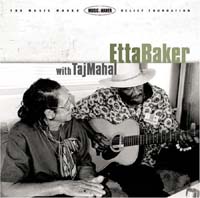
Etta Baker is the grand old lady of the blues and I'm sure she won't mind me saying that she is 91 years of age. She has influenced many a guitarist and Taj Mahal has said that she is the greatest single influence on his guitar style. This album of songs recorded between 1956 and 1998 shows that she is a force to be reckoned with. There are two parts to the recording, the 'now' section which covers the first 11 songs and the 'then' section covering the final 7.
Opening with 5 songs accompanied by Taj Mahal, Etta introduces us to her gentle style on the oft covered John Henry, the beautifully played Crow Jane, the wonder that is Going Down The Road Feeling Bad, the first self-penned track Madison Street Blues on which she airs her electric guitar and outshines guitarists half her age and the country blues of Railroad Bill. She picks up the banjo for Cripple Creek, and this is a foot-tapper, and then continues the country theme on Johnson Boys. This is my favourite and is what music is all about – it makes you happy – and the inclusion of Wayne Martin's fiddle is a bonus.
Going To The Race Track, a gentle acoustic blues, starts off a run of three songs and a poem featuring Etta on her own. Her dexterity is so astounding on Lost John that you will swear that you are listening to the playing of someone far younger. Dew Drop is slower than most of the others but you can just imagine the drops of water falling from the spring flowers. Poem is exactly what the title says. It is a four line poem that perfectly sums up growing old. The final track of the 'now' category is Comb Blues and features the comb and paper as an instrument. Taj Mahal is back for this and is joined by Algia Mae Hinton. This is a slow blues that harks back to the very beginning of the genre.
In the 'then' category we are treated to seven songs that were recorded in July 1956. One Dime Blues, one of the three songs on the album written by Baker, sounds so contemporary that it is hard to believe that it was recorded nearly 50 years ago and it shows that she was an extremely good guitarist in her time. Etta's father Boone Reid plays the banjo for Sourwood Mountain and there is just something about banjo music when it is well played. Etta returns for Don't Let Your Deal Go Down, which is played in a faster Robert Johnson style, and Railroad Bill, which also features in the 'now' section. This is a wonderful example of finger picking and, although age may have slowed her down a tad, there's not too much difference in the two versions. There's a second offering from her father, a different version of Johnson Boys. The banjo playing is excellent again but having heard the later version with added fiddle I have to say that I preferred that one.
To finish off, Etta comes in with a strong version of the classic John Henry with excellent slide guitar and Bully Of The Town which is played in a gentle, acoustic Piedmont blues style. Etta Baker is a remarkable woman and Music Maker deserves our thanks for allowing her to record again.
Music Maker page for Etta Baker
David Blue
The first album, Mercy, sought to address the blast and the random manner in which some died and others lived. In 2007, Pretty World offered meditations on gratitude, obligation and beauty. Now comes the final part, an exploration of the price of forgiveness and the cost of clinging to anger, told through songs that pivot around the homeless and helpless, and of love found, lost and held together with tape.
On the bluesy title track we meet a field hand hoeing cotton "for the rest of my life" like the father that walked out on his family in despair, Mennonite tells of a religious kid from Mexico who, wearing his new 'pearl snap shirt', found love dressed in a "short short skirt' in a bar room and left the Lord behind, while, Palestine II (and its prequel Palestine I) unfolds the tale of a marriage that began with teenage passion in a travelling preacher's tent and has had to hold together through a tragic accident, hard times and history repeating itself with their daughter running away "with the boy selling bibles."
Speaking more than singing his narratives, Baker's dust and gravel voice variously recalls John Prine, Dylan, Steve Earle, Tom Waits and John Trudell, his sparsely arranged American songbook music hewing to southern backwoods folk (disarmingly beautiful on the two step fiddle call and response swayer Who's Gonna Be Your Man) and Texan country in the vein of Van Zandt and Kristofferson.
Opening with a brief snatch of Dixie, sung in the round by a female voice (its 'look away' refrain returning to bring bitter resonance to the dark night guilty secrets of Moon) and closing on the poignant Snow with its metaphor about being lost and emotionally frozen in a drift of your own making, it is both melancholic and life-affirming.
It's hard not to be touched by the snapshots of the disenfranchised and losers who populate Signs, by the Waits-like Angel Hair where, on Christmas Eve, the singer recalls a fatal traffic accident on black ice a decade earlier, or by the unwanted pregnancy of Not Another Mary and the girl who "could not say I love you too." Even the aching piano instrumental Say The Right Words can break your heart. But, at the end of the day, between the tears, Baker reminds you that, even if you're only getting by, life is worth persevering with and far better than the alternative.
Mike Davies August 2009
When musicians appear at one of our Mr Kite Benefits, I often ask about what they are listening to and who they would recommend. Gurf Murlix, producer/musician extraordinaire, has worked with Slaid Cleaves, Lucinda Williams and many more. So, you might imagine that his ears are well tuned to fine music. So, it was that I was recommended to Sam Baker. I believe Bob Harris also had his ear bent about Sam too. Indeed, if your ears don't get wrapped around his music soon, I'll be mightily surprised.
Guests like Kevin Welch and Joy Lynn White lend their support on this first record suggesting that he's already attracting the attention of the great and good. But, it's the music that is the star attraction. From the opening track, 'Waves', with its vivid imagery of walking down to the sea and writing a loved one's name in the sand just to see it washed away, I'm hooked. Sam's lyrics are painting pictures like this all the way. From 'another bunch of boys, another blue sky' as he contrasts a baseball game and a war zone to the car 'full of baby junk' that sit on the backseat of a homeless mum's car. There are 'barbers with no nose', 'drunk cops', men 'in their underwear drinking beer', 'skinny boys with their rifles fighting door to door' and characters galore in his stories In fact, there is so much colour in his lyrics that the one word song titles are enough. Hear one song and you'll be drawn in to hear the rest.
Sam's voice adds to that colour with its gravely lived-in drawl reminding you of John Prine or Todd Snider. As my wife says, you'll be immediately won over if you're a sucker for the gravely voice. Put that next to those lyrics that present social commentary whilst painting all sorts of pictures in your mind and I'll be very surprised if a major label doesn't pick up this record.
Steve Henderson, March 2006
www.mrkite.org
David Kidman
Long John Baldry - Remembering Leadbelly (Stony Plain Records)
"Most of the songs in this collection have been part of my life since I first started singing in the mid-50's. Because they are so familiar to me I was able to record my vocals and guitar work in one 'take' for most of the tracks." What better way to start an attempt at a review than in the own words of the artist?
Long John Baldry has been a great catalyst in the evolution of the blues music form of the 60's & 70' in The U.K - something he tends to be very self-effacing about, as those who have seen him live at any point will recognise. I know of no other headliner who gives his sidesmen such accolades whilst backing off from centre stage himself. This character trait is reflected in the bonus interview track on the very end of this CD, and the liner notes acknowledge Chris Barber and Lonnie Donegan and a host of other influences
As to the content of the CD itself, well, I was amazed at the number of the tracks I knew so well whilst not having any Leadbelly in my record collection, nor, indeed, in compilation blues CDs - something I need to rectify but meanwhile LJB manages to cover this void magnificently.
This album is worthy of repeated playing, which may well have something to do with the sparseness rather than the 'over production' tendency found on so many of today's CDs. This is a tribute CD, acknowledging the input of Leadbelly, but with the unique Baldry interpretation. His vocals going from the deep huskiness, for which he is so well known, to the lighter, smoother shades of his marvellously rich voice. There were, for me, moments of goose bumps when he sounded like Alexis Korner - but then they both inspired each other way back when. LJB's voice is a musical instrument in it's own right. His guitar playing needs no accolades.
What amazes me is how perilously close he came to the possibility of not being able to perform anymore. That was back in October 1998. Having not seen him for about 20 years I was taken to a gig by a friend on a whim to The Mill at Banbury. John was not well. He managed the first half without anyone realising the levels of pain he was experiencing. He then nearly collapsed during the second part. We took him to the hospital where they had great difficulty believing that he had played a concert that night. His finger joints were severely swollen despite being soaked in a bowl of water with all the ice from the bar during the interval. The promoter at the venue was prepared to pay back any punters the cost of their tickets. Not a single one did. A case of 'actions being stronger than words'. John has every intention of returning to UK and Europe again next year. At the moment he is about to go on the road in Australia and New Zealand. Catch him if you can.
This CD has been played with great frequency since I got it when LJB toured the UK with the Manfreds back in June, 2002, but I still find it virtually impossible to point the listener to any particular track. From the marvellous sound of the pump organ backing on John Hardy, I want to go back to Take this Hammer and Go Down Old Hannah and then back again to Good Morning Blues. The only solution is to just play the whole CD again and again. Just go order the CD for yourself and you can decide!
Miranda Ward 2002
Before I start, I'll make my position clear - I am not a fan of Long John Baldry. Deep Purple, Fairport Convention, you get the idea - that's where my allegiances lie.
So, let's improve my position a little. I'd been privileged to meet John twice, on the occasion of his sadly aborted 1998 UK Tour. A close friend of mine knew John during the sixties, hadn't seen him since he'd moved to Canada, persuaded me to take her to the opening night in Banbury and I ended up putting this particular blues legend in hospital. If you're really interested, mail me and I'll tell what is, at best, a very dull tale.
That evening, musically the gig bored me intensely. Sure, the guys were all very proficient, technically adept at what they were doing, but I just didn't get it; Long John's style of blues just ain't for me.
So, I find a copy of Johns 2000 Hypertension release 'Evening Conversation' before me, requiring a review. I'm not exactly the best person for the job because, as I've said, I just don't buy this particular style of music. The man, however, I like a great deal; he is hysterical and great fun to be with. We only spent a couple of hours in each others company and I was gratified to learn that, when he was in the UK towards the end of 2000, he inquired of said friend as to my whereabouts.
Needless to day, I was chuffed that he remembered me, and more than a little peeved that when he was in my home town, I'd opted to be in Hong Kong following folk rockers Little Johnny England. And having a damn fine holiday with my daughters. Oh well, some things are just not meant to be.
I've had this release on the go for a while now, and I'm almost embarrassed to say that it has not grated the nerves once. Either I'm getting old or this music isn't quite as bad as I'd first feared.
On first listen I recognised only one tune - Morning Dew. It took a while, but I finally twigged that this was the number opening the sixth Blackfoot LP some 20 odd years previously; a quick dive into the archives confirmed the authors as Tim Rose and Bonnie Dobson. Yep, it's the same piece, wake up ears. It just sounds a little different, like the difference between the late John Lee Hooker and Black Sabbath although, to be fair, Blackfoot were closer to Lynyrd Skynyrd (and the lead guitarist of the former is now a member of the latter).
Johns partners in crime on this release are Butch Coulter, whom I saw in 98, on harmonica and guitar and Matt Taylor on electric & acoustic guitar. Christina Lux, guesting on 'Black Girl' completes the cast of this September 1999 Hamburg recorded CD.
Many of the songs are Baldry arrangements of numbers written by that most classical of composers, Trad Arr. Together with the aforementioned 'Dew, we also have here numbers from Randy Newman, Tom Waits and a Stewart/Woods/Lane composition - Flying, as well as an instrumental from Butch Coulter. On two (Waits, and a Sonny Terry/Brownie McGhee composition) Matt Taylor takes the lead vocals, which just proves that LJB is a generous host to his support band.
I think that, if you're a fan, you'll enjoy this release. You may well have a lot of the numbers already in the studio, but this is a live album, and there is always something that little bit different - special? - about live recordings. I'm sure that you won't be disappointed by your purchase.
Am I converted? Well, I just don't know, but I'll be playing CD this some more. And I will go to see Long John when he is next in the UK. If he comes close enough to home that is.
Denis Bird
One of a pair of new releases from Scottish songwriter and storyteller Jackie Leven, this is a disc of monologues rather than songs, and is conveniently split into two sections. The first of these is a recounting, by Mr Leven's twin (=fictional alter-ego) Jackie Balfour, of episodes from his doomed first job upon leaving school, that of cub reporter on notorious local Fife newspaper the Glenrodent Gazette in the mid-60s. These vary from gently observed vignettes to some more overtly amusing tales of provincial life and newspaperdom, and are delivered in an initially quite low-key and diffident manner but also with evident affection; within them we meet the various characters that people the new town of Glenrodent and its newspaper offices and gain a whimsical insight into their lives and preoccupations. The episodes are punctuated with brief but attractive piano interludes (composed by Michael Cosgrave and inspired largely by Scottish dance forms). The second section of the disc brings three choice stories of Jackie Leven's own concoction: the first of these, the infamous Sting's Dead, was recorded live in front of an anything-but-humourless German audience, while the second, Stupid Local Boasts, is culled from the double album of the two-hander show at the 2004 Edinburgh Festival which united Jackie with author Ian Rankin (the latter playing the role of straight man). The final tale, Sex Tourist, was recorded at a club in Sydney in 2001. It matters not that all three of these tales have been released previously (albeit the first and third only on not-easily-available Haunted Valley label discs), for they well complement the storytelling of the Jackie Balfour episodes. Even so, I'm not sure there's a particularly wide audience (in terms of potential record sales, I mean) for this aspect of Jackie Leven's art, beyond the "occasional entertaining listen" status that inevitably accompanies spoken-word recordings, however good.
David Kidman January 2008
A Scottish folkster with a jazz family background, Bancroft's explored both fields in her previous albums, not to mention experimenting with electronica. There's jazz blues flavours here on the musically flirty Occasional China where she slips into scat backed by Amy Geddes providing gypsy fiddle, the breathy No Smokin with a percussion rhythm that sounds like the bellows of an electronic lung, and the skittish Dented with Tom Lyne's double bass groove.
Mostly though she channels her jazz raising into folk intimacy, delivering the rippling, bluegrass flecked Supersize Me with its laments about the lack of community and childhood in the modern age, the waltzing I Carried Your Heart's age-enduring love song and, also touching on a theme of passing years, the sparse wood-smoked When The Geese Fly South.
Written four years back, Boo Hewardine guests on co-penned closing track Caroline, a 3am jazz cellar piano blues account of an unconsummated drunken one night stand and subsequent self-questioning while, underscoring the classiness of the project, the album's co-produced and mixed by Mark Freegard whose extensive credits include Maria McKee, Manic Street Preachers and, more pertinently for that sultry jazz vibe, Swans Way.
Probably more one for the Ronnie Scott's crowd than your local folk club, but certainly worth the exploring.
Mike Davies November 2010
An Austin five-piece featuring three vocalists and writers, Ed Jurdi, Gordy Quist and Colin Brooks, they picked up last year's Best New Band at the Austin Music Awards and now follow up with their debut album. Produced by Ray Wylie Hubbard and mastered by Gulf Morlix (both of whom also guest along with Stephen Bruton), it's fairly blueprint southern barroom rock country with pumped up guitars, mouth harp, swaggery rhythms and bluesy acoustic honky tonk ballads. There's no frills just good time rocking country with hints of r&b and certainly Drive By Truckers, Little Feat and Huey Lewis fans alike will appreciate the likes of a Heart On My Sleeve, Unsleeping Eye, the dobro and harmonica wailing Jackson Station and the lap steel swaying Maple Tears with its Patty Griffin harmonies. They're not doing anything new, but they're as reliable and easy to slip into as an old pair of shoes. The release also comes with a Live At Antone DVD which serves to show where they shine best.
www.bandofheathens.com
www.myspace.com/thebandofheathens
Mike Davies September 2008
Band of Two is exactly what it says on the tin - a band comprising two musicians. The pair in question are Croydon man Pete Fyfe and Garry Blakeley, from Hastings - two musical souls who met by chance ten years ago, discovered an affinity in their tastes and have built a great rapport and a catalogue of songs, jigs and reels that guarantees a great evening's entertainment when they play live.
Decade, the duo's second album, is packed full of high-quality songs and tunes, all played with an obvious love of the material and an infectious enthusiasm that will put a smile on your face and have you singing along. With a distinct leaning toward the Celtic end of the British musical spectrum, it's not surprising they elect to kick off with "Farewell to Ireland", a no-holds-barred instrumental workout that immediately displays the fine fiddle-playing of Blakeley and some furious strumming on the guitar by Fyfe - a tremendous opener. "Blackleg Miner" is a traditional song outlining the hatred for, and treatment meted to, the scab worker of the title. Fyfe relishes the lyric, giving his vocal a menacing edge as Blakeley's fiddle ducks and weaves around it and the guitar.
One of Van Morrison's best-known songs gives Blakeley his first chance at the mic, his voice a pleasing contrast to Fyfe's deeper tones. Fyfe's playing on "Have I told you lately" comes to the fore as he overlays deft mandolin fingerwork on Blakeley's guitar. A sparser arrangement than Morrison's original but all the better for it - lovely. "Decade" features two sets of tunes - "Made in Sligo" and "Scottish set" - which give both musicians the chance to show off their dexterity with some inspired, and inspiring, playing. One of the (several) stand-out tracks is the pair's reading of "Fairytale of New York", the original of which featured another child of Croydon, the late Kirsty MacColl. Two people could never, of course, hope to make a bigger noise than The Pogues at their best, but, like the Morrison song, this version loses nothing for its simplicity - well, it's such a good song, how could it fail?
Ireland gets a look in again when the pair tackle the old standard, "Danny Boy" and the delightful "Blarney roses". "I wish I was single again" is the lament of a man who regrets his marital status as he tells us: "Well I got me a wife, she's the pain of my life, I wish I was single again." A sentiment shared by more than a few, no doubt, It's a worthy sister song to "I wish that I never was wed", sung with great relish by Gay Woods on Steeleye Span's "Horkstow Grange" album - folk compilation album compilers, take note. "Decade" is neatly wrapped with nigh-on seven minutes of the "Skiffle set" - a skilful stringing together of eight songs which were so popular among the skiffle bands of the '60s.You might remain tight-lipped through "Irene goodnight" but your resolve will begin to slip during "Comin' round the mountain" and, by "Worried man blues" you'll be singing along as it segues into a "Pick a bale o'cotton", "Swing low, sweet chariot", "It's a long way to Tipperary" and "Pack up your troubles" before the set's wound up with "Knees up Mother Brown". It may sound a little naff but, believe me, it works.
Two nicer blokes you couldn't hope to meet and "Decade" is an album they are quite rightly proud of. It's a belter.
Fred Hall
Following six independent releases, the hirsute ashram-friendly psych folk Venezuela raised, California based singer-songwriter finally makes his major label debut with a collection that, produced by Paul Butler from A Band of Bees, is eclectic while remaining firmly rooted in the hippie folkster landscape.
Can't Help eases you into proceedings with marimba ripples and a tropical island sway that might make Jack Johnson sound like explosive punk before his Incredible String Band affections rear their head with Angelika where his phrasings echo the young Robin Williamson before the song suddenly mutates into a jazzy piano led bossa nova and Banhart apparently turns Puerto Rican. There's a Latin blood in the veins of Brindo too, another bossa nova croon only this time sung - or rather seductively whispered - in Spanish.
Skipping around the influences, Baby varnishes a Smokey Motown soul groove with a light reggae hiccupping and a suitably playful lyric that talks of choo choo trains in a manner that recalls Jonathan Richman. Then it's a trip down to Graceland with the easy lilting kwela tinged folk Goin' Back To The Place while the more intimate moods of Paul Simon - and the lost soul purity of Jeff Buckley - would also seem to cast their shadow over the melancholic building piano pulses of First Song For B and its immediate acoustic guitar accompanied sequel Last Song For B which sounds like a musical close companion of Bookends.
He does like to keep your ears on their toes. The oddly titled Chin Chin & Muck Muck starts out as a lyrically reflective ("when I was a young boy, I had a lot of young boys and we taught each other dearly how to love" sounds a lot like the memoir of some aging gay 'old hand') excursion into late night jazz cellar blues with brushed drums and trumpet before slipping 'clang bang wang' into another dose of sunny puttering, la la laaing ISB folk briefly interrupted by an echoey piano lounge crooner interlude before resuming with what might well be steel pan and a reference to a 'gibbous rainbow'.
And if that doesn't catch you sufficiently off balance, then 16th & Valencia is a Roxy Music glammed rocker, Rats summons the stoned soul lysergic lizard king spirit of Jim Morrison, Maria Leonza and Meet Me At The Lookout are dreamy 60s West Coast psychedelic tripping and Foolin' closes up shop with a full on bubbling Marley meets Toots and the Maytals style ska workout.
Will it see him embraced by a wider, mainstream audience? Probably not, but his devoted following is certainly going to be passing round the pipe in celebration.
www.myspace.com/devendrabanhart
www.devendrabanhart.com
Mike Davies November 2009
Devendra Banhart - Cripple Crow (XL)
With a sleeve photo that suggests you're in for an expanded version of the Polyphonic Spree, the bearded Banhart's fourth outing sees him building on his past foundations of 60s harmony pop, trippy dippy Indian drones, bossa nova and blues. Fleshed out into full band arrangements but retaining his eccentric whimsy (I assume he's being whimsical when he sings of being a lonely sailor ogling young lads on the frankly barking Little Boys), he recorded this in Woodstock, clearly on a creative roll since it features no less than 22 tracks.
As such, it can prove a tad wearying if you're not totally submissive to his merry skewed charms as evidenced on something like the bizarre The Beatles which starts out namechecking Paul and Ringo and then inexplicably finds him crowing in Spanish while folk whoop it up behind him. But if you're prepared to pick around for favourites then the tripped out sitar drenched latter-day Donovan meets Bolan blues of Lazy Butterfly, the soft whispery Queen Bee, lollopping jugband Some People Ride The Wave, guitar instrumental Sawkill River, the lazy warbling driftalong Koreak Dogwood and, in his Spanish mode, the sun kissed Santa Maria Da Feira and a melancholic cover of Venezuelan Simon Diaz's moody Luna De Margarita repay the effort of juggling with the skip and play buttons.
www.younggodrecords.com
www.xlrecordings.com/devendrabanhart
Mike Davies
Devendra Banhart - Nino Rojo (XL)
Current darling of the new folk movement, Texas born Banhart was apparently named by an Indian mystic his hippie parents followed, grew up in Caracas and LA, and dropped out of the San Francisco Art Institute to live the bohemian life in Paris. A bunch of four track recordings came to the attention of former Swans frontman Michael Gira who released them as is through his Young God Records, thereby setting into motion a growing cult following. Recorded in the same sessions as the previous Rejoicing In The Hands, this 16 track collection pretty much sums up everything you need to know. He plays acoustic guitar, has a high pitched, quivering vibrato that makes him sound several decades older than his 23 years and which prompts regular comparisons to Tyrannosaurus Rex period Marc Bolan and the early days of the Incredible String Band. Oh and of course, Syd Barrett.
Deliberately naive in his sound, which straggles warbling folk, ragtime, bluegrass and blues but here embracing arrangements that involve brass, piano and strings in addition to trusty guitar, his narratives frolic cheerfully in the fields of playful whimsy with lyrics that include tales of psychedelic squids and the cloven hoofed offspring of a man and a pig.
Dotting around at random, you'll find a bluesy reading of Ella Jenkins' folk song Little Sparrow, fingerpicked spooked lullaby Ay Mama with its mournful trumpet, the arpeggio folk blues tumbling Little Yellow Spider about, well take a guess, a vaguely pop inclined At The Hop (no, not Danny and The Juniors), an ominous Horseheadedfleshwizard where he sings about hosing down the dead before they die, backporch good timing The Good Red Road and the closing drunken swayer round the summer evening Hawaiian bonfire strummer Electric Heart. Taken en bloc it can get a touch wearying, but sampled at intervals you'll be convinced his people really were fair and had sky in their hair.
www.younggodrecords.com/Artists/DevendraBanhart
Mike Davies
The follow up to the acclaimed High Tide, Bannister's second album since leaving The Bushbury Mountain Daredevils, teams him with fellow West Mids singer-songwriter and ex Bushbury Eric Barlow. Primarily built around their twin guitars, it's a simple acoustic affair, with no ambitious productions, but it leaks honesty and a passion for the music they make. As in Bushbury days, American bluegrass back porch mountain music remains an influence, most evidently so on the naggingly catchy Mousetrap, a jug band of a number with Bannister on mandola that could have slotted easily into the Oh Brother soundtrack without anyone suspecting anything out of place. But there's more than hillbilly going on. Opening track Long Slow Day is a gorgeous tropical lilt designed for laying back and watching the sky while the spellbindingly lovely I Will Go With You brings to mind the better, less bombastic moments of Chris De Burgh and mixes it with Art Garfunkel. Art's also in the mix for Soon Be With You, although the melody harks to a mix of McTell and May You Never. Art's old sparring partner also comes to mind on Barlow's The Hippy Song while elsewhere you might hear hints of Iain Matthews or, on Maggie Lee, the early years of Harvey Andrews. A mix of tub thumpers like Let Love Find Me and Get On Board and the more, and better, reflective ballads, lyrically it's largely either love songs or about dreams pursued/unachieved, though the excellent harmony acapella is a dust to dust hymn to, the loving arms of well, mother earth. Not sure about the closing number, a bluesy Superman's Lasergun that doesn't really come off, but otherwise this can only serve to further boost Bannister's reputation among the faithful as one of the most distinctive voices and writers on the UK roots scene.
www.brianbannister.onlineidentity.com
Mike Davies
If you've not yet encountered the wonderfully original music of this perennially dynamic and talented young Whitby-based trio, then now's the time to start, and this new album, taken together with Galata Bridge, should provide the perfect starter pack. Like the band's five-year-old début CD release Home Before The Sky Breaks, Living By Stories largely (though not exclusively) turns its back on the trademark crazy, manically angular fast-driven dance sets ("Transylvanian rhythms from Bram Stoker country"!) in order to showcase the gentler side of the Banoffi universe - a veritable Delta Quadrant of lusciously lyrical creations lying in wait to envelop you. The band have taken their recent cautious experiments in layering of sound textures from Galata Bridge and the Bluebells EP on to new levels of accomplishment, and this is strongly in evidence on the trippy opener Go To Dreams, but to their credit this aspect is never overdone, and the defiantly individual characters of the three individual musicians is always foremost, with the quality of the recording attaining a new level of engineering expertise here. Quiet Fire is a truly beautiful creation, with Dave Moss's sinuous, enticing vocal line poignantly inhabiting the idyllic landscape of Bluebells.
Other songs show Dave's increasing penchant for the more pensive turn of thought, ranging widely from the eerie, economically-expressed pacifism of The Fight and the compelling title track to the quasi-catechism of Bless with its curiously effective neo-calypso setting. The instrumental tracks that punctuate the songs on this album are sensibly sequenced to follow them, in that (like the Eastern European dance-forms on which they're modelled) they often begin slowly then build in tempo or intensity. They can therefore appear slow-burners by comparison with some of the band's earlier, wilder efforts, though it still takes a fair bit of digital dexterity to get your feet round the almost wilfully complex time-signatures! As ever, Tim Downie's guitar work (which, admirably, is clearly audible throughout) is a model of subtlety and embellishment that might come as quite a surprise if you've ever witnessed his string-breaking exploits in live performance!), while Ian Hulme's prowess on various whistles, doumbek and bodhrán is unassailable as ever, sensitive in all the right places. My only (minor) complaint about this release is the near-unreadability of the text on the neat digipak sleeve, due to insufficient contrast - that latter tag certainly doesn't apply to the varied music on display on this exhilarating album.
David Kidman
This disc has been long in coming, but hey, it's been worth the wait. It's a natural confluence of two of our finest singer-interpreters who have discovered an equally natural kinship; they have much in common, not least some important formative influences. Each of them has a background to die for - both were "kid folkies in the (proverbial) sweet shop", growing up being involved in, and understanding and appreciating, folk music. For them, standards were set at an early stage, and both were introduced to major figures on the folk scene at a tender age almost as a matter of course. They met and became friends quite early on, but then for several years they followed independent courses: Mike mostly singing with his siblings (in The Wilson Family group) and Damien launching his own professional solo career after attaining the finals of BBC's Young Tradition Award in 1989, then going on to mastermind the groundbreaking Demon Barber Roadshow. They'd talked about trying some songs together, but it was not until around four years ago (to my recollection) that this idea bore fruit on a tentative foray into the clubs armed with an embryonic joint repertoire developed under the influence of the generous folk artists whose own repertoires form the thread that now binds this disc together. The folk artist whose figure looms largest over the whole set, inevitably (but entirely justifiably), is the mighty Peter Bellamy (whose own performances provided the inspirational source recordings for several of the songs chosen for the disc), closely followed by Ewan MacColl and Dick Gaughan. The vital combination of attitude and respect is an essential one for any song carrier worth his salt, and it's one which Damien and Mike closely share and keenly display throughout their work together. Each of them is passionate and distinctive as a solo singer, with a rich-toned and sturdy delivery. Mike here employs quite a bit of decoration in his solo passages, while not getting in the way of Damien's trademark throbbing vibrato, and the two voices sit well together generally (not always the case with two voices which share a roughly similar range). It's important, therefore, to retain plenty of textural variety during the course of a joint CD, and this is managed by virtue of Damien varying the accompanying instrument between English concertina (seven tracks) and guitar(three), the remaining brace of tracks being performed acappella. In the latter category we find one of the disc's highlights, a particularly enterprising choice (and the only item not associated with any of the previously notified "influences"): the cryptic and elusive A Fable From Aigge, composed by Nick Burbridge (and taken from the brilliant McDermotts vs Levellers album Disorder). The second acappella item is a runthrough of Shiny O, a shanty obtained from Stan Hugill. Damien's deft, rhythmically inventive guitar playing provides an ideal foil for Mike on three contrasted songs including The Green Linnet and MacColl's My Old Man, while his concertina provides sterling accompaniment for both solo and joint vocal outings as well as a notably poignant counterpoint to MacColl's Joy Of Living. The actual form the "duo act" takes can vary in approach: five songs are performed solo by Mike with Damien accompanying (these include Joy Of Living and Now Westlin Winds), Andrew Rose (sourced from the singing of Tony Hall) has Damien solo with Mike joining him on the chorus, whereas other songs (like On Board A 98 and Nostradamus) are taken "turn and turn about" (alternate verses each, with both harmonising on the chorus), which by and large works well (although Down The Moor feels a tad overloaded and its intimacy thus mildly compromised, and some of the harmony work seems a mite tentative at this stage). The "odd track out" is Jim Jones, which is a solo performance by Damien with concertina. Yes, both in terms of repertoire and performance style, Damien and Mike have chosen well for representing their duo activities on this CD. Finally, an honourable mention for the disc's presentation: a keen and attractive (digipack) package, its design embracing a montage of related relevant memorabilia and enclosing within a well-coordinated booklet wherein Damien and Mike each provide a nicely discursive personal reminiscence in chummy conversational mode spiced with the occasional did-you-know biographical nugget (for example, that it was Peter who originally bequeathed the nickname The Demon Barber on Damien!). Influences and inspirations are freely acknowledged, generously granted and openly encouraged (in my turn, I've been well "under the influence" of both Damo and Mike, and "The Family" ever since I myself started singing). Sure thing, Mike and Damo have done themselves proud here, and it'll be interesting to see how this musical partnership develops in due course - let's hope we don't have to wait five years to find out!
www.damienbarber.co.uk
www.thewilsonfamilyalbum.co.uk
David Kidman February 2009
This Canadian songstress (singer-songwriter to you!) won Best Album and Best Female Solo categories at this year's East Coast Music Awards, which should mean something! She played over here in the UK last autumn as part of the Twisted Folk package tour (along with Tunng), and is set to return for a handful of dates next month including the Green Man Festival. Jill's been tagged "alt-cabaret", and listening to For All Time, her second record, it's hard for me to get that tag out of my mind. I think it's her singing style and the tonal quality of her voice more than anything else that justifies that tag: smooth and velvety-sensuous, with an impressive quality of assurance that not all singer-songwriters can command. Her writing, too, is warmly heart-on-sleeve rather than introspectively angst-ridden, and the musical idiom within which she operates occupies that timeless jazz/country/folk crossover zone with a wide potential appeal. In its gentle energy, this album has a direct, up-close feel which reflects the method of its actual recording (live-off-the-floor), with individual instruments perfectly selected and balanced within the overall spare-but-rich sound-picture.
The canvas is quite broad as far as instrumental colours are concerned, with almost every one of the eleven songs being differently scored: guitars, mandolins, piano, vibes, organ, harmonica, violin, cello, bass, percussion, even a mellotron at one point. Multi-instrumentalist Les Cooper has done a fine job with the production, and other musicians appearing include Bob Packwood, Spencer Evans, Blake Manning, Stew Crookes and Blue Rodeo members Bazil Donovan and Jim Cuddy. You might find the album easier to get into after the first three tracks, which aren't really typical; the opener Just For Now is a chunky old-style ballad with a torchy country-gospel feel, then Don't Go Easy is easygoing steel-driven country, and When I'm Makin' Love To You is a cheeky swing-jazz piece set to a perky clarinet and piano backing. Ashes To Ashes is both delicate and stately, a measured and considered reflection, Hard Line has a subdued funkiness in its driving Motown vibe.
Variety and contrast notwithstanding, the standouts for me are the title track and Goodnight Sweetheart, both good examples of the kind of beautiful, simple little time-honoured love songs that you feel you've always known, and Legacy, whose generous, measured pace allows full rein to Jill's expressive vocal qualities. Jill's probably at her tremulously confidential best on the closing Starting To Show, while on some of the other songs, like the tender Two Brown Eyes, Jill reveals herself to have a sexy vocal presence akin to Cowboy Junkies' Margo Timmins. On the evidence of this CD, I can understand why Jill has made such an impression thus far, and can imagine her special brand of intimacy working much to her advantage live.
David Kidman July 2007
Brighton-based duo Kevin Barber and Mark Taylor are one of those totally-together acts that sound for all the world like they've been playing and singing together almost from birth. Typically they play an attractively melancholy brand of acoustic-based, guitarsome bluegrassy Americana, with around two-thirds of their material self-penned and the remainder made up of respectable (if not consistently outstanding) covers of (on this, their third CD) songs by Albert E. Brumley, Woody Guthrie and Paul Simon (gripe: it's a shame they didn't choose some more appropriate covers like the Gillian Welch and Iris Dement stuff they perform live), and Robert McCreedy (his Two Seconds, the best by far of the covers here). But I liked this record a lot, and even though it's primarily the vocal harmonies and tight arrangements that make the impact on first hearing the songs stand up to scrutiny and grow on repeated listening. Standouts for me included the opener My Old Friend The Moon, the somewhat Kieran Halpin-like The Price Of Freedom, and Lighthouse (coincidentally, these are all Kevin's compositions). Generally there's a very satisfying ambience about the duo's music, and it's couched in an accomplishment that's easy-going yet not without a quality of thoughtful depth and immediacy of inspiration. With top-flight recording quality reflecting the duo's close, intimate yet dynamic live presence, this is a treasurable release that deserves wider recognition.
David Kidman
A little over two years ago, I reviewed a very fine CD, Islet, which paired Rebecca's passionate and individual singing of a selection of traditional songs with the intricate and inventive traceries of Durham guitarist John Steele. For her latest recording project, Rebecca has recruited a host of accomplished traditional musicians from different cultures to assist her in bringing alive her brilliantly creative vision of these age-old ballads and songs.
Oh dear, I realise that might well conjure the image of a deliberately contrived ethno-centric mish-mash that replaces the intrinsic folk character of these songs with gimmicky multicultural baggage in order to tick the various boxes of trendy political correctness; but in reality the results of Rebecca's musical adventures are without exception non-pretentious, fresh-sounding and thoroughly listenable – albeit very often more than mildly challenging.
And as I mentioned before, Rebecca's darkly full-toned and gutsy singing – which has been described as "multi-ethnically informed" – will I guess either delight or infuriate according to taste, your reaction very probably being determined by how you respond to any singer with a strongly personal voicing and interpretive approach (it can be so easy to undeservedly mistake individual, sincerely rendered passion for laboured or mannered expression). For instance, on the disc's closer, an idiosyncratic take on The Snows They Melt The Soonest, Rebecca is at her most vocally uncompromising and adventurous: here, in intoning the text to an equally emotive didgeridoo backdrop, she sometimes pulls the vowel sounds and melodic decorations around quite mercilessly (you are warned!).
Compared to which, the faint-eared will find much of the preceding album significantly easier going. For instance, on Rebecca's percussively upbeat take on The Blacksmith, you can readily believe you're listening to Kate Bush backed by 3 Mustaphas 3 and a Turkish fiddler, while her retelling of The Cutty Wren is propelled by a spicy flamenco-style rhythm. Just as on Islet, Rebecca demonstrates a keen response to English and Scottish traditional material and Quebequois call-and-response song alike, although you may feel especially on initial acquaintance that one or two of her determinedly imaginative settings seem too eccentric and "busy". On the other hand, there are moments when the outcome of Rebecca's creativity is simply so extraordinary that you've never heard the like before (the soundscape of Queen Jane is not at all easily describable, and will stop you in your tracks for sure, while the extended, subtly percussive drone-layered setting of Lagan Love is almost as astonishing in terms of atmospherics).
All told, you may well find it surprising (though welcomely so), that Rebecca's often outstandingly original interpretations work as stunningly well as they do – although to be fair, part of the credit for this must go to Rebecca's fellow-musicians. You're unlikely to have heard of any of them (bar one), but they're superb every last man, and I'd single out Joel Shore's exceptionally characterful fiddle work (and rich, sepulchral backing-vocal cameo), Charlie Cares' sprightly whistle and bodhrán playing (on Blanche Comme La Neige), and of course John Steele's marvellously woven guitar tapestry on several tracks including a majestic, driven seven-minute take on The Bonnie Bonnie Banks Of Airdree-O. And a special mention for recording engineer-wizard Ron Angus, who plays guitar (is there no limit to this guy's talents?!) in counterpoint to Teilhard Frost's Quebec-style foot percussion on Let No Man Steal Your Time (sic), and Northumbrian piper Nichol Caisley who shows himself to be a hell of a fiddler too on Airdree. But all the members of Rebecca's support crew are vitally important, as she acknowledges by devoting four pages of the excellent booklet to their biographical background.
Do give Cinnabar a chance, for it proves an intense and haunting experience, definitely one of the most stimulating CDs of traditional music I've heard this year.David Kidman August 2010
I suspect that this CD will divide listeners (it even divided me at the start!). First some background: Durham guitarist John Steele and Canadian singer Rebecca Barclay have been collaborating as a duo for around five years now, yet this would appear to be their first CD together. On it they illustrate their common interest in performing (predominantly) traditional songs from both sides of the Atlantic - this diverse selection presenting songs from standard English sources (including The Cruel Mother, Lovely On The Water, Factory Girl and MacCrimmon's Lament) alongside three of French Canadian or Newfoundland origin (all sung in French), topped up with a brace of contemporary songs (by Dick Gaughan and Stan Rogers). So far, so straightforward; but initial aural encounter proves not quite so. John's guitar work is very skilled indeed: both exuberantly intricate and understated, gentle and yet percussive, not exactly drawing immediate attention to itself and yet intensely satisfying to listen to both in isolation and in the role of accompanist when providing the intriguing instrumental backdrop for Rebecca's singing. And there we come to what for many listeners may be the sticking-point: for Rebecca has a quite remarkable and very individual singing style that I couldn't get on with easily for the first couple of playthroughs - and I still find it somewhat of a barrier on a few of the songs, while all the time I'm trying to assimilate (and explain) its overall positive impact on the duo's music-making. Describing the features of Rebecca's style is not an easy task: her voice is dark-toned, with an attractive hint of deep mystery, and she evidently responds deeply to the texts, but her languidly moulded expression of the melodic contours involves a large degree of (what may appear overblown) swooping and diving and contorting of vowel sounds (and occasionally too much vibrato) which will strike some listeners as at best over-stylised, and at worst mannered and indulgent in the extreme. But I came round to celebrating Rebecca's individuality of style, her distinctive brand of passion - although I'd acknowledge that it doesn't work equally well on every song she tackles (Blackwaterside and Both Sides The Tweed, for instance, sound laboured and out of kilter as interpretations). But when it does work, close listening is rewarded by a mesmerising experience, a kind of pindrop immediacy that startles in its simplicity - which in turn is informed, I'm sure, by Rebecca's study of the vocal traditions of other world cultures. Finally, although this is a duo record, Rebecca and John benefit from some subtle augmentation from friends playing (variously) fiddle, flute, accordion and percussion on a small handful of songs. The basic duo will provide an intense and intriguing live experience, one which I'm now quite keen to sample.
David Kidman February 2008
Britain's foremost R&B label, Note, has a roster to die for and The Barcodes epitomise the quality on offer. Bob Haddrell, Alan Glen and Dino Coccia are the current incarnation and the guest stars compliment them perfectly. Opening with Taj Mahal's Paint My Mailbox Blue they produce thirteen tracks of British R&B that is rarely matched. Val Cowell and Paul Cox guest on vocals and their voices fit together very well on this sultry blues along with Papa George on slide guitar and Roger Cotton on Hammond. There are only four covers on the album and the second, Mose Allison's I Won't Worry About A Thing, shows a bunch of top musicians on top of their form. This is played in Allison's jazz/blues style and the newest member, Bob Haddrell, effortlessly shows his keyboard skills. However, it is Alan Barnes on sax that is the standout. The first of the originals is a result of many hands and Back At The 4 Aces is an airy instrumental that takes in jazz and a little bit of reggae. Jim Mullen adds his considerable guitar talents to this one. Great British blues musician Alan Glen is a much lauded guitarist, harmonica player and songwriter and his Petunia is next. This is slinky jazz of the highest order and has Glen written all over it, as you can tell from the guitar work. Everything Or Nothing is another Glen song and he showcases his harmonica this time - British blues from a British bluesman. He teams up with Coccia for Halfway To Nowhere, another good British R&B topped off by Zoot Money on vocal and Hammond.
It's a full band effort for the instrumental Blues For Judy which is on the jazzy side of the blues again, with Glen's guitar shining through. Can't Hold Out Much Longer is a Little Walter song but the understated vocal lets it down a bit. I also thought that Glen would have given the harmonica part a better treatment. Coccia and Haddrell team up for the first time to write Time, Talk 'n' Trouble, a slow methodical blues that doesn't really get anywhere. The Snitch is a band effort again and is plain and simply well played, British jazz/blues. They stay in the jazzy vein for Coccia & Haddrell's Undercover Lover. Although it has the added extra of Nick Newall on flute it's really nothing out of the ordinary. The last of the covers is a laid back version of Peter Green's Watch Out. It's jazzed up a little and I'm sure that it's not what Green had in mind when he wrote it. It's a low key finish with No Light In My Life. Well played, as are the others, and in the jazz vein which is a side of the band that has come out more than I'd hoped.
David Blue January 2007
The Barcodes - Keep Your Distance (Note Records)
The Barcodes latest offering on the excellent British blues, soul and jazz label Note Records raises the standard for blues tinged jazz for those who choose to follow. This opens with I Got News, which is played in a nightclub blues/jazz style. Alan Glen manages to get his guitar to sound like a Steely Dan track and the saxophone from Nick Newall is very slinky. Thick Cut is the first of the instrumentals and whilst the organ flurries from Bob Haddrell are excellent, they fall into second place after Alan Glen excels on guitar and harmonica.
Crazy Life is smooth blues tinged jazz and Glen's harmonica is on top again. The Barcodes Theme is mainly a showcase for the saxophone Nick Newall but the others get a look in too. This is a well-played jazz instrumental. Things take a turn on A Little Bit More, a jazz track on the rock side, which has Alan Glen's guitar singing. The title track is jazzy blues, pretty much akin to the rest of that ilk on the album and they get a little funky on the blues groover, Tell Me The Truth.
The wonderfully named Splanky is an organ-led instrumental. Jazz, of course, that gives the main protagonists a chance to show off again and Dino Coccia's drums are the perfect foil for the rich guitar and organ sounds. We finally get a real blues on That's Alright. The slow guitar intro added to the harmonica fills, organ and electric piano makes this a favourite. The blues theme is continued on the final track, the Sonny Boy Williamson classic, Eyesight To The Blind. However, this jazzy, up-tempo version does not do much justice to the original and the vocalist doesn't really get out of first gear
The Barcodes are excellent musicians but their singing does not come up to the same standard. Make yourself a four piece with a vocalist that adds a little power to the songs and you'll be in the higher echelons of British blues/jazz.
www.note-music.co.uk
www.thebarcodes.co.uk
David Blue
This legendary guitarist's first solo album in almost 20 years should be a cause for celebration, and it is. It's also a happy set that was self-evidently as much fun for the musicians as it is for us humble listeners. Ever since Russ made that classic 80s album Skip, Hop & Wobble with Jerry Douglas and Edgar Meyer, he's wrapped himself up in a fantastic variety of other projects- most notably the Transatlantic Sessions, for which he's been a key member of the house-band. Only now has he felt the time right to return to recording, and When At Last certainly has the feel of an easy-flowing, relaxed 40 minutes of music-making. The compositions may themselves be necessarily tautly structured, but the playing - from Russ himself and his collaborators alike - is wonderfully flexible without going overboard on the improvisation angle. In fact, it's Russ himself (especially his guitar playing) who seems quite unobtrusive, almost too self-effacing, at times! Stylistically, the eleven pieces making up When At Last move from the gentle newgrass of Little Monk to the smiling, swinging Fat Mountain, the softly driving "Irishy" Pleasant Beggar to the deftly funky Dixieland-cum-Hawaiian vibe of The Man In The Hat, the bluegrassy hoedown On Milo's Back to the curious limping almost-slow-cajun waltz of The Drummers Of England and the altogether more atmospheric repose of the title track and A Dream For Sophie (from which we're rudely awakened after less than two minutes). And all without any feeling of forced bravado or unduly showy virtuosity - Russ and his chums have it all sorted, and work it all out between them with consummate musicianship. You can, of course, expect no less from the likes of Stuart Duncan and Ruthie Dornfeld (fiddles), Jeremiah McLane (accordion), Viktor Krauss & Dennis Crouch (basses), Kenny Malone (drums, djembe) and (naturally - you can't keep the man away!) dobro maestro Jerry Douglas. If you want a pleasing and thoroughly satisfying sequence of entirely unassuming and wholly natural music-making in the spirit of those Transatlantic Sessions, then this joyous album's for you. (And you don't have to be a dog-lover to appreciate its delights!...)
www.russbarenberg.com
www.myspace.com/russbarenberg
David Kidman August 2007

Almost as if overcompensating for the previous album's terrible heavy metal looking cover, this time the album sleeve and inner photos have them firmly displaying their roots image wearing flat caps, dungarees, braces, and gabardines, photographed with spades, watering cans and tending an allotment. Mind you, those are legs hanging over the wheelbarrow and a pair of feet you see sticking out of the soil, so maybe someone's having a bit of a laugh.
They kick off in bluesy form with Black Cat, Nella Johnson singing unaccompanied before guitar, drums and banjo kick in for a rootsy bluegrass stomp. Although the voices of Barker brothers Sam and Jake can be heard on Trouble and Love Letters, as with the last album it's Johnson's that dominates, in soulful sultry mood with Hold On, conjuring thoughts of Bobbie Gentry rather than Joplin, burning a country gospel flame with Chapel where Dave Fretton's key scorch the pews, and drawling bluesily through the dark clouds of El Diablo.
They're also getting increasingly heavy these days, incorporating considerable hard rock influences into the bluegrass and folk based sound. Yes, the title track kicks up a sprightly pair of fiddle and banjo heels as its bustles along on an almost mazurka jog, but its closer to Charlie Daniels than it is Alison Krauss.
Likewise, six minute closer The Bullet where the boys take lead over a throbbing bass line and urgent riffs leading to a squealing guitar notes and pounding drums finale. That they have a track titled Song For Dio, a swampy, bluesy tune with muscular banjo and heavy metal guitar breaks about the late Ronnie James, says much, though just to confuse pigeonholing, Let It Go turns up a reggae lurch behind Johnson's Fever-ish prowl.
Thanks to Johnson, they're almost unrecognisable now from the band that made Lonesome Waltz and The Night Ain't Over. As such they may well have lost some early fans along the way, but if they keep moving in the current direction they'll be gathering considerably more..
Mike Davies April 2012
Fans of the London based British bluegrass outfit are in for something of a shock when they lay hands and ears on their fourth album. While still fronted by the banjo playing songwriter twins Jake and Sam Barker, they've stepped back from the microphones and the lead vocals are now totally handled by Nella Johnson, who originally joined four years ago as backing singer.
Johnson has a relaxed delivery, her voice honey with a streak of pepper that can do yearning and spit with equal effectiveness. By moving her into the spotlight, while keeping the bluegrass bubbling the music's taken on a twangier Nashville sound. It's evident from the get go with 'y'all come' Southern country boogie opening track It's Goodbye, and again on the bluesy stomping, harp wailing clatter Cut You Down and the fiddle scraping, train time rhythm of the closing Make Him Stay, a track which, were it for the fact it's discreetly not mentioned on the credits, I'd swear rides along on a choogling electro pop synth backing.
The single, Don't Want To Remember, takes the mood down to a bass and violin groove that underlines the band's pop sensibilities while keeping the dark folk-country tones. Like penultimate track Die Tonight, it wouldn't sound out of place in a Stevie Nicks set list.
However, the bluegrass on which they made their name hasn't been relegated to a token musical influence, the line dance friendly The Way I'm Feeling, the Dillards dappled fiddle and banjo good timing Good Place To Run with its singalong chorus hook and the leg-slapping Heaven's Bell (a kissing cousin of I Saw The Light with the banjo in full head of trad steam) all guaranteed to get the joint jumping from Acton to the Appalachians.
And, since no bluegrass album is complete without a death waltzing mountain music folk lament, then Death Meets Me Here fits the bill perfectly with Johnson's aching voice and the tears-weeping mandolin and fiddle conjuring the vintage days of the Gram and Emmy.
I've a lot of time for the band's previous releases, but the brothers' decision to put Johnson upfront certainly makes this by far their best yet.
It's unfortunate then that I have to add that they've been possessed by a self-destructive impulse when it came to the artwork. The album cover is, quite frankly, terrible; its drawing of a jealous spurned woman using mental powers to cause 'the other' woman's insides to explode from her body looking more like something you'd expect from a C-division heavy metal outfit and certainly not one to attract casual browsers through the country music racks.
Likewise, while they may also reflect the lyrics' themes of anger and hurt stemming from a broken relationship, the booklet's comic strip revenge fantasy illustrations of the songs featuring severed limbs, ghouls, meat cleavers, chainsaws and its heroine splitting open a whale with a martial arts punch just strike me as cheap, nasty and utterly at odds with the music. Silly puckers.
www.barkerband.com
www.myspace.com/thebarkerband
Mike Davies April 2009
I don't like to take issue with a band whose music I've enjoyed so much but in this instance I have to.
I hear that The Barker Band are a little concerned that The Night Ain't Over may be a little too rock n roll, well as the late great Terry-Thomas might have said 'what rot". Believe me it isn't just the mixing desk that has got the balance just right on The Night Ain't Over.
What the band has done is build on the solid foundations laid by its eponymous debut and excellent second album, The Lonesome Waltz. This is the third of many for the Barker Band, it has no need to revisit the first.
What hasn't changed is that you still have to stop and remind yourself that this is a band that learnt its trade on the mean streets of London, not the dusty highways, byways - and even dustier bars - of the Southern states of America. Much of the Night Ain't Over carries a one horse town barroom joy with it.
Mind you a band is at a distinct advantage when it can call on Nella Johnson to provide a heart-stopping moment like It's Too Late. Spellbinding on CD, goodness knows what feeling it will generate live, but I wouldn't mind finding out. With songs like It's Too Late, Johnson offers a contrast to the rollicking She Ain't The Law and the combination shows all facets of The Barker Band off to best effect.
Nowadays, there's almost a prerequisite to apologise for describing a band as 'only' country rock, as if a postscript 'with a touch of' is required.
But that's what The Barker Band is, country to its core, Sam, Lenny and Jake Barker along with Tom Wright and Laurie Sherman write great country songs, songs with a big heart and something to say. The band then takes these gems and breathes a unique life and energy into them, the result is pure joy and I can't see why anyone would need to apologise for that. It also brings a wonderfully free feel to the likes of No Matter How Bad It Gets, the album is full of songs like it, songs that have a twinkle of mischief in their eye.
That slightly rebellious air comes to a head on Anna Lee and Rolling Only With You. It's almost as if the band was content to provide the spine of the album and then allow old friends to drop in and make loving contributions. A thought that is not too fanciful when you scan the list of contributing musicians While it is a novel approach it keeps everything crisp and fresh sounding.
But like all great country bands - and you can put aside the normal measures of success, this is already a great band - there is a subplot to The Night Ain't Over. The album's not just for show and the songs just rollicking melodies, Rolling Only With You raises a wry smile for more than one reason but who am I to give it away?
The Barker Band too rock n roll? If you can finish your album with a song called Acton Breakdown and make people think it's Acton Texas you're not far wrong.
As long as it remains true to what brought it to the is point, time and talent will take care of the rest for The Barker Band. As for its third album, well if you enjoy a bit of spirit, the night won't be over for some time.
http://www.barkerband.com
www.myspace.com/thebarkerband
Michael Mee September 2007
The Barker Band - Lonesome Waltz
Every once in a while a band produces a debut album that captures and bottles the essence of the music perfectly.
The Barker Band's eponymous release fell smack bang into that category and I have to admit I doubted whether they would be able to live up to the promise it showed. However just a year later they're back and, with a second album that weighs in at just under 30 minutes. On The Lonesome Waltz, the band proves that you don't need to bang on for hours, when you get it this right, this quickly, quit while you're ahead.
While that eponymous debut will always be special, Lonesome Waltz is a true second album, any expectations have been exceeded.
The Barker Band shows the confidence to allow each song to develop organically. Instead of force feeding them in the studio, songs like Boy Got Killed In Town, flourish with little or no outside help, the song is built on the twin foundations of a haunting banjo and some memorable vocals. The Barker Band is quite capable of looking after its own brand of country bluegrass.
Mind you, not many bands are fortunate enough to have twins Jake and Sam Barker driving them on. The pair share singing duties and each adds subtle shades that make the vocals seductive instruments, The Lonesome Waltz coaxes and convinces rather than rants and raves. Beware the power of the quite men because on Never The Same, there is a tender desolation that becomes bottomless as the song progresses. Together Jake and Sam Barker make a formidable writing and performing combination.
Although it's not a long album by any means it has an unhurried, rolling gait. The Barker Band realises the strength of their own songs and are making sure that the listener is given every opportunity to savour the beauty.
It was always going to be difficult to build on that debut but instead of an albatross around the neck, it became the springboard for the excellent The Lonesome Waltz.
Michael Mee
The Barker Band - The Barker Band (2004)
It all started when the Barker boys started playing bluegrass, may sound like one of Waylon Jennings' prologues for an episode of the Dukes Of Hazzard but it is how one of the most exciting new bands began life. Barker also happens to be their real name and not some attempt to forge a link with Ma.
But these boys come from south of Watford not the Mason Dixon line and part of the band's promise is that they haven't tried to recreate the deep south, they have stamped their own personalities and environment on the album. Alongside Jake and Sam is father Lenny, a successful TV comedy writer; guitarist, co-writer and skateboarder supreme Laurie Sherman; Ted Sherman, Laurie's brother and Top of the Pops session musician; bass player Tom Spencer and alternative bass player Ricky McGuire who is also one of The Men They Couldn't Hang. And in just over a year they have become a band that, largely because of live performances, have generated a great deal of interest. If the effect of their debut album is only halfway replicated on stage then that 'buzz' is well warranted.
The spine of the album is the kind of melody driven country that hasn't quite jettisoned it's folk roots, it's bitingly honest, heartfelt and real. But it also has a distinct edge of danger lurking over it. These are not naïve country boys (and girls) playing after a day's work in the fields, love and death walk hand in hand. Aided in no small part by vocals that suggest dark family secret's are being revealed.
With an accompaniment of banjo, fiddle and guitar The Barker Band expose their music to the harsh glare of a single light, songs like You Ain't Broken My Heart, Little White Lie and Sorrow Calls cast dark shadows that only intensify the impact tenfold.
In a short space of time The Barker Band have reached a point many never reach. They have produced a collection of wonderfully emotive and emotional songs. They have also woven together strands of bluegrass, folk, country and blues to create a subtlely ornate tapestry, stirring and rumbling the soul along the way.
Should you see The Barker Band's name on a poster, take note. It could be the invitation to the gig of 2005.
Michael Mee, Editor, The Hawick News
Taking a leaf out of the Bill Jones Book perhaps, Charlie's a "she" not a "he"; that's the first thing to get clear – not that the cover shots of a good-looking, fresh-faced young blonde lass would leave you in any doubt! And her wide-eyed expression also belies any feeling that she'd ever be caught "sleeping" ...! So, having dealt with the question of image, let's proceed to the music on this, her debut full-length CD (there was an earlier demo, New Horizons, which you may have read about in these pages, which contained two of the same songs that appear on this new CD but in differently-arranged versions). This 19-year-old singer-songwriter (a Sheffield music student and classically trained cellist) sings her chosen repertoire with a maturity beyond her years, if at times still a little plainly/in the approved manner. In that her intrinsic purity of tone and expression betrays shades of Alison Krauss (especially on The Lighthouse's Tale) or Nanci Griffith (an obvious influence too), Charlie might easily be mis-identified on a "blind listening" exercise. Half of the ten tracks are Charlie's own compositions, firmly in the contemporary acoustic folky-Americana mould familiar to admirers of Lucy Kaplansky, Nanci Griffith, Janis Ian and Dar Williams, but without (yet) quite displaying comparable depths of insight - give Charlie time, and I might predict an interesting future. As for Charlie's choice of covers, these are generally better than reliable, with Jay Turner's Naked coming off particularly well and her treatment of the ubiquitous Fields Of Gold giving Eva Cassidy a run for her money interpretation-wise; only Nanci G's Outbound Plane I thought a bit under-characterised. Turning from the voice to the musical import now, I really liked the uncluttered settings, with arrangements all by Charlie herself - just over half of the tracks use only Charlie's own simple acoustic guitar, some of these gently boosted by her cello, with on the remainder some subtle and well-controlled augmentation from Kerfuffle members Sam Sweeney (whistle, fiddle, drums) and Chris Thornton-Smith (mandolin or additional guitar). The recording's another triumph for Chris - admirably clean in the best BPAS manner, although the sheer clarity of the sibilances in Charlie's voice can intrude where they sometimes feel too close or mildly over-emphasised. So there you have it - I'm sure we're destined to hear more from Charlie in years to come as she develops more individuality in both her performance and her writing.
David Kidman

While understandable, the desire of many fans not to see their favourite artists change their sound can prove inhibiting to careers with performers often repeating themselves in order to sustain a following rather than pushing forward and engaging new listeners.
Australian-born Barker is not such an artist and, as a result, I daresay there will be those disgruntled that her and the trio's latest collaboration, which revolves around themes of home, moves away from the spare chamber folk of past albums to embrace Americana and pop influences. Indeed, listening to the choppy title cut, the driving rhythms of Everywhen and the mid-tempo, bluesy harmonica-featured Ghost Narrative it's hard to avoid making references to Stevie Nicks and Fleetwood Mac. They're the sort of songs you might hear on drive time Radio 2, but surely that's a good thing, bringing the act a far wider exposure. And it's not as if they've forsaken their earlier sound entirely.
For all its galloping rhythm, Tuesday harks to their folk heritage as does the loss-laden The Cormorant And The Hero with its stately melody, finger picked guitar and mournful strings. Elsewhere, Letters is a dreamy war-memoirs ballad built around the Halo trio's classical chamber strings as it gradually transforms into a potential anthem swayer while A Spadeful Of Ground (a song about the 18th century colonisation of Australia and its impact on Aboriginal culture), takes a bluegrass foundation for its staccato banjo experimentation and, with Barker providing an a capella intro, The Blackwood closes the album on a familiar backwoods note and glowing comparisons to Dolly Parton.
Superbly produced by Calum Malcom with the audio as perfect as you'd expect from the label, this is arguably their strongest album yet and, if readily accessible melodies and catchy choruses means they finally get the breakthrough they deserve, then all the more power to it.
Mike Davies July 2013
Funded via Pledge Music by a rightly enthusiastic fan base apparently it took all of five days to raise the funds) and fortuitously times to coincide with the repeats of the Kenneth Branagah Wallander episodes which feature her song Nostalgic on the title sequence, this is the second collaboration between the Australian ex pat and the chamber folk trio of Anna Jenkins, Jo Silverston and Gill Sandell.
As before, the lyrical tone is one of wistful reflection laced with a mix of joy and melancholy couched comfortably within the contemporary folk genre. This time, though, there's a strong nautical theme blowing through the imagery and melodies that reflect the ebb and flow and sometimes tempestuous nature of relationships and emotions.
Nowhere is that more evident than on opening number Billowing Sea with its shuffling shanty tang where she sings about her hopes falling in the water and going under and the English trad flavoured Little Death with talk of being dashed against the rocks.
Ropes too harks to trad colours, both lyrically and in its brooding arrangement of strings and drums, building to a climax before fading away as she charts the collapse of a relationship while finding solace in the healing power of song.
With a minimalist arrangement that features the Royal Festival Hall's pipe organ, solitary electric guitar and Barker's near hymnal pure vocal, Pause is a more ambivalent number about the pull between loss and desire, but if f these songs address the universality of the pain of the heart, the album's final two numbers are more subject specific and touch on the pain of injustice. Again leaning to shanty form with its accordion and rhythmic sway, Witch of Pittenweem presents a first person account of Janet Cornfoot, the victim of an 18th century Scottish witch hunt who was tied to a rope between shore and sea before being thrown into a dungeon, escaping only to be betrayed, beaten, tied to a mast and stoned to death.
Shifting from one individual to a whole people, Bones is a musically and lyrically unsettling documentation of the abuses suffered by the Australian aborigines at the hands of 18th century settlers and the subsequent cover up by successive governments, as images of 'the bones of birds and children' and 'a scar to last the ages' are underscored by spectral dulcimer and groaning, weeping strings.
She does, though, balance the gloom with streaks of hope and optimism. While not as heady as its title, Reckless is a banjo/mandolin accompanied midtempo tune about taking risks for 'the giddy sake of more' as she sings 'where we go goodness we will find', Dancers offers a delicate acoustic guitar filigree as she takes time to rebuild her strength, while the jigging celebratory Calendar and the frisky Openings with its pizzicato strings are resolutely upbeat, the latter reasoning that 'a moderate poverty' may mean you possess so much more.
Returning to her nautical imagery (and a poetic tone that echoes the Lakeland poets), perhaps the most deceptive tune here is Light, which initially seems to be a slightly dreary waltzing tune with muted violin but slowly unfolds into a soaring rush as a storm builds and breaks and 'the water reflected all the beauty of that scene'; a recognition that without a little thunder peace and tranquillity are not truly appreciated. A little more recognition for Barker wouldn't go amiss, either.
Mike Davies February 2011
A bit of a double edged sword this. It's sad news if Cambridge based UK Americana leading lights The-Low-Country have fallen by the wayside after two stunningly good albums, but there's radiant light in the gloom with the release of this limited edition solo debut of melancholic, heart-aching songs by their Western Australia born singer and songwriter.
Band drummer Ian Pickering remains in the ranks, but for the remaining core instrumentation she's enlisted The Red Clay Halo comprising Gill Sandell accordion and flute, Jo Silverston on cello, Anna Jenkins on violin and Rebecca Goldsworthy on bass while various songs are fleshed out with pedal steel, harmonica and brass. Musically, there's still strains of the spooked Americana of the Junkies and hints of Gillian Welch to such numbers as This Is How It's Meant To Be and On A Train but there's also an old school flavour of backwoods acoustic folk country in evidence on things like the ripplingly lovely Blackbird and Fields of June's spare folk ballad duet with Steven Adams from the Broken Family Band, both tracks seeing Barker strapping on a banjo.
Beautifully arranged throughout and produced with a keen ear by Ruben Engzell, there's an air of winter frost and gypsy blood to Orlando and dark woods folk impregnates the strings and oboe hued The Photo, while elsewhere references might well also hark to Emmylou, Nanci and the Tanyas on the likes of the brass waltzing Mystery, On A Winter's Day, Under These Bruised Skies and the wonderful Reason For The Rain.
The closing If Love Could Save finds Barker alone with an acoustic guitar, a simple, unadorned five minute aching folk blues that perfectly underlines just why this has already earned a place on my best of 2007 list.
www.emily-barker.com
www.myspace.com/emilybarker
Mike Davies January 2007
Artists Performing the Poems of Les Barker, Poet & Professional Idiot - Vol 5
Les Barker + Skuffle + Julia Hills + John Conolly + Bernard Cribbins + Nonny James + Bob Williamson + Jon Briggs + Linda Bellingham
June Tabor + James Bolam + Gaynor Faye + Mrs Ackroyd Band + Eric Allen + Toyah Willcox + John Scott Cree
Elaine C Smith + Jeremy Irons + Tom Bliss + Sue Jameson + Alex Lester + Ken Galipeau + Cindy Kent + Norma Dixit + Michael Palin
Eileen McGann + Ann Widdecombe + John Tams with Coope Boyes and Simpson + Edward de Souza
The Guide Cats for the Blind album series is produced to raise funds for a project run by the British Computer Association of the Blind (BCAB). Guide Cats Volumes 1 to 4 enabled the Association to create EyeT4All, a programme of life changing computer workshops for blind and partially sighted people. Our vision doesn't stop there.
With funds from Vol. 5 'Herding Cats' we will empower community centres for blind and partially sighted people throughout the UK to hold EyeT4All workshops for themselves. Guide Cats and EyeT4All 'Skill Share' will transform and enrich people's lives! These projects are increasingly important to blind people as more and more services are being made available online only.
The British Computer Association of the Blind wishes to thank all the artists and everybody involved for your total support of this project in your own time and at no cost. We would like to thank all those performers who contributed to the previous albums which have now raised in excess of £50,000.
The British Computer Association of the Blind website
Les Barker's website
Les Barker's dogged persistence in mining the rich seams of musical humour in conjunction with the well-turned spoken word has paid off once again in this latest collection of musical parodogies and much more besides. Of course, the Mrs. Ackroyd Band stage act is aurally represented here in terms of its personnel (Les himself, Alison Younger, Hilary Spencer and Chris Harvey), but deliberate and reasonable use is made of the studio facilities too where appropriate. The Band turns in some fine performances here, no question, but, just as on previous Mrs Ackroyd discs, the tracks I enjoyed the most tended to include those involving the engagement of guest artists (some well-established folk performers) – and that's not just because I appreciated the various in-jokes. Here, that marvellous duo Cloudstreet present a wonderful character-play version of the ballad of Mrs. Groves and the determinedly "un-PC" tale of The Cruel Motherboard, John Tams treats us to an impassioned On And On (aka Rolling On With CB&S) and June Tabor tackles the tale of The Maid Of Melrose Town with due precision and not a knowing nuance out of place! Messrs. Pint and Dale have a brush with destiny in then shape of the loathsome ballad anti-hero Sensodyne; oh, and Jez Lowe cannily posits that You Won't Like Tom Jones; here and on the following House Of The Rising What?, the keyboard production, brilliantly inventive though it is, sometimes drowns the ends of sung lines and you have to listen very carefully to try to catch all the jokes. The non-guest items also bring some of Les's more recent classics to life: pick of these has to be the album's would-be closer, Alison Younger's delicate rendition of The Farting Lass (and yes, it Burns if you set fire to it!), but Les's doleful recitation of The Marie Depreste and the two cheesy disco hits (Hip-Hop Hamlet and the ladies' Mitsubishi Brick Shogun) are suitably well-drilled. The disc actually ends on Cariad Ar Goll, a distinct curiosity for non-Welsh-speakers – or at any rate those outside W-Rexham (Les's newly-adopted home-base). In all, I won't be dogmatic and say that Dark Side Of The Mongrel is Les's best, for (as is often the case) the one-liners often score over sustained comic invention; but it comes doggone close at times, with some priceless moments.
David Kidman August 2008
At long last, a further helping of the wit and wisdom of the brilliant Les Barker, again to raise funds for the BCAB (British Computer Association Of The Blind). This time it's a two-disc set, stretching to a generous two hours' playing-time, on which assorted musicians and celebrities deliver renditions of Les's songs and poems.
Les himself appears on two of these - on a solo live performance of Sex Is Better Than Poetry and on Hip Hop Hamlet (fronting the Mrs Ackroyd Band); I think (but couldn't totally swear to it) that these recordings are taken from existing available CDs. The remainder, however, appear to be new recordings made specially for this venture, although some of the actual musical parodies herein have been recorded before for earlier Mrs Ackroyd releases (in the case of My Husband's Got No Porridge In Him, by the same artist - Norma Waterson, but in virtually all other cases by different artists). Never fear, for it's good to hear alternative renditions, the originals can take it (and so can you!).
Roy Bailey and Wheeler Street raise the roof (and the stars) with their Ben Kenobi space-shanty, the Haley Sisters deliver an authentic Roseville Fair; Dan & Gene ship on board the enigmatic Sloop John A, Nonny James exhorts us to Send In The Cones and Fairport Convention are roped in to portray Quasi B. Goode. One or two of the latest reinterpretations don't quite measure up to earlier recordings for me - Jill Grant & Alan Berry being no match for Martin Carthy and June Tabor on Hunting The Cutty Wren for instance.
Musical items heard here for the first time include Jez Lowe on You Won't Like Tom Jones (you'll see!), Isla St. Clair on The De'il's Awa' Wi' The Exercise Bike, Chumbawamba cheerily driving their Four By Four Four Door Fortress and Keith Donnelly's manic Cat-Nav, although I can't really warm to Nik Kershaw's multitracked solo rendition of Les's more serious side (What Is), which may be a fault in my taste rather than the performance.
The spoken-word pieces are aptly characterised in the main, comparing very favourably with earlier instalments in the series: particularly well-suited to their tasks I feel are Richard Briers (Why Don't They Write It On The Side?), Jeremy Taylor (Shi Tsu), Bernard Cribbins (Odd Socks), Bernard Wrigley (Beef Dripping), and Charles Collingwood (Je Ne Sais Quoi), while Bob Harris whispers meaningfully through The Nine Banded Armadillo and we even hear from the Archbishop Of Canterbury (in both English and Welsh!) regarding The Lost Elephants Of Denbigh.
As with the cutting-edge technology on which it is based, the Cat-Nav device may occasionally lead you astray or into a bit of a cul-de-sac, but it's rarely a totally wasted journey. And it makes an ideal Christmas (or unbirthday) present, needless to say.
www.mrsackroyd.com
www.bcab.org.uk
David Kidman November 2009
This CD's brilliant title gives us vital clues both to its character, intent and origin: the "dogs" reference is part of the running gag for all utterances of the master of mad doggerel Les Barker, while the apocalyptic paraphrase points up the essentially portentous nature of Les's world-vision, with its deeply-felt concern for this earth and its environment and its condemnation of what man is doing to it to render it uninhabitable. So, suffice to say that the latest venture from the prolific Mrs Ackroyd stable (read kennel!) is a new collection of "serious" songs by Les (not everyone is aware of this side of Les's personality - though one or two of his "serious" songs, like Earth, have already been very successfully covered by "thinking" folk artistes). Les is of course best known for his mad doggerel, but his serious side is worth exploring too, even the quality of invention is sometimes uneven and his right-on ruminations don't always lend themselves to an entirely convincing musical adaptation, as the hit-and-miss nature of this disc demonstrates. That's in some measure due to the mildly erratic quality (and divergent timbres) of the singers themselves, one or two of whom I don't quite feel comfortable listening to (that's a matter of personal taste, I know). But I felt that the best of these work really well: Fiona Simpson's simple and beautiful renditions of the achingly tender First Love and We Are All The Souls On Earth, Steve Tilston's strong yet mercurial take on The Top Of The World (with Phil Beer's fiddle in attendance), Pete Morton on The Last Inch Of Freedom, Roy Bailey and Martin Simpson on The Dawning Of The Day, Michael Kennedy's impassioned version of Turn Me Round, and Phil Beer (again) with Jackie Oates telling of the Angel Of The North being just some of the unqualified successes. And another highlight - inevitably - is where Les himself appears (just the once), reciting (declaiming) Debate to a gleefully whimsical pseudo-Schubertian piano part. Elsewhere there's an occasional tendency to maudlin-ness, an impression partly due to the nature of the (traditional) tunes Les uses and partly due to the tone of Chris Harvey-Pollington's sometimes overly grandiose keyboard treatments that overlay some of the songs. Having said which, Hilary Spencer's quasi-operatic delivery well complements Chris's Beethovenian backing on The Ashes Of Time. A mixed bag then, admittedly, but still not an album to dismiss purely because it's not "funny stuff".
David Kidman
Volumes 1 and 2 of this endeavour, on which assorted luminaries (actors and musicians) performed a selection from the works of the brilliant Mancunian "poet and professional idiot" Les Barker, may have started out with humble beginnings yet have gone on to raise a mighty sum (in excess of £30,000 to date) for the British Computer Association Of The Blind charity. Both of these earlier volumes had suffered in some degree from the "worthy celebrity whose heart is in the right place but doesn't quite connect with Les's mindset" syndrome, so it's good that the various contributions making up volume 3 are altogether more consistent and successful.
This new volume rings the changes too in that it consists entirely of spoken-word performances; there are none of Les's celebrated song-parodies this time. But the 27 items are almost without exception drawn from Les's best work (of which there's loads more where that came from!). The net has been cast wider for suitably "sympathetic" actors this time round, and new recruits include Tim Brooke-Taylor, Judi Spiers, Andrew Sachs and Jenny Agutter, while returning to the fold from success in earlier volumes we have Joss Ackland, Prunella Scales and Gerard McDermott. Notably, Gerard does a splendid job steering a hairy course through the treacherous waters of the gloriously tortuous dyslexia of The Y Files (which could have been written for Stanley Unwin!). Dave Cash turns in a reasonable performance of The Franco-Prussian War Of The Spanish Succession, arguably the superior of Les's more increasingly surreal Deck Of Cards parodies, but Robert Lindsay, in The Mask Of Mono, seems curiously to rush some lines, thus minimising the comic potential of the piece. Roger Lloyd Pack's otherwise well-paced rendition of the heavily ornithological lament Knot is compromised by an intermittently intrusive montage of bird-sounds (where some, like the puffin and snipe, appear right on cue but others are distractingly irrelevant to the narrative) - and an unfortunate mispronunciation of "Guillemot"!
Les himself appears, preaching in the pulpit of The Church Of The Wholly Undecided (I think – I haven't quite made up my mind yet!). However, in the role of a collection designed to win new converts to the Mrs Ackroyd faith, this is a recommended purchase should you wish to hear other than "his master's own voice" declaiming these priceless prime cuts of surreal doggerel (though, like the tribute bands, to my mind there can never be a true substitute for Les's own readings!). And it raises cash for a supremely worthy cause.
www.mrsackroyd.com
www.bcab.com
David Kidman October 2007
The Missing Persians File: aka Guide Cats For The Blind Volume 2 (Osmosys)
www.mrsackroyd.com
www.bcab.com
David Kidman
Les Barker - Guide Cats for the Blind (Osmosys Records
Les Barker, the man behind Jason and The Arguments, Cosmo the Fairly Accurate Knife Thrower, Spot of The Antarctic and Captain Indecisive is at it again. Now, a double CD of poems and songs with a humorous bent is always going to create mixed opinions. Let's get one problem out of the way early on. Once heard, a joke tends to wear thin. As a result, many comic acts avoid putting their material in recorded format. Never mind, a double CD. However, this one arrives with a number of appealing factors.
Firstly, it does mix poem and song which adds variety and breaks up the flow in an agreeable manner. Secondly, a donation form the sale of the CD goes to The British Computer Association Of The Blind and that will appeal to the philanthropic. Thirdly, and this is the masterstroke, Les hands over the vocals to a wide ranging set of guests on all but the title and closing tracks. You'd expect to hear the likes of Mike Harding but the mind does boggle when you hear Nicholas Parsons, Martin Carthy, Terry Wogan, Cyril Tawney, Heinz Wolff, Paul Gambaccini et al making their contributions.
It's difficult to rate and compare individual tracks on a record like this. So, I can only put forward my personal chuckling moments. Anyone familiar with the serious tones of Brian Perkins delivery will be unbalanced by this version of the 'Shipping Forecast'. Disoriented, you'll be soothed by Charlotte Green's comments on 'Voicemail' and they're bound to get a resounding nod from you. Martin Carthy's 'Hard Cheese Of England' is a delightful poke at the po-faced Folkies from a man who can get incorrectly cast in that very mould. Yet, the prize moment for me was Cyril Tawney parodying his own song on 'Lassie Free And Easy' which, naturally, is a tale of a wayward dog. So, some fun and frivolity but beware the life span of the laugh.
Steve Henderson
David Kidman
Another dogression from the usual doggerel-laden musings of the inimitable Les Barker, this far-from-indogestible new CD from the Mrs. Ackroyd Band (that of the ever-changing pawsonnel!) presents a dogzen or so songs from the Barker back-catadogue. Most are (obvious) parodies, but you should not be "d-turd" by the CD's title! What makes Les's parodies so special when recorded is his superb choice of singer(s); in the past, he's persuaded his pedigree chums, like Norma Waterson, Martin Carthy and June Tabor, into the fold, and here June returns with a priceless rendition of Git Along Little Dogie that should prove no bone of contention! Sometimes, too, the "original artists" will perform the parodies of their own songs to perfection - Cyril Tawney's beautifully deadpan, world-weary Grey Tunnel Line and Bill Caddick's Custard Creams (no mere dog-biscuit!) - and the rousingly pseudo-pompous Harvey Andrews Chorus (can you handel that?!) contains soloistic interjections from "the man himself"! Artisan's Hilary Spencer sends herself up nicely with an exquisite, sweetly operatic rendition of the barkerole O Sole Mio (true afishianados will love the cod-mandolin backing!), while Alison Younger's aptly mock-genteel doglivery of Breaking Wind Suddenly evokes the dulcet tones of Kathleen Terrier. However, David Knutson's Will The Turtle Be Unbroken? seems a bit strait-laced alongside Debby McClatchy's gleefully earthy version (not yet available on record). Dogged Francophiles will love Eileen McGann's I Live Not Near The Louvre, whereas you'll definitely have heard Techno Notice before (and before….). The titanic Have You Got Any News Of The Iceberg? becomes an authentically tearful Lap-country waltz with some fine dogbro playing (though I reckon the bubble-machine should've taken the night off - Les's comedy doesn't need the silly-noises department!). So, if I may be dogmatic without being dedogatory, this doglightful CD, in full dogital sound, should prove an irresistible appendoge to any Barker dogvotee's doggy-bag.
David Kidman

Hard on the heels of Les Barker's hilarious Arovertherapy release comes a new collection that's described on the cover as "Les Barker's words sung slowly". But be warned - that doesn't mean funereally-paced renditions of Spot Of The Antarctic and other choice doggerel - this time the content is wholly serious, with not a trace of a pun (well, Les can't resist a subtle, and wholly forgivable, degree of levity creeping into the sleeve notes). Readers of Les's many slim volumes will be aware of his more serious side; after all, he's a thoughtful and caring chap with ample compassion and a genuine feeling for nature and humanity. The pieces on this new CD are concerned with his deep love of the English countryside and the Scottish landscape, also dealing with environmental concerns, philosophical and human values in a simple, direct and largely unsentimental way. Since Les is no singer, he recruits Mrs. Ackroyd Band members Alison Younger and Hilary Spencer, together with "honorary Ackroydians" Artisan, Eileen McGann and Fiona Simpson, for vocal duties, with some superb guest appearances by June Tabor (the tender, affectionate closer The Special Light Of Lonely Islands is worthy of particular mention), Annette Batty and Steve Tilston, Mike Silver, and Lester Simpson. Although Les "holds two keys down" (under strict supervision!) on one track, he sensibly delegates most of the keyboard duties to Chris Harvey, though Mark Emerson and Chris Leslie are among the other musicians appearing fleetingly. Most of the settings use existing tunes, many of these being traditional, and taken individually they are soothing, satisfying and often thought-provoking; however, since many of the settings are taken at a similar pace, the album's probably not best appreciated all in one sitting.
David Kidman
Sally Barker - Maid In England (Old Dog Records)
Finally arriving after a throat infection scare and tonsils removal held up work for a year, this finds Barker with her folk hat firmly planted, her approach and material influenced by working with trad musicians (the line up includes Keith Buck, Paul Whyman, Phil Beer, Patsy Seddon and Sarah Allen) and instruments. Not to say it's old school Waterson/Carthy stuff her pop sensibilities are still well in evidence while the likes of Fall From Grace (done wrong woman kills her lover), Sirens (a firefighter's wife acknowledges his courage despite having had to leave, unable to cope with the stress) and the rousing title track (in which Boudicea, Elizabeth I and Amy Johnson link verses) are definite folk-rock tunes.
There's a couple of covers, Steve Knightley's Captains (one of several songs referencing the sea) and Debbie Cassell's hauntingly desolate song of countryside plight The Farm (the unaccompanied intro showing Barker's voice is on top form), but otherwise it's self or co-penned material all the way; Haul Away a deportation ballad inspired by the book The Floating Brothel about female convicts sent to Australia, The Ballad of Mary Rose sung in the person of one of Henry VIII's sailors, Old Horses a quietly reflective song of ageing and exhaustion given an added ache with Keith Buck's pedal steel, Bird with its madrigal lute a tender maternal fable about nurturing and letting go (inspired by a couple who'd lost a child) thematically complemented by Sleep's Descending gentle devotional lullaby to her two children. Nice to have her back, the tonsils don't know what they're missing.
Mike Davies
I don't know where Kim was born, but the biog tells of her moving north to the Yukon some ten years ago, where she now works on cross-disciplinary arts projects in the Whitehorse area. She's an intriguing wordsmith who writes edgy, imaginative songs which prove the perfect vehicle for her winsome and clear-toned yet agreeably dynamic vocal style. Quirky personal observation, loaded with irony, is the key to most of her writing, and there's a likeably oddball quality to her word-pictures that's well reflected in the instrumental settings. Kim generally accompanies herself on fingerstyle acoustic guitar, with occasional excursions onto clawhammer banjo or cello, but she uses a handful of other musicians too, on various guitars (described as subtle or upfront!), wheezing harmonium, kora and marimba, as well as basses and drumkit. The sound-picture she creates is every bit as unique as her word-pictures, and this combination gives the album a deliciously distinctive aura. An initial curiosity is replaced by a compelling attraction as you're increasingly drawn in to Kim's world. The musical idiom's not immediately describable, probably best tagged as idiosyncratic singer-songwriter (tho' that's meant as a compliment!), although there are excursions into Gillian-Welch-style oldtime gothic (Waterfall), weird circus/music-hall (Bicker Fable) and brooding electric thrash (Anthony's Summer). This is one of the most interesting and individual releases I've heard this year so far, and a genuinely unusual album by any standards; enough so for me to be trying hard now to track down a copy of Kim's earlier album from three years ago, Humminah.
David Kidman
Danny Barnes - Dirt on the Angel (Terminus)
Mike Davies
Sylvia's pedigree in traditional music is a long and distinguished one: together with her late husband Jim, she formed the vocal nucleus of the Glasgow band Kentigern and even sang with the Battlefield Band before moving to England in the 1980s. More recently she was named Scots Singer of the Year at the Scots Traditional Music Awards in 2006. Sadly, however, I almost never see her name on gig lists … Sylvia has one of the most involving singing voices I know, supremely engaging and powerful and capable of conveying drama, deep passion, cheeky humour, stirring emotion and gentler sentiments with equal facility. So it comes as no surprise perhaps that I consider The Colour Of Amber to be definitely one of the finest of the many fine singers' albums which Greentrax have put out. An extravagant claim? Not a bit – as you'll hear yourself right from the outset on the opening track, a deliciously chuckling nonsense song Soo Sewin' Silk (a kind of variant of Who's The Fool Now which Sylvia learnt from Lizzie Higgins). You can tell that there's power within the light and airy texture here, a power in Sylvia's voice that's held in reserve for the two tremendous (unaccompanied) performances of "big ballads" that form highpoints of the disc without a doubt. Fair Annie (Sylvia's source for which was the Peter Bellamy version) is rendered with a literally stunning immediacy and an involvement that is so personal and rings absolutely true. Sylvia's outstanding, dramatic performance of Prince Heathen, towards the end of the disc, is no less superb in its own way: it's moving in the most honest sense of the word – as indeed are so many of the songs in Sylvia's renditions. She presents a choice of material that's both enterprisingly different and accommodatingly familiar, and provides just enough detail in her booklet notes to satisfy our curiosity; happily, full texts are also given. Among the disc's other successes are two sensitive settings of Violet Jacob poems (by Carole Prior and Sandy Stanage respectively). Yes, I admit I was moved to tears many times during the disc's 54 minutes, notably at moments where Sylvia's expressive tenderness surfaces, and in particular on her arrangement of Dáithí Sproule's setting of Lonely Waterloo, Les Barker's serious (and yes, beautiful) song The Turn Of The Road, and the gorgeous (if almost unearthly) title track. Which prompts me to turn the spotlight of praise for an instant on the great production values of the CD (engineered by Ian McCalman) embracing the wonderful, commendably simple and perfectly judged instrumental backings provided for Sylvia's voice by producer Sandy Stanage. Sandy also plays guitar (and exceptionally well too), while the Wrigley Sisters contribute fiddle and piano and Frank McLaughlin whistle (Frank additionally provides some subtle yet heart-stopping embellishments on the small pipes). I also liked the creative use of extra harmony and chorus voices on a couple of songs (to particular advantage on the drinking-song finale Todlen Hame, I thought). It's abundantly clear that the whole enterprise has been carried out with loving care by all the participants, and if ever any recent album from a traditional singer can be guaranteed to both move you and rivet you to your seat, then The Colour Of Amber is one such - I implore you not to miss it!
David Kidman March 2008
Some fifteen years on from their initial successes playing an important part in the revitalisation of the Scottish dance scene in the late 80s, the Cape Breton sibling combo shows they can still deliver high-energy, high-quality product, whether on heavily traditional material or their own compositions. The dozen tracks here, recorded back in 1999, have been licensed by Greentrax for issue in the UK and Europe, and cover all points between straight trad and Corrs-soundalike pop-folk (Fleetwood Mac's Second-Hand News) with equal verve. The arrangements are invariably interesting too; the highlight for me is a passionate yet not mawkish version of Tom Paxton's Every Time (strange how certain songs seem to have crept back into vogue!), set to a nicely shuffling beat, though the sprightly closing Scott Skinner strathspey (Tullochgorum) runs it perilously close! There's also a brooding organ-funk backing for Queen Of All Argyle, and Great Big Sea join the chorus on a cover of Steeleye's Misty Moisty Morning, whereas Paddy Moloney brings his pipes and whistles to Rattlin' Roarin' Willie. Aside from a small number of other additional musicians, though, it's the four band members with just Jamie Gatti (basses) all the way, and a full-bodied, gutsy sound they make too. The MacNeils' stylistic facility is clearly a major factor in their winning over audiences wherever they play, but it could also prove a mild frustration for those listeners who prefer a band to stick more or less to one style. All that said, I can't fault them on any count, instrumentally or vocally - the latter being specially scintillating this time round - and so the 48 minutes of this CD sprint by most delightfully (so much so, in fact, that I reached for the replay button immediately).
David Kidman
Out of Minnesota and youngest daughter of lap steel player Charles Barris, she grew up on a diet of bluegrass before moving to Nashville and making a name for herself as a songwriter with covers by the like of Leanne Womack, Kathy Mattea, and Martina McBride. A debut album, Reluctant Daughter, came along in 1999 but since then nothing. Until now and, collaborating Canadian blues guitarist and producer Colin Linden, this live recorded sophomore release on her own label and a brief UK tour through September.
She's been bigged up by Mattea and Pierce Pettis who rightly point attention to her quiet, crystal clear vocals and the mountain spring ambience of her often lyrically playful acoustic roots country (and on Where Is My Love) folk founded songs. Restless spirits and love lost, found and sought for provide the bulk of the subject matter, moving on with I Sang To The River, chasing down two legged dreams on The Song You Know By Heart and the aching Some Things I Know, domestic ones with Something Missing and those of making it on the world's stage for the shuffling waltzy title track.
She's not all sugar and spice either. Teaming up on writing and background harmonies with Jessi Alexander, the bad girl bubbles up on Midnight Ride to Mississippi that finds her in the arms of her friend's man while the spring in the step I Had To Tell Somebody What I Did Last Night has them both in party all night kiss and tell frame of mind.
Balancing out such light, playful moments there's the rather more wistful yearning of the hymnal keening There You Are and Butterfly, the touching but life-affirming story of a young girl who dies of (presumably) cancer but lives life to the full while she's here.
As yet, despite her songwriting successes, she remains very much in the shadows of the country spotlight but if she keeps turning out gently engaging music like this then her little voice is going to be heard a lot more far and wide.
Mike Davies
Harriet Bartlett - Eyes Wide Open (Greentrax)
This ultra-talented young lass from Shrewsbury won the Danny award at Celtic Connections two years ago. She plays a mean accordion (close on nine years' experience so far), and over the past three years has added singing to her armoury, sometimes accompanying herself on piano keyboard. And she's still only in her late teens! But it's no wonder that Harriet's accordion playing is her strongest suit, with mentors of the calibre of Aly Bain and Phil Cunningham, Karen Tweed and Ian Lowthian. No wonder too, that back in 2003 Phil C was straining at the leash to produce this, her strong debut album. It contains eight instrumental tracks and four songs; the former are mostly of modern origin – she composed no fewer than five herself (and jolly good they are too!). Whatever she plays, though, whether fast-paced or slower and more sensitive, she tackles it with flair and gusto aplenty, fingers flying across the keys in astounding fashion – she's even brave enough to try the fiendish Music For A Found Harmonium at one point! In terms of repertoire, Harriet's decision to include the nowadays-ubiquitous
David Kidman
For years now, I've immensely enjoyed Denny's contributions to his duo work with Chris Sherburn, then latterly with Chris and Nick Scott in Last Night's Fun, but he's been keeping this, his first solo album, very quiet. I can't imagine why, for it's an impressive and assured piece of work that shows him to be a song interpreter of no mean stature as well as the notably fine guitarist we all know and love. Now I know that Denny's singing can be considered an acquired taste; his detractors can only hear a monotonous drone, apparently. But this album should go a very long way to convincing such unbelievers that Denny's vocal talents are substantial and that there's actually quite a bit of subtlety in there. For the strength of Denny's interpretative powers can probably most easily be discerned in his meaningful response to, and consequent re-evaluation of, key songs from the folk singer's repertoire.
These have in some cases suffered (if that's the right word, perverse though it may seem) from what may be termed "unequalable" interpretations - Dave Sudbury's King Of Rome (June Tabor's crucial reading remaining well nigh matchless) and Ed Pickford's Worker's Song (Dick Gaughan's fine version) being two cases in point, where here Denny really (and extremely credibly) makes the songs his own property - the acid test of a good interpreter of song. Similarly, Denny's refusal to sentimentalise Nancy Spain only renders the song's emotional impact more compelling, I'd say. Other highlights are provided by Lal Waterson & Oliver Knight's Midnight Feast and Pete Morton's Love Me In Eden (the only track on which Denny allows himself the luxury of a second accompanist, the album's producer Ron Angus). Sean Tyrrell's been a major influence too, and Denny's thoughtful arrangement of Connie's Song exhibits plenty of light and shade. In fact, all of Denny's own guitar accompaniments here are a model of gentle restraint. Yes, this album shows the underrated Mr. Bartley's individual talents in the best possible light.
www.dennybartley.com
www.adamailorder.co.uk
Who's a busy boy then? Within the space of a month Barzelay's releasing both the solo album that was apparently a major factor in the band breaking up and the sixth album they were recording at the time. The (now reunited) band project arrives first, sounding just like a you would expect with their Neil Young influenced, wearily soulful Americana sound.
Me No opens in angular strummed rock mode with images of combs made from bones, setting the air of resignation that hangs over proceedings, infusing things like the eight minute Pray, Beard Of Bees, Burn The Light and Our Time Will Come with a sepia toned ghostly melancholy that winds its way around your heart with a heavy sadness.
Pulitzer winning poet Franz Wright's spoken contribution on Encounter At 3am is an unexpected treat, perfectly at one with the album's autumnal feel and an affecting emotional complement to the bruised wooziness of Born A Man's brushed drums and early hours bar piano. It could have done without The Endless Endings with its multi-tracked vocals and bursts of discordant, nerves shaking guitar storms, but as farewell and welcome backs go, this is quality Clem.
A month later you get the solo album and, it'll be no surprise to learn it sounds much like a Clem Snide collection (it even includes Me No as a bonus cut), the opening cruncher Could Be Worse finding him on his best whining twang Young form as he sings "I can't find comfort in the fact that it could be worse" while Crazy Horse guitars strike plangent notes. The Neilisms are there too on the title track but on Take Me and True Freedom it's hard to avoid thinking that, lyrically, vocally and melodically, he sounds not unlike Loudon Wainwright.
There's more of the rock edge to the solo album, Apocalyptic Friend backgrounding the dreamy melody line and echoey wearied vocal with a rumbling drum pattern and distorted guitar while Make Another Tree breaks out into bursts of throaty guitar and the marching beat tumble of Numerology builds around drum tattoos and desolate desert guitar frills. With Song For Batya's tribute to his late mother and a general mood of loss and uncertainty, it's good to hear The Girls Don't Care, a playfully cynical view of female music tastes that don't extend to Frank Zappa, Coltrane, Faust, or Can. Whether he can continue to keep the solo career going without causing the band to collapse again remains to be seen, but for now these are two welcome bites of the same cherry.
www.eefbarzelay.org
www.clemsnide.com
Mike Davies April 2009
Aside from having one of the most splendid names in the history of rock n roll, Barzelay is also no slouch as a singer-songwriter. Taking time out as frontman for Clem Snide, this is a 10 song solo set that divides itself into two halves. The Ballad of Bitter Honey half is a loose song cycle concept about a self-deluded nurse turned hip hop video dancer that charts her hopeless ambitions ("that was my ass you saw bouncing next to Ludacris, It was only onscreen for a second but it's kind of hard to miss"), exploitation and eventual downfall, Thanksgiving Waves, NMA , Well and Words Escape Me all flooded with resignation, melancholia, cynicism and despair.
Then, kicking off with the brief and breezy Little Red Dot, part two is your basic set of songs about of unfulfilled relationships, soured love and heartache, unfolded through the 30s sounding Let Us Be Naked, the caustic honky tonker bitter romantic I Wasn't Really Drunk ("I wanted so much to feel the way you do") and the leave me hurting Escape Artist Blues before winding up with a mournful, cracked emotions cover of Joy To The World that suggests the singer is feeling anything.
They all come in stripped back acoustic format with just Barzelay and his guitar (and some birds twittering on Little Red Dot) that allow you to focus on the stories and the pain they enfold. And to reveal that, when he's naked, Barzelay sounds and writes exactly like Loudon Wainwright III.
Mike Davies, April 2006

Stylistically likened to Mazzy Star, Mojave 3 and American Music Club, the Canadian singer-songwriter trades in soft, fuzzily warm melancholy filtered through a drugged out country haze as he reflects on a relationship break-up and its aftermath. Lightly kissed with string arrangements, pedal steel and the occasional caress of a vibraphone or harmonica, it waltzes through the heart's debris on dreamy melodies and a whispered voice coated with wistful regret.
As you'd image, while Look What Love Has Turned Us Into has a slight brushed country spring in its step, it never strays far from the confessional ballad territory so beautifully embodied in such softly bruised numbers as the slow waltzing Words Tangled In Blue, Soft Summer Girls, Stayed Too Long In This Place and the wonderfully maudlin moping Nobody Told Me. Almost worth getting yourself dumped for in order to enjoy its exquisite pain to the full.
Mike Davies February 2009
If you don't happen to be a baseball fan, then names like Curt Flood, Satchel Paige, Ted Williams, Harvey Haddix and Big Ed Delahanty will mean squiddly. Steve Wynn, Miracle 3 drummer Linda Pitmon and REM's Peter Buck and Scott McCaughey are. And then some. And they've put together this album of songs about some of the sport's greatest players by way of a tribute. It is, as you might imagine, a little loose but it's also rather fun. Musically diverse, it opens with typical Wynn guitar slinging rocker Past Time and before you know it Ted F***ing Williams has taken it off into a Glitter Band/Christie glampop singalong only to be brought back to the lurching swampy voodoo of Gratitude (For Curt Flood).
There's also some TexMex cantina dancing with the Spanish sung Fernando, a bit of 60s Velvets pop on Long Before My Time, throaty Dream Syndicate alt-rock for The Closer and Satchel Paige's Said simple ramshackle West Coast throwback harmonica sunshine folk-pop.
Hardly essential, but if you happen to share their sporting passions then you'll appreciate the stories recalled in the songs, from Broken Man's tale of Mark McGwire's fall from saviour to pariah in the wake of a steroids scandal to Jackie Robinson's endurance of racism in the late 40s. Buck even gets to reminisce about a drunken night on the town with Mike Mills and Yankees pitcher and Rickenbacker player Black Jack McDowell aka the Yankee Flipper.
And if you follow up the lyrics of Past Time, you'll even get to learn that the band Yo La Tengo take their name from the New York Mets' 1962 season. Because Venezuelan shortstop Elio Chacon spoke no English and didn't understand the words 'I got it, centre fielder Richie Ashburn would cry 'yo la tengo' instead. However, in one game, seeing Chacon back off, Ashburn then collided with left fielder Frank Thomas who spoke no Spanish! See, who said rock n roll wasn't educational.
www.myspace.com/thebaseballproject
Mike Davies July 2008
There's a tremendous buzz at the moment about this band... they've already been causing a stir on the current Seth Lakeman tour, and they're shortly to begin their own close-on-month-long UK headline tour with a couple of nights at Celtic Connections. So they must be sensational, right?? Well: the three Stockholm sisters (Greta, Stella and Sunniva Bondesson) tick all the proverbial boxes as regards looks and physical presence, their sibling vocal harmonies are keen and punchy, and as musicians they seem to exude an irresistible combination of proven chops and pure energy. Fall Among Thieves is my first encounter with Baskery, and the trio's debut record as such - tho' as The Slaptones they'd previously made a couple of albums (with their dad) but now they're going out as a trio armed with kick-ass snare and tambourine (who needs dad and his drumkit now?!). The whole album was recorded as-live, with no overdubs, and captures a vital indie-style killer energy that surely explains why they're getting ecstatic live reviews. Instrumentally, their proficiency on acoustic and resonator guitars, banjo and upright/double bass is sufficiently solid without resorting to note-spinnery; however, be warned that their playing style quite often has less truck with the more sensitive brushstrokes of old-timey Americana than being demonically possessed with a pounding vibe that might better be described as heavy-metal-country. Vocal-wise, there's no faulting the closeness of the meshed harmonies or the combined unbridled power of the three voices (think of a feistier version of the Wailin' Jennys, or maybe Dixie Chicks possessed with the spirit of Kleenex... ), while their solo singing is pretty persuasive too.
All twelve of the album tracks are original songs, with seven written by Sunniva alone, four by all three and one by Greta and Stella together; tho' having not seen the sisters live, I can't say who takes lead on what. As far as musical impact goes, then, Baskery will probably hit all the right buttons, and certainly there are parts of this album (check out One Horse Town for starters!) that hit the mark with a visceral force comparable to how the White Stripes, the Roches, even the Jennys (in their different ways) did the very first time I heard them. If there's a sticking point for me with Baskery, it's the lyrics for much of the time: in the main they tend to be in the "received-Americana" vein, a touch empty and sometimes rather superficial, occasionally downright vacuous, whereas songs like Out-Of-Towner simply rely too much on repetition and hard riffing for effect (yeah OK it's killbilly, so beat us all into submission!) and the exaggerated Stateside drawl of Why Don't Ya sounds like a dumb-ass parody (in fact, there's sometimes a sneaking suspicion that it's all a bit of an act). The more thoughtful Hold On and Spoken Word, the reflective Harsh, the bookending pair of songs The Brave/The Wise and the cute, whimsical Oscar Jr Restaurant Bar all score rather more for me, especially on further playthrough, indicating that all need not be lost. If you want to prove me wrong, you can check out the lyrics on the Baskery website (tho' it won't let you save or print any of the text for some weird reason). So in the final analysis the jury's still out on Baskery; while I'm betting they put on a stunning live show, time may tell as to whether they have more durable, less transient appeal.
David Kidman January 2009
The grandson of a Pentecostal preacher, the West Virginian born Bates spent his early years in a small town church soaking up songs and sermons warning about the fire and brimstone rewards of a misspent life. Now, based in Nashville, he's filtering those characters and their experiences back into his own music, itself born of swimming in unexplained troubled waters.
You get early notice that this isn't going to be a collection of upbeat boy meets girl numbers with the opening soulful slow waltzing Clean Through where the singer's expresses his devotion to a troubled lover whose "words go into my ears like rusted nails", whose hugs come with thorns and who, if "heaven's road is laced with pain" has "passed everyone in the left hand lane".
Things turn darker in the Earle-like harmonica blowing folky eye for an eye murder ballad The Promised Land where he avenges his lover's death by killing the ex-con turned born again preacher while Daisy is a B B King styled blues about having a $20m whore for a wife and Shotgun With The Devil finds him battling for his soul and sanity to the sound of brooding backwoods bluegrass banjo.
It's no surprise to learn that, alongside Neil Young, The Band and Tom Waits, one his major influences in Townes Van Zandt whose spirit not only informs many of Bates's song but whose Flyin' Shoes gets a solid cover here.
Meanwhile, back on the rack, Forbidden Love has him under the spell of some voodoo witch while a searing rock guitar bursts through the swampy blues rhythm, slow shuffling piano ballad My Way Back Home is a Waitsian lost soul's lament and, sung in a breathy husk, The Show Is Over finds the 'hurtful man' narrator at the end of his road, out of women, drink and luck as he wearily la da da's into oblivion.
Of course, none of these can hold a candle to A Drunkard's Holiday when it comes to screwing up. Suggesting a touch of Tumbleweed Junction Elton John, here, alone with mom in hospital, dad dead and his abused wife having taken the kids after his drunken rage, he plans to sign his children's names on the greeting cards then, armed with whisky and gasoline, get high and naked and go and burn down the Christmas tree on Main Street.
However, I wouldn't get too worried about his state of mind. The album closes with Death Sucks, a New Orleans vaudeville jazz march with banjo, clarinet and trumpet and cynically wry lyrics about an uncle's funeral with its drunken mourners, family arguments and boo-hooing relatives that suggests a tongue in cheek awareness of his morbid propensities.
Oh, and just to assist his apology for an oversight on the album credits, the organ and keyboards are played, rather masterfully, by Michael Bellar .
Mike Davies April 2010
Both the name of the all girl trio and the nom de music of Pakistan-born, Brighton based singer-songwriter Natasha Khan, her debut album has been critically hailed as one of the year's best. Deservedly so too. Taking inspiration from fairy tales and nursery rhymes with gothic folk songs of dark desires and disturbing dreams veined with animal and natural imagery and coloured by strings, harpsichords and percussion, the spare mood is decidedly cobwebbed and pagan.
Both in Khan's swooping vocals and in the context of the ethereal, cinematic music she's understandably drawn comparisons to Kate Bush and Bjork, (both of whom she channels on Sarah) though obscurantists might want to add witchywood duo Pooka and Patrick Wolf to the reference map while the brief drum intro and spoken passages of What's A Girl To Do betray a fondness for Spector and the Shangri-Las.
Organic, fragile, dramatic, mystical and stunningly atmospheric, it shows her naked and vulnerable caught in the open by angst on Sad Eyes, celebratory and cantering in the woodland moonlight on the military beat, mist enshrouded Horse and I and awestruck by the free spirit of the natural world in Bat's Mouth. But there's dread and danger in their wilderness too. Just listen to the deceptively uptempo Sarah
It's an intoxicating musical feats, shimmering with New Age clouds on Tahiti, going folk-tribal with Prescilla's handclaps beat and mediaeval textures and walking through the ice-encrusted piano tinkling, shaker shuffling musical landscape of The Wizard, before the album closes in sinister symphonic splendour with I Saw A light, a song that includes two dead people in the back of a car. What more could you possibly ask?
www.batforlashes.co.uk
www.myspace.com/batforlashes
Mike Davies October 2006
A leading light of the Ann Arbor folk scene who's been likened to Will Oldham, Sufjan Stevens and Jeff Tweedy, this is Bathgate's major label debut after a two word of mouth building self-released album. With a voice that shifts between the quietly brushed salted drawl of the melancholic strummed The Last Parade On Ann St and Madison House and the more throaty muscle flexing of a ragged Restless and the jazzed post-rock Smiles Like A Fist, he keeps your ears on their toes.
His songs are musically diverse too, just as you've settled into the spare acoustic folk you'll find yourself facing rock riffs, horns, electronics and brooding, frayed nerve piano figures while Every Wall You Own is an odd Celtic strum and drone that also sees him adopting a quivering delivery that sounds like the vocal equivalent of a Jew's Harp. Not immediate at all and, to be honest, a little dry, but having lured you into his world with the opening Serpentine with its cyclical melody and melting ice piano notes, you may find it harder to leave than you imagined.
www.acorktalewake.com
www.myspace.com/chrisbathgate
Mike Davies April 2008
As soon as this disc enters the player you just know you're in for a real treat: a rip-roaring set of tunes (a hornpipe and two jigs) led off by Mike Katz's signature spirited pipes and spurred on by superbly crisply registered rhythms from guitarist Sean O'Donnell with further excellent support from Alasdair White and new recruit Ewen Henderson. Ewen, whose armoury comprises fiddle, whistle, pipes and piano, is a real find, for he ideally complements the comparable talents of Battlefield's established multi-instrumentalist Alasdair (fiddle, whistle, cittern and mandolin). At times it might be quite hard to distinguish just who's playing which melody line and on which instrument, but I'm sure those of us not fortunate to have experienced the new lineup on tour yet will soon get used to the individual playing styles.
For the moment, suffice to say that Ewen brings a whole new dimension to the band, for the ensemble sound, although still commendably full and inventively busy, seems more airy and spacious somehow and newly invigorated (not that this band was ever in danger of growing stale, I hasten to add). At the same time, while all the band's traditional Scottish elements are still present and correct, with some great tune-sets that on occasion sound all too effortlessly "easy peasy" but must be so tricky to play, the new blood enables the band to push the envelope with a more personal kind of expansion of the choice of songs that's largely courtesy of Ewen. For instance, Ewen's persuaded the band to tackle an Otis Redding cover, That's How Strong My Love Is (bet you'd never expected that on a Battlefield album!), which Sean truly makes his own by revealing its Burns-like romantic aspect and incorporating a verse from The Water Is Wide - and it works too! Ewen also treats us to a gritty snatch of mouth music (The Pompous Trousers) that bookends a spicy pair of jigs, while his even-toned singing is also most attractive on his own depiction of his native North Argyll and Fort William area, Mo Ghleannan Taobh Loch Liobhainn.
Two of the album's highlights are sung by Sean - a very fine rendition of Sean Mone's subtly stirring anthem Lovers And Friends, and a well-judged account of The Lily And The Rose (which Sean found in a volume of songs collected in Ulster). What I find marginally less convincing, though, is his take on Burns' beautiful Song Composed In August (aka Westlin Winds), which like the succeeding track (an air, Iain Ghlinn' Cuaich), keeps the focus arguably too close on the piano part.
The uptempo instrumental tracks all come off well: the Great White Herring set also incidentally shows off Mike's skills as a guitarist (one take - honest! proudly proclaims the liner note), while The Pits set finds the band back in their customary role of fiery style gurus of dance with a suitably sparky combination of quicksteps, reel and strathspey. And as an added incentive, a bonus track will shortly be downloadable from the Temple Records website. All in all, Line-Up, while retaining all the usual Battlefield charisma, also heralds a thoughtful new chapter in the band's impressively long and rewarding career.
David Kidman June 2011
What is it about the mighty Battlefield Band? Album upon album they produce unchallenged top quality, with excellence of musicianship an absolute given – so by rights they should be setting the conscientious reviewer an impossible task – what else is there to say? Follow that!… But yet, every time they release a new album the band manages to ring the changes in some measure and there's another layer or two of interest on which to report. And with their latest record, Zama Zama, there certainly is something really special "on the cards" for the listener.
The album finds the band fired up anew at the state of Britain at the time of the latest economic crisis, giving vent to their anger at the nation's present-day "parcel of rogues" in a forthright, and often distinctly dark, collection of songs and tunes (the record's original connective thematic premise, gold, had over its gestation broadened to embrace cutting socio-political commentary on the universal theme of the pursuit of greed). The band's keyboardist Alan Reid contributes no fewer than three exceptional new songs: the first of these, Robber Barons, draws parallels between the unscrupulous tycoons of every age (with the Twa Corbies voraciously dining in the sinister instrumental coda!). Alan's other two songs both deal with prospecting for gold in the literal sense: Baile An Or concerns a gold rush which occurred on the Duke Of Sutherland's estate in 1869, while Three Brothers is a particularly fine story-song with a twist, set at the time of the Alaskan Gold Rush of the late 1890s.
The album's remaining songs all strike artistic gold too in some way: Allan MacDonald (brother of the band's former piper Iain) adds his characteristic warm vocal tone (and smallpipes) to a keenly observed rendition of the allegorical fable of the Cave Of Gold (Uamh An Òir), and guitarist Sean O'Donnell takes lead vocal on three songs – a persuasive account of Norman Buchan's tale of The Auchengeich Disaster (a coal mine rather than gold, admittedly), Plain Gold Ring (a bleak tale of unrequited love from the singing of Nina Simone), and Greenland's Icy Waters (from the pen of one of the Battlefields' founders Brian McNeill). The musical settings the band members provide for all these songs are well managed, often quite ominous, with plenty of imaginative touches.
As well as the songs, Zama Zama contains a whole clutch of marvellous instrumental tracks: compelling tune-sets, with gold connections in the titles to be sure – several of these having been composed by the band's ever-enterprising piper Mike Katz or fiddler Alasdair White. Tunes are conceived with the benefit of a variety of influences, including Breton, Galician, Bulgarian, Zulu, Hawaiian and Irish sources as well as traditional Scottish, and they exhibit an abundance of life while retaining momentum and musical interest throughout each magnificent set. And a sense of fun too – Mike steps into his "amazing dancing shoes" for one tune! The band's aptitude for instrumental colour, timbre, balance and internal dynamics is if anything sharper than ever, and I continually marvel at how attractively – and believably – they integrate a diversity of keyboard textures into their arrangements (unlike the majority of bands who use keyboards).
As ever, Temple's presentation is first-rate, the accompanying booklet containing full personnel credits and informative notes - but there's even more nuggets buried within the pages of the band's website. The playing's seriously on fire, the arrangements blaze, the singing is uniformly strong and entirely committed - this really has got to be the band's finest hour on record to date.
David Kidman November 2009
This is one of those exceeding classy oldtime records that's entirely self-recommending. Produced by Tim O'Brien and Dirk Powell, and released on Sugar Hill - those facts alone should be enough to tempt you, but if you've seen the movie Cold Mountain you'll also have seen something of Riley and doubtless wanted to hear more. A native of North Carolina, Riley enjoyed early and frequent exposure to Doc Watson records on one hand and the singing at the local Baptist church on the other. Although he started out on the fiddle, he moved to the banjo, learning the "Round Peak" style of playing from Tommy Jarrell, and in his spare time from the day-job (blacksmithery and welding) he specialised in handmade banjos. His authentic banjo playing and robust singing voice caught the ear of Dirk as he was scouting for the movie, and he's been in demand ever since. And now at last he's found time to get it together for this, which is only his second solo record (the first, Life Of Riley, came out quietly a couple of years back on the Yodel-Ay-Hee label). Long Steel Rail is a perfect slice of authentic Americana, with Riley's individuality shining through his close observance and deep understanding of the idioms and conventions of oldtime, whether on an air-splitting and strident unaccompanied ballad like Wandering Boy or close-rollin' instrumentals like No Corn On Tygart. For most of the time Riley sticks to banjo, moving back to fiddle for a set of tunes and to accompany his own singing on a rendition of the ballad George Collins. Though the album contains several of the acknowledged standards of the repertoire, they're given more than a lick of fresh paint by dint of Riley's complete empathy with their contours and meaning, his own artistry thrown into relief by the underplayed yet canny contributions of Tim and Dirk themselves (guitar/mandolin and fiddle respectively). Just listen to the gritty fiddle and banjo counterpoint for Riley's terse vocal on Boll Weevil for instance, or Tim's sensitively pulled-back guitar work giving just enough support to Riley on What Are They Doing In Heaven?, or the solid down-home band treatment on the old Doc Watson number I'm Troubled... The album closer, a moving unaccompanied rendition of Jean Ritchie's Now Is The Cool Of The Day, is priceless. In terms of texture, less is always more with Riley - what an artist! The fullest ensemble sound we get on the entire record is the rollicking, driving string-band combo (Riley, Dirk, Tim and guest Joe Thrift) havin' good old mountain fun on Old John Henry - bliss! As is the whole three-quarters of an hour: so go geddit!
www.rileybaugus.com
www.myspace.com/rileybaugus
David Kidman March 2007
If you find Van Morrison boring, you could get worse alternatives in your quest for soulful, jazz tinged late night blues. Armed with an acoustic guitar, exposed nerve emotions, atmospheric piano and a warm, smokey voice, Baxter writes songs for people who like the idea of James Blunt but want to engage their brain with the music too.
Informed by dashes of Latin colours, notably evident in his use of Spanish guitar and the rhythmic moods of numbers like Tell Her Today, Icarus Wings and the Jobin flavoured lovelorn Half A Man, he also filters some Eastern violin scraping into the title track and surrounds himself with string arrangements for those last dance ballad moments of Light Me Up and Miracle.
It may well take more than this album to sufficiently filter his name into the public consciousness and bring him the rewards he deserves, but with such quality in his back pocket it can only be a matter of time. www.tombaxter.comMike Davies March 2008

B.B. & The Blues Shacks are becoming a European institution with touring experience of over 20 years and an average of 150 gigs a year. Well known for their sound which is deeply rooted in 40s and 50s jump blues, this is their first release since 2008s Unique Style. London Days was, conveniently enough, recorded in London under the watchful eye of Liam Watson, he of White Stripes' Elephant fame.
The opener, Real Good Times, is a pacy R&B with a gritty Northern Soul feel to it and This Time Baby continues the R&B vibe. They are getting better vocally album by album although they always have been a tight band. High Class Lonely is a swinging R&B with Michael Arlt on harp, jagged guitar from Andreas Arlt and Hammond organ from special guest Raphael Wressnig and you have to be happy with that! Just You is slowed down and soulful before Between The Lines picks up the pace again and this strong R&B is a highlight. It Hurts So Good is good old fashioned Rock and Roll whereas Let Them Talk is a rolling R&B with a sharp vocal from Michael Arlt.
B.B. & The Blues Shacks are summed up by the next trio of songs -- My Baby's Alright has classic R&B styling, How Low Can You Go is slow, brooding Soul and Fools Getting Stronger is a shuffling blues which is compact and beautifully formed. These show how adaptable the band can be. However, Miss Wrong is standard fare and fails to match the rest of the album. The only song not written by the Arlt boys, Once In A While (Is Better Than Never At All), harks back to the Rock and Roll era and leads into hardcore Soul. How Would You Like That is a mix of R&B, Soul and Doo-Wop, spoiled slightly by the spoken bridge. Despite that, these gentle sounds are most welcome. The final official track, Turnaround, has Chubby Checker style drums from Bernhard Egger and is very 60s influenced R&B/Soul with good energy. They close with a bonus track, Autumn Sunset but I wonder why this harmless lounge music was included at all.
David Blue September 2010
The sophomore release by skewed Philadelphia singer-songwriter Brian Christianzo, a man who, if you subscribed to the concept of possession, you might believe was inhabited by the souls of Brian Wilson, the Flaming Lips, Burt Bacharach, Ben Folds, and Todd Rundgren. Often in the same song. Drenched in lushly orchestrated pop, mellifluously crooning sugar-candy harmonies, cosmic cruising guitars, plinkety pianos and widescreen soundscapes, it's all his own work, from the arrangements to every note played.
It's all incredibly sunny, upbeat stuff, deftly encapsulated by numbers like the whistlingly buoyant The Hip And The Homeless, the euphoric tango Suffer For Two, tumblingly joyous show tune Lord, I've Been On Fire, the toe tapping shuffle Scare Me Sweetly and the genre cocktail of Soy Tonto which shifts from salsa to Spector pop.
So, it comes a surprise to discover, suffering mental illness himself, Christianzo trawled inspiration for his stories from a New Jersey jail and various mental hospitals, seeking out, as he says 'people that were in horrific psychological pain' for an album that's intended 'to make the listener awkward enough to recognise it is different and yet comfortable enough to want to keep listening.' These are love songs, but (as on Officer Down - "I could come home to bed if you both weren't dead") shot through with a sense of schizophrenic unease, Surf's Up meets One Flew Over The Cuckoo's Nest if you will. Go warm in his glow.
www.bccamplight.com
www.myspace.com/bccamplightmusic
Mike Davies May 2007
When I was thinking of buying the car that's served me for the last 80,000 miles, I took it to a mechanic friend to give it the once over. He took it out for a run and when he got back he didn't say much, just nodded at it as if to say he was impressed despite himself and eventually pronounced: 'That's a whole car, that is.'
I knew just what he meant, and his summation of that car's virtues were brought to mind about the fifth time I played 'Potlatch'. Ten tracks that clock in at under 35 minutes in total don't sound much like value for money but this recent trend for greater quality control pleases me; I have more than enough cd's on my shelf that outstay their welcome as every last recorded morsel is thrown on. The Bean Picker's Union is essentially songwriter/guitarist/singer Chuck Melchin, with strong support from Eric Lichter on piano, bass, drums and production. A fair host of other musicians appear in the course of things as we go from the quiet, reflective, acoustic sound of 'Home' to the intense driving rock with a full band on 'Warrior'. 'Warrior' and 'I'm So Sorry' are the two tracks to feature Rich Atkins on drums and his enthusiastic, forceful drumming are as clear a demonstration as I've ever heard of how much difference a drummer can make to a band's sound. I really like the whole album, but these two songs are irresistible on account of the energy coming from the drum kit.
Otherwise, I think Chuck Melchin's a guy in love with guitars; there's a huge range of guitar sounds on 'Potlatch', and they're all good. There's Eric Lichter's slide guitar, dominating the atmosphere on 'Reaper', a modern murder ballad; there's Steve Saunders' e-bow guitar on the mighty 'Jenny Anne' that closes the album and there's the beautiful interplay of Chuck and Eric on assorted guitars and mandolin on 'Bride'. This last song has more than a hint of Led Zep in acoustic mode about it, and who's to complain about that? Lyrically, though, Chuck's a long way from Led Zep territory, with thoughtful, individual reflections on events and people that catch his interest. I guess he's covering similar territory to Loomer, rock'n'rolling with a country heart. At times, as I listen, The Silos or The Walkabouts are brought to mind and I'd say 'Potlatch' is as good as anything by those guys. It's a 'whole album', carefully wrought, not a duff track on it and with a wealth of musical goodies for you to uncover.
www.myspace.com/beanpickersunionJohn Davy March 2008
The second album from the London based busking folk troubadour with battered guitar and sandpaper warble is packed with his familiar short, sharp playful and pointed observations, of the world and himself, this time with a gathering of instruments that lend a Pogues-like knees up sound to several of the tracks.
A banjo plucking artmoneyart gets the ball rolling with a swipe about doing things for the money rather than the love of it, a two minute reminder that to have everything you also have to share. Continuing the protest theme, the fiddle scraping Oil addresses the state of the world when the black stuff runs out, from not being able to use your mobile phone to a survivalist mentality, while the skiffle shuffling Methadrone is about, well Methadrone and having proper drug regulation laws.
Elswhere Old Grunge is a folk stomping hymn to the power of music of all genres, squeezebox shuffle Left My Heart On The M25 bemoans trying to writing a song the world - and an estranged lover - will listen to and the hoe-downing A Real Life Country Song recounts a colourful trip to Austin.
No folk classic by any means, but great to have blaring out of the speakers down the pub where, you suspect, he'll be in his best live element.
www.beansontoastmusic.com
www.myspace.com/sexdrugspolitics
Mike Davies December 2010
Tom Beardslee - Exit This Frame Of Mind
I love receiving albums like Tom Beardslee's forthcoming release Exit This Frame Of Mind! Tom's a singer-songwriter - a fresh talent with infectious tunes, a joyful skill with a guitar, a Master's Degree in Ethnomusicology and (doubtless) a great career ahead of him!
His debut album is a samplar of his diverse musical talents. You aren't going to put Tom Beardslee in a box . He wouldn't fit and he wouldn't stay put - there's just so much musical passion infusing this young guitar traveler. He slips effortlessly from one genre and instrument to another and he seems comfortable from wherever he gets his inspiration - whether it be hip-swinging African grooves (think Paul Simon's musicians on Graceland), fine fingerstyle acoustic or moody electric blues, latin or rock rhythms. Throughout the nine self-penned (plus one co-write) songs on Exit Frame Of Mind, there's never any doubt about his total intelligence and command of his craft. One to watch for sure!
Tom Beardslee played the 12-Bar Club, Denmark Street, London WC2 on 11th April 2005Sue Cavendish
You need to know more about Tom's musical career ... so far (from his website):
Already by his mid-twenties, he has made several trips to West Africa to study highlife, soukous, Afrobeat, and traditional music. He also worked in Ghana as a studio and live guitarist, playing with musicians like Okyerema Asante, Pat Thomas, Jewel Ackah, Sharon Katz, and members of Osibisa. He lived the life of a highlife bandsman with Amakye Dede's Super High Kings, with whom he toured all of Ghana, as well as in Togo and Cote D'Ivoire.
In the US, Tom has worked with musicians from all over the world since his early teens. He has played styles as diverse as flamenco, punk, reggae, ska, rockabilly, blues, country, bluegrass, funk, and soul. His diverse musical wanderings have led him to work with such artists as Country Joe McDonald (Tom's father Mike Beardslee was a member of the original Fish line-up), Clarence Bucaro, Sekouba Bambino, Kaikpai Ukpendi, Big Dread, and Alassane Sarr.
Tom has recently earned a Master's Degree in Ethnomusicology from Ohio State. He studied at OSU with Dr. Daniel Avorgbedor and Dr. Margarita Mazo, and at the University of Ghana with John Collins and J.H.K. Nketia. His studies have led to work with Afropop Worldwide, Guitar Player Magazine, Acoustic Guitar Magazine, and Fingerstyle Guitar, as well as presentations at conferences in the US and Canada.
Bearfoot is a young and talented five-piece outfit, originally from Anchorage (Alaska), who play a kind of bluegrass – well, acoustic Americana with strong bluegrass inflections, which ain't necessarily the kind of music you'd expect to come from that locale. Winners of the Telluride Bluegrass Champions award after they'd only been together a couple of years, Bearfoot are on at least album number three already. Although their latest release, Doors And Windows, is their first to feature guest musicians, it still encompasses a strong sense of group identity and cohesion despite the band having undergone a major personnel change only last September, when California-born fiddler and singer Odessa Jorgensen arrived to take over the newly-specified lead-vocal duty, which her attractively breathy tone fulfils with class and confidence alongside the finely-profiled guitar, mandolin, fiddle and bass playing of .the other band members.
The disc's eleven tracks straddle the Americana-bluegrass divide in a generally quite easy-going fashion, though not without some altogether more intense emotional moments which tend to be focussed around Odessa's own compositions: the disc contains three of these, and they're all unqualified highlights of the disc. The heartfelt lament My One True Love, the comforting Heaven and the darker worldly insights of the title number are all pretty special creations in any company. Other goodies come in the shape of old-timey-flavoured Caroline (written by former band member Annalisa Tornfelt), a neat cover of John Hiatt's Before I Go, the steady-rollin' Northward Bound and the gentle, pleasing opener Oh My Love. The remainder of the cuts, while nicely turned, may suffer a touch by comparison I guess, but there's no weak link as such (although the closing brief acappella Good In The Kitchen is slight fare) and the ensemble work is very persuasive although sometimes decidedly on the side of understated. The aforementioned guest musicians include drummer Larry Atamanuik, banjoist Alison Brown and dobroist Andy Hall, while Andrea Zonn contributes a gorgeous string arrangement to the title song. And Garry West's production is clear and detailed.
David Kidman June 2009
Musical archivists, those in their late 50s and anyone with an interest in the British music scene of the late 60s may remember Beau, or Christopher John Trevor Midgley as was his more prosaic real name, as the first person to release a record on John Peel's Dandelion label. Issued in July 1969, a song about the Russian uprising, 1917 Revolution was fairly representative of the sort of articulate, intelligent and precisely sung English protest folk also being turned out by the likes of Al Stewart and Roy 0Harper.
A No 1 in the Lebanon, it's success back home was considerably less spectacular, but obviously generated enough interest - along with Peel's continued admiration - to spawn two albums, the eponymous debut and 1971's Creation, which featured backing by Jim Milne and Steve Clayton from Tractor. A third was planned, albeit to be released under the name of John Trevor, although the only recording to surface in that guise was Sky Dance, a track that formed part of the label's last release, There Is Some Fun Going Forward.
For most, Beau was now likely consigned to the land of the musical forgotten, but the truth is he has continued to be active, albeit since 1975 largely as a songwriter with the occasional live performance. Interest remained, however, with reissues of the two albums in expanded formats and then in 2009, the release of Edge of the Dark featuring five 1972 recordings (backed by Tractor) from what would have been his third album for Dandelion, provisionally titled High Mass, alongside other previously unreleased tracks from 1975-1985. Then, last year, Cherry Red issued Fables & Facades, a collection of full band versions of songs recorded between 1978-2000.
Yet, lurking in the vaults there remained another set of recordings that had still not seen light of day. Recorded in 1975, the original idea was to road test Tractor Studios in Lancashire, recently set up by erstwhile Dandelion label-mates Tractor. Playing 12 string guitar, the sessions went so well he decided to record what would have become his fourth album only to have a promotion at work and family relocation leave it gathering dust. Until 38 years later when a random blog and a rare live show, led to it finally being dusted off and put out there.
So much for the preamble, but what about the music? Fourteen numbers in total, three (Cartoon, The Commodore, Bristol Museum) appear on the Angel Air album, though whether these are the same versions or reworks from 1972, is unclear but either way, like the others they're in the folk styling of the time, the themes political, the words clearly and passionately delivered against 12 string guitar accompaniment, calling to mind such names as Harvey Andrews, Country Joe McDonald (especially The Wine Was Sweeter Then), Jackson C Frank, Don McLean and Paul Simon.
Presented in pristine analogue, they may be of their time but numbers like the gentle Love Is, the social injustice of Miss Alice Preece, the nine minute Why Do You Laugh? (his American Pie) still sound sharp and fresh. Plus, although it did appear on the reissue of his debut, this affords the first chance to hear in context the original recording of The Roses Of Eyam, the song made famous by Roy Bailey but written by Midgley.
I have no idea what sort of music he's making now, but listening to what he made then he deserves to be far more than a folk obscurist's footnote.
Mike Davies May 2013It is somehow hard to believe that it was 17 years and 11 albums ago that The Housemartins gave way to The Beautiful South and the 'brainchild of Paul Heaton and Dave Hemingway appears to have matured well.
Whether by design or accident, the band has been fantastically successfully while managing to skip over the landscape of popular music without really leaving a foot print. Their blend of clever lyrics and sweet harmonies have shifted albums by the lorry load but rarely are they cited as an influence.
However, aging seems to suit well and out of a band that seemed a mite too pleased with itself, glorying in humility, springs Superbi, a collection of trademark songs which will be more acceptable and appealing to non devotees, The album's first single, Manchester, is a perfect example of the simple but very effective use of lyrics. Quite how much irony there is in a band, essentially from Hull, espousing Manchester is not entirely obvious.
There Is A Song is another that is a band classic in the making, as always, the voices of Heaton and Alison Wheeler fit together perfectly but instead of manufactured saccharine there is a little tang of reality in this everyday tale of everyday folk.
Always consummate purveyors of pop, Superbi is by far the band's most interesting and multi-faceted album to date, The Cat Loves The Mouse has a bittersweet edge that makes it all the more intriguing.
With Superbi, the conclusion has to be that the band has grown into its respective talents, Meanwhile is more focussed and Bed Of Nails is simply a beautiful, adult love song.
However whether the large audience that loved them as 'pop-lite' will grow with them, remains to be seen but Superbi will surely see any disaffected replaced by a new, more mature audience.
Michael Mee
Aaron Johnson gives a terrific performance as the young Lennon, hiding his emotional insecurities and the need for maternal love behind cynicism and sarcasm while equally outstanding are Anne-Marie Duff as the spirited but troubled Julia, who introduced him to rock n roll and the banjo, and Kristen Scott Thomas as the outwardly hard Mimi who bought him his first guitar.
Love Actually's Thomas Sangster is Paul McCartney but, while he gets to sing on screen he doesn't appear on the soundtrack album. Here the original music, performed on film as The Quarrymen, is credited to the Nowhere Boys, though of the cast only Johnson and Sam Bell (who plays George Harrison) actually appear, both contributing vocals and guitar, with session men providing the likes of washboard, drums, piano, banjo and tea chest bass.
There's six band numbers with solid versions of skiffle and rock n roll classics Maggie May (The Quarrymen's live debut in the film), That'll Be The Day, That's All Right, and the twangy guitar instrumentals Movin' N' Groovin' and (a McCartney showcase on screen) Raunchy. The sixth band number is a strum through Lennon & McCartney's In Spite Of All The Danger while Johnson gets a solo credit for Hello Little Girl, the first song Lennon ever wrote, though he actually sounds more like Buddy Holly.
Other than Lennon's recording of Mother which plays over the end credits, the rest of the double disc comprises a collection of both familiar and obscure rock n roll tracks. The tracks featured in the film itself show impressive imagination on the part of the music supervisors with the inclusion of Screamin' Jay Hawkins I Put A Spell On You, Dickie Valentine's cover of Mr Sandman, Big Mama Thornton's version of Hound Dog and little known 50s Memphis rockabilly underachievers Eddie Bond & The Stompers.
Rather less imagination has gone into the second disc, a collection of (Frankie Vaughan's These Dangerous Years aside) such obvious chestnuts as Roll Over Beethoven, Rock Around The Clock, Peggy Sue, Money, and Rip It Up. Also, good as the Bobby Fuller Four version of I Fought The Law is, it didn't appear until 1965, so, in keeping with the movie it would have been better to feature the 1959 Sonny Curtis & The Crickets original.
And, just one little point, since many of the songs and artists featured on this disc were to prove influences on the music The Beatles would perform and create, describing the compilation as 'music inspired by Nowhere Boy' seems a tad disingenuous!
Mike Davies December 2009
Yes, we all remember Magical Mystery Tour, the Beatles' experimental film project which was premièred in black-and-white in December 1967 on BBC1 and then shown later in its proper medium (colour) on BBC2, and whose soundtrack double-EP spent a good number of weeks in the charts. And this DVD "rockumentary" features a cavalcade of personal memories from those who witnessed first-hand the making of that cult movie during the early part of 1967.
After a fairly clichéd but mercifully brief introduction featuring some of the usual hackneyed swinging Britain/Carnaby Street clips and trite sociology, things settle into a pattern, with actor Victor Spinetti providing the wide-eyed (and at times fawning) linking commentary for a sequence of edited-clipped interview segments in which anecdotal stories about the filming are related. Those with the lion's share of interview footage include Tony Barrow (the group's then Press Officer), Mike McCartney (aka McGear, Paul McC's brother), Miranda Ward (journalist), Freda Kelly (Beatles Fan Club Secretary) and Tony Bramwell (Beatles' road manager), and all have significant insights to impart. As do Spencer Davis and Neil Innes (there's a particularly fascinating section expounding the origins of the Bonzos' Death Cab For Cutie and the Revue Bar scene of MMT).
The various interview segments are interspersed with a few well-travelled archive stills, and some hitherto unseen 8mm home-movie footage from the filming exploits. All of which are fondly recalled as a fairly upbeat time, an optimistic cloud hung over the scene and everyone thought almost anything was possible. And for many, it clearly was - an impression given by the rather more vox-pop-style accounts of amusing incidents and memories from sundry fans, on-lookers and cast members which form the remainder of this DVD. These vary from the all-too-obviously-carefully-scripted to the genial and surprising - but all vividly recalled. There's the hapless PC whose arm-waving was prominently captured on the crowd photo on the EP sleeve (he received a disciplinary caution for his part in the scene!); the priceless, almost pythonically stilted recollections of members of the celebrated Peggy Spencer Formation Dance Team (who appeared in the Your Mother Should Know finale); and the amateur musos who gatecrashed the party at the Atlantic Hotel
One thing conspicuously missing from this film, however, is the original music!; for mood purposes, there are snatches of Woolworths-type soundalike-backing-tracks (some of which are quite tacky), but nothing from the actual record of the film. Aside from a couple of archive soundbites from fairly insignificant radio interviews between Miranda Ward and Messrs Harrison and Starr (the latter especially non-eloquent on this occasion!), neither of the surviving Beatles makes an actual appearance in this film. But this DVD was clearly enormous fun to make, and the guys at Arthouse seem to have had a ball. It whiles away a pleasant enough 90 minutes (that's the near-hour-long film itself plus just under 30 minutes of extra bonus themed segments of a fairly slight nature), but its appeal is nonetheless rather of the "you had to be there, or at least remember being there" kind, and in the end it's probably destined for the collection of the Beatles trivia buff rather than the music fan.
David Kidman November 2008
Believe it or not, this is the first in-depth CD compilation to survey Jeff Beck's 60s recordings in proper perspective. Most previous compilations have concentrated on his work with the Yardbirds, and while that phase of his career is vitally important both musically and developmentally there is much more to his story that transcends mere trivia value. This CD attempts to thread a way through licensing nightmares to redress the balance, and succeeds pretty well. It's presented more or less chronologically, and opens with both sides of a rare 1964 Oriole-label single (Dracula's Daughter), by Screaming Lord Sutch, among whose backing band The Savages Jeff but briefly lurked. Its B-side, Come Back Baby, is a prime example of that early-60s phenomenon, the ostensibly unremarkable R&B thrash filler redeemed by a marvellous strangulated guitar solo! Equally obscure sides by the Fitz & Startz and the overtly bluesy Nightshift are followed by a clutch of prime Yardbirds cuts (OK, so they've already appeared on countless CD compilations, but they serve their purpose here in illustrating Jeff's axe pyrotechnics so we won't complain). Then there's a couple of typically derivative workouts from the sessions with Jimmy Page that appeared on Immediate's Blues Anthology releases, and a rarely-heard John's Children B-side (But She's Mine) on which Jeff depped for the band's regular guitarist. Other Jeff Beck ventures usefully inserted into this compilation include a stylistically curious Paul Jones solo single and Donovan's nonsensically trendy Barabajagal, and three tracks from the much sought-after album Permanent Damage, surely crying out for CD reissue!) by the GTOs, a bunch of decidedly weird "naughty girls" whose undeserved notoriety stemmed mostly from their being Zappa protegees (and LA groupies!). This collection is completed by three tracks from the Jeff Beck Group, including (of course) the chart-topping Hi Ho Silver Lining, and one rather tenuous selection, the Smoke's Utterly Simple, on which Jeff's involvement in the production is but a rumour! (My only real moan concerns the unexplained omission of It Ain't Right, an unreleased Joe Meek production that's trailed on the accompanying press release.) Nevertheless, this is a most valuable compilation, with great booklet notes that are well up to the high Castle standard.
www.sanctuaryrecordsgroup.co.uk
David Kidman
What was less likely is that her chosen genre would be American and English folk, a love of which she brings to her sophomore album which, subtitled Songs of Murder, Death And Sorrow, is, as you might imagine, not exactly full of upbeat life affirming tales.
Delivered in a tremulous voice and soaring vibrato that's earned plaudits from Peter Buck and Shirley Collins, it mixes traditional, covers and self-penned material to potent effect. The Death of Queen Jane (one of two tracks to feature Alasdair Roberts) is an old English ballad about the death of Henry VIII's wife Jane Seymour in childbirth, taken from Scottish ballad Lord Thomas and Fair Annet, Lord Thomas and Fair Ellendor unfolds the perils of marrying for money rather than love with a tale that ends in murder and beheading while death by sword also rears its head in the traditional Appalachian bluegrass ballad Willow Garden.
Carried along by sweeping fiddle, the self-penned February has another girl done to death of her lover, so it's almost light relief when Warren Zevon's mercenary yarn Roland The Headless Thompson Gunner rolls along, transformed into a folk rock ballad.
Paul Simmonds from The Men They Couldn't Hang helps out on vocals here, and also contributes two songs, Appalachian styled folk tune Daddy's Got A Gun (which may well be inspired by the case of family slaughtering millionaire Christopher Foster) and The Clouds Of Colwyn Bay, a song about a young widow that also features Roberts on guitar and vocal.
They're not the only guests. Paul Heaton joins in on the swayalong The Ferry Boat Inn,a song he wrote with Dave Rotheray, while Justin Currie both co-wrote and sings on the waltzing One Of A Kind (which, rather than murder, death or sorrow, turns out to be a love song) and My Love Is Deep, which, delivered over cracked piano and hissing theramin, is a spooked blues is about a murderously different kind of love altogether. The production can feel a little shrill and flinty in places, but if you're looking to wallow in blood, despair, and betrayal, then Beford makes a good companion.
Mike Davies October 2011
Bedsit Poets - The Summer That Changed (Bongo Beat)
A collection of broken heart love songs, it's a bit difficult to see where they came up with the Luna meets Fairport/Pentangle tag but there's forest canopy British folk with February Kisses and Refusing To Play, chiming tumbling blurry folk rock on Reach For The Sky and the title track with a touch of medieval troubadour trad on Round and Round. The most striking reference point though is the close harmony folk pop of The Everlys which breathes through Simple Twist of Emotion and Black Heart but more specifically announces itself in a cover of the Evs' own 60s classic hit, the Gerry Goffin penned Don't Ask Me To Be Friends. Pleasant rather than essential, but ideal for when you wheel the stereo speakers out into the garden for that summer barbecue.
Mike Davies, May 2006
A resolutely unique creative mind and musician, Don Van Vliet would eventually become recognised as a singular visionary genius for both his music and his art. But when he formed his first Magic Band back in 1965, he was seen as more of an oddity rather than a founding father of the fusion of folk, blues and jazz now known as world music. Zappa was the underground avant-experimentalist, Beefheart was just a curio. So, when Safe as Milk was released in 1967 by Buddah (a label at the time more associated with the bubblegum movement), response was decidedly mixed, most mainstream pundits seizing on the quirky and more recognisably pop Yellow Brick Road (with its 'the following tone is a reference tone...' spoken intro) as the track with which they wanted to pigeonhole him.
It's a great acid bubblegum number, but listen now to Sure 'Nuff 'n'Yes I Do and you'll hear then the early swamp and desert folk blues roots of what would mutate into the seminal Trout Mask Replica and one day produce the likes of Bat Chain Puller and Ice Cream For Crow.
All hail then to SPV's sister label for resurrecting this undervalued gem (which featured a young Ry Cooder) as a 2 disc set, digitally remastering the recordings and affording a chance to reassess such growly, infectious early (and now clearly influential) Beefheart classics like Zig Zag Wanderer, Drop Out Boogie (without which the Edgar Broughton Band would have never existed), the tribal rhythms of Abba Zaba, the soul drenched blues I'm Glad and Electricty itself.
It's not the full original collection though. Where There's Woman. Grown So Ugly and Autumn's Child are missing, but in their place you get a series of bonus cuts. These are taken from the subsequent abortive It Comes To You In A Plain Brown Wrapper studio and live jam sessions that either ultimately found their way on to Strictly Personal (Beatle Bones 'n' Smokin' Stones, Gimme Dat Harp Boy), 1971's Mirror Man (25th Century Quaker, the 19 minute Tarotplane, Kandy Korn) or were simply abandoned (Dirty Blue Gene, Kandy Korn Finger, Safe As Milk take 5, Moody Liz) until some surfaced on the CD reissue of Safe As Milk. An essential piece of rock history in one handy package.
Mike Davies May 2008
Importantly, this collection serves both as a sampler for Phil's multi-faceted talent and as a salutary reminder of just how fine a musician and singer he is in his own right - not in any sense second fiddle (ha!) to Steve Knightley in Show Of Hands - and how enviably accomplished as a multi-instrumentalist. Almost incidentally, the various recordings demonstrate Phil's special qualities as a musician - especially in terms of what he himself describes as "filtering the process of fiddle playing through being a guitarist" and concentrating on building texture and atmosphere rather than just playing tunes (although he proves a dab hand at that too!), having absorbed and learnt from his fiddle heroes Swarb and David Lindley with regard to providing lyrical and creative accompaniment. Phil's also included in this box-set a few examples of his skill as a producer, where his forte is for imparting a "produced but natural" soundscape to the albums of other artists.
The first of the three audio discs is a whistle-stop tour through Phil's past archives, unearthing some priceless gems along the way. Starting with a slightly flakey First World War medley performed by "Phil and school chums" (recorded by his inspirational teacher of English), the disc moves on through Phil's early-70s partnership with songwriter Colin Wilson (where the profound influence of Swarb was most keenly felt) and then the formative Downes & Beer era. The chronology then jumps forward to the early 80s for some Arizona Smoke Revue tracks, followed by a brace of instrumental adventures on which Phil was beginning to use the studio environment in earnest. The majority of the disc's 16 selections pre-date the formation of the Knightley-Beer duo now known as Show Of Hands, the exceptions being 1988's Last Picture Show (from the first SoH cassette album), Weathercock (a one-off live teaming with Nick Hennessey) and three tracks from the 1989-vintage Albion Band sessions.
Disc 2 is subtitled Acoustic Live, and brilliantly showcases the compelling character of Phil's music-making in the live environment. Highlights here include an electrifying take on Long Black Veil (Phil duetting with Deb Sandland) and a particularly fine (undated) solo performance of Warlike Lads Of Russia. However, the disc's core comprises a typically eclectic eight-track sequence recorded at an Ebbesbourne Wake village hall gig in spring 2008; writer credits for these songs range from Springsteen, Lowell George and Steve Earle (an amusingly feisty fiddle-backed version of Devil's Right Hand, at one point during which Phil stops dead to harangue his audience for not joining in the chorus!) through Gary Davis to Johnny Coppin and (of course) Steve Knightley (the iconic Exile). The latter is one of three tracks that also feature regular touring partner Miranda Sykes, whose telling interpretation of the Patty Griffin song Icicles is peerless (and it provides further evidence of how Phil regularly and generously both grants the exposure - and places the limelight firmly and fairly on - his musical collaborators, for in doing so he invariably brings out the very best in them).
Disc 3, subtitled Acoustic Studio, focuses on just that, and thus includes studio recordings by other artists (recordings which Phil has produced and/or appeared on, for example two tracks apiece from Jackie Oates and the rugged Tom Palmer, and one from the Grandson Of Morris On album); there's also the original recording of the Show Of Hands standard Santiago (from the sadly long-deleted Alianza CD). I also rather liked the forthright acappella rendition of an Isaac Watts hymn from the Sacred Harp, performed by a quartet of Albionites (Phil with Cathy Lesurf, Doug Morter and Ashley Hutchings) back in 1986. The most exquisite gems of this disc, however, are probably the intimate recordings Phil made at Riverside Studio during 2007 and 2008, notably a gritty solo take on Border Song and a perfectly realised version of the Hollies number Bus Stop (with a gorgeous string arrangement).
The fourth disc is a DVD containing six film clips. On one of these Phil gives us an insightful, if casual, dressing-room exposition of his fiddle technique and inspirations in response to some Longdogs web questions. But it's the three specifically musical items that provide the principal interest: the short B-Sky film The Sea presents just two songs from a solo "Show Of Hand" performance at the Mynack Theatre, and there's a solid Feast Of Fiddles live performance of Acadian Driftwood, but best of all is the 40-minute film made in 2004 of a rather fine one-off Maidenhead gig which featured Charlotte Ayrton within the doughty Phil Beer Band lineup.
Given the myriad of musical delights on offer, I really hate to carp, but it's a pity that the impact of the whole box-set is compromised by some uncharacteristically careless glitches in the presentation (glitches of the kind I wouldn't have expected, given Phil's usual impressively high standards). The most serious of these is a mastering error whereby track 10 on disc one (Thomas's Morris) jumps several times. The remaining glitches, thankfully, are non-audio in nature, and all occur in the accompanying booklet (viz. the complete omission of track 7 on disc two from the notes, and incorrect or incomplete personnel credits given for a number of other tracks).
All of the material on this well-filled "first-of-several" box-set is definitely worth having, and while there's plenty therein to tempt the hard-core (or should I say hard-hatted?) Phil Beer fan, this collection is sensibly compiled to enable the more general listener to gain a greater appreciation of Phil's tremendous versatility while stressing that his seemingly effortless instrumental virtuosity is but one facet of his winning musical personality. Roll on volume 2 and the rest, then!
www.philbeer.co.uk
www.chudleighroots.co.uk
David Kidman August 2010
Another in the series of recent and welcome Talking Elephant reissues couples two Phil Beer solo releases into one most-reasonably-priced two-disc set. Hard Hats, which originally came out on TE's predecessor HTD in 1994, was an enthusiastic, if in retrospect slightly uneven collection that mixed styles on covers both in heavy-duty (folk-rockin') and trusty-acoustic mode, alongside two minor Steve Knightley numbers (This Year and She Could Laugh) and four original compositions of Phil's of varying degrees of memorability. Some come off well, like the title song (which Polly sings), the old favourite Blind Fiddler and Dave Bilston's Fireman's Song (the latter's given two bites at the cherry too), whereas others don't quite proceed beyond workmanlike. But I did quite warm to Phil's treatment of the lesser Jagger/Richard opus Blinded By Love. And whatever, Phil was backed by a solid crew that included among its ranks Simon Care, Trevor Foster, Ashley Hutchings, Polly Bolton, Dave Pick and John Shepherd, and they don't let him down. I guess the album's probably best viewed as (for the most part) a fun excursion taken on a holiday from Show Of Hands rather than as a core musical statement – although it certainly still contains plenty of better-than-decent music and of course some good playing.
The Works originally appeared two years later, in 1996, and was a more satisfying collection, not because it was an almost exclusively instrumental album. It contained a healthy and thoughtfully well-balanced mixture of traditional tunes and re-recordings of some of Phil's own pieces going back some thirty years. It interspersed lively acoustic folk-rock medleys with altogether gentler treatments, and Phil's expertise in arranging as well as playing was brought to the fore here too. Lovely settings of Swanee River and Michael Turner's Waltz and a deft jig set (track 8) provided highlights among the less frenetic moments, while a storming Lost In Space set complemented the Staten Island/Soldier's Joy and Thomas Morris/Chasing The Jack medleys and the song Flash Company which together exemplified the more folk-rock style of the faster selections. Of course, Phil's musicianship is impeccable throughout, and his sense of showmanship never falters. The Works in particular contains some stunning and abundantly classy fiddle playing, of course, but Phil's prowess on all manner of other instruments is sensibly and proudly brought to the fore here too, and the whole album is an uplifting listen, a joy from start to finish.
David Kidman June 2009
This CD comprises a set of recordings taken from a reunion gig by Paul and Phil which took place at the Nettlebed (Oxfordshire) village club in early 2007. Anyone who knows the spark generated by these two excellent musicians performing together can of course take this release as entirely self-recommending; anyone who hasn't heard the two men in tandem should invest in the disc straightaway and prepare themselves for a treat. Downes and Beer's truly magnificent individual and combined string virtuosity, their abundantly stirring vocal work and all-round musicianship, though taken as given, will always yield fresh insights into the art of expressive and interpretive nuance, and there are ample instances of such delights within the set's eclectic menu. The standouts here includes key contemporary compositions by John Richards (Honour And Praise), Phil Ochs (There But For Fortune) and Bruce Cockburn (Coming Rains), alongside a stout take on the Kipling/Bellamy Sir Richard's Song, the traditional ballad Sheath And Knife and Paul's own Blues In D - but there are plenty more fine things to be heard here. Even if one or two of the duo's renditions don't necessarily quite hit the mark for me (Jackson Browne's Call It A Loan being a song I don't much rate, while Si Kahn's Go To Work On Monday is rather robbed of its potential brooding power by an overly brisk gait I feel), there's no doubting the unflinchingly high standard of playing and singing. The atmosphere of the gig is electric and well caught by the recording, and it may well prove one of the relatively small number of genuinely repeatable live discs on the market. The necessarily minimal nature of the packaging is of no consequence, but all the same is mildly compromised by two careless typos in the writing credits: Mac McAnally is given as McNally, and Bruce Cockburn is given as Coburn... oh dear!
www.philbeer.co.uk
www.pauldownes.com
David Kidman October 2008
There have been times when within the Show Of Hands duo setup, master instrumentalist Phil's contributions have been in danger of being just a little overshadowed by Steve Knightley's songwriting and singing, so this double-CD set may come as a salutary kick-up-the-butt to remind us that Phil's own talents are no mere "small beer" (sorry, couldn't resist that!) and he's a damned fine singer too when it comes to that. Top-quality musicianship will come as given, so the persuasiveness, impact and imaginative thrust of the set must rest as much on the choice of material as much as on its execution. And it's a typically eclectic selection What you get is one album of songs and one of instrumentals - neat or what? Some cuts are live recordings, but the applause ain't intrusive really.
The "Songs" CD kicks off with a lively version of Old Riley, one of Dylan's "trad-style" creations whose only failing is a slightly premature fade; this is followed by a great rendition of an obscure Jim Webb song All My Love's Laughter. I wasn't at first entirely convinced by the Steely Dan opus Fire In The Hole, but Phil's almost Thompsonesque treatment has its own logic; so does Jimmy Cliff's Limbo, though I think I still prefer the early Show Of Hands version. Johnny Coppin's impassioned, gently beautiful setting of Gloucestershire poet Frank Mansell's The Holy Brook is given a lovely chamber-style arrangement, while Abroad For Pleasure (aka the Holmfirth Anthem) is one of the songs here which Phil revisits from Albion Band days, and a busy, funky reworking of the Band's panoramic Acadian Driftwood rounds Disc 1 off stylishly.
The "Instrumentals" disc displays Phil's supreme command of phrasing and almost casual dexterity in creating and sustaining a melodic interest through a high degree of musicality where others might fall back on equally casual notespinning. Around half of the selections are based on ceilidh tunes, while repose comes in the shape of a Breton tune learnt via Johnny Coppin and Pierre Bensusan and there's also a loose instrumental treatment of Linda Thompson's Telling Me Lies. Alex Patterson's Return has so much delightful detail lurking in the overdubs that the drums part seems a mite detached, even artificial until you get used to the balance (clever old dog!). Phil's atmospheric rendition of Flowers Of The Forest, segued into an increasingly Cooderesque treatment of When This Bloody War Is Over, brings the set to an efficient yet appropriate close (even though it cheekily brings a bit of vocal in for part of the final minute).
Of course, neither CD is quite a strictly solo set from Phil, not just in the sense that he's multitracked himself copiously but in the sense that he can't resist inviting a few guests in - there's the wondrous Deb Sandland adding an exciting duet vocal part to Phil's on the Jackson Browne song Our Lady Of The Well (sung acappella, and a Disc One highlight), Lizzie Wescott joining her fiddle to Phil's stringed instruments on Lizzie's Set, Gareth Turner's accordion stepping out for a spirited tune-set (again on Disc 2), All in all, this is a very fine release, but the sheer brevity of each of the two CDs is puzzling and a mite frustrating - at 31 and 34 minutes respectively, they would have easily fitted onto a single CD - so presumably there's method (-ism) in this apparent madness?! But at the bargain price of £13 for the whole set I'm not complaining!
David Kidman
Bees Make Honey - Back On Track (Acadia)
Formed in 1972 London by a bunch of Irishmen from showband and jazz background, like contemporaries and chums of Brinsley Schwarz the Bees were playing country rock long before anyone had even thought of the term Americana. They had several line up shifts and released one album (though they recorded several others), Music Every Night which failed to capture their live feel before finally falling apart in late 1975, Rod Demick and Willie Findlayson eventually going on to form Mealticket. Now former guitarist Mick Malloy's put together a double CD of lost (and sometimes technically rough) studio tracks recorded between 72-75 along with a December 1976 concert of a final stab line up consisting himself, Barry Richardson, Demick and Paul Atkinson. It would be nice to say it reveals an underrated and criminally neglected band, but the truth remains that they were solid, but ultimately unremarkable pub rock outfit who'd have been quite at home playing Willie and the Hand Jive at weddings and parties. But if they never rose to the heights of, say Dave Edmunds, Nick Lowe or the Brinsleys themselves, fans will still find this an enjoyable enough slice of British Jerry Lee Lewis styled country rock n roll boogie woogie and honky tonk balladeering history with numbers such as The Highway Song, Get on Board, Don't You Know and Booterstown while over on the live disc covers of the Eagles' Tequila Sunrise and The Grateful Dead's One More Saturday Night give a good idea of where - along with touches of The Band and CS&N - they wanted to pitch themselves. If they never realised the ambitions, at least the rest of the live material tells you they must have been a pretty good night out with a few beers and tequila chasers.
Mike Davies

I can see how the Quebec born, Yukon based singer-songwriter's slightly shrill little girl voice could irritate, but it also brings a wry innocence and vulnerability to her songs about hard won wisdom on the ways of love and life.
Musically, she has the crispy and frosty pen vista notes of her chosen landscape fused with the clean streams and woody expansiveness of the high lonesome Appalachian influences evident in her songs. Produced by Steve Dawson who also contributes pedal steel, National tricone, pump organ and weissenborn to various numbers, it's a generally easy on the ear collection even if some tracks don 't come off.
The whimsical Can't Drive Slow Yodel and (despite a drum machine style beat) Summertime Lonesome Blues both hark to 40s/50s rockabilly blues and such names as Wanda Jackson and Connie Francis without quite hitting the mark. Likewise, the kiss-off Terrible Valentine tries to be playful with its whistling and jaunty bounce but sounds stodgy and stiff. Maybe Eliza Doolittle should give it a go.
However, she's much more on target with the retro bluegrass and old school country colours of the self-penned organ backed Honey And Crumbs, a barroom waltzing Mama's Dress and the fiddle accompanied Firewater Bones, a poignant memoir of her late little brother Howard who, born with Fetal Alcohol Spectrum Disorder, spent many of his years in jail before dying of cancer at 36.
Alongside her own originals, there's also four covers. The slowed down, curled up warm version of Dylan's I'll Be Your Baby Tonight is, quite frankly, a bit of a dirge and she fails to get inside the heart of Patty Griffin's Trapeze but, on the other hand, she shines brightly on the traditional I'm Thinking Tonight Of My Blue Eyes, closer to the Carter Family than Dolly Parton, and with Gulf Morlix duetting and Dawson twanging guitar, Jack Clement's Just Someone I Used To Know.
It's not sufficiently strong an album to launch a career outside Canada, but there's enough to stir interest in hearing what she offers next.
Mike Davies January 2011
Even tho' I liked both of the Tanyas' previous albums, in different ways, I never quite felt they captured the laid-back, back-porch essence of this oddball, often gawky alt-Americana trio. This third album's gestation and coming-together was by Tanyas standards slow, for over the course of the year it took, life just kept getting in the way with things like Frazey Ford becoming a mom! There's less of a feeling of imperative about the sessions for this new album, more of a feeling of hanging out, "laying things down as they felt them" and seeing what happened. And this approach sure paid off, for it captures the loose, unpremeditated feel of a Tanyas gig so much better while retaining the atmosphere of close, intense yet relaxed music-making. Each of the new songs on Hello Love is a rugged jewel, like a piquant, economically expressed snapshot, treated to the simple organic growth process that's become a natural trademark for the Tanyas. The freshness of the Tanyas' live sound is conveyed almost effortlessly; one thing I specially like about the way this album's been produced is that no instrumental colours get to become obtrusive, they just sit in and out of the overall mix when they feel like it almost; if things threaten to get heavy, it's thunderclouds a-gatherin' but the storm never breaks and the air clears as if by magic. As far as writing credits go, well the album turns out to be just about half-and-half covers and originals, with two trad cuts (the raw, tremulous gospel of Out Of The Wilderness and What Are They Doing In Heaven Today?) making up the baker's dozen (and that includes the credited hidden track, a strange and beautifully childlike take on Prince's When Doves Cry). Sam Parton's gloriously breathy cover of Sean Hayes' A Thousand Tiny Pieces is heart-stopping, while at the other end of the spectrum the lead vocal turns snarling and twisted for Neil Young's For The Turnstiles fairly scythes through the instruments like nobody's business. Other high spots include the pindrop delicacy of the title track (one of Frazey's), and the ISB-like fragility of the Tanyas' take on John Hurt's delectably mournful shufflesome waltz Nobody Cares For Me, while the entirely unexpected colouring of an echoey piano ushers in Sam's Song For R. on a cloud of opaque thistledown and later luxuriates with the addition of a cello line to the texture (courtesy of guest Mark Beaty). Here, and especially earlier on A Little Blues, Sam's voice takes on the cooing lustre of a McGarrigle, methinks. The near-closing instrumental Crow Waltz is part doll's-house music-box, part-Log-Cabin-Home. Other guests on the album include John Raham (one of three different drummers), Simon Kendall, Jesse Zubot and Jolie Holland, and the whole Old Crow Medicine Show caboodle drops in on two tracks. Shame about the omission of lyrics from the booklet by the way… In every major respect, though, Hello Love really is the album the Tanyas have been threatening to make for the past three or four years, and I'm so, so glad they've finally made it. (And I'd love to hear the outtakes too!)
David Kidman, October 2006
The Be Good Tanyas - Chinatown (EMI/Nettwerk)
With jaunty debut album Blue Horse having brought them critical acclaim, sell out dates and a major label deal you'd think old time backwoods and mountain music Canadian trio Frazey, Trish and Sam would be all sunbeams and smiles. Not so with their sophomore release, Chinatown, which arrives in decidedly downbeat mood sporting song titles like Junkie Song, Waiting Around To Die (a Townes Van Zandt cover), In Spite Of All The Damage and subjects that embrace travelling, drugs, gambling, lost-love and the perils of city-life. However, like all good exponents of misery the result is strangely intoxicating to the soul.
Wisely they've not messed with the musical framework, so that their twangy moonshine, pine trees and mountain lakes voices are accompanied by banjos, mandolins, harmonics, guitars, fiddle brushed percussion and even a touch of saw, conjuring thoughts of dusty prairies, rattling box cars and folks in dungarees chewing straw and spitting baccy on numbers that embrace their various affections for high lonesome blues, deep gospel and bluegrass folk.
It doesn't all flow smoothly, Ship Out On The Sea a particularly stodgy becalmed number, but despite a mood that rarely deviates from its default setting, over the course of almost an hour's worth of material there's more than a fair share of highlights. Referencing back to the debut album Dogsong 2 is a gorgeous plaintive whipple stained with yearning fiddle, Reuben a step out down the state fair dance chugger that could have fallen off the O Brother soundtrack and, fleshed with mournful horns and a train rhythm, Horses a thing of wracked beauty.
As before, along with Peter Rowan's gentle Midnight Moonlight, there's several covers drawn from the trad repertoire too, notably a cripple creek gospel revamp of In My Time Of Dying that finds the grace notes of salvation in Jesus and the spooked, moss-hung lament that is I Wish My Baby Was Born. Rather less successful though is a breathy House of the Rising Son on which they curiously choose to deliver the verses in a mid-sentence halting manner, taking brief pauses every fee words, that singularly fails to catch the song's edge of melancholic despair and resignation. However, such blips aside, this is a fine consolidation of a marvellous debut that should safely see history repeating itself.
www.begoodtanyas.com
www.nettwerk.com
Mike Davies

The Believers are an almost constant touring band but they do stop sometimes to record their brand of roots music. Lucky You was mastered by Ray Kennedy, who has produced albums for Steve Earle and Lucinda Williams in the past and you can bank on some superbly crafted songs. The eponymous title track is a great rocking opener and immediately confirms them as serious contenders in their field. I'm Only Dreaming has Craig Aspen on lead vocal for a pleasant middle of the road electric offering. Higher Ground is rootsy, with mandolin, accordion and good harmony between Aspen and Cyd Frazzini's strong voices. It's another homage to New Orleans and has power all of the way through. Mother Nature is acoustic and has a familiar feel. I've only heard four tracks and they feel like old friends already - always a good sign! The lyrics on this are quite acerbic and shows that they are not all nice and cuddly. You've Got Another Thing Comin' has Cyd Frazzini on lead vocal and it is a very crisp & clean, moody rocker, written by members of Judas Priest, I believe. The acoustic soft rock of Read It And Weep continues with Frazzini on vocals.
Who's Your Baby Now has authentic vinyl scratches at the beginning and they lead into some pleasant nu-country. Your Hurting Ways cements their good vocal partnership and this one is firmly set in the Americana field. Acoustic led, it builds with the gradual inclusion of the band (Stevie Adamek on drums and Bill Reynolds on bass). Its sedate pace does not detract from the overall quality of what is an excellent song. Ring, Ring, Ring is old style country although it is rocked up a bit. Male vocal and dogs barking in the background - go ahead, just lose yourself. The Day The Circus Left Town is very low key and relaxing. Railroadspikes & Shotgunshells is the first of two bonus tracks and country based as you would expect on reading the title. Aspen on vocal with mandolin and a throbbing pace. The other bonus track is very Tom Petty in the intro (his country phase, that is). This is another nu-country classic with a great little riff - very simple yet so effective and catchy.
I'm looking forward to them fitting in a Glasgow gig in their very hectic schedule.
www.thebelieversUSA.com
www.myspace.com/thebelieversmusic
David Blue May 2008
The Believers - Crashyertown (Bona Fide Recordings)
Quite simply this is one of the best albums I've heard, certainly this year and probably many others. The natural chemistry between Cynthia Frazzini's crystal clear voice and the rather more grizzled Craig Aspen is the catalyst for an album of magic.
The Believers are Cynthia Frazzini and Craig Aspen. Frazzini, born in Denver, moved to Seattle and began playing rock bands. However when she was introduced to the bluegrass music which forms an integral part of Crashyertown, it was an instant and enduring attraction.
Aspen, on the other hand, is a Big Apple boy who travelled throughout the USA and headed south to the mountains of Peru before landing in Seattle. The duo's debut 'Row' found its way to the legendary producer and Steve Earle collaborator Ray Kennedy. Kennedy was hooked enough to agree to work on its follow up.
How good is Crashyertown? Well, it contains a cover of Subterranean Homesick Blues - when you're young all things seem possible, when you're this good they are - that will surely have only been bettered once and that some time ago.
Like most people with an interest in Americana, my previous knowledge of The Believers was largely confined to hearing Railroad Spikes and Shotgun Shells on the radio. If that had been the album's best track and the rest come had merely close then Crashyertown would still have been a tasty album. However, you could spend a very enjoyable lifetime looking for a flaw in any of its 11 tracks and never come close to finding one, there isn't a crack or fissure anywhere to spoil the experience.
Crashyertown really does have it all, Jordan will stir the blood, Good Days and That's Alright will break your heart and there's even a delightful whisper of Texas swing on Get Started.
But this is not music that fits neatly into any particular slot, it's as happy and comfortable as a rock n roll album as an Americana or country one. Wherever you look on Crashyertown wonderful things are created by the voices of Frazzini and Aspen. Whether it's the pair combining to make the pain of the ballads almost too much to bear or driving the bluegrass banjo of Danny Barnes and the vital contribution of Beanie Boy (the dog) on Highway Song. Duos like Frazzini and Aspen aren't simply the product of hard work, fate has taken a hand in bringing them together.
If you're looking for the real imprint of Crashyertown then Nobody's Business and Long Way To Heaven are good places to begin, you start to feel the effect of them somewhere in the pit of your stomach but the jewel in the crown has to be Fast Train, it's stripped bare and the harsh light it casts forms shadowy corners where dark emotions lurk.
Cynthia Frazzini and Craig Aspen can already count Billy Joe Shaver, Buddy and Julie Miller and Ray Kennedy amongst their admirers. The effect of Crashyertown and an autum tour will increase that number by a power of several thousand.
Michael Mee
Alan Bell - The Definitive Collection (Greentrax)
From a perhaps unexpected source (the noted Scottish traditional-music label), comes this well-timed set of new recordings of 16 of what are generally considered the best songs from the pen of the Fylde Coast's much-loved singer and songwriter (and folk festival director). Well-timed because these songs are still much-requested by folk audiences, and Alan's original recordings are mostly long-deleted or otherwise unavailable. These brand new studio recordings are performed largely by the man himself, still in fine voice, with straightforward, unsentimental, better-than-decent acoustic accompaniments in the time-honoured rich, melodic folk-friendly idiom, courtesy of his talented Fylde friends Sue Jennings (fiddle) and father-and-son team Eddie and Andrew Green (guitars) - and best of all (cue a big cheer!), there are no slushy keyboards! Sensible man that he is, Alan modestly yields up the vocal duties on occasion, for just three songs - to Liz Moore (of Fleetwood duo Scold's Bridle) for Alice White, Rebecca Green for A Sailor's Sky, and best of all the mighty trio Th' Antique Roadshow for The Dark Island. Alan's corpus of fine original songs is an enviable one by any standard, and it's been a sad fact that all too many of the 16 songs recorded here have been sung by other performers without correctly attributing (or perhaps being aware even of) their true authorship - and if this CD helps to redress even part of that imbalance then it will have served an important purpose in bringing Alan more of the recognition he so deserves outwith the purely local ambit of north-west England. Included here are universally acknowledged folk classics from various phases of Alan's songwriting career: Windmills, The Minstrel, The Lakeland Fiddler, The Jacinta, The Band In The Park, Bread And Fishes, Song For Mardale, In My Homeland, So Here's To You - the list is nigh endless in fact, and it's inevitable that even more of his best songs couldn't have been included on this well-filled release. Alan first started writing songs for the Blackpool Taverners group in the 60s, but he soon branched out into writing for themed presentations, shows, radio or television programmes, or as part of song cycles or suites on local themes, whose appeal has since proved universal and many of the songs are known the world over. It fair makes you realise just how many excellent songs Alan's written over the course of his 40-year career, and emphasises the virtue of good old-fashioned craftsmanship in folk songwriting while pointing up Alan's special skill in uniting the various strands of Lancashire folk musical tradition.
David Kidman
Bell XI - Music In Mouth (Island)
Taking their name from the aircraft in which Chuck Yeager broke the sound barrier, the Dublin-based quartet have already set the buzz going back home with their 2000 debut album Neither Am I and, from now look set to carry the word further afield with this gorgeously bruised tumble and jangle of Irish folk-pop that, on Alphabet Soup manages to reference both Chris De Burgh and Ireland's own Joan of Arc, Maud Gonne. Paul Noonan has one of those heart choking in his mouth voices that seems permanently on the edge of an emotional breakdown, an aching heard to good effect on Eve, The Apple of My Eye and, in contrast, the cascading chorus hook and plangent guitar burr of Snakes & Snakes where the Byrds mate with Miracle Legion.
Citing Talking Heads as an influence, it's not surprising to find several numbers displaying funkier shades as with the twanging guitar intro to the brooding U2 pulse of Tongue, the choppy fractured White Water Song with its semi-spoken preacher-like passages and stabbing guitar breaks. They even come over all Paul Simon goes back porch folk with West Of Her Spine. Their strengths though lie in the moody, spare introspective moments of things like parting of the ways song Daybreak or In Every Sunflower with its pump organ drone. With intricately textured arrangements that employ bells, vibraphone and fragile strings to create serious young men moods, they're going to find some inevitable Radiohead comparisons while it does seem to be tempting fate somewhat for the closing I'll See Your Heart & Raise You Mine to sound not a million miles away from Coldplay's The Scientist. However, there's more than enough individual muscle here to see them safely over the pitfalls of convenient pigeonholing.
Mike Davies
The Bellamy Brothers - 25 Years of Hits (Bellamy Brothers Records)
I think most people, even if not Country fans, will remember the Bellamy Brothers over the past 25 years - though I'd be inclined to ask what constitutes a 'hit'! If it's consistent, solid, likeable Country, then that's certainly what you will find on this 40-track double album from Howard and David Bellamy. It's not just a repeat of the originals either, as there are are several tracks which have been done at live performances. The first CD kicks off with their big hit, "Let Your Love Flow" and then "Do You Love As Good As You Look", "Old Hippie" and a seducing "Sugar Daddy" - one of my favourites on the CD. What is probably their best known song, "If I Said You Had A Beautiful Body", follows with a live audience. Next is a surprisingly cheerful "Tired Of Getting My Butt Kicked", then "Crazy From The Heart" and "I Need More Of You". A harder "Hard Way To Make A Living" leads to a persuasive "I'd Lie For Your Love" and a live "I Could Be Persuaded". "Cowboy Beat" gives a lot of bass guitar, but isn't up to the other tracks. Don't be misled by the title of "What'll I Do", it's not the old standard but a nice little song, followed by average tracks in "Feelin' The Feelin'", "When I'm Away From You" and "You Ain't Just Whistlin' Dixie". You'll quickly be lifted with a 'plopping' "Reggae Cowboy" and a catchy "I Love Her Mind", before the lads look back to when they were "Rebels Without A Clue" and end this CD with an appreciative audience in "Redneck Girl", lasting over seven minutes.
The second CD seems a bit more adventurous, with some of the tracks straying away from Country - some of which I like, but a few don't quite fit in. Following "For The Wrong Reasons", is "Country Rap" - reminds me of 'Big John' about 40 years ago! "Dancin' Cowboys" has a Mexican feel to it and "Lovers Live Longer" and "Old Hippie" are fine, with the latter being live and 'The Sequel' to the earlier one. "We Dared The Lightning" is spoilt by a monotonous drum beat, but "Desperadoes In Love" more than makes up for it. "Big Love" is average and as expected, "Almost Jamaica" has a nice West Indian feel to it. "Kids Of The Baby Boom" is another live track, followed by "Forget About Me", a catchy "You're My Favorite Star" and a typical Bellamy "You'll Never Be Sorry". "Big Hair" is a trifle too corny, but "Rip Off The Knob" and "Catahoula" have a good beat to them. "The World's Greatest Lover" is more the usual Bellamy sound and "Some Broken Hearts Never Mend" which we've become familiar with from Don Williams, is a delight. "Big Hat, No Cattle" and a live "Santa Fe" bring an end to this over-all very enjoyable album - a must for any Bellamy fan.
www.bellamybrothers.com
www.nostalgiamusic.co.uk
Elma Alexander
At long long last, we can experience this pair of marvellous LPs, originally released on Decca's Argo subsidiary in 1970 and 1972 respectively, in pristine CD sound. They are described as "collections of songs by Rudyard Kipling, set and performed in the traditional idiom by Peter Bellamy": an accurate tag as far as it goes, but arguably underselling the creative alchemy at work, also even the sincerity with which Bellamy underscores the settings. The settings are truly masterly, and the performances totally in keeping with their intent.
Both LPs comprise settings of poems and songs from the undersung (and underrated) Kipling children's collections Puck Of Pook's Hill and Rewards And Fairies. On Oak, Ash And Thorn, Peter sings unaccompanied, either solo or with chorus contributions from Royston and Heather Wood (The Young Tradition) on seven out of the dozen selections; he accompanies himself on guitar on Sir Richard's Song and The Ballad Of Minepit Shaw, and on concertina on Philadelphia, while Barry Dransfield's wondrous fiddle playing adorns Poor Honest Men and the witty ballad of King Henry VII And The Shipwrights. On Merlin's Isle Of Gramarye, just two selections are performed entirely solo and unaccompanied, and two self-accompanied on either guitar or concertina; A Smuggler's Song is augmented by harmonies from Chris Birch and Anthea Bellamy, while Song Of The Red War-Boat and the "flint-percussion" rhythms of Song Of The Men's Side both engage a chorus (Nic Jones, Mike Edmonds and Fred Woods). On the remainder of the tracks Peter makes excellent use of sympathetic instrumental accompaniment, here courtesy of Nic Jones (sprightly fiddle on six tracks) with very occasional contributions from Dolly Collins, Peter Hall, Chris Birch and Dave Arthur; Dik Cadbury (at that time a counter-tenor) sings on two of the selections.
On both LPs, the sheer quality and fondly authentic tone of Peter's settings enables the true character of Kipling's compelling, earthy and entirely unpatronising poetry to be best appreciated, for it mirrors so closely the English folk tradition, that deep wellspring from which it sprung, in its high level of serious enchantment. And the bewitchery is arguably even more intense on the more experimental-sounding items like the extraordinary, decidedly ISB-like ululation Harp Song Of The Dane Women.
But this complementary pair of LPs was an imposing achievement at the time, if more than mildly underappreciated, and now in the year of the 20th anniversary of Peter's untimely death it's great to be afforded a decent second-chance to get to know this pair of seminal LPs which lit the blue touch paper under Peter's affinity with the work of Kipling and proved the catalyst for future "posthumous collaborations with the ghost of Rudyard himself". Perhaps the most striking prefiguring of the tone of those later Kipling settings of Peter's (notably the Barrack Room Ballads) comes on Philadelphia, where an acute sense of prehistory is informed by both hindsight and irony. In his perceptive new liner-note, Sam Lee asserts that these two LPs portray Peter as much as musical curator and visionary as musical director. Whatever, they're absolutely prime Bellamy - and to be counted among the year's key reissues without a doubt.
David Kidman August 2011
This is one of the true classic Bellamy albums, a brilliant collection of stimulating and abundantly sensitive – and of course highly distinctive – renditions of traditional songs that totally exemplify the "both sides" concept, i.e. both sides of the Atlantic Ocean (and as has since been argued, it could even be said that this particular coin has four sides – English, Irish, American ballad and American gospel).
The album originally appeared on vinyl on the Topic label in 1979, then after a period of deletion surfaced on a beautifully packaged Fledg'ling/Hokey Pokey CD edition in 1992. It was always a key release, illustrating what Bellamy himself termed the mental kicking-down of barriers: for, as he readily admitted, his own singing style drew heavily on many traditions, notably Irish and Appalachian, as well as English.
Helping Bellamy out (as if he needed helping out, I hear you cry!), the 15-song collection sported a panoply of illustrious guest performers. Dave Swarbrick brings his trademark fiddle accompaniment to four tracks; Louis Killen sings the harmony part on Shepherd Of The Downs; Bill Shute and Lisa Null join Bellamy for A-Roving On A Winter's Night; and the Watersons, Anthea Bellamy (and in one case Bellamy's fellow-Young-Tradition-ers Heather and Royston Wood) provide spirited chorus and/or harmony vocals on four selections including a Sacred Harp piece (Long Time Travelling) and Amazing Grace. But truth is, none of these participants could ever steal the thunder from the magisterial bleating (no offence intended!) of Mr Bellamy, no way! This anniversary Topic reissue, you'll be glad to hear, also includes The Maid Of Australia, the bonus track from the original sessions which was unearthed for the Fledg'ling release.
Of all the seven excellent releases to have been given a new lease of life in Topic's anniversary programme, Both Sides Then is assuredly the one with the most claim to being entirely essential to any serious collection.
David Kidman December 2010
Peter Bellamy - Fair England's Shore (Fellside)
Over the 17 years since his untimely death in 1991, the late Peter Bellamy has enjoyed a kind of cult status, although his distinctive singing style, albeit audibly heir to traditional East Anglian singers (notably Harry Cox and Sam Larner), may seem to epitomize the term "acquired taste". It cannot be argued, though, that Peter is pre-eminent among the second generation of English folk revivalists who followed MacColl and Lloyd, for both his singing and his approach to repertoire have proved enormously influential, especially on key singers of our era such as Damien Barber and Jon Boden.
This latest bargain (two-discs-for-the-price-of-one) set from Fellside is an important one, for it gives us arguably the most unadulterated (and least mannered) Bellamy in the form of Peter's first three solo LPs (Mainly Norfolk, Fair England's Shore and The Fox Jumps Over The Parson's Gate), dating from 1968 and 1969 and originally released on the Xtra and Topic labels and having been unavailable for some years. These albums followed closely on the demise of the three-piece harmony trio The Young Tradition which Peter had formed with Royston and Heather Wood and which had recorded three important LPs for Transatlantic. These early solo albums pre-date Peter's exploration of Kipling, and they contain his definitive (and some may say unrivalled) interpretations of 38 prime examples of songs from the English tradition, many of these having since come to be regarded as staples of the repertoire. The vast majority of the songs on the first two LPs are sung unaccompanied, and the variety of expression Peter coaxes is extraordinary, notwithstanding the diversity of mood, tone or subject matter between the selections. The economy with which Peter tells his tales is persuasive too (only one song being of more than three minutes' duration), and the traces of his native Norfolk accent embellish the straightforward delivery to just enough of an extent. The degree of assurance in Peter's interpretations is amazing for someone who was at the time only barely in his mid-twenties. His characterisation is vibrant yet without going over the top with theatricality, and his choice of variants and versions is never less than interesting. And, as often as not, his are the originals of the latter-day revival: Bellowhead have just picked up on Fakenham Fair, while Peter's All Around My Hat was recorded a good four years pre-Steeleye. He also turns in a superlative rendition of the ballad of Fanny Blair, while incidentally this set together with the parallel Fellside reissue of early recordings of Bert Lloyd (to be reviewed shortly) provide an ideal opportunity for comparing the singerss' respective renditions of The Dark-Eyed Sailor: one rendition is half the length of the other, but both are equally valid – and consistent in performance – as interpretations.
I mentioned that the recordings gathered together for this set are Bellamy in relatively unadorned mode: there's his own concertina accompaniment on just two songs from the second LP of the three (All Around My Hat and Jolly Roving Tar) and some of the songs from the third. Also on the latter LP, Barry Dransfield plays occasional fiddle and Chris Birch harmony-vocalises on a couple of tracks; but the remainder is pure unadulterated Bellamy vox, unashamedly so, and gloriously thrilling and exciting it is too. For all in all, Peter's performances of these traditional songs are examples worthy of being set as almost required listening for all aspiring folk performers. And no enthusiast of English folk songs or singing should be without this reissue, for in my opinion it fully merits the tag "essential".
David Kidman January 2009
"Bellevue Rendezvous are a Scottish-based acoustic trio with a broadly European repertoire", proclaims the blurb on the back of the well-presented digipack, and I can't really argue with anything in that statement (well, except for the grammar!). But any review of the CD within, considering the sumptuous sound the trio makes, would be selling the product very short by just leaving it at that.
Salamander is only Bellevue Rendezvous' second record; their debut, Tangents, came out in 2007, and trickled out but slowly into people's consciousness, perhaps largely due to the trio's own unassuming modesty. However, it was a fine debut, for it set out the trio's stall persuasively if at times a touch tentatively, and at least it went some way towards capturing the spellbinding ambience of a Bellevue Rendezvous live set – a feat at which Salamander excels, not least because it was recorded almost entirely live with a minimum of overdubs. Together, fiddler Gavin Marwick, nyckelharpist Ruth Morris and cittern/guitar player Cameron Robson weave a spacious and intricately detailed yet surprisingly expansive web of sound with a supremely rich and lyrical character all its own.
The nyckelharpa is not quite the rarity it once was, even at the time of the trio's debut, with an increasing number of performers lately falling under its spell and taking up its challenges, but it's still a wonderfully exotic timbre to encounter in any context. At the same time, the individual timbres of fiddle, cittern and guitar are used nimbly and creatively to enable much more than basic harmonic and rhythmic interplay; for instance, on tunes like the Firedance jig and the Breton Hanter Dro it's so refreshing to hear the cittern used to carry a melody line rather than just pump out the rhythm. And on the intriguing 5-time waltz that opens the disc (Gabriel's Step), things are spiced up even further by the use of a jew's harp (not exactly a sound you hear often outside of novelty bands).
The resultant blend of instrumental colours which just these three musicians achieve is both startling and invigorating, as is their innate ability to combine a true sensitivity with a healthy dynamism of attack – and all superbly coordinated (you can tell the three musicians really listen to each other's playing while responding intuitively to the music and to each other). Bellevue Rendezvous also have a flair for (apparently effortlessly) combining dance tunes of European (predominantly French or Scandinavian) origin, with new compositions by Gavin that have been inspired by those traditions.
Having said that, time really does seem to stand still on the haunting Macedonian tune that forms the disc's centrepiece (track 5), and the majestic Swedish dance that comes after could actually have been written specially to follow it. Energy levels pick up again soon thereafter, with some spirited 1930s klezmer tunes and the storm-tossed time-signatures of Trip To St. Kilda, shortly after which comes the "gleefully dark and fiery" tune that gives the disc its title and provides inspiration for the attractive cover artwork. The closing track, Herding Song, is both gentle and driving, and its understated lushness leaves a contented glow reverberating in the memory.
Actually, thinking about it, there's something else that's pretty obvious but has only just occurred to me: this is very probably an instrumental album that will exert considerable appeal on those who don't normally go for instrumental albums - if you see what I mean… Both highly distinctive and intensely satisfying.
www.myspace.com/bellevuerendezvous
David Kidman April 2010
Here's the band who by now have probably received more awards than they possess instruments between them (that's saying something!) - and deservedly so. Each successive album has stunned me afresh, with excess (of an intensely pleasurable kind), and in doing so has aroused any and every conceivable emotion on the spectrum from awestruck amazement to near-outrage (in the nicest possible way); each CD seems to have surpassed its predecessor in terms of accomplishment, not to mention sheer daring and confidence - and overpowering impact.
Nevertheless, I can't help feeling that with Broadside the band now seems to have reached both a point of arrival and a point of no return. It presents the listener with what feels like a conscious consolidation of everything the mighty outfit stands for, all in one unashamed massive attack and yet with every detail in tight control and in its place within the often complex texture and arrangement: a well-drilled big-band that sets out its stall and sends out its clarion call, its irresistible invitation to party.
Of course, no Bellowhead album could be anything other than a monster, a crashing juggernaut of a beast that tramples all before it and leaves detritus of preconceptions strewn in its wake; and it'll go without saying that those of us who relish that scary-but-fun experience won't be disappointed here for it boasts an absolutely excellent recording (fab John Leckie production) that turns the spotlight wherever required at any given moment, and exudes a presence that's as tangible as the band's overwhelming lust-for-life (and hedonistic life-for-lust).
So the impact on the listener is still mega, and we can all marvel anew at every turn at the dazzling individual expertise of each single member of the team, from the stunningly accomplished cameo solo playing to the tight ensemble elements and almost incidentally brilliant harmony or choral vocal work shining through the intelligent instrumentation and keen-sighted arrangements.
The tracklist delivers eleven vocal numbers and one suitably energetic Jon-Boden-penned tune-set; the songs follow very much the mixture-as-before, in that chestnuts from the traditional English folk repertoire are roasted before the open fire of an eleven-piece band on heat then subjected to an often manic rollercoaster ride that keeps listeners on the edge of their seats and forces them to dance as if on hot coals.
In keeping with the wonderfully double-edged pun of its one-word title, Broadside ranges in terms of source material from a pair of shanties given the full-on rocked-up Bellowhead-disco treatment (Roll The Woodpile Down, Go My Way) to Copper-bottomed core-chorus-classic Thousands Or More, here knocked into a veritable danceable frenzy that drives sorrows well and truly away.
These are interspersed with timeless folk tales rendered suitably theatrically (Betsy Baker) and two particularly spooky romps based on gruesome broadside songs (The Wife Of Usher's Well, here converted into a gothic-prog extravaganza, and the more determinedly obscure Black Beetle Pies, subjected to the full-monty of histrionic, sinister and villainous Bodenry), on which the rocky-horror-show collides with a good old knees-up at the Black Bull. And right next door to the Black Bull is the Old Dun Cow, whose pyrotechnic status is caught, thrown up in the air and newly dissected for our delectation (and true-born folkies probably wouldn't recognise it!). The forthright lyrics of north-eastern mining staple Byker Hill are punctuated with ornately stabbing ELO ostinatos from the band's trusty string section, while Lillibulero expends its satirical clout in devil-may-care piping and irrepressible swaggering energy. These may be unorthodox and yes, freewheelingly idiosyncratic renditions, but even the most weird and/or overtly subversive of them can be seen to make some kind of perverse sense (except perhaps for What's The Life Of A Man, which for me completely loses the plot in a welter of raspberries and misjudged sub-Brechtian carnivalesque tomfoolery).
All things considered, though, Broadside can be judged a masterpiece of astounding musicianship allied to satisfying grotesquery. Those of us who've followed them diligently over their career thus far can't fail to observe that with this latest record has come a bit of a sea-change born both of hard gigging experience and of the trend towards a greater economy of musical expression. It's almost as though Mr. Boden and his merry chums have cultivated the art of packing each musical event into a comparatively succinct timespan of (mostly well under) four-and-a-half minutes. In this context, an idle thought crosses my mind: is this creating the equivalent of a series of pop singles tailored to the attention-/dancing-span of our times? Whatever, it comes across as both a state the band have consciously worked towards and a natural progression from the sometimes hit-and-miss, slightly tentative experimentation and occasional longueurs of some earlier adventures.
Although the renewed slickness is to be applauded and congratulated, nevertheless these pithy, highly choreographed bursts of invention, these vital explosions of sound with their brazen brassy bluster and cheeky matter-of-fact irreverence, can now at times seem a touch glib, even staged, once the initial shock has worn off. But we just know that all-conquering wall-of-sound will still conquer all, and even if it leaves some camp-followers behind in its wake (in search of fresh musical experiences) it's bound to make further conquests exponentially outwith the folk scene. No problem there!
David Kidman October 2012
The mighty behemoth elftet once again shoehorns itself into a recording studio and bursts out onto our CD players with a widescreen splatter. O the dilemma of how to introduce a review of a new Bellowhead album! - for merest mention of the band name will I guess always court a certain amount of justified linguistic hyperbole.
And by now, album number three, we might think we know it all and that we should know broadly what to expect from the band, yet the guys still have the capacity to surprise (and yes, tickle and debauch). Of course there'll be explosive big-band string and brass outings, monster-raving goodtime dance-medleys, irrepressible sea-shanties, theatrical presentations of traditional ballads and innovative treatments of folksongs, informed by every kind of music under the sun… but as ever, the devilishness is in the detail.
And that's but one way in which this latest Bellowhead CD scores higher than its predecessors. It may be due to the change in recording studio location (this time, with producer/engineer John Leckie in charge, they've decamped to Abbey Road no less!), but I'm convinced I hear a greater clarity of internal texture, a more considered approach to the display of, and focussing on, individual parts, entries and "sound events", and even a kind of finesse to the overall sound-picture.
The band's previous two albums bravely attempted the impossible, but in the end fell just a little short of accurately conveying the overwhelming yet also precisely detailed nature of the live Bellowhead experience. Even though all the requisite elements were in place, and the CDs both pretty well reflected the exhilaratingly radical, if occasionally erratic nature of their music-making alongside the breadth of their repertoire and their vast range of influences, and no expense had been spared in the lavish presentation (either aurally or visually), there was still an impression of crowded clutter, and a certain ungainliness, in the finished product, despite best intentions. Not that Burlesque or Matachin were sub-standard at all – but listening to Hedonism side by side with those earlier discs has enabled me to appreciate the advance that has been made in terms of clarity and immediacy.
For any Bellowhead performance – whether live or on record – is still an Event. Similarly, each item on the record is an Event, each song interpretation a theatrical musical statement, almost like an operatic aria or a show-stopping number from a musical. On earlier Bellowhead albums there were occasions when this approach brought a sense of contrivance, a mildly disturbing feel of striving for effect, but Hedonism seems to escape from this charge without diminishing the music's impact.
And it's still all enormous fun, from the bustling, nervy, clattering row-de-dow of New York Girls right through to the galumphing finale Yarmouth Town, which thuds on in on a deliriously funky tuba riff entreating us to join in the heavy-heavy-monster party. A-Begging I Will Go becomes a direct in-yer-face appeal from Jon Boden's streetwise urban protagonist, whose mood-changes are brilliantly characterised in the backing (edgy stabbing brass riffs and a mournful, plaintive oboe whine). The story of the wager of Broomfield Hill becomes a triumphantly epic journey, introduced by an eerie pastoral prelude and believably dramatised as the events unfold, with careful control of textures and dynamics. Captain Wedderburn benefits from a slower-burn dramatic touch, some expressive harmony voicings from Rachel and a quasi-chamber, post-Vaughan-Williams delicacy in the scoring.
After which the disc's one non-traditional item, a cover of Brel's queasily memorable slice-of-low-life Amsterdam, though valiantly idiomatic (do I detect a sly paraphrase of Greensleeves in there too?!) and way better than passable when heard in isolation, can't but suffer a little in comparison with the celebrated versions that already grace the record catalogues. The eerie tumbling momentum of Cold Blows The Wind, with its strange effects at the start and close, nods toward Joe Meek/John Leyton production-values, and displays hints of a remote un-heavenly choir behind its stentorian brass curtain (within the context of which, Jon's desperate falsetto leap at one point betrays a brief instant of vulnerable emotional catharsis). The shanty Little Sally Racket is a no-holds-barred thrash-punk onslaught complete with authentic "Oi" snarl'n'spit vocal and sub-Ramones/Batman-theme backing. Perhaps the full-on gambit tends toward the predictable on The Hand Weaver And The Factory Maid, but there's still plenty of incidental detail edging craftily in and out of the busy texture to keep the ears and mind occupied.
Finally to the splendid instrumental items – only two this time, sadly, but they make an immediate splash, being both vibrant and abundantly richly scored. For example, Cross-eyed And Chinless is a wondrous Pete Flood concoction that gives us a veritable world tour in just under four minutes; here a hymn-like chorale overlays a Latino-funk ground-bass, which is itself then overlaid with a morris tune before a sleazy sand-dance weaves through on bass clarinet, finally entwining into a jaunty ska coda. Magnificently crazy, but also superbly disciplined for all the music's gleeful complexity.
Yes, Bellowhead sure know how to have a good time still, but importantly also how to intelligently control and deploy their virtuosity and musicianship to automatically transfer that manic, heady joie-de-vivre and fully immerse and engage their audience; and Hedonism's the most powerful demonstration of that gift so far. There's also a "special limited-edition" version of Hedonism which includes, in addition to the basic CD, a more lavish variant of the booklet and a bonus DVD documentary on the making of the CD.
David Kidman October 2010
This splendid release is a brilliantly accurate (if inevitably! slightly overpowering) portrayal of the mighty Bellowhead, showing precisely why they're scooping multiple awards everywhere they turn. It captures with uncanny realism the immense drawing-power of this awesome elftet, their over-the-top presence, their hyper-hyper energy. But the band's sheer weight and size doesn't make it a lumbering, unwieldy beast – no, it's a lean mean machine, for whom the tag of folk-funk might have been invented. Lithe and Jack-Robinson-be-nimble, snappy as a whipcord, yet all the while plumbing fresh and innovative depths of meaning and expression.
The unbridled yet controlled atmosphere of a Bellowhead live show is a wondrous thing to behold (and to be there in the thick of it!), as this DVD proves in abundance. The style and approach of the camerawork superbly reflects the show – hyperactive, constantly refocusing, on the move up and down and across the stage, shifting from soloist to soloist, gesture to gesture, seeking out and alighting on fun moments and quirky contributions while not ignoring the major players at any given time. The set captured here for posterity is a classic (and high-profile) gig on the band's September 2007 tour, one that captures Bellowhead between albums having consolidated the bold mission-statement of Burlesque with ever-more-adventurous developments of their credo and getting to grips with newer material that would surface on Matachin around a year later.
For a short while early on in their career, Bellowhead was in danger of coming across as just "Spiers & Boden with a backing band", but they've moved on dramatically, and the whole affair now feels (and is!) truly democratic, the music and the arrangements both incredibly tight and yet loose-limbed, organically evolving, with all the myriads of multifarious influences and flavours brought to bear quite naturally from off of the folk-dance-and-song springboard. The best examples of all that are the tune-sets, where the word energy doesn't give you the half of it. The concert includes five (mostly scattered towards the end of the gig), of which Spiers' Sloe Gin set and the fiery Frog's Legs And Dragon's Teeth (the final encore) are especially brilliant. The dexterity and imagination displayed in the arrangements, the continual swapping-around of instruments, the exemplary sound-balance (what a hell of an achievement) – miraculous, and there are far too many details, incidental delights, surprises, to have space to dwell on. And each of the "song" items in the set is imbued with its own very specific character, from the thoughtfully compelling narratives of Outlandish Knight and Death And The Lady to the disco-singalongs (London Town and the shanties Fire Marengo and Haul Away), the quasi-cabaret of Spectre Review and the woozy Flash Company, and the no-holds-barred sanctified all-hands-to-the-pump of Jordan. Jon Boden proves, as ever, a commanding "front-man", but Bellowhead contains many other good singers (each of whom would likely be capable of leading a band in their own right); the same principle applies to instrumentalists (notably Benji Kirkpatrick on guitar, bouzouki and banjo; and violinists Paul Sartin, Rachael McShane and Giles Lewin switching effortlessly back and forth onto oboe, cello and bagpipes respectively).
Even though the 98-minute gig is a heady experience all on its own, the DVD also includes four typically tantalizing "bonuses" which mirror what could be termed the Bellowhead Attitude: that winning mix of healthy irreverence and the underlying seriousness (and respect) with which they treat their source/s (folk music) in bringing it so very much alive (and kicking and stomping) to their public). These bonus items comprise two kind-of-interviews: a pretty in-depth one with Squeezy Spiers himself in which John reveals much about the band and its raison-d'être, and a more snippety one which confronts various band members with truths, lies, preconceptions and assorted Bellowhead trivia – great fun! As is the Tour Diary (which like the latter-mentioned item possesses a slightly disjointed, almost stoned aura at times); the final bonus item is a silly DVD Teaser Trailer. No home should be without one – the whole DVD I mean! – for a better permanent memento of this iconic band at this stage of its career could not be imagined.
David Kidman February 2009
First up, you can't fault the carefully chosen title of this disc: matachin is defined as an old dance with swords, masks and bucklers, of Spanish (likely Moorish) origin - traditional yet slightly exotic, and distinctly dangerous to boot (and also quite more-ish!). Just like Bellowhead, then!...
The music of this Matachin is self-evidently not that of a band making its first foray onto record, since they've clearly moved on apace: way beyond the rather too convenient "Spiers & Boden with brass on top" tag with which some critics had (not entirely unfairly) branded the elftet in its early days. This new record is equally clearly the product of some careful rethinking and refining of the band's mission statement, with significantly less of the conscious "dare to be different, storm in, frighten the horses and make a big splash" stance about it than its Burlesque predecessor. Not that the band have stopped taking chances – far from it, I'm glad to note, for any experiment is worth trying in my book. And there's still that characteristic headlong rush of invention that's both the mother and the necessity of all things Bellowhead, with the almost-concomitant Zappaesque connotation present in the wild and at times wilful juxtaposition of disparate musical styles, elements and references within and outwith the accepted folk/world ambit. The band's musical adventures now feel altogether more democratic and less bolted-on-for-effect: and so it proves from a glance at the credits, with percussionist Pete Flood in particular much in the ascendant in this regard. The more ambitious aspect of the concept of arrangement is manifest not in the sense of greater contrivance or artifice, but in that there's now more of a sense of harnessed creativity.
Purely instrumentally too, there's bound to be a lot going on of course, and tho' it all still makes for a glorious noise, textures are less opaque and cluttered than they became at times on the EP and Burlesque, and the recording itself is pretty exceptional in this regard (it's even easier now to appreciate individual band members' contributions too). Highlightable successes for me this time round are the moments of high drama such as the hammy but chilling grotesquery of the Widow's Curse broadside with its seriously bloodcurdling imagery, also the inspired restraint of Jon Boden's fresh take on "Drew My Ship" (I like the saxy, squeezy riffing here too, which brought back memories of RT's big-band lineup), and the supremely blowsy mayhem and playground fun of Kafoozalum (or should it be retitled Kazoozalum? - and I wonder if they'll dare resurrect the full silly text for their stage show?!). Then there's the two contrasting Bellamy-sourced items: on one hand the delightful, almost underplayed (for Bellowhead!) string-driven folk-pastoral of Fakenham Fair, and on the other the full-blown theatricality of Kipling's Cholera Camp with its almost cartoonish bugle flourishes, zany Bonzoesque interjections and moments of madcap dash (and yes against the odds it all works triumphantly!). And (in a departure from the customary English sources) the distinctly obscure German folk song Spectre Review, somewhat reminiscent of The Highwayman I thought, with its alternation of galloping circus-band and chamber-classical episodes. The typically blazing tune-set finale kicks off with a brilliant "angry" cello jig courtesy of Rachael (McShane), guaranteed to get you up on the floor. Of the two reworked shanties, Whiskey Is The Life Of Man is brilliantly re-conceived as a whirling morris dance, but disappointingly, the galumphing helicon-driven momentum of Roll Her Down The Bay has the oomph but lacks the umph due to its unusually underpowered vocal contribution.
As with Burlesque, there are plenty of fabulous and memorably imaginative moments. But the discursive jazz-skank vibe in which trombonist Justin has clothed Bruton Town really doesn't square with the ballad - but its quality of detachment makes a kind of sense as a match for the relatively uneventful melody-line. But they'll always get full marks for trying… and although there's plainly still plenty of untapped potential within the mighty beast that is Bellowhead, Matachin is great to be going along with, for it will surely prove a deserved best-seller, both in re-kindling the fires of many a jaded folkie and igniting the fires of those who thought they didn't like folk music.
David Kidman October 2008
This is a somewhat puzzling release. For some inexplicable reason it has taken me a while to even get hold of a copy to review, yet after all my great expectations its impact is curiously variable. If you didn't already know it, Bellowhead is the folk scene's equivalent of a big-band; but for big, read massive! Eleven musicians, playing between melodeon, fiddles, cello, oboe, bagpipes, banjo, guitar, bouzouki, horns (a four-piece brass section including sousaphone) and sundry eccentric percussion; and six of them also sing! They include Spiers & Boden, Benji Kirkpatrick and Paul Sartin of Faustus, Rachael McShane of CrossCurrent, Giles Lewin of the Carnival Band and Pete Flood of Tim Van Eyken's band... uncommonly busy folks all of 'em! With such a mighty fermentsome vat of talent involved, you might expect the result to be either a fabulous wild hoot or a total mess - and in truth it's a bit of both, even if the former luckily predominates. Although Bellowhead's a fantastic live act, with all the flamboyant showmanship of the circus ring, it must be said that not quite everything they do actually works here, even though in true swings-and-roundabouts fashion one big advantage of the CD medium is its ability to more closely pick out the complex strands of the arrangements where necessary.
The impact of Bellowhead is still pretty overwhelming, that much is not in dispute, and their bold, seething melting-pot daringly takes the folk-with-brass essays of Home Service and Brass Monkey into another realm entirely, even beyond the world-fusion of E2K. There's some pure mardi gras, also passages of serious Buena Vista Social Club, alongside atonal Zappaesque moments (eg the interlude in Hopkinson's Favourite), while in complete contrast the ensemble achieves a surprising degree of classical poise in the persuasive study in melancholy of Courting Too Slow. My reservations (aside from the obvious one about mildly excessive recycling of material from the trusty Spiers & Boden sets, however different the arrangements) centre on theatrical overkill. Live exuberance is all very well, and much of that quality transfers well to this CD; and the big-screen Bellowhead approach succeeds on Jon Boden's powerful interpretation of The Outlandish Knight. The stately processional of Death And The Lady works well too, utilising repetitive minimalist string figures and soulful dramatic flourishes from both string and brass departments. But elsewhere there are moments which are on the face of it almost plain embarrassing - like Flash Company (which in its over-posturing lurches well over the kerb-line of acceptable behaviour in a misguided attempt to dramatise the drunkard's lot, ending up being wearisome to listen to a second time)... And yet, when I lazily left the CD to run on through that track last time it made a queerly logical sense and was much less offputting - although I still feel it would work better as part of the live show. I also felt a mite uncomfortable initially with One May Morning Early, where the glutinous, glittery warm setting and surfeit of rich vocalists makes it sound like a group of unwelcome Dickensian carol singers from one of those sickly Disney movies; but again, the warmth of this Copper Family homage won through to me on subsequent plays. I was also none too sure about Across The Line, where cutting across the (melodic) line robs the song of its expression, and the scattergun approach to Rigs Of The Time almost unseats itself at times. But as I said, when all the pieces fall into place (even only by the skin of their teeth on occasion, I'll admit!), Bellowhead are tremendous, and truly deliver a thrill-a-minute cabaret.
David Kidman November 2006
Bellwether - Home Late (Rustbolt)
Much admired by NR's own Bob Paterson, the Minneapolis based four piece came together back in 97. Co produced by Rank Strangers' Mike Wisti this is their third album and, though I'm in no position to make comparisons not having heard either of its predecessors, judging from the biog would seem to be a return to the melancholic sleepy-eyed alt-country of their debut. Acoustic guitars, a mournful harmonica, and weary vocals (suggestive of a Prine/Wainwright/Guy Clarke hybrid, the latter especially so on Dim Light) augmented here and there by keening pedal steel, fiddle and accordion, are the simple order of the day on a set of pop tinged folk-roots tunes about relationships, the road and rural life. Drawing on hill country music influences as much as 60s American folk, there's an almost Carter family feel to the title track, Sugar Moon is laced with bluegrass, while Crooked Heart, Betweenville, and Make Your Goodbyes have the feel of being written and recorded in some cabin up in the woods. Baltimore is a sprightlier affair, a bit of a good old tyme knees up complete with whistle that, like Afterthoughts (a personal favourite alongside the mournful slow waltzing The Lake) would suggest the band finding particular favour among still grieving Jayhawks fans ready for something even a little more pared back to the roots.
Mike Davies
Very much a country album (with some soul splashes), it opens down the honky tonk with former Cowboy Outfit colleague Paul Carrack handling vocal duties on the Louvin Brothers' My Baby's Gone, then tremulous voiced London soul man Johnny Nicky steps up to the mark for a cover of Time For The Sun To Rise by New Orleans singer Earl King before Nick Lowe takes over for Charlie Feathers' chugging rockabilly A Man In Love.
As I say, it's a star studded affair. Reunited with Sean Tyla from Ducks Deluxe days comes reggae classic Johnny Too Bad, Reg Meuross is on hand for Dylan ballad Seven Curses, Geraint Watkins (with whom Belmont once worked backing Carl Perkins) revives 1962 Springfields hit Island of Dreams with Belmont providing the twang, Graham Parker turns up the gravel on In The Midnight Hour, Hank Wangford can be found Waltzing With Sin (written by Red Sovine but found on Dylan's Genuine Basement Tapes), while Carlene Carter repays past favours with her mum's Tall Lover Man (recorded on the hoof after meeting again for the first time in 25 years, listen to the intro and you'll hear her laughing in the background) and (after providing backing vocals elsewhere) the album closes out with a welcome spotlight return by Barbara Marsh, formerly 50% of The Dear Janes, on the hula swaying Beyond The Blue Horizon.
Of course, Belmont doesn't play complete wallflower at his own party and even if he's not got the best voice in the world, he doesn't disgrace himself rocking and rolling away on Cash's Get Rhythm (Bobby Valentino on fiddle) and Conway Twitty's I Viberate. Disappointingly, Costello doesn't put in personal appearance, but he's not forgotten either as Belmont revisits the past for a twangy guitar instrumental reading of Alison. Your name may not be on the guest list, but this is well worth gatecrashing.
www.martinbelmont.com
www.myspace.com/martinbelmont
Mike Davies September 2009
For 15 years now (indeed, since long before Bellowhead were even a glimmer on an unimaginable horizon), Paul Sartin and Paul Hutchinson, performing as Belshazzar's Feast, have (ever so nicely) overwhelmed folk club and festival audiences with royally entertaining live shows that have married serious genuine musicianship with doses of manic and clever humour. Seven studio albums have tried to convey in strictly-audio terms the essence of the duo's live act with all their pratfalls, belly-laughs and more learned, nay academic musical in-jokes. But in the end maybe that's not ever going to be entirely possible to achieve - and why should it even be necessary?
Find The Lady marks a sneaky now-you-see-it label-switch, engaging Jim Moray as producer-engineer to conjure a soundscape encompassing both an unparalleled degree of richness and exemplary inner definition. The often very beautiful sumptuousness of texture is given extra weight by the guest appearance of Jackie Oates on a handful of tracks, and Pete Flood adds some typically quirky percussion touches to the duo's already sprightly musical inventiveness.
As on the disc's ostensibly risky opening gambit, a chirpy three-minute (wannabee hit-single?!) take on Wild Rover (fear not, for this is not the old rollicking pub-raiser but the Whitchurch, Hampshire version!), which has Jackie supplying backing vox. Following which, notwithstanding a delectable chiming setting of Thresherman, the disc seems to rather lack unity: that is, until the lads have played the joker, Primus Hornpipe. This fairly threatens to stove the whole CD in; though an (I'm sure, well-meaning) attempt to reproduce the duo's celebrated onstage zany humour, it rather misfires (I can only liken it to a tired schoolboy-level variant of the old Bonzos chestnut Intro And The Outro that unlike its celebrated role model just does not withstand even a second playthrough).
Once they've got that out of their system, though, the Pauls raise the stakes of the game and play for serious money, dealing us all the aces from the pack. Our winning hand contains four bold instrumental cards – the ornate, stately pleasure of Lull Me Beyond Thee (from The Dancing Master collection) and the slightly sinister cyclic melody of Circle Of Biscuits contrasting with the rumbustious thumpery of Royal Flush Elephant Stairs and the delicious metrical irregularity of Bloomsbury Hypermarket – as well as three gorgeous songs, on which Mr Sartin is in particularly fine voice. Queen Of The May is truly lovely, and the plaintive Turtle Dove even has Sartin family connections.
But the powerful finale Home Lad, Home is the ace to trump everything that's gone before it. It's pure inspiration, emotionally thoroughly convincing in every regards. It finds Paul Sartin returning us to the original Cicely Fox Smith text; he nobly transports us back to its rightful sentiments, well distanced from the bowdlerised "folk process" version that tends to be trotted out by indifferent floor singers on autopilot and wantonly stretched to eight minutes or more. And yet that's the same length as Sartin's own impassioned yet somehow understated reading, which is set to persuasively minimal backing where every incidental detail, and Hutchinson's brilliantly subtle chordings, all prove the more telling in their skilful underlining of the blinding poignancy of the text. Home Lad, Home is truly the jackpot, no doubt about it.
In the end, then, Find The Lady will come up trumps for every listener, not just the duo's card-carrying fans.
David Kidman September 2010
Hey, d'ya remember Belshazzar's Feast? - the formidably fine duo formed by accordionist Paul Hutchinson and oboist/violinist/singer Paul Sartin back in the mid-90s, which motored on bravely for a good number of years producing no fewer than five albums for WildGoose before drawing to a temporary halt and taking a brief sabbatical principally due to the lads' heavy commitments elsewhere (Mr. H with Hoover The Dog and Okavango, Mr. S with Bellowhead and Faustus). Never ones to let a good opportunity lapse, however, they've somehow managed to shoehorn their masterful partnership back into those already unutterably crowded schedules and hurrah, Belshazzar's Feast (aka The Spice Boys!) are now back on the road. And on the CD player too, I'm glad to see (and hear), with this tasty new culinary offering. It's even more of an appetising menu than usual, for it comes in the form of a main-dish (full-length) studio disc with a complimentary (and complementary) bonus disc containing an "appetiser prepared at a live performance", all housed in a mouth-watering vol-au-vent of a digipack.
This particular musical partnership was always something rather special, the chemistry between the two musicians very pronounced, and if anything their sabbatical has sharpened those interpersonal responses even more. You might think that with just two instrumental colours the overall sound might get just a little boring after a while; not a bit of it! The sheer variety of available sounds and textures, combined with the brilliant (and at times brilliantly wicked) inventiveness of two players who really know their instruments and their capabilities inside out, makes for a whirlwind listening experience. And that's not considering the breadth of repertoire which they can call on with such ease, from traditional to classical to pre-classical and even world but all interleaved so incredibly naturally (well that's how it sounds!) into one music. Following each delectable twist and turn of a typical album-track tune-set proves to be an art in itself, and yes, I'll virtually guarantee you'll find a fresh nuance or added cheeky, knowing musical cross-reference on each successive playthrough.
I daren't spoil the myriad of scintillating musical surprises you'll encounter in this way, but suffice to say it ain't gonna be Playford or the Penguin Café or trad-arr as you know it, Jim! The many imaginatively arranged and executed instrumental items are punctuated (mostly on the studio set) by a generous number of songs, which Mr Sartin treats in a lively and yet amicably relaxed manner that's both immediate and appealing. At their live gigs, as you'll hear on the bonus disc, Belshazzar's Feast stun their audiences into silent submission with their marvellous musicianship, then roll 'em in the aisles with helpless laughter at their hilarious banter and, er, marvellous musicianship. For these guys possess the rare ability to both inspire and entertain by combining an acute intelligence of approach with superbly witty humour and virtuoso playing. As you'll hear on these discs, in spades; while the sleeve notes alone provide more genuine laughs than a year's supply of TV sitcoms - and they're just as funny on repeat reading too!
The Food Of Love is pretty much essential cuisine I'd say, if you're seeking a night out in good company serenaded by "Hairy Hutch and Suave Sartin", two of the most able musicians you could wish for, ready to respond to your every whim and mood-swing with the most delightfully appropriate music whatever its origin. Yum, it's all quite overwhelmingly good at times: feast don't fail me now - or, as I might well say to the two Pauls: "men, u is too much!"
David Kidman June 2008
Belshazzar's Feast - John Playford's Secret Ball (Wild Goose Records)
This instrumental album celebrates the 350th anniversary of John Playford's The English Dancing Master, a collection of folk dances and tunes. Another band have done this too, 1651 with Caste A Bell, to excellent reviews - "edgy, rich, dark, quirky and complex" are some of the adjectives used by reviewers.
Belshazzar's Feast have produced a quite different album. Here are seemingly simple but impossible to resists English tunes played with musical prowess and true enjoyment. Adjectives I'd use are 'celebratory, playful, lively, lilting, melodic and entrancing'. The tunes may date from 350 years ago but Balshazzar's Feast have arranged them to complement their assured musical skills and bring pleasure to those who hear them. You'll probably want to be dancing to them too - the two Pauls are Ceilidh favourites!
Paul Hutchinson on Pianoforte Accordian and Paul Sartin with Oboe (he must be one of it's finest and most lyrical exponents in this country) and Violin (or fiddle if you prefer) are Belshazzar's Feast. They are joined by friends Robert Harbron on concertina, guitar, mandolin and bassoon and, on trumpet, Will Balkwill (principal trumpeter of the National Youth Orchestra). Sartin and Harbron co-produce the album. It must have been recorded live in the studio because John Playford's Secret Ball is as spirited and immediate as if they were playing in your room whilst sharing a pint or two with you (check out track 14!).
Youth and skill ... classically trained Paul Sartin's other band is the young folk supergroup, Dr Faustus, with Robert Harbron, Tim van Eyken and Benji Kirkpatrick, but we won't talk about them now. Look out for the two Pauls and Belshazzar's Feast. They are breaking out from the 'one of folk music's best kept secrets' tag with applause and appreciative reviews from all who hear them, including me!
Sue Cavendish
Although a significant force behind the evolving Wilco sound for around seven years (roughly from Being There through to Yankee Hotel Foxtrot), Jay's contribution had tended at times to get overshadowed by fellow-band-member Jeff Tweedy, especially in the acrimonious final few months of his stint in the band. Jay was also a key figure in Billy Bragg's Mermaid Avenue Guthrie project. Now, at long last, Jay has managed to come out with a solo record, which represents what he regards as the best fruits of a massive creative surge which in 2005 produced some 70 songs; perhaps inevitably, the catalyst for this surge was a series of personal catastrophes including the deaths of four close relatives within a short timespan. The resultant album's level of aural accomplishment reflects his skills as producer and sessioner, which are integral to the expression of his songs; much of the more curious aspects of the album's soundscape and textured arrangements stem from Jay's almost compulsive use of instruments from his store of miscellaneous half-broken "toys" (including weirdly detuned organs, oscillators and vintage guitars and a drum kit made out of sheet metal ductwork!…). Indeed, the air of fractured experimentation turns out to be rather appropriate to the fractured mental state depicted in the songs: tho' its quirky restlessness tends to make for disorientating, disconcerting, unsettling, often uncomfortable listening, to the extent that it's sometimes rather overwhelming, too much to take in. At times (as on the storming rocker Overexcusers, the punk-strut of Wide Open and the Pettyesque Replace You) the end result is distinctly thrilling, at others (the Beatlesque pop of The Palace At 4 AM and the pained acoustic troubadour mode of Good As Gold) satisfyingly restrained, yet on the few occasions when the delivery of the lyrics gets buried in a welter of effects it can get mildly irritating and the listener gets "magnificently defeated" – but what's important is that Jay's creativity is never called into question on this generally exhilarating ride through the emotions.
David Kidman March 2007
www.martynbennett.com
www.realworldrecords.com
David Kidman
Billy Bennington - The Barford Angel (Veteran)
East Anglian hammer-dulcimer player Billy was born in 1900 and spent most of his life as a gardener. His prowess on the dulcimer was nurtured from an early age, when his father (who kept the old King's Head pub at Barford) gave Billy his first instrument; subsequent years saw him playing in consort with fellow dulcimer player Billy Cooper and fiddle player Walter Baldwin and touring the Norfolk village pubs on a motorbike combination! And Billy B had earned his nickname of The Barford Angel because he used to carry his dulcimer on his back while cycling and its shape made him appear to have angel's wings! ... Billy was "discovered" by the folk scene in the 1970s, and gained quite a following through to his death in 1986. Eight tracks of his superbly nimble playing appeared on Topic's 1973 English Country Music Of East Anglia LP' these all appear on this new Veteran CD, along with others whose recorded provenance is not stated although the booklet notes imply that they were first issued on "the original Barford Angel LP" in the 80s. Billy's playing is characterised by a keen sense of swinging rhythm that's wonderfully infectious (it must have inspired latter-day dulcimer players like Chris Coe), while another unusual and interesting feature of his style is his interpolation of hand-plucked notes and chords in between the hammered ones. You might think a whole album of solo hammered-dulcimer would be tedious, but it proves not to be so, largely due to the variety within Billy's technique and the variety of material he plays - as well as plenty of the expected tunes for dancing, there's "novelty" items (The Chicken Reel), adaptations of military marches (J.P. Sousa's On Parade), popular tunes (Lovely Lucerne, from the dance-band repertoire) and songs (Billy Cooper had provided him with music-hall favourites like Obadiah and When Johnny Comes To Town), and musical showpieces (The Bells Of St. Mary's). And many of the selections are introduced with choice wee snippets of Billy recounting funny things that happened at gigs. This is a delightful and charming release (unless you happen to be allergic to the juicy clang of the hammer-dulcimer, of course!).
David Kidman
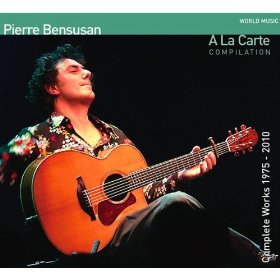
This generously-filled (74-minute) disc is headed Compilation, yet subtitled both as Complete Works 1975-2010 and Best Of. Happily, the mini-press release clarifies the situation for us: yes, it's a "best of" selection, compiled from the internationally acclaimed French-Algerian acoustic guitarist's nine albums recorded since 1975 - all of which are also being re-released now to celebrate his 35-year-long career.
The music on these tracks is unfailingly accomplished (exceedingly so), and presented at a level which allows for easy appreciation by non-guitar-nerds as well as practising musicians and those who more closely understand and follow all the technical stuff and the more esoteric nuances of guitar technique. It's an ideal primer for Pierre's personal vision of a world guitar music, providing some stunning examples of his artistry both in a purely solo capacity and placed in the context of other musicians. Gentle virtuosity, impeccable phrasing, unobtrusive technique, controlled elegance - these are the hallmarks of Pierre's playing, and just to get to Pierre's standard in any one of those areas any average guitar player could count himself more than fortunate.
And then there's the eloquent way Pierre combines a free, relaxed and playful spontaneity with an ultra-careful attention to articulation. His musical style can't be defined - it crosses right through folk, roots, classical, light jazz, French, Arabic, African, Brazilian and most other world musics you can imagine, though with an entirely natural improvisatory quality, an enviable fluidity that carries away any desire for rigid classification.
Around half of the 15 tracks find Pierre with a measure of considerately-managed backing (generally involving flute, bass and exotic percussion), notably the various selections sourced from 1987's Spices and the mid-90s set Wu Wei which provide the lion's share. All of these, plus two other tracks, also feature Pierre's attractive singing (I particularly liked his traditional-folk straight guitar'n'vocal rendition of the anonymous ballad Le Roi Renaud, recorded for his second album in 1976).
Personally, I find the solo items the most compelling; although as is often the case with solo acoustic guitar playing, even though it's very much in the "easy virtuosity" bracket, you still need to be in the right frame of mind to give the music your undivided attention. And notwithstanding the satisfyingly varied nature of the disc's menu, it turns out to be the bonus track - an eight-minute live solo version of Intuite from 2004 - which provides the highlight of the entire disc. But if you've not yet sampled Pierre Bensusan's talent, À La Carte will certainly give you the perfect introduction.
David Kidman January 2010
Bentall has been music making and story telling since 1978. He has released some ten albums and fronted The Legendary Hearts, a double platinum, hit single, Juno winning Canadian success story. A story I'd never heard. This is my first encounter with the man.
As with many artists who gain that level of success, Bentnall has had his time out, holed up in British Columbia running a cattle ranch. An experience credited with a clarified artistic vision. In truth Flesh & Bone travels a familiar musical path that can be lazily tagged Americana – or whatever the Canadian equivalent might be. However his delivery is warm and engaging and more importantly his songs both melodically and lyrically are substantial.
If you need a key to the album listen to The Ballad Of Johnny Hooke, a beautifully realised story ballad with hints of Gordon Lightfoot that perfectly encapsulates the albums core theme of life's cyclical nature and the renewal inherent in that. A fine record.
Steve Morris May 2013
A fine storyteller (take a listen to Face To Face's wedding day portrait of a father taking his daughter down the aisle or Disappearing's poignant account of the loss of childhood innocence), he has a slight dusty tone to his voice and an easy going delivery that, notably on a standout The Inside Passage, a song about his late father, recalls Ricky Ross and Deacon Blue or, on Catch That Train, Bap Kennedy.
Americana shaded pop, he mixes together the upbeat (country rocking Hold My Heart, the zydeco stomping Papa Henry's Boy) with midtempo rollers (a John Prine-like Sending Out A Message) and quieter, reflective ballads (I Never Meant To Make You Cry, She Ran Away) and the combined result is never less than a pleasure to hear.
www.barneybentall.com
www.myspace.com/barneybentall
Mike Davies April 2010
A series of refreshingly different contemporary takes on traditional material from the former lead singer of Old Blind Dogs. Ian's is a distinctive voice, and his consistent and passionate heavily-accented delivery is a joy to hear, although you may not understand every word - at least on first few listens! This is his second solo album, and again he reaps the benefit of accompaniment from a handful of excellent Scottish musicians - Carol Anderson (fiddle), Graeme Stephen (electric & bass guitars), Mark Duff (bouzouki, whistle), Niall Mathewson (keyboard, electric guitar) and Davy Cattanach (percussion) - to boost his own occasional acoustic guitar. Carol's fiddle contributions are a particular delight, atmospheric and full-toned, whether playing fast or slow - sample any of the seven tracks on which she appears, but Bogie's Bonnie Belle provides some of the most riveting moments. The rhythmic impetus provided by Davy's percussion is another of the album's particular joys - often quite jazzy and laid-back, but never lacking in forward drive (great lazy calypso feel to Ian's version of Canadee-I-O for instance). The jazzy ambience extends to the electric guitar work too, providing a great foil for Davy's energetic, nay breathlessly faultless singing (as on Gi'e Me A Lass Wi' A Lump O' Land). This is an invigorating album, worth your attention.
David Kidman
Co. Antrim-based five-piece phenomenon Beoga describe themselves as "a trad band on anabolic steroids", and at times I'm convinced you can hear what that's like! Generally, the band sound is defined by the twin-button-accordion front-line of Damian McKee and Seán Óg Graham (the latter adding guitars, bouzouki, banjo and whistle to the mix from time to time), with Liam Bradley's piano, Niamh Dunne's fiddle and Eamon Murray's award-winning bodhrán and percussion completing the aural picture.
All of which might lead one to expect a reasonably straightforward approach to their music – which would seem to be an accurate enough starting-point at any rate. But, to take the band's self-confessed analogy further, steroids can have some peculiar side-effects, encouraging the taking of strange risks and distorting, or throwing into sometimes unwelcome relief, individual features of the musical texture that might be best left unexplored. By which I mean the band's predilection for indulging in some often quite curious instrumental effects and embellishments (e.g. sprinklings of artificial-sounding keyboard tone, cheesy handclaps and suchlike) that either grate or take the edge off the ebullient and often exhilarating spirit of the playing. A spirit and energy that extends to all elements making up The Incident in fact, including some strong singing from Niamh herself, whose voice proves especially well suited to Paul Kennerley's Mary Danced With Soldiers (one of four songs, all contemporary, that are scattered among the album's eleven tracks). Beoga also bring in rather a lot of guest musicians, who don't always manage to have an entirely positive impact on the band's own playing; the over-blowsy Bottine-Souriante brass on the opening set being a case in point I think.
There are still some good decisions though: the madcap dash of the gear-changes on The Flying Golf Club, the title track and Fly Fishing ring true, and The Bellevue Waltz culminates in a fully-scored (strings and harp) pomp-prog section that just about manages to avoid plunging overboard. The band also has a reputation for cheeky, knowing humour, which extends to the fun sleeve-notes but sometimes gets the better of them on record and some items are perhaps more of an acquired taste, even considering the touches of humour that fleck generously if wildly through the instrumental sets. On The Way, featuring a duet vocal from Ciaran Gribbin (aka Joe Echo), doesn't belong here, and (the carefree Dixieland-klezmer clarinet part aside) neither really does the (admittedly well-managed) cover of Sister Rosetta Tharpe's gospel-turned-Irish Strange Things. I believe the band is still finding their feet in many ways, but as a "difficult third album", The Incident is not staged without considerable pleasures during its often eccentric course.
David Kidman June 2009
An album of quiet anguish and basically unsettled introspection, throughout which Charlie peddles his own brand of gloomy self-questioning, naggingly discontent with the world in general. You could say sometimes, with a measure of justification, that Charlie makes Richard Thompson sound positively cheerful, though in the end that would be as unfair to RT as it is to Charlie. His backing musicians - principally Mark Emerson (violin, viola, accordion) and Tim Harries (bass), both most famed latterly for their work with June Tabor - do little to dispel the air of brooding despondency Charlie conjures up with his mournful voice and softly chiming acoustic guitar, although the sound they make together is curiously attractive albeit in a cool, very subdued and somehow seemingly uninvolved sort of way. I was sometimes reminded of the dour ambience of the English Acoustic Collective too, while scattered throughout the album there are instrumental linking passages (composed by Mark and Tim) that mirror the songs almost too perfectly; in their neurotic charm they recall the later chamber music of Shostakovich or even Bartókian atonality. The CD's stumbling block, even after a few playthroughs, is that I'm still not entirely convinced by some of Charlie's angrily desperate lyrics (although I can appreciate their undetached catharsis). Yet the strange thing is, if Charlie's songs catch me in the right frame of mind they can seem quite inexplicably soothing. An album of contradictions, then, which I still think is worth persisting in getting to know - for if you can spare the time, though it may take longer than many, it will ultimately bring rewards.
David Kidman
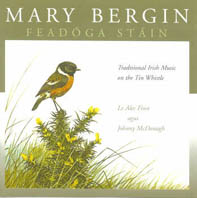
David Kidman
Dan Bern and the IJBC - Fleeting Days (Cooking Vinyl)
Who's been a busy boy then. Barely had the ink dried on the rave reviews for New American Language than along came his Swastika EP and now there's a brand new album, recorded, in another deliberate confrontational stroke, with band whose acronym stands for International Jewish Banking Conspiracy. Being of Lithuanian Jewish descent with relatives who'd suffered the Holocaust first hand, you can safely assume that he's been as ironic as he is provocative.
The music then. With the opening Baby Bye Bye a Springsteenesque acoustic guitar driven number that deals with a departed lover and the warped CD they left behind in remarkably even-tempered fashion, he's turning his gaze more upon relationships than social issues this time round. There's songs about Eva (swapping paradise for the devil with the thighs) and Jane (whose name's on his lips when he wakes up in the morning), I Need You talks about trying to escape the pain of a lost love, while Chain Around My Neck finds him asking to prove he's worthy of a second chance.
Dylan (Superman, I Need You, Fly Away) and Costello (Eva, Crow - sounding like an outtake from This Year's Model) remain the immediate reference points, though early Bruce and Steve Earle can be seen peering over the shoulder on several occasions, setting a musical landscape that straddles all shades of the folk-rock and pop terrain from Bringing It All Back Home through 60s Beatles to 70s punk-pop and contemporary blue collar. Sharp wit characterises many of the songs, most directly so on Graceland, a gospel-clappy boogie that namechecks Paul Simon, Marc Cohn's Walking In Memphis and Elvis in a number that takes a swipe at the cult of King cool and owns up to feeling much more meaning in Okemah, home of Woody Guthrie. Closing with the plaintive Dylanesque Soul, he asks if the subject of the song is going to be lured by the glitter of "the latest pen" and the social rat race or realise that "all the money in the world won't buy back a day of your past." Bern doesn't need to follow his soul, it walks beside him every step of the way.
Mike Davies
Geoff sets out his stall within a few bars of the start of the opener Good Luck Now: he says he wants to "drag klezmer music kicking and screaming back into the bars", which he sure does here. This Vancouver singer-songwriter-accordion player, himself a Jew of eastern European descent, continues the path he began taking with his 2005 album Whiskey Rabbi, whereon he forced an ostensibly uneasy marriage between klezmer (rootsy Romanian-style), sharp and "dirty political" songwriting and the raw energy of punk. Geoff's accompanied on this new set too by Diona Davies (violin) and Wayne Adams (percussion), who assist in focusing his accordionistic eccentricities and provide a constantly brilliant, busy foil for his lyrics – lyrics which both respect and marry the musical traditions from which they take their inspiration. Diona's wonderfully wild playing on The Fiddler Is A Good Woman is both tailor-made and terrific, and the track's fast becoming my most-played of the entire album. It's perhaps on tracks such as the exhortation Weep, Bride, Weep and the cheeky humour of Widow Bride, though, that Geoff provides the clearest illustration of how successfully he captures the rough spirits of both musics, but in truth the energy and chutzpah Geoff generates with his edgy cabaret style of presentation (with distinct shades of the theatricality of Alex Harvey at times, I feel, as on the strident Queen Victoria: yes, the Leonard Cohen number, which is the album's only cover) never lets up, and neither does his fertile imagination. Song To Reconcile is a savage little number voicing the humble accordion player's innermost thoughts while playing for a typical wedding. Traitor Bride shows that Geoff has his thoughtful and less iconoclastic side, while Would It Kill You? plumbs the emotional depths with great economy; in fact, these songs turn out to be among the most passionate (by being understatedly dispassionate?) on the whole album. All told, this CD should ensure Geoff's name travels beyond the Be Good Tanyas track (Light Enough To Travel) that he's already known for authoring. And long before the release of the projected third album in Geoff's planned klezmer trilogy, I trust. An intriguing hotbed of often blinding energy.
David Kidman June 2007
BitterSweet is the first actual CD ever to be recorded by Bob and Gill, even though theirs is a singing partnership of long standing. For nearly half of that 20-year timespan, they've also been the principal organisers of Chippenham Folk Festival, and both play key roles in Devizes Folk Club (which they themselves started in 1992) and within the eight-piece group Tinker's Bag. Their close harmony singing displays an evident strong and sensitive musical bond, with each truly supportive of the other's voice yet also completely naturally allowing the other to shine (or dominate) where necessary for the expression of the song, the effective communication in performance of which is paramount (as it should be).
Bob and Gill present an interesting choice of songs from both within and outwith the tradition, yet unsurprisingly the latter almost always have a strong feel of the traditional. Although both Bob and Gill are highly competent singers in their own right with attractive voices, you may well respond first to the material rather than the singing or performance aspect, for initially the actual delivery of the songs isn't what you notice, simply because it isn't to any significant degree specifically attention-drawing. Except possibly, that is, in the matter of Gill's use of vibrato (more evident on some songs than others, it must be said), which although an integral part of her technique can at times make her tone seem just a little fierce (bitter, perhaps) and thus some listeners may find it takes some getting used to.
But again, first impressions can lead your ears down false trails, and in truth I ended up liking almost all of this CD a lot - and more than I expected to after the initial playthrough. Not least because it introduced me to some absolutely superb songs that I'd not come across before (always a good test!): Suffer Little Children is a curiously effective (and economic) song from the pens of two members of the group Heritage, while John Pullen's Revels Day really does convey the lively atmosphere of the Box (Wiltshire) village custom. Opening the CD, there's a fine driving rendition of John Prosser's stirring anthem England's Glory that proves more than a match (sorry!) for any rival version in my book (!), which contrasts with the broody Calum More (by Andy Mitchel), another fine composition on the time-honoured theme of a woman's extraordinary suffering within an ordinary existence. I also really liked Bob's atmospheric take on Chris Leslie's powerful Winter Man. Amongst the traditional fare, Gill's solo tour-de-force is the awesome ballad Brown Girl, while Bob turns in a notably well-poised rendition of Fair Flora; while jointly their May Dew is a joyous pleasure to discover, as are Gay Green Gown (which it turns out Bob and Gill got from the singing of our own Graham & Eileen Pratt), and the duo's creative harmonising and unusual melodic twists on Tom's Gone To Hilo. Finally, Bob's mother Barbara is remembered in performances of two of her songs, the beautiful, if anguished Fisher Lad Of Whitby and her lovely, sweet setting of I Wandered By A Brook-side, while the CD closes with the reflective, definitively bittersweet Alan Bell Song Of Time, a chanson-like creation written in honour of both of Bob's parents and here blessed with an aptly plangent klezmer-like arrangement.
Which leads me to my final observation: that Bob and Gill have taken on board a small coterie of musical collaborators who really complement their own performances (this seems to be a hallmark of all WildGoose recordings, where the label's boss and producer Doug Bailey seems to have the knack of showing the featured artistes off to their best advantage). In this case, it's the stalwarts Keith Kendrick (concertinas), Pete Harris (bass guitar), Anahata (cello), Paul Sartin (fiddle, oboe) and Jo Veal (clarinet) who do the honours. A very attractive CD, attractively packaged.
www.wildgoose.co.uk
www.bobandgillberry.co.uk
David Kidman October 2006
Mike may have been regarded as one of the UK's most established rock'n'rollers, but many of his finest recordings have been unavailable for some time, and this two-disc anthology trawls into its wide net not only all of these but many later rarities from his mid-1970s comeback years. Personally, I can take or leave some of the later recordings, for they seem almost to verge on self-parody or err on the side of pastiche even, but I'd willingly pay the price of the whole set just to have the first disc alone. So what if some of the early cuts, like My Baby Doll, are very much ersatz-Buddy Holly - but Mike's voice had such an uncanny quality that it was at times almost a genuine dead ringer for Buddy's, and hey, I guess it doesn't matter any more (sorry!). Disc One brings together all of those highly-collectable early sides, which were masterminded and produced by the maverick Joe Meek. They invariably embody that distinctive, other-worldly aural signature that's so hard to ignore - the heavy reverb, the jangling, tinkling organ, the strident beat, sometimes also the heavenly backing choir, all much imitated but never really equalled. Truly timeless recordings like Tribute To Buddy Holly (hard to believe it attracted controversy at the time for being allegedly insensitive due to its "morbidity" and its over-close resemblance to Buddy himself!), Don't You Think It's Time, My Little Baby and It's Just A Matter Of Time. Not always as dramatically convincing as John Leyton perhaps, but with more R&R cred. A selection of Mike's post-Meek 60s recordings follows; anachronistic though some of them may sound in the context of the beat-boom years, they're respectable enough to more than pass muster, even the primitive sides cut with the Innocents (On My Mind and This Little Girl). Sadly, though, Mike's resourceful - if unsuccessful - 60s covers of material by writers such as Neil Diamond and John Sebastian are absent from this collection. Instead, Disc One is rounded off with a clutch of energetic 1976-vintage Holly covers (which have an attractive drive and plenty of interest in the glam-ish production) and the 1979 side Stay Close To Me. Disc Two starts well with Mike's innovative 1975 slow-Southern-boogie version of Don't Be Cruel, then comes his 1976 remake of Tribute (which charted in Holland and Germany), after which we get a reasonable selection from the rather more uneven late-70s material (thankfully not moving forward enough to encompass the post-acting-career Sunshine Of Your Smile and subsequent, similarly bland 80s hits or Mike's present-day revival-show work). The insert notes are particularly strong on the early years but fall short thereafter, and no explanation is offered for the omissions. Still, as a means of acquiring some valuable and hitherto-unavailable-on-CD recordings, this is a set worth acquiring.
www.mikeberry.net
www.sanctuaryrecordsgroup.com
David Kidman
Swiftly following on from her recent solo album, the freckle-faced Texan Korean teams up with the Canadian dobro player for an album of covers by their, often, unsung heroes. I'd be surprised if many out there have heard of Austin singer-songwriter Jeff Talmadge, but he provides the title track opener, a country blues to which Soo brings a suitably sultry and torched heart passion.
Out of context, the other name that may prove unfamiliar is Bob Carpenter, but as well as solo artist he's also a veteran of the Nitty Gritty Dirt Band, so it's no surprise to find his Every Other Road an easy country waltzer. The other writers are much better known, as Soo, clear voiced, vulnerable yet strong, takes hushed lead on Jane Siberry's You Don't Need, rides the blues on Butch Hancock's Boxcars and bares her old school Americana heart to simple but beguiling effect on David Halley's Ain't Gonna Make You Mine, Betty Elders' Light In Your Window and Guy Clark's Dublin Blues.
They take turns on the verses and share chorus harmonies for Blaze Foley's goodtime Big Cheeseburgers And Good French Fries and Cox handles lead duties for a scratchily raw cover of Loudon Wainwright's Be Careful There's A Baby In The House. Let's just say it's good that his playing is more prominently featured than his singing.
The remaining cover has a particularly interesting personal history. Soo grew up listening to the music of Texans like Doug Sahm who was a friend of Cox and spent a couple of years in the 80s living on Vancouver island after paying a visit. It was here that the idea of the Texas Tornados was born, with Cox being road manager for the tour that led to their formation. It was also on the island that Sahm wrote Louis Riel, a song about the Canadian folk hero, and which now finds its place among this collection, Cox fingerpicking while Soo strums and sings.
It's a modest, unassuming album but that just enhances its charm and leaves you hoping they have a longer list of favourites to get round to in the future.
www.acrosstheborderline.org
www.bettysoo.com
www.dougcox.org
Mike Davies September 2011
A Korean American from Texas, Soo walks the acceptable side of Nashville's Americana line, cranking up the swaggery bar room blues for Never Knew No Love and Get Clean and plying keening country heartache on pretty much everything else. Don't take that as a put down though.
Produced by Gurf Morlix, who inevitably contributes some scorching electric guitar and weeping pedal steel, there's a sweet ache and vulnerability to numbers like Just Another Lover, Whisper My Name and the poignant Never The Pretty Girl, a song that really should find its way into the repertoire of some of country's big hitters.
And, just so you don't think it's all tears and break-ups, the Southern bluesy organ and guitar groove Who Knows captures the uncertainty and resignation of those hit by disasters of one form or another as she sings "who knows if there will be a place to come home to".
Nodding to her heritage, she closes the album with a Hank Williams number, an acoustic, soulful cover of Lonesome Whistle that perfectly nails the song's despairing beauty. The album probably won't reach that many ears, but those it does touch will be grateful for the hearing.
Mike Davies July 2011
This is an abundantly scintillating (if perhaps mildly confusing) offering from the nifty Shoogle stable/label, on which the self-styled sisterhood trio of Heather Macleod, Lindsey Black and Kaela Rowan get it on and lay down live in one take in the studio, accompanied by David Donnelly (guitar) and James Mackintosh (percussive thingys), a really canny cocktail of songs that takes in swing, jazz, folk, Americana and some contemporary songwriting from their own pens.
It's precisely that mercurial sensibility, that sense of not being able to make up their mind where to settle, that's the confusing aspect of this release. But once you've gotten over that slightly disconcerting constant gear-changing, you can revel in the sheer vibrancy of the performances, the glorious immediacy of the music-making, the exceptional vocal arrangements and the tight-yet-responsive supporting playing. Yes, at times it is like being at an impromptu session where the participants are good mates just getting together to run through a bunch of songs they happen to love - and who cares whether the next one's gonna be a gospel number, a thoughtful new personal creation or even a beer commercial!
On some tracks (like the delectably carefree Sugarfoot Rag and Leadbelly's cowboy song) the lasses sing tight and swing like crazy, coming on like the Andrews Sisters you might say; they also bring their stylish brand of seductiveness to Man Of Many Valentines, a joint composition by Heather and Karine Polwart, and Kaela's old-fashioned Latin-tinged romance The Way You Know You Do. Then, as emotional counterweights to those fluffy confections, we're treated to some significantly fine originals in what I might call a pensive-Roches mould (Lindsey's Draw The Line and Fine Lines, David's 1,000 Miles and Kaela's Apocalypse) which are complemented by Heather's smouldering, jazzy ode to Old Mother Earth. While last but not least, the Bevvy Sisters' special take on gospel harmony is both wholly enchanting and eminently persuasive (check out Rock My Soul, on which they even manage to persuade their guitarist to sing, and Oh Mary Don't You Weep), and they also "do the good Tanyas" for a spirited cover of The Littlest Birds.
Cheeky or wot? I'll leave it up to you to decide; but it's all so wonderfully fresh and spontaneous-sounding (and remains thus on each subsequent play, which is a big advantage!) and I've grown to really love this record.
www.myspace.com/thebevvysisters
David Kidman July 2010
Eric describes this record as "an album I have been working on for most of my life", yet it's hard to believe that he's never before gotten around to recording his own personal takes on repertoire standards like Candy Man, Cocaine Blues, Stagger Lee and Sittin' On Top Of The World, songs he views as part of his DNA. But now he feels ready to do just that as he celebrates his 60th birthday with this latest collection, recorded over the past five years.
Here, largely alone with just his trusty vintage guitars for company, Eric so effortlessly pulls off the challenging trick of making the songs truly his own while still honouring the tradition. The very deliberate choice of individual accompanying instrument for each song also imbues each song with its own special character, and these are inspirational readings where the material comes up real fresh. The blues evergreen Come Back Baby is given a swampy treatment quite different from Eric's earlier recording of the song, makes a persuasive companion piece to the standards.
The disc concludes with what Eric regards as "children of the older songs": four self-penned numbers where he's accompanied intimately and sparingly by friends; that's both a fitting and thoroughly companionable, and typically modest, sharing gesture.
David Kidman October 2011
As the title implies, it uses as its jumping-off-point a kind of tribute-cum-concept: in this case to the legendary, inspirational Delta bluesman Booker (Bukka) White (who died in 1977). It all stems from an after-gig encounter with a fan, which resulted in Eric holding, and later getting to play, the very guitar (a 1930s-vintage Resophonic National) that had belonged to Booker himself. As Eric typically humbly puts it: "I felt like this guitar finding its way to me was a signal that I had journeyed far enough to be able to make an honest tribute to the music of my heroes".
So the journey he undertakes for this album begins with the half-spoken, half-sung title number, where, accompanying himself on that hallowed guitar, Eric gives us his honest and affectionate response to the stories locked within the instrument. The sheer spiritual intensity of the experience proved the well of inspiration from which sprang a whole series of new songs from Eric's pen. It's entirely indicative of the endemic skill of his invention that while no individual song is either a direct slavish copy, or in any respect a blindingly obvious homage to Booker, Eric manages to convey the sheer depth of the spiritual bond that connects him to the Delta blues tradition, his creative response to it and his unerring ability to reinterpret it for the modern era. Eric does this by putting himself in position of his heroes, but in a contemporary context, to "create songs that could have been part of their repertoire and could have come from their own experience". Thus, A-Z Blues is a latter-day troubadour's travelogue, the whimsical Turning Pages is a personal ode to the joys of reading, and A Good Woman posits Leadbelly's musical response to the advice of a wise uncle, while With My Maker I Am One (an atmospheric standout track) reflects tellingly on the dichotomy between the sacred and the secular, much in the declarative way that Muddy Waters might've done. Rocking Chair is a fanciful extension of a childhood memory where Eric was mesmerised by hearing Fats Domino's Walking Down To New Orleans, while Sunrise Blues both encapsulates and epitomises the delta experience in a perfect sepia-tinted flashback. Another particularly strong track, Walking Blues Again, brilliantly taps into the righteous anger that many of Eric's heroes must have felt but were reluctant to voice.
In addition to the dozen excellent brand new songs (and one brief "guitar poem") on this latest CD, Eric also turns in a brace of magnificent covers: a powerful take on the folksong Wayfaring Stranger characterised by a smoulderingly understated empathic passion, and a knowingly phrased account of Blind Willie Johnson's Nobody's Fault But Mine. The latter is one of nine tracks where Eric enjoys the support of Grant Dermody's exceptional harmonica playing, which also notably imparts a suitably steamy ambience to Flood Water, Eric's fine account of the catastrophic Mississippi flood of 1926/27.
The additional dimension, that extra-deep level of "connection" that has inspired and driven Eric to create this latest bunch of songs, has got to've led to him producing his career-best thus far, for it casts a spell that's impossible to ignore.
David Kidman April 2010
Recorded in Nashville, Get Onboard has been on the production line since May 2007 and Bibb says that it has been one of the most exciting projects of his career. He hits the nail on the head when he says "It's a further exploration into the place where blues meets gospel and soul". He uses the best session musicians around as well as special guests Bonnie Raitt and Ruthie Foster. The soulful and spiritual Spirit I Am is a great opener and Bibb's sweet voice will smother you in honey. The Promised Land is bluesy and bouncy and New Beale Street Blues is a jazzy, New Orleans blues. The latter is another tribute to the great city that is still recovering from Katrina. The eponymous title track has a vocal that is so sweet and so clear. It also has great harmonies and he has more soul than heaven itself. If Our Hearts Ain't In It has Bonnie Raitt on slide guitar and a big production to match. All I can say about Pockets is that it is an Eric Bibb song if there could ever be one. The voice, the gentle approach and the understated instrumentation are his hallmarks.
The gentle acoustic vibes continue with River Blues, which is not, as the title suggests, a blues in the truest meaning of the word. This is followed by Deep In My Soul and that's where he has rested. Folk, country, gospel it covers so much. Conversation is a slow, precise and heartfelt blues duet with Ruthie Foster and the understated brilliance of God's Kingdom has, as the title suggests, Gospel overtones Step By Step stays much in the same vein and the final track, Stayed On Freedom, lifts the pace a little with a country blues. This arrangement of the Civil Rights anthem, which in turn was adapted from a traditional spiritual, hits the spot Eric, and his producer Glen Scott, may just have unleashed a future classic.
David Blue April 2008
The word legend is used far too often these days but Eric Bibb is a well on his way to becoming one. His blend of tender blues, folk and roots music has won him fans all over the planet and I am delighted at getting a chance to review his latest offering, Diamond Days. He starts, complete with authentic crackles, with Tall Cotton and immediately his velvet voice just cradles your senses and by the time that you get to the end of Still Livin' On you will wonder where the last 44 minutes or so have gone. Tall Cotton has a strong African folk influence with Kahanga 'Master Vumbi' Dekula on Hi-life guitar a standout. Destiny Blues is self-penned, as are 11 of the 12 tracks on the album, and is a quirky acoustic blues. Jenny Bohman is quite a surprise on this as it builds up very well. Eric gets a groove on for Shine On and sets up an all round, classy song. This is personified by Bibb's silky vocal and Bohman's short harp bursts - a highlight. So Glad is spiritual in its composition and its delivery and the plain and simple technique used is so effective. This is followed by the bluesy, bouncy Storybook Hero before Eric tells it how it is on the eponymous title track. This tale of life's highs and lows is again delivered in Eric's gentle style and sends out a strong message.
There's some more mild country style blues on Dr. Shine and this is another fine example of Eric's storytelling ability. The addition of Jim Shearer on tuba gives it a New Orleans feel. Heading Home has a contemporary feel but still gives you that comforting glow with Mats Oberg turning in some Larry Adler style harmonica. You get a feel of what an Eric Bibb concert would be like via the live recording of In My Fathers House. This is a raunchy, urban blues and shows him to be a superb live performer - I'm sorry that I missed him on his recent trip to Scotland - with the band giving it some real acoustic stick. Things are slowed down again for Forgiveness Is Gold with its anti-war message delivered by a velvet glove. If there is to be a definitive Eric Bibb song on this album then, ironically, it is the Bob Dylan written Buckets Of Rain. This is a country blues with just Eric on vocal and the superb Martin Simpson on acoustic guitar - probably the highlight of the album. The album closes with Still Livin' On and he finishes in the same vein that he has produced throughout the album. Gentle country blues is the order of the day as he pays tribute to many of his heroes including John Lee Hooker, Reverend Gary Davis and Pop Staples, amongst others. He finishes with the authentic crackles too! There's two added surprises in the form of a lovely version of the traditional Worried Man Blues and a video of Eric in his favourite Parisian guitar shop where he treats us to three impromptu songs on a 1930s Gibson acoustic. I have to give a mention to the fact that Eric gives us the guitar chords to some of the songs on the album sleeve just to give us mortals the chance of emulating the great man. I'm off to dust down the old guitar for one last shot at stardom!
David Blue October 2006
Eric Bibb - Friends (Manhaton)
David Kidman
A Family Affair is very much a spiritual journey for Eric, a venture on which he's supported by his father Leon, who avows in his insert-note that "one of my deepest pleasures is sharing the concert stage with my son". This much shows, for this is a lovingly presented sequence of songs that mean a lot to Eric. Memories, influences, passions, all combine to make this an affecting emotional journey. Songs by Pete Seeger and Leadbelly make for invigorating openers, and the ensuing sparse holler-style performance of Look Over Yonder is quite stunning in its impact. The two musicians' mutual pride in each other's considerable accomplishments is demonstrated particularly in Eric's own composition Love Like A Good Song, while Eric himself takes centre stage for no less than three out of the twelve cuts including an impressive cross-cultural reinterpretation of Let Me Fly. The African connection is further reinforced on the next track, Leon's recitation of a Langston Hughes poem against the virtuoso kora playing of guest Mamadou Diabate. Mellow instrumental exotica are also present on the following There's A River, symbolising the eternal life force that forms such a positive and dominant element in Eric's work. I can't quite get on with Cyndee Peters' vocal contribution to Balm In Gilead though; in fact, maybe the final few tracks (which include an unexpectedly successful piano-accompanied version of Fields Of Gold) lend an aura of over-contentment to the album which gives a more lasting impression of complacency than perhaps was intended and having the effect of softening somewhat the more awesome impact of the earlier cuts, but make no mistake, this is still a highly satisfying (if personal) collaboration.
David Kidman
A native of East Pennsylvania, Craig has for some 25 years been regarded as a songwriters songwriter, a role which was facilitated by his decision to move to Nashville in the early 1980s; for a time he was a member of the trio Schuyler, Knobloch & Bickhardt, but it was the honorary placement of his songs on CDs by such luminaries as Alison Krauss, Johnny Cash, Martina McBride, Iain Matthews, Willie Nelson, The Judds, B.B. King and Ray Charles that ensured his status, and to date hes chalked up some 800 songs! In 2006 Craig returned to the concert stage and to his home state, and for this, his latest (second) CD in his own right, he trawls right back over his songbook to land unerringly on choice material of varying vintage. These include reworkings of songs famous in versions by others, and a sensitive revisit of his celebrated weepie This Old House (written in the 80s), and even a more than passable take on the traditional Lord Franklin.
The predominant mode is easy-listen, warm country-folk, couched in spacious, mellow and companionable settings that reflect Craigs seemingly effortless craftsmanship. The icing on the cake is the presence of a galaxy of excellent musicians and singers - selectively employed, naturally - including among their ranks Byron House (bass), Lloyd Maines (dobro), Andy Leftwich (fiddle), Carol Rabinowitz (cello) and Catherine Styron (piano), with guest appearances by Tim OBrien, Rusty Young, Darrell Scott, Janis Ian, Terri Hendrix, Maura OConnell and Beth Nielsen Chapman. Impressive, huh? - well yes, but somehow the whole is less than the sum of its parts, for altho each individual track is pleasing and passes the ear most agreeably (for Craig is a sufficiently persuasive interpreter of his own material and accompanies himself elegantly) thats probably all there is to it. The most memorable songs are the wry opener Life With The Sound Turned Down, the gentle devotional Prayers For You, the plaintive and more richly harmonised Where In The World, the evocative title number (with its melodic hint of From Clare To Here) and the foot-tapper If He Came Back Again.
Its all admirably intimate, like listening to a not over-close friend reminiscing and sharing minor confidences, but in the final analysis arguably a touch too contentedly soft-edged (even within a mainstream context) to make you want to spend too long in Craigs company.
David Kidman August 2009
No, John doesn't cover Roy Harper's McGoohan's Blues on this set, and he is definitely an individual and "not a number" (there is only one of him!), but he does deliver a completely different experience on this, his first album. For in complete contrast to his second, Water And Wine, which I reviewed a few months back for NetRhythms, The Prisoner is an almost completely pared-down acoustic offering, with only an occasional bluesy piano (courtesy of Richard Metcalfe) to boost Jon's own guitar. The title track leads off very much in a Bowie-chansonnier mode, suitably impassioned and bleakly intense; after which Jon lightens up a little in terms of lyric content. To be honest, I find this set hard going in listening terms, and Jon's vocal delivery is quite often out of tune and it's sometimes wearisome to get through a whole album full. There's no doubting Jon's power and conviction, but it seems there isn't always the substance to match the power here.
David Kidman
Big Blue Hearts - Here Come Those Dreams Again (Eagle Eye)
Once signed to Geffen, the San Fraciscan four piece's debut album drew comparisons to the Evs and Orbison and that 60s twangy pop is certainly in evidence on this sophomore outing, a collection of countrified pop that sits easily alongside the likes of Chris Isaak and the Mavericks. No surprise they've cropped up on the soundtracks to such TV shows as The O.C. and One Tree Hill.
It's not a world shattering album (and I could live without the uptempo rock n rolling Don't Mind Messin'), but it does come packed with easy on the ear melodies, Scott Minchk's silvery guitar licks and David Fisher's dreamy croon put to the service of generally upbeat romantic songs. Ordinary People, the title track and the Orbisonesque You Can't Lose What You Never Had are the real keepers, but it'll all go down nicely next time you find yourself with a highway and an open top car to spare.
Mike Davies
Sometimes you just need to rock, throw back the sofa, strike a few poses; in the words of Mr. Todd 'Get the electric house rocking with your dirty juice'. Um, well, after those bon mots, it's clearly an uphill job to sell you this minor gem. It may also point up the reason why Big Head and the boys are massive in the US and hardly a blip in the UK. We've simply forgotten that rock can actually be damned good stuff; that it's not all Spinal Tap.
Despite the lyrical quote above - from album opener Dirty Juice which comes on like a non-cartoon ZZ Top - is far from simply salacious rock. Indeed, to short circuit the description, it's the album Bob Seger might make should he choose to enter the new century. Todd's voice has a similar burr; a bluesy edge that adds feel to even the slightest of lyrics and The Monsters have the capacity to move from Main Street to Katmandu at short notice tho' the rhythm section are seemingly capable of a heartier punch that the Silver Bullet Band's.
So, nil points for boundary breaking but a high five for delivering an album that proves old fashioned mainstream US rock to be in the fittest of health.
Steve Morris
Big House - Woodstock Nation (Dead Reckoning)
Well, I could just say buy this one now and leave it at that, but I won't of course. Woodstock Nation really pushed my buttons. It's a tour de force and on first listening there's nothing diverse, dark or dignified about it, just straight up, 'pass the Jack Daniels and turn up the volume' country rock with a touch of soul and blues. Despite the title, the only feeling of nostalgia you get is a not-so-secret wish for years past when those Southern rockers first stratted their stuff, J.J. Cale breezed out of Tulsa and Wilson Pickett and Steve Cropper Staxed it to us right in the solar plexus.
What Woodstock Nation serves up is a refreshingly clean, high-octane brew of songs to dance your troubles away to. Lead singer and guitarist Monty Byrom says, "We recorded live in the studio. Then we do a thing called 'underdubbing'. We go in and play everything live, then take stuff off, to keep in sparse and simple." It works. Soulful vocals, lyrically edgy songs, tight percussion and instrumentation; all are given the oxygen they need.
I have to mention the 'N' word. Big House came to Nashville from Bakersfield, California in 1995. There are great changes in Nashville now from a new and nonconformist generation of artists, signed by maverick indie labels with fresh ears and attitude, who must be worrying the bejesus out of the purists. It was thinking on that, on the album's second listening, when I realised that there is so much more going on in Woodstock Nation. Buck These Haggard Blues (Merle Haggard's another renegade Bakersfield 'boy') , the reflective title track Woodstock Nation; even the hint of deeper things on the spoken intro to the opening track, mourn the vision which once was Woodstock itself. This is one totally awesome album which transcends the bland mediocrity and sugary schmaltz so often served up on the country charts. I'll now be looking out for their two previous MCA albums, Big House and Travelin' Kind. Wonderful!
Southern England based blues rockers Big Road have been around for twenty years or so and have honed themselves into a very tight unit indeed. Their music rarely gets past the 1970s but that should not put you off as they can flit between the bluesy pub rock of the opener, No Other Baby and the Barclay James Harvest style folk rock of Butterfly. The latter of these is one of a few self penned songs amongst many covers of classic and not so classic blues and rock. Sandwiched between these two are the chugging blues of Howlin' Wolf's Howlin' For My Darling and the earthy Do Better Than You're Doin'. They don't try to be Howlin' Wolf and that is a good thing as many have tried and failed. The strong guitar work here makes this a good version. They play a couple of Bo Diddley songs in Who Do You Love? And I Can Tell This. The former is classic Diddley and the band show that this type of chugging song is their forte. The latter is played in a 60s R&B style; so much so that you would not know that it is a Bo Diddley song.
Steve Brayne introduces the harmonica for the first time on Help Me and this is very much a 60s British blues song, harking back to when the band started out. This Is Hip is a well known John Lee Hooker song and it is always a risk taking on one of the great man's tunes. Their blues/rock treatment just doesn't quite work but there are not many who can give a different slant to John Lee Hooker. Play With Fire is so obviously a Rolling Stones song, even if you didn't know that the songwriting pair of Nanker and Phelge were pseudonyms for the Stones in their early days. This accomplished performance is a good version and probably the highlight of the album. They turn to Howlin' Wolf again for Commit A Crime. Again, it's very difficult to cover The Wolf but they've done well this time and this track has the best vocal on offer. Love With A Feeling is a slow Chicago blues with burgeoning bass from Mo Whitfield and shows that they can turn out a good blues when they want to - a highlight. The album closes with the classic All Along The Watchtower and they've tried to go down the Hendrix road rather than the original Dylan way. This is one of my all time favourite songs and if you haven't heard the Hendrix version first then you would be raving about this version - that is high praise, believe me.
David Blue
The Bills originally came together as the Bill Hilly Band back in 1996; they're another of those lively, vibrant and hugely entertaining outfits for which Canada's renowned, putting across their chosen brand of music with a high level of exuberant, upfront energy. Each of the five players making up the Bills (needless to say, none of them named Bill!) is a virtuoso musician in the acoustic roots field, and gets plenty of opportunity to demonstrate his talent on a variety of indigenous musical stylings from bluegrass to cajun, oldtime to Parisian café swing, gypsy and klezmer to ceilidh-dance. Too much variety? - well, that might be your verdict, but everything they tackle is done with absolute authority and authenticity. Nearly all the cuts are own-compositions by band members, and they clearly have considerable writing talent within their ranks to complement their prowess as musicians. Mandolinist Marc Atkinson and guitarist/lead vocalist Chris Frye contribute the lion's share of the compositions, with a couple of instrumentals by classically-trained fiddle/accordion/piano wiz Adrian Dolan. The Bills aren't afraid to throw in ideas from other musical disciplines along the way - Lay Down cheekily interpolates the main theme from the finale of Shostakovich's 2nd piano trio (honestly!), while the opening cut Overture is very much in the mould of those appetite-whetter pieces that you used to find on musicals and film soundtracks where they cobble together the main themes from the show to come. They also turn in a neat chamber-swing rendition of Hoagy Carmichael's Stardust, and throw you off kilter with a distinctly Tanglefoot-like acappella stomper of stirring maritime skulduggery Bamfield's John Vanden (with shades of Stan Rogers' Barrett's Privateers too, methinks!) and a fun slice of nonsense-Français Oeil Au Beurre Noir (set to a frenetic breakdance breakdown tempo), before finally cooling off with a delicate piece of solo fingerpicking (The Walk Home). Many of the tracks take you on a whirlwind journey through copious musical reference points in the course of three or four minutes: Nowhere To Be starts off pure Cajun, then veers into calypso shuffle, whereas the Cambridge Set struts out as pure Scottish-ceilidh then drives along into feisty Cape Breton reel territory. The Bills' freewheeling inventiveness and supreme confidence seems to know no bounds and respect no boundaries and, as you can hear, they sure are having loadsa fun too - as you will listening to this disc.
David Kidman
"I find myself back in a more hopeful place", the American singer-songwriter says of a collection that was crafted while he was holed up in an airstream trailer in the mountains of California.
Bingham explains, "Up there, it was totally isolated. No phones, no noise, no lights. At night the only thing you'd hear is the bugs and the coyotes. It's lonely when you get back up in there and there's nobody around, but for me, I kind of grew up that way in the middle of nowhere. Since I've started touring, I'm surrounded by people all the time, so getting back to the roots of everything, that's really where I seem to find stuff that's meaningful when I'm writing songs."
"My mother drank herself to death, and my father shot himself. I was also going through a huge transition with the band - we were breaking up - and I felt so lost playing with different musicians for the first time in years." This time out he deals with his demons more assertively, a philosophical shift encapsulated on the tracks 'Radio', and 'Hands of Time', both of which find Bingham resolving to stay strong. 'Broken-Hearted Tattoos' is a wistful waltz for an unborn child, the singer imagining what kind of parent he'll become, while on the title track he declares, "I don't fear nothin' except for myself/So I'm gonna go out and raise me some hell."
Sonically, Fear and Saturday Night has pure Rock 'n' Roll attitude and a folkie heart coursing through its veins. Flanked by crack players like Daniel Sproul and Jedd Hughes on guitars, and Chris Joyner on Hammond organ, piano and Wurlitzer, it makes a mighty noise, its spiritual uplift and Bingham's grainy vocal delivery resonating with the ghosts of Bruce Springsteen and Steve Earle, touchstones and kindreds whose sincerity and everyman poeticism he shares.
Bingham, a native of New Mexico, grew up in Texas and, as a teenager, juggled playing guitar with riding bulls on the rodeo circuit. Writing became a cathartic conduit for the torment of his wretched upbringing. Those who heard his songs were deeply affected by them, and pretty soon he was trading the peripatetic life of a cowboy for the peripatetic life of a musician. His first albums were the self-released Wishbone Saloon and Dead Horses, after which Lost Highway Records (Universal) signed him up. Former Black Crowes guitarist Marc Ford produced his major label debut, Mescalito, which slayed the critics. Texas Music Magazine reckoned he talked and sang "with a whisky-and-cigarette throat that screams hard living". Roadhouse Sun followed, before Bingham collaborated with T Bone Burnett on the soundtrack for the 2009 movie, Crazy Heart, co-penning and performing the Oscar and Golden Globe Award-winning 'The Weary Kind'. He was feted with an Americana Music Association accolade as artist of the year in 2010, and in the same year issued Junky Star - his most successful record yet - with his group, The Dead Horses. A lot of peopled didn't realize when that Oscar stuff was going on and Junky Star was released, he was dealing with the loss of his parents.
It's a loss that still haunts Bingham, but rather than be defined by it, he wants to defeat it, to emerge form it a better and more blessed man and artist - something he does with grit, grace and considerable beauty on Fear and Saturday Night.
www.binghammusic.com
www.facebook.com/ryanbingham
Two years ago, the Oscar winning Texan singer-songwriter released Junky Star, an album which, like its predecessors, leant on such influences as Dylan, Springsteen, Townes Van Zandt and Steve Earle, to whom he's regularly compared. It was exactly what the fans would have expected, a collection of dusty Americana. God knows what their initial reaction was to this, then.
Opening number Beg For Broken Legs serves warning that things might be a tad noisier this time around with Bingham's voice a throatier, deeper, pebble-gargling instrument and heavy rifffing guitars snarling around the midsection of the song. The acoustic intro to six minute second track Western Shore might make you breathe easier, but then the damn thing turns into a tempest of electric guitar, bass, fiddle, drums and keys. There's plenty of this. Guess Who's Knocking's a swamp of distortion and heavy, grinding riffs, Heart Of Rhythm is heavy southern blues rock n roll and Keep It Together's another devil howling in the wilderness blues that comes on like an Americana Led Zeppelin.
He does have mercy on more sensitive ears, though. The Bruce-like Flower Bomb offers early rumbling acoustic respite, No Help From God is a six minute country blues moan with brushed snares and both The Road I'm On and Never Ending Show serve reminder that he can still turn out staple alt-country rockers with twanging guitars.
The most powerful number, however, is the eight minute Rising Of The Ghetto, a tribal rhythm call to urban revolution against 'the fellows who try to make it hard, to live, around here' and see those that live there as just war fodder.
A progression on rather than a deviation from his sound, it's an album fuelled by rage at and defiance of a system designed to keep you down ("It's me motherfucker, I'm knocking on the door,' he sings on Guess Who's Knocking). but, just to let you know he's still in touch with his roots, the album winds up with To Deep To Fill, a throaty acoustic blues invested with the spirit of Woody Guthrie, right down to lyrics that run 'I'm going to join the protest, I'm going to stand up and sing this time once again, stand up and be a man. cause this land was made for you and me.' Tomorrowland, it's a new dawn.
Mike Davies December 2012
Bingham's first album since winning an Oscar for The Weary Kind (included on the 'international' version as a bonus track) was always going to be subject to more scrutiny than previous releases. But if he felt any pressure to satisfy expectations or go big there's no indication among this 12 track (the) collection of underplayed bone weary and dust coated America that draws its influences from the touchstones of Young, Dylan, Springsteen and Van Zandt.
Produced (and pared to basics) by T Bone Burnett who co-wrote and played on the Crazy Heart award winner, it's essentially business as usual as Bingham and his well seasoned band trawl though gravelly tales of the economic meltdown, blood, tears and lost soul road songs.
Opening track The Poet lays out his cards as a troubadour of travails, others and his own, before the first of the Dylan echoes kicks in with The Wandering (although the mouth organ intro is straight out of Heart Of Gold), resurfacing on the times need to be a changing jump blues Direction Of The Wind and the slow sway two step Self-Righteous Wall.
From Bob to Bruce, and that's drought ravaged Nebraskan fields he's wandering through on burned heart love song Yesterday's Blues, Lay My Head On The Rail, and the defiant acoustic strum Depression.
It's not all about the two Bs, though; the bluesy Strange Feeling In The Air has a Waits meets Waylon growl while equally bluesy six minute closer All Choked Up Again suggests John Prine may be on his playlist too.
"I think I just killed a man", he sings there and murder looms large too on the title track's plaintive tale of a farmer driven to desperation and Hallelujah, sung by a murdered man caught in a lonely limbo; neither are exactly big on faith in a benevolent God. Not, generally speaking, an album veined with hope and affirmation but at least one that stares defiantly into the storm, those who've claimed the Oscar win's over-hyped him may want to eat their words when next year's Grammy nominations are announced.
www.binghammusic.com
www.myspace.com/ryanbingham
Mike Davies September 2010

Day Is Done opens on a deceptively restrained croak before raging guitars and muscular drums kick in and haul it down to the swamp for a night on the tiles, then it's on to the Earle- shuffling, harmonica blowing Dylan's Hard Rain, the mandolin stomping Tell My Mother I Miss Her So and the burning, gospel-infused, guitar wailing Bluebird.
Snake Eyes may strip it back to a lone acoustic guitar and cracked voice and Rollin' Highway Blues conjure thoughts of Townes, but the dominant mood here is cranked up and electric, swaggering through Endless Ways, marching down the highway of the political themed Hey Hey Hurray and the hard, almost Zeppelin heavy Change Is. Not for the musically nervous, but if you like your bourbon straight from the still, then this will keep your glass flowing.
www.binghammusic.com
www.myspace.com/ryanbingham
Mike Davies August 2009
Escaping from a tough, West Texas ranchland background, Bingham grew up early. He learned guitar in a small Mexican border town and traveled the rodeo circuit riding bulls. Putting out a couple of self-released albums along the way, he eventually wound up in Austin, where he was taken in by the cowboy literati and mentored by the likes of Joe Ely and Patty Griffin.
This, his major label debut, is a powerfully haunting work of pure Texas rock and roll. Most immediate stand-out is probably 'Bread & Water', a slide-guitar driven stomp of pedal-to-the-metal boogie. Elsewhere, there's steely shuffles and tunesome laments, plangent stuff of dirt and dust writ on the hoof and sung on the fly.
"I've been fighting all night with the dogs in the alley looking for a bone to eat, starving to death," he sings on 'Ever Wonder Why', a track you suspect is somehow key. "Everybody's troubled with your hustle and your bustle, your payment on your house is late. If I ever have a problem like that, I guess I'll be in pretty good shape. You can kiss my ass goodbye!"
Wiry, whiskey'd, weathered and worn, Bingham is wise beyond his years. A coolly hatted-and-booted box of bones. Yup, tender and wearied, classic and timeless, this is a great album. Fourteen rough and bruised songs, wrung from the heart with an ache and a drawl. The 'real deal' epithet gets thrown around with abandon. Sometimes, just sometimes, it's true.
Ross Fortune September 2007
www.myspace.com/rossfortunetx
The first impressions of Ryan Bingham's Dead Horses are good and formed instantly.If Big Country Sky had appeared on a Townes Van Zandt album it would not have raised an eyebrow. It fits in perfectly with the flawed genius's gift of giving voice to heartache. If any man epitomises the line in the song 'certified member of the lost band found' it was Van Zandt.
In fact, the comparison between the two goes even deeper. Bingham from New Mexico, would fit perfectly into that golden Texas circle completed by Steve Earle and Guy Clark. But Bingham is undoubtedly his own man, not quite as irascible as Earle (then who is), not quite as 'doomed' as Townes and not quite as 'gnarled' and careworn as Clark, Dead Horses nevertheless is a gritty and earthy as all three.
That quality is in no little part down to the album's naturalness, it is unpolished country rock at its very best. All the tracks are plated pretty much as they must have been written. There's a real feeling that no-one other than Bingham has had much influence over the songs. It all gives Dead Horses a timeless quality, you can't simply label Ryan Bingham as a young artist, Ghost of Travelling Jones would fit seamlessly into any era.
In the best possible sense Ryan Bingham is a glorious throwback to an age when the songs were hacked from the heart of musicians who used their gift to exorcise demons as much as entertain.
Michael Mee February 2007
David Kidman December 2007
Andrew Bird - Weather Systems (Fargo)
Mike Davies
A founding member of The Paul Butterfield Blues Band, Elvin Bishop has been around long enough to be called a legend. Not that passage of time is the only qualification; Elvin Bishop is a true guitar great. This only his second release on Delta Groove Music (see my review of his first, The Blues Rolls On) but he has firmly established himself at home. The eponymous title track is a laid back blues about his 1959 (a great year) Gibson Cherry Red ES-345. Stinging slide guitar and barrelhouse piano makes for a great opener. Neighbor Neighbor is R&B, vocally excellent and that slide is sublime. Fat & Sassy does what it says on the tin and Barbeque Boogie is the kind of storming boogie where Bishop excels. Many Rivers To Cross is a strange inclusion. It's hard to beat the Jimmy Cliff version but the inclusion of slide guitar is effective. However, I'd rather he hadn't really bothered.
Blues Cruise has a Cajun feel, no surprise since it has the addition of Buckwheat Zydeco on accordion. The extra guitarists, such as Roy Gaines, Tommy Castro and Ronnie Baker Brooks make this, in effect, a jam session and a damn good one too. Doo-Wop Medley is mainly the classic Still Of The Night but I can't make out where the medley comes in although this instrumental is well played on slide guitar. We get back to Elvin Bishop territory with Get Your Hand Out Of My Pocket, which is a good romp with boogie piano and rocking harmonica from Bob Welch and John Nemeth respectively. His Eye Is On The Sparrow is a strange title but this strolling blues instrumental with added horns is more than passable. The solo, Clean Livin' has a spoken vocal and tells us all about what has happened to him health wise throughout his life and he wonders why he is still standing – a cautionary tale. Festivities are rounded off well with the laconic Midnight Hour Blues.
David Blue September 2010
Although it's been a while since their first CD release Upstream, the Bismarcks haven't sunk without trace, they've been busy with bookings and of course melodeon player Ed Rennie released a solo CD last year too. But here we have Joanna, which I'm pleased to report is like Upstream exactly what it says on the tin, "traditional dance music from England". As a ceilidh band, the Bismarcks achieve more in getting folks dancing - and keeping them out on the floor - than many a larger ensemble, for this three-piece is tight-knit and precise with an enviably economical use of rhythm. All three members are themselves dancers, a factor which counts immeasurably in this scene where fitting the right dance to the right tune is always a priority; you can tell from the enterprising mix of tunes paraded forth on this CD that their tune selection process has been painstaking and meticulous (no jaded trotting-out of the old favourites to pad out the sets here, and when Speed The Plough arrives to round off the set of hornpipes at track 3, it actually for once feels absolutely right !). And once you've got used to the sound of the Bismarcks, you'll find it a joy to listen to this CD - which is not something you can honestly say for many ceilidh band records… At first play you may find their sound a mite underwhelming, but that's their economy of expression, which allied to their great sense of internal balance and musical synergy results in a sound that emerges greater than the obvious sum of its parts. There's a crispness and bouncy energy to their playing that's utterly infectious; I bet you can't get through the inventively "Bismarcked" Tarantella/Quebec set (track 4) or the jolly hornpipe-set (track 11) (for example) without feeling the urge to step out onto the floor! An essential feature of the Bismarcks' sound is Gareth's excellent piano playing, which strikes a near-ideal medium between propelling the dances forward and allowing the melody line to step through to the forefront while sympathetically accompanying it. In addition, his instrument seems marginally less dominant in the mix than it was on Upstream and much the better for it. That's not to say I don't appreciate Ed and Nina (melodeon and fiddle respectively) for their sparkling contributions, for they work so well together as a small unit rather than incessantly stepping out of line to massage their own egos. I was interested - and mildly surprised - to learn that the tune-sets on this CD have not actually yet been "road-tested" by the band at dances, yet this unusual fact doesn't seem to have made the performances any more clinical for all their technical proficiency and rehearsed polish. As for the choice of material, it's as wide-ranging as before, with no stones left unturned in the band's search for appropriate tunes. My only reservation concerns (the arrangement rather than the source of) the Australian Mudgee Schottische, which loses momentum when it pares down the texture and fades out. Then finally, when the dance is over, the CD ends with a curio, a pub-session bonus track, which features vocals-only by the band and assembled multitude.
David Kidman
The Bittersweets are a (now Nashville-based) alt. folk-pop-country trio who would like to think live up to their name. Their lazy, dusk-tinged and gently lush music doesn't quite measure up to that tag, although the lyrics to the songs themselves (largely the work of the band's guitarist/keyboardist Chris Meyers) do possess a certain bittersweet double-edge dichotomy in the way they approach and reflect their chosen subject matter (life's paradoxes). The main catch is that the vocal skills of Hannah Prater, which provide the most prominent musical signature of the Bittersweets' sound, are arguably too sumptuous to convey that necessary degree of double-edge, especially when, as here, her voice is combined with a sunny, genially pop-friendly yet tightly crafted band sound which on the other hand sometimes suffers from an over-reliance on ancillary grandiose keyboard gestures. Only very occasionally does a deeper import manage to surface through the gentler twang and pedal-steel ambience (nice production by Lex Price by the way), which, in complementing Hannah's singing, stays just this side of sensuous for most of the time: My Sweet Love and When The War Is Over (and the early stages of the ensuing hidden track) prove more persuasive, but the quality of sheer aching is best conveyed in Tidal Waves, a melancholy epic that's an exception to the rule in that it comes from the pen of Hannah herself. But elsewhere too many of the songs don't really stick in the memory although they make for a pleasant enough diversion while the disc's in the player.
David Kidman June 2009
Back in 2008, I reviewed the impressively accomplished debut of this singer-songwriter (real name Steven Thompson), on which he unveiled a collection of songs that inhabited an attractive pop-folk territory whose very accessibility and general thoughtfully upbeat tone somewhat belied their preoccupation with mortality.
Since releasing My Dancing Heart, Steven's star has been very much in the ascendant, with tons of radio airplay and some high-profile support boosting further festival appearances. And now, Steven's new album is if anything even more listener-friendly, while embracing an added poignancy of expression and fuller, smoother, more considered musical settings. His songs still contain that Blabbermouth trademark - wit alongside the wistfulness (or if you prefer, Nostalgia And Humour, as he titles one of the songs here) - in spades, and yet once again they don't always yield all their riches immediately.
Unbelievably perhaps (ha!), those issues of mortality are again very much present, but not all-pervasively so, and it's that key quality of non-depressing plaintiveness that together with the intelligently "produced" settings lifts the mood right up into the appeal category. It's not easy to describe Steven's music – though you can readily identify genial throwbacks to 70s goodtime folky-country (Old School), atmosphere-laden modern would-be chanson (Paris) and eerily delicate retro balladry (I Return), while My Time Machine is a veritable Tardis that morphs from Ultravox-style 80s to late-60s psych. And there are times (like the album finale Fifteen To One) where the most apparent of Steven's influences seems to be the iconic 1967 Love album Forever Changes; indeed, his lyrics sometimes possess a comparable degree of elusively enigmatic vision, an insight into the human condition as reflected from the achingly personal experience. Maybe the slightly suspect 70s-live-show-type humour of Chicken outstays its welcome, but the remainder of the songs score a bullseye by just coming on stage, making their point and then taking their leave with an admirable economy of purpose and execution and entirely unassumingly.
Steven's own gentle, understated banjo and guitar are clothed - selectively bathed - in congenial (and surprisingly compelling) arrangements that for the most part really suit the individual songs; these include some quite gorgeous string writing (on Hypochondria By Proxy in particular), and judicious use of keyboards, bass and percussion.
Me And The Metronome is not mere writing-by-clicktrack exercise its title might imply; no, Steven has produced another finely-wrought collection that deserves your open-minded attention. But hey, it would have been even better if he'd managed to include the complete lyrics in the booklet.
David Kidman November 2010
Black - Between Two Churches (Nero Schwarz)
It's been over ten years since Colin Vearncombe released anything under his former nom de musique, but because he says "the ambiguity gives me valuable freedom as a singer-songwriter", he's now reverted to name that saw him enjoy his biggest success.
After several years of paring everything down to basics, he's also returned to the fuller band sound of yore and, while artistic rather than commercial considerations were undoubtedly uppermost, the album also includes his most radio friendly recordings of the past six years. The album opens with one such. Come Out of the Rain is a full blooded ringing guitar slice of insurgent romantic pop with tumbling verses and a big chorus. After years of living with Scott Walker comparisons, thoughts here turn more to Ian McNabb and the glorious majesty of the Icicle Works. Signal Black Spot (though the lyrics actually have its a 'single') is another, though also veined with hints of Bowie.
Not for the first time he makes reference back to his biggest hit with the irony tinged Are You Having A Wonderful Life while on Signal Black Spot he sings "my best days may be gone but I'd exchange for none, not with the fire that's in me now". There's certainly heat in these songs, and if the others don't have the same strident pop sensibility they still burn with an intense power.
Three tracks were previously released on an earlier EP. The smouldering sexually themed semi autobiographic bluesy rock title number with its rumbling guitar midsection, a romantic yearning Blue Nile-like acoustic In A Heartbeat with its brushed percussion and chorus reference to the Delfonics La La Means I Love You, and the slap rhythm voodoo swampy Cold Chicken Skin (one of two numbers co-penned with William Topley) that, for old codger ears, will doubtless summon the ghost of John Congos.
Listening to the throaty blues and guitar work on the rock n roll rooted Teenage Wall, it's hard too not to strike comparisons with Richard Thompson, an influence that surely also finds its way into Same Mistake Twice (the other Topley collaboration) and the edgy electric folk-blues If You're All Done Dying.
It's not all muscle flexing. The end of relationship doomed romanticism of Her Coat and No Knickers is an acoustic guitar and piano slow waltzer round the barroom while the album closes on its finest track, the reflective History of Rock 'n' Roll Part I, another lyric pivoted around choices to be made in a tale of rock n roll burn out, love lost, songs torn out of hurting and the bitterness of finding fame. In another life it could have been produced by Phil Spector for the Righteous Brothers. In this one it's an emotionally stirring climax to the rebirth of the man in Black.
Mike Davies
Only just over a year ago, Winchester-based Darren really impressed me with his debut album Silent Poetry, and he's been swift in producing a followup. Thinkers And Fools, which was written largely while travelling around Europe during 2007, is a collection of songs documenting a range of emotions as well as historical and social/environmental issues. Effectively, it continues where Silent Poetry left off, forming a second instalment of purposeful, passionate songwriting. Darren has a real flair for the keen economic expression of incisive contemporary commentary through lyrical, sometimes quasi-traditional-feeling musical settings. On songs like Decisions, World Without Cars and Mind Out Of Gear, Darren keeps idealistic thoughts in due perspective by tempering them with realism; Icarus To The Sun and Where The Waters Rise both espouse a telling optimism; whereas Old Mother Nature, Selling Honey To The Bees and Money examine the impact of unethical practices on our environment. Throughout Thinkers And Fools, Darren's poignant and entirely relevant musings are, ideally, presented within bold, attractively rich fiddle-based or string-assisted textures expertly arranged by Joe Broughton and featuring contributions from Joe along with Messrs. Dempsey and Swarbrick (at whose studio this, like the previous album, was recorded), Helen Lancaster (viola) and Emma Capp (cello). In Thinkers And Fools, Darren has given us a persuasive and thought-provoking set of new songs that will stand the test of time.
David Kidman October 2008
The Black Family - Our Time Together (Dara)
This stylistic ragbag of an album collects together a baker's dozen of recent performances by the members of the illustrious Black family (Shay, Michael, Mary, Martin and Frances), all dedicated to the memory of their mother Patty (herself a fine singer), who'd died in late 2003. At times, as on the opening "stage-Oirish" of McGilligan's Daughter and the Dubliners-era standard Zoological Gardens, there's an infectious sense of distinctly homespun music-making, a joyful delight in joining in with each other's songs and choruses. At others, notably when the pace slackens, slightly higher (more consciously glossier) production values seem to prevail, as on Frances's lovely rendition of Cathie Ryan's Rathlin Island. Generally speaking, instrumental backings are kept simple – guitar or piano, occasional accordion or fiddle, whistle or keyboard (mostly courtesy of producer Phil Cunningham). This gambit accentuates the tenderness of the tribute the family members are making on this release. Each of the Blacks take a turn to lead a song – which is the best possible solution, for it reminds us just how characterful and individual each one is as a singer. Shay's acapella rendition of The State Of Alabama is a definite highlight for me, while in a less lusty vein I also enjoyed Fare Thee Well A Stór (incorporating Tom Anderson's lovely tune Da Slockit Light) and Mary's take on Dick Gaughan's Sail On. Elsewhere, the collective poignancy of Kieran Goss's All That You Ask Me and Alan Bell's So Here's To You both sure hit home, as does the closing track, where Patty joins the rest of the singers on A Bird In A Gilded Cage – never one of my favourite songs by any means, but it provides a genuinely touching note on which to end the CD.
David Kidman
A solo album from the Pixies' front-man Frank Black, here reverting to his "alter-ego of yesteryear": it's an album whose 11 songs grew out of a studio session for a single track (originally destined as a bonus cut for a compilation) whereupon Frank was imbued by the spirit of the eccentric Dutch painter/musician Herman Brood (remember his band Herman Brood & The Wild Romance at the tail-end of the 70s?), who committed suicide by throwing himself off an Amsterdam hotel roof in 2001. As well as covering Brood's own song You Can't Break A Heart And Have It, in typically edgy punk fashion, the album contains ten new Frank Black originals, which typify his free-ranging compositional style and veer from the Pixies-like Threshold Appreciation to the poppier She Took All The Money and the thrusting charging Captain Hasty, the darkly, enigmatically erotic Tight Black Rubber and Your Mouth Into Mine to the disc's standout track, the desperately beautiful Angels Come To Comfort You; perhaps the weakest track is the bland Discotheque 36. Frank has the benefit of a small backing group comprising Dan Schmid, Jason Carter and Mark Lemhouse, with Violet Clark contributing haunting vocal lines to a couple of the tracks. The whole project embodies the spirit of Brood himself, the "Dutch personification of sex, drugs and rock'n'roll", yet inextricably laced with Frank's own persona, and is an album worth owning for its - em, frankness of portrayal and its many insights as well as the accuracy of its musical vision.
David Kidman November 2007
An iconic veteran of the Irish folk music scene who once had an album spend over a year in the Irish Top 30, Black made her eponymous album debut back in 1983, juggling work as part of De Dannan between 1984-1986 before concentrating on a solo career that has since spawned 13 studio albums as well as one live and several best of compilations.
So pure of voice, she was used as a benchmark for testing the quality if hi fi, Black's output has never slipped below the excellent, whether she's been singing straightforward folk or the more country and jazz inflected material of her later years.
Released to celebrate her 25th anniversary in the business, this latest collection features 25 songs representing the span of her career, from the debut's Rose Of Allendale and Anachie Gordon to Your Love off Full Tide as well as her duet with Emmylou on Sonny from the Best of 1991-2001 and the seminal Only A Woman's Heart with Eleanor McEvoy that formed part of 1995's The Collection.
It's pointless enumerating everything that's here and if you're a Black devotee you'll likely have all the represented albums anyway. But there are little extras to tempt. Song For Ireland, for example, is actually not the version featured on 1988's Collected but an alternative take from the same year with fiddle, viola and synth added this February, while Katie from By The Time It Gets Dark appears here as a remix as, off the same album, do Once In A Very Blue Moon and the title track itself.
There's also two brand new recordings, one on each of the two CDs, from this February, the self-penned torchy piano ballad Sweet Love and a haunting emotionally resigned simple voice and piano reading of Tom Waits' If I Have To Go.
Inevitably there'll be much argument over favourites that weren't chosen (mine would include The Moon And St Christopher) but, often favouring less well known numbers and largely avoiding duplication from the 91-01 compilation, there can be no complaints. Other than it's high time she released a proper new album.
Mike Davies September 2008
Mm, this is good. Michael's a member of the illustrious Black Family group: brother to Mary, Frances, Shay and Martin, but a very fine singer in his own right, as this solo album proves beyond all expectations. The fact that it also features supporting performances from his siblings and a small handful of other brilliant musicians (including its producer John Doyle) is icing on the cake. Why is this CD so special? Well, it's a superb collection of songs for a start, chosen not to satisfy a marketing man's artificial targets but purely because Michael likes them and they perfectly suit his voice and temperament. He draws his repertoire from many and varied roots sources: Irish and Appalachian traditions, contemporary folk songwriting, English revue, comic music-hall, and even a sea-shanty. One particular glory of the disc is the strong sense of unity given to this ostensibly disparate selection of material by Michael's voice and his keen interpretive approach. Even when he's drawing on Irish tradition, he doesn't choose the hackneyed songs either - indeed, there's only one of them I've ever heard before, and that in a completely different setting. The Willow Tree gets one of the most enchanting treatments on the entire disc, with a ravishing backing vocal from Mary, guitar by John Doyle and flute by Seamus Egan. Mo Mhadú Bheag, again featuring John Doyle (on Carthyesque guitar), is most sensitively done, and forms a contrast in mood with Michael's brilliantly turned (and unaccompanied) account of Pat Molloy (which he got from the singing of Donal Maguire). Michael's masterly use of the air An Fhaillaingin Mhuimhneach for Shay Healy's address to the rascally Tarry Flynn provides another of the disc's highlights for me, with Liz Carroll's fiddle and Michael's own banjo in delectable counterpoint to the puckish vocal line, and he brings us a very slightly understated, yet still thoroughly believable take on John Richards' classic Deserter (with Frances on backing vocals this time). The shanty, Billy O'Shea, works unusually well for having a sparkling instrumental accompaniment (Dirk Powell on fiddle and banjo, John Doyle on guitar), while midway through the album is a spirited set of jigs, on which Michael gets to pick up the banjo again. My only slight misgiving is that perhaps the use of a piano on a couple of the songs towards the close of the set (albeit beautifully played by Dirk Powell) doesn't quite work for me, as I find its timbre tends to blur the precision of the emotional impact that Michael achieves elsewhere. Unlike some Irish singers, who specialise either in heartfelt ballads or dextrous lilting, Michael is a master of both ends of that spectrum. On the uptempo and lighter songs, Michael's abundantly lively delivery demonstrates a breathtaking and finely-tuned control of pace and line and word patterns. This CD is a delicious, and much repeatable, listening experience; why it hasn't been more widely feted is a real mystery.
David Kidman February 2009
The latest offering from York's finest folk-rockers-cum-ceilidh-troupe bears all the hallmarks of a band who, having passed the initial acid-test hurdles and milestones and established a real definite presence on the scene, are now confidently moving onward and upward with an even more pronounced sense of purpose. On this they're proving they care strongly about establishing their own identity for the all-important stage in their career marked out as that difficult third album (well, 2½-ish!), and although to be fair they're still on occasion displaying traces of that partially (if unconsciously) adopted "Bellowhead meets Duncan McFarlane Band" mantle, by and large they show they can rise above such pretensions.
Setting out their collective stall from the very first up-beat, with that archetypal (yet deceptively well-controlled) power-drenched throw-everything-at-you sound bringing all the essential elements of the BTP experience: thumping, stomping beat with intelligent deployment of cross-rhythms from the winning twin-hitter-team of Yom Hardy and Dave Boston, Laura Barber's demonically brilliant flying-every-which-way fiddle, Martin Coumbe's blinding raucous fuzz-drenched electric guitar, Stuart Giddens' suitably animated melodeonery, Tim Yates' stocky, chunky new electric bass, and full-throated piratical yo-ho-hos interacting with Stuart's commanding, robustly characterised lead vocal.
The first seven tracks spring this hearty smorgasbord through your headphones in a bewildering headlong romp through tradition and invention, from a significantly sturdy opening take on Valiant Turpin; a scintillating, whirling Devil In The Kitchen tune-set; a mighty snare-tattoo-driven account of Ford O' Kabul River; a wonderfully raggle-taggled solo fiddle ride into the shanty-filled abyss of Bulgine; a modestly-titled and freshly-squeezed set of The New Jigs; a phantasmic, portentously mendled grind-'n'-bump treatment of the grisly Lankin ballad; and a more extended, episodic instrumental set making good use of textural contrasts.
Now - and here's the curious part - thereafter I found myself losing faith just a touch. It's not that BTP is making any less effort to entertain, or that their performances over the latter few items of the disc are any less committed, or that there's any shortfall in dynamism. Maybe there's hints of a sound-stage formula creeping in, and there might be felt less of a capacity to surprise once the listener's gotten a bit more used to the way BTP are. Anyway, I didn't find the disc's final stages quite as compelling as those which had gone before - although having said that, when taken in isolation it still proves pretty hard to resist the choppy dance-floor funk of Rackabella or the deliriously twisty-and-turny contours of Whitstable Cottage in particular.
Arguably, taking on Jake Thackray's formidable Landlady in madcap klezmer mode was a brave gambit indeed even if it doesn't quite come off (and the humour feels a tad self-consciously manipulated to avoid being glossed over), and perhaps the singalong title number seems a bit of an anti-climax after Laura's breakneck whiplash opening tune. But these observations, I stress, are merely comparative when any listener is bound to be knocked out - or at least pleasantly overfaced - by the impact of the album's stunning first half.
Whatever, no true-blooded folk-rock fan will be disappointed in purchasing this seriously invigorating disc. Because what's still important is that these guys sure know how to party - with more than a vengeance!
David Kidman April 2013

A four piece acoustic string band from Washington State's capital city, Olympia, they describe their music as 'progressive Americana', investing bluegrass with a love of indie, jazz, and punk. However, their debut album has little to scare traditionalists as they whip up the sort of fiddle stompers and banjo strummers that earned them second place on last year's Telluride Bluegrass Festival, an event not especially noted for rocking the boat with left field experimentalism.
Citing Old Crow Medicine Show and the Be Good Tanyas among their influences is about as far as the progressive gets. Which isn't to put down the music they make; numbers such as the bluesy jogging Salt Creek, the back porch flavour of Mermaid and the unaccompanied gospel blues Rust can all stand tall with anything by their genre peers while their versions of the trad Clock Old Hen and Bill Monroe's Jerusalem Ridge are guaranteed to get audience on their feet. They even include a decent - if slightly too fast - Appalachian flavoured cover of Springsteen's I'm On Fire that provides a fine showcase for Kendl Winter's high lonesome vocals. Not as maverick as they wish to appear perhaps, but these bushes still yield tasty fruit.
Mike Davies February 2011
Black Prairie's a new band based in Oregon, which comprises three members of the Decemberists - guitarist Chris Funk, bassist Nate Query and accordionist Jenny Conlee - along with two Portland musicians, violinist Annalisa Tornfelt and guitarist Jon Neufeld. Together they make a most enticing sound (at times quite a strange and unearthly sound), which often can be described as bluegrass-fusion in the true sense, since it fearlessly strides forth into musical experimentation while candidly encompassing the principles and sounds of newgrass, old-time, classical/chamber, cajun and even gypsy and jazzy klezmer music along the way.
It usually all flows pretty naturally without seeming particularly contrived, although the actual mix, and its various twists and turns, can be a bit bewildering from time to time, especially in that several of the disc's tracks (I'd call them adventures) are in terms of structure distinctly episodic in nature - certainly less like traditional bluegrass, say, and more akin to newgrass or the fusion work of folks like Jerry Douglas. In fact, Chris turns out to be a very skilled exponent of the dobro, and has clearly derived much inspiration from Jerry.
All but four of the disc's 13 tracks are purely instrumental, and most of them have been composed by band members. Tracks like Across The Black Prairie and Atrocity At Celilo Falls seem almost to take the form of impressionistic tone-pictures constructed in miniature movements, although their total timespan manages to remain both succinct and economical. Western movie soundscapes appear not to be far away either, whereas Ostinato Del Caminito is a touch ostentatious, almost in the attention-seeking nature of the soundtrack of a cartoon with its novelty effects and pointed, action-mirroring musical gestures. Tango Oscuro marries tex-mex and klezmer, while A Prairie Musette slouches into the realm of sleazy Parisian café music. The three uptempo chugalong tracks (Back Alley, Annie McGuire and Home Made Lemonade) are the closest to traditional bluegrass instrumental showcases, yet even these have an honest quirkiness all their own, largely due to the keen interpolation by accordion and violin of cajun and other flavours into the tasty licks provided by the dobro and guitar.
Four of the cuts furnish opportunities for us to sample Annalisa's not inconsiderable vocal prowess too; these include a compelling, slightly eerie take on Red Rocking Chair, the slinky slow honky-tonk ballad Crooked Little Heart and the rather spooky closer The Blackest Crow. There's something quite special about Annalisa's violin style, which matches her equally distinctive singing voice: she provides a rich, often very mournful tone to counterpoint her sensuous, lazy Margo-Timmins-like crooning. Like the instrumental pieces, the songs are brooding and atmospheric with an evocative tension, and never shortchange the expectant listener. Which leads me to remark also on the excellent control of internal dynamics exhibited by the band as a unit.
This is a genuinely haunting, impressive and well considered debut which achieves a surprising degree of coherence considering the myriad of musical influences on display.
David Kidman April 2010
Now, if all tribute bands ended up like Blackie And The Rodeo Kings it might be worth trawling through endless regurgitations of Radio Ga Ga and Where The Streets Have No Name.
Sadly, reality is a little different and in truth when Colin Linden (the blues guy), Stephen Fearing (the folk guy) and Tom Wilson (mr. longhair, crazy junkhouse guy) joined forces to record a tribute to Willie P Bennett, they were already respected musicians and the project was a one-off. However, a decade later, the band is ready to introduce itself to the UK with this 'Best Of'.
With a folk/blues/crazy junkhouse combination it's little wonder that Swinging From The Chains Of Love is full of the kind of music that sets your spirit free. The first thing to go is any notion that BATRK is simply a country band of some indeterminate shade, despite what the name may suggest. Any band that covers Folsom Prison Blues is either courageous or daft but then to do to it what this band has done has to be heard to be believed. All I can say is that the song is indelibly stamped in my memory, you'll have to dig deep to find a trace of the original..
In common with most 'Best Ofs', Swinging From The Chains Of Love doesn't quite gel as an album. It's not particularly a bad thing but the accomplished and slightly smooth I Catch You Crying is from a different album and time than the swampy rock of Water Or Gasoline and it's fairly clear.
However, if the band's hopes for Swinging From The Chains Of Love was to introduce a band full of passion and energy then it's job done.
www.myspace.com/blackieandtherodeokings
Michael Mee March 2009
Blackie and the Rodeo Kings (otherwise known as BARK) is a side project of three established Canadian musicians: Colin Linden, Stephen Fearing and Tom Wilson. Each of them bring their songwriting, singing and guitar playing to the party, and with the backing of Gary Craig, John Dymond and Richard Bell, there's a large sound being made here. 'Let's Frolic Again' is the second release from mammoth recording sessions back in 2006, following the earlier appearance of 'Let's Frolic', an album that garnered the band many plaudits.
Now, despite what you may be thinking from the band name, this ain't no cowboy music. Blackie's first musical hero is - was - Willie P Bennett, a Canadian folk songwriter who, sadly, died just a couple of weeks ago. Two of his songs are included among the fourteen tracks here. A better known reference point, though, would be The Band. It's not just the contributions of Garth Hudson that evoke the memories; at least a handful of these songs sound like they could have been played by the original purveyors of Americana, an impression helped along by Richard Bell on organ and accordion, and occasional vocal echoes of Levon Helm.
Mostly, they're a band that are all about having fun, the big sounds and guitar hooks inviting you to get down the front and party. Occasionally, they slow down and sing a slow dance number. With just a hint of Old Mexico in the arrangement, 'There's No-one Like You After All' is a song that could have been written by Willie Nelson, it's such a perfectly neat expression of one of those suddenly sincere moments when you deeply appreciate the presence of your nearest and dearest.
I have to say, though, that I have a nagging feeling that 'Let's Frolic Again' doesn't quite add up to the sum of its parts. There is no killer punch to knock you in the solar plexus and say 'THIS is what we're all about'. There are hooks, there is great playing and singing, but I've not found it really getting under my skin. I think there's a few things that aren't quite right: the vocals are frequently a bit muddy in the mix at moments when they need to be right up front; the impact of the hooks is sometimes lost as the band start wandering off at a tangent; there is definitely a bit too much padding. The closing track is over five minutes of the band doodling around with 'Red Red Robin'; they're clearly having fun but I'm most definitely not, much as it might make me grin like an ape at the end of a gig. This album's been growing on me slowly, but so slowly it feels like I'm having to work a bit hard at it. Close, then, but no cigars.
www.myspace.com/blackieandtherodeokings
John Davy March 2008
When not busy pursuing singer-songwriter careers (some 25 albums between them) as folkie, bluesman and guitar-rocker, Stephen Fearing, Colin Linden and Tom Wilson can be found hanging out in their incarnation as arguably Canada's finest roots rock outfit. Their fourth joint album in ten years, this pulls together their combined strengths for a stylistically varied but cohesive collection of Americana.
Produced by Linden, who's also responsible for some very tasty slide guitar licks, it was recorded at Bearsville, legendary former home to the Band from whom Garth Hudson dropped by to add his own chops along with contributions from Daniel Lanois (who both plays pedal steel on the mournful folk-blues Crown of Thorns and wrote House of Soul) and, adding 'heavenly harmonies' to The Fool Who Can't Forget, Pam Tillis.
There's something for everyone here; Life Is Golden and the title track's swaggering slide blues, a Memphis soul I Give It Up Everyday with Wayne Jackson on trumpet, the George Harrison-esque country pop Silver Dreams, October Lies with its evocation of Richard Manuel, Stones boogie Buried In Your Heart, and the strutting rock n roll that is That's What I Like.
Considerably more than the sum of their individual parts, this is seasoned, grown up, lived in salt of the musical earth (North) Americana, that warrants a spin on your nearest convenient highway. And if you find you've scoured the sleeve credits in vain to find out which track Hudson played on, no you're not going blind. The gang put down some 29 tracks at the recording session; this is the first batch, the rest (featuring the Band man's contribution) will surface this Spring on a sequel titled, imaginatively enough, Let's Frolic Again.
www.rodeokings.com
www.myspace.com/blackieandtherodeokings
Mike Davies February 2007
Hmm; Blackie and the Rodeo Kings. The name throws up images of outfits like Wylie and The Wild West Show, quality in their own way but ultimately faux western country designed to conjure up nostalgia in folks who were never there. It's an image and a suspicion that the western shirted, bestubbled urban cowboys strolling on the cover do little to challenge. Indeed an inner pick showcasing Nudie style band jackets positively encourages caution.
Dropping the mythical needle into the mythical groove and opener Swinging From The Chains Of Love confirms that what we have in B&TRKs (deduce an album title here?) is a superior country rock outfit. But wait there's a fine guitar buring underneath that owes more to Sonny Landreth than Chet and when the solo rises in the mix you decide that listening to the whole album is gonna be less of a chore than you might have imagined.
Now, I have to confess that that whole opening scenario is for folks coming to Blackie's band cold. The cognoscenti will have deduced that the band is actually Canadian eminences Stephen Fearing, a man with a string of fine solo discs in his wake; Colin Linden, a like wise prolific and inspiring solo (and a regular catalyst on the Canadian roots scene) and Tom Wilson, the only one unknown to me but clearly a man to have in your writing corner if his contributions here are representative.
OK. let's move on: If I Catch You Cryin' is what you hope a Wilburys / Straits single might sound like in a parallel universe; Water Or Gasoline is a muscular with great electric dobro from Linden - it's a cut that Raitt / Feat fans will relish. Stoned is the first truly great track and the one that'll give this set shelf space rather than an iPod precis. It's swampy in a Cale / Tony Joe way with a chorus that could be best Tom Petty. Other highlights include the Lanois / Buddy Miller spirited Born To Be A Traveller; their great rampage through Bruce Cockburn's Tie Me At The Crossroads and the closer, House Of Sin with its great guitar and malevolent undertone.
Now I know that this piece is comparison rich and you might be tempted to dismiss it a derivative. Don't. It's clearly the product of it's heritage as wine owes much to grapes. It won't turn your life around but it will become a regular spirit lifter.
Steve Morris
No apologies for reviewing a 1999 album that never saw the light of day in the UK, but may soon. The double CD, 23 tracks in all, brings togther three stalwart canadians, Colin Linden, Stephen Fearing and Tom Wilson. Our three protagonists share a common love for the songs of Willie P. Bennett, so much so in fact that they made an album of his songs in 1996. However Kings of Love is a broader canvas featuring not only songs by the band members, it also includes co-writes and songs by Bruce Cockburn, Jules Shear, Murray McLaughlan, John Martyn, Fred Eaglesmith, Janice Power and Bennett himself. Let's face it, 23 songs is a long haul but having three 'frontmen' the album offers variety as well as quality.
So we'll have a look at some of the, to me, outstanding moments to try and illustrate how good these guys are when they're together. Opening with Fred Eaglesmith's 49 Tons just made me want to go out and buy his Drive In Movie album. Powered by acoustic guitars and decorated with Dobro, Leslie and mandolin the track feels as if 49 tons of diesel is coming at you through the speakers. Jules Shear's Tombstone may have been rejected by the Band (they did demo it) but here, with Linden on vocal and the Band's Richard Bell on keys, it sounds the part. A Fearing/Wilson co-write Nickles & Dimes is a real highlight with its aching sense of hope being underpinned by a sense of doom. The band get down to more of a Nashville sound for the Wilson/Gary Scruggs song Boots of Leather, with some graceful pedal steel work from John Drymond. Dick Dale meets Hank Marvin on Bennett's instrumental Summer Dreams Winter Sleep and the first CD winda up with Linden's Queen With A Broken Crown, again sounding like his heroes the Band. A bonus is Bruce Cockburn turning up for a solo.
Bennett's Red Dress opens CD2 sounding like Van the Man singing a Band song. Janice Power's blues-drenched Vale of Tears abounds with foreboding atmosphere. Featured on the Band's Jericho album, the Linden/Weider (guitarist with the Band) Remedy gives any other version a good run for its money. Some scintillating Wurlitzer electric piano from Richard Bell. Willie Bennett's guitar instrumental Andrew's Waltz is a sublime Linden moment or two. There you are, you've read enough about the tracks that do something for me. Of course there's always more, outstanding musicianship, beautiful harmonies, the hugely talented Linden's production, three distinctive lead singers and a great choice of material. Remind you of anybody?
cj holley
Blackmore's Night - Fires At Midnight (SPV Records)
Richie Blackmore, star plank-spanker of Deep Purple and Rainbow fame, has long been a fan of Jethro Tull's mix of folk and rock. Here, with his wife Candice Night (a former Purple/Rainbow backing singer), and a strong band, he gives his own take on the music pioneered by Tull in their Minstrel In The Gallery period, with added Renaissance touches.
It's an intriguing combination that has already produced two other albums. Blackmore is a talented guitarist - no question. Here he also contributes hurdy-gurdy and mandolin. Candice Night has a sweet and clear voice and plays electric bagpipes (!), harp, penny whistle, recorder, and the shawm, a renaissance reed instrument. They write interesting, imaginative songs, and use a wide variety of influences from the folk and "world music" spheres, as well as prog rock. Fans of Tull should like it - but maybe not love it.
Candice Night's voice is a dead-ringer for Mary Hopkin or Nancy Sinatra - almost too smooth and clean to be true. Rarely does she manage to get much emotion into her singing, so it's technically good and pretty but also pretty soulless, uninvolving and restricted in range. Couple that to the album's production style (another of Blackmore's responsibilities), which is glossy and over-polished, full of overdubs and reverb, and there are no rough edges to catch the listener's ear. It slips by in a not unpleasant fashion, but never quite manages to get a grip on the imagination.
Blackmore's guitars are often remote and processed; playing over layers of synthesizer strings, or double speed and ethereal. Again, it's technically impressive but doesn't reach off the record and grab the listener. The record doesn't start well. The opening track, Written In The Stars, sounds like an out-take from Europe's pomp-rock Final Countdown album, while track two is the worst-ever-cover of Dylan's The Times They Are A'Changing, which manages to make this angry and rather vicious song sound like something The Tweenies would jig around to. It's just horrible. However, things perk up considerably from the third song, I Still Remember, which is more honest and straight-forward. Here's the first example on this album of the clever interplay between Richie's wailing but unfussy electric playing and Candice's sugared voice. Home Again, a rock take on a Russian folk song that's ticklishly familiar (some have suggested it's the St Trinian's theme!), develops into a great singalong, full of what sound like balalaikas, recorders and accordions (but could well be hurdy-gurdy and shawm), and massed voices from a clapping, stomping rabble, presumably high on borsch and vodka! This is so reminiscent of Those Were The Days My Friends that that song would seem a natural for the band's next album. Crowning Of The King is full-on medieval pomp, full of brass and drummers a'drumming. Benzai-Ten is Japanese in flavour. All Because Of You is a pop song, while Waiting Just For You uses Jeremiah Clarke's Trumpet Voluntary as the tune. Surprisingly, the title track is not a cover of the Jethro Tull song of the same name but an atmospheric and haunting rocker about the Halloween bonfire tradition. Village On The Sand uses a flute, further suggesting Tullian influences.
Ian Anderson did guest on Blackmore's Night's first album, and this track is reminiscent of the kind of thing Anderson was writing 20 years ago on Broadsword And The Beast.
The best track on the album, however, is the aptly named Storm, which starts as an intricate zephyr of an acoustic guitar solo and brews itself into a howling gale with fiddle, drums and bass driving the song along. If Ian Gillan or Ronnie James Dio were at the microphone, giving it plenty of grunt and vibrato, this would be full-on medieval metal - especially if Richie switched from acoustic to electric guitar - but Candice Night naturally gives it a gentler, more feminine aspect that's fresh and less cliched, if also less powerful and gutsy.
Over all, there are many good things on this album, but Blackmore's Night have yet to find the perfect balance. It still sounds experimental and quirky, rather than natural. Candice's voice isn't strong enough to carry a whole album, but would work wonderfully in tandem with a male singer. There's a great deal of promise here but only when they start performing from the heart rather than the head will those promises be kept.
Phil Widdows
Black River Bluesman - Ants In My Kitchen (Gecko Yell Records)
This is the second album of alt.blues by Black River Bluesman and The Cockroach Combo and represents a certain musical maturity in these Finnish scamps. The album opens with Ain't No Good, an almost conventional start, by BRB's standard, but the edge is provided by Jukka Juhola's menacing growl of a vocal. The harmonica led title track follows and sees the band go hell for leather. This growling punky R&B sums up BRB'S attitude and their version of how the blues sound today. Day After Day however, is how the blues may have sounded the first time anyone played them - stripped bare to just voice and guitar. The 60s R&B influenced Jump And Run is a strange one and has Juhola twisting his voice to unbelievable levels. They can be conventional and the chugging Out In The Woods is a case in point and it leads into A Stone In My Shoe which is an amalgam of 60s R&B, 70s punk and contemporary blues. This is grungy in the extreme and Juhola's manic vocal tops the whole thing off.
I Got The Message is a chugging, earthy blues delivered in a menacing way – this is the blues of old. Next up is the Motorhead meets country blues of The Long Red Dirt Road – I'm speechless!! They continue to be on the edge with By The End Of The Day with its traces of British R&B and the 60s R&B feel carries on with Miss Captain Belle. The strangely titled Tiger Leaping Gorge has a live feel, even down to the small errors and the final track, Cranberry Railroad is about as straightforward a blues as BRB gets (apart from the Finnish lyrics) and could be classed as uninspiring compared to the rest of the album. However, that is not the case and it is just another example of how Jukka Juhola has matured as a songwriter.
David Blue
One for those who don't think The Tindersticks or Nick Cave are sufficiently bleak and mournful, the Black Swans hail from Ohio and are essentially a vehicle for baritone singer-songriter Jerry DeCicca, a man clearly steeped deep in the darker worlds of American gothic country and British folk.
His frames his haunted dirges of solitude and guilt with spare guitar, drums, bass and violin, often evocative of the early minimalist work of Roxy Music and the lugubrious Ferry on albums such as Siren and surprisingly more textured than their simple structures initially appear. Indeed, the slow swaying The Raft is a thing of true hushed beauty with Noel Sayre's violin lullaby drifting you often into dreams. Probably not an album you'd want to sit through in its entirety at one sitting if you're feeling in any way depressed, but taken in small doses the sombre, dolorous tones of songs like Days Are Long, Hours Never End, Rocks In My Shoes and the gorgeous backwoods waltzing Bring You Down prove unexpectedly inspiring and comforting.
Mike Davies, February 2006
The second album from these inexplicably undersung Celtic music specialists-par-excellence surpasses even their accomplished, well-received 2003 debut Far From Home. With an infectious musicality that's born out of many years' combined active service to the music business in various roles, the five members of Blackthorn together conjure a constantly bright, fresh and scintillating sound, one that's uniformly confident in all departments. Led by strong flute and whistle work (courtesy of Philippe Barnes and Sarah Mooney respectively) and bolstered by assured guitar and bouzouki rhythms, the breezy front-line textures are also inventively contrasted with fiddle (Alex Percy), concertina (Mannie McClelland) and occasional banjo and mandolin from bouzoukist and co-founder Fergus McClelland, with some nicely syncopated jazzy bass adventures to knit it all together in a thoroughly credible ensemble sound. In fact, all of the band members are multi-skilled as instrumentalists (no fewer than three of the five play guitar). As regards material, the band's stock-in-trade comprises tunes from all over Britain, with a natural (and perfectly reasonable) slight emphasis on Irish, along with the occasional self-penned item; all are intelligently realised and played, both with a real flair for clarity and variety of internal texture and a lively yet unassuming approach to maintaining momentum throughout a set. In addition to the tune-sets, Fergus also turns in honest and upfront performances of three songs from the tradition, including the infrequently-heard The Neat Little Bunch Of Rushes; Sarah joins him later, on Banks Of The Sweet Primroses. Present-day bands playing Celtic repertoire don't come much better than this, and their musicality has an even greater impact for its not thrusting its expertise in your face.
David Kidman October 2008
UK born but raised on an Indian reservation in Florida before decamping to California, Blake spent much of her twenties touring America, gigging and selling Native American jewellery. Now based in London where she runs the country lifestyle store Jessie Western, this is her second album and a firm reminder that she's kept Americana in her musical heart and voice.
Slightly twangy mainstream for my persaonal tastes perhaps, but you can hear her Southern influences (Skynyrd as much as Lucinda or Harris) ringing clear and, as things like You Go Your Way and Don't Try This At Home show, she's got a powerful set of lungs while You're A New Sky and Sleepy Eye Hill iluustrate the softer, more Dolly aspect of her voice. Not one for those who want their Americana dust coated and soaked in cactus juice, but there's plenty here to please anyone with a cowboy hat in the closet
www.jessiewestern.com
www.myspace.com/puffafishrecords
Mike Davies January 2007
Lancashire born and now based in Glastonbury, singer-songwriter Blake is one of those people whose debut albums sound like they've been making music for years and will continue to do so for years to come.
Influenced by the 70s West Coast sound of artists like Mitchell and CSN&Y but equally embracing Gershwin and George Harrison, he's on the poppier side of the folk fence and clearly has a talent for weaving intoxicating melodies with hummable hooks as well as deftly picking them out on his acoustic guitar.
His warm, breathy voice has been described as being between Jeff Buckley and Nick Drake, though he's softer than the former and less fragile than the latter, while the opening For Your Sake, with its softness and swells, suggests a touch of the less fey Donovan and a clear affection for the traditional.
Those roots are in evidence too on Rush which harks back to the days of Matthews Southern Comfort's fusion of folk and psychedelia and Tell Me Beth, Do You Recall? with its heady summery sway feel and jazz undertones.
There's jazz colours too on Feathers while elsewhere, with croony melody, guitar break and airy touch, Heart And Soul is a prime example of how he brings pop sensibilities to bear, it and numbers like Simon and Gypsy Fireflies evoking such Beatles-derived comparisons as Andrew Gold, Glenn Tilbrook and Gallagher & Lyle.
Romantic and confessional without sinking into cliche trite, this is a sensitive, impressive and thoughtful collection of classic songwriting that deserves to reach a wider audience than the folk tent at festivals.
Mike Davies July 2011
Having discovered country music when she chanced upon and became a regular listener to Songs From The Ark (6pm Fridays, Radio Reverb 97.2FM or www.radioreverb.com), bands like 16 Horsepower and The Handsome Family inspired Brighton based Blake to start making her own music.
Teamed with musical partner Paul Roberts who arranges the material and plays guitar, bass, violin, accordion and piano while she takes care of mandolin and vocals, the result is highly individual and distinctive.
I have no idea what the recording set up was, but Blake's voice seems to be coming from some subterranean Appalachian cavern, a dark, tremulous almost soulfully feral warble sounding like demonic spawn of Kate Campbell, Marianne Faithfull and Patti Smith while the doomed love Ballad of Della Star and Jesse Black could be Stevie Nicks by way of Nick Cave.
Her vocals are set against spare, spooked arrangements that could soundtrack some southern gothic old west ghost story with their moss hung guitar lines, bone scraping violin, dry percussion and, on Holy Fields, a desolate banjo that echo the darkness of the lyrics.
Opening with Anna Lee, about a woman revenging herself on the man who raped her as she knelt to pray, it's full of stories of death, lovers' stolen moments, outlaws and desperate wives with recurring natural images of wings, birds, trees and the night. None of the songs are under five minutes, Cold White Sky clocking in at just over eight but, best heard with the volume high to catch the subtleties and simmering emotions, rarely do they let your attention wander.
It's a raw, rough sound that might not suit all ears, but studio polish would only lessen its hypnotic allure.
www.myspace.com/treyblake23
www.reverbnation.com/treyblake
Mike Davies October 2010
The first career spanning anthology by the best old school American rock n roll band to have slapped a bass since the golden era of the 50s. Formed in LA by brothers Phil and Dave Alvin, John Bazz and Bill Bateman during the punk explosion of the late 70s, they pretty much single-handedly paved the way for a rockabilly revival as well as later laying the ground for the American roots-rock renaissance. Blues, doo wop, Chicano r&b, soul, country and rock n roll went into the melting pot that fed their recordings and sizzling live shows, producing the three albums, live EP and assorted rarities collected here.
Kicking off with Marie Marie (a UK hit of course for Shakin' Stevens), you get 52 stomping goodtime cuts that along with other such Blasters classics as American Music, Border Radio and I'm Shakin' also features two numbers (One Bad Stud, Blue Shadows) from the Streets of Fire soundtrack, the cassette only What Will Lucy Do?, out-takes that have only otherwise appeared on the 1991 compilation, and 8 previously unissued tracks of out-takes and a live 1985 cover of Jimmy Reed's Take Out Some Insurance that's the only extant recording of the two Alvins playing together on their own. And with all this they still find space for a bonus hidden track, a brief slow boogie-woogie piano Little Phil.
Served up with comprehensive new notes by Rolling Stone's Don Snowden, this is a long overdue recognition of the band's influential place in the history of contemporary classic American roots. Now, if someone could pull together a definitive Dave Alvin solo set too.
hello.apo.nmsu.edu/~sjnk/bullwinkle/blasters.html
Mike Davies
Blanche - If We Can't Trust The Doctors... (Loose)
More moody, melancholic dark country in the manner of the Handsome Family, the Detroit quintet can also boast rock street cred in frontman Dan Miller directing the Hotel Yoruba video for the White Stripes, he and wife Tracee having formerly played with Jack White in early hometown bands. But their own chosen musical groove is that of old school country (albeit with Do You Trust Me? recalling the trade offs of Lee and Nancy), even if they are channeling it through something like the Gun Club's swampy Jack On Fire. It's a spooked, American gothic sound of rotting moss, backwoods shadows, decaying cabins and wasted years, cranked up into echoey menace with Superstition, the death hovering So Long Cruel World, a poisonous anti-romantic stomping Garbage Picker and the pedal steel inflected The Hopeless Waltz, a marvellously sour hymn to disappointment and pain. Hardly Millers Lite then. White puts in appearance to play guitar solo on the opening scuffed shuffle Who's To Say (a creepy stalker song but arguably the most upbeat notes here), but Blanche (and surely there's a colour link here!) don't need any namedropping to earn their own stripes.
Mike Davies
Here's another Gurf Morlix discovery, in the shape of a historical artefact - a piece of "lost art", indeed - on which a bunch of session tapes vintage 1979 and 1980 are here released for the first time, continuing the label's mission to make available all of Blaze's extant recordings in some form or other. It follows on from two live collections (most recent of which was 2004's Oval Room) in presenting the definitive collection of Blaze's Houston recording days. The recordings sound great considering their provenance, being lovingly mastered by Gurf from studio safety tapes (remember, all of Blaze's master tapes were either lost or stolen – which only adds to his cult-legend status!). It's still probably safe to say, though, that despite Gurf's championing of Blaze's music, his name mightn't be one to cause the lightbulbs of recognition to flash right away, for he died in 1989, short of his fortieth birthday. A close friend of Townes Van Zandt (and subject of the Townes' song Blaze's Blues), Blaze was a maverick fellow-Texan singer-songwriter to whom Lucinda Williams's song Drunken Angel (from her Car Wheels album) formed an affectionate tribute. His work is characterised by an uncompromising emotional honesty, although its quality of invention might be considered uneven since it wavers uncertainly between keenly-observed lovelorn balladry (Picture Cards, Faded Loves And Memories), kinda wrily humorous material, some with an element of political commentary (Officer Norris, No Goodwill Stores In Waikiki), some more cuttingly ideological in stance (New Wave Blues). Some of the stuff in the latter category misfires a bit, but it's all invariably worth hearing, and New Wave Blues in particular contains some priceless (if cheesy) lines. Blaze's singing is interesting too, for he has a fine voice when he chooses to use it, occasionally also adopting a slightly lugubrious tone to good effect (as on Small Town Hero) and sometimes coming over more fragile than he probably intends; good though the later live recordings are, his fans will say the range of his voice is heard at its best on these studio tapes. Blaze may not have been a major talent in the manner of TvZ, but still, a few of his songs have been covered over the years (Lyle Lovett, John Prine, Merle Haggard) and a soon-to-be-premièred documentary by Kevin Triplett (Drunken Angel: The Legend Of Blaze Foley) will doubtless spark some renewed (and justified) interest in Blaze's music.
David Kidman June 2009
Well if ever there was a self-descriptive "exactly what it says on the tin" record, then this is it! Having recently celebrated their ten years as a band with a concert at this year's Celtic Connections festival, they've decided for their latest CD release to give their fans a permanent reminder of just how much they can still wow the village-halls with their immaculate and exuberant musicianship and joyous music-making presence that really involves their audience. The ten selections enshrined here come, uproarious applause and all, from recent recordings made at Glenuig Village Hall in remote West Lochaber where the band showcased a brand new live set. Engineer Calum Malcolm has captured every last detail of the spirit and essence of Blazin' Fiddles in all its glory, a truly white-hot experience that gets the spine tingling and the feet up and dancing. The thoroughly tried-and-tested lineup remains unchanged, the five fiery fiddlers - Allan Henderson, Catriona Macdonald, Iain MacFarlane, Bruce MacGregor and Aidan O'Rourke - again more than ably augmented by the trusty bedrock rhythm section of Marc Clement (guitar) and Andy Thorburn (piano). But quite honestly, I've never heard them sound better than this, ever: the Magnificent Seven they certainly are! There are no surprises as far as type of material or overall presentation method is concerned, but this is emphatically not to be counted against Blazin' Fiddles, for one thing they are not is predictable (other than predictably excellent in all departments!). The weight, and at the same time lightness, of the massed-fiddle texture is always spellbinding, even if you've experienced it before, and the band's selection and combining of tunes is as enterprising as ever, for they've unearthed several great tunes I'd not hitherto come across. One of my favourite tracks has got to be the exhilarating Miss Jena set, which starts out with a new tune by American fiddler Hanneke Cassel, before launching into a trio of spirited reels both Irish and Jewish in origin. Then again, the gorgeous slow air Smirisary, composed by Glenuig piper, singer and scholar Allan MacDonald, is a masterly evocation of the atmosphere of the deserted village nearby, with a stunning sense of almost classical poise (and a heart-stopping opening solo), while the set of "strathspeys with attitude", comprising Colonel Thornton's (track 4), and most especially the Highland Plaid set (track 9), are an ideal demonstration of the band's vivacity and abundance of gleeful energy. I can't stress enough, just how good this music makes me feel. Splendid!!
David Kidman March 2008
Peter Blegvad - Choices Under Pressure - an acoustic retrospective (Voiceprint)
If a central tenet of surrealism is the juxtaposition of disparate but commonplace ideas, Peter Blegvad is a casual surrealist in spades. This career retrospective is a re-recorded series of slightly quirky, irreverently approached but more or less conventional takes on blues, country or bubbling pop songs. Playing off these are lyrics with either simply bizarre topics told in simple terms or more conventional stories employing dramatic metaphors or images to powerful effect, Blegvad uses surrealism as an outlook, a casual tool; sometimes overt, sometimes just an underlying state of mind informing the lyrics, showing through between the lines.
On the one extreme we have 'Inside A Giant Eye', 'God Detector', 'Byron as an Embryo' or the exhortation to Astral Travel told in a late night lounge jazz-blues croon 'Let's Travel Light'. On the other, the touching 'Daughter' ('Everytime she blinks/She strikes somebody blind') or 'Scarred for Life' ('Leave me something to remember you by/More than a lock of your hair/Leave me scarred for life/Show you really care'). As with Blegvad's astounding newspaper cartoon 'Leviathan', reputedly Simpsons creator Matt Groening's favourite, the songs are highly literate & may harbour serious or philosophical points but are kept well clear of pretension by a wry humour. Three songs are co-written with XTC' s Andy Partridge, two with Blegvad's ex Slapp Happy colleague, composer Anthony Moore. Despite compositions originating between 1977 & 1999, the album has a cohesive, acoustic based feel with prudently spartan arrangements. Henry Cow's John Greaves & Danny Thompson share the bass chores on electric & upright acoustic respectively.
The overall sound is heavily influenced by producer, keyboard, flute & guitar player Jakko Jakszyk. Blegvad's acoustic guitar playing is accomplished & understated & his seemingly cigarette stained voice distinctive with splashes of Dylan & Harper. Mere written descriptions might invite comparisons to Syd Barrett, Beefheart or Robyn Hitchcock. While this would be no bad thing & there is some shared conceptual territory, this is an entirely distinct, inspired & highly listenable collection which may have you searching out the originals or the recent 'Book of Leviathan'.
www.voiceprint.co.uk
www.leviathan.co.uk
James Hibbins
With a repertoire that brought together the latest calypso favourites, string band tunes, traditional island favourites, and banjo led American minstrel songs with a band as well versed in jazz and ragtime as in the relaxed swing of the West Indies, Blake was a huge favourite around the Bahamian clubs and hotel circuit, his reputation such that he was enlisted to perform for the likes of JFK and Harold Macmillan.
Legend also recalls that, while he was forbidden from playing his most popular song, Love Love Alone's tale of Edward VIII's abdication to be with Wallis Simpson, at the arrival of the Duke and Duchess of Windsor to take up the Governorship, the Duke invited him to play it at a Government House party where it received a standing ovation.
The first ever CD compilation of the five albums he made for the Art label, the album trawls through his early 50s recordings, including among them such gems as Run See Jerusalem's account of the 1929 hurricane, jaunty murder threat Jones (Oh Jones), J.P. Morgan, Gin And Coconut Water, Watermelon Spoilin' On the Vine, Foolish Frog and Peas And Rice.
Many of Blake's recordings found their way to the US where his influence spread among artists such as Dave Von Ronk, Pete Seeger, and Josh White, many of whom (like Johnny Cash's rewrite of Delia's Gone) recorded their own versions of Blake's song. And, of course, where would Harry Belafonte have been had Blake not been there first. Or, come to that, Leon Redbone.
Playful, unpretentious and full of an exuberance in the simple pleasures of life, it's a joy to hear. Employed in the late 70s and early 80s by the Ministry of Tourism to provide a musical welcome to arrivals at Nassau International Airport, Blake died in 1985, since when he's become something of a forgotten name, so full praise indeed to Megaphone's Stephane Mismuth for reviving his music for the appreciation of a whole new generation.
www.bahamasentertainers.com/Artist/BlindBlake/blake_bio
www.wirz.de/music/blakbfrm
Mike Davies June 2009
The Blind Boys have been together in one form or other for almost 70 years, but this is their first time of recording in New Orleans - and they've certainly pushed the boat out by engaging for backing duty those New Orleans musicians of celebrity status and high calibre Allen Toussaint, David Torkanowsky, Roland Guerin and Shannon Powell, as well as Crescent City icons The Preservation Hall Jazz Band and the vital young Hot 8 Brass Band. Naturally enough, the album includes among its dozen tracks a couple of tributes to the city's most famous gospeller, Mahalia Jackson (with whom the Blind Boys had shared billing): these being sterling renditions of her songs How I Got Over and If I Could Help Somebody. The opener (Free At Last) sets out a delicious swampy boogie groove, and You Got To Move brings Crescent City right into your living-room, Uncloudy Day and I'll Fly Away bluster joyously into Dixieland (the latter a touch rough'n'tumble but hey, who cares?!). The album's not all gospel by any means tho', for the Blind Boys also tackle the soulful strut of Earl King's Make A Better World. Committed, energetic performances and excellent backing musicianship - the Blind Boys will sure see you into heaven afore them!
David Kidman January 2008
Though still retaining a base in mainland UK, singer/songwriter and multi-multi-instrumentalist Tom still considers Alderney his home, and this CD is his tribute to the immense long-lasting (and continuing) inspiration he derives from the Channel Islands, their history and landscapes. It collects together from Tom's five CDs to date (one solo, two with Tom Napper and two with his "old combo" Slide) all of his original songs and instrumental pieces which have Channel Islands connections; these demonstrate a striking consistency of approach and vision, each one a nugget of true quality (you could say mined from the very silverlode of Sark!). Amongst these we find such key works in the Bliss canon as the reflective The Race, the haunting story-songs The Merry Bells Of Helier and The Grey Lady, and the touching anthem Turn And Face The Wind. But although this CD is termed (and marketed as) a compilation, just under half of its contents consists of brand new recordings, which in turn fall into two specific categories: three of the songs have been vitally reinterpreted by Tom's recently-constituted three-piece band The Pipers Sons (in which he's joined by Tony Taffinder and Chris Parkinson), while four of the items embrace previously unreleased material. The latter category contains one of the CD's highpoints: Homecoming Day, the story of the Alderney islanders' return after World War II and their welcome-ashore by the cornet-playing of John McCarthy (here replicated by Charlie Greenslade, additionally backed by a brass ensemble). There's also Tom's lively take on the catchy traditional song J'ai Perdu Ma Femme, which provides an emotional counterweight to Where Strangers Stare, a powerful Bliss composition that postulates on the mystery of Alderney's Elizabethan wreck, and features the beautiful singing voice of Alex Birch. Finally, I shouldn't need to mention – given Tom's track record – that not only is the songwriting unerringly craftsmanlike, strong and characterful, but the playing and singing throughout the whole CD is first-class (Tom plays a dozen instruments, all of them brilliantly!), as is the sound quality, allied to the excellent, informative and attractive packaging and presentation (all in the now-familiar Bliss house-style).
www.tombliss.co.uk
www.myspace.com/tombliss
David Kidman April 2007
On first acquaintance, DoorWay might seem a fairly straight-down-the-line set of soft-edged acoustic bluegrass-tinged gospel-inflected songs, much in the mould of the music associated with the band for which Ron plays banjo, Alison Krauss's Union Station. But there's an intimacy and overall thoughtfulness about the songs - all Ron's own compositions - that sets them apart from the more predictable generic gospel fare, and the ten songs therein together run through the varying moods of man's struggle with the concept and practice of faith. Ron deals sensibly and inspiringly with the relevant personal issues, while not force-feeding you religion - which is both welcome and refreshing. To help him spread his message, Ron receives some typically expert playing from his reliable mates (including Messrs Tyminski, Duncan, Douglas and Krauss), and his own playing leaves nothing wanting. It all sounds just so, in place and well controlled, but there's also an edge to some of the songs (the rocky Above The Line in particular) which shows that Ron's musical stance, like his faith, is not complacent. Neither is the neat and relaxed instrumental work on the whole album (and there's also two purely instrumental tracks, segued together near the end of the disc). In the end, DoorWay is a feelgood album, but a feelgood album with more substance than might at first be credited or admitted by those inclined to distrust any gospel record. It's certainly somewhat of a personal and artistic triumph for Ron and his team, so (like his deeply-held beliefs) it should not be criticised for what it is not, but instead celebrated for its self-confidence and sincerity.
David Kidman June 2007
This new album from blues supremo Rory features her unique takes on 13 of Robert Johnson's greatest compositions. However, the first sound we hear on this disc is that of a gospel choir, the Straightway Ministries Choir of Utica, Mississippi, setting the scene spiritually for just a gloriously open-throated half-a-minute before handing over the stage to Rory and her guitar for a more direct retelling of the classic Crossroad Blues. In celebration of her discovering, only last winter, that Johnson's family are alive and well and living in Mississippi, Rory's been on tour with a special concept show (Down At The Crossroads: Blues Meets Gospel) this very summer. Now those shows must've been something ... But for now, and for the remainder of the CD in fact, it's just Rory and her guitar, and we never hear the choir again. Shame. Even so, nothing wrong with that, when Rory's own performances are so fresh, full of that trademark true grit and intense feel for the music. The drawback for a reviewer now is trying to find anything new to say about Rory, for she's so consistent a performer, her renditions of these now-classic standards like Ramblin' On My Mind, Come On In My Kitchen, Walkin' Blues and Hellhound On My Trail (and a clutch of lesser-known numbers) are so darned Right, sacrificing nothing either in integrity or in peerless execution - and yet somehow when Kind Hearted Man faded from the speakers at the end of the disc I was left wanting something more. Something different? Perhaps something more radical? Well maybe I should've seen the show. Go figure ...
David Kidman, October 2006
Luka (once known as Barry Moore) still keeps well out of his elder brother Christy's shadow on this new collection (his twelfth, if I've counted right!) of pleasing, often country-tinged contemporary folk songs from his own pen. To a certain extent, Luka shares his brother's command of dynamics, light and shade within his vocal work, but lacks Christy's gorgeous deep, velvety tone, instead possessing a personal brand of expressiveness that displays a more overt passion. The key to Luka's own songwriting is maintaining the necessary balance between intimacy and universal sentiment, which he does here on this new collection more successfully, I feel, than on his arguably less accessible previous album Tribe. Luka has described his own music as "stadium folk for the bedroom", and there's more than a grain of truth in that tag, since the lyricism of his anthems remains intact within the full and finely-graded acoustic-based instrumental settings, for which enjoys both abundantly high production values (David Odlum) and a classy crew of musos, with some especially felicitous touches of scoring (clarinet, string quartet, harp, flute, pedal steel) alongside the guitars, bass and gentle percussion strokes, and even a gospel choir intoning on three songs (notably the delicious Eastbound Train). The tender balladry of See You Soon, Everyman, Sunday and When Your Love Comes is, I find, more satisfying than the slightly forced nature of some of the more uptempo numbers (like Fire) which seem to rely a little over-much on mantric repetition for their effect. But Luka's sensuous delivery always tends to compensate for any momentary melodic shortcomings, and overall this new set, which gets stronger as the disc progresses, may prove to be among his best in a 20-year-plus career (so far) whose biggest mystery has always been why he's not had a higher profile.
David Kidman April 2009
Although his throaty croak sometimes slips into a hometown Birmingham voice, Blower's a mesmerising singer whose meld of rapper, carnival barker, junkyard prophet and shaman clearly has studied at the musical feet of Tom Waits, Dr John, Johnny Cash, Captain Beefheart and Jim Morrison.
It's a rich cocktail of genres too, embracing the blues, call and response gospel, folk, worksongs and, preceded by the unaccompanied intro O Heart Breaker!, The Army Of The Broken Hearted, even offers a combination of scratching and didecoi soul pop.
Opening with the Spanish guitar backed Ringing The Bell For The Last Time, he instantly underlines his mastery of hypnotic steamrollering rhythms and testifying style repetitive chorus, an approach that finds equally potent expression on the bottleneck slide guitar driven stomp I See Trouble Round The Bend, dusty field work song rap Blood On The Doorframe and the quite brilliant swampily menacing a capella social and spiritual collapse title track with its simple clapping percussion accompaniment.
Elsewhere Childhood rides the haunted desert vistas with Leone gathering to a border mariachi showdown while a rumbling Man With No Shadow stalks the salvation blues with a clever reworking of the staple devil at the crossroads mythos before the brief Thank You bids a gently whistled home on the range hula acoustic jog steal from May The Circle Be Unbroken. Easily one of the most exciting new names to emerge from Birmingham in the past five years.
www.myspace.com/benjaminblower
Mike Davies September 2010
Poster boys for 80s blue eyed soul and funk dance grooves, they hit big with 1986's Digging Your Scene but, save for It Doesn't Have To Be This Way the following year, never really persuaded the British public to take them to their heart. They called it a day in 1990 with Robert Howard aka Dr Robert - going on to work with Paul Weller and carve a low key solo career. However, the original four members reunited last year and, with financial funding from fans, put together this comeback album.
There is, as you'd imagine, a bit of that old jazzy soul, best exemplified by the sax swaggering I Don't Mind, Save Me (very Style Council) and the staccato swamp funky Only Joking. But, what makes it worth exploring for none Monkey devotees are the tracks that steer away from their old template. The opening The World Can Wait, for example, which, splicing West Coast vibe and spooked folk, sounds much more like a vintage Zombies number. Or there's the folk-country inflections to the shuffling Travellin' Soul, a gentle Scottish-Occidental lilted When Love's In Bloom, the 60s psychedelic pop of I Dream Of You and the urgent rhythmic drive of The Bullet Train, a number that along with Frontline, suggest our Bob may have been listening to a few Alabama 3 albums in the past year or so. Unlikely to see any major - or even middling - revival of fortunes, but certainly worth bending the ear.
Mike Davies September 2008
This is a live album with a difference, for it's both a technically faultless and faithful reproduction of a stage show and, more importantly, possesses, or should I say is possessed of, that often elusive extra dimension, a replication of the sheer energy, spirit and panache of that show – and that driving energy never ever lets up, ripping through your speakers with intense visceral force. You may know what to expect, in a general sense, but Blowzabella's trademark joyous sonic fracas, still pretty much unique after nigh on 30 years, retains the power to faze your senses, with settings permanently on stun.
The current lineup has never sounded more robust or headily confident in its musical vision, one which may well have spawned more imitators than folks would like to admit. Some have questioned: whither Bellowhead, with nearly twice the complement making an equivalent decibel-count? And yet while one can see the point, that's not really such a fair comparison, for each outfit has a different mission – it's just that with hindsight we can appreciate that Blowzabella paved the way for the whole folk-big-band ethos all those years ago.
Here on the unassumingly titled Dance, that mesmeric, charismatic, fierce yet jolly blending of buzzing, humming hurdy gurdy (Gregory Jolivet), soaring saxes (Jo Freya, Paul James) and blazing bagpipes (Paul James, Jon Swayne), dazzling diatonic accordion (Andy Cutting), vibrant violin (Dave Shepherd), and Barn (Stradling)'s bounding bass-electric together conjuring an aural alliteration of the most bewitching kind that's guaranteed to set your feet on fire. Yes, dance means dance: a continuous ceilidh that relentlessly trips the heavy fantastic with a glorious hour's worth of splendid tunes gleaned from every which place on the musical globe, from schottisches to bourées, waltzes to jigs, branles to mazurkas, rant-step dances to hornpipes, and rounding it all off with a jovially punchy medley that kicks off with the lusty 17th century jig where it all started (ie. the one the band was named after in the first place!) - that's the way to do it!
Deep joy and deepest musicianship waxing incandescent, striding triumphantly hand in hand along the strand; ample cause for celebration and cheering.
David Kidman December 2010
David Blue - David Blue/Singer Songwriter Project (Elektra)
It had to happen one day, David Blue reviews David Blue. I've known about the other David Blue for some time but, other than Outlaw Man which was covered by The Eagles, I didn't really know too much about his work. Blue (real name Stuart David Cohen) was a contemporary of Bob Dylan and was one of his closest friends in Greenwich Village. These two albums from 1966 and 1965 respectively are the first two of his all too short career.
The eponymous 1966 album opens with The Gasman Won't Buy Your Love, a fractured blues that shows Dylan's influence, especially through the vocal delivery. Blue covers a number of different bases on this album as the bouncy 60s pop of About My Love and the Byrds style pop-folk of So Easy She Goes By shows. Bob Dylan meets Phil Spector's wall of sound on If Your Monkey Can't Get It. The album symbolises the 60s and although some of the songs remain rooted there, that's no bad thing. Midnight Through Morning and It Ain't The Rain That Sweeps The Highway Clean are two cases in point. The former is beautiful in parts and the latter is unashamedly entrenched in that decade. The point is that they are a snapshot of the time. Arcade Love Machine was possibly an influence on The Doors. Grand Hotel has a country feel to it and could quite easily be quoted as a reference point for the alt.country genre. Justine is only one a few electric tracks and it just reminds you of when Dylan went down the same road – very much blues influenced. There's more fractured vocal on I'd Like To Know but this is pleasant and nothing more. Like others, The Street is vocal, guitar, bass, drums and organ and his influence on those who followed can be heard in this sedate offering. This is certainly not the work of a second rate Dylan. The album finishes with It Tastes Like Candy, another of his electric songs and that about sums it up.
The Singer Songwriter Project was the first introduction of David Blue (under the name of Dave Cohen) and sees him have three tracks on this compilation in addition to three from Richard Farina, two from Patrick Sky and four from Bruce Murdoch. House Un-American Blues Activity Dream is the first of Farina's songs and, although it could stand on its own musically nowadays, the lyrical content may be a little suspect. Birmingham Sunday is more of a folk song but Farina does this so well, showing many facets to his performance. Farina's last song is another English folk style song, Bold Marauder, and again it is very enjoyable. Patrick Sky opens with Talking Socialized Anti-Undertaker Blues, which is a hillbilly tale about undertaking costs and is a great romp. His other offering is Many A Mile, which shows Sky's lovely voice and could have propelled Sky to greater things if everything had been equal. Bruce Murdoch's contribution begins with Rompin' Rovin' Days, another well sung, charming folk song and then goes onto Down In Mississippi, which is a 60s political song which still has much relevance these days – this is a highlight! Farewell My Friend is classic Americana and it still sounds fresh today, 40 years after its release. This shows that Murdoch had a voice to be reckoned with. His final song, Try An' Ask is another fine example of Murdoch's sweet singing voice and it also shows that he could master the guitar as well. This song, much in the Bob Dylan mould, is another highlight. Dave Cohen's offerings give us the Americana tale of how to live, or not live, your life (I Like To Sleep Late In The Morning), a blues influenced acoustic classic (It's Alright With Me) and excellent guitar and voice folk (Don't Get Caught In A Storm). These songs indicate what was to come from Cohen after he became a Blue.
David Blue
BB3 is essentially just a bunch of good ol' mates having a great ol' time playing a selection of their favourite country blues and death folk songs, twanging and plonking away to their hearts' content on a sundry grab-bag of guitars, mandolin, bouzouki, banjo and relative exotica such as saz and cumbus. But these mates just happen to be three pretty fine musicians: Ben Mandelson and Lu Edmonds (both members of Billy Bragg's Blokes and 3 Mustaphas 3) and Ian Anderson (English Country Blues Band, Hot Vultures and fRoots supremo).
The story is that BB3 came together in spring last year just to pay tribute to Shirley Collins who'd just been awarded the MBE, but their impromptu set made such an impression they were quickly signed up to make an album and to appear at further events. Their delirious, deliciously skewed music sounds like a more world-savvy Y2k version of those devil-may-care 60s string band-type ensembles (Famous Jug Band, Holy Modal Rounders etc) who cheerfully reworked ancient good-time, R&B and country material, some of which had already been recycled by that era's bluesmen.
The melting pot is well and truly cookin', with a surprise round every corner too, as bluesy chestnuts and English folk songs alike are hijacked for global trips and effortlessly transmuted along the way. Particular successes include a creative conflation of Fred McDowell (A Few Of Your Lines) with the germ of a Coppersong, also Me And My Chauffeur Blues (where Memphis Minnie betrays her Romanian gypsy lineage), a crazed Don't You Just Know It (the lunatics have taken over the asylum!), a pseudo-Siberian romp through Elmore James's Sunnyland, and (arguably most memorable of all) a shimmering, Cooderesque ramble through Hank Snow's A Fool Such As I. The trio also revisit some obscure ECBB numbers like the knockabout gutbucket Crazy Fool Mumble, the mongrel-hybrid Preacher's Blues and the traditional ballad of Lovin' Henry.
Finally to the disc's title, which could well refer to the unashamedly raw, rough nature of the growed interpretations - which are filtered through decades of musical adventures around the globe. Often as not they come out decidedly wonky, but proudly so - and fun fun fun.
www.myspace.com/blueblokes3
www.blueblokes3.com
David Kidman October 2008
Blueflint's a four-piece folk-bluegrass outfit from Edinburgh that's centred around the considerable talents of Deborah Arnott and Clare Neilson, both of whom write songs and play banjo, and Roddy Neilson, who writes songs and plays fiddle; the fourth group member is double bass player Hugh Kelly. Theirs is an inspired and imaginative take on Appalachian-style bluegrass that lyric-wise wittily references contemporary life experiences, never afraid to cheekily brand-namecheck or make commentary where appropriate – after all, when you come across song titles like P45 and Bottlebank you kinda expect nothing less!… The vagaries and complications of romance are explored playfully and with at times almost indecent gusto on Missed The Boat and the delightfully acerbic P45 (I just lurve that line about "I'll be the p in your P45, the dog shit on your shoes"!) – but bouncy tongue-in-cheek irony ain't the band's only strength, for they also show compassion for the plight of the modern-day city-office-slave (Light In The Window). Importantly, they also display a very keen feel for the time-honoured murder ballad tradition.
Several of the album's songs exhibit an authentically old-timey-Appalachian feel – standouts being the droning High Country and the lonesome-fiddle-backed close-harmony beauty of I Climbed A Mountain (those gals sure have superb singing voices), while the sparse title song is a powerfully dark little ballad built around the age-old concept of the hanging-tree. Mr Lovealie paints a cautionary picture of romantic expectation and Last Waltz is an aching reminiscence with heavy overtones of the Tennessee-Waltz-school of barroom country. Least typical track is probably the finale, Barren Lands, which due to the presence of guest musicians on wheezy trombone, harmonium and beating drum approximates nothing less than a rumbling New-Orleans-death-march with a curious waltzing gait.
Songwriting credits aren't quite evenly apportioned; Deborah gets six and Clare four, whereas Roddy ends up with just two – Mary and Bottlebank – on which he naturally takes the lead vocal role, his Scottish burr being quite distinctive in an Alasdair Roberts-kind of way (I'd have liked the album to've been longer, to give Roddy more exposure). All of which adds up to a triumphantly individual group-collective take on the twin traditions of old-timey folk and knowingly contemporary Scottish country music, a set that as a sizeable bonus boasts some magnificent instrumental and vocal chops to support the strength of the songwriting.
Blueflint are a real discovery, and the evidence of Maudy Tree (and their fine previous album High Bright Morning too, by the way) I'm sure they're gonna be sticking around for a while – I do hope so, for their quirkily inventive songs sure have both character and staying-power in spades. And even after only a relatively short acquaintance, this modest new release is feeling set to become one of my albums of the year. (Distributed by Proper.) Blueflint are doing a very limited number of UK dates spread thru April, May and late June.
David Kidman March 2012

Drawing on bluegrass and traditional American and English folk, the Edinburgh quartet are centred around twin banjo playing vocalists Deborah Arnott and Clare-Louise Neilson with Hugh Kelly on double bass and Roddy Neilson providing fiddle and taking lead on the songs he writes.
Augmented by guitar, drums, mandolin, harmonium, pedal steel and brass players for the album, the album has an authentic Appalachian feel, underlining how so much of American folk music had its origins in Scottish and English migrants, though one suspects lines like 'I'll be the P in your P45, the dog shit on your shoes' from the bouncy P45 are something you'd expect to hear being sung on any mountain cabin porch.
There's plenty of lyrical and musical wit to be found in such numbers as the friskily playful Missed The Boat, Take Your Shoes Off (which features Arnott on uke) and Bottlebank, probably the only lost love lament to specifically namecheck a Sicilian wine (Nero D'Avola), Belgian beer (Chimay Red) and single malt Scotch (Talisker).
But they're equally at home on the more sober and sombre moods of Light In The Window's snapshot of 9-5 gloom ('dressed up in office clothes I sell lies just to make a meagre living'), the hanging and murder that inform the title track, High Country and Mr Lovealie, and Mary's tale of the farm girl who gains celebrity but loses her soul by changing herself through cosmetic surgery.
As you can see, while the themes may be familiar folk music narratives, the band have a keen eye for recasting them in contemporary contexts, something that sets them apart from many musically similar outfits. Likewise the way Barren Lands' traditional diet of bleak terrain, icy winds, howling wolves and a woman whose struggle's driven by her pregnancy is musically couched in a lurching New Orleans funeral march with ripe trumpet and wheezing harmonium.
The girls' voices are pure and strong (beautifully showcased on I Climbed A Mountain where they're backed by just fiddle), they all play exceptionally well and they clearly have fresh and inspired musical imaginations. Sounds like recommendation enough to me.
Mike Davies October 2011
The Bluegrass Patriots - Springtime In The Rockies (Copper Creek)
www.bluegrasspatriots.com
www.coppercreekrecords.com
David Kidman
Blue Highway has over its impressive longevity proved itself as one of the most consistent, versatile and influential groups in contemporary bluegrass, winning a large number of awards along the way, most recently IBMA Song Of The Year in 2008 for Through The Window Of A Train, which naturally is included on this collection celebrating the group's first 15 years.
Blue Highway comprises Tim Stafford (guitar), Wayne Taylor (bass), Shawn Lane (mandolin), Rob Ickes (dobro) and Jason Burleson (banjo) – all names to conjure with – and each one's a darned good singer too, as the brilliant acappella gospel of Wondrous Love and Some Day proves. But this is a well-rounded compilation that brings together a decent selection of tracks from the group's four Rounder CDs, one from Rob's solo disc Big Time, topped up with three fine new cuts from a more recent session in March 2009. The latter includes a brand new joint composition by Tim Stafford and Darrell Scott, Bleeding For A Little Peace Of Mind, a standout cut on which Darrell guests on guitar and vocal.
Although the soloing is expectedly first-rate on all the chosen selections, the group chemistry is also persuasive, and the Ickes/Haynie instrumental Monrobro is a timeless showcase that wears its age lightly. The relaxed steering of the musicians through genial, well-crafted bluegrass waters on cuts like Still Climbing Mountains, the haunting The Seventh Angel (which has Alison Krauss guesting with an ethereal backing vocal), the switch to hot playing for Elzic's Farewell, the plaintive tenor of Cold And Lowdown Lonesome Blues, the more ambitious episodic structure of Sycamore Hollow, and those effortlessly accomplished grooves throughout, whatever the balance or the complementary parts.
It's a pity that Rounder couldn't have licensed some tracks from the group's '90s Rebel/Ceili Music albums and made this a double-disc collection that could've been more legitimately claimed to cover the whole 15 years, but even as it is this 13 tracks still presents a real fine anthology of classy contemporary bluegrass from one of the genre's most expert, and yet still proudly evolving, practitioning outfits.
David Kidman February 2010
On July 1st 2005, those fab Celtic rockers Bluehorses played a blinding headline set at Saul Festival to a 1200-strong crowd under canvas. They were filmed by a crack TV crew, and sound was recorded using 24-track technology. The resultant two-DVD set proves the finest possible vehicle for celebrating ten years of BlueHorses: a mighty chariot, charging full ahead and flattening everything in its path yet treating its passengers with due respect and honour. It's a summation of everything that makes BlueHorses so special, so much more than the glib big-white-hope of flawed legend: a real antidote to all the flaccid pomp that folk-rock has always threatened to become. It's a long time since I watched a DVD of a live show that's made the neck-hairs prickle like this one; the fantastic electric sense of sheer presence is but one abiding factor. This is a band on a distinct creative high; while heavy-duty and built to last, they've taken their craft deep to heart and had (and still have) great fun doing it, and have taken their crowds with them all the way to the lofty heights of thundersome psychedelic goth-folk-metal, truly like no other band on the scene. Now with the unit shorn slightly down to an even tighter four-piece, Nic and the lads have enabled the forestage focus to fall firmly on the increasingly multi-skilled (and still forbiddingly tasty) Lizzie Prendergast, who moves with consummate ease between her trademark fiery swooning soaring electric violin and mandolin, synth-keyboard and space-Celtic harp - and has the vocal dexterity of a fiend from hell to boot, the feisty belter and the seductive crooner both held captive within the same demonic frame. The storming, commanding presence of Lizzie herself, and her innate theatricality, both characterise and determine the at times surprisingly delicate balance between darkness and light that pervades the band's music: one that, while always thoughtfully contrived, nevertheless seems infernally natural. But let's not for one moment play down the contributions of the other band members, all modest almost to a fault: Nic Waulker's simply one of the most resourceful drummers on the circuit, with an unrivalled ear for arrangement and technical balance too (the sound quality on this set is top-bracket), while Nathan Waulker's bass and Jay McDonald's guitar together supply a breathless, towering wall of sound that can also be supportive and/or sensibly subservient when the occasion demands. The stunning 80-minute set (disc one) blazes through a veritable parade of Horses classics, including their typically supercharged renditions of trad-folk items Mad Tom's Song (the lunatics have taken over the asylum where Steeleye left off!), Blackleg Miner and Black Is The Colour, alongside the anthemic fave Witch In Wedlock and the staple Ostara/Morrisons tuneset. But glory, the concert also proudly brings out a generous helping of then-previously-unshowcased material: Billy Boy, Viv Aldi's Hot Metal Lucky-Dip Extravaganza, the Gravel Walk/Beltane/Litha set and a menacing, gutsy Night Visit. The energy of the performance and the enjoyment of the crowd fairly bound out of the screen, making this one of the most iconic, most desirable live records I know. The second disc contains all manner of bonus material including off-stage jamming and rehearsal footage, bootleg video clips, discography and interviews held with Nic and Lizzie positioned in front of a roaring fire: interesting and often illuminating though this all is, it's bound to be a lightweight companion to the meat of the utterly thrilling concert disc, a gig I've replayed many many times and still can't tire of, such is the frisson it produces each time.
2008 Footnote: Things are a mite different now in the BlueHorses camp, with a new studio album just received for review. Check out the website for latest news.
www.nativespirit.co.uk
www.bluehorses.co.uk
David Kidman May 2008
Tennessee husband and wife duo Ricky and Micol Davis' third album has been mastered by Motown legend Bob Ohlsson who worked on many of Stevie Wonder's hits. Heaven & Earth bears the Ohlsson stamp but is very far removed from those Wonder tracks. Always Lookin' is a mid-paced Country rocker with a little funk on the side. A rasping vocal from Micol Davis makes for a good opening. The slow and hypnotic eponymous title track is played on piano and there is something spiritual about it. Give It Away/Hard Times has a grinding boogie slipping into a rhythmic Delta blues before reverting back to some grinding to finish the duet of songs off. The War is a beautiful piano ballad and their voices work well together on Goin' Down Midnight, a mid-paced rocker. Wandering Soul is gentle Americana and so easy to listen to. Tupelo sees the introduction of saxophone to back up the slide guitar all played in a laid back Southern US style.
Ramblin' Train is a bit heavier and darker than its predecessors although it is a bit out of sorts with the rest of the album. There is some more gentle Americana in the form of the Jesse Winchester written Biloxi and their strong harmonies underpin a classic Southern Country rock on Hand In Hand. The traditional I Wish I Was In Heaven Sitting Down brings Janis Joplin to mind and the gentle High In The Sky is much akin to Krista Detor in its execution. Runnin' Around is rousing, rocking Country and they finish with the swamp music of Gustard Bellue. This is a jaunty end to an overall excellent album and it is split into two tracks, in effect. There are children singing on the second part and dogs barking in the background which gives a homely feel. To give more of a background, Gustard Bellue is the dog of the story - imagine calling out for him in the park!!
David Blue January 2010
Having returned to life by way of Omnibus' re-recorded versions of earlier material, the alt-country pioneering trio speedily follow-up with a set of all new numbers. Well, save for Butterfly, Free State of Jones and By Your Side which are band versions of songs from Cary Hudson's first solo album, recorded after his divorce from bassist Laurie Stirratt and the band's implosion.
The hiatus doesn't seem to have made any difference, the trio essentially picking up where they left off with the mix of alt-country, bluegrass, Southern country soul and country-rock that set the template for those who followed in their wake. Enough troubled water's flowed under the bridge for them to slot back together fluidly, trading licks and meshing like the well oiled unit they are.
With a guitar line that vaguely recalls Bowie's Sound And Vision, the album opens with the mid-tempo soulful Groove Me, which is exactly what they proceed to do; ringing out the chords for the Mexico-set She's A Wild One, scuffing up hard dirty Southern rock and harmonica for the title cut's tale of cheap hotels and bad connections, riding a chugging train rhythm rebel roller Gentle Soul (very Jason & The Scorchers) with its slide guitar and getting into some serious gutbucket blues stomping for play out track Skinny Dipping.
With Omnibus having both drawn a line under and reinvented their past, welcome return may not be offering anything new in the genre stakes, but it certainly points to a healthy future.
www.myspace.com/bluemountainlauriecary
Mike Davies October 2008
Having recorded three albums for Roadrunner before disbanding, the Oxford, Mississippi trio have got back together and set up a new home. Since they couldn't take the old furniture with them, they've made a set of reproductions. Which is, to say, that, ahead of an album of new material, they've re-recorded 14 of their old songs (stripping away the distortion in the originals) as a sort of all new Best Of.
Comprising Cary Hudson, ex wife Laura Stirratt (twin sister of Wilco bassist John) and drummer Frank Coutch, they were among the pioneers of the alt-country movement with numbers such as Wink Of An Eye, Blue Canoe, Soul Sister, and Sleeping In My Shoes all stalwart genre classics. A handy introduction for those coming at them new and, being new, reinvigorated interpretations, also great value for old fans who should really find their blood fired by the rousing rework of the guitar ringing Generic America. Nice to have them back
www.bluemountainbandoxfordms.com
www.myspace.com/bluemountainlauriecary
Mike Davies September 2008
If there's a British answer to the Carter Family it has to be the Carthy/Waterson axis. They come together again here with Norma, Mike, Martin and Eliza joined by Barry Coope, Jim Boyes and Lester Simpson to form the premiere supergroup of trad folk and vocal harmony. This is mountain music if the mountains were the Peaks and Lake District and the valleys the Yorkshire dales, steeped in spirituals, songs of love and yearning, songs of the lust for life.
Of the 14 tracks, half are traditional, among them Gown Of Green, The Banks of Sweet Primroses and a quite magnificent Standing On The Promises of God and Stars In My Crown, while Mike Waterson contributes the jokey music hall informed Rubber Band, Mole In A Hole and Three Day Millionaire and Boyes the closing The Goodnight Song (where someone's microphone seems to have been placed at the back of along hall) leaving a remaining brace of covers, the Texas born Blue Mountain and the opening No One Stands Alone, another of the album's stirring folk hymns.
Although there are solo spotlights, most numbers get the full seven piece acapella harmony treatment, a glorious rush of perfectly pitched and counterbalanced vocals that offers up a spellbinding celebration of the human voice and makes this a firm contender for Folk Album of the Year.
Mike Davies
The contemporary Folkish airs and Celtic laments on this debut album from Edinburgh born Ross Wilson have been wryly described as 'Caledonian Soul'. Quite so, and if not for sometimes disparate, then certainly engagingly contrary, reasons - and all the more enjoyable for that. Ross's precarious history saw his teenage years in Scottish Secondary education revolved around, in absentia, an alternative approach to achieving 'scores' and 'Highers'. More Trainspotting than swotting as it were. And, until recently, a bane that was seemingly to curse his singer/songwriting achievements going much further. Fortunately for all, a Damascene de-tox in Brooklyn, NY saw him regenerate his neglected muse to build-up both a grassroots fan-base and peer appreciation – not least the double-bass master of Jack Daniels improvised hotel conversions himself, Danny Thompson, who guests on several tracks.
It's the album's collective essence that invites further indulgence given that no songs immediately make you sit up and beg but then fine wines need to breath. Though, 'This is not a) Love Song with its liquorice, rich gentle Gypsy-Swing and ghosts of Phil Lynott's broguish romanticism, will probably be the first you flick-back to replay. The atmospheric, harmonic cadence and simplicity of Skin & Bones is a certainly a contender for this Summer's French campsite romantic strummer. Think Benjamin Francis Leftwich sipping Calvados with Stars Of The Lid. Much to enjoy from this heart-on-sleeve troubadour of candour. You'll dream of seagulls and herons' cries as the fading embers of past loves are wafted aglow by their passing wing-beats.
John Kennedy March 2013
In 1979, in response to countless demands at live gigs for a permanent memento, the Blues Band marked the start of their record career with The Official Blues Band Bootleg Album, a set which in the end sold very well (and was taken up by Arista). Thirty years later, in November 2007, the band revisited that seminal collection during the course of the live concert which provided the source for the Bungay Jumpin' Live DVD release (itself reviewed below). Delivered presents most of the material from that original album (though exactly how much I can't check 'cos I don't have the original!); but what's important is that the performances are brilliantly fresh and stacked full of the easygoing musicianship, affection, commitment, total respect for the material and attention to detail – and sense of enjoyment – that have been hallmarks of this band's work right from the start.
The now-familiar lineup (Paul Jones, Dave Kelly, Tom McGuinness, Gary Fletcher and Rob Townsend) comfortably maintain the highest standards of performance and professionalism yet retain the sense of keen spontaneity for which any blues band worth its salt should be aiming. For me, the highlights of this 50-minute, 12-track set are Paul's heartfelt rendition of Son House's Death Letter, Gary's tender singing of his own composition So Lonely (which he's taken over from Dave!), and Paul's own Noah Lewis Blues (written in tribute to the unsung harmonica player). But there's not a dull moment, and once you're past the comparatively routine opener Come On In there's a feast of blues-based music on offer; only the obligatory audience-participation-laden Shake Rattle And Roll outstays its welcome on this occasion. Better than reliable, and most often decidedly inspired, it's obvious why this band are still going strong nearly 30 years on from their formation!
David Kidman July 2009
This superb hour-long set was recorded at the same Suffolk venue as Delivered, seemingly at the same concert, and proves an even finer outing for the versatility and showmanship of the individual band members. They prove beyond a shadow of a doubt that the blues can encompass many colours, shadings and moods, and that it's not all tediously predictable within the confines of the 12-bar format (a popular misconception, even now). Each of the musicians is on excellent form, and they ably ring the changes and switch instruments (and vocal duties) as appropriate. Dave picks up the mellifluous twelve-string for Charley Patton's Moon Going Down, and Tom turns in some particularly fine mandolin playing to counterpoint Paul's harmonica and Dave's slide on You Got To Move (in fact, Paul's exceptional harmonica work is a constant source of delight throughout).
The sheer energy and drive the band brings to numbers like Jim Canaan and I'm Moving On is well contrasted with Gary's showstopping, intensely powerful composition World Gone Crazy (written back in October 2001 in the aftermath of both personal tragedy and 9/11). After all these years in the biz, the Blues Band clearly know how to come up with the goods time after time without getting stale or tired, and here they deliver a supremely well-rounded set of which repeated viewings will prove highly satisfying. Any audience noise is entirely unintrusive, and yet the sense of occasion is well captured and straightforwardly conveyed in the direct, no-nonsense filming method. This DVD comes with a 13-minute interview segment (entertaining and reasonably informative), and a bonus (audio) disc of the same concert set (which sounds great too). One for the fans, sure, but also persuasive enough to foster some conversions to the cause of well-played, well-sung blues-based grooves from a band at the top of their game.
David Kidman July 2009
The Blues Band - Be My Guest (BGO Records)
The pace drops for Oo Oo-ee, which is a barroom tale before picking up again on the live tracks Don't Lie To Me and Big Boss Man sung by Jo Ann Kelly (also no longer with us) and Phil May respectively. Bad Penny Blues has Ian Stewart playing his heart out along with Charlie Watts on drums and Paul Jones on customary harmonica. The first Dave Kelly song is When I Itches I Scratch which features Katie Webster on Farfisa organ - no slide guitar from Kelly though. The lazy Bad Boy follows with more of Jones' harmonica and the pace returns with the good time Can't Get My Ass In Gear with Mike Sanchez and Plas Johnson.
The Memphis Horns guest on Normal Service and Leaving with great harmonica on the former and subtle keyboards from Pete Filleul on the latter. Renowned boogie-woogie pianist Bob Hall is on the shuffling Longing For You Baby. The Stonebridge-McGuinness-Green composition Fat City doesn't quite work and sounds, in part, like a theme from a seventies detective show. Two classics follow in the shape of Let The Good Times Roll and CC Rider. The familiar Jones vocals give a sense of security here and Jools Holland on Let The Good Times Roll is technically brilliant, as you would expect. Frenetic big band sounds hit you on Swing Out Dave before the funked-up R&B of What You Wanted and Half The Man (Twice The Fool) lead you neatly to the low-key traditional spiritual Resting On Jesus to finish.
The Blues Band are fortunate to be able to call on such an esteemed circle of friends and this album should lead you to search out the original recordings to hear what they can do on their own as well.
David Blue
The Blue Nile - High (Sanctuary)
As their patient fan base well know, a new record from the Scottish trio is rarer than a decent Madonna movie. In their 25 year existence they've managed to release just three albums. This is their fourth. And even some of the songs here are over a decade old.
But who cares, the wait is inevitably always worth the while, their sublime, melancholic cinematic songs and music imbued with the soul of rain washed city streets, early morning rooftops and the forlorn, regret-stained hearts of the lost and lonely, Paul Buchanan's weary, cracked voice the watershed of Springsteen, Randy Newman and Ricky Ross.
Indeed, sharing as they do the same sense of compassion, storytelling, melodic structures and emotional ache. it's hard to escape thoughts of the Boss on the inexpressibly wonderful spare acoustic ballad I Would Never, the hopeful Everybody Else and the simple, downcast American Dream disillusion that unfolds on Because of Toledo to an acoustic guitar and whispered strings.
Although it's undeniably sepia hued ballads such as Days Of Our Lives story of a London housewife whose life has faded away that are the band's backbone, they're no slouches at the uptempo moment; She Saw The World propelled by an urgent, living on nerves melody built around tickling percussion, beat box and piano, kin to their earlier Headlights On The Parade or, for the uninitiated, reminiscent of Deacon Blue's Raintown album.
Rounded out with the pensive Newmanesque piano ballad title track, closing quiet love-assured eight minute epic Stay Close (a lyrical sequel to Family Life) and their own slow dance interpretation of Soul Boy, unrecognisable from Mel C's cover version, this is nothing short of indispensable.
www.femalefirst.co.uk
www.thebluenile.co.uk
Mike Davies
Centred around the songwriting team of Kate Lamont and Doug Sauter, Blueprintmusic is a six-piece ensemble making extraordinarily enchanting music that straddles bluegrass, newgrass and art-chamber genres but also resounds with echoes of more exotic eastern and African influences and takes in some indie s/s sensibility along the way. Providing an inspirational setting for Kate's elegantly passionate voice and Doug's adept and intricately moulded banjo and guitar work, the band's instrumental complement encompasses cello, mandolin, fiddle, dobro and bass with a modicum of percussion. At times I thought of Alison Krauss and Union Station, but Kate's voice, while every bit as entrancing, is more soothing than sweet; at others I remembered Crooked Still's innovative pairing of banjo with cello, but Blueprintmusic create their own magical world that's entered through the portal of Kate's airy and often ethereal songwriting. A gentle world that doesn't need to draw attention to itself, one that's just there: but one with a clearly defined purpose and character, a distinctive blend of textures and sounds that evokes, and draws the listener unhurriedly into its ethos of reflective calm. Take the tender opening song, Quickening, which with its slightly oriental leanings momentarily recalls the recent Abigail Washburn album I've raved about on these pages but whose poetic romantic lyric displays an earthy grasp of emotional reality. Or Persephone, where swooning string lines don't flow in quite the expected harmonic directions, creating an undercurrent of unease that offsets the confident strength of the imagery. Nevada is a kinda tongue-in-cheek hoedown (complete with tricky time-changes and jittery windblown cello solo) in response to the landscape of that state, with the memorable refrain: "strange how the wind feels stronger, if you sing the road gets longer, riding through Nevada". The emotional pull of one's musical heritage and culture is examined with an entirely plausible degree of puzzlement on The Blues Was Written Down Here, and Trust Trees is a beautiful (if autumnally angled) exposition of the power of love. The closest Kate gets to a conventional bluegrass tune is the singalong, chugalong Limit, but even this lyric calls things into question. There's also an all-too-brief instrumental interlude, String Intervention, which sounds like a chance meeting between Bartók and John Tavener. Perhaps the only song on the album where I feel the setting doesn't quite attain the creative level of the lyric is Day Breaks, but that's only a comparative (and fairly insignificant) blip in the context of an intensely appealing set of subtle and well-considered songs.
David Kidman July 2008
David Kidman
I won't say I felt lukewarm about the Canadian heroes' last (eleventh!) album Small Miracles when it came my way for review back in the spring of 2008, but I did wonder to some extent why they've acquired such a massive reputation over the past couple of decades - for all their undoubted expertise in creating consistently classy and satisfyingly listener-friendly roots-country-rock sounds. The small miracle, if you like, is how they manage to come up with the goods time after time and still manage to sound both fresh and original, and plausible, within that context.
So now we come to the band's latest album, number 12, which turns out to be a magnum opus of epic proportions – or maybe it's just best to look on it as a good old-fashioned double LP – it's even been brought out on vinyl in that format (just to enhance the retro feel no doubt – or is that just a cynical marketing gambit? hmm, no I don't think so, these guys genuinely believe in capturing the spirit and yes, the excitement of unwrapping that there double sleeve.
Anyway, back to the music. It's even more widescreen in its scope than Small Miracles, with if anything even more variety in its expression and an even greater sense of accomplishment. And yes, it's bloody irresistible - virtually every single track. And that's not something I expected to be writing! There are highs and relative highs, but no real lows within the set's 85-minute span (although the voltage reduces just a little on parts of the second disc). Aside from the absence of Bob Packwood now, the lineup's exactly as it was on Small Miracles – i.e. Keelor, Cuddy, Donovan, Egan and Milchem – with all songs being jointly credited to Keelor/Cuddy. And yes, each song, whether ballad, pop-rocker or country-rocker, has a real strong melodic content, fab hooks, a keen approach to effective instrumental scoring, and a brilliant sense of the Craft of just what goes to make a great song. And along with the ante-upping ambition that goes with a double-album, the band have evidently given much thought to the flow of the whole set, for there's a rightness and inevitability about the sequencing that might on the surface defy received wisdom or logic.
Another special element of this set is the supreme effectiveness of the contributions of guest artists - violinist Anne Lindsay's string arrangements, backing vocals from Wayne Petti and Suzie Ungerleider, Julie Fader's flute, to pick just a few. So I'll just tempt you by taking you through some of the standout moments then: the luscious title song (one hell of an opener), with its flutes, pianos and mellotron (more Moody Blues than King Crimson) providing the ideal setting for the rueful lyric; the totally can't-get-it-out-of-your-mind hook of the uptempo jangler Never Look Back; the curiously concise psych-eastern workout that develops at the centre of Million Miles; Wasted, which brings in Who-style harmony vocals then a weirdly cool Spirit-style jazz-coda; beauteous ballads like You Said and One Light Left In Heaven; and the second disc's big adventure, the majestic, killer Venus Rising (but is that a clumsy edit-in I hear?).
If this kind of mix is yours too, then what's there not to like? I've not heard all of the band's previous work, but The Things I Left Behind is sure the best I've heard of theirs - far too good to leave behind in the racks if you see a copy.
David Kidman January 2010
Blue Rodeo are deservedly big both in their native Canada and wider afield, and their eleventh album will doubtless spawn a clutch of hits as it brings a further reliable dose of their special widescreen brand of roots-rock-country. The lineup's settled at Jim Cuddy, Bob Egan, Bazil Donovan, Greg Keelor, Glenn Milchem and Bob Packwood, but they also employ a small string section on three or four tracks this time round - otherwise it's business as usual, you'll be pleased to hear. Opening with one of those melodic guitar riffs to die for, So Far Away sets out the band's stall in chunky style before the ballad This Town takes an altogether more pop-oriented approach and the rocky bluegrass twang of Blue House breezes along in on a sprightly current of pedal-steel and barrelhouse piano. Later on, the curious textures of Black Ribbon weave a certain elusive magic, and the rollicking would-be-chart-topper C'Mon catches a groove, but generally speaking for me it's the less crowded tracks, like the yearning Three Hours Away and Mystic River, and the deliciously cool vibes of Together and Beautiful, that satisfy the most – although there's no denying the ever-pleasing accomplishment and musicianship on display or sheer power of the band's songwriting, the winning Cuddy-Keelor team that has produced hit after hit over the past near-quarter-century. Put simply, it's no wonder that Blue Rodeo are considered one of Canada's hottest musical exports, for their seemingly inexhaustible winning formula doesn't ever seem able to disappoint - so keep 'em comin', lads!
David Kidman March 2008
Quite why, given such great pop singles as Slight Return, Marblehead Johnson, Cut Some Rug and Keep The Home Fires Burning, Mark Morriss and co haven't received more respect and recognition is hard to explain. Still, musically and lyrically frequently evocative of Squeeze, they keep turning out quality music in the hope someday things might progress to an upper level. Following on from Luxembourg, this is their fifth album and the first for their new label home.
Rather depressingly, the first single, the plangent chiming guitar wonderful My Neighbour's House, failed to register but hopefully that's just a blip given the abundance of such great tracks as the summery melancholy of The Last Song But One, Thank You Not Today and Hope And Jump with their subtle undercurrents of Latin rhythms, and the lope along Wasn't I Right About You? The undistinguished jerky rock Head On A Spike is probably not the best choice to return them to singles chart favour, but such minor concerns shouldn't blight a rather fine listen.
Mike Davies November 2006
The Boat Band's recorded archive has been gradually making it onto CD, and at last we're now at completion stage with this handsome two-disc 20th anniversary reissue of the band's first two cassettes (Back Up And Push and Take Me Over The Tide), recorded "live in Wendy's shed" in 1989 and 1990 respectively.
The Boat Band of that time was more of a loose company" than an organised band as such (after all, it originally came into being almost by accident out of a motley cluster of musos mainly associated with outdoor theatre companies and canal boats). The nucleus of that inaugural band lineup comprised Greg Stephens (guitar), Kate Barfield (violin), Dan Fox (trombone) and Gavin Lewery (melodeon), with "floating members" coming and going, being drawn from a large pool of itinerant musicians. Regular additions to the core lineup on these two early Boat Band releases were Jez Dolan, Chrissie Gladwin and Barrie Marshall, whose spirited contributions (concertina, clarinet, saxes, tea-chest bass and extra vocals) did more than keep the band afloat on their wild and wilfully diverse raft of musical adventures. The dictum "if it touches the heart and moves the feet, it's in the repertoire" has been a fixture and fitting over the entire 20 years of the band's existence, indeed.
"Anything-goes" has always been as much a description of the cast of players as of their repertoire: typically, rowdy Cajun classics like J' Étais Au Bal would be unashamedly succeeded by Bahaman songs (Captain Go Ashore, Run Come See Jerusalem), spirituals (Bright Morning Stars) and shanties (Shallow Brown), rumbustious renditions of session dance tunes (New Rigged Ship, Soldier's Joy), traditional balladry (Ship In Distress), rough-house oldtime (Cripple Creek), dixieland ragtime (Pig Ankle Rag), jugband blues (Trouble In Mind, Crawdad Song), novelty Latin numbers (Bechet Rhumba, Mama Rosin) and jokey tex-mex frolics (Gumbo Frog), and even an obscure Romanian tune (Muntilor) arranged for trombones to sound like foghorns (don't ask!).
This is grand reasons-to-be-cheerful stuff, for everything here comes with all the feel of the playful ad-hoc session. Sounds like it really was fun fun fun, happy happy happy all the time crammed in that thar' shed! This should "tide you over" nicely till the band's next new album.
David Kidman November 2009
David Kidman December 2008
The celebrated singing fiddler of Bellowhead and Spiers & Boden appears never to sleep, for his energy and artistic creativity would on this evidence seem to be limitless: he seems almost to have produced this second solo album - a masterwork by anyone's standards, I suspect - in his spare time (what spare time?!). Yet it's not just been dashed off casually in a few minutes: instead it's clearly the product of much thought and reflective insight (not to mention also that all twelve tracks are Jon's own compositions and he plays all the instruments himself!).
Cynics might say that the lavish hardcover-book packaging of this modern-day concept-album (for that is what it is!) signifies a degree of pretentiousness above and beyond its basic intent to be taken seriously, yet this aspect of the product is as probably as much a manifestation of the high standards and proud house-style of the Navigator label as an indication of the genuine literary and musical validity of the artistic statement housed therein. It also points to the work's place both within, and continuing, the tradition of post-apocalypse literature (including music and film); moreover, its use of what I might term a song-cycle format is less often encountered, at least within the "folk-apocalyptica" sub-genre.
Although Jon doesn't specify the exact nature of the disaster that has befallen mankind in his scenario, Songs From The Floodplain nevertheless manages to be a very visual album, in that its imagery is close-focussed in the harsh light of the post-catastrophe landscape. At the same time, its aural ambience is touching (in both literal and tangible senses), with its dark tableaux all the more compellingly conjured by dint of the sparseness and economy of the actual language used and the near-minimalist nature of the musical settings, which are for the most part built around fresh-toned acoustic textures and a keen, direct vocal expressiveness that's all the more telling for its restraint and its gently soaring ebb and flow. The subject-matter may sound depressing, yet the music is not doomy and gloomy at all but instead often quite desperately beautiful. Unusual and inventive touches like grungy electric guitars or percussion are sometimes brought into play in order to ominously enhance, rather than distract from, the sparse but rich texturings already provided by acoustic guitar with occasional fiddle or concertina.
The individual songs are intriguingly structured too, and many are shot through with resonances or paraphrases of traditional song form and content or lyric (while Dancing In The Factory even uses an actual traditional melody). Several of the songs also contain enigmatic recurring characters, survivors of the catastrophe who in its aftermath are clinging to, enacting or observing behaviour patterns ingrained in their genes by means of folk custom or practice, out of both desperation and optimism "doing what they can" to making them relevant to the new situation where the trappings of society itself have broken down and everyone now has to mark his own territory. The preacher, for instance, still comes to call on the unwary (Penny For The Preacher), and he goes about Beating The Bounds to an archaic-sounding ritual dance. Other songs disquietingly convey the puzzlement and helplessness of the individual survivor: in Days Gone By it's the "brave boy" who now is left to roam uneasily and vulnerably through the wasteland like a vagabond. Like the ravaged landscape itself, he's haunted by the blind man, the spectral black crow and the living scarecrow (When The Walls Come Tumbling Down), then reassured by the presence of the gypsy's daughter (he travels the ancient Pilgrim's Way to find his April Queen). One standout song, Don't Wake Me Up Till Tomorrow, carries within its resigned simplicity of expression what I might describe as a Bellamyesque air of poignancy. The cycle is concluded by bringing many of the characters together for the final parade-past, in the laconic language and majestic gestures of Has-Been Cavalry.
With Songs From The Floodplain, Jon has produced a magnificent, and totally engaging, album, one of originality and total integrity of vision and execution. Often disturbing, sure, but with a strangely almost optimistic undercurrent, and thought-provoking in the best possible way; and on a musical level very convincing too. It's likely for some listeners to be a bit of a slow-burner, but others will respond more immediately to its compelling riddle. Me, I firmly believe it's destined for classic status.
www.jonboden.com
www.navigatorrecords.co.uk
David Kidman February 2009
This is Scottish ex-pat singer-songwriter Eric's first ever DVD release – and, bearing in mind that this year's gruellingly long UK tour (which continues right on through till mid-September) is billed as his "farewell" (read "retirement from performing live") tour, it will almost certainly also be his last. Its heavenly length (close on two hours) and exceptionally high performance and production standards together ensure that it will stand as the definitive keepsake for anyone who has fond memories of seeing Eric perform live, while it will serve as the equally definitive substitute for those not fortunate enough to have done so over the years. It presents a complete concert performance given in March this year (shortly before embarking on the aforementioned final UK tour) at the noted Australian venue by Eric with his long-term musical companion and accompanist, guitarist/mandolinist John Munro and – on this particular date – Emma Luker (fiddle), Pete Titchener (guitar), Damien Steele-Scott (electric bass) and Jon Jones (percussion). Good though his accompanists are, it's inevitably on Eric (and John) that the spotlight falls and the film's closeups concentrate, with plenty of shots of Eric's expressive singing and John's unbelievably dextrous fingerwork.
The qualities that make Eric such a compelling songwriter and performer are carried through into the informative between-song banter, with all that characteristic mixture of warmth, compassion and genuine good humour. Totally engaging, and thoroughly professional, as befits an old-stager with a true respect for his audience. The selection of songs – 21 in total – reads almost – but not quite – like a "greatest hits" collection, and although every Bogle fan will mourn the omission of classics (he's written so many!) or the inclusion of less favoured material (let's face it, a few of Eric's lighter songs don't quite cut it after a few too many hearings), there can be few disagreements (broadly speaking) over the final choice, which inevitably includes Now I'm Easy, Rosie, No Man's Land, Leaving Nancy, Singing The Spirit Home and (best of all) And The Band Played Waltzing Matilda. While a sprinkling of more recent songs worked well for contrast, the sheer combined power and glory of Eric and John in full duet mode on A Reason For It All (one of Eric's very finest creations in my opinion) provided the set's highlight for me.
The sound quality is absolutely superb and the camerawork brilliantly involving yet unobtrusive. Finally, there's a bonus segment of interview, in which we see that Eric's still a very unassuming and modest man who may well be continually (and some say shrewdly) underselling the key place that he's earned in the pantheon of folk singer-songwriters. Magic!
David Kidman July 2009
Eric Bogle - At This Stage (Greentrax)
There seems to be a 'mind-bogleing' plethora of releases of recordings by the brilliant Scottish singer-songwriter Eric Bogle at the moment - a veritable Bogle Bonanza if I may say so! There's a mighty five-disc bargain-box compilation, Singing The Spirit Home, also on the Greentrax label, which I will get round to reviewing shortly; whereas by comparison At This Stage is a mere stripling of a two-disc set, which contains a series of remastered live performances taken (mostly) from gigs in Australia. I'd presume these to be of early-to-mid-80s vintage, although rather frustratingly the booklet doesn't say. Even listing the personnel of Eric's backing band here - John Munro, Brent Miller and Andy McGloin - may not give us much of a clue. The only real indication is available to those Bogle fans who will realise that a little over half of the material presented on these two discs (ie. the whole of disc 1 and the first two songs on disc 2) was formerly available on the 80s (vinyl only) set In Concert. The remaining hour's worth of recordings, which are sourced from performances in South Australia (Goolwa Folk Festival and an Adelaide radio station) and the USA (Philadelphia), would appear to be previously unreleased; the sound quality on these is arguably even better than those on the Perth-sourced In Concert tapes. On the radio session, which contains some surprisingly-less-often-heard songs like At Risk and The Law, Eric performs solo. As for the repertoire, there's bound to be some duplication with the aforementioned anthology (largely the well-trodden "greatest hits" like Now I'm Easy, And The Band Played Waltzing Matilda, No Man's Land, Leaving Nancy and Little Gomez), but there's also a judicious handful of rarities including a very fine cover of Stan Rogers' Lock-keeper. The dichotomy (and intrinsic disparity) between the two sides of Eric Bogle (the deeply felt serious commentaries and the uproarious 'funnies') is very evident on this set, and only serves to confirm my existing reaction - that some of the comic numbers (especially Do You Know Any Dylan? and Nobody's Moggy Now) still have a tendency to wear thin (or should I say fall flat?!) after a while - although I loved the unintentional 'slip of the tongue' in the latter, a moment to treasure!!! The actual performances hold up very well; indeed I'd venture to say many could be classed virtually timeless. The arrangements are nice and restrained, just two acoustic guitars, occasional electric guitar or mandolin and electric bass. And by the way, the set's "no-lose" presentation deliberately, and rather usefully, codes Eric's celebrated introductions and the songs separately.
David Kidman
Eric Bogle - The Colour of Dreams (Greentrax)
Though he remains best known for such anti-war folk songs as The Band Played Waltzing Matilda and No Man's Land aka The Green Fields of France, Bogle's career and repertoire encompasses considerably more than that. Born in Scotland but resident in Australia since 1969, he's notched up an impressive array of studio and live albums bearing songs dealing with politics, social issues and relationships. His latest is a particularly potent collection of commentary and observations on Australian and global issues and events both contemporary and drawn from history, the weightiness of the topics addressed often belied by the jaunty Celtic steeped acoustic folk tunes in which they're wrapped.
Just a brief glance reveals songs about the human cost of drugs (the bluesy slide guitar No Resurrection), the economic decline and population loss of rural Australia (singalong swayer The Koala Cafe), the shameful removal of Aboriginal children from their own culture to be raised by whites (Reconciliation) - also the subject of the recent Rabbit-Proof Fence, the vicious circle of child abuse (Daniel Smiling), Australia's refugee policy (Ibrahim), corporate greed (Global Economy) and 9/11 (the deceptively tranquil sounding Bar Harbor).
And when anger and rage don't fuel him, there's compassion, sadness and hope to hang on to; the reach for a dream theme of the title track as he recalls the inspiration of King, Armstrong and Mandela, the bittersweet nostalgia and regret that hues the watltzing Elvis'n'Me, the clarion call for a green awareness (Care For The Land), the strength we take from our ancestral roots (a jiggy The Dalai Lama's Candle), the moving As If He Knows which recounts how, duringWWI, the Light Horsemen who agreed to shoot each other's horses rather than leave them to Arab cruelty and Elizabeth, a heartrending story of grief and memories about friends who lost their daughter to Sudden Infant Death Syndrome. It's a song that'll take a soul of stone not to hear without bursting in floods of tears.
And, just to set it off, there's three numbers that all reflect on thoughts of home and paths taken, Homecoming, the simple hymnal Cradle To The Grave with its slow marching beat and Dave O'Neill's stirringly Scottish guitar solo, and, playing out, Soaring Free, a setting of poem about his home town of Peebles written by the sister of the drummer in the rock band of his youth.
In a lifetime of making memorable records, this may just stand alongside Now I'm Easy as his finest body of work.
Mike Davies
Although she's carved a successful career out of singing mainstream country, there's always been a seam of the traditional running through Boggus' work. It's exposed in full here with an album that finds her tackling 17 classics from the American folk tradition, unplugging the electrics for a simple acoustic approach with instrumentation that includes cello, mandolin, accordion, jews harp, hammered dulcimer and banjo with Gretchen Peters and Matraca Berg helping on background vocals.
Produced by Bogguss it still sounds like a polite and well crafted studio product rather than conjuring images of front porches and dusty hillsides, but there's no doubting the sentiments and passions behind it and her voice is open and honest. As you might imagine, there's been no messing around with the songs, each given a respectful treatment that stays true to those versions remembered and passed down from old school days and family gatherings.
Her choices span the various American folk genres, embracing bluegrass, cowboy songs, blues, skiffle and old time swing, ranging from the murder ballad Banks Of The Ohio. yodelling cowboy lament Git Along Little Doggies and banjo staple Ol' Dan Tucker to the worksong spiritual Swing Low Sweet Chariot and kiddies song Froggy Went A-Courtin', a song that dates back (in print at least) to 1611 Scotland and runs to a staggering 171 verses, though mercifully she restricts herself to seven.
Most have travelled far beyond American shores and the album includes such well known evergreens as Shady Grove, Shenadoah, Red River Valley, Wayfaring Stranger, Careless Love (a lazily relaxed bluesy treatment), Wildwood Flower, Rock Island Line and Stephen Foster's enduring Beautiful Dreamer.
However, some will be less familiar. Dating from the American Revolution, Johnny Has Gone For A Soldier will be less well known than Siuil A Ruin, the old Irish tune on which it's based and popularised by, among others, Clannad, Mary Black and Altan. Likewise, lullaby All The Pretty Little Horses, Erie Canal (an actions song often heard in American fifth grade classrooms) and Gold Rush tune Sweet Betsy From Pike may be new to those not up on their American folk history.
Fortunately, Bogguss has written a hardback companion book of the same title to accompany the release containing brief historical notes to the songs' backgrounds. She's no Harry Smith (he compiled Folkways' seminal Anthology of American Folk Music and wrote the synopses) and doesn't delve too deeply in the songs' provenances and variations, but she does turn up some interesting facts and dates, noting, for example, the different possible derivations of Red River Valley and the lyrical transformations of Wildwood Flower. And, if you happen to have a guitar to hand, there's sheet music and lyrics for all the songs too to help keep the tradition alive.
Mike Davies May 2012
Twenty years and twelve albums into her recording career, Suzy Bogguss is one of the elite few women who have achieved success in the field of Country music to have inventively explored different avenues of musical expression. You can name the others on the fingers of one hand - Emmylou Harris, Linda Ronstadt, Lucinda Williams, and Shelby Lynne. (I nearly ended up with a six fingered hand then!). Five years ago, Suzy produced an album whose clear intent was in the single-word title – 'Swing!', a delightful collection of originals and standards that oozed coolness and charm, whether it be her readings of Nat King Cole or Duke Ellington's timeless pieces, or new songs delivered with the charm of Lee or London (that's Peggy or Julie not Spike or Jack!). Her good friend Ray Benson, of Asleep At The Wheel, guided her thorough the production here.
Four years on, Suzy has again retained some of her new-found jazz leanings in a set of mainly new material, released on her own independent label 'Loyal Dutchess'. There is even more a sense of ease and self-assurance on 'Sweet Danger' than on its earlier companion piece. This time she's enlisted the production skills of Jason Miles who has previously worked closely with the likes of Miles Davis, Luther Vandross and Sting. Suzy and Jason combined the different and complementary musical skills of musicians from both Nashville and New York to give the album its uniquely engaging freshness of appeal.
There isn't a bad track on this album. Suzy begins with the deceptively simple and commercial sounding 'Bus Ride', featuring crisp guitar lead and a Steely Dan-styled laid back "maybe we're not alone" refrain. Her jazzy inflections are to the fore as she alternately scats from both speakers on 'Everything' and the stand-up bass snaps out a syncopated rhythm with accordion and keyboard snatches conjuring up images of the love struck. The Verlon Thompson song 'No Good Way To Go' even includes a playful rap as it takes a less than serious look at breaking up (not as hard to do as it was in the early 1960s, perhaps!).
The best known cover here is Suzy's version of the mid 70s' worldwide monster soft rock hit for Chicago, 'If You Leave Me Now', which she makes her own without departing too much from Peter Cetera's original arrangement. My own favourite track on the album was written by Suzy's husband Doug Crider. It's a tender confessional ballad where the singer asks her late lamented partner for his blessing on her new relationship. If this premise sounds a little sentimental, the song is restrained, dignified and builds beautifully.
The arrangements throughout are outstanding and there are some fine guitar, bass and B3 organ flourishes that repay frequent listens. Suzy and Jason employed the very best musicians on this album and they work exceptionally well together as a band. Other stand out tracks for me are Beth Nielsen Chapman's soulful 'Right Back Into The Feeling', with its Muscle Shoals-styled accompaniment, and the closing song 'One Clear Moment'. It's yet another simple construction, played and sung with well-defined and understated conviction. When Suzy played this song in London recently, she dedicated it to the memory of co-writer and close friend Carson Whitsett, a very fine keyboardist (and one-time member of Booker T's band – the MG's) who died from a long term illness during the making of the album. Carson had been closely involved with 'Sweet Danger''s construction. There can be no finer tribute to any musician than to be so closely involved with such a fine piece of work at the end of his life.
'Sweet Danger' continues to take Suzy Bogguss forward in her artistic quest to sing and play the music that she enjoys. It's not just a happy coincidence that the refreshing sounds produced are both sophisticated and accessible. Suzy's musical career is, in its own gentle way, groundbreaking. Long may she continue to court danger so sweetly, making music of such high quality as this delightful and well-produced album.
www.myspace.com/suzyboggussmusic
www.bogguss.com/home/index.html
Simon Beards February 2008
Bohinta, formed some twelve years ago by Martin Furey, is a curious beast; in the past it's seemed to be an outfit in search of an identity. Currently, the band's centred round the distinctive talents of Martin and sister Aine (Martin, who now writes all of the band's material, is one hell of a songwriter, whereas both take a highly effective share in the vocal duties), with added instrumental support from (mostly) Martin Swan, Robin Hurt, Creig Stewart (CAS) and Garry Low. Bohinta's never been an easy band to pin down though; apparently, their earliest recorded efforts embodied a kind of melancholic grunge ethic, following which there was a period (somewhat confusingly represented on the intriguing Sessions album that came out in 1997) where they embraced a certain amount of acoustic-celtic experimentation. All seemed to have gone quiet since then, but now Belladonna has appeared out of nowhere; it presents a portrait of a creative and healthily evolving unit, getting round to forging its own identity at long last through the vehicle of Martin's songs, moving beyond both the grunge and acoustic-celtic vibes into a more consistent, largely pop-folk-ambient groove. Even so, there are specific moments which hark back - the mournful, mesmeric Colour's Bride for certain, as well as What Makes You Dream, with its typically plaintive, sinuous vocals from Martin, which has a celtified backing that comes closest to the Sessions. The opening (title) track brings to your speakers a powerfully spooky atmosphere that's at once chilling and warm. Other songs such as Wedding Song and Beauty inhabit their own weirdly entrancing musical universe, ambivalent yet distinctly organic, extremely compelling and definitely deserving of repeated hearings to get the maximum from their complex structures. Aine's amazing vocal stylings, mysterious and often ethereal, prove an integral element in forging the Bohinta sound nowadays, and it's the heady combination of voices (hers and Martin's) and the concomitant majestic musical textures (with their unerringly intelligent use of individual acoustic - string - or electric - guitar - strands resounding, given their full weight amongst the denser sonic backdrops) that imprint the music on your consciousness and insinuate, nay, insist you to come back for more. Belladonna is an unusual and highly inspirational release.
David Kidman
Bonnie Prince Billy - Greatest Palace Music (Domino)
On which Bob Harris lookalike Will Oldham decides to revisit some of the best songs of his diverse musical careers between 93-97, as chosen by the fans, and re-record them for a 'greatest hits' collection with a bunch of Nashville session players, thereby providing them with a sort of unifying musical identity. The result may cause diehard devotees to raise eyebrows as Ohio River Boat Song turns into a jaunty folk fiddle jogger and I Send My Love To You comes out the other side transformed into a potential line dance hayseed bounce n boogie with the help of pianist Hargus Robbins. But it's hard to see how anyone could find fault with the warm earthiness Oldham seems to have found in revisiting his musical memories, the cracked tenderness evident on Gulf Shores and You Will Miss Me When I Burn with is keening pedal steel and Southern gospel air or the ghosts of Hank and the Carter family that now invest the beautiful Agnes, Queen of Sorrow, Horses and No More Workhorse Blues, or indeed the jubilant heel-kicking round the porch that now western swings through the erstwhile anguished I Am A Cinematographer and makes it sound like Guy Clark getting down at the party. Proof that a good song can be twisted into any shape and still sound good and that even Oldham can crack a smile when you least expect it, whatever he's been drinking I trust he's got a few more casefuls in stock.
Mike Davies
Early last year, I was sent a Boldwood demo CD, which consisted of just five short instrumental tracks - but what impressive, and abundantly fine, music-making it contained! Now at last we have a full-length disc from Boldwood, which certainly well lives up to expectations. The band originally came about through the enterprise of accordionist Becky Price (who's recorded joint albums with Blowzabella members Jon Swayne and Dave Shepherd, and was also a member of Finality Jack for seven years); the story goes that she was searching for new tunes in the library at Cecil Sharp House and unearthed some long-forgotten manuscripts of English and Welsh tunes mostly from the "golden age" of the 18th century, when classical and "folk.traditional" musical worlds cohabited quite easily, to realise the performance of which she felt the need to form a band specially. She recruited four classically-trained musicians who all had a wealth of experience in, and a deep understanding of, traditional music: three fiddle/viola players (Kate Moran, Richard Heacock, Daniel Wolverson) and harp/guitar player Davide Calvo - who seems since to have departed the fold, his place now having been taken by bouzoukist/guitarist Tim Perkins (from Finality Jack). The result is aurally stunning: a satisfyingly full-toned sound which combines a deft brilliance in the playing with a rich harmonisation of parts, and it's all delivered to your ears with a really fresh and energetic drive that's totally irresistible. To start with, and providing the fulcrum of the Boldwood sound, there's a tremendous, nifty vitality in Becky's own playing, which not so many exponents of her particular type of instrument (the piano accordion) possess. This quality truly complements, and is complemented by, both the unusual musical personality of the whole ensemble and the combined forces of the three fiddles and their distinctive emotional character. So it's dsance music, then, sure - but dance music with a bit of a difference: not a mere soundtrack for a ceilidh, but a valid listening experience in its own right. Perhaps my favourite tracks are the footstomping Three Sea Captains/Seven Stars set, the lusty Barbara Allen/Savage Hornpipe medley, and of the slower items Bold Britain (composed by Dave Shepherd) and the altogether darker-toned, lush, viola-rich closer Hunsdon House, but the whole CD is delightful. You could say that Boldwood's achievement in recording this toe-tapping disc is no mean feet; and they sure won't fail you now!
David Kidman May 2008
Just days after they handed over the master recordings of I Had The Blues But I Shook Them Loose, the band went back into the studio to start work on a collection of acoustic recordings in direct contrast to its indie rock.
Of course, acoustic isn't exactly new territory for the band. most of the B sides have been recorded that way and, aside from singer Jack Steadman being weaned on a diet of Young, Mitchell, Martyn and Drake, guitarist Jamie's father is Neill MacColl, son of folk legend Ewan and wife Peggy Seeger, brother of Kirsty and recent musical partner of Kathryn Williams.
So it's fairly natural that they take to the folkier side of things like ducks to water, opening track Rinse Me Down suggesting a few old Simon & Garfunkel albums on their iPods too while the banjo dappled gently jogging Many Ways and the scuffed throat Dust On The Ground both hew to the old American folk pathways also trod by the likes of Bon Ivor and the Handsome Family.
Jewel comes out of the backwoods church hymnal while the warbling vocal and tumbling scales of the lovely Fairytale Lullaby hark to a marriage of Donovan and the ISB, these and the fingerpicked melancholic beauty of Leaving Blues and Flaws, the beautiful Old Friends-like Lucy Rose duet title track and the skittering Ivy & Gold, all making this a far more memorable and emotion plucking album than their debut. And, if Steadman can refrain from delivering them on stage in his Byrne-esque epileptic spasms, quite possibly a more lasting way forward.
www.bombaybicycleclubmusic.com
www.myspace.com/bombaybicycleclub
Mike Davies July 2010
Black Rock is the tenth solo album from the industrious Mr Bonamassa and sees him team up again with producer Kevin Shirley of Black Crowes, Aerosmith & Led Zeppelin fame. Shirley, of course, produced 2009s critically acclaimed The Ballad Of John Henry. The album's title comes from the recording studio in Santorini where Joe wanted to get a 'world' feeling for the songs.
Steal Your Heart Away is a grinding opener. Joe is on form immediately on vocal and guitar. I Know A Place remains on the slower side but this has power all the way. However, don't let that fool you into thinking that the craft isn't there, this is a majestic musician at work. He introduces dobro on When The Fire Hits The Sea and he switches between acoustic and electric effortlessly. This old style blues shouting lets his show the expression in his voice. Quarryman's Lament has him stepping away from the blues for a more straightforward rock that has folk and Celtic leanings. Great harmonica too. Spanish Boots, written by Jeff Beck, is a blues rocker with Joe's fingers in a blur. If there is anyone better in the genre then I'd like to hear him or her. Joe likes to throw in some Middle Eastern/Asian influences from time to time and on Bird On A Wire Is Black Rock's. This Leonard Cohen song, made famous by The Neville Brothers, will grow and grow on you. It's completely different from their version and it may well become a Bonamassa staple.
Three Times A Fool is a great old Otis Rush song an Joe plays it as a classic blues rock. He's never sounded better vocally too. Willie Nelson's Night Life is turned into a big, brassy blues with BB King, who originally made the song his own, adding his not inconsiderable talents. BB's voice is still one of the best on this up-tempo version of his classic. Wandering Earth is an expansive Chicago style blues with a Joe twist. James Clark's Look Over Yonders Wall is a fast paced, energetic blues Athens To Athens, that'll be Greece to Georgia, USA, has a bouzouki as well as guitar giving us Delta blues for the 21st century. Joe throws in all sorts of strange instruments here. Blue And Evil is a rousing penultimate track. It confirms his status as a consummate performer but he often says that he plays too many notes. That may be so, but they are all in the right place. The closing track is Blind Boy Fuller's Baby You Gotta Change Your Mind which exudes class and tops off another blinding Joe Bonamassa album.
Joe Bonamassa was recently named as Best Blues Guitarist in Guitar Player magazine's Readers' Choice Awards for the third consecutive year – glad to hear that I'm not the only one who thinks he is the best that we have heard for some time!
David Blue March 2010
Joe Bonamassa has been hailed as "the new king of the blues" and from what I have seen and heard over the past couple of years, I cannot disagree with that statement. Live albums are not always the best quality but this is a more than ample follow up to his highly acclaimed 2007 album, Sloe Gin. He plunders this and 2006's You & Me for most of the songs here and it is produced again by the excellent Kevin Shirley.
The first CD opens with the electric Bridge To Better Days from You & Me and you couldn't have a much better introduction to Joe Bonamassa. It's rocking stuff and he is already playing the crowd. Free's Walk In My Shadows is a classy walking blues and he has the crowd hanging on his every note. He is so precise on the slow blues of So Many Roads but there is no loss of impact with his power guitar in the live arena. At over 10 minutes, India/Mountain Time is a master class. India is the shorter instrumental intro/outro although it interweaves throughout. This may well become one of Joe's signature tunes in the vein that Freebird became for Lynyrd Skynyrd for example. John Mayall's Another Kind Of Love is a funky blues based rocker with a stunning solo although the song is short by Joe's standards. The title track from his last album, Sloe Gin, reduces the pace a little. I said in my review of that album that this would be a great live track and I was not wrong. This will become another of his signature songs as both power and gentleness shine through. One Of These Days is a throbbing finish to the first CD. There are power chords all over the place as he takes it down in the middle before building it up to a storming slide guitar finish.
The second CD starts with Chris Whitley's Ball Peen Hammer from his Slow Gin album. It has an acoustic start but it shows the power of the man and is a real crowd pleaser. He follows this up with If Heartaches Were Nickels and stays in the acoustic field. It's a blues rock and this is what he is best at. There are no big solos here and it is all about the song this time. Woke Up Dreaming is a staple of his live performance and just listen to how fast one man can play an acoustic guitar. Django/Just Got Paid is an epic amalgamation of Joe's original from You and Me that turns into ZZ Top's Just Got Paid, a song that he only plays live. He can turn his voice from a whisper to a shout at will. Charley Patton's High Water Everywhere highlights his acoustic dexterity and superb technique. The song builds slowly as the band pounds away in good style. He gets a big cheer for Asking Around For You so you can tell that this is a fans favourite. This smooth blues shows that he is not all about power but he still finds the space for his incisive guitar and yet another great solo. The set finishes with a medley of Jethro Tull & Yes in the form of A New Day Yesterday/Starship Trooper/Wurm. Seamless transitions are the order of the day and I cannot praise this high enough. This is a guy on the top of his game. If you haven't seen Joe Bonamassa live then this will keep you going until you do.
www.jbonamassa.com
www.myspace.com/jbonamassa
David Blue September 2008
Fronted by the dark, thick, sinewy vocals of Gold Blade's Jay Taylor, Manchester's answer to Lambchop and Giant Sand, the 8 piece ensemble play what they describe as a mix of chewed-up blues, jazz, country, cajun, atmospherics, cinematics, grit and menace. Seems a reasonable enough menu. Recorded at the magic Gavin Monaghan's Magic Garden in Wolverhampton, this five track EP serves a taster for the soon come album. My Week=Your Year is the sound of Dick Dale and Ry Cooder doing a David Lynch soundtrack, guitar reverb and ghostly harmonica moodiness to be found on The Chief as Taylor invites some unsuspecting buddy to come listen to his tape of old Angus Young licks. Don't be 10 and Tenterhooks are brief instrumental enhancers, the former a throbbing double bass, samples and sandstorm pinch of guitar effect beat-jazz, the latter a simple doodling piano and accompanying barking dog. Which leaves the title track, a haunting Gallon Drunk desert night snake coiling slice of shadowy Americana with the sort of chorus that climbs into your bloodstream. The album promises to be intoxicating.
Mike Davies
The Bonham dynasty just keeps getting stronger.... John Bonham, irreplaceable drummer with Led Zeppelin, his son Jason, also a tub-thumper, and now Johns' sister Deborah releases another album. She's not trading on the name though, this woman can sing... Like a smoother version of Bonnie Tyler, her voice is at its' best on big bluesy songs like the self-penned "Go Now" and her reworking of "Need Your Love So Bad", the latter with some great lead guitar by Peter Bullick. These are tracks that just scream "See this woman live!"
She doesn't confine herself to the blues though. There are hints of country ("The Devil In New Orleans", "Open Up Your Heart"), folk ("Anything", "Ten Steps Back") and even ballads ("Without You").
The CD features guest appearances by Mick Fleetwood, Robbie McIntosh from Paul McCartney's band, Robbie Blunt and Dougie Boyle, both of whom have played with Robert Plant, and Jason Bonham sounding remarkably like his late father. Man, I'd like to see Deborah's contacts book....
The stunning track of the CD is the title track - "The Old Hyde". Written about the farm that brother John sank some of his royalties into, but also written for John, her father and her other brother Michael, it's a simple but powerfully effective memorial for "the three men I've loved and will always love the most". It's a beautiful song that benefits from some inspired penny whistle playing from Andy Findon.
This is an album I'll play again, and I suspect with greater pleasure each time. The copy I was sent for review came with a bonus disc containing "Battle Of Evermore", "Superstition" and "Songbird", all of which are pleasant enough - but your copy of "The Old Hyde" doesn't contain it, you're not missing a great deal.
If Deb and the band can rock like this on CD, they should be great live. The US has just found out on her debut tour there... when's it going to be our turn?
www.led-zeppelin.com/deborahbonham/.
Mark McCulloch
Born in London of Anglo-Italian heritage, LIPA drop-out Bonfanti comes with a deep throaty vocal growl that sounds much older than his 27 years and solid grounding in the blues that embraces influences from the gallows pole crunch of Led Zep to the swampy groove of Tony Joe White.
A more than capable musicians, he plays a pretty mean slide on Give Me Your Cash, one of the album's more British blues lopes (like Messin' Round No More it wouldn't have been out of place on an old Blue Horizon compilation) and the breakneck instrumental Tweed Blazer sees him racing over the frets like the love child of Duane Eddy and Link Wray on amphetamines.
Bonfanti reckons there's a pervasive British flavour, but there's no escaping the American colours that dominate Goin' Down's bayou shuffle (where Tom Waits hangs out with early Creedence), the acoustic country blues Devil Girl and the street corner harmonica stomp God Only Knows that's likely to see some Seasick Steve comparisons thrown his way.
He notes that, while he loves the blues, his music is also fed by related genres like folk, soul and country, and it's these shades that arguably provide the album's strongest and most relaxed moments with the laid back strummed acoustic Bleeker Street, ragtime gospel Sweet Louise and the two part tempo shifting title track with its loping rhythms and barroom boogie piano.
Bonfanti says he has inherited his father's strong work ethic and doesn't like days off. On this evidence, he won't be getting many of those.
Mike Davies January 2010
From the fulsome reviews, you'd be forgiven for thinking that this could raise the dead and create world peace. It's not that. But it is pretty special. Bon Iver is actually one Justin Vernon who, when his previous band fell part, holed up in a Wisconsin cabin four for wintry months (bon hiver is French for good winter, but you already recognised the pun) and wrote and recorded the songs here.
The setting clearly informed the mood and the ambience, the songs veined with natural imagery, Vernon crooning reflections of loneliness, isolation and of love gathered up and thrown down in a silvery falsetto against a simple strummed guitar and occasional keyboard or, at the end of The Wolves, clattering percussion. There's some additional drums on the opening Flume while For Emma features trombone and trumpet, but otherwise this is a one man affair. Even the male voice choir that opens the icily wondrous Lump Sum is a multi-tracked Vernon.
There's cracked rustic hymnal qualities to Flume and Blindsided while Creature Fear (which extends into pulsing instrumental coda Team) could have come from Brian Wilson's backwoods cousin and Skinny Love is simple strummed soul-pop that takes Neil Young down to a revival meeting. Closing up shop with muted catharsis re:stacks, "the sound of the unlocking and the lift away", it leaves you calm, serene and somehow cleansed. Maybe the next one really will raise and dead and bring world peace.
www.boniver.org
www.myspace.com/boniver
Mike Davies May 2008
The low-key announcement that EMI were to issue fresh digital remasters of all five Bonzos albums didn't immediately excite me, but having finally received review copies I'm now more inclined to praise than condemn. Remember that the entire contents of the albums themselves (well virtually) have already been made available on CD, notably in the good-value early-90s Cornology collection which gathered together on just three discs all five of the original albums, also finding room for a few choice "dog-ends"; but now along come these definitive single-disc editions of the five individual albums, which will most likely prove to be the ones to have. They chart the progress of the pioneering and iconoclastic outfit (which for convenience we'll henceforth just call the Bonzos) from madcap 20s/30s-jazz pastichers through ever-increasingly surreal musical adventures to their close-of-play status as cult underground humorists, and the picture is rounded out with the useful inclusion of a handful of (mainly contemporary) bonus tracks – some of which were new even to this long-time Bonzos fan.
So, taking the albums "chronodogically", Gorilla was for many the epitome of the Bonzos, and will always be the benchmark. The band's unwieldy and sprawling origjnal name may have taken its corrupted cue from Dadaist surrealism, but their musical satire was rapier-sharp and the targets ranged gleefully wide, with wicked, succinct and acutely-observed (though sometimes also quite affectionate) parodies of anything from Beatlesque pop whimsy (The Equestrian Statue) to trad-jazz (the priceless Jazz: Delicious Hot, Disgusting Cold), Elvis (Death Cab For Cutie) to teen romance (Piggy Bank Love), via lounge crooners and the like, with a sprinkling of jolly silly tunes taken from obscure 78s thrown in for good measure. The Side 2 opener The Intro And The Outro is one of the all-time classics of musical humour… Gorilla's generous selection of bonus cuts comprises all four sides of the band's two pre-album Parlophone singles My Brother Makes The Noises For The Talkies (gleaned from an ancient 78) and Alley Oop (the Kim Fowley number), together with another Spike Jones-inspired titbit On Her Doorstep Last Night (later to be covered on Roger Ruskin Spear's first solo LP), which, unaccountably, bears no recording details… and finally the monumental BBC Radio One parody The Craig Torso Show. The pick of the Gorilla bonus tracks, however, is a priceless early demo of Ali Baba's Camel, notable for its headlong dash and madcap zeal.
By the time of album two, Doughnut for short, the Bonzos had gone seriously "underground", being embraced by John Peel along the way, and their humour had become significantly more diverse and arguably even more overtly surreal, drawing its wicked parodies from sources that ranged over virtually every possible then-current vogue: rock'n'roll, roaring-20s, doowop, electric blues, satan-rock and Zappaesque weirdness. Happily, this reissue is complete, right down to the uncredited sound-collage that provided the original LP's runout grooves. Bonus tracks include a rehearsal runthrough of Blue Suede Shoes, a strange and defiantly uncommercial cover of Cher's Bang Bang, an alternate mix of Alley Oop, a rare "German version" of the Mr Apollo single (which also suffers from a glitch, a small "skip" during the instrumental bridge, by the way) and the single version of Canyons Of Your Mind (B-side of their Urban Spaceman hit).
Onto Tadpoles, which gave an ostensible soundtrack to the band's contributions to TV's Do Not Adjust Your Set, more orthodox in that respect than some of the more overtly rock/freak gestures of parts of Doughnut but still delightfully zany and retaining the band's gift for parody. The bonus tracks, however, more accurately chart the transition to the patchier whimsy of Keynsham, with some quite unfunny moments like Boo! (no wonder it never made it as a hit single!), the obscure B-side Readymades, and three suitably zany radio session pieces including the recently-salvaged Craig Torso Christmas Show (not as side-splitting as the first one but worth having nevertheless).
Keynsham was for many Bonzos fans somewhat of a disappointment, a kind of concept album but with some quite ordinary "hey, where's the joke then?" material being worked into the mix alongside the flights of fancy. An uneasy marriage, and even the more sardonic moments were almost too polished in their studio versions (just compare Legs Larry's Look At Me, I'm Wonderful in the radio session version for a good illustration). The bonus tracks are a wayward bunch too (presumably to partly reflect the dearth of unreleased material from 1969/70 from the Bonzos as a band (they virtually split in 1970), also partly no doubt to reflect the different directions the various band members were pulling in). There's a Roger Spear album track from 1972, Viv Stanshall's rendition of Cliff's Young Ones and Are You Having Any Fun?, Neil Innes' Elton John parody How Sweet To Be An Idiot, and the own-up-time obscurity by "Topo D. Bill", Witchai Tai To, a haunting rock-style rendition of a Red Indian chant, which had appeared on a Charisma single in 1969. Hmm…
Finally to Let's Make Up And Be Friendly, the Bonzos' 1972 "reunion/swansong" LP, viewed by many as a contractual-obligation exercise in all but name (well it was probably fun to make at the time), which truly plumbed the depths of their invention (mothers and all, lavatorial and otherwise) and contained at least two virtually unlistenably bad tracks. The album was most notable perhaps for the lengthy Rawlinson End, a brilliant and eccentric Viv Stanshall masterpiece that was the forerunner of a number of classic episodes of Sir Henry's saga in subsequent years. Let's Make Up… also contained at least two cute and distinctly well-considered parodies (prefiguring Neil's work with the Rutles), a strain (I use that word advisedly!) of the Bonzos' art which loomed large on their radio sessions and comes across loud and clear on the bonus material for this disc, especially Sofa Head (incorporating Give Booze A Chance) – this 1969 radio session track would arguably have fitted better onto the Keynsham disc, as would the early version of The Bride Stripped Bare (By The Bachelors), here taken from a previously unreleased rehearsal tape. There's also Neil Innes' single Lie Down And Be Counted, another Roger Spear album track and to close proceedings, a home demo of the very last song that Viv and Neil wrote together, No Matter Who You Vote For…, that sounds decidedly 80s (it doesn't say when exactly it was recorded). Aside from a couple of perplexing decisions within the choice of bonus tracks – not least, why exclude the three that had previously appeared on Cornology (Labio-Dental Fricative, Recycled Vinyl Blues and Trouser Freak) – this set of remastered discs is still worth acquiring. And it might just give you further insights into the reason for the falling-apart of the hotbed of creative humour that underpinned the Bonzos; certainly there are more clues in the recordings than in Neil's new booklet-notes, fun though they are to read and interesting though they may be from a discographical viewpoint. So to the burning question, then: will we see the exhumation of more unreleased gems, and is it just "dada for now"?
David Kidman January 2008
Roy won't mind me saying but he's been around for a while now but during that time he's mingled with some of the best in the business. On this live album, he gives us a flavour of people he's known, including the Reverend Gary David, from whom he learned very much. Book Binder's guitar style is very gentle, acoustic finger-picking and his vocals are as equally gentle. This album has 17 tracks interspersed with an introduction for each and he opens with one of his self-written songs, What You Gonna Do, that introduces us to his tender country blues. Baby Let Me Lay It On You is the first of a trio of Reverend Gary Davis songs and Roy makes it sound so easy even though he hasn't played it on stage for 25 years. As Roy regales us with stories of Davis he also shows us his wry humour. He then goes on to give us a great version of Delia before reminding himself that he can't sing one of the nightclub verses from Jelly Roll (too lewd). This is a highlight of the album and provides finger-picking of the highest class. Three Times Seven, written by Merle Travis. is more of the gentle, easy going material and his second self-written song, Full Go Around makes it obvious that he soaked up everything from the blues greats that he has known and gives it his own stamp. Ragtime Millionaire is a William Moore song and gives Roy the chance to flit between country blues and ragtime which he does seamlessly. Innuendo abounds on Dave Van Ronk's Yas Yas Yas and Roy turns in an outstanding performance.
Cocaine Blues is another Reverend Gary Davis song and it's the same gentle style again but that is what these songs call for. He turns to Pink Anderson for CC & O Blues which turns out to be a bit faster than most but the quality is not lost. Roy stays with Pink Anderson for Travellin' Man and shows his top quality fingering skills again. It's Mississippi John Hurt next and Mermaids Flirt With Me. The first time that I heard this song was when I picked it up on a David Johansen album and I love this song. Needless to say, I love this version too and Roy gives it a very sympathetic treatment. Charlie Stone, written by Larry Johnson, is another example of Roy's well played country blues and Luke Jordan's Won't You Be Kind has Roy flirting on the edge, as many blues songs do. The sign of a great musician is that he makes it sound so easy and that is exactly what Roy does on Billy Joe Shaver's Chunk Of Cool. He finishes with songs from another two greats, Jimmy Murphy and Jessie Thomas. Murphy's song is Electricity and Roy's playing is simply electric. Jessie Thomas' Another Friend Of Mine is chosen for the closing song and the upbeat finish rounds off what is an excellent introduction into the world of Roy Book Binder.
Singer-Songwriter Bluesman opens with Roy's gentle blues on It's Gonna Be Alright Someday. I think it's his clear lines, both vocally and musically, that wins over his audiences. This is further confirmed with The Preacher Picked The Guitar – simply wonderful. St. Pete Blues sees him in reflective mood as he remembers his mentors Pink Anderson and Rev. Gary Davis. Anywhere You Go is a little more up-tempo but it still has that book Binder quintessence and the following Travelin' Man Blues is a classic country blues. The country blues theme continues with the moral tale, Can't Do That No More and Roy turns to slide guitar for She Did You A Favour, which he delivers in his own inimitable style. Gentle country blues are back on Goin' Back To Tampa but Roy turns all contemporary for New Age Woman Blues – still creates the same high quality though. He stays in the modern idiom for Trouble In The Streets and tackles a dark subject with some gusto. Another string to his bow is the gospel influenced blues of While He Served His Time. This shows that he can stretch across the blues genre. Blind Lemon is obviously for Blind Lemon Jefferson and Roy's lovely finger picking is as fine a tribute as any. The closing tracks confirm Roy's status as one of the best exponents of acoustic blues about today. I'm Goin' Home Today is a bouncy country blues and Palm Trees Shakin' In The Night is a slide blues par excellence. Both songs and, in fact, both albums, are great examples of his song writing and show Roy Book Binder to be a master of his craft.
David Blue Sept 2006
Boris Boogaloo makes a welcome return to the blues after the experimentations of his last album, Crazy Shadows. He opens with Brownie's Blues, strangely enough a Brownie McGhee song, and he also takes on Sonny Terry's role for good measure. His wispy vocals give the song an air of it being homemade and this feeling continues throughout the album. Muddy Waters classic Hootchie Cootchie Man (sic) is a well known and powerful blues but Boris turns in a less that powerful performance. Some people may think that this is weak but what we have here is the blues stripped bare. The title track is the first of five self-penned songs and is an acoustic blues with a world weary vocal. This shows an increased maturity in his songwriting and bodes well for the future. From there he goes on to turn in a very passable cover of Canned Heat's World In A Jug.
Smilin' Blues has that rare Boogaloo thing, a drum beat! This is electric, contemporary and urban although, on this occasion, Boris's voice is a little weak for this style of song. This is the type of track that should be belted out. The chugging I Got A Feelin' continues the vein of electric guitar and drums but it still needs that powerful voice and maybe a bit of distortion too. No Pain is the penultimate self-written song and it's a return to the laconic acoustic style that is more suited to his vocal technique. The drums return on Driftin' Blues, the last of his covers, and are joined by slide and grungy electric guitars. I hate to harp on about the voice but it just doesn't suit these types of arrangement. It may have been better to tackle this acoustically but it is a fine song no matter what. There's a full band set up again for the finale. She Knocks Me Out has Mr. Apple on drums, as he has on the others where drums have appeared, and signs that Boris's vocal has managed to adjust to the electric style. All it needs is a little bit of grit. Boris Boogaloo's songwriting has come on in leaps and bounds and the improvement between this and his first album is quite marked.
David Blue
Those folk at Frogville must be pretty hot on the quality control, I haven't heard a bad record from them yet. You can file Boris and his mates under "unclassifiable". In a Wilco-like manner they seem to want to have a go at most genres - for the fun of it, or because each song demands a different setting, or just to show they can. Whatever the reason , the results are pretty impressive.The opening track, "Volcanic Wind", could have been lifted from John Hiatt's songbook, "Chicken Man" is an extended piece of swamp-funk, "Branded" is a near- instrumental not far removed from Calexico's desert music... and so on. On first listen, the stand out track is "Caves of Burgundy", a modern take on an old folk tale and the only song not written by Boris McCutcheon himself. Cheekily opening with a little Dave Rawlings imitation, it soon settles into a cheery groove, offsetting the story of tragic death in a bleakly humorous manner.
Repeated listening however soon brings out the subtler charms of the other twelve tracks, and though for me not everything quite comes off, the best songs have a magical musicality that the listener can happily revel in, and hear new details each time round. Very varied on instrumentation, one of the standouts for me is "Charles Mingus Bird", a slightly jazzy boogie with strummed acoustic guitar, piano and stand-up bass. As for the lyrics, well generally they're elliptical enough that you can take what you want from them: hymns to mother nature, a sad lament for the car that can be no longer held together with duct tape (complete with duct tape sound effect), and stories that might come from life or they might come from desert dreaming. Generally though I think you can say that Boris is amused, and we can all be glad that Frogville have brought us another great band.John Davy April 2006
Stating the blindingly obvious at the start - Borders Young Fiddles are five young fiddle players from the Scottish Borders: Lori Watson, Shona Mooney, Allan Hyslop, Rachel Cross and Innes Watson (who also plays guitar). They originally came together to support Jimmy Nagle at a recital of Borders fiddle music at the 1999 Scots Fiddle Festival, and shortly thereafter, spurred on by Lori's long-term research into Borders fiddle playing - a style which compared to other Scottish (and further afield) styles has been surprisingly neglected - they decided to produce a recording that would bring together tunes from that tradition alongside some of their own original music. At the time of making the CD, all but Lori were in their late teens, but no special pleading needs to be made on that account, for the musicality and maturity - and sensitivity - of their playing is in every way a match for many players twice their age. Four of the five youngsters have been long-term members of the Small Hall Band (which provides a learning and playing platform for traditional music for many young Borders musicians). It's only fair to mention that since recording this CD, Allan has departed the lineup to pursue his other musical interests, his place having been taken by fellow SHB member Carly Blain. Together the young musicians bow forth a supercharged, wonderfully full-bloodied sound that's almost overpowering at times but incredibly addictive and (to me at any rate) virtually impossible to tire of (even for the 68 minutes of this CD, which whizz by like a fiddler's elbow). Singling out any of the 16 tracks for special mention would be almost a heresy, for there's not a weak moment, but you certainly need to sample the opening self-titled set at least to get a feel for the vibrant, supercharged sound of the ensemble. After which, even when things settle down a tad, as for Lori's solo air (The First Set), or on The Souter's Return (track 11) or the sweet waltz that introduces the enterprising Swedes And Bagles set (track 9), there's invariably plenty of delectable internal intricacies for both listeners and players to enjoy. The jaunty syncopations of the polkas making up Bob's Favourites (track 10) provide a further instance of the "moreishness" of the BYF sound. The youngsters' playing is energetic but never forces the pace, and the spirit of Borders fiddlers Tom Hughes and Bob Hopkirk looms large in terms of influence these players bring the music to life in a thoroughly contemporary way - it never feels anything less than relevant to present-day music-making when it's played as fetchingly as it is here. Their sense of internal balance and rhythmic timing is faultless, like a well-oiled machine, but there's no sense of merely going through the mechanical motions when the playing's so joyously on fire as it is here. Somewhat confusingly, this CD is marketed as volume 3 of the Borders Traditions series (which began with generic Sangsters and Fiddles releases and continues with Boxes, to be reviewed shortly). But it's one of the best fiddle albums I've heard in a long time, and well worth seeking out. And by the way, it's an enhanced CD, containing features on the Borders fiddle style, band members' biogs, music notation, and details and samples of other recordings - excellent value at £12.50, a valuable educational tool as well as great listening.
David Kidman
Both of these Daves have their roots in traditional music: Dave Bordewey, after forming his first folk group with Tim Laycock while at university, was then a resident singer at Cecil Sharp House and other London folk clubs, and subsequently multi-instrumentalist with the band Crows throughout the 1980s, whereas Dave Young's background is firmly in dance, having followed his practical dancing experience with stints in several dance-bands in the south-east before moving to Malvern in 2000. The two musicians came together as an "act" in early 2004, although they've been playing together in their own ceilidh band almost since meeting in a local pub a few years previous. You can tell the closeness of their musical rapport right from the outset on this CD, with the energetically nifty strains of Dave Young's anglo-concertina calling us in with the Cotswold morris tune Happy Man which introduces the opening set. Indeed, both an enviable instrumental dexterity (without feeling the need to show off) and a goodly, intuitive feel for the impact of rhythm and melody are hallmarks of the duo's playing throughout. It's hard to get bored with their playing anyway, but they score additional points engaging plenty of variety in texture by swopping instruments around - Dave Y alternates between anglo and melodeon, while Dave B proves more than proficient on fiddle, guitar and mandola (and even beats a bodhrán or bass drum from time to time) - and the sound they conjure is always full and interesting, with judicious and ever-thoughtful use of multitracking on several tracks. Of the three tracks involving Dave B's able vocal performance (pity there aren't more!), I particularly liked the duo's approach to Just As The Tide was Flowing, with its unusual rhythmic stress. The tune-sets, which make up the bulk of the CD, are well contrasted, with original sources ranging from morris (quite a few of those, naturally!) to Liam O'Flynn and the Chieftains, while their performance of the Pete Coe 3 set (tunes learnt from Pete & Chris Coe) conjures up distinct images of our Pete bouncing up and down onstage! Yet Dave Y's own tunes (of which there's a healthy contingent here) make for especially stimulating listening, notably the Kentra Bay set near the end of the CD (which also includes its title tune, a wayward and strangely earthy concoction indeed!). Even the duo's renditions of well-worn dance repertoire, like their spirited closing medley of two versions of Princess Royal, have something to say in view of the ever-lengthening list of available versions including many we know and love - indeed, it speaks much for the duo's musicianship that this is the case. That track provides an invigorating end to a consistently invigorating 57 minutes' listening.
David Kidman
Sarah's been described as a "rising songstress", whose exuberant style is a mixture of classic country songwriting and 80s indie-punk dynamic, and on the face of it not quite what you might expect to find on Sugar Hill. But her debut CD for the label is a confident and forceful set that show Sarah has no need to prove herself in the arena. Sarah's got a really strong singing voice with a distinctive personality, and she can be heard at her best on the steel-driven Around 9 and the punchy Lonely Town Of Love, while her gentler side surfaces on Belle Of The Bar and the yearning Tom Waits opus Blind Love. Her band is tight and sympathetic, with Mike Castellana's electric and pedal steel work especially captivating. Sarah's original compositions are pretty fine, but she also makes a good passionate fist of her chosen covers, particularly Come Back To Me (sourced from LA punk pioneers X), Greg Cartwright's Stop And Think It Over and the aforementioned Tom Waits song. Occasional intrusive production touches (like the annoying radio interference on Modern Trick and an over-enthusiastic barroom chorus on Open Up Your Back Door) aside, the album sounds great, making a direct impact; I can't comment on whether it achieves its desired aim of being "a take-home version of the live show", but it's certainly full of heartfelt energy and equally heartfelt songwriting, and marks Sarah out as one to watch – and see live if she ever comes across the pond.
David Kidman May 2008
Although the leader of this outfit, Fiona "Bosie" Mackenzie, hails from the island of Lewis, she's not to be confused with her near-namesake, Fiona J. Mackenzie, who's recorded a couple of albums of Gaelic song for Greentrax… even so, I wasn't exactly sure what to expect from Shoebox Memories, even when it was described as an album of songs reflecting Fiona's own personal experiences.
Partly reflecting Fiona's performing background in indie, soul and jazz bands and her teaming-up with jazz guitarist Graham Stephen, it's a lyrical and reflective set in character, that moves stylistically from prog-inspired folk (the opening track Petticoat High, a song that won Fiona finalist status in 2008's VH1 Song Of The Year contest) to more conventional balladry in the style of Doris Day (Only Friend, which coincidentally managed the same feat) and intuitively insouciant rumination (Dress Me Up In Blue). The more relaxed numbers like Hypnotised And Mesmerised certainly live up to their names, and I really liked the softer, more defined vocalising of the sparsely-accompanied Pride (there's an attractive touch of Karine Polwart burr here), while in general the jazzy-folk nature of the mix works well at the service of the songs (once or twice I was reminded of the approach of Northumberland-based duo Landermason).
Fiona's singing style is clearly inspired by the greats whom she admires, notably perhaps Ella Fitzgerald, as much as by contemporaries like Eddi Reader, and she has a natural command of phrasing that's both telling and appealing. Musical backdrops are expertly coordinated within the looser band framework, and mainly involve the core band lineup of the aforementioned Graeme Stephen (guitars), the seemingly ubiquitous Chris Stout (fiddle), Euan Burton (double bass) and Guy Nicolson (percussion); it's Graeme's special signature that oh-so-subtly permeates these arrangements.
Sporting an exceptionally clear and internally well detailed recording, Shoebox Memories is a warm and approachable record whose elements add up to at least one notch above the "file under rising talent" box to be ticked.
David Kidman October 2011
This disc fair threw me a real curveball that rebounded right off its wild Frontier! From out of the depths of Berlin, Mississippi (supposedly - but further investigation throws up a double-bluff in the form of a potential Berlin, Germany origin instead) comes a self-styled "magnificent seven" of men with silly names who manically merge country with modern pop culture, proudly and unashamedly peddling their own brand of trashy country-punk-rock with a cult party feel. Think slightly-slowed-down Hayseed Dixie meets the B52s but with strong, beefy male vocals that sometimes teeter on the edge of camp parody but just about manage to convince they're serious about what they do. Weird, huh? Well, vocally there are some exaggerated Zappaesque moments alongside more straightforward rock, punk and country gestures, but one strength of the team is the resource they can call upon from song to song. Musically they're sh**-hot, with a hard-driven desire to have fun that finds room for some better-than-decent playing along the way. Their references take on garage bands, rockabilly riffs, raw power-indie and skewed country-rock, as they cover some on-the-face-of-it-unlikely material (I loved their breakneck Who Do You Love-style transmutation of Polk Salad Annie, f'rinstance, but Dépêche Mode's Everything Counts is probably just too mannered for country-comfort). And Plastic Bertrans himself joins the band on the bonus cut, a cover of his own, his very own Ça Plane Pour Moi. OK, it's been against my better judgement I suppose, but I ended up enjoying this one pretty much - tho' I'm not sure how long it will be before (if) the novelty wears off - so maybe I'd better get to experience The Bosshoss live. But I guess God must love cowboys after all!
David Kidman November 2008
Cyndi Boste - Scrambled Eggs: The Rose St Sessions (Sound)
I have to admit that when I put this on the CD player I had to check I'd not got the wrong disc, Boste's voice so deep and growly rich on the opening Of My Country and Never look Back she sounds like some southern backwoods swampy male folk blues singer. Maybe that's what teenage years spent listening to the likes of Joplin, Young, Reed and Cohen will do to you.
Anyways, she's definitely female (which becomes apparent the more you listen to the nuances in her timbre) and rather than the deep south she hails from rural Melbourne, her music embracing country twang flavours (she's been compared to Lucinda Williams though listening to My Brother's First Girlfriend you might add Rita McNeill to the list too) as much the blues and stripped down folk roots.
Although a singer-songwriter, this, her third album, is actually a collection of covers of favourite songs by such fellow Aussies as Andy Cowan, Tiffany Eckhart and, perhaps the only name known outside of her native country, Viki Simpson of The Waifs.
It's a fine collection of material too, ranging as it does from the traintime bluegrassed chug of Jesus On The Mainland, Tonchi McIntosh's haunting Bridges, the gothic country feel of Ride, Simpson's mournful Company and a duet with McIntosh on the backporch waltzing love song strummer Think About You.
Recorded in the back room of her house with the appropriate feel of a bunch of friends gathered round with their dobro, lap steel, violin or accordion to play a few songs, it's a relaxed organic affair that confirms the warmth of her voice and delivery. There's also three self-penned numbers, two live versions of songs from her Push Comes To Shove album, the excellent Holy Waters and an impromptu wine bar swagger through the bluesy country Roller, and a back room sessions of No Way Out off the debut Home Truths, apparently originally a 'toe-tapper' and now reconceived as a wistful melancholic ballad. I've not heard any of her previous material, but if these are representative of the songs she writes then there's some tracking down to be done and a keen anticipation of her next studio set.
Mike Davies
It's five years since I reviewed their Zoysia album, my first introduction to the Missouri outfit fronted by former Uncle Tupelo roadie Brian Henneman. Prior to that they'd released seven other studio albums and been recognised as pioneers of alt country while a ninth, Lean Foward, also passed me by in 2009.
I'm picking up on them again with this live acoustic set recorded in an old schoolhouse back in 2007, featuring a collection of material from a back catalogue that's now mostly out of print. There's nothing from Zoysia, so it's all new to me and I've no idea how the original versions sounded (though I gather earlier albums mixed it up with Neil and Lynyrd Skynyrd) , but the songs are strong enough to survive the exposure of being stripped down to guitar, mandolin, upright bass, banjo and basic percussion.
It's a relaxed performance with between song chat, audiences members hollering and a sense of the musicians enjoying getting back to the nuts and bolts. I Don't Want To Go Home is revisited from their album of Doug Sahm covers, there's an extended banjo showcase version of Rural Route off their debut, written by ex member Tom Parr, and drummer Mark Ortmann's One For You from 24 Hours also makes the list, but otherwise it's all Henneman-penned, the likes of Gravity, Smokin 100s Alone, and signature song Kerosene makes you wonder why they're still not better known than they are.
Mike Davies September 2011
Singer Brian Henneman used to roadie for Uncle Tupelo and clearly picked up a few tips while humping the gear. He probably spent a lot of time listening to Neil Young on the tour bus too. This is the band's eighth album, one that opens in vintage early Crazy Horse days form with the guitar distortion wah wah fuzz of Better Than Broken and over the next ten cuts, proceeds to balance things like the equally cranked up Middle Man and handclappy blue collar rock swaggerer Mountain To Climb with assorted countrified variations. I Quit (a song about drinking, obviously) drawls through a barroom blues lurch with gospel girlie backups, Blind's a lazily loose limbed slide and lap steel book-by-the-cover tale of mixed race lovers that also takes a wry dig at the talentless packages churned out by American Idol and its ilk, while the simple acoustic Where I'm From and Feeling Down's honky tonking jog nod the head to more hayseed trad Southern country.
The songs also sport a nice line in dry wit, Happy Anniversary loading up the wordplay as Henneman talks about his melancholy trousers, masochistic shirt and best foot forward shoes, reminiscing over an ex while eating from "a plastic plate of sorrow, from a buffet of regret" . And there's political bite too snapping through the not entirely listenable distortions of Align Yourself's disapproval of herd mentality and the why not help cut the other man's grass of the closing jam workout title track, which as you horticulturists will be aware is a type of lawn.
They're not going to suddenly find themselves taken up as alt-country rock darlings at this stage of their career, but as long as they keep making albums like this they'll always have a solid following.
Mike Davies, July 2006

Being a Radio 2 Album of the Week seems a pretty good way to launch your debut. But then the Sheffield singer-songwriter clearly has already established a weighty collection of admirers with co-writers including Chris Difford, the Verve's Simon Tong and, shrugging of retirement for the occasion, former Floyd Rick Wright while Youth handled the production and none other than Bryan Adams took the cover photo. On top of which she recently supported Bryan Ferry and provides the vocals for The Dream her co-penned title track of The Orb's new album.
But take away the famous names and she still stands tall. The opening Way To Go is a classic slice of the sort of big guitars and swirling chorus lines pop-rock that once lifted Texas to dizzy heights while What A Fool swaggers along on a punchy mid-tempo. Copenhagen, Walk Away, More Than Missing You and IDKWIW check all the boxes for those awaiting the new Maria McKee and I Can't Stop Myself From Loving You is evidence that she's possibly got a few early 70s Carole King and Dusty albums in the collection. As with many first albums, there's a couple of numbers that don't quite measure up to the peaks, but with a seven minuet This I Swear showing she can sustain musical mood and emotion, it marks an impressive calling card that's destined to have earned her a sizeable following and reputation before the year's out.
www.myspace.com/helenboulding
www.helenboulding.com
Mike Davies February 2008
Building a following on the New York folk scene, identical twins Sarah and Claire talk of such influences as Gillian Welch, Allison Krauss and Cat Power but if you're looking for a quick pigeonhole then perhaps a jazzier Be Good Tanyas with a dash of vaudeville would do the trick.
They're certainly steeped in old school Americana with gospel and blues also filtering into their sound while The Kitchen Song, where voices entwine with Sarah's cello and Claire's fiddle, has a definite classical influence. Indeed, the brief instrumental Pick On Piece Reprise is pure chamber music. At the same time, You're Right is out there in Fleetwood Mac rock territory with its punchy electric guitar.
The harmonies are as bright as the melodies are generally playful, bouncy on the opening jazzy blues On The Road, Make It Last and a knee slapping Digging For Gold with what could easily be spoons percussion. They do laid back warmth just as easily, Williamsburgh Bridge made for listening to while gazing up at night skies, World With No Boundaries a lovely honeyed slouch and I Have Fallen the sound of unadorned heartache. And if they're playful, then the closing throwaway Porker Song's vegetarian ditty shows they can make a point while smiling too.
Mike Davies June 2008
Canadian Jimmy Bowskill's album for German label Ruf Records shows real confidence and ability. Is it me or are guitarists getting younger every day? Not yet 20 years old he's already made three albums before being signed to Ruf. This, his fourth, "The Jimmy Bowskill Band Live" was recorded in a theatre in his hometown of Peterborough, Ontario.
He is an exciting young player with a powerful, yet still youthful voice and riffs abound on the gritty opener, Far From Reality. His style on Peter Green's Rattlesnake Shake is actually more reminiscent of Paul Kossoff and there is some way over the top sustain. Walk In My Shadow is a Free song and whilst he is no Paul Rodgers in the vocal stakes, he has more than the capability to match Paul Kossoff. His fingers are now starting to fly. Loser is the obligatory slow one and he turns in a strong vocal performance to hold the crowd. Be Mine is a driving rocker and Dan Neill's snare drum gets a real beating. Slide guitar adds to the wall of sound. Broke Down Engine is Rory Gallagher, Joe Bonamassa and Gary Moore all wrapped up in one - he really is that good!!
Drifting Haze is a very descriptive title as Jimmy takes you out on an ocean of sound and allows your mind to completely relax whereas Diamond Ring is a cracking blues rocker. It's shorter than most but that allows him to maintain the impact. Jimmy's treatment of the old Free song, Ride A Pony just confirms that the sky is the limit for him. He really can go anywhere his ambition takes him. The hi-pace instrumental, Karaday gives drummer Neill the chance to come to the fore. BB King's Three O'Clock In The Morning is a mournful blues with a big solo and Link Into Your Chain is a superb finish. It is full of energy and action and confirms his songwriting credentials. Big things beckon for Jimmy Bowskill - remember the name!
www.jimmybowskill.com
www.myspace.com/jimmybowskill
David Blue May 2010

The Tasmanian singer-songwriter has an impressive phone book, her debut album featuring as it does appearances by both JD Souther and Jim Lauderdale as well as Steve Arlene and BJ Cole. Mind you, I should also observe that the former two only actually appear the songs they co-wrote; Lauderdale on the uptempo Loving Between The Lines and Souther with the more wistful Lucky Day.
Not that Boxall needs a helping hand to pen or sing a decent song. Largely keeping the acceptable Americana side of Nashville country, she has a warm, slightly dusty voice with a slight twang that conjures thoughts of young Nanci Griffith or Patty Griffin and, highlighted by unadorned torch-tinged Electric Blue, is no slouch on the guitar either.
The songs aren't overly ambitious, content to keep mostly to either bruised heart or self-sufficiency subject matter, but they do get your fingers tapping on the barroom table as the melodies and choruses rise above the chatter. Co-written with Adam and Shannon Wright, the opening Fool For Now gives good twangy guitar country-folk, Gonna Give It Up harks to the sort of good old pedal steel honky tonk you might have heard George and Tammy singing while Going Home On Sunday fetches out the banjo for some bluegrass mottling.
Best though is her self-penned Brigitte & Tuesday, a gently tumbling, blues tinted rootsy number about the daydreams of "two skinny girls with glittery pink finger nails" getting high on lemonade. If these are her letters, she's sent them special delivery.
Mike Davies October 2010
Katy Boyd's an ex pat West Coast singer-songwriter, Benny Wain's a Dorchester based electric red fiddle player and together they've been creating quite a buzz with their blend of folk, bluegrass, Americana and Celtic fiddling. Boyd handles all the vocal duties with a voice that betrays a Southern twang while Wain makes the strings dance and legs twitch on songs that display a keen sense of wit alongside social observations and emotional poignancy.
Opening track, Gravity, a girls together tale of a meeting between a teacher and a former pupil in which the latter discovers she's dating the former's ex-husband, borrows from the classic country cheatin' song tradition and, at times, reminds me of Bobbie Gentry and Jeannie C Riley.
That Southern flavour percolates throughout, at times giving Boyd a hint of a deeper voiced Parton, especially when the musical mood turns to the backwoods colours of the jaunty Hey Grandpa, bouncy old school country pop Don't Send Me Flowers and the more reflective Dad's Song, three numbers that offer family snapshots and childhood memories that may or may not be autobiographical.
Other than the latter and the lovely Slow Dancing with its images of cardboard floors and paper dresses, the songs are all uptempo, allowing Wain plenty of opportunity to bend the elbow and scrape the strings, demonstrating why he's held in such high esteem in folk and bluegrass circles alike on both sides of the Atlantic.
Flexing her wit, Doctor Doctor takes a poke at celebrity and the tabloid circus, cleverly using media satire to get away with lines about Paris Hilton being a harlot, tramp, nymphomaniac bitch with no concept of a job, which obviously isn't the case. Humour bites too on Cinderella, a feminist spin on the fairy tale that advises her to refuse the footwear and seek independence while closing tempo switching Be An American sees the album off with a socio-political satirical bite about the United States of Self Deluding Blind Arrogance.
It may not be a fairy tale, but on this reckoning the pair's career can certainly look forward to happy ever afters.
www.myspace.com/katyboyd
www.boydandwain.co.uk
Mike Davies July 2010
But I first encountered Kev's music over ten years ago in quite another context, on his very unusual CD Bon Cabbage, which was (less than helpfully) credited to Movies CB (the initials somewhat perversely standing for Ceili Band, which the contents of the CD itself most definitely did not reflect…). That album was a collection of original songs written by Kevin himself, defiantly idiosyncratic in character, which took a wry slant on aspects of London life. On that album, Kevin's voice was backed by a host of other excellent musicians; but on his long-awaited followup record, Palestine Grove, the majority of the backing is provided by the album's producer/engineer, that remarkable multi-instrumentalist Gerry Diver, the address of whose Wimbledon studio where it was recorded gives the collection its name.
So, although (aside from Kev himself, and uillean piper Paul Brennan guesting on one track) the new record's personnel are almost entirely different, its dominant presence is still – as it should be – formed by Kev's ultra-distinctive singing voice, a voice that gives shape and personality to the engagingly quirky character of his songwriting. His gruff, growling, gravelly timbre is something really special, and will appeal to anyone who appreciates the singing of Tom Waits, but there's an added fire in Kev's full-bodied delivery, a rich and powerful passion that pervades his very being and breathes the lyrics right into the listener's soul - a quite extraordinary achievement. Kev's writing has a combination of deep humanity and sardonic sideways humour that at times put me in mind of Michael Marra perhaps, although Kev's messages, while every bit as thought-provoking and intrinsically truthful, are arguably less obscurely expressed.
The commanding authority of Kev's voice certainly constitutes a binding thread for the dozen almost maddeningly diverse songs presented here: there's a dark, poignant beauty in The Walls Of Eden and Lines On The Death Of Martin Israel, whereas the title song is a cri-de-cœur from us helpless individuals, a rather savage indictment of those in control of our destinies. On the other hand, O We Who Dream With England movingly counterpoints Kev's poet's address with a paraphrase of the tune better known as Dives And Lazarus. The latter is one of four songs (not quite correctly identified on the booklet credits, by the way) which capably utilise individual melodies from traditional folk songs (well, maybe I'm not quite so convinced about The Blue And The Gray, but this may be due to inevitable associations impinging too vividly from the tune used). On the lighter, almost playful side, there's contrast from the rollicking Big Blue Train, the breezy cartoon-style gallop of Sunny Little Avenue and the jaunty 60s-holiday-twang of So Summertime. And Kev brings back the old Beefheartian gambit of putting the previous album's would-have-been-title-track (ie. here, Bon Cabbage) onto album number two - and it turns out to be one of those gloriously eccentric concoctions that wouldn't have sounded out of place on a Strangelies album.
All in all, Kev's songs hit home so successfully with their companionable simplicity of expression that the sometimes almost inordinately busy instrumental settings – though delightful in their own right – can distract just a little with their plethora of skittery, clattery percussion and occasionally cluttered (albeit brightly, cleanly recorded) textures. But the other way of looking at it is that there's such a degree of genuine creativity and invention here, whether in the settings or performances or in Kev's vital lyrics, that you'll never get bored and most likely gain an enormous amount of pleasure and stimulation from many successive playthroughs of this consistently intriguing album.
David Kidman July 2009
The Boys Of The Lough - Twenty (Lough Records)
Yes, the multi-national Boys really have now made twenty albums! And the amazing thing is that I've never before been sent one of their releases for review, so I've a large gap in my collection that needs plugging - all the more urgently now that I've spent a few hours in the company of the Boys and the utterly charming Twenty. It's a deceptive CD though, which so unassumingly works its way into your consciousness rather than shouting the members' prowess by tricks and gimmicks and speed-driven virtuosity. Like the Boys' previous releases, it draws together the strands of traditional music - the tunes and the ballads and songs - with a gentle consummate musicianship that's presented in a way that other bands would envy. Perhaps the Boys' special claim to fame is their ability to draw on the music of the members' respective traditions and present it as a unified and common pool of experience. They're blessed with two exceptional singers of great distinction - Cathal McConnell from Fermanagh and Brendan Begley from Kerry - and for many, myself included, the six songs will prove the CD's highlights, fine though the tune-sets are. Cathal's version of the night-visiting song (I Must Away, Love), blessed with a lovely multi-fiddle arrangement from Shetland's Kevin Henderson, must rank as one of the finest committed to disc, and his rendition of the lullaby The Willow Tree is simply spellbinding, while Brendan's characterful rendition of the hymn of praise Mo Ghrá'sa Mo Dhia may seem an unusual choice but it's another piece to receive the aptest possible setting from Kevin's massed strings. Brendan's second song, a Gaelic version of Ned Of The Hill, also receives a committed performance, while Cathal's lively retelling of the Ned Kelly legend contrasts well with his final song, the tragic yet supremely beautiful A Last Farewell To Stirling-O, for which Malcolm (Stitt)'s guitars provide a simple yet effective accompaniment. Back at the tune-sets, the vitality of the playing throughout is marvellous, and the conciseness of expression is reflected in the brevity of the sets (no one set lasts over four and a half minutes, and most rather shorter). I particularly enjoyed the set of hornpipes (track 3) and the Boys' exploration of the incorporation of Scottish influences on Irish music around Lough Erne (the strathspey/reel set at track 8), also the joyous quality in the interplay of melody lines that a natural increase in tempo brings out in the playing on the set of polkas at track 9 (some well-integrated box playing from Dave Richardson here too). Twenty albums on they may be, but the Boys have lost none of their touch, one could argue they just keep on getting better, and this is a grand example of their art.
David Kidman
BR549 - Tangled in the Pines (Dualtone)
The biggest drawback for the five members of BR549 - the name derives from a telephone number - is that they are all having far too good a time to realise how big they could be.
If ever a band was of its time it's BR549. They embody the current willingness to push and bend the boundaries of country music. What's more they do it with a huge grin.
With the release of their eponymous debut in 1997 the band scored an instant hit and between then and 2001's This Is BR549 they were twice Grammy-nominated and toured with both Dylan and the Black Crowes. However the departure of two founders members caused a hiatus and when the decision to continue was made, the remaining members were joined by Geoff Firebaugh and Chris Scruggs, grandson of both Earl Scruggs and Tex Dickerson, which leads us to Tangled In The Pines.
You can't help but warm to an album that manages to pack in punk, country and rock n roll and in every conceivable combination to boot. BR549 take the guiding spirit of traditional hillibilly and treat it with irreverent respect. However, every now and then they can't resist the temptation to reach back in time, When I Come Home and Honky Tonkin Lifestyle are pure bred and traditional. Set in amongst the gnarled and twisted they are a comforting reminder that not everything is better nowadays.
But as the band says 'ain't got time to die' and with the energy of Tangled in The Pines spurring them on, BR549 may just become the most famouse telephone number since Pennsylvania 6-5000.
Michael Mee
Giving the lie to the belief that all music journalists are tone deaf, Brace was the music writer for the Washington Post while Cooper is the present incumbent on The Tennesseean. When not reviewing others or playing individually (Brace leads Last Train Home), they make music together, an old school classic country sound informed by such legends as Roy Acuff Tom T Hall, Larry Gatlin and Gram Parsons, dusty twangs in keening harmony on songs with timeless melodies.
This is their third album on which they're backed by two of their heroes, dobro wizard Mike Auldridge and pedal steel master Lloyd Green. As you'd image, there's a fair amount of both instruments here, providing a golden icing to an already rich cake that also features Richard Bennett on guitar, Jen Gunderman on keyboards and accordion, bassist Dave Roe and Pat McInerney on drums.
The album opens with a cover of the Seldom Scene's wonderful Herb Pedersen penned Wait A Minute, a road weary love song that also sees Kenny Chesney guesting on low harmony. It's just one of a clutch of highlights among the 11 cuts, particular mentions going to the Gram-flavoured Suffer A Fool, the duo's own Missoula Tonight inspired by the fires in Glacier National Park, Big Steve, Cooper's tribute to a renowned Nashville doorman, Jon Byrd's wistful road song chugger Silent Night and, another cover, Tom T Hall's I Flew Over Our House Last Night.
They're personal choices, yours may well include John Hartford's friskily sad I Wish We Had Our Time Again or Circus, a Brace/Cooper soft country shuffle about childhood and things we lose as we grow older, played out with brushed drums and the effortless interplay of Auldridge and Green. There again, there's nothing here not to like on a relaxed, easy on the ear album that slips down like smooth bourbon on a warm night.
www.myspace.com/ericbraceandpetercooper
Mike Davies December 2010
Their first studio recording in three years may, as the title says, have only half a dozen tracks, but many a fellow Americana roots-rock outfit would be glad to have that much quality on a double album. Of the six, only three are band originals. Guitarist Scott McKnight provides the easy rolling Always Raining On My Street, a relaxed, pedal steel streaked country number that you might find on the jukebox down Jimmy Buffet's joint. Fellow guitarist Karl Straub contributes Soul Parking's slice of ringing guitar anthemic chorus country-rock, Brace's dusty twang lifting it skywards.
Brace himself provides Big Fish, a good time yeehaw carnival swing co-write with Yannick Farquhar that sends the pedal steel whirling round the dancefloor while Chris Watling's sax impersonates a kazoo and backing vocals go ba ba da ba ba.
The other three cuts are all standards. Keeping the jazz flavours steaming, My Baby Just Cares For Me harks to the original arrangement by Donaldson and Kahn rather than the Nina Simone hit, Kevin Cordt providing the trumpet and the lyrics restoring the references to Maurice Chevalier and Lawrence Tibbett rather than Lana Turner and Liz Taylor.
Gilbert Becaud's Piaf classic What Now My Love gets a lounge cum Paris cafe treatment, sung both in English and French and turning into a trumpet cocktail of jazz combo and hula dance band instrumental midway. Brace keeps his bilingual skills sharpened for the closing version of Johnny Mercer's Autumn Leaves, an interpretation that goes from Johnny Cash chugging train rhythm twangy guitar through chanson to Straub's lengthy Memphis licks solo before a jazz trio interlude and a brief switch to English vocals before the Gallic finale.
A new full length album's currently in the works. Given this taster of their current musical whereabouts, I can barely wait.
www.lasttrainhome.com
www.myspace.com/lasttrainhome
Mike Davies June 2010
Paul's status as the singer-songwriter's singer-songwriter would seem to be confirmed by the high regard in which he's held by his peers. And yet (here's an admission for you, then) there are times when I still don't quite "get" Paul; and, however assured and straightahead his latest offering, Hooba Dooba, might sound, I can't help feeling – certainly through the album's early stages – that much ado is being made about next to nothing.
On the face of it, Paul has everything going for him – passionate lyrics, top-flight long-time musical collaborators (Liam Genockey, Bill Shanley, Jennifer Maidman and Anthony Drennan), solid production values: the works. These salient features are all duly present and correct on Hooba Dooba, and yet I can't get around the fact that much of it doesn't really add up to anything sufficiently musically interesting or distinctive. OK, so the accessible-rock mode of Cry It Out is perfectly acceptable, the tasty Caribbean-Feat-style groove of Rainbow steals along brightly enough, and The Price Of Fame is competent enough as AOR. But none of these first three songs does any more than wend its pleasing way through the speakers leaving no real lasting impression, even though Paul sings with conviction, as ever (he couldn't do anything else!). Much like 2005's Say What You Feel, Paul's latest CD produces initial disaffection, almost a feeling of why bother, which the dire sub-crooner slush of One More Today and the posturing soul-strut of The Winners' Ball (the disc's collective nadirs) do absolutely nothing to dispel.
I'll admit that things do improve significantly thereafter, and the album starts to find its feet, albeit cautiously, with Luck Of The Draw (a better-than-passable ballad) and the playful chugalong Follow That Star. Then follow the sensitively arranged Mother And Son and the folkier-tinged admonition Money To Burn, both of which strike home and easily manage to persuade me to keep listening – and on replay they convince me even more. I'm not entirely sure that Paul adds much of significance to his folk-turns-to-rock cover of the Beatles' You Won't See Me, but it makes a pleasant enough diversion before the final pair of songs, the magisterial, brave and powerful utopian portrait of Over The Border and the mellow, reflective and country-rock-styled ballad Living The Mystery with its timeless sentiment. Now there at last are some songs that feel destined to last beyond cursory playthrough.
It's only in the second half of the disc, then, that Paul redeems himself and his reputation as an artist still capable of stirring the emotions with his songs and singing.
David Kidman April 2010
Paul Brady - Say What You Feel (PeeBee)
May I too say what I feel? Right - I've the greatest admiration for Paul Brady, as a fine singer and songwriter, possibly almost equally fine a guitarist. I've enjoyed his solo outings over the years, finding them at worst largely highly competent if not always madly exciting but invariably well worth hearing and getting to know on repeated listening; occasionally I've taken issue with the blandness of the instrumental arrangements, but the songs themselves, and Paul's velvety singing voice, have usually carried the day for me. Listening to this new collection of Paul Brady songs, there are many, many moments when I luxuriate in the warmth of Paul's singing and the uncluttered backings that are carefully considered yet ample in their own way. I feel good and satisfied, but then catastrophe! for quite suddenly I find I've lost interest and my mind is wandering. I can't explain it, since as soon as I start again, I'm back in there with Paul and he can almost do no wrong.
Now that's how this review was started, a month or more ago, and that has been my reaction every time I've revisited intending to complete the piece. But only yesterday I stuck the CD in the player again having picked the wrong disc out of the pile, without thinking almost, well I was thinking of James Taylor, why I don't know, and well this time I stayed hooked. Go figure! Yes, this really is a very nice record. Take it in the spirit in which it was evidently made - ie as Paul himself had said, he "felt completely free making the record, in every way", and this comes through in his vocal performance (he seems to have relaxed into discovering the lower register of his voice) and in the unconstrained reflective nature of the writing (indeed, as reflected in the album's title). Paul's knack for producing what have been termed insightful, soulful modern folk compositions shines through the refreshingly understated backings, resulting in something that sounds for all the world welcomingly spontaneous yet equally obviously has been put together with an uncanny natural thoughtfulness. Gently stimulating, and in the nicest possible way. The album sessions took place in Nashville, with a hand-picked crew including bassists Dannny Thompson, Byron House and Viktor Krauss, also Reese Wynans, Tom Britt, John R. Burr and Kenny Malone. The assured immediacy of the musicians' performances is the perfect foil for Paul's own singing and playing, suiting the songs them selves like that proverbial velvet glove; in the end, it all lends itself to intense yet relaxed detailed listening. If you've ever appreciated Paul's work, this new disc is self-recommending; if you haven't hitherto, then this would arguably be a better place to start than any compilation of his earlier recordings, merely by virtue of the sparser arrangements which allow for better concentration on the songs and the singing.
David Kidman
In terms of performance style, there's now an added degree of unity because these new renditions are very much band-oriented (Paul being accompanied by the standard three-piece of Liam Genockey, Steve Fletcher and Jennifer Maidman, with sundry guests, including Mary Black, Ciaran Tourish, Curtis Stigers, Anthony Drennan and Shea Fitzgerald, either providing cameos or filling out the sound even further when called for). Sometimes there are distinct shades of the soul-inflected blowsiness of Van Morrison, with a tendency towards blandness which I feel detracts (to a greater or lesser degree, depending on the song) from the power of the lyric. This is more of a disadvantage for the CD than the DVD, lacking as it does the latter's inevitable visual interest, and is also probably more of a minus point in some cases where you know the original recorded versions of the songs. Whatever, the selling point of the release remains its primary focus - on Paul, his songs and his passionate delivery of them, and in this respect it can't be faulted.
Maybe it goes without saying, then, that the DVD is even more essential, since it gives us the six programmes in their entirety together with a considerable amount of interview footage and just under half an hour of extra material comprising five songs recorded at the same sessions but not used for the series. That's a glorious 37 songs in total, plus an additional rehearsal sequence. Paul's got a great band together, and the arrangements are well orchestrated and fully together, and - importantly - everyone's having a great time and playing and singing with total commitment. Not all of the songs are given in band performances though - some have just Paul, guitar and piano. And I love the archive snippet of Paul singing Shamrock Shore solo and unaccompanied to a spellbound bar; we could have done with more of the same! There are occasions when interview extracts are faded in over the music during the performance, which can be mildly irritating on repeated play, but that's a very minor criticism in the overall scheme of things and given the format of the programmes is only to be expected. It's all of excellent quality, and very good value. Can't argue with that!
David Kidman
Following excellent reviews for her fourth (2006) solo record Catch Tomorrow, Dale Ann went on to win the 2007 & 2008 IBMA Female Vocalist Of The Year award, and has garnered further healthy endorsements from Alison Krauss and Ricky Skaggs along the way.
Following that successful album with Don't Turn Your Back, Dale Ann presents another selection of songs that extends beyond the time-honoured bluegrass frontier into contemporary songwriting and gospel. This time though, it's a selection determined more by a central theme, that of courage and how it gives hope and inspiration; Dale views it as "a dream album", and it's clear from her performances that these 12 songs mean a lot to her. There's always a reason to give life's highway one more chance, as the title track posits, and Dale Ann's still-exceptional voice is loaded with the conviction that this is the absolute right course to follow. Dale Ann also demonstrates her persuasiveness with deep traditional material on the mountain ballad from her native Kentucky, Blue Eyed Boy. Of the more recent compositions, Al Anderson's touching The Last Thing On My Mind (which Dale Ann discovered on a recording by Patty Loveless) is another wonderful disc highlight, and works well as a scene-setter for Fifty Miles Of Elbow Room, the Carter Family classic, here given a simple, straight-ahead bluegrass ensemble rendition. As is Christine McVie's Over My Head, whereas a distinctly more high-octane bluegrass treatment is given to Tom Petty's I Won't Back Down and the driving narrative Ghost Bound Train, while the almost-traditional Heaven is given a heartfelt rendition with the help of some beautifully managed duet and harmony vocals from Jamie Dailey and Darrin Vincent. Louisa Branscomb's Will I Be Good Enough?, which tellingly captures the awesomeness of parenthood, is a bit of a tearjerker but Dale Ann manages to rise above sentimentality here.
Finally, and leaving one of the best till last, Dale Ann's own lovely composition Music City Queen makes a tender closer to the disc. I shouldn't need to mention it, but once again Dale Ann's blessed with a high-class dream-team of backing musicians, the core of which comprises Stuart Duncan, Tim Laughlin, Mike Bub and album producer Alison Brown (who judges exactly the right sound for Dale Ann's music).
David Kidman July 2009
This expressive-voiced east-Kentuckian lady with deep rootsy sensibilities (who used to be a member of the New Coon Creek Girls) delivers us, with her fourth solo record, a bluegrass album with a difference - well, several differences, for her material (and her treatment of it) extends beyond the confines of bluegrass and into gospel, straight country and even Irish folk. It's a deliberately thought-provoking selection, Dale Ann says, wherein the songs express long-lasting sentiments and concerns. It helps too that she's backed by a crew of great musicians like Michael Cleveland, Stuart Duncan, Jesse Brock, Tim O'Brien, Glenn Gibson, Andy Hall, Pete Kelly, Alison Brown (who's also the album's producer) and longtime co-writer Vicki Simmons; together in various permutations, they give Dale Ann a tightly controlled framework that also allows room for the individual voices to breathe. And as well as the aforementioned instrumentalists, Dale Ann brings in some guest vocalists: Marty Raybon (duet on Holding On To Nothing), Larry Sparks (duet on the exquisite gospel hymn Pass Me Not, a standout cut if ever there was one), and Jim Lauderdale, Andrea Zonn and Steve Gulley (harmonies). But the main departure from the bluegrass norm is when Dale Ann brings in the members of Irish band Lúnasa for an atmospheric treatment of When The Mist Comes Again (one of two very fine David A. Thompson compositions on the CD - while the superb melody of the other, Mercy Railroad, is distinctly familiar from somewhere I can't quite place). Having noted all the extras, though, it's indicative that Dale Ann's own voice always rises above the rest and is never relegated to a subservient role in conveying the import of the songs. These include, alongside a clutch of fairly consistent new Dale Ann originals, Connie Leigh's Rita Mae, Kris Kristofferson's Me & Bobby McGee, and Chris Stuart's Julia Belle - all of which receive sparky treatments that at times in the delicious perkiness of Dale Ann's delivery recall Dolly Parton's latter-day born-again-bluegrass discs (no bad thing there!). No wondering, then, at the glowing testimonials from the likes of Alison Krauss on the back cover - Dale Ann's definitely a very gifted singer with a strong and sure personality. Catch Tomorrow will I suspect prove one of the most durable of contemporary bluegrass-based albums of the year.
www.daleann.com
www.compassrecords.com
David Kidman
His first studio album in five years follows a period in which Bragg had become disillusioned with the record industry, "wondering whether there was any place for a middle-aged Billy Bragg in a market dominated by the X-Factor", and then suffered a major bereavement (the death of his mother) – all of which forced him to take stock. He says: "I took a long, hard look at who I am and what I do. This album is the result."
He made the decision to call upon his old friend Joe Henry, and once securing Joe's agreement for production he then set about putting together a set of songs. With Joe's regular crew of musicians in tow, Bragg fairly sneaked into the studio, and the record was made in just five days. It possesses a spontaneity, a rootsy ambience that in many ways is a stylistic continuation of the experience of the Mermaid Avenue Sessions (the Guthrie project which was reissued in complete and expanded form only last year). It even contains a sensitive and heartfelt cover of Woody G's I Ain't Got No Home, while two further tracks (Over You and Your Name On My Tongue) are joint Bragg/Henry compositions. The remainder of the songs explore the ups and downs of relationships that have stood the test of time – perhaps a rather different Bragg from the one of England, Half English or even Mr Love & Justice, then, but definitely not one to be ignored.
He's come full circle to the painful personal politics of some of his early classics, and he explores, with impeccable economy, the pain of love (and loss) in all its aspects; Swallow My Pride is both intensely vulnerable, soulful and soul-baring, January Song is both soulful and forlorn, while Handyman Blues is both rootsy and sublimely, truthfully lyrical. The supporting playing is comparably lovingly managed, as on the tender gospel-flavoured Do Unto Others which inhabits a kind of English Ry Cooder vibe, and the equally tender country-flavoured Chasing Rainbows. Not forgetting the cautiously hope-ridden closer Tomorrow's Going To Be A Better Day…
Bragg tells it like it is, and we can take it. Tooth And Nail is a masterly set indeed, an artistic statement of true integrity. There's also a limited special edition Bookpack which appends to the basic CD a 36-page booklet and a DVD of ten promotional videos made for earlier singles.
David Kidman March 2013
The latest all-new collection from The Bard Of Barking is his first since 2002's England, Half English (which itself came after a lengthy gap of nearly six years). It's a shame, but folks now seem to persist in using the tag of political songwriter as a shorthand for dismissing Billy as a man whose relevance has passed its temporal sell-by date. But as this new set proves, Billy's still got plenty to bragg about, and he fairly and sincerely celebrates that tag in the face of adversity, for his concerns are still ours - or should be!
Having said that, there's a mellower ambience to some of the songs. Some of them (Sing Their Souls Back Home) have an almost Guthrie-esque demeanour, while others (Something Happened) have a slightly uncomfortable edge betraying that Billy's perhaps not entirely at home with more emotional matters. The over-obvious pun of The Johnny Carcinogenic Show is laboured (even by my own standards!), and taken beyond the point of no return by its third intonation. And there's a feeling at times that Billy's trading on fairly blatant musical references rather than letting the lyrics speak for themselves - as on the all-too-familiar musical hook (and intro) of the title track, and the middle-eastern flavourings of O Freedom.
Similarly, what does sometimes tend to dilute the force and effect of Billy's writing is the soulful (and indeed, almost too well-considered) nature of the band backing with which Billy clothes much of this latest batch of songs. Well played though it all is (the Blokes excel themselves, and there's even a guest appearance by Robert Wyatt). However, I do find that when I listen to the second disc (the "limited-edition" part of this release), which comprises what amounts to a parallel-universe completely-solo version of the same twelve songs, the lyrics do seem to pack more punch. That intense, raw and primitive vox-plus-electric-guitar combination (or vox-acappella on You Make Me Brave, a treatment which pares the song down to its plaintive, naked truth) proves extremely persuasive, and it's strange that some songs come over as more tenderly felt in their stripped-down guise. But in the end, the two discs prove wholly complementary, and taken together they finally reveal that Billy's not (as some may have feared) lost it, but that he's just showing his innate humanity more as time goes by. And there's nowt shameful in that, while he still retains the courage of his convictions.
David Kidman April 2008
Billy Bragg - Must I Paint You A Picture (Cooking Vinyl
Must I Paint You A Picture is the Billy Bragg CD for everyone who has ever thought that they ought to buy a Billy Bragg CD. It's also the CD that Billy Bragg fans should buy, just to appreciate how far he's come, and how a good songwriter can mature into a great songwriter.
I remember seeing Bill busking with his electric guitar, amp on his back and a speaker on each shoulder, firing chords into the Thatcherite empire that he despised. I remember seeing him at pretty much every socialist benefit that I went to, and the songs from those early years are here, in all their stripped-back dole-queue concrete tower block rage. Yet for all those that assume that the young Bragg was a political songwriter, there's ample evidence of his ability to write a love song. For every "Power In The Union", there's a "Walk Away Renee". It's his use of words, the concise way that a line can contain a whole argument, a verse can paint a landscape and a song can be an entire manifesto that first engaged me. The twisting of words, the puns even, all were immensely attractive when I was a younger man who shared the same political outlook as Billy Bragg. We all get older, though, and some of us mature. As you play through the 40 songs on this collection, the subjects mature with the composer. The political targets are still hit with ease, but older men have other issues to contend with.
Quite rightly, the songs on this double CD are arranged chronologically. Many of them record the history of the last couple of decades, and it's best to get that in the right order, but it's also good to hear how raw talent can flower into a unique singer/songwriter. A Japanese translation of the lyrics of "Milkman Of Human Kindness" reveals that Billy is "the deliverer of human love", and that's a pretty good description. There's love songs for women that he's known, and love for the common man, working on the means of production and trying to rise above it. Love songs and a cogent political argument for £11.99? I can't think of many other singers who can offer that. Oh, and if you buy it right now, there's a bonus disc of another ten songs.
If you don't have many Billy Bragg records, it's worth getting this one just to see where he's been and where he is now. If you have no Billy Bragg records, it's time to buy one and listen to the words as you enjoy the music. Depending on your age, this will either inspire you, or remind you of the times when you were inspired. Whatever your political persuasion, if you have an open mind you'll enjoy hearing emotion written really well. Just for the nostalgia value alone, Cooking Vinyl really ought to have put a sticker reading "Pay no more than £11.99 for this CD" on the front, though.
Mark McCulloch
Billy Bragg & The Blokes - England, Half-English (Cooking Vinyl)
Bragg's first collection of self-penned material in six years following his two albums of previously unrecorded Woody Guthrie numbers recorded with Wilco sees him continue his new found taste for collaboration working in a full band format (with The Blokes who include ex Faces man Ian McLagan among their ranks) for the first time since his days in Riff Raff a lifetime ago.
The title comes from a collection of essays written during the 50s by novelist Colin MacInnes reflecting on the notion of English identity with the arrival of influences from America, Africa and the West Indies. Bragg explores the same theme of multiculturalism, reclaiming Englishness from those who use it to bolster their own right wing racist or political agendas. It is, says Bragg, about everyone who see themselves as English - the ten generations of the Bragg family who have always lived in Essex as much as the new English people. Right on sentiments and ones expressed musically in the album's mixture of roots influences that draw from Algerian folk through ska and souk.
It's hard to argue against something like Take Down The Union Jack, a lament for nationhood that rails against the old Empire values it embodies and takes a pop at Gilbert & George along the way, especially when delivered in the manner of old school Bragg. What's harder to get your head round is his desire to recast himself as Chas n Dave meets Lazy Sunday on the single St Monday, to come over all Ian Dury and the Blockheads on the ska brass coated title track (which embraces mention of curry alongside marmite, morris dancing, and Morrissey) or cod Specials on the frankly rubbish Dreadbelly. Although NPWA (No Power Without Accountability), an attack on faceless and greed obsessed global mercantilism, doggedly remains a dated slice of Red Wedge funk rock powered by McLagan's Hammond, repeat listens do break down initial reserves and get into your bloodstream.
But there's also more immediate tracks - Distant Shore, an all too short melancholic number written in the voice of an asylum seeker, Some Days I See The Point's reflective disappointment with life, the countrified soulful He'll Go Down with its twangy guitar and theme of domestic abuse, the rolling country blues of the wittily titled Tears Of My Tracks about flogging off your life-defining vinyl at a car boot sale. Most instant of all though is the jaunty African dance rhythms of Baby Faroukh, one of those rare occasions of a Billy Bragg number promoting spontaneous dancing in the aisles.
It's not his best album but it could well provide him with a couple of minor hit singles. However it takes a lot of getting used to, and not only is it unlikely to win him many new converts at this stage of the game but even some long time admirers of the old Bragg may take a bit of convincing.
www.billybragg.co.ukMike Davies
David Kidman December 2007
12 new songs, all played live, yes David Brake and That Damned Band are back. Live albums are notoriously difficult to pull off for many a reason and, in my opinion, every band that is worth its salt has to release at least one in their career. They open with the title track with a Bob Dylan style verse and Billy Joel rapid delivery a la We Didn't Start The Fire. It has a strong, simple chorus and it allows the band to set out their stall as a tough live band. Greyhound Bus is good modern country rock and suits Brake's easy style. He has the ability to become another great American storyteller. It's so easy to listen to this band and they are on top form on Kayla Blue. She Owns My Bones leans toward classic country and although it's a bit sedate for me I'm sure that it will please those many country fans out there. There's some more contemporary country on Ugly People and I Got Friends is pleasant enough middle of the road fare.
Ignorant Hicks is Eagles style country rock and a jovial dig at city dwellers whilst the effortless Kingdom Of One is top class new country - a standout. Bottle Of Beer is more traditional country and not particularly inspired and Jennifer's Leavin' is standard fare new country. Things lift up with Bar Tab Blues, a great example of Brake's excellent songwriting skills and the album finishes with Beer Gut. The fun filled lyrics obviously strike a chord with the men in the crowd and there's some good interaction with the audience at the end but it's a woman's voice that you hear most clearly.
It takes a good band to pull off a live album - this is a good band.
www.thatdamnband.com
www.davidbrake.com
David Blue January 2007
David Brake and his band have been described as Texas Y'Alternative and on listening to Lean Mean Texas Machine it's not hard to understand why. He covers a number of genres on these eleven self-written songs and succeeds on most of them. The opener, Even Five To Closing Time (What Do I Do Now) is a straightforward contemporary country sing-along with Billy Curtis' fiddle on top form. The eponymous title track is country rock with heavy slide guitar and is grungier than the more traditional opener. Born In A Bad Mood has blues overtones and its cagey introduction builds up into an excellent blues rocker – with fiddle!! There's a return to the heavier side of country rock on Swindler with its Eagles style vocal harmonies whereas there's a hint of Bob Dylan in the arrangement of Cowpunks, Angels and Architects which is delivered in a country/folk/rock style.
The first slow song on the album is 101 tattoos and it is completely different to what has gone before. He adds saxophone and piano, the result being more like a Ben Folds song than blues or country. All Mine brings back the heavier country sound and he almost goes alternative on this. He achieves the alt. sound on El Paso Café but the fiddle manages to hold on to the country roots. Think Of Me is a night club piano song and nothing more but the band return to form on The Ballad of Tom Delancy (Love Kicked My Ass). This is unashamed country with the fiddle going good guns. The album finishes all too soon with Sounds Of The Sacred. This is a bit too slow for a closing track in my opinion, (I've said in the past that I like albums to finish on the upbeat) but when David and the band come up with something that is a combination of Tom Waits and Bruce Hornsby then I shouldn't be too churlish.
David Blue
It's been a long while since we had a new solo album from Kate - too long! - but, to be fair, she's been an inordinately busy lass of late, not only touring incessantly with Jez Lowe and his Bad Pennies for the past six years but also continuing with her thriving writing and directing career in the theatre. Kate's last solo release, Old Fashioned Looking Glass, was a compilation of previously released material, I gather, and in any case due to all the above perfectly legitimate reasons we've not had the chance to hear much of Kate in solo-performing mode since Out On My Own. But all this deprivation can be forgiven so to speak, now that we have Little Canaan in our hands, for it's a fabulous CD, full of great songs and wonderful performances, which positively exudes talent, thoroughness and a sensible degree of preparation right down to the notes. Being released on Jez's label, what you get is what you'd expect: a quality product, with a wholly professional look to the package as well as a top-drawer sound quality - a sharp, crystalline production, with every single strand audible and present. Quite simply, the whole team has done Kate proud, providing her with just the right kind and degree of enhancement to enable her special talents to shine through most effectively.
Every track's an absolute gem. Of Little Canaan's eleven, just under half are Kate's own compositions, and truly excellent they are too, every one a strong and individual creation. First there's the rousing title track, penned jointly with Jez himself, which comes complete with telltale distinctive Jez-like melodic leaps and contours (especially in the catchy chorus) and embraces many of the musical styles that have influenced Kate (from old-time to gospel, Celtic to Eastern European). Then there's the abundantly beautiful Tahunanui Bay, which has the feel of a classic Irish ballad, and a creamy duet vocal by James Keelaghan (no less) that's as sublime as Kate's own violin playing. Trevithick And The Mine is an almost Guthrie-esque tribute to the Cousin Jacks, the Cornish tin miners who took their skills to work over in California during the Gold Rush; this song, although directly inspired by Kate's later travels elsewhere, vividly recalls Kate's Cornish childhood, as does the highly evocative Carter's Fair (where I'd swear you can hear the trot of those horses in the jaunty rhythm!). The poignant Italian Boy In London (dedicated to a good friend in Kate's theatre company), followed by a medley of emigration songs, closes the CD in fine style. As well as those original songs, Kate has also tellingly reset the lyrics of the Canadian song Hard Times to give it a more contemporary feel, and she's collaborated with Jez on a reworking of the Canadian folk ballad The Shanty Boy. The CD's three covers are very fine too: there's a special personal rewrite by Jez of a song he wrote for one of the new Radio Ballads, The Waltzer (receiving its première recording here), a cryptic Peter Bond song Roland's Oak, and the lovely, delicate Northern Songbird (from the pen of New Zealander Jacquie Hanham, with whom Kate sang in the band Freewheelin' back in the late 1990s).
Not only is every one of the album's songs of top quality, but also the instrumental settings are superbly well-considered, with guest musicians and their individual colourings expertly utilised. As well as Uncle Jez himself (on dulcimers, guitar, banjo, harmonica, cittern etc), Kate's fellow Bad Pennies (Andy and Sean) put in regular appearances, and Dave Dunston's soprano sax soars aloft on Northern Songbird; both Jez and Edwina Hayes contribute backing vocals to several of the songs too. And let's not forget Kate's own performance: her five-string violin has a distinctive, full timbre, sometimes even a little dark and viola-like, which rings out with real authority, while Kate also occasionally picks up guitar, bouzouki or cittern (on just one track apiece). Kate's singing is delectable throughout, really getting the best out of the material; I may be mistaken, but it seems that her range has expanded of late, with some gorgeously earthy, yet smooth, lower-register tones that round out and compensate for a very occasional harshness at the higher end. All told, this is an overwhelmingly delightful CD that surpasses even my high expectations; I love it to bits! Don't become suspicious just because the Daily Telegraph is describing Kate as "impressive" - take it from me that she is, all that, and a very persuasive solo artist with a lot to offer in her own right when not "on lowen" to Jez and his Pennies!
David Kidman July 2006

Try and imagine a musical cross between Dolly Parton's Jolene and Mary Hopkins' Those Were The Days, then add some gypsy fiddle and a playful lyric and you're getting close to More Than Ice Cream, a song that's likely to become the Swedish singer-songwriter's signature tune. It's a catchy number, but it would be a shame if it became the one that defined her because, as this mostly self-penned (the two weaker tracks are by producer Henrik Astrom) album shows, she has a lot more to offer.
Discovering country through such artists as Parton, Cash, Harris, and Young, her influences have resolved into a predominantly Appalachian sound underscored by instrumentation that includes accordion, banjo, mandolin and fiddle in addition to her own acoustic guitar.
Pretty much recorded live, although there's upbeat notes to Ice Cream and the lock and key meant to be relationship she sings about in Sweet Marianne, the overall lyrical tone is fairly dark. Piano waltzing ballad You Broke My Heart pretty much speaks for itself, death and the regret of things left unsaid are at the heart of the strings enfolded funeral farewell Goodnight while the poignant banjo accompanied Grace deals with a bullied girl who turns to self-harm to try and feel something.
The starkest though is Biggest Betrayal In the World which, built upon a military snare beat and piano and guitars that gradually swell to a climax and fade, is an unsettling story of a father's participation in his daughter's sexual abuse that easily stands comparison with Suzanne Vega's Luka.
Over the past few years there's been a steady stream of names emerging from Sweden to find critical acclaim - and often commercial success - on the indie folk/roots scene, First Aid Kit, Lykke Li, Yonder, Elin Ruth and Jose Gonzalez among them. It would be an injustice if Brander's wasn't added to the list.
Mike Davies October 2011
As you might expect from the title and a cover that features cacti and singer Dave Kinkaid in a traditional charro jacket, there's a bit of Tex-Mex here. Notably so on the opening title track burrito ballad with its mariachi guitar intro and desert moods. Except midway in to the song it morphs into the sort of muscular 80s Celt rock more associated with, say, The Men They Couldn't Hang or Big Country. And, save for the gently lilting acoustic cover of the classic Guantamera (sung in Spanish), the rest of the album's pretty much shared between the similarly inclined The Triangle Fire and The New York Volunteer (American-Irish folk stompers both) and straight ahead rowdy guitar riffery with a fierce throaty swamp rock boogie He's Waiting, surf rock She's The One and a scuffed up blues The Only Love I Can Get that sees Bad Company veteran Simon Kirke on drums.
When you get down to the bottom line, this is basically meat and potatoes swaggering bar room guitar rock n roll that'll spend a couple of weeks on the stereo and in the car before being filed away in the collection, dug out every few years for a reminder blast. But you can't say it doesn't do the job with aplomb.
www.myspace.com/thebrandos
www.hauntedfieldmusic.com
Mike Davies March 2007
Brandywine Bridge - The Grey Lady (Kissing Spell)
Down in deepest Leicestershire, Sheila Copson, Stuart Hague and Dave Grew came together as Brandywine Bridge back in 1974. They were one of the many self-admittedly minor-league but often hugely entertaining acts who ended up getting their crack at the game by recording for John Golding's pioneering independent Cottage Records label, some of whose releases are currently being reissued in an ongoing programme by the Kissing Spell label. Brandywine Bridge's 1978 LP An English Meadow was reissued a couple of years ago, and now here's their 1977 offering, The Grey Lady. Like its successor, it presents a credible mixture of tune-sets (efficiently and robustly played on various permutations of recorder, banjo, mandolin, concertina, guitar and bodhrán) and (largely) original songs composed by band members, primarily on local historical themes. While some of the 70s folk albums you hear again nowadays have dated tremendously, those of Brandywine Bridge – though definitely "of the period" as far as performing style goes, and thus a mite limited in scope at times – still sound fresh and appealing, and some of the songs in particular are certainly worth reviving (not so sure about their curious – over-ambitious? – version of Jack Hall, though… ). Overall, perhaps, The Grey Lady isn't quite as consistent an album as An English Meadow, but it's still an engaging way of spending 35 minutes.
David Kidman
Brass Monkey was formed in the early 80s by Martin Carthy, John Kirkpatrick, Martin Brinsford and brass musicians Howard Evans and Roger Williams, to involve brass instruments in the accompaniment of traditional English folk music. The excitement this unique blend generated has continued right on into Head Of Steam, their first disc since Howard's untimely death back in 2006 and thus welcoming into the distinguished fold as direct replacement trumpet maestro Paul Archibald. The musical diet is well proportioned as ever, with a typical assortment of polkas, quicksteps and morris tunes played proudly, vibrantly, con molto brio, and punctuating a handful of (equally typically, carefully researched) songs. There now may be a slight hint of "so what?" familiarity hanging about selections like the opening schottische/polka medley, but it's salutary to remember that Brass Monkey have always been among the pioneers and to their credit they will never sound stale or predictable. For the band's felicitous approach to scoring is still keen and bold, and as unfailingly intelligent as their creative treatment of the vocal items, while the abundantly lively ensemble work is always more than the sum of its parts, every constituent of which in turn has more to say than the mere notes or nuances.
On top form we find the good Mr K's sprightly squeezery, the lynchpin of the Brass Monkey sound notwithstanding the prominence of the brassers - and John's singing is as lusty and vivacious and 150% committed as we've come to expect (where does the man get his boundless energy from?!), with Bold Archer possibly forming the highlight of his vocal contributions to the set. Mr Carthy's exemplary, thoughtful guitar traceries prove every bit as chilling as ever, with lately a quality of frailness creeping into his vocal work that has its own special attraction when it comes to telling the narrative with a combination of reverence and credibility. This applies especially to the solemn Death Of Nelson, and his unusual variant of The Trees They Do Grow High is another winner. Throughout the disc, of course, the bold, bright brass work, in turns blazing or mellow, can never be faulted, and the whole steaming mass is genially driven along by Martin B's signature drumkit, fabulously fleet of foot and far removed from flabby folk-rockism. Head Of Steam is certainly on the right lines in providing the listener with another grand feast of finely-tuned rumbustiousness: it's the rail thing!
David Kidman April 2009
David Kidman
Jimmie Bratcher, or rather, the Reverend Jimmie Bratcher, is a guitar toting Christian Blues rocker that is likely to pull up to his gigs on a motor bike. Have you got a picture of him yet? Red is his third album but it's the first that I've heard so it's a new set of ears for the Reverend. Red opens with Bad Religion, a Southers style boogie with drawled vocals and slide guitar. As openers go it's not too flamboyant and is a good, solid start. Bratcher gives a plaintive vocal performance on Mercy but he funks up the melody with the excellent addition of horns. This is very different from the opener and his voice gets stronger throughout the song. He shows that he's not just a one trick pony and there's some good interaction between guitar and brass. I See Red is an excellent blues rocker - all pomp and circumstance and Drive is R&B that drifts into soul. T.J. Herrick gets his chance to shine on saxophone and the horns give it an all round fuller sound. Jimmie throws in some New Country on Dance With Me and it's a bit out of touch with what has gone before. Having said that, this is a very, very good song but I wonder what style Bratcher feels more comfortable with. Restless For The Son is smooth, sultry and sophisticated jazz club fare.
Another style is shown on Beautiful People. This Country Rock has Jimmie in strong vocal mood and although I expected more guitar fills, the short guitar solo is fine. We are given a genuine blues on Three Chords and it's an interesting idea to play the words around the three chords that everyone thinks that all blues consist of. This has a very strong guitar performance and the horns will just blow you away - a standout. The Blues continue with I Love My Baby but Jimmie keeps us on our toes by varying the style. He then goes on to mix Blues, Rock and Country to come up with a winner. It's slightly reminiscent of Sammy Hagar, Marching To Mars era and Jimmie judges it well by keeping it short and dynamic. Right Side Of The Tracks is a modern, urban blues and it's such a pleasant change to be on the other side of the tracks for a while. There's some straightforward blues rock on No Pretense but it probably has some of the best guitar work on the album. Things are wound up with Happy, which is an upbeat, fast paced instrumental that shows exactly what he can do on guitar as he flits between jazz and rock.
I said that Jimmie Bratcher is a guitar toting Christian Bluesman but I didn't get the feeling that the message was being rammed down my throat. You can take whatever you wish from the album.
David Blue October 2006
Mike Davies October 2009
Any serious attempt to explore or chronicle the musical culture of the (too often unjustly marginalised) travelling people of Britain is to be welcomed, and in this regard the recent book-and-companion-CD Traveller's Joy (published by the English Folk Dance & Song Society) has already proved useful and informative to both the relative newcomer to the field and the more seasoned specialist. The set under review here, which, in common with all productions under Rod Stradling's Musical Traditions imprint (a best-kept secret even within the folk fraternity!), is definitely aimed at the specialist, also happens to be presented and packaged in such a handsome way as to positively tempt (rather than encourage dismissal by) those not determinedly allergic to the unaccompanied voice. And that's notwithstanding the set's obvious value-for-money statistics (three CDs with 89 tracks lasting a total of 3¼ hours, all housed in an attractive DVD case with typically superb 48-page booklet in MT house-style, all for just £20) ...
Down By The Riverside is a unique and immensely valuable compilation documenting the repertoire of a single English Gypsy family, the Brazil Family of Gloucester, and spanning the generations. The lion's share of these recordings feature Danny, Harry or Lemmie Brazil (in that descending order), with a handful sung by Angela Brazil, a few by Alice Webb, and just one or two apiece by Joan Taylor, Doris Davies, Alice Webb's son, or Hyram, Tom or Weenie Brazil. The three well-filled discs here prove to be the tip of the iceberg in terms of the astounding amount of material which has been recorded over the years. The recordings come in the main from the exhaustive collections of Peter Shepheard (taped in the 60s and 70s) and Gwilym Davies, topped up with just a few from the collections of Mike Yates, Hamish Henderson and Peter Kennedy. The vast majority have never appeared on record before, so there's precious little duplication (one of Lemmie's and three of Harry's were scattered throughout individual discs on Topic's mammoth Voice Of The People enterprise, and one of Harry's cropped up on Traveller's Joy together with the enchanting C&W-accented version of Barbary Allen recorded in 1978 by then-ten-year-old sisters Debbie and Pennie Davis, which in turn had already turned up on an earlier Musical Traditions release). Quality is significantly better than merely serviceable almost throughout, and the few inevitable instances of "obvious join" tape-edits and obtrusive background noise don't pose any serious barrier to listening.
The material consists for the most part of songs and ballads, punctuated by a few lively snatches of tunes played for stepdancing, mainly by Lemmie on melodeon. The songs embrace traditional and broadside sources, as well as a version of Nobody's Child and some arguably more questionable material like Down In The Coalmines: each item is reliably Roud-indexed too. One particularly useful feature of this set is that it enables comparison of different family members' versions of the same songs by placing these together in sequence; admittedly these are often fragmentary, but the exercise is fascinating nonetheless (though it's a pity that the booklet notes don't take the next logical step, of identifying for easier reference from within the combined list of the family's song repertoire which family members sang which individual songs). The accompanying booklet includes fullest-possible transcriptions of the sung texts, together with notes on the songs themselves (also, usefully, listing alternative versions by traditional singers currently available on CD), the tunes, a small selection of photographs and some background reminiscences by the recorders themselves. There will be minor bones of contention, and you may not agree with all the inferences drawn during the commentaries on individual songs, but the fact remains that Down By The Old Riverside is an important issue, an invaluable reference and resource, and there can be no argument that such recordings need to be available outwith the corridors of purely academic research. I must, however, mention one small caveat here, that Danny Brazil sings with a hoarse, rasping tone (the result of a voice-box injury sustained in a fight) which for many potential listeners is likely to prove at best mildly unlistenable; I myself began by finding it more than a little offputting, but after repeated exposure (and a willingness to listen beyond the immediate sound) I'm beginning to appreciate its charms and savour Danny's interpretative skills. In summary, this set provides a substantial showcase for the traveller culture as well as a rewarding listening experience for anyone with more than a passing interest in song, and it surely warrants your investigation, although when all's said and done the aforementioned Traveller's Joy is still probably a better bet as an introductory point for the newcomer to this music.
David Kidman September 2007
For the past couple of years, Breabach have been one of the most talked-about new acts on the Scottish folk scene, with blistering appearances under their belt in successive years at the all-important Celtic Connections festival showcase, then a knockout performance at 2007's Cambridge Folk Festival. And their debut CD certainly brings right into your home the youthful excitement and drive of their music-making. It may start at a deceptively unhurried pace, with an enticing slow march, but you soon get drawn into the stride when it eventually gains tempo for Gordon Duncan's reel Davy Webster's. Breabach generate a genuine frisson of excitement on faster and slower pieces alike, but by dint of powerfully integrated ensemble work as much by virtuoso solo playing - this feature is welcome in a scene where many young bands concentrate more on technique and note-spinning. Scott Skinner's celebrated lament Hector The Hero is most poignantly managed, while the exhilaratingly edgy syncopations of dance-sets like the slip-jig medley at track five don't let up and exude a breezy involvement. Throughout, the individual and collective talents of this young four-piece on a variety of fronts are most impressive: the Breabach signature is a strong pipes-and-whistle presence (Donal Green and Calum MacCrimmon appear equally expert on any combination of these instruments!), both full-toned and fully complementary with the sweet-toned purity and infectious lilt of Patsy Reid's fiddle and Ewan Robertson's finely-judged guitar playing. Having said that, one highlight of the whole disc is the fiddle-and-guitar duet at track 8 (a march, strathspey and reel dedicated to the family of a former band member's late father). Other highlights are provided by the two songs scattered almost casually amongst the disc's 11 tracks – Patsy's singing of Allan Ramsay's Lochaber No More (with a fine harmony vocal from Calum) is especially persuasive, and Ewan's naturally-poised rendition of Matt McGinn's Rolling Hills Of The Borders hits home all the more for being taken at a less "rollicking" pace. Instrumentally, the band's ingenious management of melodic lines proves there's no need for pushing overtly tricky showmanship, since in the end the sincere lyrical expression and the sensitivity and passion in their playing count for far more. The group sound is boosted just sufficiently on occasion by double bass (courtesy of guests Duncan Lyall and Ewan Vernal), but Breabach themselves can more than hold their own without. A tremendous debut.
David Kidman January 2009
Jake Brennan & The Confidence Men - Love & Bombs (Yep Roc)
It's been a while since we last had an early Costello soundalike, so here's Boston's Brennan to put things right. A former member of hardcore outfit Cast Iron Hike who's basically done a Jesse Malin and switched genres, he has the same curled snarl and sneer to the voice on songs like Shake 'Em Down and Frank Black's If It Takes All Night which swagger in the same punky manner as the first couple of Costello albums. But he soon gets fed up of that and the country kicks in, Annie May) and Moe Bandy's It Was Always So Easy (To Find An Unhappy Woman) all Jason & The Scorchers rip snorting kick ass rebel rock, the latter's intro also prompting thoughts of Sam the Sham while Sarah's Got A New Favorite Song, In My Stepdad's Truck and Original Mixed Up Kid straddle somewhere between Gram Parsons and John Mellencamp and Two Of A Kind 's duet with Sarah Borges is pure outlaws at the honky tonk. Released with a bonus DV charting the recording of the album, it might not be the one to make him the next big alt-country thing but it certainly stands tall as an impressive debut.
Mike Davies
Everything that Moya Brennan did as the voice of Clannad and now does as a solo artist is both authentic and honest, she is one of music's class acts. On an Irish Christmas Moya Brennan isn't trying to modernize traditional music in order to make it seem more accessible, she's introducing a new generation to the wild beauty of the real thing.
If your feelings about Christmas records are coloured by the 'muzak' that follows shoppers around like a bad smell, then Brennan's version is undoubtedly a breath of fresh air.
As she begins the album with the Carol Of The Bells she creates such an atmosphere that it is impossible to deny that there is magic in the air, while the Wexford Carol is spiritual in a way that will freeze the blood and thaw the hardest of hearts.
While Moya Brennan is blessed with the kind of voice that could light the darkest night, it's the simple way she has approached 'classics; like God Rest Ye Merry Gentlemen and Joy To The world that makes them and the album special. Instead of being tied down by staid tradition, they soar and fly free.
This is an album of songs that have been wonderfully crafted and then placed in the hands of a special talent who has cosseted and caressed them. The Gaelic version of Silent Night (Oiche Chuin) is an unforgettable end to a quite remarkable album.
Michael Mee December 2006

Ok, first a brief English Literature history lesson. Born in 1593 in Stafford, Walton was an ironmonger by trade who set up shop in London and became a friend to poet and local vicar John Donne. Retiring from ironmonger around 1644, he became a writer, producing various biographies, including that of Donne. However, he's best known for his treatise on his favourite pastime, fishing. Charting a four day fishing trip by two friends, The Compleat Angler: Or The Contemplative Man's Recreation was published in 1653 and has become a classic, not just as the seminal fisherman's reference book but as a portrait of rural England's virtues in a century of upheaval.
Right, now that you're up to speed, let me introduce you to the latest work by acclaimed virtuoso 6 and 12 string guitarist and, as it happens, angler. Inspired, appropriately enough, by one of his own fishing expeditions with Eric Humphreys, captain of the Welsh National Angling Team, it sets to music Walton's songs and poems and those of others contained within the book.
Played on a double neck 18 string acoustic guitar with accompanying string quartet and wind instrument, the musical arrangements are in keeping with the period from which the writings come; chamber pieces, madrigals and minuets with Brett's falsetto conjuring the courtly troubadours entertaining the assembled nobility.
The playing is, as you would expect, dazzling while Brett's vocals and arrangements superbly capture the mood of the lyrics (the odd word change or shortening the only revisions from the originals) and, though it may be just my imagination, at times seeming to reflect the rivers ripples and currents.
The set opens with a sprightly reading of John Chalkhill's O, the Gallant Fisher's Life and includes George Herbert's Virtue (driven on a throbbing bassline pulse), Henry Wooton's hymn to Spring, a darkly swirling setting of Michael Drayton's watery journey Of Rivers and an elegantly airy arrangement of Francis Davison's In Praise of a Beggar's Life that embraces the poem's pastoral naiveté without any note of modern day irony.
There are two instrumentals. Titled from the book's final words, Study To Be Quiet is a superb nimble interplay between strings and guitar that makes you wonder why Brett doesn't enjoy the same high profile as John Williams while the The Compleat Angler itself is another remarkable display of picking, even if its blues roots are a couple of centuries further down the line from the source.
Courtly folk ballad Corridon's Song, The Angler's Wish and jaunty folk dance closer The Angler's Song both draw on Walton's own writings, though my personal favourite is Christopher Marlowe's The Passionate Shepherd To His Love (better known perhaps by opening line 'come live with me and be my love'), Brett's interpretation invested with a twinkling lust far removed from the usual images of chaste swains and virginal nymphs. It's a tremendous piece of work that, somewhere down the (fishing) line surely deserves to be treated to a full live Royal Festival Hall performance of songs and readings.
www.thecompleatanglersongsandmusic.com
www.paulbrettguitarist.co.uk
Mike Davies April 2009
The title pretty much tells you what you need to know. If you're aware of Brett ("the best 12 string guitarist on the planet" quoth Music Week), then you know you're going to get some solid examples of virtuoso guitar picking. If you're not and you're a fan of the instrument (a 1969 Guild F212 in Brett's case), you really should give him a listen.
I'm no musician so I couldn't give any technique commentary, but, as evidenced by the instrumentals Pickin' It Up and Run Don't Walk, this is what I'd imagine someone with six hands playing 12 string guitar would sound like.
If you want convincing that Brett knows his way around a fretboard then you don't need to look much further than the opening number. Daunting enough to cover as a straightforward rock number, Brett's taken Bat Out Of Hell and inspirationally rearranged it for 12 string. Complete with all the time changes. Amazingly, it sounds as if it was actually conceived to be played this way. And, transforming it from operatic to folk, Brett does it ample justice vocally too.
He picks out the blues influence in the original, and that's the genre that informs everything else here too. There's one other cover, a stripped back to basics version of the old rock n roll chestnut, Shakin' All Over, which he musically relocates to the Deep South hobo campfires and gives it a swamp voodoo shiver.
Otherwise, it's all self-penned old school acoustic blues which, as per the requirements of tradition, largely involve songs about being done wrong by your woman (PMT Blues, Walkin' On My Grave), toughing out hard times and debilitation (Hold On, Don't Stick That Needle In Me), and selling your soul to the Devil to play the blues, be that old Nick (Devil At The Crossroads) or the record company man (Can't Take Away My Music).
And, when it's now almost obligatory for any modern day bluesman to include a track that pays tribute to one of the old time greats, Brett slyly includes Muddy Water Blues, which is actually about being flooded out. And he's not just a guitar maestro, he does a pretty fair duck impression too.
www.paulbrettguitarist.co.uk
www.myspace.com/paulbrettguitarist
Mike Davies November 2007
Louisville native Gary "Stretch" Brewer here brings us his eighth recording for Copper Creek, and once again demonstrates his healthy respect for traditional bluegrass (especially the music of Bill Monroe, Larry Sparks and the Stanley Brothers). Gary's music is, like Larry's, more guitar-driven than banjo-driven, and his repertoire is a diverse mixture of bluegrass, gospel, guitar instrumentals and old-time. Cementing Gary's blossoming friendship with admired country songwriter Tom T. Hall (who's engineered the album), the album also includes a couple of joint compositions between Tom and his wife Dixie, which pay homage to the traditions Gary so clearly admires and is inspired by - the self-explanatory Elvis On Velvet And Monroe On Grass and the more ambiguous Molly & Mildred. Gary also covers Woody Guthrie's Pastures Of Plenty (recalling the redoubtable Flatt & Scruggs version) and the Don Gibson classic Sea Of Heartbreak, amongst a fair smattering of purely traditional tunes and songs. Regular backing is courtesy of stalwarts Wade Butler, Blake Hopper and Charles Duffey (collectively dubbed The Kentucky Ramblers on the sleeve), whereas on the final cut, Little Liza Jane, one of several for which Gary switches to banjo, Gary's dad Finley is featured on lead vocal (I'd liked to have heard more of this ol' "ace-in-the-hole"!), while other guests dropping in on the sessions include Stuart Duncan, Rob Ickes and Larry Beasley. An efficient release and an amenable way of spending nearly 40 minutes, which while perhaps not setting the world alight, should maintain a good appeal to the majority of bluegrass enthusiasts.
David Kidman
Now, here's an odd one. Having got his break when he was one of chosen to represent Northampton as its local support act for Joan Armatrading, he's now making his album debut amid pr claims that he can 'silence a room with little more than an intro'. Well, it's going to take more than an intro to find a substantial audience for an album that often plods along (the dirgey blues of Open My Eyes,) or flounders insipidly (the lacklustre jazzy swing Two Inches Taller. His voice falters at times too.
But then, when you're ready to consign him to the bin, he comes along with Want You where he sounds very much like Jonathan Richman, tremulous piano ballad heartbreaker It Still Aches, twee but affecting best friend elegy Gordon, Days, Weeks, Years where he reminds you of David Bowie when he was still David Jones and the warm 50s doo wop nostalgia of love and vinyl number Watching Records Go Round & Round. Best of all though is the medieval troubadour styled Velcro Girl that, delivered with a disarming catch to his voice, has a simple melody, clever lyric and the sort of chorus that you can't shake.
Flawed genius who needs more discipline or a no hoper who got lucky with a handful of songs that probably exhausted his talent, I guess only time and a second record will tell.
Mike Davies March 2013
Parting company after Ghost of a Dog failed to emulate the success of 1989's debut album Shooting Rubberbands At The Stars, some 14 years later Brickell and her band, Brad Houser, John Bush, Brandon Aly, and Kenny Withrow, got back together to record the independently The Live Montauk Sessions, the result of a five week writing session with several of the songs recorded before the ink was even dry on the paper. Now, with several solo Brickell albums under the bridge, they're back again, this time with a proper label deal, and sounding just as good as they did back when.
It's a pretty even collection of mid and uptempo tracks. Scratchy punk of the later Blondie persuasion informs Long Lost Friend, the funky jazzed Mainline Cherry and the Mingus hued flavours of the lengthy improvisational Elephants & Ants underlines just why the band sport the name they do. Wear You Down, Oh My Soul and the title track are fine examples of their easy swinging 70s flavoured soft rock r&b with its country soul and hints of jazz and blues, titles like No Dinero and Spanish Style Guitar showing off their Latin and Afro-Cuban influences too.
It's sophisticated, grown up listening, songs about soured relationships balanced out with more optimistic lyrical grooves, and while it's never going to restore them to their former heights it should see them enjoying a comfortable level of commercial and critical favour if they decide to stick around a while longer.
www.newbohemians.com
www.ediebrickell.com
Mike Davies November 2006
Eugene 'Hideaway' Bridges has been playing the guitar for 40 years, since the age of 4, and is now basically on a perpetual touring regime. This new, eponymous album is a bit of a departure for Eugene insomuch that he has recorded it with musicians that he has met on the road rather than his normal full band. The 12 new songs begin with Piece Of The Mountain, which is Gospel with a silky vocal that will take you to heaven itself. This will cleanse your soul so you should listen to it at least once a day. Very clean sound (production). The gentle Life Has No Meaning is acoustic led and Country tinged with Lucky Oceans, co-founder of Asleep At The Wheel, on pedal steel. Special Friend is soulful and has good harmonies whereas Never Alone has a powerful vocal and could be described as modern Doo-Wop. Oceans returns on pedal steel for Baby Your Love, a Soul/Country crossover with Sam Cooke coming to mind. Bridges shows again that he has such a sweet voice on In Your Arms Tonight. This is another in the Sam Cooke, or even possibly Jackson Browne, arena. All this and he hasn't really unleashed his guitar yet.
Look At Me Now is Soul but only average and a little disappointing. Even Eugene picking up the bass on this one doesn't save it. Ain't Got Time has Bridges on Resonator guitar and playing the blues at last. It's simple in its application and invariably that's the best way. He could also go electric on this one to great effect, I am sure. Love Got The Best Of Me is a slow, classy blues with a B.B. King style vocal and has the best guitar work so far. I thought that I was getting We Will Rock You at the beginning of Big Legged Woman but Bridges soon dispels that. This turns out to be an acoustic blues, just guitar and percussion. He's coming on to a game now but the Country/Blues of I Can't Wait is a bit too sweet and nothing spectacular. Man And His Guitar finishes things off. This is a jazzy blues with Clayton Doley on Hammond and finishes up as a great end to the album. When Bridges lets loose on guitar he really makes it sing. Add that to his heavenly voice and you have an artist in his prime.
David Blue May 2007
Anne Briggs has long been regarded as an iconic figure in British folk and folklore; during the 1960s she released a very few recordings on the Topic label, mostly of her stark but wonderful unaccompanied singing of traditional songs. Timeless and pure, and entirely unmannered, Anne's singing on these early recordings has been viewed as a benchmark for interpretation and has exerted a profound influence on singers from Sandy Denny through to modern nu-folkers Joanna Newsome and Beth Orton. Her truly free-spirited, fully wandersome lifestyle was the inspiration for the character in Richard Thompson's Beeswing, and her presence was compelling (both in the musical and personal senses).
The Time Has Come was recorded for CBS in 1971, and departed from her previous records in that it consisted exclusively of non-traditional material: eight of her own compositions (seven songs including one co-write with Bert Jansch, and one instrumental piece), one song each by Steve Ashley, Henry McCulloch, Lal Knight and Johnny Moynihan, and a tune by Stan Ellison. Anne's own songs are extraordinary: wonderfully strange, hypnotic, quirky, often dark, and showing a deep affinity with the natural world. Her choice of songs from the pens of others reflected this too (Johnny's elliptical, visionary Standing On The Shore, which Sweeney's Men had already recorded in 1968, is a case in point), and she was evidently also much drawn to elements within them which "captured some of the essence of a good traditional song" (which Steve Ashley's Fire And Wine does par excellence, of course). Of Anne's own songs, The Time Has Come's title track had already appeared on records by the Pentangle, Dorris Henderson and (improbably) The Alan Price Set, but her own rendition is especially fascinating.
This LP's other principal departure from Anne's previous recordings lay in that she eschewed unaccompanied singing completely and accompanied herself throughout on either guitar or bouzouki (Anne was only the second performer to incorporate the latter instrument into English folk music - after Johnny, who had been Anne's boyfriend for much of the 60s), and sometimes in decidedly unusual tunings. Despite the very-70s use of a touch of reverb on a few songs, the mood of the LP is otherwise pretty stark and unadorned, but intensely attractive; it's an entrancing artistic statement, one of true integrity, and so much more than a revealing and satisfying artefact of its time. It remains a very special album indeed, and one that should be in every collection. Its latest reissue is timely: Colin Harper's booklet essay has been expanded, indeed largely rewritten, from that which accompanied the original Columbia Rewind CD issue, now newly incorporating valuable quotes from a 1997 interview with Anne and incidentally correcting a couple of former ambiguities along the way; however, the new booklet, for all its interest in introducing some rare portrait photos, inexplicably omits other interesting photos from that first CD reissue. Nonetheless, although this new edition (which I believe has been newly remastered too) is obviously the one to have, I couldn't in all honesty recommend purchasing it if you already have the Rewind CD, for sadly there are no bonus tracks to tempt you to shell out all over again this time.
www.en.wikipedia.org/wiki/Anne_Briggs
David Kidman August 2007
Ian Briggs & The Supervampers - Blues Avenue (Cobalt Music)
Harmonica player Ian Briggs has been about for a number of years, I'm sure he won't mind me saying, and for the last ten he's been with The Supervampers. They haven't been a prolific recording band; in fact they've only released one other CD before this. Most of the tracks on Blues Avenue have been written by Briggs and guitarist Andy Christie but there are a couple of songs from old masters thrown in as well.
You're The One I Play My Harp For has distorted vocals and great R&B harp - a solid opener that is based on a 16 bar blues by Fingers Taylor. The instrumental, Strut is a swinging, shuffling blues with strong harp work ably backed up by Christie on guitar. Anders Olinder gets a chance to shine on the title track and unleashes his Hammond to great effect. This is out and out blues, albeit on the nightclub fringe, with lovely wailing harmonica and slinky guitar.
Christie gets his wah-wah pedal and Bo Diddley beat out for Intermission Riff 1 before slowing the pace down for Broken Heart. Briggs stretches out his harmonica on this one and Maggie Reeday adds a sultry vocal. The first of the covers is Pontiac by Sonny Boy Williamson. This is high octane boogie-woogie with lung bursting harmonica breaks and is sure to get the crowds going. Dangerous Women slows down the pace again and there's good depth to the harmonica, probably because Briggs uses a chromatic harp on this, apart from the middle section where he used a diatonic (you can tell that I've been reading the sleeve notes!). Add in a laconic vocal and an excellent solo from Christie and there you have it.
There's more lung bursting harp on the short, chugging Intermission Riff II before going on to Leaning On The Shovel Of Life. This, according to Briggs, was really an end of day jam that just evolved and he had had the title in his head all day. He offers up some screeching harmonica and is now on top form. The repetitive vocal adds atmosphere but it's all too short. The Walter Horton song, Easy, is one of Briggs' favourites. His slow, almost Kansas style, delivery is wonderfully played and you can just tell that this is a man playing some of his favourite music.
The third of the Intermission Riffs, imaginatively entitled Intermission Riff III, has the band grinding out a great rhythm and, as the other two were, is a vehicle for Andy Christie to strut his stuff. Mean To Me has a contemporary jazzy blues feel to it and has Sarah Randle on vocals this time. The album finishes with Wonderful Time, written by young American harp player Dennis Gruenling. Briggs and the band turn it into a jazzy nightclub blues with jaunty harmonica. It's apt that they chose this to finish with as it sums up the whole album and a wonderful time was had by all.
David Blue
Conor Oberst (who could virtually be classed as aka Bright Eyes single-handed!), had a big year in 2005, with not one but two breakthrough albums (I'm Wide Awake It's Morning and Digital Ash In A Digital Urn); following which, it was not until late 2006 that he got to releasing any new product - and even this collection can't quite qualify for that tag. Nevertheless, it may well be eagerly received by those who didn't get to latch onto Conor's music before last year, for it brings together an enticing selection of tracks of which even the most avid collectors are unlikely to have more than a handful. Conor's writing covers many bases, but probably most typical are Trees Get Wheeled Away (which has both a Dylanesque sweep to its setting and delivery and a pained indie sensibility that flirts with both alt-country and wyrd-folk), Blue Angels Air Show (which has shades of Robyn Hitchcock) and the croaky Seashell Tale (which could easily be a Handsome Family outtake). Accessible introspection is the name of his game, and lyric-wise he plays his hand close to his wheezy chest with a potent combination of the surreal and the all-too-real that's quite often every bit as quietly menacing as it sounds (as on I've Been Eating For You). Noise Floor is actually a really valuable collection, which assembles an hour's worth of gems that were hitherto languishing in underserved obscurity: singles, one-offs, unreleased tracks, miscellaneous collaborations and covers recorded variously on cassette, minidisk, reel-to-reel and PC, all of which persuasively chart the transition of Conor's music and ambitions from basement project to well-regarded (if occasionally mildly indulgent) leader-of-the-band. Well I call it a band, but the lineup over the seven years covered by this compilation has been relatively fluid - at any time it may have included, in addition to the seemingly omnipresent Mike and Nate Walcott, luminaries such as Gillian Welch, David Rawlings, Andy LeMaster and Ben Kweller; the absence of personnel credits in the package is unfortunate in that regard. But musically, this great retrospective is brimming over with creative ideas and fascinating (if sometimes seriously strange) music, and should tide us over nicely till the next "proper" album Cassadaga, due out very soon. My only complaint is that it seems you'd have to buy the vinyl version in order to get access to five more of Conor's rarities.
David Kidman March 2007
Now here's a reissue that deserves banner-headlines! The Mighty Brimmo's first-ever LP, rescued from long-time oblivion at last (it only survived one measly pressing on its original Fontana issue of 1968), still sounds great today. It presents a typical early set that's Brim-full (over-obvious pun!) of diverse musical inspirations, covering an eclectic range of styles that defied categorisation even then. It's often the case that the reissue of an artist's debut LP proves an embarrassment both to the artist and the listener – but emphatically not in this instance, for Fire And Brimstone positively bristles with unbelievably proficient, accomplished and inventive instrumental work (both guitar and clawhammer banjo) and characterful (and often surprisingly delicately-shaded) singing. And the choice of material is enterprising almost to a fault: exceedingly cosmopolitan (even for an East-ender!), it takes in some of the often unjustly neglected contemporary greats (Michael Chapman, Mike Heron, John Martyn, Jackson C. Frank), a couple of blues standards, some modern calypso, a bit of country (Ol' Blue), some cockney music-hall (Salvation Army Lassie), and Paddy Roberts' celebrated comic ditty She Loved A Portuguese. It's an eminently satisfying set: folk music in its broadest (and correctest) sense and all its multifarious glory. Now some might say that even then Brimmo's reputation as an early example of the folk comedian/raconteur had preceded him, but there was no hint of staleness or unpreparedness about his act. His approach to his role as entertainer of the people has proved an inspiration to many, and his live act is still as fresh today - as is this reissued debut album. It sounds ab-fab in its digitally-remastered state. Which is where I started this review. The only disappointment with this package is the omission of composer credits for the 18 tracks.
David Kidman July 2006

A poetry graduate whose musical upbringing was shaped by her choir director father and country loving stepfather, Bristow cites influences as diverse as Clannad and Dolly Parton, Kate Rusby and Alison Krauss, but it's the old school bluegrass of her raising that rings through her debut album and her mountain stream clear voice.
With contributions from banjo man Ivan Rosenberg, guitarists Mike Dowling, John Lowell, and Colin Sillence, as well as the Brother Mule trio of fiddle player Brian Wickland, upright bassist Eric Thorin and guitarist Ben Winship who also produced the album, it makes for an impressive first offering that highlights Bristow's capabilities as both performer and writer.
Indeed, four of the songs here were all placed in the Folk/Country category of 2009's UK Songwriting Contest; the fiddle and clawhammer banjo driven Seasons, lilting shuffle Stargazing and waltzing front porch Lowell duet Lonesome Lullaby were all semi-finalists while Who's Gonna Tend Your Grave?, a standout heart-wringing number written to commemorate the 10th anniversary of her father's death, deservedly earned a Finalist placing.
The other numbers are exactly also rans, though. Set to a rolling stock rhythm That Train Won't Run is based on the true story of a woman who, wearing a sign reading 'I don't want to be a burden', stepped in front of train, Ain't Glory Grand displays her gospel affections, I Can Hear The Hills and the part spoken Somehow harks to family sessions listening to Dolly. And, if you're wondering where the English folk colours come in, then listen to the aching Fear of Drowning and the unaccompanied lament of The Miner's Tale.
She could, perhaps, do with a little deeper resonance on numbers where her voice is more exposed, but that's a minor quibble for a name bluegrass circles will be hearing mentioned a lot over the next twelve months.
www.myspace.com/heatherbristow
Mike Davies December 2009
Mark's another of those veterans of Americana who've been around for years making music, telling stories and writing songs, yet hardly known even to devotees in the UK. He takes his inspiration from indigenous sources as diverse as Mark Twain, Hank Williams, Jimmie Rodgers and Bob Dylan. Mark started out on the 60s New England folk scene, later moving to Nashville to study traditional country music; finding himself unwilling to conform to the stereotypical country songwriting (all that beer-swillin' and cheatin'), he set out to create his own brand of Americana. On the evidence of quite a lot of this album, however, it sounds as though Mark's personal vision might well owe more to Hank than any more strongly individual worldview. Sparse instrumentation centres round a lonesome fiddle (courtesy of Boxcar Willie sideman David Russell), Denis Colby's lead guitar and Mark's own guitar, and then there's Mark's vocal style, not quite steeped in the country groove, which I found took a fair bit of getting used to at first. Two or three plays in, though, and I was beginning to warm to his Dylanesque manner much more and finding unexpected depth in his persuasive balladry. When Mark goes in for a more florid arrangement, as on the closer Fly Away, this detracts from the impact of the lyrics I find. All the songs on For Karrie are Mark's own compositions, with the exception of Once A Soldier, written by Texas DJ Eddie Russell. Quality's pretty consistent, but in the end there's perhaps not a lot that sticks in the mind after the CD's been removed from the player. Blame the crowded marketplace…
David Kidman
The earliest of the original Ewan MacColl-Charles Parker Radio Ballads are fifty years old now, and still retain their power and originality in spite of all subsequent experimentation in folk and other musics. Their groundbreaking techniques and principles, of weaving together voices from actuality with songs written from and about the recounted experiences, have proved enormously influential, and their lineage has stretched on into a new series of Radio Ballads, also being felt further afield in the creative use of sound samples within a musical landscape, the most recent example within folk music being Simon Emmerson's award-winning The Imagined Village project. Now, Ewan MacColl's son Calum, himself a skilled musician and producer, has brought together the various threads in Primary Transmission, which in collaboration with DJ and producer Broadcaster mixes extracts from the original Radio Ballads with newly-recorded underlying techno and house beats. That may sound incongruous, but the end product is anything but… Both nodding to and developing from the work of the likes of Moby and Fatboy Slim, and inspired by the integrity and humour of the original recordings, these new tracks also embrace a similarly addictive character, and repeated play stimulates further repeated play to penetrate the various layers of expression and meaning. There's an exciting, edgy quality to these new tracks, generated in part by the sometimes relentless beats, while the looping of various melodic fragments and figures can be intensely satisfying (as on Watch Yourself, which draws heavily on The Big Hewer). On occasions (eg Loneliness), the nagging repetition of some samples can irritate, but this is admissible in context of being part and parcel of the experimental experience. Some of the individual juxtapositions turn out to be surprisingly moving too, as when the "voice of the master" is shuffled through the canvas of Johnny (a kind of reshuffle of The Ballad Of John Axon). Admirers of the original Radio Ballads should not be offended, but the impression given by Primary Transmission is sometimes more of a regurgitation than a reinterpretation. Yet as I've already hinted, the "remix and remodel" approach works more often than not, and unravelling the underlying interpretative commentary of Primary Transmission proves a distinctly fascinating exercise. The album's disappointment is that out of its ten tracks, the final four turn out to be merely abridged (albeit tighter) versions, radio edits, of some we've only just heard, leaving less than half an hour of original music in total.
David Kidman July 2008
Scottish expat, now living in Sydney writing songs, Karl brings his personal philosophy home to us directly and emotionally on the cryptically-yet catchily-obviously-titled Nowhere Now Here - "it's cause and effect", he says, "the simple philosophy of remembering that you are never nowhere, you are always now here". Ho hum… Karl admits his biggest influence, his creative turning point, was hearing Mike Scott's solo album Bring 'Em All In, and the sound-world on Karl's own album certainly echoes that, with easy-rollin' banjo, fiddle, mandolin, dobro and pedal steel prominent in the clean and sparsely-textured mix. Having said that, there are more than echoes of Desire-period Dylan here too, which can't be entirely a bad thing.
Karl's distinctively cracked, aching vocal style is attractive and inviting, and carries with it the soulfulness of simple beliefs that have hidden depths; his sweetly homespun songs of longing often carry resonances way beyond the glaringly obvious. It seems to be the slower-paced cuts, like Leave On A Light, Paperback Book, Moonshine Dancin' and Ride Out Alone, that make the strongest impression from the start; you feel they stretch on out at just the right pace to let the lyrics make their impact. There's also a kind of really appealing Gillian Welch-meets-Townes Van Zandt feel to tracks like If Not For You. I'll admit that not all the songs on this album make their mark first time, or even second, but there's more than enough to hold your interest until that next play - which tends to come round a lot sooner than you think! This is still a pretty impressive and haunting album.
David Kidman
David Kidman December 2007
Legend has it that young band Broderick were formed after a chance meeting at a session and they so impressed Steáfán Hannigan that he signed them to his label at once! They originally comprised accordionist Luke Daniels (ex-Riverdance, De Dannan, Reeltime), Clare Garrard (flddle, viola), Colm Murphy (fiddle), and Don Oeters (yes, the Flatville Aces' drummer, on guitar and percussion), who've since added Rick Foot (double-bass) to their permanent line-up. As on their acclaimed début album Kissing Fishes (released less than two years ago), Cortanze Castle finds them augmented by just a few guests at strategic moments, although this time round the group identity seems more unified too. The album's title carries with it resonances of the band's concept of "a mythical place where the ghosts of past masters from all the great folk traditions reside to play their music together for eternity" - Irish, Galician, Breton and Scandinavian traditions are evoked side by side here, and the defining influence of producer Steáfán is thus keenly felt in the mix, while still maintaining that all-important sense of group identity.
The overall feel of the album is possibly slightly mellower than its predecessor, though there's no lack of fire in the playing. Luke's accordion will at first appear to be the dominant timbre, particularly on the first few tracks, although Clare's fiddle often gives Luke a run for his money, as on the set of Finnish polkas (track 6), and the twin-fiddle passages are as scintillating as those on the first album. Luke even gets to sing this time, though on just three tracks; his vocal style could probably be described as a kind of understated sean-nos that may take a bit of getting used to, but I find it most attractive despite not being able to make out all the words! That other rising star Jon Boden also occasionally lends his vocal skills to the album (notably on a cover of Stan Rogers' little-heard Field Behind The Plow), and plays some rather neat guitar too. Rick's sensitive bass work comes to the fore with a solo on Johnny Halloran's. Other guests - Declan Folan (fiddle), John Paul Gandy (piano) and of course Steáfán (percussion) - all acquit themselves honourably, but the prevailing impression is of a well-tuned (and well-attuned) band playing with an enviable degree of poise and energy in virtually equal measure.
David Kidman
First impressions count, quality interpretations of traditional songs and tunes, with some notable self penned additions was what I had hoped to hear on my trawl around the Dublin song pubs last year. I had been disappointed in Dublin but this album by Broderick is excellent compensation.
Broderick consists of Luke Daniels, Clare Gerrard, Colm Murphy and Don Oeters. The first track sets the atmosphere of the Irish session, combining a variety of strings and accordion on a set of lively reels which get the feet tapping instantly. The Riverdance flavour continues on the Shig Jigs, little surprise given that Luke was inspired to write these whilst accordionist with the show. The jigs and reels race along at a tireless speed, interspersed with the simplicity of accordion and guitar arrangement on Tommy's People and contrast well with guest Airavata's sweet clear vocal style on traditional favourite Claudy Banks and the melancholy Holy Ground. and Bramblethorn.
A very credible debut album that should guarantee Broderick a place at festivals.
Stevie Horton
A distinct case of a WYSIWYG, "what it says on the tin" release, about which there will be no qualms in recommending for the Brodsky devotee. It presents close on two hours of typical Brodsky live act, recorded at three different locations (North Carolina, Georgia and Dublin); not quite sure how three dates divide up into two sets, but there you go... Anyway, Chuck plays solo, with Don Porterfield's fretless bass in tow, and by and large you couldn't find a more persuasive combination to get across the message of the songs. The catch, as with all live records, is that you just had to be there, for there's plenty of evident banter with the audience and some of the more in-joke side of Chuck's sense of humour is bound to be lost in translation to audio disc. Equally inevitably, then, unless you were actually there (or at one of Chuck's recent gigs), you may well find the experience palls after around three-quarters-way through the first of the two discs. Or even earlier if you've never entirely connected with some of Chuck's trademark baseball tall-stories. This is not meant to sound ungrateful for Waterbug's enterprise, but the hard truth is that nobody but a diehard Chuck Brodsky fan would put the release of a Brodsky live set above one of any other artist. And this does form a perfectly reasonable sampler, a way-in to Chuck's world, with many of Chuck's finest creations represented here, and with the carrot of two brand new songs (Lili's Braids and the break-inducing fun of Armitage Shanks) to tempt us further. With the bottom line that Chuck is a very talented storyteller in song, a gifted raconteur whose ability to hold his audience is never in question, and so there will always be a place for the issue of a live set such as this, particularly when it's presented to Waterbug's usual high standard. Quality of recording itself is excellent, but on the latter half of disc one there's a slight (but disconcerting) aura to Chuck's voice which makes me wonder whether those particular tracks had been mastered at too low a pitch.
David Kidman August 2008
Chuck's famed as one of America's finest purveyors of good old-fashioned story-songs, many having a baseball theme. Tulips For Lunch, his latest offering, opens with one helluva classy, and wholly irresistible, example of the latter, Curse Of The Billy Goat, but thereafter (with just a couple more exceptions, Death Row All-Stars and The Great Santa Snowball Debacle of 1968) abandons the baseball environment for other milieus in which to set his compelling narratives. Some, like The Point, still pursue the "game/life" metaphor (here, a father-son relationship is expressed across a ping-pong table), whereas others (Mary The Elephant and The Ballad Of D.B. Cooper) colourfully explore bizarre tales from America's past with astonishing depictive assurance and linguistic bravado. While social satire is still one of Chuck's major strengths, there's also a Dylanesque sweep to the picaresque adventures of A Toast To The Woman In The Holler. There's also an interesting departure from the norm in that Chuck somewhat unusually contributes a romantic tale in Two Left Feet. Old Song Handed Down, which examines the feelings of a musician in a Russian village in the 1880s, makes capital out of its quasi-klezmer musical inflections. The album's 57 minutes of music forms an engrossing parade of images, almost too much to take in properly at a single sitting, for like any good movie it needs a fairly instant replay to get the measure of its continually unfolding narratives, but probably more so since its constant proliferation of ideas more closely resembles a succession of thoughtful self-contained "shorts" from the mind of the same "auteur". Apart that is from the album's one non-original piece, Chuck's recitation of Nick Annis's In The Beginning, which is an ideal foil to the preceding portrait of The Man Who Blew Kisses (from the lyric of which comes the album's title, by the way). Like Chuck's previous album Color Came One Day, Tulips For Lunch again partners him with masterful producer/musician J. P. Cormier, whose sense of history and tradition complements Chuck's own and is transmitted through his absolute mastery of musics from Cape Breton to bluegrass. Chuck's splendidly fertile narrative imagination is given a perfect backdrop by J.P.'s equally fertile musical imagination, making Tulips For Lunch one of Chuck's finest albums yet.
David Kidman August 2006
Chuck Brodsky - Radio (Red House Records)
Time Out Music editor Ross Fortune wrote a while ago, "so many contemporary singer-songwriters differ from their more illustrious and acclaimed forbears in one marked respect - namely, they seem driven less by the tangible need to create than by the whole product, marketing and celebrity schtick. Where's the edge, the intensity and desire?"
Well, I found that edge, intensity and desire. Lurking in the Folk section of HMV was Chuck Brodsky's 'Radio' (Red House Records RHRCD 119). Apparently even in America he's largely a secret, sourced on the internet, playing the coffee-house and folk circuit and handling his own career.
I see the problem. From a tradition of Woodie Guthrie and Bob Dylan but with the voice of an up-tempo, warm John Prine, Brodsky, with his Dylan acoustic/country/blues/rock groove, is another artist who's difficult to pigeonhole. He cites his influences as varied as Dylan, Jackson Browne and Little Feat and he's paid his dues like his illustrious folk forbears, with a dozen different jobs, from Philadelphia, California and Israel, finally settling in North Carolina.
Brodsky is a great storyteller who marries memorable melodies and fine guitar playing with songs of great humour and heart. His baseball sporting heroes (Moe Berg), personal observations (Our Gods), being Jewish (On Christmas I Got Nothing), and the little things in life are the colourful palette he uses. A personal favourite of mine is the rocking Creepsville, which might be a surreal story of a musician on the road (or maybe not!), but every song is a masterpiece, demands complete attention, repeated playing and leaves one smiling!
There is a bright, clean production by Kristian Bush (aka half of folk-rock Billy Pilgrim) and Don McCollister, and the album rolls along with me wishing Dylan was writing songs like this today (Blow 'Em Away). But, what the hell, Brodsky's there! Brodsky's guitar is augmented on 'Radio' by musicians David Hamburger on Dobro, electric and resophonic guitars; Mike West on banjo and banjouki; the superb keyboards of Brandon Bush and a spot-on rhythm section. For those who like to check these things out, Hamburger plays on Annie Gallup's Courage my Love (another of those wonderful 'hidden' albums I rave about) and Brodsky sings harmony vocals. Brodsky returns the favour by recording Gallup's 'Circle' on 'Radio'.
Other Brodsky recordings to look out for: A Fingerpainter's Murals & Letters In The Dirt
Sue Cavendish
Having established themselves as Cambridge's answer to the Burritos and bringing a warm glow to the hearts of those who swoon over pedal steel and banjos, their last album hinted that a change was in the wind. And here it comes with a decidedly tougher, rockier album that pretty much sidesteps the whole country feel entirely and would be much more at home in a roughneck bar than a honky tonk. Steve Adams still has a twang to the voice, but this is miles away from Gram and Nashville and you certainly won't find country radio in the same room as St Albans and the line "no-one wants to f*** you in this town", just one of several songs to get a tad potty mouthed with its lyrics.
However, ears with a fondness for bands like Neutral Milk Hotel, the Soft Boys and Robyn Hitchcock's solo work will prick up at the sound of the loose limbed noisy riff and rocking Please Yourself, the choogling psychedelic pop of Salivating, a chiming Borrowed Time and the bluesy Son Of The Man. There's a lot of pub rock strutting here, The Girls In This Town sounds like Sweet with cowbells and guitar solo but also room for the more musically reflective mid-tempo Mimi and Old Wounds, the only song to show any vestiges of their former genre inclinations.
Their sense of wit remains in place, delightfully so on album stand out (but still sweary) Cinema Vs House, a jolly circling guitar slice of pop romping about the best place to go on a date, Adams observing that, after 'waiting so long to be by your side', the cinema means "two hours without speaking".
If feedback breaks you out in a cold sweat and the thought of squally solos and snarly rhythms sends you to the nearest exit, then you may want to thank them for their past endeavours and move on. But, if you like things with a bit of spike, then the title says it all.
www.thebrokenfamilyband.com
www.myspace.com/thebrokenfamilyband
Mike Davies April 2009
Broken Family Band - Welcome Home, Loser (Track and Field)

Having begun as a bit of a mess around, Cambridge's answer to the Burritos have now made it to their immaculately crafted second full length album, getting a bit more serious about the sustained career but still keeping a wry sense of subversive humour and adhering to the original mission statement of writing songs about women, drink and religion.
Living In Sin's amusing love song to a sick Satanic lady notwithstanding, this though is considerably darker than anything they've done so far. Even the jaunty knee slapping opening Happy Days Are Here Again pulls the rug out with the line "we can f**k each other over just for fun. " It's a sensibility that rears its cyical and despairing head time and time again on tracks such as Honest Man's Blues, the Neil Young-like O Princess, the green-eyed insexurity riddling Where The Hell Is My Baby?, and Yer Little Bedroom.
But since self-pity and crying in your beer has always been a country staple, it's hard to resist the moping joys of honky tonk nugget We've Already Said Goodbye, the marvellously miserable Cocktail Lounge and the title line featuring Wherever You Go. Even more authentic sounding than born and bred Americana, it's a mark of the band's witty sense of irony that's the most upbeat, optimistic track on this whole splendid album should be called John Belushi, a skippingly infectious song about given excess a rest and getting on with the joys of life.
Mike Davies
The Broken Family Band - Jesus Songs (Track and Field)
Initially formed as a bit of a lark with a manifesto that specified songs had to be about sex, booze and Jesus and a musical approach straddling country and rock n roll, the Cambridge quartet soon found themselves being taken more seriously than they took themselves. Encouraged to buckle down and consider things in the long term, they've built quite a reputation on the back of their now more sober live shows and their rather fine debut album Cold Water Songs.
However, they did find they had a bit of a backlog in the Jesus songs department, hence, with nothing to do one weekend in the middle of nowhere they decided to clear the shelves, plug in the guitars, tune the piano, set up the drum, call in some banjo and accordion assistance and record a seven track mini-album of country God botherers. With some additional tinkering after the initial flurry of industry this, the first release via their new label home, is the result.
Walking Back To Jesus comes in three distinct parts to provide the album's bookends and divider; Part One (the first song they ever wrote) a lazy one chord drone about dying consisting of little more than the title line that suddenly erupts into a small storm of guitar squall, live favourite Part Two a jauntier banjo plucking twanger about not being able to keep your mouth shut while Part Three, about putting your life in order and being a good person, is a simple strummer that comes complete with a choir.
Between times they cover Neutral Milk Hotel's The King Of Carrot Flowers Parts Two & Three with a lollopping banjo arrangement; Mother O'Jesus is a duelling guitars number about family and telling someone to come home that sees Steve Adams reaching the high notes and self-deprecating lyrics that state "I've got a song that'll make you feel better but this isn't it'; recorded live after too many beers Poor Little Thing, an accordion flavoured duet with Shetland singer Inge Thomson, is a letter of admonition to someone with a tendency to screw people around; and Kissing In The Rain is a plinkety piano, brushed drums and guitar strum weary jog in which Adams bemoans how ugly blokes manage to pull great women, walks the dog and tries to use Jesus as a chat up line. As time filler loose ends go, it's rather good.
Mike Davies
The Broken Family Band - Cold Water Songs (Snowstorm)
I first heard this bunch on John Peel and was instantly intrigued, not least because while they sounded like Will Oldham fronting the Burritos they actually came from Cambridge. As in East Anglia, not Massachusetts. With pedal steel, honky tonk piano and banjos standing proud, an authentic twang to Steve Adams's voice and songs that deal with such staples as women, drink and either Jesus or the devil, they make country music like it's been in the blood for generations. But they also dip it in a very British sense of humour. It's unlikely that, for example, either George Jones or Gram Parsons would ever have come up with a song titled (I Don't Have Time To) Mess Around with the line "there's a dog sleeping in my bed, if I tickle his balls he gives me sweet head." Which isn't to say they're extracting the country urine. Adams can jokily sing about not being able to keep his hands off anything with breasts on Don't Leave That Woman Unattended (which George might indeed sympathise with) and talk about getting his heart trampled in You Were A Nightmare in a strangled tonsils round the tongue warble that might be more at home in Rocky Horror, but he does it with a wit born of genuine affection for the music.
Occasionally you wish they'd hang fire on trying to inject whimsical drollery into everything, setting the gorgeous keening love song duet Nights In the Tractorbeam in a Close Encounters frame for instance, but Gone Dark is a fine sliver of heartbreak and Twelve Eyes Of Evil gives a solid Steve Earle on the saloon dance floor thrust to its hellfire warnings and, quite possibly, a tale of far too many drugs. At The Back of the Chapel and the explosive finale to The Mardi Gras Rescue Mission suggests they probably kick up a storm live and have a secret stash of surf guitar records, but the gold stetson has to go to the wry guitar pickin' and national steel rolling melody of The Devil In The Details which features Samantha Parton from the Be Good Tanyas and finds Adams's dusty vocals intermittently calling to mind Gerry Colvin of Colvin & Quarmby. Cold water well worth the pouring on.
Mike Davies
Four years ago, David's return to the recording studio after a long absence with the acoustic-based, folk-blues of Try Me One More Time proved beyond any measure of doubt that he'd lost none of his touch, and the CD was rewarded with a Grammy nomination. With typical unpredictability, then, we find that David's followup record is a completely different animal both in style and musical approach.
For Use Me, David asked some of his favourite singer-songwriters and musicians to write (or choose), produce and perform on songs tailored to his own versatile but distinctive skills as guitarist and vocalist. I'd be less than honest if I didn't admit that on balance I probably find Use Me not entirely satisfying generally; it was even quite a disappointment to start with, principally because the predominant feel on the bookending tracks (1, 2 and 11) is a kind of electric R&B/soul-blues groove that doesn't light my personal candle overmuch. But things sure improve a lot in between, with the second of the two tracks featuring Levon Helm, a sparkling jump-about arrangement of the Gus Cannon jugband number Bring It With You When You Come, which is followed by a great new Tim O'Brien song Blue Is Fallin', which features its composer on mandolin and backing vocals and a stupendous fiddle solo from another Nashville veteran, Stuart Duncan.
I warmed to the album more after that, and although comparable artistic heights don't seem to be reached again, there's an authentic enough vibe to Dr John's composition You Don't Wanna Make Me Mad and Keb' Mo's ominous slow-burner blues Diggin' In The Deep Blue Sea. David trades some juicy electric licks with Jimmy Herring and John Bell on the wibbling hi-cookin' guitar-funk of Old Neighbourhood, and luxuriates in the smoochy Brook Benton doowop number It's Just A Matter Of Time with Linda Ronstadt, Laurie Lewis and Nancy Josephson providing the vocal trio backdrop. On David's fresh treatment of Vince Gill-Guy Clark number Lookout Mountain Girl there's a generous slice of return-compliment-paying in David's nifty flat-top duet with Vince's mandolin which is followed by an equally nifty duet exchange between Jack Pearson and Pete Wasner.
It sure seems that David's own performance both fires off and fires up in the presence of his fellow-musicians most stylishly, so admirers of his art won't ever feel disappointed with this record.
David Kidman August 2011
The first and second instalments of BGO's Bromberg remastered-reissue programme – comprising all four of his Columbia albums fitted onto three CDs – give us plenty to think about. Like pondering why this musician's musician, acoustic guitarist par excellence, newgrass pioneer (before the term was even invented) and master of all manner of musical styles (not to mention noted musicologist) should have eluded mainstream or at least wider acceptance beyond the session-man "hired gun" ambit … one of musical life's many mysteries.
It could be, of course, that the guy's always been simply too eclectic for his own good! Certainly, even audiences of the early 1970s – when the first couple of albums were released – would have been polarised to a certain extent, and although Ry Cooder, his closest parallel (in terms of musical eclecticism), gained a good measure of punter-cred towards the middle of the decade, Bromberg never seemed to reap the expected accolades although his early adventures gained him a devoted, if small cult following. And that despite an unscheduled appearance at the 1970 Isle Of Wight Festival, one that should have seen his star rise rapidly.
His wildly divergent eponymous album of 1971(a difficult year for music!) started out and finished off deep in sensitive singer-songwriter territory (Last Song For Shelby Jean and Sammy's Song), but in between took a no-turning-back journey into the soul of the blues in its many guises with intermittent stopovers at celtic and old-time instrumental (The Boggy Road To Milledgeville) and eccentric humour (The Holdup) along the way – not to mention its centrepiece, a leisurely conversational seven-minute ramble through Dehlia. The album was mostly Bromberg and his guitar, "a studio album intended to give live ambience", but some tracks featured backing musicians drawn from the cream of contemporary roots and psych players including Norman Blake, Vassar Clements, Jody Stecher, David Nichtern, John Hartford, David Amrans and Steve Burgh. It was a wayward and almost wilfully diverse selection, and even by today's accepting standards it doesn't quite hang together – but it certainly contains some amazing playing.
As does 1972's Demon In Disguise, all but two tracks of which was recorded before a real audience and had more of a collaborative feel with the presence of extra musicians, with the aforementioned (with the exception of Norman Blake) joined variously by Messrs. Garcia, Lesh, Kreutzmann and the Godchaux from the Dead lineup of the day, as well as Andy Statman, Ken Kosek and Tracy Nelson. The selection of material was even more eclectic, with five of Bromberg's own compositions complemented by versions of the standards Tennessee Waltz and Mr. Bojangles, together with Tut Taylor's gleeful tune snippet Sugar In The Gourd and a spiritful medley of Irish fiddle tunes; there was also more of a rounded band sound to the proceedings. But the album wasn't released in the UK at all; this may have been part of the reason why it was all of two years before Columbia released another Bromberg album. But then it also probably wasn't – for the timing of Bromberg's brand of adventurous and mildly eccentric eclecticism (a word that was yet to be coined, after all) was way out of kilter with either the staleness of old-school pop and mundane country or the oncoming thrust of punk or new-wave.
So the fact that Wanted Dead Or Alive was released at all was something of a miracle. It was a bit of a curio nonetheless, especially since it somewhat pointlessly kicked off with The Holdup, the slightly zany George Harrison co-write which had already appeared on Bromberg's 1971 debut. Otherwise, eclecticism ruled the day, with a broadly similar mix to the first two albums that included more originals including the typically laconic, extended slow-drag twelve-bar (Someone Else's Blues), alongside a smattering of covers. These included Kansas City, Dylan's maddeningly simple country-waltzer Wallflower (at the time only heard on a bootleg or a Doug Sahm Band LP), Statesboro' Blues (here creatively medley-ised with Church Bell Blues) and a swaggering Dixieland-style take on an old Bessie Smith number Send Me To The 'lectric Chair. The Dead constituent of the guest-list remained in situ, augmented by Peter Ecklund, John Payne, Jay Ungar and Neil Rossi inter alia.
But for the followup album, 1975's Midnight On The Water, Bromberg gathered together what amounted to an almost entirely different backing band, which this time relied heavily on the contributions of Dr. John (Mac Rebennack) and the production skills of Bernie Leadon and Brian Ahern, with cameo appearances by such as Linda Ronstadt, Emmylou Harris, Bonnie Raitt, Ricky Skaggs, Doyle Lawson and Buddy Cage; only Jay Ungar, Steve Mosley and Peter Ecklund were common to both records. This time the covers reached further back into doo-wop and R&B history (hits from Sam Cooke and the Fleetwoods) as well as unearthing then-obscure material like David Blue's I Like To Sleep Late In The Morning and Clifford Gibson's Don't Put That Thing On Me – all valid grist to Bromberg's mill and thoroughly typical of his enterprise in terms of choice. One album highlight, though, the Yankee's Revenge tune-medley, featured no fewer than three fiddlers (Bromberg, Ungar and Dick Fegy)! After Midnight On The Water, Bromberg was signed to Fantasy and enjoyed a measure of commercial success – but that's another story… All the above reissues come with excellent booklet notes, personnel credits and occasionally lyrics too, so can be recommended.
David Kidman August 2010
Although by now he's chalked up something closely approaching four decades of singing experience on the local folk scene, a solo performance from John is a rare occurrence indeed, for he's best known these days for his involvement with the doughty shanty-crew Kimber's Men. Which makes the appearance of this CD a significant cause for rejoicing among those who appreciate fine singing.
For there can be no dispute that John's is one of the great voices of the folk scene, one whose essence is captured to absolute perfection here by Ross McOwen at his Higgin Chamber recording studio. Here John wraps his wonderfully strong, enviably firm and supremely confident bass voice around 20 songs that by and large reflect his long-time love of a straightforward repertoire of tried and tested, genuinely felt songs that have a special meaning for him: songs that have stood the test of time and yet still have potential for good fresh contemporary interpretation – which John provides here in (suitably rich, dark-chocolatey-hued!) spades.
The oft-invoked Paul Robeson comparison is one that for once is neither specious nor glibly convenient… so the centrepiece of this collection, and its focal point for many, will be his charismatic rendition of Old Man River, a big reading in every way, powerfully done with total conviction as well as tonal panache, more than a match for any one of the classic Robeson recordings of this showpiece, spinechillingly good and with an impact that never fades however many times you play it.
But John's no one-trick pony, for his deep love for, and deep familiarity with, all of the songs he's chosen to record here rings out bold and true. His commitment is to share them with his listeners, in which exercise he proves the best possible communicator, with as natural a flair for unfolding a story (whether it be Archie Fisher's iconic Witch Of The Westmairland or the lesser-known Ferryland Sealer) as for encapsulating a feeling or mood (The Lover's Ghost and The Banks Of The Lee, both of which are moving disc-highlights). Although John's is an unreservedly "big" voice, both in obvious timbre and maturity, it's a marvellously flexible instrument that's capable of much refinement, delicacy and dynamic shading, as his exceptional take on Jock Of Hazeldene demonstrates (here he also makes unexpectedly effective use of decoration). His diction is impeccable, as is his virtuoso control of line whether in moulded legato mode on the ballads or at a faster pace (tripping effortlessly through the metric idiosyncrasies of Bold Reynard The Fox).
Modern-day classics like Stan Rogers' Field Behind The Plow and Andy M. Stewart's Queen Of All Argyle also come off very well, as does Archie Fisher's wistful Shipyard Apprentice; although all these are taken quite fast, they lose none of their potency. On just under half of the songs (nine in total), John accompanies himself on guitar, a further two on bodhrán; the remainder are beautifully rendered in pure acappella mode.
All in all, an outstanding and loving portrait of a singer at the top of his game, truthfully and classily recorded; a disc of old-fashioned folk values, and one to really savour.
David Kidman February 2011
Thomas Bromley may sound like one of those nerdy, techno-pop geeks that blighted 80s music. In fact he is one of the new breed of singer songwriters that are currently injecting an organic excitement into music.
With Two Nine-Five, multi-instrumentalist Bromley has produced an album of delicate layers that includes just about every shade of emotion you can imagine and many that you can't.
Thomas Bromley is a 'big' singer whose voice is neither overawed nor overshadowed by the pace of of Danger Ahead, perhaps the most perfectly formed pop song on the album and one that is surely high on the list of projected singles.
However his uniqueness is not drawn from power, nor from his natural talent in writing and performing 3-minute pieces of music which are consistently better than most, but from the love and care that was lavished on the tender Daisy and Out There. If you'll forgive the pun both are completely natural and grow and blossom of their own accord. As well as 'grand expression' Bromley is completely comfortable revealing intimate feelings.
Two Nine-Five is, as a debut should be, bustling with life and promise, Bye The Way and Mark My Words are funky, fresh-faced and full of soul. Bromley may be skilled at revealing the deeper side of life but he's not averse to a good time either.
Even at this early stage in his career Thomas Bromley has set down a marker that he may well struggle to match never mind beat. The anthemic Standing Strong is a classic love song, it makes David Gray sound as if he's living up to his surname.
If that song in particular and Two Nine-Five in general, represent the pinnacle of Thomas Bromley's career then he has much to be proud of, a public hungry for real music however may not be satisfied.
Michael Mee
Elliott Brood deliver a raw and vitally upfront wall of energy that keeps admirably tight control of light and shade within its often complex instrumental borders. There's often a thrusting punk-rusty-guitar-and-packing-case-drumkit basis to the sound, within which banjos may strum and ukuleles may ripple away - almost doing their own thing, but you can hear the distant relations and the connections in there too. Mark's strong, rasping vocals overlay it all, cascading sometimes pained and aching and sometimes wailing with darker and quite elemental power. The distorted contrasts between full-on-electric and old-school acoustic textures make for an unsettling effect, while there are some decidedly strange touches of scoring too, like the growly brass parts on Woodward Avenue, the weird samples on The Body, and the faded, clinky parlour-upright on Notes, all of which serve to disorient you yet keep you riveted to the speakers.
From the military banjo drumbeat of T-Bill to the Ramones-with-uke vibe of Write It All Down For You and the Glitter Band-influenced country-rock singalong Without Again via the Buzzcocks-meet-Springsteen Garden River, the eerie backporch 31 Years and the crashing onslaught of Chuckwagon, Elliott Brood have given us a gritty, tough album, awesome in both senses of the word: a record where no one track's the same as, or even the mirror image of, its neighbour - but where in fact the common thread lies in the uncompromising and significantly unpredictable nature of the music-making. Sure, there are some messy moments, some stumbles, some curiously illogical interjections, but it's a bit like thinking your way through Trout Mask Replica, where the weirdnesses and inconsistencies start to make their own sense after a while. It may not be an easy ride, but the journey is infinitely better for being made.
David Kidman August 2008
Here's a wonderful record of two experienced musicians enjoying themselves thoroughly in bringing to our attention a host of rarely-heard compositions taken from a collection of manuscript tune books from North Shropshire, dating from the early-to-mid-19th-century. No dry dusty note-precise academic-style renditions here, just good honest committed playing from musicians who are steeped in the performance of music for dancing and adept at conveying its listenable qualities too. Neil's an excellent fiddle and flute player, an English dance music specialist who's also worked with Roy Clinging on Cheshire's musical heritage, while melodeonist Tony has been a mainstay of the British cajun scene for some years and is currently a member of the Boat Band. They work well together, and their sense of joy in the discovery and execution of these tunes is palpable: listening to them is like being present at a classy session with everyone enjoying every minute. The sense of momentum they generate (and importantly, maintain) is both natural and impressive, as is their use of instrumental texture; in particular, Neil's use of the octave fiddle to augment and thicken the basic melodic lines. And although there's necessarily an amount of sensible double-tracking of fiddle and flute parts, the effect is never one of over-decoration and I really appreciated the sheer variety of texture which Neil and Tony bring to their scoring of these pieces. The tunes themselves are a delightful mixture of hornpipes, waltzes, reels and polkas, with a good helping of military marches too (ranging from the grand to the elegant to the stirring). I particularly enjoyed the Nineteenth Century/Hanley's Hornpipe set and the following morris-like tune The Flock's In A Cluster, also The Kerry March (even if one debates its geographical reference!) and the wonderfully lyrical Albert Hughes' Waltz. And I'm intrigued by Neil's claim that the disc's title tune has a Welsh flavour. But whatever, this is a stimulating disc that should encourage more owners of obscure old manuscripts to make the music public.
David Kidman September 2008
Whether it was as Elaine Bookbinder or as a member of Vinegar Joe, alongside Robert Palmer, there has been one constant in Elkie Brooks' career, she was blessed with one of, if not the, greatest female soul/blues voices this country has produced.
Probably best known for Pearl's A singer, Don't Cry Out Loud etc etc , fashions have come and gone but Elkie Brooks has always been a great singer and will be until the day she dies, which is probably when she'll stop singing.
Hers was always a 'big voice' and on Electric Lady it doesn't smoulder it spontaneously combusts. What age and experience has done is add a patina, she fits the songs like a glove because she's lived them. Released to coincide with her 'First 45 Years' tour it proves that even in her mid 40s she can still rock.
Of the 11 tracks, four are covers but even her choice of covers reeks of class. The Doors' Road House Blues, Dylan's Groom Still Waiting At The Altar, Paul Rodgers' Muddy Waters Blues and Tony Joe White's Out Of The Rain aren't common or garden choices but all are paint blistering.
Whether it is the ballad So Good Looking or the rootsy blues of Out Of The Rain, she wrings every last drop out of every last note but it's raw, real and straight from the heart. There is nothing remotely showbusiness about Elkie Brooks.
And for those who are interested in that kind of thing, not only does she sound fantastic, she looks great as well. Here's to the next 45.
Michael Mee
Over the past couple of years, the Bristol based singer-songwriter has been steadily making a name for herself with festival appearances at home and in Europe (she recently headlining the Bordeaux River Festival), supporting Newton Faulkner, Lou Rhodes and Martin Simpson, contributing to an Odetta tribute album and recording for Children in Need single all You Need Is Love.
Having released an EP four years, her debut album has been a long time coming. It's certainly worth the wait. Described in Bristol's splendid listings magazine Venue as a singer of 'sad-eyed modern spirituals', she has a dark, oak-matured pure voice that at times calls to mind Joan Baez, most especially so on the opening strings and guitar laced You Will Be Free. On the other hand, the hushed, intimate Soft Sleeper conjures Liz Frazer from This Mortal Coil fronting The Cowboy Junkies for their Trinity Sessions album. Then again, the lilting township hued True Speaker suggests a meld of Tanita Tikaram and Thea Gilmore singing Paul Simon while her range and depth of expression on the soul-folk No-One But My Best carries echoes of early Armatrading.
None of these references should be taken to suggest Brooks is simply blotting paper for her influences. The echoes may be familiar but her voice is distinctively her own while, as she ably demonstrates with the desert bluesy Hunger, a stripped naked gospel infused Lines, and the bass, strings and piano accompanied yearningly heartfelt rootsiness of I Don't Want No Other, so too are her warm, enfolding melodies and confessional lyrics.
Having engraved her name in your heart with the slow building, softly pulsing eight minutes Is It Love, the showstopper that could feasibly bring America quivering to its knees, she ends the album with a simple, hymnal voice and guitar version of the traditional spiritual Michael Row The Boat. All you can say is, hallelujah.
www.kateybrooks.co.uk
www.myspace.com/kateybrooks
Mike Davies March 2010
Brooks & Dunn - Hillbilly Deluxe (Sony/BMG)
It fits perfectly that Brooks & Dunn begin Hillbilly Deluxe with Play Something Country, a song that champions the delights of Patsy Cline over P Diddy (no contest, first lady wins every time) because, along with Big And Rich, they have shaken the dust from country music and injected a huge dose of urban rock n roll into it. Whiskey Do My Talkin', for instance, may have been drawn from the blueprint that constructed a thousand classic country songs but sitting on the next bar stool sits a guitar riff that came straight from the city.
Hillbilly Deluxe is just about right for the title as well, because comparing this to rough and ready backwoods country music, is akin to comparing camping to spending the night in an air-conditioned, all mods con campervan. Brooks and Dunn have built a huge comfort factor into their music, it has a broad appeal.
But once you start from that point, the journey through Hillbilly Deluxe, is a fantastically entertaining one. Once a Brooks & Dunn melody and lyric get their hooks into you there's really no escape. 'While she sorts out why Mr Right done her wrong' may border on the 'theatrical' but who can deny that they haven't imagined themselves in a bar band late at night, pouring their heart out, Brooks & Dunn have saved you the trouble.
If you're in any doubt as to the duo's lofty perch in the country music hierarchy, then the last person who could claim Sheryl Crow as a backing singer was Michael Jackson, however she makes a telling guest appearance on Buildin' Bridges along with Vince Gill.
While Brooks & Dunn haven't strayed too far from the universal themes or accepted formula of a classic country album on Hillbilly Deluxe, strong, silent men being anything but strong or silent, they have certainly gingered it up.
But the duo aren't hugely successful by accident and Hillbilly Deluxe is an album you'll find it hard to put down.
Michael Mee
Broom Bezzums is a duo comprising singing fiddler Andrew Cadie (who also plays Northumbrian pipes and guitar) and singer Mark Bloomer who plays flute, mandolin and guitar. You may have come across Andrew before, either as a member of the trio Roll-A-Penny or as a solo artist. Broom Bezzums' debut release as a duo, Arise Ye Sons Of Freedom, appeared a couple of years ago, and presented a politically-unified collection of songs reflecting Andrew's keen interest in the industrial history of his native north-east, attractively punctuated by vitally-performed instrumental tune-sets, many pieces originating in the Northumbrian Minstrelsy collection.
The strong local flavour and acute sense of political commitment both again inform the duo's followup record, as does a broadly similar ratio of songs to instrumental tracks. But if anything the performances are even more vigorous and full of life this time round – check out the raucous knees-up of The Blind Fiddler, or the driving Disco Reels set. Vigour does not preclude sensitivity however, as the small but significant selection of Andrew's excellent original compositions on the disc demonstrates to good effect: The Miner's Ghost is an eerie tale built on a genuinely spooky coincidence, the broadside-style Clipboard Lassies warns of the dangers of credit cards and This Happy Marriage examines Anglo-Scots relations (and comes with a particularly catchy chorus). As well as swaggering versions of the ballad Binnorie and Banks Of The Dee (which, perhaps contrary to the impression given by its title, takes the form of a pitman's lament), there's also a well-observed take on Colin Dryden's Factory Lad (which first came to my attention on the James Fagan/Fagan Family recording), and Mark's forthright, smoky voice comes into its own on Colliers' March, while the disc closes with its most well-known item, a suitably malcontent, if mournful take on The Begging Song.
The various tune-sets don't always play second fiddle to the songs, however, for they're filled with lively playing and Andrew's original tunes display well-absorbed influences from Scottish and Irish traditions as well as the expected Northumbrian inspirations. Arrangement-wise, while the duo sound is sturdy, full and rich, the fine detail of each individual contribution is both admirably audible and believably integrated. At the risk of trotting out the obvious sweeping statement - I'd say go buy broom bezzums!
David Kidman December 2009
Broom Bezzums is a duo comprising singing fiddler Andrew Cadie (who also plays Northumbrian pipes and guitar) and singer Mark Bloomer who plays flute, mandolin and guitar. Andrew, who's also a member of the trio Roll-A-Penny, released a marvellous solo CD The Snow Tree only last year, whereas Mark is blessed with an attractively smoky voice and forthright singing style and, being a former professional drummer, brings a powerful rhythmic charge to his playing. Arise You Sons Of Freedom, though perhaps a clumsy title, is nevertheless an exhortation that's worth heeding, for certainly this vital collection of songs and tunes, many (though not quite all) of North-Eastern origin, will keep you awake and attentive throughout the generous duration of the disc. The tunes are an interesting selection and embrace the minor-key delights of The Peacock Followed The Hen (from the Northumbrian Minstrelsy), a sparkling set of pipers' jigs and a handful of inspired self-penned compositions in the traditional idiom. The songs include vigorous treatments of Blackleg Miner, Working Men Of England, Oakey Strike Evictions and Rigs Of The Time, alongside sensitive treatments of Here's The Tender Comin' and Bonny Brown Hair (though I'm not totally won over by Mark's revised/improvised melody for the latter), and the disc concludes with a strong Andrew Cadie original, the self-explanatory Chains Of Tyranny which, thematically speaking, brings the proceedings full circle to where they began some 50 minutes earlier. Considering that only two musicians are involved, the ensemble sound is rich, while at the same time there's much fine detailing to occupy the ear. Vocal harmonies are solid and well managed, and Andrew and Mark complement each other admirably on any instrumental combination they choose to employ. It's going to sound like I'm resorting to the obvious cliché, but I'll make a sweeping statement (and I do mean it!): go buy broom bezzums (buy 'em when they're new)!
David Kidman November 2007
SPV's Essential Blues Archive series is turning out to be a bit of a treasure trove, with two further well-presented SleevPac digipacks each housing no fewer than 20 representative tracks, in generally superior remastered sound and with informative liner notes. This pair of discs charts the career of Big Bill from the late 20s to the early 50s, during which period he pursued an unusually elliptical path. In the late-20s he was an accomplished ragtime-hokum blueser, then in the following two decades he took on the role of social commentator on black urban life and really connecting with his audience. Disc 1 contains almost all of the best known examples of these categories of Bill's output, along the way visiting his wonderfully scratchy violin work on CC Rider (always one of my favourite Broonzy recordings) and ending on a high note with the celebrated recordings of Key To The Highway, All By Myself and I Feel So Good. Disc 2 picks up where these left off with more choice examples of Bill's perceptive artistry and his skill in blending in with his accompanists, before - around halfway through the collection - chronicling Bill's sudden, startling and daring decision in 1949 to revert to his original solo style, a move that set him at the forefront of the then-emerging folk revival movement. The classic sides Bill then cut (like Five Feet Seven, I Wonder and Mindin' My Own Business), together with his controversial Get Back, are truly seminal recordings, those for which folks now remember him best - I could listen to these over and over and still find something new, and it's no wonder that such wonderfully relaxed sides proved such an inspiration to the British folk-bluesers of the 60s. Big Bill's versatility (both in the vocal and instrumental departments) is often underestimated, and these two well-filled and sensibly-programmed discs should go some way to any due reassessment of the breadth of his showmanship.
David Kidman March 2008
Tom Brosseau - What I mean To Say Is Goodbye (Loveless Records)
Those of you who peruse these columns with some regularity may recognise the relatively unknown name of Tom Brosseau from my earlier ravings. Of course, if these ravings had been of little consequence, my family and friends would have been justified in their belief that the men in white coats were coming for me. So, now, in my defence, I can hold up the evidence of this new record and the fact that Bonnie Raitt says 'there's a guy, Tom Brosseau - wait till you hear him'. Hey, hold that ambulance.
LA based Brosseau has been picked up by Loveless Records of Seattle and clearly the word is spreading. Helping him out on this record are Benmont Tench of Tom Petty's Heartbreakers, Sara Watkins of Nickel Creek and Pete Thomas of Elvis Costello's Attractions. Of course, his vocals remain as high pitched and lonesome as we heard on those previous records but now I remember that it's a vocal distinctly reminiscent of Jeff Buckley.
The musical backdrop keeps that country blues meets Hank Williams at his bluest feel to it. However, this time out, his lyrics and music step up a notch in their sophistication. The opening track, 'West Of Town', begins as if it is going to be one of those 'love lost' songs that seemed to regularly pop up on the earlier records but it soon descends into a Dylanesque web of words that will require more than the odd listen. Even then, we won't be sure what it all means - you know, in a nice way, it leaves lots to explore. 'Tonight I'm Careful With You' suggests a 'got the girl' kind of happiness whilst keeping a melancholic feel hovering. Indeed, this joyousness is spreading as the up tempo 'Wear And Tear' sees Tom getting pretty much as energetic as he gets with 'home made pie and lemonade' lyrics to boot. Next up, the drop dead gorgeous 'Grafton' has Tom on sparse guitar plucking, some delicate Wurlitzer organ and the sound of a creaking chair. So, though the sophistication steps up with a wider instrumentation base, the intimate feel is not lost and the charm of the early records remains. Lyrically, not only does this record progress but also there is a loose insert with a short story from Tom that demonstrates the mastery of a wordsmith. On the music front, they are mainly Brosseau's songs with the one exception of the traditional song 'In My Time Of Dying' which he duets with Angela Correa. Yes, it's not a get up and boogie sort of record but small town music with a big future.
Steve Henderson
Tom Brosseau - Late Night At Largo (Advance Copy)
Last time out, I suggested that Tom's debut was musically 'so sparse that you feel like you're intruding in someone's private space'. Hey, no changes there as 'Late Night At Largo' follows with a further 12 songs from Tom in another lo-fi production of his lonesome acoustic style. Recorded after the waitresses had cleared the tables and gone home. Tom alone at the microphone gets that 'after they've all gone' feel on the button.
This time there are a number of songs about failed love affairs/unrequited love such as 'Mary Anne', 'Anymore', 'Rose', 'Lonesome Valley', 'Young And Free' culminating in the wonderfully Southern gothic 'How To Grow A Woman From The Ground'. Most of the time, Tom gently strums his guitar though, occasionally, he'll add harmonica such as on 'Portrait Of George Washington' . The net effect would fit perfectly as a soundtrack to the dark novels that Southern US writers like Flannery O' Connor made their stock in trade. You could imagine Tom sprawled out on the porch of some run down delta basin shack with a major brawl occurring inside and a tornado winding its way down the path towards him and, yet, he gently plays concentrated on the pain and sorrow found inside the song. Yes, you're right. His material is not for the faint hearted but if you like your acoustic folk/blues on the down side of Townes Van Zandt, Tom is your man for music that's so fragile but so sweet.
www.tombrosseau.com
www.lousrecords.com
Steve Henderson
Tom Brosseau - Tom Brosseau (Bad Pan Recordings)
Think Gillian Welch is over produced? Figure that contemporary country blues has nothing to offer? Get in the queue for Tom Brosseau. So lonesome and high-pitched is Tom's voice that the rest of my household can't believe that Tom hasn't got his sister in to do the vocal. So sparse is the backing that you feel like you're intruding in someone's private space. From the gentle counting in of 'No Reason', this is a potent blend of bleakness and blues bent on releasing sadness from the soul. 'I Have Been A Prisoner, Oh Lord' recalls the spirituals that preceded country blues and 'I Tuned My Guitar To The Hum Of The Train' with its wailing harmonica is a paean to the hobo if ever there was. Their familiar sound is such that I had to check that these are original songs from Tom's pen. Indeed, all the material on this impressive debut is self-penned.
Despite 'The Apple Girl' taking his heart, titles like 'Broken-Hearted Love' and 'Never Had Much Luck' indicate that the blues piles high on this CD. Mainly, it is Tom alone with his guitar and a distinctly lo-fi production with some sympathetic accompaniment here and there on organ and fiddle. It may not lift your spirits but it consoles in a very personal way that you're not the only one to suffer in the world. So, if you hanker after those days where you could sit and listen to a record that simply speaks to you, look no further.
Steve Henderson
Since around this time last year or just before, the profile enjoyed by this charismatic Weardale duo (guitarist-songwriter Andrew Davison and mandolinist-tunewriter Graeme Carroll) has risen considerably, largely due to their hard graft in putting themselves about by some intensive gigging around and about in far-flung places way outwith north-east England. The word has certainly spread, to the extent that Hollow Hills, their second CD, has been very eagerly awaited. For those of us who were captivated by Brother Crow's debut CD (One For Sorrow), Hollow Hills feels very much like a continuation of that disc. In the nicest possible sense, it's more of the same - excellent original songs, delivered with a gentle passion to a typically finely judged and unobtrusive stringed accompaniment: no more, no less. And that's meant as a compliment to the consistency of the lads' output, the unity of their distinctive vision which embraces a deep spiritual connection with their native landscape. The flipside to this coin of consistency, though, is the inescapable fact that a significant number of their original songs tend to inhabit a broadly similar chord sequence and melody contour - and a fairly uniform medium-slow pace into the bargain. This observation is exacerbated, I feel, by the running-order chosen for the new CD, where four out of the first five songs seem to lack variety in these purely musical respects and thus the listener may well end up missing out on the impact of the powerful narratives being spun. And yes, they are powerful, shot through with a passionate empathy with the characters and their plight and a keen sense of local history that's strengthened by the lads' thorough research into their sources (they've definitely taken a leaf out of Tom Bliss's book here!). Here we learn of the lost industries of Upper Weardale and Teesdale (lead mining, dairy farming), there's stories of a parting couple (St. Cuthbert's Day), a railway accident (As Children We Would Run) and the local Union Workhouse (Child Of His Time); and Hollow Hills even takes up where One For Sorrow left off by providing (in Dead Man's Coat) a sequel to the earlier CD's tale of Tom Lowrie. Having got the above (necessary) reservation out of the way, then, you'll find the second half of the disc somewhat more contrasted and the songs thus somehow more immediately memorable. And Hollow Hills also contains some comparatively uptempo material: the punchy No Money For The Widows, the folk-friendly singalong refrain of The Road To Who Knows Where, and the playful little instrumental Bingology. But lest the potential purchaser be deterred by a cursory glance at the tracklist, not failing to notice the "heavenly length" of Brother Crow songs (again, only one clocks in at less than five minutes), let me say that in truth one barely notices the passage of time when caught up in the narrative flow of the tales being recounted. So in a nutshell, this new CD's another quality product (both in music and presentation terms), and (my reservations notwithstanding) is unlikely to disappoint Brother Crow's growing fanbase.
David Kidman November 2008
David Kidman October 2007
I started off to review this disc with a distinct feeling of "hey, so what?"… for here's an over-sized bunch of clever-clever young muso students under the aegis of wunderkind Joe Broughton having a whale of a time given a large studio space to have fun and indulge their dreams. But barely a minute or two into the disc and I was totally won over. Perhaps the first thing I noticed was that the highly professional standard of the musicianship, their exemplary precision and articulation, is matched entirely by the super, ultra-detailed clarity of the recording, where you can literally taste as well as hear every strand of the incredibly complex texture without ever feeling an over-clinical, mechanical compensation is being put to work. No wonder, when you discover that mega-talented Joe's equally talented brother Ben was responsible for the recording.
This is quite literally a what it shows on the tin release, in that it crams all 75 (yes, 75!) musicians onto your sound-stage like sardines, but their energy bursts out as soon as you open the tin and the contents of the Tardis spill out into your room, seemingly with entire abandon but in fact supremely controlled. These students of the prestigious Birmingham Conservatoire don't just know their craft in terms of technique – indeed, the CFE has already been playing to real audiences up and down the country over the past ten years, as an essential part of the learning process. And this rounded approach has evidently paid great dividends, for the whole recording was, amazingly, recorded in just six hours! There are times when Joe's experienced guiding baton audibly whips this massive ensemble up into a thoroughly infectious frenzy, a veritable orgy of hyper-energy and orgasmic music-making that the listener is landed right in the thick of.
Arrangements are commendably tight (they simply have to be!), and although every element and "orchestral section" is in its due place there's a tremendous feeling of spontaneity in the playing, the element of proud showing-off is still there in spades but sensibly sublimated to the demands of the music and the scoring. The ensemble is also capable of some very persuasive light and shade, and demonstrates its skilled handling of that aspect through the choice of keenly contrasted music and moods during the course of the CD's dozen selections. Even the inevitable quota of hell-for-leather tune-treatments emerge vital and fresh, as the ensemble really does breathe new life into some over-familiar material.
Everything is grist to this particular folk mill, with unashamed juxtaposition of deeply serious and highly silly gestures, spicy solos and quasi-classical tone-painting: viva Zappa, you might say! Here you'll find the whole gamut of folk culture and its aural tradition, and much more – Irish session staples played as though life itself depended on it, Fairport tunes played as if by a Chinese orchestra, breezy Latino brass meanderings, skirling percussion, swooning string syncopations, moments of tense repose where (say) a lone whistle takes centre stage, sparkily extravagant jazzy gestures, and so forth. Highlights for me include the darkly gorgeous The Owlet's/Skibbereen Lasses set (scored for massed strings only), a gleeful tribal-funk reading of the call-and-response shanty Blood Red Roses (yes the ensemble boasts two singing percussionists, a guitarist and accordionist too!), the sheer unalloyed beauty of the melodic traceries of the stately eight-minute tone-poem formed from Arthur McBride, and the unstintingly vigorous Bear Dance (brass-monkeys with knobs on!).
The disc closes on a very upfront massed-vocal rendition of The Parting Glass, and there are also far too many specific contributions that fall under a momentary spotlight and deserve proper credit and mention, but I simply haven't the space here (personnel are listed individually within the booklet). This is a tremendously exhilarating (often exhaustingly so!) and joyously life-affirming disc. All credit to Joe B then - for I assume him, in his role as facilitator-extraordinaire, to be responsible for the creative, innovative nature of the arrangements as well as the overall direction of the ensemble itself.
David Kidman December 2009
Banjo virtuoso and so much else besides, Alison's still carrying the torch for top-flight music at the label she co-founded nearly 15 years ago. Her own tenth album release is less a solo album per se, but that's no complaint for it's an invigorating new collection of instrumental cuts that entertain and uplift with their gentle virtuosity and easy invention, all underpinned by the seemingly effortless musicianship of her trusty collaborators – pianist John H. Burr, bassist Garry West and fiddle/mandolin man Joe Craven. Several of the album's tracks were co-written by Alison and John and inhabit that wholly elegant, sometimes enigmatic but invariably satisfying cross-fertilisation of bluegrass and newgrass with genial improvisation. Especially appealing are the jig-time Rain Or Shine, the hot-club swing of The Clean Plate Club and the more majestic Under The (Five) Wire, but the whole collection sparkles and there's not a dull moment. A particular hallmark of this new record is the keen interplay between banjo and piano and yet these timbres don't dominate, for each of the musicians gets plenty of opportunities to stretch out nicely. The entirely relaxed nature of the musicians' individual contributions is enhanced by the overall unity of the musical vision which is so obviously shared by Alison and her team. There are also guest appearances by John Doyle and Stuart Duncan, and some well-judged drumming from Larry Atamanuik and Kenny Malone. Alison evidently still keeps the very best company!
David Kidman June 2009
David Kidman December 2008
Alison Brown - Stolen Moments (Compass)
Probably more than any other banjo player, Alison's been responsible for transforming the image of that instrument from an awkward plonky country curiosity to a suave and yes, musical beast that's capable of considerable delicacy as well as gentle virtuosity - in the right hands of course. Like Alison's, naturally! I've always enjoyed Alison's records, for their tasty blend of fine musicianship and scintillating arrangements, their enticing blurring of musical sub-genres (bluegrass, newgrass, jazz, celtic) has always proved a winner for me. And Alison's musical sensibilities have always been given that extra degree of boost by the unerring choice of extra musicians.
For Stolen Moments (so named because of the demands that its making made in between running the label - business - and parenthood!) Alison has again managed to garner superb instrumentalists in support - bluegrassers Sam Bush (mandolin) and Stuart Duncan (fiddle), Irish musicians John Doyle (guitar) and Seamus Egan (flute), with long-time collaborator John R. Burr (piano) and guitarist Robbie McIntosh (ex-Pretenders & McCartney Band). The mix of musical styles on Stolen Moments is as enterprising as before, and there are some typically stimulating cuts - for instance, The Magnificent Seven is a tricky-metered hoedown groove, and Carrowkeel has been inspired by Gregorian chant - but overall I feel the focus is softer and more mellow even than Alison's previous records, and, for me at least, the high-class musicianship is diluted somewhat by the perhaps unintentional blandness of much of the material.
The vocal tracks include Paul Simon's Homeward Bound (with the Indigo Girls singing), the old Hendrix number (and Rod Stewart hit) Angel (with Beth Nielsen Chapman taking the lead) and the traditional One Morning In May, and despite their good intentions these, like much of the rest of the record, veer just a little too far in the direction of easy listening. That effect is I'm sure partly due to the piano style John uses, a rippling, easygoing one that despite its virtuosity accentuates the "easy" at the expense of the musical substance - and it doesn't help that it's so prominent in the overall mix. The album's almost effortless consistency, normally a bonus, is in this instance a bit of a drawback, for it's almost too accessible and I do miss the occasional rough edge. But that's me - and other listeners may well find this album of classy and sophisticated mood music more intrinsically satisfying. One thing's for sure, there's absolutely nothing wrong with the standard of musicianship or playing on this release, and for that reason alone it deserves to be heard.
David Kidman
Ever since the age of fifteen in his native Scotland, Alistair has been singing both the old traditional songs and newer songs written in the traditional spirit. In the early 1970s he moved to Canada, where he lived for 30 years and was a member of the Friends Of Fiddler's Green troupe (along with Finest Kind's Ian Robb, incidentally). Alistair returned to England in 2002 and settled in Cornwall, where he now resides. Currently he sings and plays with Feague, as well as with Hudson Swan, Niall Timmins and John & Marian Heath and is a member of the Golowan Band which leads the processions for the Mazey Day and Montol festivities in Penzance. Little wonder that he enjoys a healthy reputation as a much-in-demand performer (proficient and appealing both as singer and anglo-concertina/button-accordion player) replete with versatility and good humour – a true folk entertainer. Deil In The Lum is an attractive and well-balanced collection of songs from all over the folk spectrum, performed with style and aplomb. Mixed heritage seems to be a common denominator, as exemplified in the title song (which Alistair heard sung by John Eaglesham of The Clutha) which has words from the Kidson collection and a tune collected in Orkney. Below Niagara Falls is a kind of hybrid of shanty and forebitter, and If You Want To See The General (aka Hanging On The Old Barbed Wire) points up the necessary contrasts well (with some verses I'd not encountered before too!). Alistair also turns in reliable performances of more well-travelled fare like A Wee Bird Cam Tae Ma Apron, False Bride and Billy Taylor, while taking pride in presenting lesser-travelled variants (and backing them up with informative liner notes). Other triumphs include the gleeful slice of acappella nonsense Irish Jubilee, a jaunty There's Bound To Be A Row (complete with guest brass-band!), Paddy In Glasgow (learned from Kevin Mitchell) and Sae Will We Yet – the latter capped with a delicious hornpipe from Cape Breton intriguingly entitled Glencoe Village Hall! There's also a couple of sets of session tunes where Alistair is backed by Hudson Swan on fiddle (Hudson, together with Niall, also provides chorus vocals for several songs). The only instance where I feel Alistair doesn't quite penetrate to the core is on his slightly briskly dispatched rendition of Graeme Miles' sublime Where Ravens Feed (but then we're spoilt by Martyn Wyndham-Read's matchless recording!). On the evidence of this thoroughly likeable CD, we ought really to be hearing more of Alistair outside of Cornwall!
David Kidman November 2008
After what seems like countless (actually 23) albums showcasing his glorious deep growl of a voice and tellingly rootsy writing style, you'd perhaps be forgiven for thinking Greg's got nothing more to prove and nothing more to show – but hell, he just keeps on coming up with the goods, finding a subtly different spin on his art with a brand new collection of self-penned songs of easy craft and dependable quality. Which is why each successive Greg Brown album proves a harder act to review - for if it springs no surprises then there's gonna be little meaningful to say beyond the "this is another fine record that entirely effortlessly amasses its Brownie Points".
As indeed here with Freak Flag – well almost, I guess. This album nearly didn't happen – when the entire batch of original recordings destined for its release was destroyed in a lightning strike at the studio site. But Greg just turned round and wrote another new batch of songs! And every one of these is a gently polished little gem with its own special sound-world, from the cheeky Someday House to the wayward rockabilly Where Are You Going When You're Gone, the wistful reassuring fireside glow of Rain & Snow to the tougher-edged bluesy roller Mercy Mercy Mercy. And this time round, almost at the end of the disc, there's a couple of covers, both as it turns out by "family": (daughter) Pieta's Remember The Sun and (wife) Iris DeMent's Let The Mystery Be - the latter receiving a particularly gorgeous, vulnerable reading.
But it's quality through and through, with no excess baggage – well, except possibly the title track, a kind of hymn to family connections on which Greg seems (uncharacteristically, but here, forgivably) guilty of over-emoting a little. But I'll admit, even though Greg's never anything but leisurely in the manner in which he lovingly caresses you into submission, no individual song is ever allowed to outstay its welcome and he always knows just when to stop. And at the risk of damning with faint praise, you can't say fairer than that.
Oh, and should you still need convincing, here's one more selling point: a crack backing crew including Bo Ramsey, Richard Bennett, Steve Hayes and Jon Penner, with Mark Knopfler guesting on one track (Flat Stuff). Yes, Greg's latest offering is an intimate and involving album with a real sense of depth and atmosphere that manages to keep a puckish smile on its face while it keeps its own freak flag a-flyin'.
David Kidman March 2012
The foregoing pair pretty much sets the presentation limits of this retrospective, with Brown running the genre gamut of gospel (Evening Call), blues (Joy Tears) and (old time) folk (Summer Evening), while maintaining a lyrical content that, in the main, reflects upon all facets of the human condition. Proving that intended humour is never far away, in the percussive Whatever It Was Brown mentions that there was a drive-by shooting last week in Lake Wobegon. Early in his career, Brown was a regular contributor to Prairie Home Companion.
Volume 1's second disc, a DVD, contained a 1993 documentary about the Iowa bred musicians career. On this occasion Disc 2 contains four songs with a playing time in excess of twenty-seven minutes. Supported by Peter Ostroushko on fiddle/mandolin, Brown growls his way through unreleased rough mixes of the already familiar Lull It By (the Milk Of The Moon studio version appears on Disc 1) and Verona Road, plus the previously unreleased Gallery - wherein the narrator reminisces about [all] the woman he has known. Supported by a hypnotic Ramsey electric guitar riff and Bob Black on dojo, the disc closes with an almost eleven-minute impromptu live rendition of Christmas Song - the focus being a different kind of nativity. There's even the aside that the child grew up to be a good fisherman! When it comes to wielding rod and line Brown excels.
Where Volume 1 spanned a decade and a half of this Iowan's career and was able to extract songs from almost the same number of albums, Volume 2 draws from only six titles. Don't know whether that makes this retrospective a tad premature, although I have to say that for Brown-heads the bare-to-the-bone contents of Disc 2 are somewhat essential.
Arthur Wood, Kerrville Kronikles, June 2009
Greg Brown - If I had Known (Red House Records)
Music lovers who stumble across this record may well later utter the title under their breath. Just a few years back, I came across Greg Brown and this led to the sort of trail that all music fans have followed to find out more about their 'discovery'. Now, here is the perfect sampler for you to grasp to your chest. Get there early and you'll also find your CD comes with a DVD documentary of the man himself. Spanning his career from 1980 to 1996 and complete with some detailed liner notes to help your trail of discovery, you'll find 17 tracks of pure delight.
If you came across 'Driftless', the celebration of his music recorded by fans such as Iris Dement and Lucy Kaplansky, you'll find many of those favourites are present here by the man himself. His songs can dig into his own loves like the fishing images of 'Laughing River' or the country flavour of 'The Train Carrying Jimmie Rogers Home' but you're never far away from personal relationships. Interestingly, they are more often happy images of loving memories rather than tales of unrequited or lost loves. Take the unabashed appeal for some further passion from his beloved in 'You Drive Me A Crazy' sung to a bluesy tune that is more about good wholesome sex than unhappiness. There are more sexual shenanigans to be found in 'The Poet Game' where the artist lives his life to the full. Vivid imagery leaps up everywhere like that in 'Spring Wind' of an old couple burning their letters of passion to avoid the children getting embarrassed. But it's not all about personal relationships; there are social observations of how life can be unfair to such as those unfortunates of 'Boomtown'. Then, you'll get 'Canned Goods' which tells us of how Grandma managed to create food with 'a taste of the summer' when the former just doesn't cut it on that front. In one swoop, you see how Greg can conjure up images which are cinematic even if not familiar to you personally. A master at work without doubt - just wish he'd hop the plane over to the UK.
www.gregbrown.org
www.redhouserecords.com
Steve Henderson
Greg Brown - In The Hills Of California: Live From The Kate Wolf Music Festival 1997-2003 (Red House)
Ever since its second year, Greg's been a generous and stalwart performer at this festival, which began life as a one-day retrospective of Kate's music back in 1996 but quickly expanded to become a two-day, then three-day, annual event. Greg's unique personal qualities, not least as a consummate artist of wholly enviable laid-back freshness, have characterised the event from its early days, and he's contributed much original material which hasn't been heard elsewhere, even on his multiplicity of album releases! So this well-filled (148-minute) compilation of recordings taken from the festival proves a doubly welcome addition to that already exhaustive Greg Brown discography, containing as it does a couple of examples of poetry alongside plenty of Greg's self-penned songs (including the rather special tribute to Kate's Guitar) and a handful of well-judged cover versions. On the majority of the selections, Greg's accompanied by Kate Wolf's erstwhile long-term collaborator Nina Gerber (on either electric or acoustic guitar), while Garnet Rogers, Bill Griffin, Pete Heitzman and Karen Savoca make regular contributions over the years and Dave Moore and Shawn Colvin provide brief cameos. Greg displays a healthy degree of consistency over the seven years which these recordings span, and once you've tuned yourself in to Greg's distinctive dark-brown vocalising and laconic, almost casual delivery and stylish accompaniment, you'll not want it all to end. I can even forgive the occasional over-indulgences (like Slow Food) in view of the delicious economy of most of the rest of the cuts. All in all, this set's an admirably useful documentary record of Greg's input at this festival.
www.gregbrown.org
www.redhouserecords.com
David Kidman
Not another tribute album with royalties bound for a worthy cause, I hear you say, and it features songs from a 'singer's singer' (or a 'songwriter's songwriter' to be more accurate), whose name is hardly a byword in the UK.
Well, no, not exactly. Although the above statement is true up to a point, this new release is a breathtakingly beautiful introduction to the world of Iowan roots writer and performer Greg Brown for those of us new to his intricate and skilfully woven portraits of 21st Century humanity. If you are familiar with Greg's considerably prolific work already, then be prepared to be entranced by the performances included here.
All the artists were approached by Red House Records, the label which first launched Greg Brown's recordings over twenty years ago, to contribute a song of their choice for this tribute. All are women who have, in their own very different ways, made significant contributions in the fields of folk, country, roots and rock music within the USA and Worldwide. These include Lucinda Williams, Gillian Welch, Eliza Gilkyson, Iris Dement, Lucy Kaplanski, Ani DiFranco, Shawn Colvin, Victoria Williams and Mary Chapin Carpenter. Other less familiar names contributing to the project are Ferron, Karen Savoca, Robin Lee Berry and Leandra Peak. The songs come from eight different Greg Brown albums from the period 1981 to 2000.
The result is a startlingly beautiful set of performances that do more than justice to the sensitive and keen imagery contained in Greg's lyrics and enhance his already fine and memorable melodies. Each track is performed with the minimum of, for the most part, acoustic Instrumentation. Subtle changes in atmosphere are added, for example, via touches of electric cello, as in Ferron's bluesy interpretation of Where Is Maria?, and the addition of harmonium and banjo that highlight Victoria Williams joyous rendering of Early, a song originally from one of Greg Brown's first recordings.
Standout tracks for me include Lucinda William's opener, Lately, a starkly simple, pared down and brooding performance, featuring (and co-produced by) Bo Ramsey on electric guitar and Weissenborn. Eliza Gilkyson gives us a beautiful version of Sleeper, on which she provides her own harmony vocals to the narrative song with some excellent lead guitar support from Robert McEntee. Gillian Welch's clear, traditional simplicity brings out all the sun-drenched beauty in Summer Evening, supported as ever by the dexterous lap steel and backing vocals of Dave Rawlings. Karen Savoca, together with her guitarist partner Pete Heitzman, produces a funky, syncopated version of Two Little Feet that utilises her expertise with conga and percussion to great effect. There are so many good things to listen out for on this quality album.
Perhaps the most poignant and delightful offering of all comes from Pieta, Zoe and Constie Brown who are none other than Greg's own 28, 21 and 18 year old daughters. Their voices blend beautifully, reminiscent of the McGarrigle Sisters or even the more recent Be Good Tanyas. The song they have chosen to perform is particularly heartfelt as it was written by their father about his grandmother - the charismatic Ella Mae.
All in all this is a magnificent release. All royalties go to The Breast Cancer Fund of San Francisco and the album has been personally dedicated to Greg Brown's close friend Widdie Hall who died from the disease in 1988. Widdie had been a strong support to, and influence on, the US folk music scene during the 1970s and 1980s.
Yes, this is another tribute album but one of great sweetness and substance. It is quite simply a painstakingly beautiful set that stands head and shoulders above some of the hastily produced and ill-conceived projects that have, from time to time, given the phrase 'tribute album' a bad name. This fine collection can do nothing but good for Greg Brown's future, his fans and those who have yet to discover his work. Its a distilled gem.
Simon Beards
I've been waiting in anticipation for the new Kevin Brown album since hearing Mojave Dust and Tin Church does not disappoint. He opens with Lancashire Blood On A Texas Floor, a tale of the Alamo that will send a shiver up your spine. The complete album was recorded live and on Watch Your Step he has that certain tone to his voice that will pierce your inner thoughts. Love Hurts is faster paced than most and shows that he has fantastic control of his guitar and the traditional Jack Of Diamonds is given the Kevin Brown treatment to great effect. He keeps up his superb level of guitar playing on You Never Can Tell before going off to the Delta for All Around The World. All I can say about this is that it is a stunning live performance and vies for the top track of the set.
Brown will take your emotions to the limit and does so with the subdued, rhythmic classic song Take Your Troubles And Let Them Rest to great effect. Take The High Road follows and no, it's not about the Scottish soap opera. I'm running out of superlatives now and each song is getting better and better. Athletics is not a subject normally associated with the blues but the subject of The Ballad Of Jesse Owens is, I feel, exactly the kind of man that people should be singing about, no matter whether it's the blues or not. Well done Kevin. What Kevin Brown does so well is his ability to fill out the sound and Stone By Stone is a good example of this. Sometimes a guitar on its own can sound a bit thin but not Brown's. Shellshocked Johnny is more Americana than blues but it does show an artist that is so comfortable with his talent. The final track is Lead Me On and it is a wonderful way to finish. It's almost spiritual feel with give you that feel good factor for hours afterwards. The only problem that I have now is that I'll have to wait for the next album.
David Blue
Kevin Brown - Mojave Dust (Doodah)
Blues isn't for the head. It's an earthy trinity of heart, soul and something very much lower. It's born of despair, lives in the moment and leaves its echoes when it's gone.
A new album of spine-tingling acoustic Delta blues in all its raw purity by Kevin Brown is shortly to be released by Doodah Records - and it's totally compelling in its intimate sparseness. Mojave Dust was recorded live, using a single microphone and no graphic equalisation, and every subtly and touch of slide on strings can be heard. All new songs (plus Robert Johnson's Travelling Riverside Blues) are of the highest quality. Brown's voice is strong and emotionally-stirring in its desolation.
Once signed to Chrysalis, Hannibal and Taxim, West Country-based Brown is one of our greatest blues musicians and songwriters, and Mojave Dust is arguably his best album yet. Less is definitely more. This is guitar playing at its most immediate and wonderful. Essential blues.
Sue Cavendish
Kevin Brown & Moussa Kouyate - Kora Blues (DooDah)
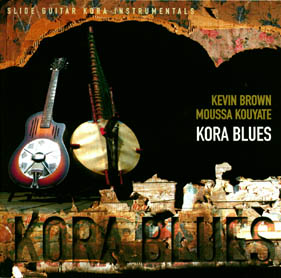
This latest offering from slide guitar maestro Kevin is a stylish follow-up to 2001's Mojave Dust, similarly atmospheric but in a completely different way. It teams him up with Senegalese master kora player Kouyate for the first time on record, although the two musicians have played together much over the past two years, ever since their chance meeting at the Bath Fronge festival in 2000. It's a shame that there's only 37 minutes of music on this CD, for I could easily have listened to twice that amount, so intoxicating and beautiful is the blend of instrumental textures and so stimulating is the musicianship.
There's a striking empathy between the two musicians, but this was hard-won, and emanated not as you might expect from the common kinship between West African music and the country blues, but from what Kevin has described as the discovery - following many hours of struggles of understanding, efforts to find common ground and eventually finding through their faith in each other's musicality and inner strength - that their "internal clocks beat from the same pulse".
This is a genuinely uplifting album, a highly spiritual experience yet one that's fully accessible and not in any way discordant or unduly esoteric, and more than all that it exudes a very real sense of collaboration, with music-making that's utterly natural and unforced. Captured live in the studio, with all the immediacy and low-key dynamism that implies, this is a superior product indeed, full of joyous spirit and so much more than a one-off memento of the two musicians getting together.
David Kidman
Maggie Brown is a very, very fine country rock singer indeed, she possesses a sensual raunchy edge to her voice. When she launches into Forty Dollars and, in particular, Mosquito Net she sounds as if she's just risen from the steamy heat of the swamp.
The edge that Brown brings to all the music on her eponymous debut album, is surely born out of a remarkable life. Singing and writing at the age of 14, she was packed into an old tour bus by her mother. They made it as far as Texas and for the next four years lived on that bus, playing the bars and honky tonks of the Lone Star state. Not the easiest life but a great grounding for a performer.
Like thousands before her, she headed for Nashville where sadly tragedy struck and her mother passed away. Left alone in a strange place Maggie Brown headed home to Ferriday, Louisiana and in an attempt to find normality, she went to college, married and had a child. For six years she swapped singing for domesticity.
Despite the objections of a husband reluctant for her to perform, Maggie Brown's love of music returned and the result is this truly memorable debut. Hers is the music of a singer who has learned and hardened her craft on the road and it shows, there is an unstoppable energy about the album, never once does her belief waver, these are her songs, this is her life.
If Maggie Brown had stayed with country rock, we would be welcoming the arrival of an exciting talent, one to sit alongside Tift Merritt and co. However, country rock is only one side of Maggie Brown and, as good a country artist as she undoubtedly is, she is an even better blues singer, Black River Blues oozes out of her soul, this the song of a young woman who has experienced and survived the hard times. It has a depth and honesty that few can match, she has earned the right to sing the blues. But even that isn't the end of Maggie Brown because she possesses the gift given only to true musicians, not only can she set the blood coursing through the veins, she can break hearts at a stroke. Jacob's Eyes is chillingly poignant, ripped from bitter experience it fixes with its gaze and never lets go. But this is an album full of surprises, Nowhere To Go But Crazy is an uncomfortably personal story of coming to terms with loss.
It's rare to come across any album, never mind a debut, that is as forthright, open and complete as Maggie Brown. She appears to have a crystal clear of what she wants her music to say, when you think of what she went through to get here, maybe it's not so surprising.
Michael Mee January 2007
Poet/lyricist and one-time "fourth member of Cream", Pete served his apprenticeship on the British jazz-blues circuit with influential figures such as Graham Bond and Dick Heckstall-Smith, before forming a fruitful writing partnership with Cream's Jack Bruce. As the freewheeling 60s drew to a close, Pete harboured thoughts of performing his own music, and formed a group of his own, the Battered Ornaments, with Chris Spedding, Rob Tait and Butch Potter as its nucleus but typically also involving a flexible panoply of other musicians. This band released a highly experimental single at the beginning of 1969 (both sides of which are included on this excellent anthology), and followed up with a brace of albums (A Meal You Can Shake Hands With In The Dark and Mantle-piece), which were among the first to be released on EMI's "progressive" Harvest imprint. This anthology provides two well-contrasted prime cuts from A Meal...: the jazzy workout Dark Lady and the more exotic, distinctly Cream-inflected Station Song - but then, disappointingly, no tracks from Mantle-piece, although to partly redeem matters we begin the story of Pete's subsequent band Piblokto! at the very beginning with the pithy (and arguably proto-punk!) single-A-side Living Life Backwards. Piblokto! was formed by Pete and Rob T, and used the services of guitarist Jim Mullen; in early 1970 the band produced their enormously successful LP Things May Come And Things May Go, But The Art School Dance Goes On Forever, an altogether more commercial (if still pretty eccentric and eclectic) collection from which the present anthology sources no less than five suitably representative tracks including the more psychedelic High Flying Electric Bird (complete with notorious swanee-whistle solo!), the rootsy, Band-like Golden Country Kingdom and the lazy, jazzy Country Morning. The band's next attempt at a single, Can't Get Off The Planet, was another ambitious, if sprawling cut, and both sides of that release are included here, and the anthology continues with just three cuts from the band's equally musically adventurous mid-1970 album Thousands On A Raft, following which the band underwent some painful lineup fluctuations and released a further single Flying Hero Sandwich - both sides of which close this wonderfully well-filled disc - before Pete, disillusioned, disbanded the band entirely. This is a most useful anthology, and the foldout booklet contains a lengthy and authoritative essay by Mark Powell. It'd be good if this release heralded a fuller reappraisal of this key phase in Pete's career, for his output over the course of those three cataclysmically creative years contains some very brave music that has stood the test of time extremely well.
David Kidman August 2006
This is Oli's follow up to his critically acclaimed debut, Open Road, and legendary producer Mike Vernon has brought the best out of him again. Evil Soul is a hi-octane opener which is driven by the drums of Jamie Little. Brown's voice has improved since my review of Open Road and two years of almost constant touring has helped that so much. His guitar work is still stunning on this snappy introduction. Makes Me Wonder is a fluid blues which is slightly jazzy in some of the passages. The piercing guitar is the focal point. The metronomic Keeping My Options Open is a grinding blues based rocker whereas Speechless turns to a softer rock with a sophisticated feel. Brown's guitar needs no encouragement to come to the fore and he confirms his status as one of the UK's premiere guitarists. His treatment of the classic Fever, by playing it in a 60s R&B style is a success. It's always hard to do something unusual with such a well known song but he does add a different feel to it overall.
Not A Word I Say is the first slow song on the album. It is moody and smouldering with the guitar as the star again. It builds well from the middle onwards. I Can Make Your Day is another grinding blues but a bit on the heavier side this time. Oli lets it rip here on the type of song that Joe Bonamassa excels at. Real Good Time has punchy guitar with a soulful feel. The funky Take A Look Back has a slicing guitar and the funk continues with No Diggity. Oli switches effortlessly between styles but the one constant is his guitar. Love's Gone Cold has to be a blues with a title like that. This is slow and dark before it explodes into life when Oli lets that guitar go. Unfortunately, the album has to finish sometime and On Top Of The World is a wonderful sing-along song to wrap things up with. Played with panache, it is a testament to Oli's all round growth. Oli Brown will help form the future of British blues.
David Blues April 2010
Oli Brown has taken in the influences of the great British blues players of the past and those of his contemporaries such as Aynsley Lister to take up the baton for the 21st century. He has already shared a stage with greats such as Koko Taylor, Walter Trout, John Mayall & Buddy Guy and is ready to take his place in the spotlight. Psycho is a contemporary blues played by a power trio. The rhythm section of Fred Hollis on bass and Simon Dring on drums ably backs Brown's guitar in its quest for the elusive note.
The eponymous title track is a mid-paced grinder with nothing out of the ordinary in the voice. Stone Cold (Roxanne) is a shuffling blues in the Kansas City style and there is no doubting his credentials as he lets it rip on the chorus. The first cover, Can't Get Next To You has him not really out of first gear yet and this needs a bit of pace injected. It's another contemporary blues rock with the introduction of Govert Van Der Kolm on organ. Shade Of Grey is slow again and has a spoken vocal intro. It does build a little and turns to the funky side.
All The Kings Horses has a heavy intro and highlights Brown as one of many playing this type of blues at the moment, and he's certainly not the worst by any manners of means. This has his best guitar work yet and the pounding drums from Billy McLelan breathe life into it as it builds to a fantastic crescendo. Black Betty (yes it is the Ram Jam song) has a drawled vocal and although essentially the same as the Ram Jam cover of Leadbelly's song, Oli does let himself go - short and sweet. Missing You is a slow, uncomplicated blues with incisive guitar bursts - this will be a great live track. New Groove is a beefed up Robert Cray style strolling blues in parts but we have had to wait until Played By The Devil before we get any genuine pace and this is a highlight as he shows how good he really is. Complicated is slowed down again but I'd have rather had him sprinting for the finish although this 21st century blues is a good finish to an intriguing album.
David Blue August 2008
Having reviewed her first and third albums, her last two seems to have slipped by unnoticed. However, it's good to clap ears on her second release since signing to Red House, the label fittingly based in the house in which she spent her early childhood.
Musically, not a great deal has changed in the interim, she still makes soulfully languid, sparsely arranged folk blues Americana and sings in a warm sultry smoked voice, but much more relaxed and assured, save for the rocking El Guero (beefed up from her previous Shimmer EP) this a more laid back reflective affair with none of her slide guitar boogie.
Veined with imagery drawn from the natural world with several references to flowers (roses especially) and water and painting impressionistic portraits, it opens with the slow bluesy Wishes Falling Through The Rain and an atmosphere of heat-heavy Midwest afternoons before wishes reappear on the lyrics of the gentle country lilting One Way Round. It's one of several highlights here with particular mention due to wistful keyboard backed Out Of The Blue, the yearning Prayer Of Roses and aching country slow dancer Never Did Belong, all of which feature keening pedal steel from Brian Wilkie.
I'm especially taken with Grass Upon The Hills, a two step bluesy ballad that pays tribute to the blue collar lives that built the land, forgotten heroes "in a lost nation with no priorities', and Faller's empathy with a kindred spirit, "a crowd of people' in their face, but there's nothing here to disappoint.
www.pietabrown.com
www.myspace.com/pietabrown
Mike Davies June 2010
Pieta Brown - In The Cool (One Little Indian)
The daughter of folk singer Greg Brown, while there may be obvious musical bloodlines to be traced on tracks like This Old Dress (a hymn to traditional American family values with Iris DeMent on backing) and Lonesome Songs (with dad on guitar), Brown is much more steeped in the blues, her slide-guitar getting down and dirty on the hips-shaking title track, Precious Game a driving rocker, while Tears Won't Do Any Good is a good example of the old school smoky blues rocker clothes she clearly feels comfortable wearing.
She has the riffs and soulful groove, but she has the songwriter's eye too, 4th of July a finely detailed snapshot of summer holidays set against thoughts about America, #807 a sultry walk down the cracked pavements of early morning streets and Ring of Gold a Johnny Cash chugging journey through love and loss. This is her third album, it could well be the one that has people start prefacing Greg reviews by mentioning he's Pieta Brown's father.
Mike Davies
Pieta Brown - Pieta Brown (Trailer)
As in daughter of Greg who, along with sisters Zoe and Constie was first heard on these shores via Going Driftless, a tribute album to their dad, singing Ella Mae, his song about their grandmother. Released Stateside in 2002, this is her debut album (a second, I Never Told was released year) and produced by Lucinda Williams's knob twiddler Bo Ramsey who also plays guitar, it's an earthy folk blues based affair that reveals an appealingly laid back hushed n sultry vocal style that suggests her as a female answer to JJ Cale (though it does mean you have to listen close to her blurry mumble to make out the lyrics) and the ability to craft sparsely arranged intimate stories.
The opening Lullaby sets the easy going mood with the sound of sun and cornfields and then proceeds through a set of lazy, stretch out and languidly sparse but deceptively textured melodies that variously enfold the dusty blues of Blind Dog Yell, the more Victoria Williams-like folksy nursery rhyme simplicity of Even When and the old school soul that shimmers through the weary Tell Me How.
Although she never actually breaks into a sweat, she still ups the groove with the traintime chugging On The Edge and swaggers round the barroom, whisky glass in one hand with a sashaying Bury Me as the steel guitar chops out. Not a huge blues devotee personally, my own leanings are more towards the backporch picking of Don't Turn Away and the Mickey Newbury feel of the speak-sing Can't Take It Away, but there's no denying she's got a definite strong sense of direction guiding her chosen musical pathway. And, just a note for those who reach for the eject once the last track's notes have died away, hang on a few second and you'll find she and the band keep the party going with a bonus hidden boogie.
Mike Davies
Although based in Suffolk, with a date sheet that keeps him gigging for most of the year across the UK, Europe and the USA (his 2011 date sheet lists 101 gigs, but he did have Jan-Mar off), Brown must be one of the hardest working musicians in the UK. Fortunately, somewhere along the way he found some time to drop by a studio and lay down his debut mini album, showcasing a guitar style that's drawn comparisons to Jimmy Page, Davey Graham and Nick Drake and musical influences absorbed from travels that have taken him North Africa to North America.
Given his schedule, it's not too much of a surprise to find that the choppy rhythm title track with its fingerpicked acoustic and baying electric is about a restless travelling lifestyle, a musical stew of blues, rock and Americana.
If you can hear Zep influences there, Your Good Girl's Gonna Turn So Bad upturns the preconceptions of its title by not being another blues number but rather a slice of country rock edged ringing guitar power pop that suggests both Orbison and McGuinn while No Fool Like An Old Fools turns the pace down and the heat up for a smouldering moody ballad with reverb guitar that hints at Chris Isaak.
He keeps the styles shifting with the acoustic Oh My Head where those trad folk/jazz Graham influences surface and, again leaning towards the trad, though more Scottish than British, his vocal delivery on the folk blues Ocean Of Stars combines a less fey Donovan with a not so gruff Robert Plant.
His guitar work throughout is exemplary, but just to reinforce the point, the album closes with a reprise of the title track stripped back to just the voice and acoustic finger style playing that would indicate Roy Harper among the influences too.
It's an impressive calling card, but maybe next time he could book a few more days off and make the follow up a little bit longer.
Mike Davies July 2011
For their fourth WildGoose record, the companionable West Country couple have chosen to present an entire programme of songs with a maritime leaning - but with not a shanty in sight! And it's a resounding success.
Some of its songs have been in Tom and Barbara's repertoire for years in one form or other, but this themed disc furnishes an ideal opportunity to revisit them. Two sets of paired songs have their origins in Seascape, a show about North Devon maritime history which Tom and Barbara put together back in 1979: Padstow Bar To Lundy Light, an evocative travelogue, was specially composed by Tom for the project, as was The Wreck Of The Montagu, the true story of an embarrassing naval disaster. Other songs discovered by Tom & Barbara at around the same time include The Watchet Sailor (for which Tom provides Barbara with an imaginative guitar accompaniment) and the Newfoundland ballad The Spirits Of George's Bank. The latter, together with a further six of the disc's sixteen tracks, is sung unaccompanied - a testament to the excellence of the couple's sturdy singing voices. These are also heard to good effect on The Ship In Distress, for which the sole instrumental accompaniment is provided by some eerie harpeleik (Norwegian fretless zither) chordings. Although Tom and Barbara always treat their chosen (predominantly traditional) sources with respect, they're not averse to having fun with the material too, as their brilliantly characterised "argument" of The Herring's Head demonstrates, while they also relish Redd Sullivan's venomous Firing The Mauritania. Elsewhere, Barbara delights in singing The Blackbird "in the old way" (in the version collected by Fred Hamer from Shropshire singer May Bradley) - as also does Tom with The Bold Princess Royal.
Outside of the purely unaccompanied selections, the Browns are accorded some distinctly spirited backing from (among others) Keith Kendrick and the Askew Sisters, whose contributions so perfectly match Tom and Barbara's own lively, passionate delivery. For instance, I don't think I've heard a more infectious treatment of Ten Thousand Miles (Away): here you can virtually feel the salt spray in the wheezing bellows-action of Hazel's melodeon, with Keith's anglo concertina and Emily's breezy fiddle steering the gallant barque along on the morning tide.
Sporting informative (if somewhat discursive!) booklet notes, this is a superbly programmed, vitally performed collection that convinces on all levels: neither a dry, dusty ship's chest of maritime academia nor a hastily-cobbled set of songs to appeal to the sea-faring novice or tourist, but a significantly entertaining hour's worth of good songs well sung, proving that the traditional folk experience is very much alive and well.
David Kidman October 2008
This latest offering from Tom and Barbara, those irrepressible West Country singers who are perennially welcome visitors to folk clubs and festivals around this fair isle, has only just come to my attention - however, it was actually issued last year, as what the duo themselves term "a mainly self-funded project, produced specifically for the village hall circuit and for local sales", and thus not widely circulated outside that remit. Which is a pity, for it's a generously-filled (72-minute) thematic compilation, which collects together a dozen tracks from the duo's existing recorded output for WildGoose and nine newly-recorded tracks. Indeed, West Country Night Out proves a very attractive stand-alone release, even if you already own one or more of Tom and Barbara's previous three CDs (and if not, then why not?!) - having said which, this compilation may well provide the incidental incentive to complete your collection! For you can't go wrong with these rich and characterful renditions of songs and tunes, both well-loved and lesser-known, originating from Somerset, Dorset, Devon and Cornwall. Tom and Barbara are the ideal interpreters of this indigenous material, and they can always be relied upon to bring warmth, affection, vital expression and a keen sense of fun to their renditions, whether acappella or with selective yet perfectly-judged instrumental accompaniment. The programme for this delightful "night out" encompasses typically bracing versions of "popular" (but no less welcome) selections like Tavistock Goosey Fair, The Farmer's Boy, Widecombe Fair and Lamorna, the original "west-ender's song" (well, only because it namechecks Albert Square I guess!), and less well-trodden (though brilliant) comic creations like My Old Game Cock, Mortal Unlucky Ol' Chap and Paul Wilson's Bampton Fair, also the quite charming miniature Barnstaple Fair, within the context of which nestle comfortably more lyrical material like Seeds Of Love, The Watchet Sailor and Barbara's own lovely air Where Umber Flows. The whole disc contains many neglected gems of repertoire that well balance the chestnuts - though even these are blessed with sterling performances that would be hard to better. Although Tom and Barbara are variously augmented by other fine musicians here and there, the freshly-recorded songs are true duo performances (well, virtually - for label boss Doug Bailey adds some chorus vocals!) that really do reflect their companionable, unpretentiously captivating and thoroughly entertaining live act. Thankfully, you don't need to go all the way to a far-flung west-country village hall to get a copy of this excellent CD - just go to Tom and Barbara's website And now there's even better news: Tom and Barbara's next all-new CD, another themed collection (the maritime-flavoured Beyond The Quay), is due any time now - can't wait!
David Kidman August 2008
I always really look forward to seeing and hearing Tom and Barbara, for their special brand of west-country warmth ensures a wholly personable welcome every time and their years of experience (and intense enjoyment) of singing folk music bring an immediacy and freshness to every performance they give. They're also two of the finest singers on the folk scene; each is blessed with a wonderfully strong, rich and earthy tone of voice and a definitive, innate grasp of harmony to complement their solidity of melodic line. What's more, they have an unerring instinct for a good song, and - every bit as important - a great sense of which songs truly suit their voices and style of presentation. Their richness of tone is mirrored in the rich diversity of material that they perform, all fitting comfortably within The Tradition (in its widest sense), and all grist to the mill of folk-song you might say. All of which is represented on this delectable release, from juicy chorus songs both traditional and newly-composed to ancient ballads, from West Country dialect pieces like Bread & Cheese & Cider to songs from the village-hall circuit (When Mother And Me Joined In). There are a couple of "fair songs" from the West Country (Bridgwater Fair, collected by Sharp in 1906/07, and Paul Wilson's relatively recent fun sketch of Bampton Fair). In the aforementioned "big ballad" category we get sterling renditions (from Barbara in these instances) of The Lowlands Of Holland and Barbara Allen; the latter, all too often recorded in indifferent and/or unsatisfactory versions, here is sung unaccompanied, to a sensibly full text and utilises a tune variant that's intriguingly different and quite challenging. There's also a fine example of a crafted, sensitive and inspirational modern song that so powerfully transcends easy nostalgia and "cuts to the quick" (the title track, which comes from the pen of the multi-talented Hilary Bix - who was also responsible for the album's wonderful artwork, graphics and design by the way). Not only the visual impact of the CD as a package is considered here, for the purely sequential design of the CD is thoughtful and attractive too - the running-order is neatly bookended, with a brilliant choice of opener that's a kind of modern calling-on/come-all-ye (Eric Bogle's The Sound Of Singing) and a suitably emotional "parting-song" as closer (In Friendship's Name, culled from the repertoire of shepherd Willie Scott and now newly translated by Tom and Barbara from the original Border Scots).
David Kidman, June 2006
Jackson Browne's talents as a songwriter of influence require no endorsement. Since the release of his debut album in 1972 he has consistently written some of the most literate, intelligent thoughtful and thought-provoking songs that have graced country rock. And, in case that all sounds a bit too 'worthy', being the co-writer of Take It Easy with Glenn Frey isn't the worst entry on a musician's CV you'll come across.
But there comes a time when age and experience mesh perfectly with god-given talent and it may just be that Time The Conqueror is that moment for Jackson Browne. The album's cover, with Browne sporting a grey-flecked goatee and sunglasses is, in its way, the perfect illustration of what lies beneath. Browne is no longer furiously chasing causes - it's for young bands to tilt at windmills - instead his music takes measured aim and never misses.
The title track and Off Of Wonderful are both delightfully mature and reflective, always one of country rock's more engaging performers both these tracks have a comfortable mellowness running through them that draws you in. But, as you'd expect, Jackson Browne isn't quite ready to go quietly into that great good night just yet. His social and political antennae are just as keen as they ever were, Drums Of War and Where Were You are both clear-eyed and superbly crafted indictments. Writers like Jackson Browne don't need to couch their views in analogy, phrases like ' Why is impeachment not on the table' need no interpretation, Jackson Browne has always been a committed artist and that shows no sign of waning.
But it's the near 10-minutes of Where Were You that is at the core of Time The Conqueror. It is bleak and hard-hitting; again 'from Air Force one he surveys the devastation' doesn't miss its target. And while he retains his drive, Jackson Browne is a musician first and foremost, Going Down To Cuba and Giving That Heaven Away are so intimate that they become pleasant one-to-one conversations between old friends - Browne and his audience.
For over 30 years Jackson Browne has been one of the best writers and performers of that brand of relaxed, laid back country rock that has its spiritual home on the West Coast and while Time The Conqueror continues that tradition, it's also music that has grown up as gracefully and elegantly as its author.
Michael Mee October 2008
Jackson Browne - Solo Acoustic Volume 2 (Inside Recordings)
It has to be said that these days Browne's status is a pale shadow of the days when he was making records like Before The Deluge, The Pretender and For A Dancer. Unless you're a real devotee, you'd be hard pushed to name anything of his last studio album, The Naked Ride Home, from six years back.
Taken from various live recordings during his solo tour of 2004, Vol 1 pretty much exhausted the set list of popular favourites, which leaves the sequel (a stop gap until the next studio album) to trawl through a clutch of lesser known numbers intercut with his introductions. The voice, of course, remains as haunting as ever, still stained with concern and honesty, and hearing him on older numbers such as In The Shape of a Heart, Sky Blue And Black or Enough Of The Night rekindles the magic. But, whatever the merits of My Stunning Mystery Companion or Casino Nation, it's hard to image them prompting a rush down the local store.
Mike Davies April 2008
Jackson Browne - Solo Acoustic Volume 1 (Inside Recordings)
If ever an artist was in the perfect setting to display the crown jewels of an already illustrious career, then it's Jackson Browne in front of an audience, playing acoustically. Sometimes only an absolute will do, believe me it doesn't get any better than this.
Browne sits neatly in the school of intelligent singer/songwriters that includes the likes of Randy Newman and James Taylor but where Taylor is scholarly and slightly detached and Newman is urban and satirical, Jackson Browne's country rock comes straight from the heart of a passionate man. The proof of the pudding, as they say, lies not in the words or the music but the silent reaction of the audience. The electricity Browne creates stuns the audience, the burst of applause that greets each song's finish, acts as a release as one spell is broken, only for the next song to cast another.
With songs as exquisite as For A Dancer, Browne demonstrates why mere mortals would trade a million words for one line that expresses as much as he does time and time again.
Although this is his first live release since 1977's Running On Empty, over three decades as a working musician of immense talent, means that when he is in his natural habitat he's completely comfortable and here he 'works' the audience with charm and ease.
Jackson Browne is one of the world's consummate folk/rock singer songwriters, and shorn of any adornment, Solo Acoustic shows just why.
Michael Mee
Jackson Browne - The Naked Ride Home (Elektra)
It's been six years since Browne's last studio album, Looking East, but this, his 13th, is clear evidence the wait's not been down to any creative impasse. Earlier this year he was given the John Steinbeck Award, joining John Sayles, Arthur Miller and Springsteen as artists whose work embodies the same social and environmental concerns as the author. These are concerns that have occupied the Californian singer-songwriter since his first album and are evident again here with Casino Nation, a brooding portrait of a world that fosters 'the intentional cultivation of a criminal class' and 'entertainment shapes the land the way the hammer shapes the hand.' It's a world where self-interest dominates (Walking Town), where so much is 'changing for the worse.'
But if The Night Inside Me sounds a note of disillusion ( 'I don't know how I believed some of the things I thought'), there's still optimism in his heart, a belief that the love of a good woman can pull you through (My Stunning Mystery Companion. Never Stop) and that there will come a day when the simple truth of childhood will be found again and the trumpets will blow for the hungry, the lost and those driven insane.
Musically, it's pretty much what you'd expect, the opening dark confessional title track's country hues and the For Everyman West Coast soulfulness of About My Imagination about a definitive a Jackson Browne sound as you'll get, though the epic Sergio Leone, which both offers a biosketch of the film-maker and uses his career and themes as a metaphor, could easily pass for his Canadian counterpart Bruce Cockburn. The ride goes on, hitch a lift.
Mike Davies
Multi-instrumentalist Bob Brozman has spent many years gathering expertise on worldwide ethnic music but for his latest album he has returned to his roots, which are in blues and Americana. The title of the album gives an indication of what we are about to receive as Brozman gives us his take on modern living. He plays an amazing array of instruments on the album and is forever experimenting with new and wonderful ones. He starts off fairly conservatively on National guitars for the Iraq protest Follow The Money, on which he makes them ring like bells - a lively, high impact opener. Look At New Orleans is quite self explanatory. A personal view on what really happened when the levees burst. He is an extraordinary guitarist and gets the most from his instrument, and the 7 string banjo, with notes that you would not think possible at times. The banjo remains for the earthy Old Man's Blues, which has echoes of the original Delta music even though it is played on the strangely titled Okinawan Sanshin. Airport Blues remains firmly in the Delta with Brozman's wailing vocal making it acoustic blues of the highest order. Shafafa is more of a ragtime/music hall song played on Hawaiian guitar & dobro and whilst pleasant enough, it does not carry enough of an edge for me. Lonely Children has a loose, fluid feel but it covers a dark lyric on the plight of the homeless. This is played on a myriad of instruments including firsts for me in the shape of Chaturangui (a 22 string Indian guitar) and grass clippers! Let's Get It Boy is a competent instrumental and introduces us to yet another new instrument, this time it's a Gandharvi, a 14 string Indian slide guitar.
Three Families Blues is very dark and tells the tale of an immigrant, a soldier and an Iraqi - lyrically stunning and very thought provoking. Another instrumental, Strange Ukelele Blues gives you exactly what it says on the tin - a festival of strings from a Resophonic ukulele and 7 string banjo. The traditional tune, Green River Blues is full of sedate acoustic tones and Crooked Blues is not about felons but infirmities instead. However, Brozman goes on to compare physical crookedness with that of politicians. He plays the latter in an offbeat way but with strong acoustic slide. Rolling Through This World has a Spanish guitar style intro to a bass heavy dramatic acoustic offering. There are many other Spanish influences here. Slow Motion Blues is painfully slow but is a boon for lovers of slide guitar and there is another percussion experiment with Jim Norris using a straw bag of metal rattles. The self same slide guitar meets The Doors on People Are Strange. The novel use of percussion reaches a peak on this with 'instruments' such as broken toy piano, pots & pans, butter knife on table and a bamboo anklung being used. A strange combination I hear you say and he almost pulls it off. If he had added a little more menace to his 'devil voice' performance then he would have been there. A pared down How I Love That Woman gives a relaxed end to the album. This Texas blues instrumental with Brozman on Hawaiian guitar and bassist Stan Poplin will allow you to close your eyes and forget about the troubles of the post-industrial blues.
www.bobbrozman.com
www.rufrecords.de
David Blue January 2008
David Kidman December 2007
Bob Brozman says that he has been playing guitar for 45 years and he's just beginning to figure out some of the basics of music. I know what he means – he's revisiting his deeply held ideas and re-evaluating them. Blues Reflex is the result and Brozman opens with the superbly titled Dead Cat On The Line. This is a stomping Delta blues where he plays all of the instruments apart from the drums and there's a fantastic prelude speech by the Reverend J.M. Gates lifted from 1929. Brozmans National guitar playing is superb and he plays an instrument by the name of a duff bender which I think is an Arabic device of some sort, all of which, when added to his gruff vocal, makes for a wonderfully eccentric song. Rattlesnake Blues is a traditional tune given the Brozman treatment and his beautiful rolling guitar is the making of the song. He turns to the jazz genre for One Steady Roll and the French influences abound. Despite the exaggerated vocal it is his guitar that carries this one. Death Come Creepin' is a good old Delta blues and Vieux Kanyar Blues is more contemporary. The overdubbing a la Les Paul is welcome and shows how innovative a guitarist he is. Only three of the thirteen tracks are not written by Brozman and Poor Me, written by Charley Patton, is one of them. This is very slow but is full of character.
The last of the covers is Skip James' Cypress Grove Blues and this is an interesting version of the song. Brozman just about gets away with it and his guitar playing, as usual, is on top form. He goes on to give us a slide guitar master class on Little Tough Guy Blues before giving us a first on New Guinea Blues (I'm sure that no-one else has ever written a blues about that country). The song itself is a standard blues and little else. It's Mercy We Need is the third instrumental of the album and is a sobering piece of music. Mean World Blues is bouncy but More Room At The Edge is probably one too many instrumentals. He seems to be running out of ideas but there are some Indian influences in the guitar work. The final track, Workman's Song, is yet another instrumental and although he has been playing Hawaiian guitar throughout it is this one that sounds most like it. The album has petered out a bit but is worth buying at least for the first eight tracks alone.
www.bobbrozman.com
www.rufrecords.de
David Blue January 2007
Papua New Guinea Stringbands with Bob Brozman - Songs Of The Volcano (Riverboat)
David Kidman
Ian Bruce - The Demon's Dance (Ruglen Records)
Scottish singer-songwriter Ian has been recording since 1980; this is his seventeenth release, yet it's the first that's been recorded and personally produced up in his own studio in Glenlochar, Scotland. Ian's known on the folk scene as the tough-biker-lookalike with the gentle, winning and true heart-of-gold personality and an amazingly fine singing voice, and he's blessed with a legion of loyal fans who recognise his exceptional performing and writing talent. His intrinsic Scottishness, unlike with some performers of that nationality, is no barrier to wider audience appreciation, but instead is turned into a virtue. So, narrowing the focus down to this particular CD: first, Ian's never in my opinion sounded better on record, his singing especially exhibiting a stunning maturity of phrasing and degree of control, qualities that would make the CD worth the asking price on their own, even if the playing, production and quality of songs were less than top-notch - which they emphatically are not. Ian states in his booklet note that it's the first time he's made a conscious effort to include songs of other writers from around the folk scene - here, five out of the eleven tracks, of which I suspect only the one by Stan Rogers (The Last Watch) is at all familiar even to folk devotees although they all should be better known, such is their high quality. Stephen Clark's Comin' Hame (Coming Home) is a standout, and Arthur Wakefield's Between The Nab And Nancy runs it close. Modest almost to a fault as ever, Ian hasn't owned up to "Scottishising" Coming Home, but his subtle amendment of the lyrics is perfectly in tune with the character and meaning of the song. That's a perfect example of the way that through his carefully considered interpretations Ian makes the songs that he didn't write himself into so very much his own personal statements - a quality that he shares with only a select few performers of our time (while too many others seem content to churn out carbon-copies of "received interpretations"). Ian's own compositions (four out of the six co-written with Charlie Milne, one with Sandy Stanage) range typically widely in mood and subject matter, from the intelligent yet superficially flippant slice of self-observation Arrogant Man and the similarly dual-faceted Crazy Countdown through to the lovely calypso of Brown Eyed Baby (the inspiration for some of the images on the booklet art), the poignant One Flower Down (dedicated, like the entire CD, to Ian's recently-departed mother), the evocative Then The Rains Came, and the more raucous opener Lonely Time (which perhaps overdoses a touch on the "impromptu informality" vibe). The musical settings employed on any recorded artefact have always been important to Ian, as opposed to merely re-creating the compelling-in-its-own-way live voice-and-guitar act in which he excels – even though he'd be the last to want to submerge his own personality with inappropriate over-arrangements. It's clear that he's chosen his select band of musician collaborators very carefully indeed for this album - Angus Lyon (accordion, piano), Stewart Hardy (fiddles), Marc Duff (recorders, whistles, bouzouki, bodhrán, etc), with Shaun Blandford (bass, percussion) and Bertie Frisch (drums) - no heavy-handed mob this, but an enticingly conjoined crew whose outstanding, spirited yet relaxed contributions are managed with a well-defined expertise by Ian himself occupying the production seat. Completing a very attractive CD, the booklet artwork is very appealing indeed, while the lyrics are available either on the CD-ROM itself or on Ian's website. Quality shines through everywhere on The Demons' Dance, which I wouldn't be surprised to find fast becoming one of my all-time favourite Ian Bruce CDs.
David Kidman

Just Another Day is slow and bluesy with Bruce's world weary vocal a highlight. Perfect Place is a funky blues with Trower on form. This is one of the top tracks on offer. The blues theme continues with Bad Case Of Celebrity and Trower shines again. Jack Bruce is just Jack Bruce; I can't give him any higher accolade than that. The Last Door has a faster pace but there is no loss of quality. Come To Me has signs of deterioration in Bruce's voice but musically they are still on top form. Trower lets it go on the solo and the rhythm section keeps things going very well. White Room is the first of two classic Cream songs to finish the set. This is subtly different from the original and although Trower's solo is great, Clapton's is still better. It's good to hear the old song again though. Politician has that classic bass line and guitar riff. There's another big solo from Trower as they go out with a bang.
David Blue September 2009
Junior Albert's dad was the composer of hundreds of gospel songs, including this album's title track (which has enjoyed recent fame in the wake of O Brother Where Art Thou?). Albert Jr is already a veteran performer of some 50 years, and this collection of a dozen country-gospel songs (seven of his father's and five of his own co-written compositions) shows his talents off to good advantage. He's blessed with a good baritone voice, has years of experience of singing this kind of material with passion, and on this CD he enjoys the backing of a superlative and totally idiomatic supporting cast drawn principally from pickers and singers of the Missouri area (who include within their ranks Tim Crouch, Steve Bush, Randall George, Dean Holman and Boone Carlon). An admirably solid, straightahead set of flavoursome and inspirational country-gospel, often nostalgic but not overly sentimental, that surely won't disappoint if that's your bag.
David Kidman
You may not recognise the name but chances are you may be aware of the, ahem, Norwegian freak-folk songstress without realising it. In a nice touch of post modern irony, Channel 4 used her spare icy rumbling blues folk Lullaby For Grown-Ups as the trail to their recent horror season while her piano backed tremulous cover of Cyndi Lauper's True Colors provided the soundtrack to Sky's High Definition TV campaign. That had a touch of the Kate Bush about it, and you may hear other hints across Changing Of The Seasons (Balloon Ranger), her fifth album but only the first to find its way over here.
Born Ane Brunvoll, she draws on the influence of her jazz singer mother (check The Treehouse Song) as well as what, to go by The Puzzle, would seem to be a cocktail of traditional English folk and Leonard Cohen, string arrangements providing regular settings for her soulful cold winter air vibrato that, at times, conjures a bizarre marriage of Bjork and Dolly Parton.
Aside from one other cover, a spare acoustic version of Alphaville's Big In Japan, it's all self-penned material, showing her as as adept as a writer as she is intoxicating a voice. The mood and tempo rarely rises about a hushed, moody minimalism in the manner of Bon Iver, but it's hard to resist being beguiled and mesmerised by numbers like the seismically fragile The Fall, spectral waltzer Armour with its violin and nervy piano, Gillian's touching tribute to Ms Welch, the folky McGarrigles-like backwoods inflections behind Round Table Conference or the dappled, hymnal loveliness of Raise My Head where she sounds like a one woman Be Good Tanyas. "I'll linger with pleasure", she sings on the log cabin melancholy song of the same title. You will too.
PS. You may also want to search out Sketches, a totally acoustic version of the same album, with two extra tracks
www.myspace.com/anebrun
www.anebrun.com
Mike Davies February 2009
Nine albums in, he's been a label mate to Gillian Welch, profound influence on Kathleen Edwards, shared stages with Son Volt, lauded as a songwriter by Richmond Fontaine's Willy Vlautin and copped an Americana Album Of The Month award from Mojo. Not bad for a chap from the wide open plains of, er, Devon.
But this isn't the tale of a yankee wannabe, Bruntnell is, at heart, a fine songwriter who chooses to dress his songs in the guitar based pop-rock thats at the heart of most great post Beatles music of note. Indeed Rodney Crowell has declared that foursome to be the prime influence on modern country and whilst it's easy to see a lot of Jeff Tweedy in Bruntnell's work it's just as easy to detect common influences in Wilco. In other words the label Americana is both convenient and a total misdirection.
Retrospective offers a generous seventeen tracks from Bruntnell's output from the 1995 debut to a 2013 reworking of the song Played Out recut with Rumer to delicious effect. And yet there's a cohesiveness to this almost two decade spread of material; centred on Bruntnell's weathered voice it's the quality of writing and strength of songs that shines whether dressed in Powderfinger-y guitars such as Here Comes The Swells or the two acoustics and voice of personal favourite By The Time My Head Gets To Phoenix.
At the end of the day the most remarkable thing about this release is that it is merely a retrospective rather than a greatest hits or indeed a box set for what it displays is that Peter Bruntnell is a writer and performer of the finest quality there is.
Steve Morris June 2013
Peter Bruntnell - Played Out (Loose)
Those slavering for an album of new Bruntnell gems after the brilliance of Ends of the Earth will have to wait a while, but in the meantime this collection is a useful chance to reacquaint yourself with some of the Welsh Kiwi's best material, re-recorded in a solo acoustic setting with guitarist James Welbourne. Without the plangent guitars, it's all hushed, intimate stuff showing off his gravelly husk of a voice to fine effect on soundtracks to a hundred broken hearts. Inevitably the sparser arrangements ring the changes on things like Here Come The Swells, now sounding more resigned and weary than in its biting, ringing guitar incarnation. The same's true of Jurassic Parking Lot's lament for a lost neighbourhood while Ends of the Earth, You Won't Find Me and I Want You sound even more melancholic and crushed than ever and the fabulous By the Time My Head Gets to Phoenix emerges in an autumnal folk setting, although One Drink Away sounds marginally more sprightly with Welbourne's mandolin giving an extra shade of bluegrass.
An album for the already converted rather than the curious newcomer, though fans might wonder why, although he includes I Want You from his debut out of print release Cannibal, there's absolutely nothing here from Camelot In Smithereens.
Mike Davies
Peter Bruntnell - Ends of the Earth (Loose)
He should be American, but he actually hails from New Zealand of Welsh parentage, spent much of his life in Surrey and now lives in Devon. Such geographical and biological niceties aside though, he's Americana to the musical core. Having been 'discovered' with his third album, Normal For Bridgwater which featured assorted Son Volts, and acclaimed as the UK's leading alt-country light, he's back to not only consolidate that position but to extend it on a global scale. Produced by Pete Smith, James Wellbourne again prominent on guitar with Volt's Eric Haywood on pedal steel, it opens with nothing less than an instant classic, the majestic Here Come The Swells, a lyrically biting song ringing with plangent guitar that sounds like the masterpiece Tom Petty left off Damn The Torpedoes as sung by a young Roger McGuinn.
It's a hard act to follow, but Bruntnell pulls off the trick with ease, his burred vocals tackling tales of lost times, faded lives, unfulfilled hearts and bruised romanticism with the comforting warmth of a family dog nuzzling into your arms.
City Stars may breath cynicism, but musically it's one of those numbers that makes you want to find a roof to stand on and stare into the open heavens, a mood that equally permeates the Gram-like Laredo Kent and the forlorn loveliness of the title track Sadness hangs too on the shoulders of the closing Murder In The Afternoon, a touch of Steve Earle to what's not only quite possibly one of the most beautiful murder ballads ever written (complete with birdsong) but one that comes with a darkly humorous punchline.
It's not all so laid back. Tabloid Reporter is where Petty meets Jason Ringenberg for a raging attack on the gutter press, stormed up with two ringing solos from Wellbourne, quickly followed in the same frame of musical mind by Rio Tinto, an eco themed song of industrial pollution and environmental poisoning named for the world's largest mining conglomerate.
Heart, passion, intellect, honesty and a voice that should be distilled and bottled, make a space on the album's of the year list right now.
Mike Davies
I have to confess that I was not familiar with Stephen Bruton's previous work despite him having had stints with the Kris Kristofferson and Bonnie Raitt bands stretching back some 17 years. Spirit World is his fourth solo album and if the others are of a similar quality then I'm going to hunt them down.
The opening, 7-minute epic, Yo-Yo is a song that you will not be able to get out of your head and Teach Me How To Stay may well be influenced from his time with Bonnie Raitt.
Jackson Browne says that Bruton is a guitar player's guitar player and that he writes new classics (maybe he hears himself in some of the tracks). I can't argue with that, just listen to Just A Dream and you will know what he means. There isn't a weak track on this album. Lyrically excellent and musically brilliant, this is a collection of songs for lovers of quality melodic country-rock.
Comparisons to Mark Knopfler will abound, especially on the quaint Acre Of Snakes and superb Make That Call. The shuffling Liar Out Of You, like the rest of the album, sounds so effortless and you feel that you could just pick up your guitar and play along – the mark of a true great.
The closing track, The Best Is Yet To Come, is, I hope, his vision of the future. This album is from a master craftsman working at optimum level and I, for one, can't wait to hear if he can better it.
www.stephenbruton.com
www.newwestrecords.com
David Blue
British guitarist Danny Bryant has released six albums prior to his latest, Just As I Am, and the new album contains 8 new songs along with a cover of John Hiatt's Master Of Disaster.
Shut Out The Light is a standard rocker to open with and Bryant sets the standard with a searing guitar solo. Blues For Buddy is a big, ballsy blues, just like Buddy Guy. For The Last Time is a rock ballad and Every Time The Devil Smiles is a slow, blues rocker to rival the best in the genre.
The big production on the eponymous title track leads into John Hiatt's Master Of Disaster, which is not a heavy rocker as you may have expected from the title. It has a strained vocal but it is appealing in a certain way and this will be a grower. The raunchy Day By Day is an excellent example of Bryant's guitar work and he will beat you into submission as he slugs his way through The Hard Way. The 8 minute epic, Alone In The Dark is slow and powerful with a big guitar solo to finish. Bryant's voice may not be the greatest but it is strangely effective and he has honed this and his superb guitar playing over a career that has yielded in excess of 2,000 live shows so far. I think Danny Bryant will be around for quite some time yet.
If you want to find out how far Danny and his band have come then check out his excellent 2002 debut album, Watching You, which was recently re-released on the Roots Collectibles label. Highlights on the album are Since You're Gone and Purple.
David Blue January 2010
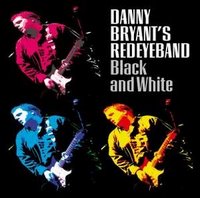
Hertfordshire born Danny Bryant has been plying his trade with his Redeyeband for the last nine years and those have produced over two thousand performances. It is that hard toil that has now reaped deserved recognition for Danny and his band. His performing credits include playing alongside Jeff Beck, Joe Bonamassa, Greg Allman, Buddy Guy, Peter Green and Mick Taylor. Black And White is their sixth album and follows the massively popular Live album which has hit the I-Tunes Top 10 blues charts in six countries. 10 original tracks start with Tell Me, a grinding blues rock with searing guitar. It's good to know that there are a number of top class young blues guitarists coming through and Bryant is in the forefront. Between The Lines is slower than the opener but still has that grinding blues feel. Love Remains is the ballad! There's a bit of Axl Rose in his vibrato and the song is good enough as he follows the formula but the extended solo is the highlight.
Twenty One is a strolling, rocking blues with another scorching solo. Any Wonder is a power ballad and he is just getting better and better. Low Down Blues is an uncomplicated chugging blues and he continues to swap slow tracks with more up-tempo ones on Walk Away. This is acoustic led and very good despite its simplicity. I do like his guitar style and he is becoming more and more of a favourite. Old Blues Song has a bit of Joe Cocker in the vocal and it's another slow one with yet another strong guitar solo. This type of blues power ballad could be called pastiche or passé nowadays but it still gets my vote. The penultimate track, Last Goodbye is a blues based 70s rocker and the closing title track, Black And White is a low key, acoustic finish - good song though. Danny Bryant is one of the best guitar players that I have heard this year and that's black and white.
David Blue March 2008
Celia's a Tyneside-based singer/songwriter who fronts country-rock outfit The Katy Freeway (previously known as Virginia Slims). Even tho' she's been writing songs for some 20 years, this is her first solo outing, ostensibly a culmination of her diverse activities over the past decade. Certainly it contains some fine work, on which she's backed by a reliable crew that includes guitarist Jim Hornsby, keyboardist Tony Davis, bassist Rob Tickell and drummer Doug Morgan. Perhaps inevitably in view of Celia's beginnings in folk music, it's the two specifically folky tracks, placed together rather too near the end of the CD, that initially made me sit up and listen: the traditional My Lagan Love and She Moved Through The Fair both receive superb performances. Earlier on, it's Celia's own compositions all the way, reflecting a pensive puzzlement and a willingness to question her experiences of life and love. Musically, the album's first five songs purvey a pleasing, gentle brand of new-country-flavoured acoustic rock, with some tasty guitar and dobro picking from Mr Hornsby throughout. And the more feisty gospel-rock of Singing To The Lord is pretty attractive too. But the sentimental waltz-time Poor Wandering Ones and the lounge-muzak Charlie just feel out of place alongside. Then, the final pair of tracks prove are of an altogether raunchier and bluesier honky-tonk cast - they're live recordings made with The Katy Freeway. So in all, you could say, No Deals, No Promises offers just that – an uncompromising selection of tracks that displays a keen desire to show off a diversity of musical styles but despite some very satisfying moments ends up lacking an overall focus.
David Kidman August 2008
It's an immediate change of pace then for Not Like Loving You, a country soul ballad that melds Patsy Cline and Percy Sledge. Then the tempo picks up again as a railroad rhythm guides you into Where The Pavement Ends before the rollercoaster mood repeats itself with Helen's Requiem, a gospel tinged farewell to a down on her luck mother who drowned in her attic.
Brazilian percussion, horns and classical guitar add warm colours to Goodbye, The Only Life I Know takes a bluegrass dust road shuffle as she sings of a mother leaving her daughter so she can have a better life, and Second Time Around takes it back to the blues boogie. Tonight and Late Night Call invites jazz swing on to the saloon dancefloor while waltzing leaving song Green Dress and the Nashville rockier Meridian (I Love The Same) complete the set with country in mind.
It's a classily solid rather than outstanding release, but backed by a veritable army of highly accomplished musicians and with her voice considerably firmer in the studio than on the live album, it will certainly boost her already growing reputation considerably.
Mike Davies August 2009
You've probably never heard of her, but you should make a note of the name because this throaty voiced New York based singer-songwriter's starting to turn heads with her blend of Southern country, blues and jazz. Influenced by Nina Simone, Dylan, Grace Jones, Ryan Adams and Bonnie Raitt, her Second Time Around album variously touched stylistic bases with big band, 50s torch, soul and even Latin drawing comparisons to Peggy Lee, Lyle Lovett, Mari Wilson and Norah Jones alike, the raunchy kickass country title track becoming a regular on the Radio 2 playlist.
She's currently working on a studio follow-up, but in the interim comes this live album, drawn from the 15 shows she played for the troops last October. Taking its cue from Cash's Folsom Prison album, it's a no frills, raw and energetic affair that opens with the steaming train rhythm bluegrass breakdown of the Grateful Dead's I Know You Rider and keep the musical mood firmly uptempo and bourbon swigging as she and her three piece band steam through self-penned numbers like What Does It Take? and Second Time Around alongside such staples as Elvis' That's All Right Mama, and Muddy Waters' Forty Days And Forty Nights.
Perhaps in keeping with the shows, the rock n roll stuff's pretty basic and Bryden's voice doesn't really distinguish itself, but she fares a lot better when she takes the pace down for Lynyrd Skynyrd's slow blues burner Tuesday's Gone (and showcases her Joplin touches) and scorching covers of House Of The Rising Sun and Hellhound On My Trail.
Mike Davies February 2009
Jim Bryson - The Occasionals (Square Dog/east central one)
Some recordings hit you in the face like a hammer blow and can lose their appeal almost as quickly. Others like this however, are insidious, wheedling their way unnoticed into your subconscious to devastating effect. Jim Bryson's dark vignettes are peopled by gritty, world weary characters, just enough of their stories sketched in simple first person lyrics and supported by musical dynamics to draw the listener into their, often twisted, internal monologues.
The songs are dressed in raw, chiming & driving organic sounds with a twist of Country courtesy of a highly sympathetic scratch band of Bryson's friends 'The Occasionals' - drummer Peter Von Althen (Starling, Skydiggers, Fred Eaglesmith), guitarist Ian LeFeuvre (Starling, Lynn Miles), bassist Darren Hore (Punchbuggy) and pedal steel guitarist Tom Thompson (Kathleen Edwards, Meg Lunney). LeFeuvre, spraying sweet and caustic electric guitar like the sinister mutant spawn of Paul Westerberg, Richard Thompson and Neil Young heavily influences the overall sound.
The warm burr of Bryson's voice is well suited to these tales of heartache (he might find it hard to write without the word 'heart'), revenge and bittersweet small town relationships. He achieves smooth integration of story and music and knows how to write a memorable melody and strong chorus line, elements which make for rewarding repeated listening rather than short term impact.
James Hibbins
Out of Ottawa with a clutch of wry stories to tell, Bryson's already earned himself Bob Harris's support, the whispering one calling him intuitive and mesmeric. Without Piano opens the set in wistful form, an I'm gonna break your sweet hearts love song picked out on an acoustic guitar. But don't be lulled into expecting the rest to follow the same course. But Travelled By Land immediately turns up the ampage, its jangling noisy guitars and Bryson's bruised and yearning voice reminding you that he cites Soul Asylum as one of his early passions. Others were The Replacements, dBs, Long Ryders and even Husker Du, all of whom can be heard lending their inspiration to the Byrds touches underpinning crunchier rowdy guitar pop tracks like February, Soupy Sayles and the chugging Impaler. His first concert experience was The Clash and it obviously made an impression. He does quiet just as well though, Lately, the mournful desert night loneliness of 26 Miles By Car and the closing One Cigarette all marking him out as a major new talent as both writer and singer. Not sure how the more 'blowtorch' numbers will work stripped back down for his solo tour supporting Dar Williams, but you can be pretty sure that this fine album will pay more than an occasional visit to the CD player.
www.jimbryson.org
www.eastcentralone.com
Mike Davies
Born in Cleveland and based in New Orleans since 2004, Bucaro filters Muscle Shoals soul and rootsy Americana through his third album, released back home two years ago but only just reaching wider markets.
Written after a lengthy hike across the Appalachian trail and influenced by both Jon Fante's 1938 novel Wait Until Spring, Bandini and pianist Bill Evans' 1977 recording You Must Believe In Spring, a warm, ageless Southern soulfulness imbues organ dripping songs which, other than the Pink Floyd feel of the bluesy sociopolitical When Man Plays God, would seem to have been born of putting down roots with a new home and relationship.
It's an easy on the ear set that makes for soothing background listening but which also reveals deeper textures if you focus in on individual numbers. If there's a problem, it's that Bucaro's musical influences sometimes shine a little too brightly in his voice, melodies and heartfelt delivery and it's hard not to find yourself thinking of Dylan, Browne, Morrison, Clapton and a mellowed Marc Cohn. Still, there could be worse comparisons and with such strong numbers as 'Til A Spring Wind Blows Again, the gospel tinges of Renew My Faith in You and Take My Love, On The Map's six minute soul blues and the heart-aching Tirelessly Blue you could well find this slipping into your albums of the year list.
Following the album's positive reviews, Bucaro went back and revisited the material he'd previously put to one side as too personal, releasing follow-up New Orleans last year. Hopefully that too will be spreading its wings with wider distribution before too long.
www.clarencebucaro.com
www.myspace.com/clarencebucaro
Mike Davies April 2010
Initial play, and well I wasn't quite sure what to make of this - a sweet, warm tenor voice (it's been compared to both Jackson Browne and Van Morrison, but I'm none too sure about that!) wending its soulful way through the gently steamy, lazy Big Easy landscape, with a slightly woozy recording ambience that's at once tightly focused and yet woollier in some of its details. The record's charms became apparent after a couple of plays, although it still poses a bit of a shock to the system at first after you've been listening to someone with a heavier-duty voice. But Clarence's deceptively lighter tone is still capable of much feeling and expressiveness, as the intriguing emotional range of this collection of ten intimate self-penned songs proves. The songs making up New Orleans were written (and originally recorded) in that city, and come from a period of Clarence's life where he'd found a new love and home there (although he's since relocated to New York City). Their heartfelt nature gives the record a uniquely soul-baring ambience in spite of the often quite raunchy settings he and his fellow-musicians have provided. From the tender confessional of It's Only You Tonight to the gritty sousaphone-generated funk rhythms of Let Me Go Of You, the "skewed-rock" of The Other End to the desperate romanticism of Matters Of The Heart, this disc soon proves more than the sum of its parts. Only the slightly contrived imagery of Abandoned Mine rings any kind of a false note in this generally pretty convincingly intense set. By the way, on investigation it turns out that Clarence had released an earlier pair of albums which were recorded in New Orleans and New York respectively - the former even appeared on Rounder I see, so might well be worth digging around to hear.
David Kidman October 2009
Two elements in particular make this a little winner of an album, the début release of singer-songwriter Pat (who has just completed a tour with Jeff Finlin). Engaging lyrics that are allied to tuneful melodic lines, and the icing on the cake, an accomplished, highly savvy production (by Pat himself and Brad Jones) that embraces the very best of pop elements and sensibilities. Musically, and perhaps against all the odds, it entirely convinces, being a veritable kaleidoscope of "pet pop sounds" stretching onward from the mid-60s, a rich and diversely detailed tapestry which manages somehow to convey a real unity of artistic vision. The evidence?: well, the bookending opening and closing tracks come on as easy, swinging-countrified Beach Boys-meets-Gentle-On-My-Mind jobs with prominent bass harmonica, then The Luckiest Girl brings the Small Faces into Wackers territory, Smile On My Face sort-of-crosses the Kinks with Lindisfarne, The World Is Flat has more than a touch of Simple Minds and 80s new-romanticism, there's an epic White-Album sweep to Under The Sun, then there's the faux-Doors organ swirl that introduces the clangingly guitar-heavy, driven swoon of Love Goes Up In Smoke, the Gothically icy orchestration of Glass, the gentler XTC/Squeeze influence permeating Insects and Angels… and those are just some of the intelligently-integrated musical reference points! Of course, the lyrics revolve around love and romance, but the apparently straightforward images are tempered by Pat's ability to distil conventional feelings and experiences in economical expressions and choice musical settings. I can't single out a favourite track, simply because each and every one could be so at any time. In the end, it's perhaps the press handout that's most worth quoting, if only for its uncanny accuracy: this album is "a welcome reminder of how beautifully simple and effective pop can be". The only unwelcome thing about it is its disappointing playing-time (34 minutes).
David Kidman
The title an Emily Dickinson reference, this relatively quick follow up to 2006's Under The Skin finds the sometime Fleetwood Mac alumni on outstanding form, several of the tracks stemming from the same sessions that found fruition on the band's Say You Will reunion album.
As you'd expect from the man responsible for some of the best soft rock songs ever written, there's a decent smattering of those hook laden trademarks here, most notably the radio friendly hit single Did You Miss Me and an irresistible The Right Place To Fade which could easily have been taken a lost Rumours outtake. Not least since it's also one of several tracks to feature rhythm section Mick Fleetwood and John McVie.
But it's the more experimental angles that make this so distinctive and showcase his mastery of the guitar. Ironically recalling the blues playing of Peter Gree, opening track Great Day's guitar figures and percussion could be used as a latter day answer to those stereo demonstration discs with its switch between speakers and the clear precision of the finger picking. Likewise Time Precious Time is a masterclass in guitar arpeggios fluttering across a spacy vibe and echo treated vocals while Bel Air Rain has what can only be described as the guitar equivalent of a flight of locusts.
Then there's the title track which rocks out like a demented Neil Young crossed with the White Stripes, thundering away on stomping drums with Buckingham yelping a la David Byrne on Pyscho Killer like a man possessed.
After such challenging moments, the album bows out on quieter notes with a lovely acoustic rippling Underground with Buckingham's voice at its most breathily tender and the achingly reflective 60s flavoured surf sway strummed anthemic Treason, a tremendous conclusion to one of the most exhilarating releases of the year.
Mike Davies September 2008
It's been a while since the sometime Fleetwood Mac songsmith and acoustic guitar wizard plied his solo wares, but who would have expected this. Almost dispensing with percussion, fingers flying nimbly over the nylon strings and mixing board, and multi-tracked (sometimes whispery) voice soaked in echo, he's in spartan experimental mood, taking California pop frameworks and skewing them at different angles in a manner that calls to mind the deconstructions of Brian Wilson in his more off the wall phase. Just lend an ear to his version of Donovan's Try For The Sun with its gypsy folk on speed glissandos.
He finds it pretty much impossible to stray too far away from the commercial melodies that have kept the Mac afloat for 32 years, but he prickles them enough to ensure that they sound just a little discomforting as numbers such as the handclappy fever dream Buddy Holly of a nervy Show You How, the hammer clicking tribal calypso nursery rhyme It Was You, a slurred dubby surfside title track which leans on the tune to Send In The Clowns, or the reverbed bossa nova Flying Down Juniper seep out of the speakers. At times, he also summons thoughts of Mike Nesmith. There's one track, the country-pop Down On The Rodeo, on which he reverts to standard group format and sounds just as you would expect a Lindsey Buckingham track to sound. It says much that it's the least interesting thing here.
www.lindseybuckingham.com
www.myspace.com/lindseybuckingham
Mike Davies November 2006
Grace was the only full-length album that was released during Jeff's short lifetime, and in the decade that followed its release it has sold well and found its way onto many critical "best albums" lists. For this new Anniversary Edition, the album itself has been remastered by veteran engineer George Marino and constitutes Disc 1 of this three-disc set. I'm not convinced that the remastering has brought any significant improvement, for the album always did sound good with plenty of presence, and indeed I'm not sure that many purchasers will even be able to note any difference. Arguably, some of the quieter passages gain in perspective, but otherwise some fairly close listening hasn't yet revealed much else of significance; but then again, I don't have a state-of-the-art system to hand at the moment… So the question will be – is the rest of this new Legacy edition worth the extra outlay? Disc 2 certainly is, for it brings 13 non-album rarities and collectors' items, including eight previously unreleased studio and live performances. All of this material was recorded either in preparation for the Grace sessions or immediately after, and includes the compelling Forget Her (originally intended for Grace but dropped in favour of So Real), some unexpected but actually pretty fine covers of Dylan, Nina Simone and Hank Williams numbers, a live rendition of MC5's Kick Out The Jams, the wayward but raunchy freak-blues Alligator Wine (shades of Edgar Broughton here maybe), two alternate mixes of Dream Brother (one with different lyrics), a distinctly "heavy" promo-only "road version" of Eternal Life, the epic 14-minute workout Kanga-Roo (which has appeared before, albeit on the rare promo-only Peyote Radio Theatre EP), and the collection's temporal odd-one-out, the uncharacteristically blowsy I Want Someone Badly (which Jeff recorded for a movie soundtrack around two years after Grace). Even the rambling eight-minute acoustic blues medley doesn't outstay its welcome. In all, this 69-minute CD provides us with yet another significant piece of the enigmatic jigsaw that was Jeff Buckley, and one which both the true devotees and the merely curious are likely to find very satisfying indeed. Disc 3 is a DVD containing the five videos that were produced in conjunction with Grace (Grace, Last Goodbye, So Real and Eternal Life, plus one for the "substituted track" Forget Her), together with a newly expanded version of the documentary The Making Of Grace, which features new interviews with Jeff's band members and with the album's original producer Andy Wallace, then finally a discography. Valuable as all these items are, and handsomely packaged though the whole set is, it's inevitably with Disc 2 that the main interest lies, and perhaps this disc should also have been issued separately.
www.jeffbuckley.com
www.columbiarecords.com
David Kidman
David Kidman
Richard Buckner & Jon Langford - Sir Dark Invader vs The Fanglord (Fargo)
Well now, he's an unusual pairing. Bucker, a troubadour of Nick Drake and Richard Thompson descent with a whispery dark voice and a fondness for non linear symbolist lyrics, and Langford, the Welsh born founder of punk outfit The Mekons and no compromise country crew The Waco Brothers. Spending in a week at Sally Timms' apartment, swapping instruments and lyrics and generally working together to shift each other's goalposts, they emerged the other end with this intriguing but often uneven art rock collection. At times there seems an almost wilful attempt to subvert the songs with the noisy arrangements, at others it's so disarmingly beguiling you want to hug it.
There's a fair emphasis on scuffed up rock n roll sonics on the opening Rolling Of The Eyes with its fuzzing Iggyesque guitars and swagger and the frankly barking The Inca Princess, while, bizarrely, Torn Apart sounds like it wandered in from a Sawdoctors album. Both men have done and will do better, but Nothing To Show is a decent barroom and a bottle waltzer in the grand tradition, No Tears Tonight tinkles nicely under a Townes Van Zandt desert sky filled with stars and Stayed and Sweet Anybody both do appealing quivering vibrato. An interesting rather the essential album but there's enough going on to satisfy fans of both camps and perhaps prompt further investigation of each.
www.richarbuckner.com
www.mekons.com
Mike Davies
Richard Buckner - Dents And Shells (Fargo)
More sequel than follow up to Impasse (though with less of the indie rock), the Nick Drake, Richard Thompson influences still apparent, Buckner's sixth album continues its predecessor's trajectory of non linear symbolist lyrics and impressionistic musical moods, lightly brushed by his Bruce Cockburn reminiscent whispery voice. Not, on first listening, quite as striking, but slowly it begins to weave its magic, the likes of Chamers' spare piano and spacy percussive rumbling drone, the gently floating country ache of Fuse, the early frosty morning brittle yearning of A Chance Counsel and the tinkling classic pop that is Her all slowly drawing you into their melancholic miasma. Not one for campfire singalongs maybe, but there's enough here to ensure he warms an increasing number of hearts.
www.mergerecords.com
www.fargorecords.com
Mike Davies
Richard Buckner - Impasse (Fargo)
Knocking around for several years on the troubadour circuit to a critical acclaim not reflected in sales, Buckner's been pinned to the alt-country peg thanks to his first two albums but that's not really reflective of where he's at, his more recent work embracing indie rock as much as roots while his last album, 2000's The Hill, was an adaptation of poet Edgar Lee Master's Spoon River Anthology set to music with help from a couple of guys from Calexico.
Recorded entirely solo save for ex-wife Penny on drums, his latest sounds suitably homespun but with its electric guitars, keyboards and electronica it's hardly sparse, an effect that paradoxically throws his parched voice (at times he sounds not unlike a wearily resigned Bruce Cockburn) into even greater relief.
Given lyrics that tend to the abstract and obtuse, it's hard to identify with on a literal level, but the emotional resonances of Buckner's weary moan and phrasing connects on a far deeper level, and while you may not understand them you just know these aren't happyclappy singalongs. Which doesn't mean they have to be impenetrable musically. They may have odd titles like Hoping Wishers Never Lose (a bit Lou Reed that one) and Grace-I'd-said-I'd-known but they also have hummable melodies and brisk rhythms (Born Into Giving It Up is pretty much rock n roll in this world), the acoustic beds overlaid with intriguing keyboards, guitars and percussion to shape and swerve the songs textures so that drones and distortions sometimes blend with gentle acoustic picking. But it's his most uncluttered, as with Count Me In On This One, where you can almost see the forlorn heartache seeping from the songs bones that he's at his very best.
Mike Davies
Let me say from the out, I'm no great fan of Latin American rhythms. Maybe it's a chemical thing but listening to a salsa is rather like feeling seasick. So what chance then an album that applies the BVSC's Afro-Cuban sound, featuring Omara Portuondo and the late Ibrahim Ferrer, to the original orchestrations of tracks by such names as Franz Ferdinand, Arctic Monkeys and Kaiser Chiefs?
Well, as it turns out, quite a sizeable one. Opening with Coldplay swaying through Clocks, you're treated to the unlikely but amazingly hot fusion of Latino dance and Sheffield punk with the Arctic Monkeys and Dancing Shoes, the Kaisers shimmering to a brassy groove on Modern Way and El Lele de Los Van Van doing a piano shuffle of High and Dry veined with Radiohead samples.
Other collaborations are less surprising. Given their dance sensibility Franz Ferdinand seem naturals to team with Coco Freeman on a Spanish version of The Dark of the Matinee while Maroon 5 and Dido & Faithless are natural pairings for, respectively, She Will Be Loved and One Step Too Far. Likewise Quincy Jones joining forces with Vanya Borges for Ai No Corrida and the Spanish acoustic guitar run through Sting's Fragilidad.
A couple of teamings don't quite come off. Jack Johnson's mellow vibe sounds unexpectedly uneasy on Better Together and U2's bluster rather overpowers Coco Freeman on I Still Haven't Found What I'm looking For.
Arranged by Demetrio Muniz, Miguel Patterson and Kenito and produced by Kenny Young, there's tracks too without the benefit of guest stars; Portuondo sambaing through a Latin version of Killing Me Softly, Borges offering a dreamy lazy shuffling I Don't Know Why and Ferrer sealing his legacy with his final recording, a classy reading of As Time Goes By, both solo and as a duet with Portuonda. I'm not converted to the Latin sound, but I'll admit this is very persuasive attempt.
The album was produced in aid of Artists Project Earth (APE), a charity that lends support for natural disaster relief and climate change awareness, with a minimum £2 donated from the sale of each disc.
www.rhythmsdelmundo.com
www.apeuk.org
Mike Davies January 2007
The more cynical amongst you might feel spoilt for choice as to which of these many tracks would shorten an Abigail Party host's evening of horror-guests by playing it on rotation to be rid of them. A little harsh, perhaps. Although 27 year old, American Born, Parisian educated, now resident in Portugal, Buettner's debut album is more for the dedicated enthusiasts of attic-bound Parisian skyline introspective muse gazing, it has a lyrical magic that beguiles the listener into repeated indulgences. Echoes of Marianne Faithfull, Leonard Cohen and Nick Drake's heart-beats measure in sparse guitar-picking fragility come to mind.
It's a dreamy, ethereal rootless road-movie of the imagination redolent with enigmatic charms - a tortured 'Torch' meander along Autumnal Montmartre rain-patina cobbled alleyways. Conversations about Buettner's works involve references to Goethe, Sibylle Baier and 'Ginsberg-ghosted Parisian-Beat-music' ('For Folk's Sake') must surely entice both the inquisitive and smokey, bar-stuck lovers weighing ambiguous truths between them.
John Kennedy March 2013
Formed back in 2002 as part of a project to bring old-time country music to the SW of England, the six-piece outfit has subsequently worked as both a performance and teaching band. The lineup of this spirited combo is unchanged since 2009, with the gals contingent still outnumbering the fellas by 4:2, and its third release here carries the series forward with a similarly come-on title. That sense of enticement, of welcome-and-come-on-in, is present in the feel of the performances, which are homespun and unpretentious almost to a fault, on occasion charmingly underplayed, but invariably appealing and entertaining.
The Gals possess a winning combination of infectious fun in the music-making allied to an accomplished degree of musicianly expertise, lively and animated with a quickfire delivery that's neither rushed nor determined to prove a point, and exhibiting an eagerness to please that extends right through to the lovingly informative detail presented in the booklet notes.
All of the Gals are accomplished musicians with a thorough grasp of the old-time idiom and a real deep love of American roots music of whatever persuasion: ace fiddler Kate Lissauer's probably the most well-known of them (check out her latest solo CD Stately Mansion), but banjoist Johnny Whelan, flatpick guitarist Peter Dunn, and uke merchant Sooz Clare are no less talented. The lineup's completed by Sibylle Riesen (foot-percussion) and Eve Morris (bass), and together the ensemble makes an uplifting sound that's guaranteed to set your feet dancing steps along with Sibylle (whom you can hear loud and clear on around half of the tracks).
The material comes mostly from approved tradition, whether that be string-band or old-time, country or bluegrass staples, ragtime or gospel, with the occasional novelty number thrown in for good measure. Highlights include Kate's fresh-minted, energetic takes on classic fiddle tunes (Jerusalem Ridge, Sweet Marie, Falls Of Richmond and possibly best of all Frankie, from the repertoire of the late Kentucky fiddler Buddy Thomas); a sparky account of the Burl Hammons tune Greasy Coat; Sooz's Patsy Cline-inspired rendition of Just A Closer Walk With Thee; Kate's forthright take on the Louvin Brothers' I Wish You Knew; and Pete's authentic account of the little-known Hank Williams song Weary Blues From Waiting. Great fun is had by all on the Sooz-penned title track (a slice of philosophical hokum), the gleeful cowgirl number I'm A Wild And Restless Cowboy From The West and the knowingly sad (but slightly silly) I Left Her Standing There (With A Doodad In Her Hair), replete with yodelsome interjections!
In general, it's easy to forgive any relative shortcomings in the vocal department, where the leads maybe aren't always as convincing or successful as the capably coordinated (if at times slightly undercooked) harmonies, but the performers' enthusiasm and affection for the music, and their deep joy in its communication, swiftly enable the listener to overcome any reservations.
David Kidman May 2013
D'ya like old time Appalachian string-band music, played authentically and with passion and excitement? Then the Buffalo Gals are surely for you. That's what I said when I reviewed their first CD (2005's Won't You Come Out Tonight) just a couple of years ago; its followup intentionally mirrors that disc fairly closely, certainly in musical approach and mission statement but noticeably also in terms of physical presentation (attractive design of disc and booklet, with well-informative liner notes in a consistent format). All of these factors will prove an immediate reassurement to potential purchasers who like me got cheered up enormously by the Gals' debut.
Perhaps I need to cover the background again, since the band's still not all that well known outside of the old-time circuit (more's the pity!): Buffalo Gals is a six-piece outfit that was formed back in 2002 as part of a project to bring old-time country music to the SW of England, subsequently working as both a performance and teaching band. The sextet originally comprised three gals and three fellas, but due to a recent change of bass player the ratio is now 4:2 in favour of the ladies! All the Gals are accomplished musicians with a thorough grasp of the old-time idiom and a real deep love of American roots music: fiddler Kate Lissauer's probably the most well-known of them (check out her fine solo CD Walk Chalk Chicken), but banjoist Johnny Whelan, flatpick guitarist Peter Dunn, and ukulele player Sue Clare are no less talented. The lineup's completed by Sibylle Riesen (foot-percussion) and Eve Morris (bass), and together the ensemble makes a real lively sound with plenty of drive and lift, a sound that's guaranteed to set the feet dancing steps along with Sibylle and bring a feelgood smile to even the grimmest visage. And what's more, the Gals are thrice blessed indeed, for all band members (except for Eve) sing: Kate, Sue and Pete are characterful lead vocalists in their own right, while they're all capable of turning in some spirited harmony and chorus work too. The repertoire covered by the new disc's 14 tracks again reflects that of the old-time country string-bands, with dance tunes, blues and ballads unashamedly interspersed. It covers a similar mix to its predecessor, with the Gals' thoughtfully-developed takes on familiar old-time standards (Big Scioty, Crawdad, Cindy, John Henry) rubbing shoulders with less-often-heard tunes and songs (proportionately more of these this time, including the Louvin Brothers' Great Atomic Power, the blues-jazz staple Trouble In Mind done to an East Kentucky fiddle tune and a version of the Carters' adaptation of Ma Rainey's Jealous Hearted Me). There's also a successful medley of Peg And Awl and Old Grey Mare, while this time round the Gals even manage to include a fun original penned by Sue (Daddy's Little Lulu, heavily inspired by Maybelle Carter's style). If there's one element of the new disc that I'd judge more irresistible than the rest, then it's gotta be Kate's fabulous soaring fiddle work, a real tour-de-force of fire and attack that propels everything else along either with it or in its wake, and in whatever musical context. I also really liked the sensibly-paced Alabama fiddle tune Farewell Trion, which I'd not come across before.
I guess I've gotta find some small reservation, which is that unlike the Gals' debut, this new disc would appear to have been recorded in the studio rather than live: this, I stress, is only an issue, and that a mild one, when listening to the two records side by side, the new one presenting at times slightly more of a consciously balanced sound, with one or two tracks displaying just a little less punch (just that last ounce of edge and rough-house rawness being absent). Also, some of the individual instrumental lines aren't quite as upfront or well-delineated. But that's all very much comparative, and the delightful and joyful music-making on this latest CD still has a very immediate impact, making it one of the most safely recommendable of recent discs in its field.
David Kidman January 2009
Buffalo Smoke - Smoke Signals (Herd Records)
I can only imagine that there was a collective holding of breath as the members of Buffalo Smoke settled down to listen to Smoke Signals for the first time.
Was it brave or foolhardy to tamper with people's lives and begin the album with a bluegrass version of Midnight Hour then include Revolution - with harmony vocal supplied by Glenn Tillbrook - Don't Let Me Be Misunderstood and (What's So Funny 'bout) Peace, Love and Understanding.
However, Buffalo Smoke went even further and 'hijacked' Apache. No Hank B Marvin, no guitar moves, and not a leg crossover in sight. Hayseed Dixie may have done it to The Darkness but the 'Shads'? Tread softly for you tread on my icons. Thankfully, they treat Apache with care and love and make it work superbly.
So, whether the sudden rush of air is a collective sigh or relief or not, the band can congratulate itself on a job well done. Not only is Smoke Signals beautifully played and produced, it's great fun to listen to as well.
Although Tom Amenta was raised in the foothills of Appalachia, and rather bizarrely came to this country as part of an exchange between bluegrass musicians and Morris dancers, and the rest of the band are obviously experienced and talented, they have neatly sidestepped the trap of becoming a UK bluegrass covers band, slavishly following the original style. They never try to make here, sound like there.
While the result may be a slight softening and almost anglicising of the music, it gives it a broader appeal beyond bluegrass, although My Window Faces South sounds suspiciously Texas swing, let's not spoil the enjoyment with labels.
Amidst the raised eyebrows and slightly startled expressions that will greet some of Smoke Signals tracks, there will be an equal number of nods of approval as the band returns to more familiar territory.
There is a pleasant flow as the heavier Down By The Riverbed, where the band is augmented by the wonderfully evocative voice of Helen Roche, gives way to the lightness of Blue Days, Black Nights and eventually Buffalo Smoke finds safe bluegrass harbour, with the Louvin Brothers's I Wish You Knew. On Smoke Signals the band has managed to strike the perfect balance.
Whilst the choice of songs would give most musicians sleepless nights, it is to their credit that they extract something new from some songs that have been under just about every musical microscope known to man. In fact the highlight of the whole journey is arriving at What's So Funny 'bout Peace Love And Understanding.
It just goes to show that a classic song, well looked after will not only survive but flourish.
Michael Mee
Although last year saw her teaming with Wendy Waldman and Deborah Holland as The Refugees, this is Bullens' first solo album since Dream #29 in 2005. Even so, aside from the last two tracks, the songs themselves date back even further, co-written between 1990-1995 with a variety of Nashville collaborators, as working songwriters for the country factory rather than necessarily for their own projects.
As such, produced by Bullens, there's a mixture of styles, even among collaborations with the same writer. Thus, both co-penned with Bill Lloyd, Love Gone Good is swaggery fiddle driven (by David Mansfield) bluesy Southern country rocker while In A Perfect World is Byrdsian twangy reverb guitar folk rock. Paired with Matraca Berg, Can't Stop This Train is a slinky dobro rich blues whereas All My Angels (a more hushed version than on the Refugees album) reflects the warm country gospel soul of co-writer Wendy Waldman and teamed with Al Anderson produced the rock n rolling piano boogie I Didn't Know.
Her Nashville stint paid dividends, and the album revisits two of the hit songs she con-wrote with Radney Foster. Labour Of Love became the title track of his second album and he repays the favour by duetting here while, featuring her fellow Refugees on backing, the 50s style rock n roll country of Whistles & Bells was the first track on 1993's Shouldn't a Told You That, the last album by the Dixie Chicks to feature original lead singer Laura Lynch.
Chances are most will never have heard of Jimmy Tittle, but as well as playing in both Merle Haggard and Johnny Cash's bands he's had his songs covered by Cash, daughter Rosanne and son-in-law Rodney Crowell. He and Bullens wrote the lovely lost love country ballad Everywhere And Nowhere which, as with the bluesy rock Let Jesus Do The Talking, features Bullens' daughter Reid on backing vocals.
The two new songs are solo numbers, and, like the rest of the album, fine showcases of both her songwriting and life seasoned voice; The Misty Hills of Tennessee, with its mandolin, fiddle and dobro, sounding exactly the front porch toe tapper the title might suggest while, featuring just her and acoustic guitar, the heart-weary Good At Being Gone should have Kristofferson hammering on her door begging to record it.
It's an excellent- if stylistically mixed - album but, having revisited her past material on both this and the Refugees album, hopefully the next one will point a little more towards where her pen is at in the here and now.www.cindybullens.com
www.myspace.com/cindybullensmusic
Mike Davies October 2010
Cindy Bullens - Dream #29 (Blue Lobster)
Those unfamiliar with Bullens who get round to reviewing her latest album will probably focus on the guests who put in appearances. Delbert McLinton joins her for the bluesy bar room This Ain't Love, Boston's Red Sox pitcher Tim Wakefield harmonises on the twangy country rocking 7 Days and, the real celebrity spotter news, Elton John pumps piano on the swaggering boogie blues talker title track, reuniting a 70s relationship that saw Bullens providing back ups on three tours, the Blue Moves album and Don't Go Breakin' My Heart.
It's understandable that writers will spotlight such things, but what they really should be noting is that Bullens remains an underrated force and talent who, were it not for a litany of record label disasters and personal tragedies (her daughter died of cancer) would surely be accorded the same sort of respect and accolades as, say, Chrissie Hynde to whom she often bears comparison.
Joined by a band that includes Garry Tallent on bass and George Marinelli on guitars, this is a perfect tough n tender companion piece to the previous Neverland, the muscle and sinew evident from the get go with the slow burning rock of Oriental Silk, a country hued Jellico Highway where Bruce and Lucinda share the driving and the swaggeringly upbeat ringing Pettyesque Box Of Broken Hearts.
With its drawled spoken intro and Steve Earle delivery, Love Letter From Las Vegas perfectly underlines the fact that Bullens can mine the motherlode from rock country territory but it's arguably the slower, more heartaching numbers that really show her at her best. The chiming falling apart worlds apart relationship of Too Close To The Sun pulses with a quiet sorrow and the strummed, gradually building circular melody of Mockingbird Hill details how sometimes the most perfect looking facades can hide a world of hurt in a house that's home to pain.
However, the album's real diamond and the one where those Hynde comparisons really come to the surface is Paper And Glass, a plangently melodic song of loss in a photograph which may refer back to her daughter, but should strike a chord with any heartbreak frozen inside a frame. With dreams like these, it's about time Bullens stopped being a snapshot in a favourite album and became part of music's bigger picture.
Mike Davies
Cindy Bullens - Neverland (Artemis)
Back in 1979 I bought a copy of Desire Wire, the United Artists debut album by a Massachusetts born rock n roll 'asexual tomboy' who'd sung on Elton John's Blue Moves and Don't Go Breakin' My Heart and earned a Grammy nomination for her vocals on the Grease film soundtrack. The album spawned another Grammy nomination with Best Rock Vocal Performance for the single Survivor. In 1980 she signed to Casablanca Records and released Steal The Night. It fared less well and, having recently married Dan Crewe, she semi dropped out of the business to raise her two daughters, restricting herself to session work and occasional live appearance with the likes of Bryan Adams, Dylan, Rod Stewart and Lucinda Williams. I'd lost track of her work by this time, unaware of a third album in 1989 on MCA or that she'd focused herself on songwriting, penning numbers for Irma Thomas and the Dixie Chicks. Then in 1999 she came back into my musical life when Artemis picked up Somewhere Between heaven and Earth, the second release (the first, the Why Not? EP back in 94) on her own Blue Lobster label. It was an emotionally devastating reacquaintance, the album being a collection of songs inspired by and dedicated to her daughter, Jessie Bullens-Crewe, who died of Hodgkin's disease at age 11 in 1996. With guest shots from the likes of Williams, Bonnie Raitt, Beth Nielsen-Chapman and Rodney Crowell, it was an album that crushed your heart, no more so than on the songs In Better Hands, Water On The Moon, Boxing With God (which also refers to her father's Alzheimer's) and As Long As You Love (Scarlet Wings), a duet with her surviving daughter, Reid.
Now comes the follow-up and, for reasons best known to their psychiatrists, Epic have declined to release it in the UK. Produced by Ray Kennedy, it's a more rock n roll affair, laying out its musical agenda with the opening title track, a ringing guitar number duetted with Steve Earle that in its thematic cocktail of loss and longing, and the refusal to lose yourself by withdrawing from life and living in the past, echoes to its predecessor's concerns and emotions but also would seem to link the slow then soaring ballad Long Way Down (I Liked Falling) and the harmonica soaked The Right Kind of Goodbye, two songs relating to the break-up of her marriage (a not uncommon side-effect of parental bereavement) and her new romance with a straight woman.
Tougher yet still countrified rock n roll comes with Hammer & Nails (her John Hiatt duet version of the hit she co-wrote with Radney Foster), the sort of number Dave Edmunds might have done, which of course links directly to Sensible Shoes, a strutting Stonesy number (with a Start Me Up style intro) she co wrote with Edmunds's former bassist John David. Baby I Want Your Love finds her in Delta bluesy mood, picking out the tune on resonator guitar, semi-speaking the words because she'd developed a respiratory infection when she came to record the vocal.
It's not all what she terms 'hip-swingin', lip-poutin' rock and roll.' Send Me An Angel (re-recorded, as is the twangy chiming Drivin' My Heart Around from Why Not?), on which she's joined by Emmylou, is a slow strummed country ballad, Cry To You kicks up a pair of mandolin heels and twangy guitars in solid roots-rock manner that recalls The Hooters, while, arguably the album's stand-out track, Gravity and Grace is a hymnally poignant weary and bruised but slow waltz tug between internal emotions with Benmont Tench on organ. On the closing One Single Moment, she sings of coming through the numbness, of finding that light at the end of the tunnel, a song that should be mandatory for counselling groups the world over. It's a stunning record from an artist who is clearly at her writing and singing peak and, while you can order an import online, it truly deserves a full UK release, so if any label manager's reading this, check out the website because she's shopping for a deal.
www.cindybullens.comMike Davies
Cindy Bullens is a classy lady of immense talent. She appeared in 'Grease', released a Grammy-nominated album and toured with Elton John. Her many album credits include Elton John's 'Blue Moves', Geoff Muldaur's 'Motion' and Bob Neuwirth's 'Look Up'. Her own last album, 'Cindy Bullens', appeared in 1989. She's one of those 'I wonder what happened to them?' artists; well, now we know and it's uncomfortable stuff, but don't look away.
Four years ago her eleven-year-old daughter Jessie died of cancer complications. This album of songs was Bullens' way through the tragedy. Sometimes a songwriter really does have something to write and rail about and, when they do, we can relate with them and our own frustrations, anger and helplessness. With Bullens there is no self-pity; it's strong, defiant and redemptive fare whilst she is 'Boxing With God' and 'Better Than I've Ever Been'.
Hers is no little voice; it's confident and true, honed by her 'rock singer' past. Friends have provided joyous backing vocals: including Bonnie Raitt and Beth Nielson Chapman on 'I Gotta Believe in Something'; Bryan Adams on 'Somewhere between Heaven and Earth' and Lucinda Williams on 'The End Of Wishful Thinking'. Her daughter Reid joins her for the beautiful 'As Long As You Love (Scarlet Wings)'. Bullens is herself an assured musician on acoustic and rhythm guitars and harmonica, and a varied group of session musicians provide the band support for songs which move you, rock you and take you to that other place, that only the best music can.

Hair cut short now and performing solo, she previewed her July UK release album with a one-off short set of songs at that great venue for songwriters, the Kashmir Klub, London. She, like her album, shines with a great light; there's passion, hope, love and the only sadness for us is that something so tragic was the inspiration for such a wonderful album.
Sue Cavendish
The Bunch - Rock On (Fledg'ling)
Back in 1971 various Fairporters and Fotheringays got together for a knees up at the newly opened Manor Studios in Oxfordshire. This album was what came out the other end. It doesn't pretend to be more than it is, a bunch of mates doing their favourite rock n roll tunes, and while it all sounds a bit more sluggish than I'd remembered and time hasn't done any favours to Ashley Hutchings' attempt at Nadine, the chance to again hear Sandy Denny getting to gutsy grips with That'll Be The Day. Love's Made A Fool Of You and Willie And The Hand Jive, sounding achingly plaintive on Learning The Game and duetting with the then Linda Peters on When Will I Be Loved is not to be missed. Add to that Richard Thompson taking lead on swaggering boogie woogie barrelhouse versions of Crazy Arms and Jambalaya, his rare cover of Dion's My Girl In The Month Of May and it's collector's appeal is obvious.
Available on CD for the first time, it's not only been remastered but they've dug out four unreleased numbers too, a version of Let There Be Drums in which Gerry Conway is curiously mixed right down while Roger Bell's sax is up front, Trevor Lucas taking lead on Twenty Flight Rock, Thompson's rip it up High School Confidential and an enjoyably ragged rehearsal tape of Linda taking shaky uncertain lead and Sandy doing backing on La Bamboo.
Mike Davies
There's been renewed interest in the waif-like, elusive (and, for 30-odd years, reclusive) singer-songwriter Vashti, ever since her 2005 comeback disc Lookaftering. So much so that Spinney Records, who a few years ago had rescued her 1970 album Just A Diamond Day from vinyl oblivion, have decided to grant a proper CD release to Vashti's early, pre-Diamond Day recordings: many of these Vashti herself had only rediscovered following the unearthing of some old tapes in her brother John's attic. The recordings (the nature of which, Vashti herself is eager to stress, is decidedly more pop than folk) are spread over two CDs. The first disc presents all Vashti's early singles - those commercially released, for Decca in 1965 and Columbia in 1966, and those for Immediate in 1966 which remained unreleased - followed by a couple of acetate demos and four primitive voice-and-guitar recordings made by John in 1966 (with a further four bonus cuts on the limited-edition version of the set). The Decca single is a prime example of its kind, a rather persuasive Andrew Oldham production number of a Jagger-Richard song (the compilation's title track) within the rich clothing of which Vashti comes over like a cross between Marianne Faithfull and Judy Dyble. The Immediate cuts are also pretty persuasive, especially Coldest Night Of The Year (which teamed Vashti with the duo Twice As Much) and the Mike Hurst-produced I'd Like To Walk Around In Your Mind, but the 1966 tapes also contain some fine lyrics, some of Vashti's writing of the time being (perhaps surprisingly) quite bitter in tone, and some very beautiful - if stark and vulnerable - performances. The sparse fragility of Vashti's voice is also very much in evidence on Disc 2, which presents, totally unaltered (and complete with her own spoken introductions) the entire sequence of twelve songs that formed Vashti's original 1964 demo tape. The tape of these was only rediscovered earlier this year, when preparing the 1966 tapes for mastering, and it turns out to be amazingly well-preserved, right down to the unbelievably intimate atmosphere of the recording. For Vashti, it may have felt like "finding teenage poetry at the back of a drawer", but there are some really lovely songs here including perfect little pop miniatures like Don't Believe What They Say, and we can appreciate that Vashti's worldview and essential thematic concerns have remained largely unchanged over the 40+ years since these songs were written and recorded. Vashti's admirers will love the music on these two discs, but its appeal should extend beyond her existing fan-base, for there is much to enjoy here and at long last the realism-tempered-with-optimism of her writing can be appreciated for what it is. The presentation of this release is superb too, by the way: a handsome and admirably sturdy hard-cover case houses both CDs and an integral 24-page booklet containing full song lyrics and a revealing recent reminiscence from Vashti herself as well as photos and newspaper clippings.
David Kidman December 2007
The true cult legend that is Vashti Bunyan, after discovery by Andrew Oldham in the mid-60s and being rather unfairly heralded as "the new Marianne Faithfull", recorded a fine, if understated, album of her own songs, Just Another Diamond Day, at the tail-end of 1969; this had a very limited distribution at the time, and only finally gained a decent, wider and proper reissue a very few years ago.
Now she's returned to recording after a 35-year sabbatical, and Lookaftering is the fruit of her recent labours. Like its predecessor, it's a typically intimate and delicate work, with a fresh pastel-classical-folk feel conjured up in the drifting accompaniments, which this time round (using nylon-strung guitars, piano, flute, recorder, oboe, harp, harmonium and string quartet, also the more unusual timbres of hammer-dulcimer, autoharp and wine-glasses) have been masterminded by Max Richter in Edinburgh, Vashti's new home-base. It's a very beautiful album, paradoxically both lush and sparse-sounding; and well yes, it's all very much of a similar pace and mood, but it casts a spell alright, which remains resolutely unbroken over its 11-track, 35-minute span.
Vashti's intensely fragile voice (sometimes compared to that of Bridget St. John, but arguably more frail) is the focal presence of this new CD, and there are isolated moments when you almost wonder whether she's going to make it beyond a whisper and actually reach the note she's aiming for, but that on-the-edge, right-in-your-ear intimacy is all part of the undying charm of her private and special mode of expression.
The songs themselves are archetypal Vashti in that they exhibit her trademark gentle integrity, this time though manifested less in idealism than in her trying to make sense of the past few difficult years following the break-up of her long-term relationship and coping with the tensions that her life decisions involved. That means there's an at times unsettling undercurrent to some of the songs (the eeriness of Here Before, the poetic sweep of Turning Backs that's tinged with a surprisingly emotional temperature. The at times hesitant gestation of these new songs, and their eventual, at first diffident and then brave emergence, is, in a way, creatively reflected in the album's title: Lookaftering, a softly defiantly made-up word, perfectly verbalises a simple and important concept.
Careful and close listening is what Vashti's music deserves, nothing less, and that approach should enable you to appreciate Vashti's art more than a cursory impression of ephemerality or superficiality might engender in a less attentive ear.
www.anotherday.co.uk
www.fat-cat.co.uk
David Kidman
It's been a few years since the funky six-piece outfit bearing the Burach brand-name last stunned with their admirable Scottish traditional/fusion blend – 2000's offering, Deeper (on Greentrax) was a quite special example of its kind, characterised by a typically youthful energy and strength and some exceptional playing under the leadership of manic accordionist Sandy Brechin. However, the intervening years have brought a near-complete change in lineup, with Sandy himself the only common denominator. Shortly after Deeper, Sandy got together with guitarist/songwriter David Taylor, bassist Chris Agnew and drummer Alan Brown, and then Gavin Marwick (fiddle, mandolin and banjo) returned to the fold after a ten-year break (he'd played on the band's 1995 debut The Weird Set). Listening to Unstoppable, there are times when you might initially form the opinion that Burach is less of a "heavy-folk" outfit than a five-piece Celtic-rock band with Scottish trad overtones; certainly, the vocal tracks (seven out of twelve) are now self-penned (five by David, two by Chris) rather than traditional, and the tunes are all compositions by group members or their friends. But listen beyond the backbeat and the occasional mid-Atlantic cliché and you'll find much that is still satisfying about Burach - they've not sold out by any means, and the less distinguished nature of some of the songs (and a concomitant mundanity of delivery) can be deceptive. Whether the songs "speak to you" or not, however, there's no escaping the brilliant nature of the musicianship and the bold excellence of the playing, notably Sandy's whirling box and Gavin's driving fiddle. I find the optimum approach with this CD is to listen to the vocal tracks individually rather than as part of the 53-minute menu; there's no ready fault-finding, but they simply seem to reveal more when taken in this way. The instrumental tracks really rock, and they work well in either context, despite just an occasional suspicion of "approved-formula kick-up". Coming after Burach's three previous releases, Unstoppable was a bit of a shock at first; it initially seemed comparatively underwhelming in some respects, but it has definitely improved much on closer acquaintance and deserves not to be hurriedly written off. To call the band's music unstoppable may be a bit of an extravagant claim, but they still pack plenty of punch, especially in instrumental terms.
www.brechin-all-records.com/burach.htm
David Kidman June 2008
The latest musical project from singer, songwriter, poet and playwright Nick Burbridge (long-time Levellers collaborator and driving force behind McDermott's Two Hours) is a determinedly unplugged set of self-penned songs that invokes an entirely contemporary world-view while remaining cleverly rooted in the traditional Celtic idiom. To assist in realising his dark yet compassionate vision of our society Nick has enlisted the multi-instrumentalist skills of alt-folk specialist Tim Cotterell, whose subtly quirky style of clothing surefootedly suits Nick's memorably artful and puckish wordsmithery.
The various characters portrayed within opening vignette Last Train Home are "gathered" through a torrent of articulate poetry whose Dylanesque thrust knowingly complements its attendant sweeping melody, according a powerful sense of alienation (Robb Johnson filtered through T.S. Eliot, perhaps) that is curiously intimate and yet leaves us with no illusions. Here, as throughout the 12-song collection, Nick's grainy, weathered voice possesses a compulsive and companionable Irishness (a veritable Burbridge trademark which also permeated last year's exceptional volume of poetry The Unicycle Set); this can, in the twinkling of an eye, switch between tenderly lyrical and rough-hewn, almost belligerent. Suitably contorted melodies reflect Nick's intelligent (and unflinchingly honest) expression of the bitter truths of life and its issues; and yet the overall impression is of a fluent, relaxed artistic personality with a consummate gift for the sympathetic presentation of the imperfections of humanity.
Although in his response to the world's foibles Nick's personal brand of poetic justice can seem provocative, even confrontational, it invariably also embodies a built-in empathy with the human condition, which is typically characterised by linguistic richness and expressive warmth. For the jagged edginess of the vocal lines - and the lyrics themselves - is offset by sensitive instrumentation which can impart a significantly elegant (and surprisingly fulsome) beauty to the proceedings. This device is particularly effective in plaintively conveying the painful depiction of one's feared twilight years Aren't You Going To Say Goodbye, John?, the almost mystical nature-portrait The Years, and the mournful, ethereal yet earthy keening of the potently elegiac Sorrow No More. Nick's whimsical and at times decidedly enigmatic look-at-life quite often recalls vintage Dr Strangely Strange, while an abundantly playful jiggery weaves itself in and out of pieces like Sister Mercy, The Monkey and especially The Road Less Travelled, whose genial philosophy calls to mind the lilting whimsy of Colum Sands.
This magnificent, insightful collection, arguably Nick's finest to date, immediately captures the listener's ear and mind with musical and lyrical invention that barely lets up before its final cadences are abruptly snatched away from the airwaves.
David Kidman April 2012
Singer, songwriter and playwright Nick Burbridge, you'll recall, is the primary driving force behind the superb band McDermott's Two Hours, and he's collaborated with The Levellers on quite a few musical projects over the years. Here he presents a new departure; his latest CD, All Kinds Of Disorder, is titled after his second collection of poems, which was published as a pamphlet edition back in 2006 (and already reviewed here at NetRhythms - to which archive I'll refer you for a more detailed discussion of the poetry itself). The present CD, described as "a unique album of spoken word, music and effects", brings innovative and imaginative musical settings - by The Levs' fiddle player Jon Sevink, with assistance (and guitars) from Rob Kennedy - to bear on poems from the collection. Well not quite - since four of the eleven spoken-word pieces on the CD, including two of the finest, (Fledgling and Open Houses, don't actually appear in the pamphlet itself (which potentially confuses matters somewhat). Even so, there's a strong sense of artistic unity about the disc, which is occasioned by Nick's personal poetic vision and his preoccupation with (and commitment to) the concerns of life's dispossessed (whose characters populate these poems) and their outlook on life. The majority of the poems are based on true stories or real characters from the underbelly of his home city Brighton (with occasional embellishment under poetic licence of course), often with an ironic twist (as in Up In Smoke). The new CD collection can be viewed as an expansion of the five-track sampler mini-album that was issued with the book; the sampler's five tracks all reappear here, albeit remixed by Jon (in some cases quite substantially) in the interim.
Nick's experimental fusion of music and poetry is both genuinely groundbreaking and compelling. Sure, performance poetry can be an acquired taste, but Nick demonstrates that it's possible to be both literate and accessible, for here the cadences of Nick's speaking voice are creatively complemented by the highly credible musical settings afforded the word-pictures. These settings vary stylistically from folk-baroque (Dance 6 Pt. 2), new-age atmospherics (Children), urban-speak street-rap (Oi!) and folky-minimalism (Open Houses) to brassy guitar-led funk-rock (Better Luck Next Time For Hove Musician), fond impressionism (Moondance), ominous stalking percussive soundscape (The Power Of Prayer) and ambient electronica (Up In Smoke), with the quirky primitivism of Outreach and the fuller musical development of the tender Fledgling forming a powerful climax to the set. It's a brave and uncompromising artistic statement, although I admit to feeling a sense of incompleteness when the disc reaches its end, leading me to reflect on the remaining poems in the volume which are at the very least equally worthy of your attention.
David Kidman October 2008
Brighton-based Nick, best known to NetRhythms readers as long-term Levellers collaborator and leading member of that fine band McDermott's Two Hours, is not just an accomplished musician, singer/songwriter and playwright running his own fringe theatre company! For as this book proves beyond a shadow of doubt, he's a highly literate writer of poetry who's not afraid to probe unusual experiences with a level of consciously poetic expression that might be considered unfashionable. All Kinds Of Disorder is, perhaps surprisingly, only Nick's second book of poetry (his first, On Call, came out in 1994), yet its jewel-like qualities make it worth waiting for. It comes in a pamphlet edition which is funded by the Arts Council Of England, and the package also includes an intriguing five-track sampler CD containing readings of three of its poems (Just Like That, Children, Moondance), together with two other pieces of undefined origin (Up In Smoke, Dance 6), all arranged with accompanying music and effects tracks by the Levellers' Jon Sevink (these being taken from a full-length "soundtrack" CD containing ten or eleven arranged poems that's planned for release later this year). I liked Nick's poetry a lot, appreciating its rich variety, its economy of image and its piquancy of expression - all qualities which come naturally to a gifted songwriter yet which are not necessarily (let alone automatically) present in the work of contemporary poets. That doesn't mean, of course, that his poems could be sung - but that the qualities alluded to above are creatively harnessed at the service of a different discipline. Nick's poetry communicates by the kind of telling combination of pithiness and linguistic truth which can be found in the poetry of e e cummings, and altogether without compromising artistic or social commentary values. Mirroring the strangeness of experience and reality, disturbing yet entirely logical shifts of emotional perception and stance occur credibly within the space of a short poem like the opening Last Waltz, while longer pieces like The Man Next Door and Shrink are altogether more expansive in construction, panning out into an almost cinematic grandeur of imagery. Knowing cultural references are relevantly and believably integrated rather than being forced in for mere effect or to achieve a false degree of reader-bonding. Communal - if often quite dark - humour is inhabited by a deep compassion of understanding. Society truths are examined almost detachedly in the curiously conversational The Power Of Prayer, while Virtual Reality places a simple landscape vision into the realm of understated philosophical sci-fi. Other poems, like The One Turning The Other Way, may recall the visionary thoughts of Auden or Eliot; if not quite embodying those masters' potent innate musicality, Nick's adept use of internal rhythms is still striking. The healthy spirit of optimism pervading much of the volume is strongly in evidence in the final selection Celibate. This is a powerful volume of poetry, and I look forward to hearing the fuller-length soundtrack CD.
David Kidman
There's hoochie coochie swampy twang (Like A Train), New Orleans stroll (Down to The Blackmarket), delta blues (It Ain't Right Paul Burch's Rattlesnake Daddy Blues) and Presley and Jerry Lee rockabilly (the doo wop shuffling Little Bells and slow Latin flavoured piano boogie Honey Blue). There's even room for some strummed folk ballad storytelling with Ballad Of Henry & Jimmy.
Nothing here sounds remotely contemporary (that's a compliment), but everything feels fresh and full of life, Burch totally relaxed in his musical skin as he breezes through songs like the Texicali shaded Vene Amore and Lead Me On, dancing around love and romance in its assorted hues. Modestly unshowy, but easily one of the best Americana albums of the year.
www.paulburch.com
www.myspace.com/paulburch
Mike Davies September 2009
Paul Burch - Last of My Kind (Spit and Polish)
A swift follow up to the sometime Lambchop vibes player's Blue Notes solo album earlier this year, this is a collection of songs written to accompany Jim The Boy, a rites of passage novel by his friend and neighbour Tony Earley. He'd been initially asked to perform a couple of Carter Family or Jimmie Rodgers songs for a reading but instead came up with a whole set of originals to accompany the tale of a young small town lad's coming to terms with his grandfather's imminent death. You don't have to know the book since while Burch's songs reflect the characters and incidents they're essentially their own visions, but when Harvey Hartsell's Farm relates to a jaunty musical backing about how the old gambler slaughtered all his animals to avoid the bank taking possession of them or Jim's run in with tough city kids unfolds via the instrumental Country Boys In A City Alley you want to read more. A ten minute song about Polio, told to Jim by Penn when he visits the mountain, is a masterful piece of storytelling while to banjo accompaniment Amos's Blues sketches out a deft mini autobiography. Given the theme it naturally end son a poignant note, Jim finally meeting his granddad on the touching Last of My Kind before the instrumental Nightjar rounds the album out with a musical evocation of the whipporwill's call as the sun goes down.
Musically it's again steeped in the sort of simple, unadorned old tyme country and jug band folk repopularised by Oh Brother, acoustic and steel guitar, banjo, mouth harp, and slapped bass as down home comfortable as life worn denim overalls while Burch's double malted and hayseed voice with its occasional Willie Nelson and Woody inflections offers such back porch observations as the sun don't shine on the same dog every time and his melancholic but life-affirming portraits catch you in their warm embrace. A darn good page turner.
Mike Davies
Paul Burch & WPA Ballclub - Blue Notes (Spit & Polish)
Washington-born Paul is probably best known for his work with Nashville country-soul collective Lambchop since 1995, but he formed WPA Ballclub with fellow-Lambchop member, steel guitarist Paul Niehaus. Blue Notes, however, is the band's first UK release, and sports a healthy range of material that takes in sprightly up-tempo drivers and yearning ballads with equally easy-going facility.
Paul's blessed with a warm and distinctive voice that communicates the different emotions with considerable charm and strength, coping well with the album's changing moods. All the songs are self-penned, with a great rootsy feel that reflects Paul's eclectic background in R&B, bluegrass and rock'n'roll (he's worked with artists as diverse as Vic Chesnutt, Bill Monroe, Vassar Clements and Marianne Faithfull in the past). Having said that, the opener, Willpower, is a really attractive and unusually gentle country-style ballad that seems to waft in from another era, with the pedal steel perfectly complementing leader Paul's vibes.
The next few tracks take us effortlessly and naturally through primal Sun Records slapped-bass country rockabilly boogie territory to the badlands of Burrito-style country-rock and slouching western-swing to the Carter Family-style Oh My Darlin'. Although I'm not entirely convinced by one or two of the rhymes (“Isolda, I can't hold ya”), Blue Notes is both musically and lyrically a most satisfying album that bodes very well for Paul's next solo release, due shortly.
David Kidman
Paul Burch & WPA Ballclub - Blue Notes [Spit & Polish]
Quietly building a reputation as one of the UK's leading country labels, Glasgow's Spit & Polish carves another notch on its bedpost with the first release this side of the pond for the occasional Lambchop vibesman and fellow cutlet pedal steel player Paul Niehaus. Unlike the country-soul favoured by the loose Nashville collective, Burch is steeped in authentic old time Opry country, Willpower, Isolda, Hitting Bottom and the Appalachian back porch of Oh My Darlin' firmly pointing the ears in the direction of such stalwarts as Jimmy Rodgers, Bill Monroe, Marty Robbins, George Jones and (as per the chugging guitar strum of Forever Yours) Mr Johnny Cash. Barroom laments, trucking highways, heartless women, and restless wanderers are the stuff of his plaintive ballads and turkey trot bluegrass, absorbing, affecting stories delivered in a warm, easy-going double malt home on the range voice that makes you want to rush out, slap on a pair of worn denims and a battered stetson and head down to that hayride with your best girl.
Mike Davies
After many years of being the accompanist string player in various folk duos, trios and bands, playing music from the English, Irish and American traditions as well as contemporary song, John has now directly succumbed to the temptations of the creative muse and produced a whole album of his own instrumental compositions. Through the wonders of modern technology (the "digital recorder/looper"), John's able to physically play, record, play back/over and harmonise simultaneously - and he gives a demonstration of these seemingly limitless possibilities on this CD, to the extent of it quite often being distinctly overwhelming in its effect (at times it feels like too much to take in all at once, albeit a rather pleasant and quite invigorating kind of overload!). Echoes is intended to be a true reflection of John's live solo performances. Well, wow! for John's technical ability and his heavy-duty musicianship (whether on guitar, bouzouki, mandolin, fiddle or bodhrán) can never be in dispute. And nor can his inventiveness and practical skill in arranging source material, for the disc's 16 tracks derive their inspiration from "the special places and experiences which conjure musical echoes and ideas" which (together with a few of the actual tunes used) originate from all manner of folk musics and sub-genres. As I've hinted, some may find the textures of John's "high-class twiddling" a shade too "busy" on occasion, but the saving grace is that individual lines are always clearly defined and followed, and so the whole is usually as satisfying musically as the sum of its many parts.
David Kidman February 2008
No - Burgess, Ådin & Wingård aren't an obscure firm of Norwegian solicitors from a Monty Python sketch, but an interesting new Anglo-Scandinavian trio (comprising expat Richard Burgess, Anders Ådin and Patrik Wingård), who here make their debut on CD, performing traditional and original tunes and songs from England, Scotland, Norway, Sweden and France. That enough to tempt you? Well I could go on: they play with brio, accomplishment and conviction aplenty, and they employ a refreshingly unusual instrumental complement - English concertina, clarinet, hurdy gurdy and guitar. The Doggerland of the title is the land-mass that linked Great Britain to the continent some 6,000 years ago, and thus it's a fair symbolic representation of the Anglo-Scandinavian collaboration, one present-day cultural equivalent of the joining-together of the land-masses perhaps. The trio's particular brand of "cultural reconstruction" is attractive and vibrant, with Scandinavian tunes placed unashamedly in sequence with or alongside folksongs of definitive English origin (Sailor Boy, The Sheep Stealer, One April Morning, Rambling Sailor), and one rousing set of tunes from the Borders to kick proceedings off. The trio are adept and ingenious when it comes to such combinations of music having different cultural origins, though it must be said that there's an occasional betrayal of Richard's present domicile loyalties (Norway) in his singing accent, which lends a slightly forced, stilted air to some of the more well-known traditional songs here. Richard fares better on his own original compositions, of which there are three: two in particular (Glorious Deserters, his response to the belated pardoning, in 2006, of 306 British deserters of the First World War, and the Nic-Jones-like Luxborough Galley, based on the true story of an 18th century British slaving ship) are very fine indeed, while the third, Josefine - which, believe it or not, is sung in Norwegian! - is itself a reinterpretation of a song written by French box player Emmanuel Pariselle. Multi-skilled linguistic prowess is sealed with a Cajun Mardi Gras song sung in French! As I said, an interesting exercise in cultural collaboration, but musically rather more than that, and honestly recommended.
www.doggerland.com
www.sjelvar.com
David Kidman October 2007
Tim Burgess - I Believe (Pias)
It's not surprising that this album sounds so American - Burgess has lived in Hollywood since the late 90s and some of the 'aura' must have rubbed off on him. I Believe is an extremely good album from The Charlatans front man. I Believe In The Spirit is a sleepy start but after a couple of listens then you'll be humming along as it creeps up unnoticed.
Held In Straps has a contemporary feel about it as Burgess rails against Universal who, presumably, knocked back this solo effort. The falsetto vocal on Only A Boy fits perfectly with the whole theme of the song and We All Need Love has a sing-a-long chorus that is brilliant in its simplicity.
The songs are as much acoustic as electric and the quirky Oh My Corazon makes good use of both. Be My Baby and Love To Spend The Night are self-explanatory titles but the simple tags hide two well-constructed acoustic songs. There's country and Motown tinges on the album as well - just listen to the music on Years Ago and Say Yes respectively.
The penultimate Po' Boy Soul starts strangely but develops well although it doesn't quite reach its potential but the final track All I Ever Do with its catchy chorus is a fine way to end the album. The only disappointment is that the album, at just over 36 minutes is far too short.
David Blue
Joe's a master accordionist of considerable stature, and a legend in his own lifetime; his musical and recording career (unbelievably!) now spans five decades. The Morning Mist, Joe's latest recording, is named after one of his own compositions, but otherwise contains tunes - mostly traditional - that have deep meaning for him. Joe's rolling, driving playing style is one that's once heard, never forgotten, and if you respond to it you'll surely find the 70 or so minutes of music on this CD a constant delight. There's an elegance in the robustness of Joe's playing that's hard to resist, maybe even harder not to warm to in fact, whether he's tackling reels, jigs or hornpipes (as on a good proportion of the 21 tracks here) or a slow air (of which there are four examples) or that old warhorse O'Carolan's Concerto, or even a Parisian musette. Joe's sense of joy in the music is communicated in his playful phrasing and bouncy delivery, which effortlessly transcends his undisputed technical proficiency (though he obviously relishes the frills and extra notes he can accomplish with that right hand!). Sample the set of hornpipes (track 3), then the superb rendition of the following air (Lament For Aughrim) and the set of reels (track 5) to get a sense of Joe's ability to deliver the goods stylishly on highly contrasted material. On all selections Joe is accompanied on the piano by Charlie Lennon, faultlessly sure, yet with no hint of mere mechanicality, the musical bond between Charlie and Joe being strikingly evident. This CD certainly does the trick in celebrating Joe's exceptional musicality.
David Kidman
I can't remember where I first heard of this staging of Fairport Convention's celebrated folk-rock opera but it proved irresistible enough for me to obtain a copy of this trimmed down 'sampler' DVD from a 2 hour show to 30 minutes. For those of us that were lucky (and old) enough to have witnessed the National Theatre's excellent Lark Rise To Candleford in the late 1970's will much appreciate that folk tales such as 'Babbacombe' Lee should adapt well to the stage and by utilising the strengths of predominantly Dave Swarbrick's original songs and tunes employing a diverse array of talent from the 'house band' Little Johnny England and the 'cast' writer/director Kevin Burke should be proud of his efforts in conveying this tragic tale.
With inventive use of aerial acrobatics (think Cirque Du Soleil) particularly on the effective Dream Song sequence, dance, magic lantern style puppetry and screen projected images the production would appear to move at a reasonably brisk pace. With only (to my knowledge) one production of the show it would be a great injustice to the 'folk scene' to be deprived of more outings and if there are any festival organisers reading this review could I suggest that you check out the following link You Tube.uk
Pete Fyfe August 2010
Another "grab it while you can" re-release from Mulligan brings back into circulation the scintillating album of duets that Kevin made with button-accordionist Jackie in 1979, around a year after his second solo album If The Cap Fits. Actually, Jackie gets to play concertina and accordion as well as the aforementioned melodeon, and his vigorous playing is a real joy that closely matches Kevin's spiritful fiddling. Other musicians get a look-in too, albeit in strictly subsidiary or accompanimental roles (bodhrán – Francis Thoma – on the set of slides; piano – either Paul Brady or Philip Beglis - on Andy McGann's Reel for instance). The music's played at a lively tempo, but sufficiently non-frenetically to enable the delights of the playing (and the notes!) to be savoured along the way. And the menu's not all jigs, reels and hornpipes by any means, for the Garrett Barry's set includes a stately march-style air and there's a brief (yet not insensitive) snatch of An Paístin Fionn later on the disc. The slow hornpipe The Blackbird is a bit of an odd-track-out here, with Ignatius Commerford's guitar bringing an altogether gentler feel and sense of almost classical discipline to the playing, even when Kevin's fiddle enters the picture. Eavesdropper is a solid collection of Irish traditional music, expertly and joyously delivered, that, every bit as much now as when it originally appeared, is an object lesson in how to perform and present this repertoire. This disc is a straight reissue, with no liner notes, only a bare tracklisting, and no bonus material – but it's still required listening.
David Kidman March 2009
This CD came out over a year ago, but it took a while to track down! (Now that the two men are on the road with Patrick Street once again, the disc should theoretically be more easily available.) It's a very much no-frills production, focussing on exactly what Ged and Kevin do best - for they have no need of fancy engineering or recording tricks. Indeed, one might argue after hearing this disc that they work even better together as a duo than as one half of Patrick Street! In Tandem brings the two musicians together in a partnership of strict equals, on seven instrumental tracks (five tune-sets, a suite and a single tune to finish with) and four songs. Taking the instrumentals first: sure, you'd expect Kevin and Ged to do the business on Irish trad pieces, which they do with colours a-flyin' of course, especially so on the set of reels (track 7). It may also seem an obvious comment to make, but this refreshingly unadorned presentation, in giving us the opportunity to hear the two men play together with absolutely no distraction, really allows for maximum appreciation of the countless subtleties within their playing. By being permitted to concentrate fully on this, I was struck anew how truly excellent a guitarist Ged is, both in tracing and supporting the melody line - and gently so rather than merely taking the easy option of hammering a rhythm home; and then, how darned fine a fiddler Kevin is, balancing lyricism with a superbly fiery drive and a "following and being followed" technique that exists in total sympathy with Ged's playing, literally in tandem (though Kevin can also stun with his sheer bravado too, as on the suite of Breton tunes). The songs are a good choice too: the well-worn Johnny Todd receives the most successful of the reworkings here, utilising the filigree accompaniment of the version put together by the late Scottish guitarist Tony Cuffe, and I liked Ged's take on Mick Ryan's Lament. Ged's rendition of Sting's powerful We Work The Black Seam, though it gives the impression at first hearing of being a bit flat (even perhaps outside his vocal comfort zone), this may just be a numbed expression of the song's deep personal resonances (Ged being the son and grandson of miners from the South Durham coalfield). Finally there's Steve Tilston's thought-provoking anthem The Proud Man, which receives a welcome airing here – although I'm not convinced by Ged's decision to omit the proud refrain, leaving the song shortchanged somehow. But this is a small point in the context of what is overall an exceptional release, one which deserves to be widely circulated as an outstanding example of how to present two musicians at the peak of their powers working naturally and yet creatively within their acknowledged framework.
www.kevinburke.com
www.gedfoley.com
David Kidman December 2007
Co. Derry-born but now residing in Scotland, Mary has been singing from an early age, and yet amazingly, this (a self-produced EP aside) is her debut recording. Although she plays guitar and keyboards outside of this album, the objective of said CD is to showcase Mary's vocal talent, which is considerable. Forthright, passionate and confident in tone, Mary is always sure of where she's taking a song, and she never leaves you in any doubt about her commitment to the songs and how much they mean to her. As a collection of such songs, it's a convincing mix of recent (and mostly acknowledged classic) compositions and adaptations of traditional material, and she sings them all well and with an attractive sense of affectionate nostalgia. Especially successful, I thought, were Mary's versions of the two Frankie Hepburn songs (James and Trust), a heartfelt The Home I Left Behind, the Kate Rusby-originated (I Wonder What Is Keeping) My True Love, and her nicely-observed cover of A Woman's Heart (a hard act to follow indeed). Mary's is much the accessible contemporary-popular-folk approach: the radio-playlist-friendly mode of which is certainly very appealing, eminently tasteful rather than cutting-edge - and nothing wrong with that. As far as I'm concerned, the musical settings here almost deserve equal billing, for they shine and surround Mary's voice with (for the most part) a restrained and yet powerful blend of acoustic instrumentation, principally based around a guitar part which is gently augmented by a further guitar line, with keyboard, flute, whistle, cello and fiddle embellishments that are perfectly judged for both the song and the singer. The supporting cast is of uniformly high calibre, and includes fiddlers Chuck Fleming and Alastair McCulloch, accordionist Gordon McCulloch, and producer David McNee (guitars, bouzouki, piano etc.). Perhaps on some tracks Mary's professed desire to keep things simple is contradicted by the abundant richness of the settings, but if you warm to Mary's style (as I quickly did) then you'll find this less of a drawback, for her accomplishment is a real virtue. The recording - although originating at different sessions in London and Glasgow - enjoys a fine uniformity of sound, glossy but not overly so and with a keen eye for crispness of internal detailing that puts it in the classier bracket straightaway.
David Kidman March 2008
Michelle, currently lead vocalist with Cherish The Ladies, is an assured and charismatic young singer with a truly seductive turn of phrase (and a strong Irish accent), who here on her first solo record offers up an enterprising and unusual collection of (mostly contemporary) songs which, while containing some quite unexpected items, manages to successfully pull all the disparate strands (the threads) together.
Although originally from rural east Cork, Michelle's latest experiences have been outwith the purely Irish music circuit, notably seven years spent in the thriving Edinburgh folk ambit, which has clearly informed not only her choice of material but also her choice of musicians, who lend a special air to her personal interpretations of the songs. When you learn that all three members of Lau (Kris Drever, Aidan O'Rourke and Martin Green) are involved, as well as Karine Polwart, James Ross, Donald Hay, Kevin McGuire, Su-A Lee, then you'll get an idea of the subtly sophisticated and often very ingenious nature of the settings Michelle Burke enjoys.
From the sparse piano-lied treatment of Andy M. Stewart's Where Are You Tonight I Wonder? up to a clattering industrial-percussion backdrop for Chris Stuart's Springhill Mine and a busy stabbing motif pervading the more lavish textures of the spectacularly dramatic Molly Bawn (the disc's only traditional item), which opens the album in fiercely challenging mood.
Inspired no doubt by her studies with Mícheál Ó Súilleabhain (pioneer of the academic integration of classical and traditional music), Michelle and her producer (Aidan) tend to treat the songs as art-songs rather than folk-songs, and utilising James's piano as a textural base for the majority of them tends to reinforce that feeling. In that type of classy setting, Michelle's own personal, deliberately measured brand of vocal expressiveness is a blessing rather than a curse, although on one or two occasions her response seems just a little too cultivated and assured, to the extent of seeming slightly mannered perhaps (especially on Gary Burn's I Would Be Stronger Than That, I thought). But her approach well suits the two Sandy Wright songs on the disc, Hey Mama (a tender and precise treatment of this story of a man on death row) and Tears Of The Sun, on both of which she enjoys some prominent harmonies from Karine.
There's also a bit of a jolt for the listener at first with Michelle's manipulation of the tune of Dylan's I Shall Be Released – but it's a highly persuasive rendition. But there's a quietly epic quality to Michelle's stylistically fractured version of Tom Waits' Broken Bicycles, and I really do like her charming guitar-backed rendition of I'll Take You Home Again Kathleen, which closes the album in refreshingly non-hackneyed fashion and a warm glow. This is an intriguing and brave debut that augurs well for Michelle's future, for she could clearly, and credibly, take her talent in a number of different possible musical directions (I wonder what she's holding back!).
David Kidman February 2010
Abner Burnett - Sal Si Puedes (Worpt)
A Buddhist Texas lawyer who recently retired to run a tree nursery, a decided eccentric individual in the world of Americana troubadours, Burnett's 1975 debut even included an extended instrumental workout based on Miles Davis' Jack Johnson while the follow up featured sitar on a track called Hindu Pickin' Cowboy. He then dropped out of sight for over 20 years.
Not entirely at one with the old romantic myth of guitar strumming Texans ("they were the rudest, most ignorant ungracious assholes on the trail ...and...I've never seen a photo of the Old West with a guitar-strumming troubadour in it.") or his native landscape ("West Texas is the ugliest goddam place I've ever been. There is nothing that could seriously be called scenery for a hundred miles in any direction."), he describes his fourth album as a grab bag of "old whorehouse piano licks, old guitar folk ballad chord changes and piano stylings ripped off from 19th Century romantics and early 20th Impressionists."
Roughly translated, what you have is a mix of American folk blues, Spanish strolls, New Orleans rock n roll and piano rags delivered in a husky voice that mixes two parts Randy Newman to one part Leon Redbone with a dash of Waits.
He offers up a finger picking cover of Beyond The Sea but otherwise it's all self-penned material, ranging from the funky soul blues The Demands of Love, a Fats Domino styled Find That Dog A Home, rowdy roadhouse groove Bright Side and the slurching horn parping boogie blues gambling song 7-Falls to the wistfully melancholic piano ballad Galveston Bay and satirical drunken swayer Take It To The President where the Newman influences are readily apparent. And for good measure he knocks off a medieval allegory with The Uncharged Knight and pays personal tribute to friends who've passed on in the mortality contemplating rag Boomtown. And if you can't find something there to tickle the musical fancy, you could always get in touch with him for advice on ornamental shrubbery.
Mike Davies
This album was completed in a white-heat condition, fresh from T-Bone's work on producing the acclaimed Plant & Krauss disc Raising Sand. Yet it's very different from both that latter collaboration and T-Bone's 2006 return as recording artist in his own right (True False Identity), being instead a highly theatrical and rather disturbing portrait of the landscapes evoked by the world of playwright Sam Shepard. For it's in the commissioned creation of songs for a retooled 1996 version of Shepard's surreal and prophetic 1972 play The Tooth Of Crime that T-Bone's latest album has its roots; even so, it's taken Burnett over ten years to refine the songs into a form he's satisfied makes sense.
There's a kind of ramshackle aura about the songs, which Burnett himself compares to shards from a broken mirror that come together to create different angles of perspective on the crazy world. The musical pieces are like fractured rock'n'roll, jarring the ear into submission (albeit compellingly). Anything I Say ..., the opener, is typical in that respect, with deep bass brass and twisted twang guitar figures contributing to the sense of nightmare and serving as a vessel to transport the listener to the apocalyptic Dope Island where he reflects during The Slowdown (the latter was one of the numbers not in the end used in the stage play, by the way).
The play's journey is mirrored in the album's song-cycle, taking us through the sickly, almost Beatlesque mellotron-soaked universe of Kill Zone (which has a soaring melody inspired, we're told, by Roy Orbison) into the sinister, murderous sprechstimme portrait of The Rat Age and the heavy-footed, quasi-Beefheartian cacophony in the relentless rhythms of Swizzle Stick, getting trapped in the ambient menace of Telepresence and the gangsterian coven chant Here Come The Philistines, before ending with a weirdly gentle (yet not entirely happy) apotheosis Sweet Lullaby. Burnett's unconventional approach is boosted and aided by the presence of a tight musical team anchored by Marc Ribot and Jim Keltner, with contributions by Greg Leisz, Jon Brion and Darrell Leonard and some alluring, unsettling vocals from Sam Phillips and David Poe.
All in all, Tooth Of Crime is quite an extraordinary work, an atmospheric and enticing opus that's challenging and yes, biting enough to withstand detailed scrutiny and much repeated listening in order that the multi-layered textures and meanings may gradually reveal themselves in time to come.
www.tboneburnett.com
www.myspace.com/tboneburnett
David Kidman May 2008
The gently uplifting atmosphere of this CD will calm the soul, I'd guarantee - and although the mood is predominantly serene, there's still plenty of grit in the playing, which generates more of a sense of forward momentum than the aforementioned adjectives might at first seem to prefigure. The two musicians are both very gifted guitarists, flawless exponents of meaningful fingerpicking much in the style of the English school (Jansch, Graham etc). Just to give some background: John (Michigan-born but currently based in California) has also released a series of fine albums on which alongside some skilled instrumental treatments he sings traditional (and some contemporary) songs in a sensitive, attractive and gently understated (though highly persuasive) manner, while Gordon, a music therapist by trade, has issued some solo guitar records which have been all-instrumental and largely of a spiritual and meditative nature. Here, both musicians are in joined-at-the-hip deep-empathy mode, clearly most comfortable with their craft, and extremely captivating it all sounds too. The music they play is inspired by the great spiritual teachings from various traditions, embodying the vital philosophy that music should be healing, should uplift the soul and should inspire. It's a sequence of joint compositions which bear the fruit of a longtime friendship between the two men, and the stylistic gamut runs from powerful and beautiful mini-tone-poems (Europa, Iona Wind and Ocean Dream - these being inspired by a 1200-year-old monastery, the Scottish island and the majestic Big Sur cliffscape respectively) through musical expressions of inner peace and spiritual warmth (Jalanti and the title track) to the bluesier Come Home. The internal and external landscapes come together on pieces like Big West. For the most part, this is music of distinction and originality, perhaps the only slightly derivative moment coming with the distinctly Anji-esque Souldance. There are also one or two occasions when the level of musical development may have been constrained by the format (for instance, the closing East-West Raga feels to have been "abridged", though it was probably only intended as a distillation of the blend), but this is small fry compared to the genuinely joyous and comforting impression which the music-making on this disc presents, and the scintillating technique which is displayed therein. The mellifluous tones of John and Gordon's guitars are augmented on a few of the tracks by restrained touches of keyboard, tamboura and percussion (and on Ocean Wind an extra slide guitar), but there's nothing at all distracting, thankfully, and the whole enterprise is expertly engineered.
www.mccormickjohn.comDavid Kidman January 2008
Can't say that I know much about this lot, save that they are three sisters from the US, with a bunch of backing musicians, who on this album create a quite pleasant blend of country, pop and folk. The mandolin, fiddle and bluesy slide guitar arrangements that are featured give an extra edge though - this never becomes a sickly sweet exercise in countrified pap, and as such is worthy of a listen. Best tracks are 'God Made Woman', which has a thoughtful lyrical content, 'Two Step Recipe', which I thought might descend into syrup, but is saved by a nice fiddle break, and 'The Prayer of St Francis', a track I really enjoyed with it's interesting arrangement. Thank goodness they don't sound anything like the Corrs!
Jon Hall
It used to be provenance of rock musicians, usually of a prog persuasion, but these days folk supergroups seem to be springing up all around. We've already had Cry Cry Cry, Monsters Of Folk, and The Imagined Village, and now comes this new Scots-Canadian get together which, taking its name from the Burnsong retreat they all attended, features King Creosote, Emma Pollock, Karine Polwart, and Future Pilot AKA (Sushil K. Dade formerly of Soup Dragons) alongside perhaps lesser known names Kim Edgar, drummer/producer Mattie Foulds, pianist Michael Johnston and female rapper Soom T.
Not that they were all exactly strangers. Polwart, Foulds and Edgar have all worked together before and it's unlikely that Kenny Anderson (KC) hadn't at least met Polwart at some stage. The songs are all collaborations with the vocals largely shared between Pollock, Polwart, Edgar and Anderson although everyone, quite literally, gets a voice.
Musically, there's a generous helping of different influences. What Is Life skanks along on a mix of reggae, cabaret and carnival with Soom T taking lead vocals and giving it a taste of banghra, (rape?) revenge drama Blood, Ice And Ashes adopts a Kate Bush-like piano ballad form and throws in some discordant electric guitar as it turns into PJ Harvey and, reminding you of their shared background, Helpless To Turn is all fecund pastoral folk.
Elsewhere Future Pilot AKC strides along on a clattering military drum beat sounding like The Proclaimers reinvented by Ian Curtis, alcoholism-themed Sorry plays like a sad McGarrigles lullaby, You Need Me To Need This is slow mazurka cabaret while in complete contrast, Send Them Kids To War, fronted by Soom T, is a bitter protest song that marries Celtic and Indian in a tumbling dervish whirl.
I'm as yet unpersuaded by Majesty Of Decay, a cascading melody prog folk metaphorical tale, sung by Edgar, of a boy finding beauty in a weed while Pollack's Trouble sounds a little too much like the catchy pop retro keyboard one they put together to get the radio airplay, but I'll firgive them everything for Since We've Fallen Out, the opening accordion backed duet between Anderson and Polwart, a beautifully sad tale of a relationship falling apart that conjures the heart and soul of Richard and Linda Thompson.
Most supergroups tend to make one album before everything falls apart over clashing egos and schedules. Hopefully, the Burns Unit will have more balm to apply.
www.theburnsunitband.com
www.myspace.com/theburnsunitband
Mike Davies August 2010
Gary Burr - Stop Me If You've Heard This One (East Central One)
Perfect title for this wonderful album. You will have. Gary's songs, covered by other artists, have topped both country and pop charts. He's collaborated with artists as varied as Michael Bolton, Carole King and Aerosmith. Nashville-based, his songs are universal as all beautifully crafted songs are. He is also a gifted performer of his own songs. This album provides a unique opportunity to hear eighteen great foot-tapping and heartstrings-tugging songs performed as the songwriter conceived them.
Now is the time to get my retaliation in first about songwriting. Songwriting is an art and a craft. The theory that it works like this, 'Man, I am a vessel for the Muse' isn't the way it usually works. Gary often challenges himself (or is challenged) to write songs about impossible subjects. Last night we heard 'live' 'Betty Learned To Yodel' and 'Honk For Jesus'! As well as launching his album, licensed to label East Central One, he is here in London to work and co-write with Universal songwriters. If anyone has any doubts that we need help over here, I suggest they get hold of Alex Webb of the Music Publishers Association's article in the Independent from last Sunday!
His first song 'Love's Been A Little Bit Hard On Me' was reviewed as 'dumb but infectious'. Infectious, yes, but certainly not dumb; Gary has smarts in spades. His throwaway lines between numbers were as sharp and well-observed as the songs he writes. He has a great voice, stylish fingerstyle guitar playing on his cutaway Taylor - and his 'live' album showcase at the 12-Bar Club on May 25th was world-class quality. Jokingly he described his songs as careening between sensitivity and depression. Love and loss feature strongly but 'depressing' he wasn't! His performance will be remembered as one of the most entertaining in a long time. Gary Burr has found the key and anyone wondering what that might be should buy the album.
Sue Cavendish
Listening to Disciples of the Truth is like being carried along on a nostalgic wave of good old-fashioned country songs.
There will be those (largely po-faced reviewers) who will sniff heartily at Disciples of the Truth and dismiss it as 'too retro'. However, those who enjoy a country band, playing country music wonderfully well, will be enchanted by its integrity and charm.
But Burrito Deluxe is no ordinary country band, founded by Sneaky Pete Kleinow, an ex- Flying Burrito Brother, it includes Carlton Moody, Jeff 'Stick' Davis, Richard Bell, Walter Egan and Bryan Owings, this is about as close as you get to a country supergroup.
Although none of the band is in the first flush of youth, they can rouse themselves when called on and Out Of The Wilderness provides an energetic opening.
Disciples of the Truth is unashamedly and gloriously country rock (hard to avoid it when Kleinow, along with Gram Parsons and Chris Hillman pretty much invented the genre) but where the experience and sheer talent of the band blossoms is with the album's ballads. Anyone who believes that Jimmy Webb and Glenn Campbelll hold the copyright on using Wichita as a theme for a song, needs to think again. The Burrito Deluxe take on Wichita is tender and spine tinglingly beautiful.
Throughout Disciples of the Truth Burrito Deluxe stick pretty firlmy to the traditional themes of country rock, i.e. love won and lost but they weave those themes with golden melodies and unforgettable harmonies. Disciples of the Truth may not be that much different from many other country rock albums, but it is undoubtedly a whole lot better than most of them.
Michael Mee, Editor, Hawick News Oct 2006
[Ed. Note: "Sneaky" Pete christened the band Burrito Deluxe in 2000, taking its name from the title of the Flying Burrito Brothers' 1970 album. The band has recorded two critically acclaimed albums: 2002's Georgia Peach, a tribute to Gram Parsons; and 2004's The Whole Enchilada, which included keyboard genius Garth Hudson of The Band. "Sneaky" Pete retired in late 2005 and it's with great sadness that we report that he is suffering from Alzheimer's disease.]

Where do the best musicians go when they are past the first flush of youth and the stadium lights have been turned off?
Well 'Sneaky' Pete Kleinow, Garth Hudson, Carlton Moody, Jeff 'Stick' Davis and Rick Lonow got together and formed Burrito Deluxe.
Kleinow was a member of the Flying Burrito Brothers, enough in itself to warrant a ticket into any country rock hall of fame, after that he worked as a session musician for The Eagles, The Rolling Stones, Carly Simon, John Lennon, Stevie Wonder etc, etc.
He also enjoyed a rather different parallel career as a visual effects specialist, working on the 'daddy of them all' The Empire Strikes Back and Terminator. This strange combination shows him to be man who doesn't do things by half.
Singer Carlton Moody was one of the Moody Brothers while Jeff 'Stick' Davis featured with the Amazing Rhythm Aces and drummer Rick Lonow played alongside the great Johnny Cash. From those impressive CVs you can gather that Burrito Deluxe is no ordinary gathering of middle-aged musicians heading for The Sunshine home for the 'seen it, done it brigade'.
Atop all that talent sits the legendary Canadian Garth Hudson, who, as if you didn't know, was a member of The Band who arguably pretty much invented the whole Americana thing. The Whole Enchilada? And then some.
There is a sunny easiness about their music, individually the musicians concerned have spent the better part of their careers at the cutting edge, collectively it's now time to take a step back and have some fun. The results are the warm melodies and rich tunes that greet the listener from You Got Gold on. That opening track sets the tone for what is a hugely entertaining experience.
Again because of the sheer weight of talent brought to bear, everything on The Whole Enchilada meshes together perfectly, nothing is allowed in that would upset the natural balance and rhythm of the album. Their excellent cover of The Letter being a perfect example, it's impossible not to be submerged under the torrent of harmonies, while the instrumental Sister is carried in on a summer breeze.
But this is country music son and god is never far away, Ezekial's Wheel is barnstorming, passionate and god-fearing. However pride of place goes to Rex Bob Lowenstein, anyone who has heard Mark Germino's fabulous original would approach any reworking with some trepidation but here it's performed with care and attention.
There is nothing wildly original about the inspiration behind The Whole Enchilada, it's a country and western album but it's a country and western album performed by giants.
Michael Mee

Twelve years and motherhood on from her not entirely brilliant critically dismissed The Red Shoes, Bush has finally emerged from the cocoon of parenting, creative impasses and general domesticity for her fourth long gestating album. Not one but two discs, the deeply personal A Sea Of Honey and, A Sky of Honey, the latter no less than a full blown concept album about a painter in the manner of erstwhile mentors Pink Floyd. Indeed there's times when you'd think that was Dave Gilmour on guitar. It isn't, but Dan McIntosh does a darn good impression.
So, the Sea first and a collection of songs that aren't going to dispel the popular perception of Bush as being as mad as a box of spanners and spending her time away with tiny winged sprites, writing ditties full of nature imagery and obscure metaphors. You'll already be aware of the opening single, King of the Mountain, an atmospheric, synth flavoured, reggae hinting meditation on Elvis and the cult of celebrity (something she's experienced first-hand), that makes Bjork's lyrics seem like primary school readers. But that's doggerel compared to Pi , a song to a mathematician, a "sweet and gentle and sensitive man" that sounds pretty much like you'd expect a Kate Bush number to sound, except with a chorus on which she recites pi to the hundred or so decimal place. Sing along with that one then.
Veering off into Renaissance guitar territory, Bertie is the one most likely to irritate, a madrigal-like twee paean to her son the, er, 'lovely lovely lovely lovely Bertie' who brings her 'so much joy'. He's going to hate her when he's sixteen and his mates whip this out on whatever the iPod replacement is by then.
"Washing machine, washing machine, washing machine," she sings on Mrs Bartolozzi, a wonderful, deceptively simple piano led widow's song about household drudgery that serves as a complex spin cycle metaphor for life and relationships as it gets all 'slooshy sloshy' and we struggle to 'get that dirty shirty clean'. Wonder what erotic image the line 'you're standing behind me little fish swim between my legs' might conjure, eh.
Potential single How To Be Invisible is a moody little pulsing rock number with an nagging guitar line that reveals a spell for invisibility, once again exploring Bush's distaste for the exposure fame brings while the bubbling synth electro prog rock funk Joanni finds her delving into reveries of Joan of Arc, looking beautiful in her armour, at the head of her army. Make what role model identification of it that you will. The final cut, A Coral Room, is the deepest, a breathtaking naked memoir of her late mother, heartrending as, backed by Gary Brooker on piano, she paints a picture of a sunken city and 'the little brown jug' that once held milk and now brims with memories.
Out of the Sea and into the Sky then for disc two's song cycle poem, an album teeming with organic loamy melodies that embrace textures from rock, jazz, folk and soul. Opening with birdsong and a spare piano as a little boy speaks of a day full of birds that sound like they're saying words, it's essentially a romantic celebration of song and artistic expression as limned through images of 'oil and the brush', birdsong, footprints on a beach as the suite moves from daybreak to evening. Rolf Harris turns up to speak and sing on two tracks, An Architect's Dream and its linked strings-coloured tone pulse The Painter's Link, before matters proceed to the title referencing Sunset, a gorgeous sketch of summer and the soul escaping into the night sky as the track gathers flamenco momentum.
More birdsong follows with Aerial Tal, slipping into the Latin jazz drum n bass beats sway of Somewhere In Between and another possible single before the final, and arguably best tracks, of the suite. Nocturne is simply breathtaking, rising for choral hymn to sweeping chill out groove of bubbling acoustic guitars and percussive beats swelling to a funky Floydian crescendo that cuts into the album's title track as the world turns, sunrise greets the earth in a promise of renewal and a euphoric track that recalls the days of Big Sky with its scorching guitars, pounding drums, urgent rhythms, soaring big screen vocals, breaking into a massive, blood thrilling Gilmore-like dirty guitar chopping solo before an abrupt end sees the whole project fade away once more on bird song. Awesome.
Sure it's largely stuck in the 80s (you'd think she might have picked up a bit of Radiohead influences along the line) and it might not have anything as immediate as Running Up That Hill. But, her voice is infinitely richer and more mature, the arrangements more finely tuned, it's also one of the most exhilarating albums to have crossed your ears this year. Roll on 2017.
Mike Davies
Standouts are the lovely Bill Monroe-style waltz The Old North Woods, on which Sam's joined by the Heard-Meyer Family Strings (bassist Edgar Meyer with wife Cornelia and son George, at age 16 making his recording debut) and Junior Heywood (a trio tune with just Edgar and Jerry in tow), but I also liked Sam's livin', breathin' updating of some old bluegrass favourites (especially Monroe's Midnight On The Stormy Deep) and his new take on The Ballad Of Stringbean And Estelle, which Sam co-wrote with Guy Clark and Verlon Thompson. Sam also includes a 1976 rendition of the old Apple Blossom tune from out of his personal archive, on which he duets with banjo player Courtney Johnson (co-founder of New Grass Revival), and a cheeky fun bonus rendition of Hot Tomales. Elsewhere, one or two of the more extended cuts tend to stretch out a little aimlessly maybe, but it's all in the cause of continual evolution of the bluegrass template I guess and overall this is a vitally fresh set that makes you glad to be alive - you bet!
David Kidman October 2009
You can trust the co-founder of the 70s/80s seminal progressive bluegrass band New Grass Revival to come up with something well invigorating on a solo record, and this has always been the case since NGR dissolved in 1989. And considering Sam's status as "supersideman", collaborating with everyone from Lyle Lovett and Emmylou to David Grisman, Edgar Meyer and the Flecktones, I'm left wondering how on earth he finds the time to cut any records at all! Yet each successive solo record has given us something different, and Laps In Seven is no exception.
This time round, Sam puts it down to the presence of his special guests, who include Buddy Miller and Emmylou Harris (but hey, since these only appear on the first track, The River's Gonna Run, this argument is quashed right away!). And, lest we forget that Sam's a champion fiddler as well as mandolinist, he picks up his bow for a duet with Andrea Zonn who brings her trademark fiddle playing and singing to a soaring new rendition of David LaFlamme's White Bird; and even the mighty presence of legendary master electric-violinist Jean-Luc Ponty on his own New Country (which the team had premièred at Telluride Bluegrass festival last year) doesn't take anything away from Sam's ever-impressive contributions (on fiddle as well as mandolin again here). No sir, the true identity of this new album comes as much from Sam himself and his supreme mando-skills as from his ultra-tight band (banjoist Scott Vestal, guitarist Keith Sewell, bassist Byron House and drummer Chris Brown), who together cook up a wholly believable live-sounding groove that rocks in the studio setting too.
The album's twelve tracks cover a wider gamut even than Sam's previous album King Of My World - there's some real traditional high-octane bluegrass cuts (best of these is definitely Sam's driving new take on the old Charlie Monroe number Bringing In The Old Georgia Mail, tho' Ridin' On That Bluegrass Train, with Tim O'Brien taking that high 'n' lonesome harmony part, runs it close!), some super-soulful Feat/New-Orleans-style swamp-boogie (I Wanna Do Right), the haunting but little-known Leon Russell song Ballad For A Soldier, and a Robbie Fulks number (Where There's A Road) that brings Sam's own interpretation to a song that he'd played on when Robbie himself had cut it! The lyrical Darrell Scott composition River Take Me provides an entirely plausible springboard for a challenging yet subtle mini-workout. And whatever the style Sam and his crack team get it just right. I remember finding King Of My World just a tad anonymous in parts, but Laps In Seven is a more enticingly coherent set with an altogether stronger identity. Oh, and the weird title? - well, it's that there ol' dawg and his silly waterbowl rhythm again!
David Kidman, July 2006
Henry Butler - Homeland (Basin Street Records)
Another artist from the impressive Basin Street roster, Henry Butler is a pianist extraordinaire. He is the latest in a line of great blind musicians and this is his second release for Basin Street. The opener, Jump To The Music, sets the scene with its boogie-woogie introduction before opening out into a highly infectious jump blues. The instrumental Henry's Boogie is self-explanatory and you'll begin to hear just how good a pianist he is. The interplay between the piano and bass is excellent.
The Way We Loved is a ballad and the rich tones of Butlers voice are evident. The title track sees Henry and the band get funked up and is more evidence of his diverse style. Hey Little Girl has Fats Domino influences whereas Casino is the first blues based track with slide guitar accentuating his lugubrious vocal and John Lee Hooker touches. Iko Iko gets the Butler treatment on Some Iko. There are some snappy drums and Henry's fingers are on fire with funky keyboards. There's more funk and piano wizardry on The Game Band Strut before he slips back into a slower pace for I Stand Accused. This is a great example of Butler's syrupy vocal.
0S7.0 is the second instrumental but this time he leans more towards the jazz idiom. The album finishes with two tracks that have a Professor Longhair feel to them. Fess was one of the first blues artists that I 'discovered' and I remember buying an album called Live On The Queen Mary, recorded by Paul McCartney, way back in the 70s. You Can't Have My Love is full of Longhair inflections and Ode To Fess, Butler's tribute to the great man, I'm sure will bring a smile to the old man's face, wherever he is. Butler's piano playing, like the rest of the album, is top-notch.
www.basinstreetrecords.com
www.henrybutler.com
David Blue
Butterfly Boucher - Flutterby (A&M)
Mike Davies
This one's been out over a year now, but I've only just picked up on it. Jamie's a San Francisco-based singer-songwriter with an easy, mellifluous style, who has a gift for writing accessible, immediately beautiful songs which are both philosophically introspective and universally evocative and genuinely life-affirming in nature. Jamie has a strong and melodious singing voice that suits her writing style, and the dozen songs that comprise Garden Of Days are fine examples of her craft. There's no angst or depressive soul-baring here, just positive feelings and practical, encouraging life-philosophies, but that doesn't preclude gradation and shading within the overall brightness. Confidence in artistic creation, a love of nature and its own creations, and a positive attitude to life are uppermost in Jamie's simple word-pictures and direct, honest imagery. Garden Of Days is not one of those albums where you can readily cherrypick highlights, for it flows effortlessly and almost seamlessly through its 43-minute span and although every song proves equally delightful in its own way, some personal favourites will inevitably be teased out after a few plays I suspect. Having said that, I noted that I was marking out I Found You, Rain and If I Made A Painting for immediate replay after just one playthrough... Although the press card describes Garden Of Days as Jamie's "newest" CD, I'm not aware of any previous records by Jamie, and I can't believe that so pleasing, finely-nuanced and well-produced an album could be her debut. Similarly, I can't pinpoint any specific influences or musical references (though at times there are hints of a more folky Nanci Griffith maybe). Jamie's website gives a background story including mentions of her having sung backup for Sylvia Tyson and that her former band members went on to become Counting Crows; beyond that, there seems to be little info available. No matter, I suppose, when she can produce, seemingly out of nowhere, an album as good and fluent as this. Recorded in her own Byrdhouse Studios, Garden Of Days also features the musical talents of Laurie Lewis, Lorin Rowan (of the Rowan Brothers), Mike Shirkey, Asher Fulero, Colm O'Riain, Art Kershaw and Steve Fisher (the latter also performing a captivating vocal duet with Jamie on String Of Pearls). The artwork is a real joy to treasure too, among the most attractive I've seen on a CD package, and the booklet contains full lyrics to boot.
David Kidman June 2007
Every time North Carolina-based Jonathan releases a new record, he seems to be taking his music into a new direction too, and The Law And The Lonesome (great title!) evokes the very milieu into which he's moved: that of the sweeping and spare Texas landscape. The title track kicks off with a gloomy, bleak slice of dusty "you took the wrong way home" Americana, with Jonathan's pained vocal line and gentle, uncomplicated guitar picking punctuated by dark chordings from a five-string violin and a deep twang guitar. Epic yet claustrophobic, and grand yet intimate; much like Jeffrey Foucault, I was minded to think at times during this set of ten songs, most of which have a terrific sense of atmosphere, dealing as they do with desperate people and their dark familiars (crows, coyotes and sudden storms). Standouts include May The River Run Dry, the classic tale of Diana Jones, the desolate Cohenesque The Fifth Wheel, the tender Soldier's Lullaby and the laconic desperation of Clean. Only Houston Window Blues seems a bit of a throwaway by comparison with the deeper resonances of the rest of the songs. Intimacy is a key quality of this record, with Jonathan's own undersold musicianship augmented only by that of co-producer/sound engineer Chris Bartos.
David Kidman August 2008
North Carolina singer-songwriter Jonathan's previous CDs Wildflowers (2001) and The Waitress (2003) presented simple but powerful tales of love and death couched increasingly within a credible contemporary milieu. The Sea And The Sky sees him teaming up with world-folk-roots duo Dromedary (comprising multi-instrumentalists Andrew Reissiger and Rob McMaken) to showcase a whole new suite of songs - not a concept album in any sense, I hasten to add, but a satisfying set nevertheless on many levels. One reason why it all comes together well is the quality of the accompanying instrumental work, which often possesses a semi-improvised air that in a kinda unpredictable way sets the seal on Jonathan's lyrics. A couple of tracks even take the form of a believable, extended instrumental workout; the newgrassy Gold Coast seems to derive inspiration almost equally from Arabian oud music and jazz, while The New World takes the art of mood-picture flamenco into new territory before opening out into a beautiful chamber setting. On the latter, as occasionally elsewhere, the panoply of plucked stringed instruments is augmented by Robbie Link's cello and Rex McGee's fiddle (Jason Cade also guests). Cross-fertilisation of various ethnic styles is all grist to Jonathan's mill - I've Been Stolen fuses jugband and gospel-country to the strains of the South American charango, for instance, while the ostensibly enigmatic title track takes a dancing Asturian bluegrass riff as its springboard. But it's the songs themselves that especially impress - the pick of which must be the delicate opening True Companion, the compelling and intriguing eastern-modality of The River Girl, the fetching old-timey backporch ambience of The Young Slaver, the affectionate For You and the lonesome brooding Verdigris. Whether your leanings are toward bluegrass, newgrass, country, folk or world musics, this CD is well worth your investigation, even notwithstanding the superior songwriting on display.
David Kidman
One of those does-what-it-says-on-the-tin jobs, this 24-track retrospective covers all the hits plus just a few strange choices (The World Turns All Around Her, This Wheel's On Fire). Around half is taken from the formula-jangle days and the rest from the post-Notorious Byrd Brothers country-rock fallout; it's a reasonable enough selection, and logically enough Chestnut Mare is the latest track on display (let's be honest, they didn't do anything memorable after Untitled did they?). The sequencing is a bit weird though. No bonus cuts, no unusual or alternate takes, just the originals in all their glory - fair enough. OK, if you haven't got any Byrds in your collection at all there are worse places to start.
David Kidman, July 2006
Singer-songwriter George grew up in a Sydney suburb, hanging out with contemporary musicians, yet it was not until autumn 2004 that he released his debut, the EP Iron Skies. One of the songs from that EP (Goldmine) was heavily playlisted, which encouraged George to pursue his musical career further, and Foreign Water (which also mops up that track, by the way) is the result. It's a satisfying collection of atmospheric pop-folk-rock, its twelve self-penned songs (well thirteen, counting the hidden bonus track) each deserving your attention. The overriding vibe is of a cool but captivating early-to-mid-Pink Floyd sound, for George's singing (tone and phrasing) is very reminiscent of early David Gilmour and the melodic contours of several songs also betray DG's influence. Occasionally there are also distinct echoes of late Beatles, and snappy, catchy tracks like Tongue Tied could have come from a lost Split Enz session (Oz-rock surfaces from time to time elsewhere too), whereas Paint It Grey and especially Up In Ova both have the feel of those lazy Neil Young harmonica-backed offerings we know and love. Saying all that might give the impression that George's writing is merely derivative and retro, but he emerges from all comparisons with credit and his own voice (generally an attractively layered vocal sound), and his songwriting is simple and mellow yet full of memorable lines and metaphors. My favourite tracks at the moment are the mournful Comes Around, the unnamed gentle alt-ballad hidden track that builds into a stellar anthem, and intriguingly-structured and string-inflected High And Wide. Admirably clear production's by Jonathan Burnside (The Sleepy Jackson) and Tim Powles (The Church), and George's guests include Emily & James Palethorpe, Michael Hubbard, Leah Gihlin and Holly Throsby. If your taste is for loose flowing and richly layered yet sparsely textured songs whose shifting musical moods reflect the ambiguities of the relationship issues they depict and discuss, then look no further, for you'll find much to enjoy in George's work.
David Kidman Sept 2006
Peter Gabriel Byrne is a singer-songwriter and guitarist, based on the Island of Sark. Though Manchester-born, Peter grew up in Dublin, then later moved back to London, obsessively absorbing influences while continuing to practise the guitar and playing the folk circuit, finally getting round to recording a debut album (Perfect Moments) with the help of producer Tom Greenwood (sadly, this album never saw the light of day). Following a series of profile gigs at the 12-Bar Club supporting the likes of Martin Stephenson and Jackie Leven, he moved to Sark, where he now lives contentedly.
The gentle, unhurried feel of Sark life permeates Peter's music, and even though his lyrics deal directly with the emotions of the human psyche and reflect thoughtfully on relationship themes, there's not the edge of s/s angst or introspection to his songs that you might expect to experience. Peter describes them as "acoustic folk songs inspired by my Irish roots", but I don't really hear anything specifically Irish therein (aside perhaps from a certain kinship with the gentle spirit of Christy Moore occasionally). Instead, Peter's style bears more of a resemblance to that of Mike Silver (in its easy melodic facility especially), Johnny Coppin, or at times early Roy Harper, while the effortless, memorably simple (and yet sometimes quite intricately phrased or florid) guitar figures that Peter employs to usher the songs into being are often of the "I'm sure I've heard this before somewhere" kind yet without immediately seeming derivative. The reassuring (and catchy) Calling All Angels is a good example of this, whereas other songs carry resonances of singer-songwriters as apparently diverse as Beth Nielsen Chapman, Nanci Griffith and Allan Taylor but with more of a pop-folk sensibility.
Peter's singing voice too is mellow and plaintive, soaring gently aloft with a relaxed and tranquil demeanour offsetting the longing, yearning quality of his lyrics and making for very attractive listening; there are times when I'm reminded of the late John Wright, but without John's ability to bring the same degree of hushed reverence to his expression. So what's there not to like in Peter's music? Nothing - and I've struggled to pin down what doesn't quite satisfy, but there's an inescapable air of slightly-unfinished-business about several of the songs, as well as a niggling feeling that Peter's characteristic deft understatement might sometimes prevents his music from making the deeper emotional connection with the listener that the personal nature of his observations might imply or demand: then again, that's not always a bad thing of course, and folks should still readily respond to Peter's soothing delivery and perfectly accessible musical idiom.
www.myspace.com/petergabrielbyrne1
available from CDBaby
David Kidman January 2010
Founder member of that innovative and long-lasting folk band Malinky, Steve has for some time also been one of Scotland's most sought-after accompanists; he's also worked with Emily Smith and Fred Morrison. He's also been involved in four volumes of the acclaimed venture to record all the songs of Burns and the inaugural volume of the Tannahill project; now, however, he's released a solo CD in order to further showcase his interest in the potential connections between traditional music and poetry, notably that of the Arbroath locality in his native Angus region on the east coast. It's a lovely record, providing ample evidence that Steve's a very fine traditional singer who so far (aside from his work alongside Karine Polwart when she was part of Malinky) has been hiding that particular side of his talent under somewhat of a bushel. As Steve explains in his booklet note, the sense of place is one of the strongest pulls in terms of choosing and performing material, and here he's chosen to set poetry by (among others) Violet Jacob, George Webster Donald, Helen Cruickshank and Marion Angus. This is expertly done in an entirely apposite musical idiom and with the acute feeling for the texts that you'd expect from a man steeped in the local atmosphere and traditions. Some of the tunes have the air of familiarity (for instance, that used for The Bonnie Lass O' Cairnie appears a paraphrase of Dainty Davey, and Young Jessie O' Bonnie Dundee uses the sprung rhythm of Cam Ye O'er Frae France), but they all suit the poetry very well. The sensitivity of Steve's vocal phrasing is mirrored in his well-written and informative booklet-notes, and full texts are given too. Steve has also appended two of his own songs - The Ither Lass, an assured first attempt at a song in local dialect, and the self-explanatory Leaving Angus In The Mornin' - and a translation of a Norwegian ballad which sits well with the rest of the album. The album includes just a few acappella items (the delicious patter of Hogmanay stands out here), but elsewhere Steve's own accompaniments - on guitars, bouzouki, cittern and bodhrán - are a model of restrained taste and gentle fluidity; he's also enlisted the occasional help of Norwegian guitarist Tore Bruvoll and Dundonian mandolin player Chris Wright, but he never gets swamped by unnecessary over-layering. Even where Steve indulges in a little experimentation, as when he utilises what I'd take to be an E-bow to produce a fuller, drone-based sound (on The Seaward Toon), the result is magnificently eerie and genuinely hypnotic; the brief but equally evocative April 1918 uses a loop of concertina drones, but this is atmospheric rather than distracting, properly enhancing the poignantly brief poem. An impeccable gem of an album.
David Kidman June 2007
To be honest, I'm not a huge blues fan. I can get on with some of the genre, but tend to find myself zoning out on the 'woke up this morning.. moaning about my woman' style numbers or indulgent guitar onanism.
Consequently, self-penned opening track, Hot As A Pistol, didn't have me much warming to the latest outing by the veteran Canadian bluesman and sometime actor. However, slipping into the smokier drawl and gospel streak of Yield Not To Temptation maintained interest and the old school leg-slapping lurching rhythm of the trad Bootlegger Blues with its mandolin, fiddle and producer Steve Dawson on banjo, ensured further exploration.
Trad blues lovers will be more taken than I with the fat horns and slide guitar cover of Lowell Fulsom's swaggery Black Nights, but once over that hurdle the rest of the album kept the foot tapping as Byrnes moved through Dawson's pedal steel backed soulful country blues jog Walk On, the New Orleans goodtime jiving romps through Robert Johnson's From Four Until Late and Louis Jordan's You Can't Get That Stuff No More, and his laid back slouching lope with Jimmy Reed's Take Out Some Insurance On Me. And, I confess to being rather fond of the dust coated weary cover of He Was a Friend of Mine, a trad folk tune I recall from the early days of the Byrds, here given new antique lustre with Jeanne Tolmie's harmonies, Daniel Lapp's fiddle and Dawson's pump organ.
We parted company in much the same territory as we met with the late night piano bar, brass and blues groove of Byrnes' Me And Piney Brown's youthful remembrance of seeing Big Joe Turner bar-tending in Kansas City, but by now I'd become more attuned to the lay of the musical land and, while it's not a place I'm likely to visit often, Byrnes made it well worth the stopover.
Mike Davies January 2011