
A to Z Album and Gig Reviews
This compilation brings together some of the best of the artists who are regularly to be found playing at Glasgow's Acoustic Affair shows. These events began in early 2002, and have ever since provided a vital platform for emerging Scottish talent, principally in the sphere of songwriting. It's not exclusively for emerging talent, though, for this compilation includes tracks by Benny Gallagher, Clive Gregson, Karine Polwart, James Grant and Karan Casey. Some of these are taken from existing album releases, Benny's from a forthcoming set and Clive's being a fresh rendition of Antidote recorded with his new "singing partner", Wiltshire singer Jacqueline Sharp. There's also a healthy stylistic variety herein, with the superbly intimate stripped-back acoustic texturings of Carol Laula and the confidential and intense Nick-Drake-like indie-folk of Unkle Bob contrasting with the more straightforward timeless folk-pop of Sam Corry and Dan O'Neil (aka The River Detectives) and the sexy jazziness of Sophie Bancroft, via the contemporary acoustic pop of Paul McLaughlin (aka No. 1 Son). Also appearing are Kieran Docherty (Fall From Grace, taken from his debut CD Expectations, raises the stakes well, even in this company) and the defiantly gritty, quirky indie star Sporting Hero. Overall a mixed bag, but if this compilation manages to introduce you to just one really good act you've hitherto missed, then it'll have been worth while.
David Kidman Sept 2006
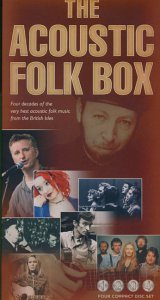
This is a truly exceptional 4-disc compilation box-set in that it fully deserves both its hefty PR profile and a place on the shelves of every folk enthusiast, even those who already boast a large and varied CD library. This box purports to be a "definitive collection" celebrating British acoustic music, and presents a well-nigh-unrivalled history of the folk revival in this country from 1960 to 2000. The compiler is that gentleman of impeccable taste and authority David Suff, who has clearly lavished an inordinate amount of care and time on the project, incidentally producing an exemplary 56-page booklet which perfectly balances insightful informativeness and readability with a high interest quotient in the chosen photographs, and appends a genuinely useful and (unusually!) largely highly accurate discography which lists not only the original releases but also on which releases the tracks might be currently available.
The Acoustic Folk Box complements (rather than supersedes) the (only ostensibly) similarly-themed previous sets like The Voice Of The People and The Electric Muse (which dealt with traditional source singers and folk-rock respectively), for it traces the acoustic thread in the music of the late-20th-century folk revival, an aspect which to date has not been anthologised. It starts with Lonnie Donegan, finishes with Eliza Carthy, and in between covers virtually every important artist whose recordings could be made available (anyone with even an inkling of the difficulties involved in obtaining - or in this case failing to obtain - the necessary permission for including tracks from the likes of Christy Moore will appreciate the harrowing enormity of such a task, and David has done a grand job so no complaints please!). Importantly too, vital developments such as the Shirley Collins & Davy Graham Folk Routes, New Routes fusion are given their due.
The individual selections are almost without exception intelligently chosen, very often eschewing the all-too-obvious choices in favour of cuts more truly representative of the artists concerned. OK, so I was puzzled by the Ralph McTell choice (Spiral Staircase), and those by John Renbourn and Martin Simpson are arguably more marginal than seminal, and I'm sure every experienced listener will part company with the compiler occasionally, but that matters not in the scheme of things, where infinitely more bullseyes are scored than on yer average compilation. David proves his credentials as a true connoisseur of the music by including some of the (wholly or partly) unsung heroes of the folk-roots revival such as the English Country Blues Band, Jez Lowe and Rory McLeod, and by choosing superior versions of Ron Kavana's Reconciliation and Richard Thompson's Beeswing (to give but two examples) from among the different ones recorded by the artists concerned.
Each disc is sensibly sequenced too, and properly represents a single decade. But a particular glory of this set for me was that, even though I'm already familiar with many or most of the selections and/or performers, it kept making me realise that I'd almost forgotten how good they were and made me rush back to my shelves to dig out again Frankie Armstrong's Lovely On The Water, Chris Wood's Lisa and June Tabor's Abyssinians (to name but three). The downside of course is the realisation that quite a number of the key original releases sampled herein (Bandoggs, Roy Harris, Vin Garbutt) have yet to surface on CD reissues, for whatever reason. But even without taking into consideration the rarity value of such cuts, this is an immensely valuable compilation, and a veritable benchmark which belongs firmly in the "if you only own one" category, an equally essential purchase both for the already-converted and for those coming fresh to the delights of British acoustic folk.
David Kidman
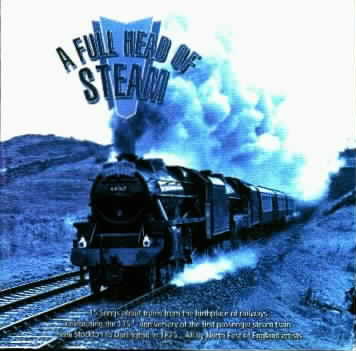
Should you wake up thinking, "By golly, today I think I'll treat myself to a CD full of songs about trains!" this is probably the CD for you. If your tastes run to traditional folk music, I daresay you'll be well pleased. If, however, you're reading this on the 06.57 from Portsmouth to Waterloo (calling at Havant, Petersfield, Haslemere, Guildford, some place in the middle of nowhere for ten minutes, Woking, and just long enough outside Waterloo to make you seriously late for work), then sadly, the song "Directors Of Connex Cry From Prison (With Extra Hard Labour)" is not included.
A Full Head Of Steam is a collection of songs performed by North Eastern artists to celebrate the 175th anniversary of the first passenger steam train from Stockton to Darlington. It's a (mostly) chronological journey from 1825 onward, and The Bev Sanders Band get us started with 'A Dream Of Steam And Freedom'. George Stephenson wonders whether he can take people to the ends of the earth, or just to the limits of their patience. (I may have made the last bit up.) It's a singable song, with a rousing chorus, and it starts the CD off with that reassuring thump that all train journeys give you. All is well, here is comfort, let us take you wherever you would be bound.
Much of the other material on the CD had me singing along, too. There's some familiar songs amongst the selection; Nebula perform 'Right Side Of The Footplate', a Huw and Tony Williams song covered by Fairport Convention as 'Travelling By Steam'. The FC version just has the edge, to my mind. Lindisfarne are featured, with 'Train in G-Major', a new recording of the old favourite from 'Fog On The Tyne'. Actually, the song has precious little to do with trains, but that's just nit-picking.
The songs show trains from many aspects: from the view of the driver (Ewan McColl's 'Song Of The Iron Road'), through the engineers who built the railway system ('The North Eastern Line') to the changes seen by a railway worker over half a century ('Jacko The Shunter'). There is also reflection that a train journey means leaving ('Railwaymans Farewell To Darlington').
Toward the end of the CD, the subject matter drifts from the railways of England to take in other countries - America and India. The predominantly traditional sound of most of the songs changes, too, with Skerne providing an authentic skiffle feel to 'Midnight Special' and The Whisky Priests rocking out in top form on 'Full Circle'.
The range of talents assembled here is exceptional. Some will barely be known outside the North East, but Martin Stephenson, Vin Garbutt, Eddie Walker and the duo of Bob Fox and Stu Luckley are well-established artists. It's good to see a mix of musicians like this, the international superstars side by side with local club performers.
Overall, then, this is probably one for those who like their music traditional and their trains running on steam. Given the original idea behind the project 'a tribute album about trains', the compilers (Ian Luck and Brian Launder) have done a good job. One of the local M.P.s has given his endorsement to the project, some chap from Sedgefield, and he's pictured in the sleeve notes. I understand from other sources that he plays the guitar too, ... should go far.
Unlike the 06:57 from Portsmouth to Waterloo ... OK, guys, next project - "Railtrack ain't working, let's go back to steam". Or maybe "Beeching was wrong!". I think you get my drift.
http://www.afullheadofsteam.co.uk
Mark McCulloch
All Along The Wall, commissioned by Brampton Live prior to that festival's unfortunate cancellation this year, brought together five songwriters (Jez Lowe, Boo Hewerdine, Julie Matthews, Rory McLeod and Ruth Notman) and two performance poets (Kate Fox and Elvis McGonagall), holed up for five days in January in the remote Northumbrian farmhouse of Saughyrigg, close to Hadrian's Wall itself, in order to create a concept piece portraying a geographical and temporal journey across the Wall, telling its story through its people and landscape past and present.
The resultant performance (on day six), recorded in front of an audience, is enshrined on this CD in all its spontaneous glory. While its basic methodology may recall Shrewsbury's recent Darwin Project, All Along The Wall is less a series of songs and more of a mixed-media (song and poetry) collaboration. Yet what could easily have been a bitty and inconsistent melange of diverse elements is transformed by some ancient alchemy into an intriguing kaleidoscopic processional across the expanses of time, during which the listener can experience the Wall from the perspectives of such characters as a Shepherd Who's Lost His Sheep (Julie's powerful take on the foot-and-mouth crisis), the daughter of a Roman soldier (Ruth's poignant epistle Dear Friend), a North African legionnaire (Boo's End Of The World) and a philosophising rambler (Boo's ruminative finale Shore To Shore), or through the captivating retelling of local legends such as Bowness Bells, Haltwhistle Women and Lizzie Batey (the Good Witch from Brampton). Other special moments include the archaeology-themed pairing of Rory's poem The Age Of Wind And Stone with Julie's Albion-like Bridge Over Time, the stirring Rock Of Gelt (co-written by Ruth and Julie) and Rory's delightful country-style waltzer telling of a soldier's love for his Galloway Girl.
The two poets' individual contributions outside of the song contexts work really well as interludes, and even bear a certain amount of repeated play. Interestingly, Elvis's awesome, declamatory brilliance (which is often mildly outrageous – and yes, there is some post-watershed language on display, but it's not gratuitous!) turns out to well complement Kate's sensitivity and comparable linguistic precision, while both of those artistic traits are mirrored in the keenly realised songwriting.
However, while the concepts are sound and the very act of combining song and spoken word often delivers a glorious surprise, there are occasions when I feel the spoken interpolations do not always fully complement the stories-in-song, and occasions where they are actually intrusive, especially on repeated listening (on Haltwhistle Women for instance, an enchanting Jez Lowe song which I could play over and over were it not for the dramatised "gossip" section which ceases to please after initial play).
But to concentrate on the many positive facets of this enterprising project: I could best sum up in saying that by turns highly emotive, wistfully pensive and deliciously witty, All Along The Wall really delivers on its ambitious concept, without any sense of overreaching, and manages by and large to be both enjoyably informative and musically and poetically satisfying.
David Kidman October 2010
Various - All I Want For Christmas (Dusty Records)
Oh yes, it's that time of the year again when you can't walk into a store without being assailed by the festive delights of Slade, Roy Wood, Bing and any number of artists roasting their chestnuts by an open fire. It doesn't have to be that way, at least not in the privacy of your own headphones when you can curl up with a yule log of your own musical preferences and remind yourself that Christmas isn't turkey and tinsel for everyone and that it's not supposed to be just about celebrating how many presents Santa brings.
This is a collection pulled from the deepest obscurity of independent Americana (homegrown and Swedish versions), 17 tracks by artists of whom I'm not ashamed to admit I recognise only one. That'll be opener Eric Hisaw, the Austin singer-songwriter who sounds like a Steve Earle knock-off, bemoaning that he ain't been home at Christmas for too long as he waltzes around his local honky tonk's spruce.
After that it's unknown territory. Barn Burners come over all Chuck Berry with ode to getting seasonally sozzled Lit Up Like A Christmas Tree, Shelly King sprinkles snowflakes over the bluegrass with Let's Stay Home For Christmas and Samuel Jackson by Swedish countryrockers Silver Saddle proves that just because it's the season to be merry you can't sing about standing in a welfare line while Leanne Atherton's bluesy Bells of Bethlehem tackles similar issues to remind everyone that it's supposed to be a time of charity and loving one another, not passing by on the other side.
Elsewhere decidedly contrasting contributions come from The Lonesome Trailers with their Christian country Man In The Middle, The Unkool Hillbillies with a boogie woogie Honey, Merry Christmas, Cynthia Gayneau out in the Appalachian backwoods for I Remember Christmas, the self-descriptive Honky Tonk Christmas courtesy The Stumbleweeds, and Scott McClatchy's heartland rootsy cover of Steve Earle's Nothin But A Child.
For those who need their fix of traditional Xmas tunes, there's a couple of covers, Winter Wonderland from Billy Eli Band and a world weary Do You Hear What I Hear? From Saltwater. But when push comes to shove, the one to crank up over the turkey simply has to be Groucho's chugging country power-pop desperate love plea Dead By Christmas. Wrap that one up with mistletoe. And if you want send a festive greetings card, you'll be pleased to know all the artists have their e mail addresses included!
Mike Davies
Back in the rather musically trashy mid-70s, the original Electric Muse project shone like a beacon of hope. Four noted music critics and historians of the day (Karl Dallas, Robin Denselow, Dave Laing and Robert Shelton) were commissioned to produce a four-disc set to accompany their history of how folk turned into rock. The tracks for the set were largely drawn from the catalogues of the Transatlantic and Island record labels in a unique joint collaboration which formed a benchmark for many subsequent themed chronicles and anthologies. For the set's 20th anniversary in 1996, Lawrence Aston compiled The New Electric Muse together with a volume 2, expanding and updating the total coverage to fill six CDs in all. Now, a dozen years later, comes a freshly compiled All-New Electric Muse collection, which has been produced, researched and curated by the redoubtable David Suff, Fledg'ling Records supremo and one of the leading authorities on folk and folk-rock. Naturally, it exhibits the very highest standards in all three of these categories. Firstly, in order to expound the set's central thesis, you do need to read David's eminently thoughtful introductory essay, for the story of folk into rock can never be expressed better nor more succinctly and I'd be wasting your time by trying (and failing!) to meaningfully précis it here. Suffice to say, the tracks could not have been better chosen to illustrate that thesis, and David's booklet notes are exemplary, there's no other word for it; complemented by some brilliantly selected and entirely relevant archive photos and album sleeve reproductions, the whole set looks great and is a total bargain of the "every home should have one" variety. How much fabulous music there was around, we're reminded. For yes, the music's great too, these three new discs absolutely stuffed with representative gems, ideally sequenced to take you on that journey across the faery bridge from folk into rock that's so memorably depicted on the resurrected and adapted original artwork illustration. It's a great stand-alone compilation, for which any comparison with the original Electric Muse or its anniversary successor should not be mandatory. Personally, I miss one or two of the not-easily-available tracks from that original set, and us old lags will already have most if not all of the tracks on countless other compilations (if not the original issues themselves)… But, taking the All-New Electric Muse for what it is, no purchaser seeking a comprehensive and sensible overview of the field will be disappointed in the slightest with its coverage and excellent standard of presentation.
David Kidman April 2009
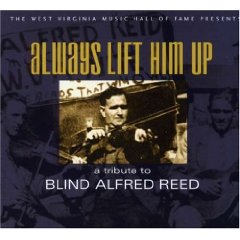
The name of Blind Alfred Reed is probably hovering on the periphery of our musical consciousness without quite recollecting his place in the scheme of things. Born 1880 in West Virginia, he managed to eke out a living from being a songwriter, music teacher and fiddler for dances. His main claim to fame is probably that veritable American anthem from the Depression era How Can A Poor Man Stand Such Times And Live?, which came to the attention of most of us, I suspect, through Ry Cooder's classic early-70s rendition - perhaps even through the New Lost City Ramblers' discovery of the same song a few years earlier. Yet as this tribute collection proves, Reed wrote many more songs of social commentary, being a true chronicler of his times. He tackled a diversity of subjects too, topical concerns like poverty (the collection's title song) and fashion (Why Do You Bob Your Hair Girls?), while he also did a nice line in sanctified gospel (You Must Unload, Walking In The Way With Jesus). And he recorded many titles himself in a prolific mere three years at the tail-end of the 1920s...
Anyway, this present tribute comes under the auspices of the West Virginia Music Hall Of Fame, and has been masterminded by Tim O'Brien. Musicians appearing within the "house band" he's assembled include Jerry Douglas, Kenny Vaughan, Wayne Moss, Kenny Malone, Nick Forster, Michael Lipton, Ted Harrison and Russ Hicks, while track leaders in the spotlight include Tim himself and his sister Mollie, Connie Smith (The Prayer Of The Drunkard's Little Girl), Larry Groce (turning in a killer You Must Unload), John Lilly (Explosion In The Fairmount Mine), Kathy Mattea (We've Got To Have 'Em, That's All) and Charlie McCoy (Fate Of Chris Lively And Wife). I specially liked Dwight Diller's duet with John Morris on the title song, as well as The Carpenter Ants' jaunty take on Money Cravin' Folks, the acappella trio Bare Bones' There'll Be No Distinction There, Everett Lilly & The Songcatchers' vibrant I Mean To Live For Jesus, Mollie's characterful take on Beware, and Tim & Mollie's delicious You'll Miss Me. And two of Reed's compositions (Walking In The Way Of Jesus, Black And Blue Blues) each get a pair of contrasting renditions. Not every selection turns up solid gold, it's true, but there's no way of faulting the conviction of the performances and there's more than enough to keep the stove burnin'. Recording and presentation are state-of-the-art, with full credits given, while there's also a brief but sensible tribute by Ry Cooder and a more thorough biographical essay by Tim that sets Reed's life and work in perspective.
www.properamerican.com
www.wvmusichalloffame.com
David Kidman October 2008
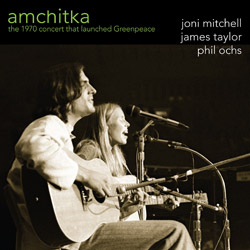
As anyone who was politically aware in the 70s will know, Amchitka was a volcanic island in southwest Alaska where, in 1965 and 1969, the US government carried out underground nuclear tests. Environmentalists were alarmed and outraged and on Oct 16 1970, a benefit concert headlined by Joni Mitchell was held in Vancouver to raise funds to buy small fishing ship the Phyllis McCormack, rechristened The Greenpeace, in which 11 activists would set sail to the island the following year in protest against a third test scheduled for that November.
They failed to prevent the explosion (though the AEC withdrew from the island in 1973), but that historic concert marked the birth of Greenpeace. Almost 40 years later, the organisation is still crusading to prevent ecological damage and a recording of that night has finally surfaced. Seeing that there was a tape recorder running, concert organiser and Greenpeace founder Irving Stowe asked soundman Dave Zeffertt whether, if the artists gave the okay, he could have a copy. Everyone, save for Chilliwack's manager, agreed. Now, transferred from his reel to reel tapes, it's being released via Greenpeace as a 2CD set with all artists royalties being donated to the organisation.
Following Stowe's rallying cry introduction, Phil Ochs opens the show in typically potent and political form, his anger that Prime Minister Trudeau had just declared martial law firing up his performance as he kicks off with The Bells and runs through a set of personal classics that include Rhythms of Revolution, I Ain't Marching Anymore, Joe Hill, Changes and Chords Of Fame.
Then comes a surprise guest. When Stowe approached Mitchell she asked if it was okay to bring a friend to play a few songs too. Although he'd never heard of the name she mentioned, he said sure, hoping it wouldn't ruin the show. Enter stage left, James Taylor, whose Sweet Baby James album had gone platinum that very night, with a vintage set featuring songs that have become evergreens, Fire And Rain, Carolina In My Mind, Something In The Way She Moves, and You Can Close Your Eyes.
The second CD is all Joni, and although, unhappy with the sound quality, she's edited out her opening version of Chelsea Hotel, it's testament to her professionalism and lack of vanity (as well as a very human touch) that she's left in For Free where she loses her way part way through the song, apologising for noodling around until she can find the path back.
The edited version of the set leads off with a sprightly Big Yellow Taxi, also taken from Ladies Of The Canyon, the then just released album that had turned her into a star, segueing straight into a free spirited playful Bony Moronie. From there it's back to her previous material with a lovely full of youthful innocence Cactus Tree from her Song To A Seagull debut and The Gallery off Clouds. Returning to Canyon she delivers a stunning version of Woodstock but for audiences on the night the real treat was the chance to hear as yet unrecorded songs for the following year's album, Blue.
Here then, in still exploratory form are My Old Man and, accompanying herself on Appalachian dulcimer, slapping the body for percussion, A Case Of You. The third nugget from Blue is a breezy, vocally soaring performance of Carey that slides seamlessly into Mr Tambourine Man, touring and romantic partner Taylor joining her midway through in one of the very few recordings of them working together.
He's there again with assorted uncredited friends for the finale, returning to Ladies Of The Canyon for Circle Game. Sadly it fades before the end because the tape ran out, but there is a significant compensation in the fact that the concert features the only officially available version of Hunter (aka The Good Samaritan), a song of which no studio recording has ever been released. History in the making all round, then.
The CD comes with a 48 page booklet of previously unseen b&w photos of the concert, the Amchitka voyage and contemporary Greenpeace.
www.amchitka-concert.com
www.greenpeace.org
Mike Davies November 2009
The soundtrack of the concert special put together to honour the rescue workers of Sept 11, this is a star studded affair brimful of songs that cut to the emotional heart. The melancholic but pride infused tone is set from the outset with Springsteen's stark My City of Ruins and while you might have reservations about rounding things off with Celine Dion's misjudged syrup and strings drenched God Bless America (Willie Nelson's plaintive pain and pride filled acoustic America The Beautiful is far more dignified, even with Mariah Carey wailing away on the mass chorus), you can understand the sentiment.
Between times songs of healing, hope, defiance and dignity are the order of the day. Bon Jovi's stripped down Living on A Prayer, Wyclef Jean's version of Redemption Song, U2's Walk On, and a surprisingly subdued Tom Petty with I Won't Back Down. Billy Joel's New York State of Mind nicely catches the sense of the Big Apple's need for community oneness, while, rather bravely, Limp Bizkit's cover of Floyd's Wish You Were Here with Goo Goo Doll John Rzeznick on vocals is very politically pointed in the circumstances. You also get two songs called Hero, one from Ms Carey, the other by Enrique Iglesias, neither are great but only one necessitates the skip button.
But exceptions noted aside, everyone rises to the occasion for heartfelt performances, even Stevie Wonder regains his form with Take 6 on Love's In Need Of Love Today while Paul Simon's resonant Bridge Over Troubled Water, Dixie Chicks' I Believe In Love and surprisingly Sting's Fragile stand tall in the highlights zone. The defining moment though goes to Neil Young who delivers a version of Imagine that can choke you almost to tears.
Mike Davies
This 3-CD set is a bit of a mixed bag. It collects together three original Pye albums from the late 50s, two of which were originally issued on the Nixa Jazz Today label. These latter two LPs in particular spotlight the pioneering work of Alan Lomax in collecting field recordings of American folk and blues musicians who in those days wouldn't normally have found their way into a recording studio.
The first, subtitled Murderers' Home, is a collection of (mostly) work songs (topped up with a few blues) recorded at Parchman, Mississippi in 1947 by prisoners (gangs or individuals, either completely anonymously or under aliases) carrying out their duties. Even in 1947, though, the custom of worksong-singing was dying out. Sure, the recordings are primitive, but actually pretty good considering the circumstances in which they were made, and any occasional recession in sound quality doesn't get in the way of appreciation. One or two of the selections turn out to be merely tantalising fragments, but most are more fully realised pieces, including some grand examples of more extended hollers (notably "CB"'s Whoa Back). (This album supplements rather than supersedes the more exhaustive series of Lomax recordings of this type of material, mostly made a decade or so earlier, which are currently available on Rounder in such series as Deep River Of Song, though it's a pity that unlike the Rounder releases this Sanctuary issue omits the original song texts from its booklet.)
The second, subtitled Blues In The Mississippi Night, is a kind of thematic concept collection – "the story of the blues told by men who have lived the blues and created the blues" – incorporating recordings of blues giants such as Memphis Slim, Sonny Boy Williamson and Big Bill Broonzy alongside a clutch of loosely related tracks by unidentified singers (including some more worksongs from a group of convicts). The format used was to intersperse musical performances within a framework of the three principal bluesmen talking about their lives and their music (probably half of the album's total playing time is speech). The result, recorded in 1946, proved fascinating indeed, a triumph of documenting totally frankly the black man's experience of the inequities of the Southern system of racial segregation and exploitation – so frankly, in fact, that the bluesmen themselves were reluctant to be identified even on the recording's eventual release in 1957.
The third of the reissues – American Song Train Volume 1 – is the exception in that it comprises entirely studio recordings on which authentic American folk material is revived in performances by Alan himself with Peggy Seeger, Guy Carawan, John Cole and Sammy Stokes. Simply accompanied on banjo and guitar with occasional harmonica, these are appealing if not always exceptional renditions of attractive material; those on which Peggy sings lead tend to form the highlights – the ballad The Two Sisters and a couple of children's singing games for instance. An intriguing footnote to this latter album, by the way, is that the credited engineer is Joe Meek! Whatever, this reasonably-priced set is worth having for once again making available these important recordings in a sensible CD format.
www.sanctuaryrecordsgroup.co.uk
David Kidman
Various Artists - American Roots (Union Square)
And so the Oh Brother bandwagon trundles on, but at least this latest compilation of , er, American roots music is upfront about feeding off the hype. As it notes, several of the songs here figured prominently on the soundtrack with the first number out of the starting gate being Ralph Stanley with Man Of Constant Sorrow. However, trawling several decades of bluegrass, folk, clues and old time country, there's a lot more besides too among the 34 tracks.
Although more contemporary names like Nanci Griffith, Emmylou, Alison Brown, Lynn Morris and, stretching a point slightly, Eva Cassidy are included, the bulk of those featured tend to come from between the 70s and the dawn of time. There's plenty of the usual suspects - Dylan, Taj Mahal, Guthrie, Bill Monroe, the Carter Family, the Louvins (and much as I adore If I Could Only Win Your Love couldn't something less of an old chestnut have been used) and a token Johnny Cash (I Walk The Line, obviously) - but what earns this its stripes are the less familiar (to mainstream ears anyway, and that's who this is aimed at) but no less significant contributors to the rich heritage of American folk music. The Country Gentlemen, the oft forgotten Sonny Terry & Brownie McGhee, bluesmen Skip James and (the only artist to warrant two tracks) Mississippi John Hurt, bluegrass doyenne Hazel Dickens (two of her songs are also covered by other artists), Grateful Dead alumni Dave Grisman, and The Delmore Brothers.
It's good too to have crystal clear recordings of both Duelling Banjos and Foggy Mountain Breakdown, two of the definitive bluegrass instrumentals, and full marks to whoever compiled this for including Fools Gold by the much underrated Poco, a Buffalo Springfield spinoff whose role in popularising country rock has been too long overshadowed by The Eagles and who are long overdue for a reappraisal.
Mike Davies
Various Artists - And They All Sang Rosselsongs (Fuse Records)
Before I go too far, I must stress that this is NOT one of those "all and sundry try their hand at covering songs by one particular writer" albums that come out from time to time and accomplish little other than to embarrass both the performers and the songwriter. Here, in contrast, the very rationale for this release comes from Leon himself. To summarise: for over 40 years, Leon has been "writing songs and sending them out into the world", most of them through the medium of what he terms (with typical self-effacing modesty) his own "very limited voice"; from time to time, one of his songs has attracted other voices and other interpretations, so why not, then, a whole album of other singers' interpretations of his songs? Why not, indeed, provided that those "other singers" are the right ones for the job? So, Leon goes on to explain,"15 singers were approached and challenged to choose one song each to record, the only proviso being that it had to be a song he/she had not recorded before." The result was a set of supremely powerful performances by (in Leon's words) "singers who know how to sing words and are not afraid to stamp their own personalities onto the songs". And, not quite incidentally, an equally powerful proof (as if proof were needed!) of the excellence and longevity of Leon's songwriting. Because of the personal nature of the singers' choices, this is emphatically not a "Rosselson's greatest hits" set. Having said that, one of the songs (The World Turned Upside Down) could well lay claim to inclusion within that collective tag: for is there really anything new that a singer could bring to that oft-covered opus? - well, Robb Johnson turns in a stunning, fresh, spine-tinglingly imaginative, majestic and yes, meditative rendition that (fully in line with Leon's brief) can genuinely be termed an interpretation as opposed to a tired tribute-band cover. Robb's contribution alone is worth the asking price, but every one of the 15 singers delivers the goods in his/her own individual way while retaining the essential, piquant, je-ne-sais-quoi flavour of Leon's writing. David Campbell tries out a bold arrangement for Stand Up For Judas and gets away with it (and with honours); Roy Bailey brings his own brand of storytelling magic to the fable of William; Eliza Carthy perfectly characterises The Man Who Puffs The Big Cigar; Other highlights are Sandra Kerr's sparse, simple yet effective treatment of My Daughter, My Son, Janet Russell's intense, moving take on Song Of The Olive Tree and Martin Carthy's considered version of The Wall That Stands Between, while Nancy Kerr & James Fagan do a beautiful job on the folksy Still Is The Memory. I also really liked Barb Jungr's take on Invisible Married Breakfast Blues (one of the many undervalued Rosselsongs, I feel), and Elizabeth Mansfield's cabaret-style rendition of Don't Get Married, Girls, which does a very nice line in "slightly over-the-top" characterisation. One or two of the other singers who naturally incline towards a theatrical manner of presentation might be felt to (albeit quite unintentionally) draw attention to their fine vocal qualities at the expense of the lyrics, but generally speaking the deeply-felt quality of their interpretations is the overriding and compensating factor. The most important thing is that these songs are put out there, and brought to life with conviction and real understanding of what they're about; almost all of these, not just the best of them, can stand proudly alongside Leon's own signature renditions (which I wouldn't want ever to be without, I hasten to add). While the series of brief quotations appended in the booklet ably typify the Rosselson philosophy and provide a telling commentary on the performances: a neat touch that.David Kidman
Various Artists - Anglo International! (Folksound)
A considerable cornucopia of conglomerated concertinas, collected into a consorted or concerted cacophony of compact construction? Not quite, Leonard, although this commendably copious three-disc set presents plenty of fine playing and, quite against all the odds, turns out to be non-daunting, and a "really good listen" for the non-hardcore concertina fan. And coming so soon after Brian Peters' magnificent Anglophilia CD too, the Anglo enthusiast is really being spoilt now! Anglo International! gathers together (mostly recent, and all previously unreleased, some even specially recorded) performances from many of the instrument's most skilled players, from John Kirkpatrick, Noel Hill, Chris Sherburn, Roger Edwards, Will Duke, Roger Digby, Niall Vallely, Mary MacNamara, Andy Turner and Harry Scurfield through to names who are arguably perhaps known more to the true box specialist (like John Watcham, Tom Lawrence, Andrew Blakeney-Edwards and Mandy Murray - the latter a real find! - and Felix Castro Vicente from Galicia). Many of these folks are of course acknowledged as technical virtuosi of justly celebrated unflappable technique, but all-round musicianship is just as often on display on this set, and it all sounds duly effortless – even though those in the know will tell you different! There's also a sprinkling of historical archive recordings, suitably cleaned up and sounding very fresh indeed, from the likes of Scan Tester, Fred Kilroy and Nigel Chippendale; and there's even some "Zulu squashbox music" too! All of which should tell you that this set contains a staggering cross-section of musical expression, amply fulfilling its aim of demonstrating the versatility of the humble instrument and the surprising breadth of its repertoire (including generous representation of "novelty" and strictly non-folk items as well as Irish and English repertoire).
Many tunes are of the less well-known variety, too, which is a distinct bonus. Although the vast majority of the music here is instrumental, there's a handful of vocal tracks which unashamedly present Sous Les Toits De Paris and St. James Infirmary alongside traditional (the Threlfalls' fine rendition of Bonny Labouring Boy). Elsewhere, morris tunes, jigs, reels and hornpipes rub shoulders companionably with military marches, Scott Joplin and music-hall in a delicious parade that passes by your ears almost in a flash and without overstaying its welcome. On some tracks (eg those by Bertram Levy, Chris Sherburn, Mandy Murray and Frank Edgley), the Anglo is augmented by other instruments. It seems churlish to point out that, within such a mouthwatering expanse of diversity and musical excellence and diversity, some of the Anglo's present-day (indisputably) key exponents are maddeningly, and inexplicably, omitted - there's no Brian Peters, and for that matter no Keith Kendrick... And while the presentation certainly appears at first glance to be admirably exhaustive, with a fat 48-page booklet, the whole package is actually compromised rather by slipshod editing (some track details are transposed or mixed up, eg on the final pair of tracks on disc one) and by the adoption of an apparently random, entirely illogical, and thus needlessly confusing, sequence for the sections devoted to the individual players, their biographies and their tune source details (even though these are well written and include much fascinating background information that's just as useful, and non-impenetrable, to the non-specialist as to the Anglo aficionado). But at only £25 incl P&P, this feast of a set is a hell of a bargain, and Noel Hill's magisterial and highly emotional keening on his landmark seven-minute performance of a slow air (Limerick's Lament) is alone almost worth that modest asking price.
David Kidman
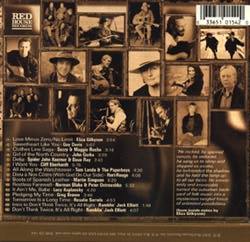
In honour of Minnesota-born Bob Dylan and his 60th birthday on May 24, 2001, Minnesota label Red House Records' artists have put together an album of fifteen of his songs, which includes some absolute gems, introduces us to some artists we may not have heard and confirms the label's depth, breadth and quality.
Dylan's songs are powerful material and women have often brought some additional magic to them and/or produced the definitive version. Joan Baez's 'Love Is Just A Four Letter Word' (1968) and Little Feat's Shaun Murphy's 'It Takes A Lot To Laugh, It Takes A Train To Cry' (2000), immediately spring to mind. We all have our favourites, and now I have some new: Suzzy and Maggie Roches's laid-back harmonies on 'Clothes Line Saga'; the reflective 'It Ain't Me Babe' by Lucy Kaplansky; Eliza Gilkyson's opening track 'Love Minus Zero/No Limit'; and Rosalie Sorrels' gentle-country 'Tomorrow Is a Long Time'.
John Gorka's beautifully-paced 'Girl Of The North Country'; 'All Along The Watchtower' (with banjo) from Tom Landa & The Paperboys; Hart-Rouge's version in French of 'With God On Our Side', Martin Simpson's 'Spanish Leather' - as haunting a cover of that heartbreaker as you're likely to hear; and a rough-and-gritty blues 'Pledging My Time' by Greg Brown - all stand out.
Dylan's genius is without question and these artists lovingly tip their collective hat to him here. Happy Birthday, Bob!
http://www.redhouserecords.com
Sue Cavendish
Various Artists - A' The Bairns O' Adam (Greentrax)
It's taken me a while to get round to this tribute album to Hamish Henderson, for no apparent reason other than that it's been listened to piecemeal rather than all in one sitting. It doesn't deserve to be treated in that way, for it's a fine, abundantly thoughtful and generously unified CD. No generic pigeonhole does it justice, just as no generic pigeonhole does Hamish himself justice. Poet, songwriter, collector, soldier, academic - Hamish, the true polymath, was without doubt one of the major cultural figures of 20th Century Scotland, and this excellent CD is an honest, serious and eminently fulfilling tribute to this great man. Most of its tracks were recorded specially by artists who were personal friends of Hamish's and/or else greatly admired his work, and the collection both reflects the breadth of Hamish's activities and highlights his personal concerns and passions. The new performances are suitably committed and without exception very fine indeed; highlights for me (among a CD stacked full of great performances) include Alison McMorland's rendition of The Flyting O' Life And Daith and Gordeanna McCulloch's two tracks, which begin with an immensely gripping and highly concentrated take on the brief ballad The Speaking Heart; Gordeanna really penetrates to the heart of her songs like no other singer, and her rendition is a real showstopper. I also enjoyed the brief moment when Adam MacNaughtan "tak's the floor" for the delicious tongue-twisting Victory Hoedown, and the contrasting reading of one of Hamish's poems (the moving Ninth Elegy), so very convincingly linked by the reader (Margaret Bennett) to a performance of one of Hamish's favourite Gaelic songs. Another emotional moment comes when piper Allan MacDonald performs the two song airs he'd played at Hamish's funeral, though for me the effect is diluted just a tad by Fred Freeman's reciting of Hamish's own laments over the first of the tunes. The lighter side of Hamish is recalled with Ballad Of The D-Day Dodgers (courtesy of Rod Paterson), while Geordie McIntyre turns in The Ballad Of The Men Of Knoydart accompanied by Alison's banjo and Sandy Brechin's box. Other musicians contributing to the new recordings include Angus Lyon (accordion) and Malcolm Stitt (guitar, bouzouki). The final piece on this affectionately-compiled tribute is another masterstroke - Jeannie Robertson's vital 1960 performance of My Son David, taken from the archive of the School Of Scottish Studies. The remaining non-new recordings on this CD are interesting in themselves: there are two by Hamish himself - first a distinctly spirited, albeit brisk1951 performance of The 51st Highland Division's Farewell To Sicily, and second the "canntaireachd" of Mouth Music. An unusual inclusion is the Corrie Folk Trio's 1968 recording of Hamish's "Free Mandela" song Rivonia. Then there's Dick Gaughan's celebrated 1978 version of The Song Of Gillie More (taken from his eponymous Topic album) and the 1972 rendition of The John MacLean March by The Laggan (a version which Hamish himself particularly enjoyed). As tribute albums go, this one is truly in a class of its own.
David Kidman
Various Artists - Autumn Acoustics (Solarise Records)
The online-based independent label Solarise has a mission to alert the world to the wealth of talent out there. It's now releasing its second compilation of music from independent acoustic-based artists, some signed and some unsigned, some from other countries but mainly from England. The vast majority of these were completely new to me, but almost every one of them has something of interest to say and most have an individual way of saying it. An increasing number of us are becoming acquainted with the songs of Lancaster-based Angie Palmer, and her track I Need You appears here; though not entirely representative of her current work, it nevertheless showcases Angie's songwriting talent and distinctive, skilled guitar and vocal approach very well. Worcester-based Jamie Knight presents the slightly over-ornate Girl In The Light from his album Bound (on which the jury here's still out). Otherwise it's a lucky dip of unknown names, out of which those I rated most (apart from Angie!) were Birmingham roots/folk outfit Medicine Sunday and Denmark's Perfect Pitch (who coincidentally both feature a female vocalist and a cool, tight, stripped-down arrangement), Australia's Jeremy Harrison (the intriguing Old Man Patriot, set to a hypnotic rippling guitar figure) and America's Big Wolf Pappa. Maybe the Torch Moths' Look To The Hills is a rather obvious graduate of the Syd Barrett/Robyn Hitchcock school of acoustic whimsy, but still it's none the worse for that. Roger Francomb's soulful Breathe stretches out nicely, with overtones of John Martyn and Richie Havens. The CD sags a bit with the more ordinary acoustic-rock selections towards the middle, which though efficient enough are ultimately too melodically repetitive and thus less memorable. Overall this is a worthwhile collection though, and if it achieves its aim in bringing these performers to our attention then all the better.
David Kidman
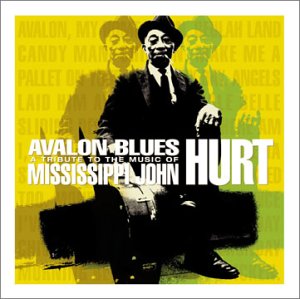
Mississippi John Hurt was my first love and I go back to his music again and again. I'd 'discovered' his 1928 track, Stack O'Lee, on an old blues compilation just prior to the music industry rediscovered him 35 years after that original recording was made. He'd been working as a farm labourer in Avalon until a young blues enthusiastic wondered if he was still alive and went down to Mississippi and found him. It's a story stranger than fiction. MJH died in 1966, but not before playing Festivals and coffee houses across America and recording some of today's most influential acoustic blues. Candy Man Blues? You'll hear it here first. Those 1928 recordings are available on CD; Avalon Blues: The Complete 1928 OKeh Recordings (Columbia/Legacy) and there's more on Vanguard and Rounder. His fingerstyle, thumb-playing-the-bass-line-on-top, rolling acoustic folk/blues has influenced the likes of John Fahey, Leo Kottke, Bob Dylan and a thousand more.
Our thanks are due to Tom Hoskins who rediscovered MJH and to Peter Case who 'collected' a host of contemporary blues and country giants to record his songs for this wonderful, just-released tribute album. Chris Smither, Bruce Cockburn, Lucinda Williams, Alvin Youngbood Hart, Steve & Justin Earle, Peter Case & Dave Alvin, Ben Harper, Geoff Muldaur, Mark Selby, Beck (who plays that seminal Stack O'Lee, here called Stagolee, alone with acoustic guitar), Victoria Williams, Bill Morrissey, Taj Mahal, Gillian Welch and John Hiatt take 15 of his songs and give them their own blues, folk and country interpretations.
I won't say more; Christmas is six months away so you'll have to buy it for yourself. The album is a must-have!
http://www.vanguardrecords.com
Sue Cavendish
Ballads Of The Book is an elaborately ambitious project which features some of Scotland's best writers and musicians. The brainchild of Idlewild's Roddy Woomble, it began in 2005 as a simple idea to bring together the literary talents of Scotland's writing community with a diverse range of new and established recording artists. Idlewild had of course already explored artistic collaboration with poet Edwin Morgan on their album Remote Part, but Roddy wanted to take the idea a stage further by enabling other writers also to create original lyrics which the musicians could then interpret however they wished. The dual qualities of literary, poetic elegance and cutting-edge innovation in the writing are reflected in the unbridledly eclectic nature and range of the musicians and singers chosen to participate. Established folks like Alasdair Roberts, James Yorkston and Mike Heron (original Incredible String Band member) turn in some inspired vignettes (Alasdair Roberts' take on Robin Robertson's The Lowing works particularly well), while there's a rare appearance by the elusive hippy-child Vashti Bunyan (on Rodge Glass's The Fire) and King Creosote essays Laura Hird's Where And When? and Karine Polwart's setting of Edwin Morgan's The Good Years is utterly charming. Elsewhere we find contributions from Idlewild themselves, the Trashcan Sinatras, and two of Chemikal Underground's own acts (De Rosa and Aerogramme); and the Delgados' Emma Pollock gives us a taste of her solo activities with a gutsy interpretation of Louise Welsh's Jesus On The Cross. All of the chosen performers respond to the writing in an invigorating, imaginative and persuasive manner, although the more strange among the imagery isn't always necessarily conducive to an instantly appealing musical setting and thus some of the tracks take a few plays to sink in. But tracks like Sons And Daughters' brooding The War On Love Song, and Dreamcatcher by the as-yet-unsigned band Foxface are but two of the album's standouts and undeniably impressive on first acquaintance. Aidan Moffat's rough-hewn, episodic indie treatment of Ian Rankin's The Sixth Stone seems ideally matched to its author's peculiar literary qualities, whereas Alasdair Gray's Sentimental Song proves suitably cryptic in the hands of Lord Cut-Glass. The stylistic disparity of the contributions - and of the writing, indeed - isn't in fact a problem, much against my expectations. And the label's website contains a wondrous mini-site devoted entirely to the project; copious information on each of the performers, together with full lyrics... great, but nothing on the site will print out!).
David Kidman March 2007
Balling The Jack: the Birth of the Nu-Blues (Ocho)
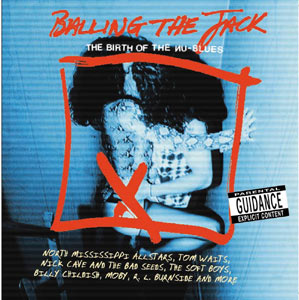
I think it was J.J. Cale who once proclaimed that he'd "heard the news, it's the same old blues". And despite this collection's claim to be The Birth Of The Nu-Blues (note that the typography places the N back to front in Nu - and hey, why not Blooz or some other text derived massacre?), surely Cale is, in part, right on the money. The Blues (blooze, / bluz / bloos) is a feeling, an emotional response. The roots of any music given the name must be based in the gut, the heart and, of course, the soul. Consequently all talk of deconstructing The Devil's Music leaves me somewhat cynical. Now I know that the blues is also an arm of showbiz; it's clear that even a giant of the genre like Muddy Waters went out to entertain. It's for sure that even his Mojo couldn't perform to order, if you see what I mean. Further it seems clear that Robert Johnson's sticky end was the result of him cashing in his performer's charisma a little too often rather than old Nick collecting his contractual obligations.
What I'm saying is that however you slice the rhetoric, if you can't walk it like you talk it, it ain't the blues.
Take Moby, whose Find My Baby is included here, can a piece of music that samples and reshuffles genuine blues be the blues? Is the process of programming and reordering computer samples head or heart? I woke up this morning, believe I'll boot my Mac? Mind you, there are those who believe that installing Windows is akin to signing a pact with the Devil . . . And indeed, Alabama 3's Woke Up This Morning (stupidly omitted from this disc) which also samples blues legends, I'd gladly accept whilst mauling Moby. The difference is clear; Alabama 3 feel the music whilst, for me, Moby remains a hapless observer. Just as an aside, could the relative commercial success of these two acts actually prove my point in these musically anodyne times?
What of the rest of the album? Well I'll go along with Captain Beefheart as nu (oh, dear) blues, buy why showcase him with the 37 year old Electricity rather than say the still three decade old yet intrinsically nu-er Dachau Blues, a clear forerunner of the genre being floated here. Tom Waits too will get the vote though tying him to any specific mast is folly. And . . . well after listening to the full enchilada it's clear that the nu-blues is indeed same as the old blues. You know you can deconstruct, add beats or cover yourself in woad, but in the end if you don't feel it, it ain't the blues.
What's more the argument is as old as, well, the blues. The blues was ruined when it left the slave ships and took the fields right? Well no but when the musicians migrated to Chicago and plugged in, no again. Ok, but when those white boys stole the music . . or Wolf went psychedelic? My advice - ignore the blather. This might be 'old skool blues given a turbo-charge with hip hop thrills, punk power and art rock experimentation' but it's still music aimed and heart, soul and groin like all good rock'n'roll and it's the response of your organs that count.
Personally - and let's go back to the real meaning of the album title here (black slang for, er, having a reallly good time! Ya dig?) - seems to me that nu blues is for the nu breed who prefer their pleasures AA powered rather than driven by flesh and blood.
Steve Morris
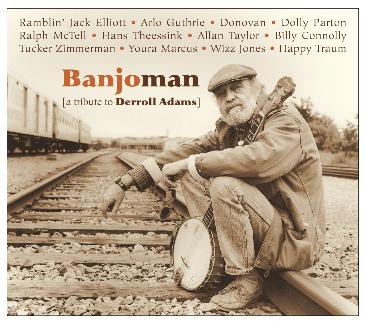
"Banjoman" Derroll Adams died in February 2000, aged just 75; it's no exaggeration to state that ever since the 60s he'd exerted a profound influence on many musicians. So much so, in fact, that this tribute album was already being conceived, with the blessing of Derroll himself, as far back as 1998. Hans Theesink has been the prime mover for the project, and the end result now appears on his own label. It's a lovingly presented artefact indeed: a fulsome 77-minute CD, housed in a sturdy case and coming complete with a beautiful, substantial booklet which includes sensible biographical notes interspersed with often poignant reminiscences (Derroll's own as well as those of the participating musicians) and a selection of excellently reproduced photographs as well as full song texts and performer credits. Performers associated with Derroll were very keen to be involved with the project, and so it took shape very quickly; even so, Derroll sadly never got to hear the end product. The material is a mixture of covers of Derroll's own songs, specially-composed tributes and songs from his own repertoire, and this works well and provides both a thematic unity and the necessary variety. Rambling Jack Elliott, one of Derroll's earliest musical collaborators, contributes three tracks - The Cuckoo, Muleskinner Blues and a version of Derroll's own The Rock (one of two on this CD). The timbral depths of Derroll's own distinctive voice are approximated by Hans Theesink's delivery on Freight Train Blues and 24 Hours A Day. Allan Taylor's resonant tones are just perfect for his personal homage Banjo Man and a superb version of Derroll's own song The Sky. Donovan brings to the project a fine version of The Mountain and a new rendition of his own somewhat fey Epistle To Derroll, also supplying vocal harmonies to several other tracks. Other memorable moments are provided by Dolly Parton on My Dixie Darling, Wizz Jones and Ralph McTell duetting on Willie Moore, and Ralph's own touching and finely-drawn memoir A Feather Fell. As will be expected, Happy Traum and Arlo Guthrie also put in appearances, as does Derroll himself on the apposite closing recitation of A Profound And Beautiful Sadness. Just one or two of the tributes are perhaps a little over-reverential, but for the most part the gentle persuasiveness of Derroll's own approach is affectionately conveyed in these tribute performances. It's a really splendid package, in every way worthy of the character of the man it commemorates, and thus a truly fitting tribute.
Derroll's album on www.theessink.com
David Kidman
Various - Beautiful: A Tribute To Gordon Lightfoot (Northern Blues)
And still the tributes keep coming. Best known for If You Could Read My Mind, the Canadian singer-songwriter's been churning out songs for the past 40 years, hitting a golden streak in the 60s when he provided hits for himself and artists such as Peter, Paul and Mary and Marty Robbins. Five Grammy nominations and 17 Juno Awards seem reasonable grounds for this homage by his fellow Canadians, 15 newly recorded numbers by such well known acts as Cowboy Junkies and more internationally obscure names like Connie Kaldor.It has to be said that it doesn't start promisingly. The Way I Feel is Cowboy Junkies by the numbers, Jesse Winchester turns the great Sundown into a lumbering swampy blues, while Ron Sexsmith saunters through the fairly recent Drifters with an offhand casualness that sounds like he was staring out the window while he sang. But it gets better from the moment Bruce Cockburn enters the picture with a wonderful slowed down late night and nicotine smoke resonant guitar interpretation of Ribbon of Darkness, Blue Rodeo, rather perversely choosing a song Lightfoot's rumoured not to care for, give Go Go Round a ringing country rock treatment while Blackie and the Rodeo Kings (which includes Stephen Fearing) pretend they're The Band for Summer Side of Life.
On the face of it not a match made in heaven, even so The Tragically Hip (Canada's mix of REM and U2) give civil rights number Black Day In July a suitably powerful mood that captures the events it's describing, while elsewhere other highlights must surely include Maria Muldaur's weary bruised heartlands folk version of That Same Old Obsession, James Keelaghan investing Canadian Railroad Trilogy with the spirit of Stan Rogers and Harry Manx bending lap slide and steel around the lazy day fishing ode Bend In The Water.
Though it would have been interesting to hear what say Bare Naked Ladies might have made of The Wreck of the Edmund Fitzgerald, refreshingly there's a fair representation of lesser known songs (possibly because that way they're not going to get so readily compared to the originals) rather than such obvious chestnuts as Early Morning Rain or Cotton Jenny. But yes, If You Could Read My Mind is here, courtesy of the aforementioned Ms Kaldor who, since you ask, is a Saskatchewan folkie whose voice carries the taste of the prairie and echoes of Joni and whose version must surely give even Lightfoot shivers.
Mike Davies
Soundtrack - Because of Winn Dixie (Nettwerk)
It's hard to imagine the ten year olds at which this tale of a girl, a dog and a community coming together is aimed are going to be much impressed by a soundtrack that features the likes of the Be Good Tanyas. However, their significant elders might well be advised to give this a listen. Rather than simply lifting material from extant albums, most of the recordings here are exclusives, kicking off with the Tanya's distinctive Opal's Blues. Other purpose build cuts include Emmylou Harris's late night under desert skies Cabaret, the skippingly sunny I've Gotta See You Smile by Leigh Nash of Sixpence None The Richer, Shawn Colvin's pure crystal streams sounding Fly, Someday Somehow from the Bangles-like sibling quintet The Beu Sisters and rising bluegrass star Alice Peacock with Sunflower.
Elsewhere the Finn Brothers's previously issued gorgeous Won't Give In sits alongside Shirley Ellis's classic Clapping Song while, keeping the rock n roll doo wop nostalgia going former Smashing Pumpkin James Iha joins forces with Ivy's Adam Schlesinger for a romp through Bobby Darin's Splish Splash.
Film co-star Dave Matthews (yes, of the band) puts in backing and production vocal duties for the gospel shuffling Glory Glory belted out by Patrinell Wright and Gloria Smith of the Total Experience Gospel Choir. Oscar winner Rachel Portman provides the three haunting, downhome rural Southern folk hued score samples that provide a fine evocative aural image of the film's wistful coming of age nostalgia itself. Take the kids, buy the album.
www.becauseofwinndixiemovie.com
www.nettwerk.com
Mike Davies
This rather unprepossessingly titled 3-disc set might easily have been dismissed as just another trashy tourist-fodder cash-in, but instead it's a real gem, and yes it does contain some classic performances from the Irish tradition. Each of the three discs has been available before, but this low-priced box is a sensible way of acquiring them for your collection. The original releases date from the time of the major folk revival (late 50s/early 60s), and are some of its greatest treasures.
Disc 1, The Lark In The Morning (subtitled Songs And Dances From The Irish Countryside), dates from 1955; its actually the long-lost first recording by Liam Clancy and Tommy Makem. These two legendary figures in Irish music were signed to the Tradition label, in fact, for a time before their heady success on the Ed Sullivan Show catapulted them into a major recording contract with CBS, and this LP, recorded in Ireland by the American folksong collector Diane Hamilton, presents them at their unadulterated and charming best, taking their place naturally among family and friends (these include Paddy Tunney, Joan Clancy, Sarah Makem, Dennis Murphy and the shortly-to-be-famous fiddler Padraig O'Keefe). It contains superbly definitive renditions of songs, many of which are now staples of the repertoire (Paddy's Rockin' The Cradle, Sarah's In The Month Of January and Tommy's Cobbler, to name but three), some as solos and some as duet performances, punctuated with fresh, unadorned playthroughs of sundry jigs, hornpipes and reels. Of course, as Liam's own chattily illuminating insert notes point out, these recordings come from a more innocent time, but they are immensely captivating and attractive in their own simple way, with plenty of presence and no need for any studio enhancement or artifice.
Disc 2 dates from 1961, and takes the Clancy/Makem story on to the third original "Clancy Brothers And Tommy Makem" album release, where Liam, Patrick and Tommy embarked on an exploration of what the sleeve note endearingly terms "all the moods and lines of the Irish song". Although recorded a long way from their native homes, this time in New York, it still claims to retain the "old country ring of honesty" in its own playful, foot-tappingly vigorous fashion. Myself, I find their often exaggeratedly hearty style (very much the precursor of pub-folk Oirish) has dated rather, and bears repeated listening somewhat less than the other two discs in this box, but there's still a certain historical fascination in these performances.
Disc 3 - The Bonny Bunch Of Roses - dates from 1959, and brings forth Seamus Ennis, his voice, whistle and uillean pipes, on just 14 selections from his vast repertoire that runs the gamut of Irish tunes and song. "Sharing the pipes and poteen", these are authoritative performances indeed, a joy from start to finish, infused with warmth and erudition, and many arguably virtually unrivalled too. But the whole of this box-set is a veritable bargain, an investment that any lover of the real Irish tradition won't for a moment regret, to be sure. I'm already looking forward to volume 2.
David Kidman
Almost eighteen years in the making, Big Blue Ball grew from three extraordinary Recording Weeks at Peter Gabriel's studios in the summers of 1991, 1992 and 1995. These times made creative use of the studios' different rooms and facilities for all manner of collaborations and experiments involving a host of world musicians, many of whom were in effect just dropping by. This hour-long album is but the "final cut" eventually made by Peter in conjunction with Kurt Wallinger (World Party, Waterboys), the tip of the recorded iceberg (the press release enticingly lists some that didn't make it onto the CD), and its eleven tracks feature (musically) every potential element from Afro-Celt to techno, oriental grooves to ritual percussion and Madagascan rap. Although each track is a real melting-pot, each also has its own distinctive stylistic signature, and there's an immediacy about the music-making on the majority of the tracks that betrays the often lengthy period of studio gestation, for the sessions were all about vibe and momentum and the buzz of having all that talent in one place for only a short time. Having said that, the end product is still self-evidently a studio distillation of all that talent. Although some tracks will inevitably appeal more than others, there's a high artistic success factor to the experiments enshrined within. I was captivated by the ethereal Rivers, which spotlights Hungarian Martya Sebestyen's amazing voice, and the middle-eastern eclecticism of Habibe (featuring Natacha Atlas), while the exotic pounding groove of Hukwe Zawose's Forest is both hypnotic and stimulating, as is the intriguing blend of Juan Cañizares' flamenco guitar and Papa Wemba's Congolese band on Shadow. I also liked the trippy Celticry of Altus Silva (with Joseph Arthur and Iarla Ó Lionáird vocalising) and the Sinead O'Connor collaboration with Joji Hirota and Guo Yue on Everything Comes From You. Rossy's rap Nijy also conjures an exciting sound, partly through embracing Jah Wobble's signature arpeggioed bass work. But for me, the least satisfying are the tracks featuring Peter G's own vocals, which have a sound more akin to straight pop-rock: the opening and closing tracks, while Burn You Up, Burn You Down (featuring Billy Cobham and Jules Shear) is closer to conventional disco. Perhaps the biggest surprise is the unity achieved by the sequencing onto a single disc of so many disparate musical elements - a tribute to the studio skills of Messrs Gabriel and Wallinger without doubt.
www.realworldrecords.com/bigblueball
David Kidman September 2008
Big Chill/Rhythm Sticks At The Festival Hall 16th July 2000
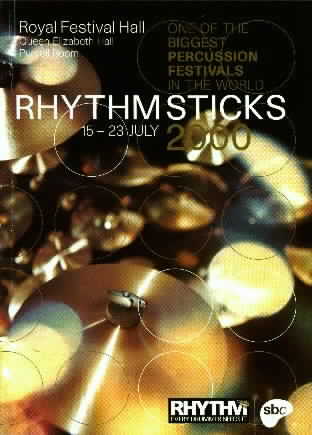
One of the biggest percussion festivals in the world is being held at the Festival Hall, London. World, jazz, rock, contemporary and classical styles, have come together for a nine-day drumfest ending on July 23rd. It's an immense aural and visual extravaganza, guaranteed to dominate and batter into abject apology anyone who's ever laughed at a 'drummer' joke. Promoting it at the Festival Hall, big sound and big acoustics with full screen backdrop of projected images and smoke effects, make for a larger than life occasion.
Of the many diverse acts on Sunday presented by Big Chill, The Master Musicians of Jajouka and Talvin Singh, Robin Jones and his Latin jazz, and Luke Vibert and B.J. Cole with Pete Lockett, I tell you about the latter because of its uniqueness.
I've never seen anyone chain-smoke and drink beer on stage at the RFH. Pony-tailed Luke Vibert did, like some laid-back conductor orchestrating his programmed sounds, smiling at B.J. and enjoying himself enormously. Vibert must be one of the most creative of the young exponents of electronic music. It's not just drum & bass, hip-hop, ambient, or whatever is the latest thing being played in the clubs, he's working with real musicians. There is risk in any performance where you juxtapose and adapt programmed beats and sounds and weave them with the personality of 'human' input (in this case) of pedal steel and awesome live percussion. This is where Vibert obviously gets his creative kicks. Legendary B.J. Cole's pedal steel may have got a little lost in the synth sounds but Lockett's contribution took it to another place entirely. From frenzied sung scat, emulating the tabla, to djembe, to 'talking' style drum played with western sticks, the whole performance was boosted into one powerful thunderstorm of sound. Pity he's not on the album, Luke Vivert, B.J. Cole - Stop The Panic (Cooking Vinyl), but I like it anyway!
If you need a sticks fix email: rsticks@rfh.org.uk
Sue Cavendish
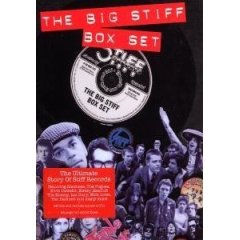
If this ain't an essential Xmas present then I don't know what is! Quite simply one of THE compilations of the year, this lavish and fabulously comprehensive four-disc collection, housed in a chunky hardcover DVD-sized box with a great little 68-page book, gathers together in a heady parade over five hours of music from the magnificent Stiff Records label. The set's 98 digitally-remastered tracks provide an arguably definitive overview of the groundbreaking imprint, embracing the hits, the should-'ve-beens, the discoveries, the trends and the more peculiar experiments, many of which haven't appeared on CD before, while it also finds time to throw up (and I use that phrase advisedly!) some enticing rarities along the way. All the various facets of the Stiff corporate personality are represented, from the label's first-rate championship of (and massive impact in turn on) emergent punk to its support of the mod scene and its work with late-70s pub-rock and 80s electro-pop. It had more than its share of unsung heroes too, and it loved to shock the music establishment by promoting and nurturing unique and oddball talents(true British eccentrics like Max Wall, who released his first-ever single, England's Glory, on Stiff at the age of 69!),
Disc 1 kicks off in 1976 with the first half-dozen of Stiff's A-sides (catalog numbers BUY. 1 through 6, classic Nick Lowe through The Damned via Roogalator and stuff I'd not got round to hearing at the time like the quasi-Beefheartian boogie of Tyla Gang and the raunchy 12-bar of Lew Lewis), then continues more or less numero-chronologically by way of Elvis Costello, Devo, The Adverts, The Yachts and Jane Aire & The Belvederes. And Mick Farren reinventing the Deviants with his own brand of rocked-up punk (Let's Loot The Supermarket Again). Not daring to omit those brilliant mavericks that Stiff discovered, Wreckless Eric and Ian Dury, who deservedly get a couple of tracks apiece. The Damned get four, charting their "progress" from New Rose to One Way Love. The disc closes with one of the few Stiff releases that never did much for me, Romeo & The Lonely Girl by Ernie Graham. In the midst of the disc, there's chalk to cheese with the aforementioned Mr Wall and Motörhead, whose lone Stiff release White Line Fever (born out of the dirt at the crossroads where punk met heavy-metal) never even made it to the shops… and that's just one of the many enticing rarities that Stiff have proudly placed on display for this celebratory box.
Disc 2 moves the story on from 1978, opening with The Members' Gumbyesque "classic-of-Oi" debut Solitary Confinement that sidestepped their later preoccupation with the reggae vogue. The label's coloured-vinyl collectables are represented by the rarely-outed Humphrey Ocean's fun (if mildly Duryesque) Whoops-A-Daisy. Stiff also promoted talented one-offs who at the time were hoping for a jump-start to their careers, like the mod-punk-pop Realists, the altogether grittier Scottish punks The Subs (who as it happened didn't go on to better things) and Pointed Sticks (who regrouped last year as The Tranzmitors). Disc 2 also presents examples of Stiff's flying in the face of the attitude of the day by promoting female performers, from Rachel Sweet (I Go To Pieces and the tremendous girly-pop B.A.B.Y.) to the rather weird Lene Lovich (who gets three tracks on Disc 2), Kirsty MacColl (her aborted second single You Caught Me Out appears here) and the brilliant Go-Go's. Also during the course of Disc 2 we witness the post-recording-debut infancy of Madness (arguably the label's most successful act) and their "heavy heavy monster sound" (One Step Beyond) from an era when the Two-Tone fixation was in full swing. Stiff also fostered the development of the ingeniously quirky songwriter Jona Lewie (veteran of the Brett Marvin/Terry Dactyl combos who came out of the 70s pub-rock circuit), Graham Parker's backing band The Rumour (here represented by the atypical, if at the time chillingly contemporary, synthy epic Frozen Years) and sharp Staten Island-based power-pop outfit Dirty Looks. Disc 2 also brings us the awesomely over-the-top chainsaw-wielding mayhem of the Plasmatics' Butcher Baby and the Ubu-inflected Motor Boys Motor, concluding with proof positive that Stiff had their finger on the pulse of the tastes and trends of the scene in all its diversity: tracks by the legendary Desmond Dekker and the exuberant tex-mex party man Joe "King" Carrasco.
Disc 3 kicks off with the second of the set's three Any Trouble tracks, followed by the under-appreciated but stimulating yet delicate punky-reggae of the Equators (Baby Come Back) and a contemporary but rockabilly-inspired obscurity in the shape of Nigel Dixon's only release. Then comes a procession of Stiff chart hits, courtesy of Jona Lewie, Dave Stewart (with Colin Blunstone), two apiece by Tenpole Tudor and the era-defining Belle Stars, with further contrast in the form of the excellent mod-punk of Department S, the post-punk outfit Theatre Of Hate in their Westworld and the strange "Cure-meets-Wurzels" of The Dancing Did's Lost Platoon. Not to miss out the tremendous, angst-ridden (and chart-topping) cover of It's My Party by Dave Stewart and Barbara Gaskin (surely one of the most penetratingly accurate reworkings in pop history), which earns pride of place on Disc 3. Eddie Tudor's country-folky Hayrick Song is surprisingly good fun too; this, like the Passion Puppets' rather fine (if in places quite Bunnymen-like) track (Like Dust) was new to me. Also on this disc, Stiff's 80s excursions into vaguely electro-pop New Romantic territory are represented by the misleadingly-named Electric Guitars, the more screwball Devo successors Yello and the intriguing world-music-wise singing of Brigit Novik (with electro-pop outfit M). Disc 3 also chronicles the label taking a chance on some decidedly unlikely acts: Alvin Stardust and Tracey Ullman... and perhaps the least said the better (musically) about ex-Pretender Billy Bremner's annoyingly repetitive Loud Music In Cars, although the weird synth-and-samples workout Who Likes Jazz? by one-single-wonder duo Via Vagabond has undeniable charm all its own.
Finally to Disc 4, which moves into the mid-80s (and the label's eventual collapse into bankruptcy in 1987) with some typically "crazy to try but crazy not to" ideas like the tasty gospel of The Inspirational Choir Of The Pentecostal First-Born Church Of The Living God (yes, really!), framed by some more prime Kirsty MacColl sides, no less than four Pogues tracks and two from edgy ska revival outfit The Untouchables. There's also a slice of strident "wild colonial" Attitude from Northern Ireland's Ruefrex, classy if mildly anonymous pub-rock from Dr Feelgood, the heavily Jam-influenced pop of Makin' Time, the sparky female pop of the Mint Juleps (who mostly sang acappella, though not on this appearance), the seminal fringe-indie of Furniture, the soulful neo-garage of The Prisoners, some swinging acid-jazz from Tommy Chase and the recorded debut of Belfast-born singer-songwriter Andy White. The set's closing sequence brings the label uptodate with its recent renaissance and tracks from recent albums by Eskimo Disco, the Tranzmitors, the Producers and the re-formed Any Trouble. Oh, and finally there's a nod to Stiff's contribution to comedy too, but in the form of an extract from the Wit & Wisdom Of Ronald Reagan album (which doesn't even last 4 minutes and 33 seconds, if you get the gist...).
One other factor in the overall high desirability of this box is its presentation. Its hardcover case encases not only the discs themselves but also an insert containing a full colour book featuring a label history, new interviews, a potted biography of every artist on the discs and as many photos and bits of illustrated artwork for sleeves, flyers and badges as the makers could squeeze in! Unfortunately, the disc-by-disc tracklist is almost unreadable, due to poor resolution of the faint typeface used; that aside, the book is a recommendable collectable in its own right, and a perfect companion to the discs themselves.
All in all, the box-set may concentrate on the singles Stiff released, with a healthy quotient of rarities and stuff hitherto unavailable on CD, but it does illustrate (and very well too) Stiff's maverick character, its willingness to take a chance on ostensibly unpromising acts or musical adventures and its determination to fly in the face of acceptability. Oh yes, and the influential nature of many of the acts who were nurtured or launched at Stiff and jumped ship for greater things as destiny called. OK, so in the end many of its acts were barely even footnotes in the history of music, and you're unlikely to love every single track on this set, but that was the wonderful nature of Stiff the label - and looks set to continue to be following its relaunch, as it's enjoying a really good press with its latest batch of releases.
David Kidman November 2007
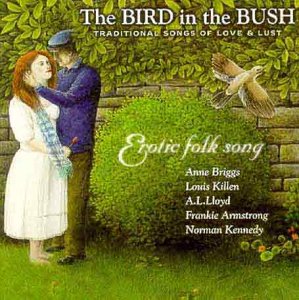
Various Artists – Bird In The Bush: Erotic Folk Song (Topic)
David Kidman
This CD, all proceeds from the sale of which go to Henshaws Society For Blind People, presents a superb collection of Yorkshire songs and tunes - by which I mean true Yorkshire! For as the properly researched booklet notes explain, all of the selections originate from Knaresborough, Harrogate, Nidderdale and nearby. Although the various local singers and musicians are gathered together under the collective umbrella of The Blind Jack Band, their performances are strongly individual and of sturdy and reliable quality, and all participants are of considerable repute locally. Much of the material is of Yorkshire-traditional origin, i.e. gleaned thereabouts, with several items collected by Kidson - but equally, much of it may well be unfamiliar except to hardcore Yorkshire folk specialists (around half of the items were new to me too). The CD is bookended by pieces associated with local sword dance teams at Kirby Malzeard and Ripon, spiritedly performed by Zeke Deighton with the aid of the Blind Jack "house band" (Nick & Mary Barber, Chas Marshall, Nick Adams and the CD's instigator Mark Ellison); Zeke's fine singing also crops up on a handful of other pieces scattered throughout the disc, including The Sledmere Poachers (culled from Ingledew's volume). Another notable North Yorkshire singer, John Greaves, is allocated two songs (The Bonny Hawthorn and A Yorkshire Farmer's Lament), while on four tracks imaginative use is made of extracts of spoken verse to introduce performances by the house band of tunes from various manuscript collections. Other traditional songs are sung by Laura Hockenhull (with brilliant fiddle accompaniment by Ben Paley), Stella Fisher, Mark Ellison and John Burrell. It's also good, though, that modern-day compositions on a Yorkshire theme are not neglected: Magna Carta man Chris Simpson contributes a self-penned narrative ballad and a pleasingly evocative instrumental piece; John Burrell turns in a sympathetic performance of Bob Pegg's wonderful Leaving The Dales; Sue Dunn and friends present the Albion Band tale of Swift Nick; and Dave Burland complements his refreshingly uncloying treatment of the traditional Stow Brow with a fine rendition of Jake Thackray's Old Molly Metcalfe. This admirable and credibly-sequenced disc forms an excellent collection, and deserves a place on the shelf of any serious enthusiast of the Yorkshire folk scene and its repertoire. It's available (for only £10) from Harrogate and Knaresborough Tourist Information Centres, Henshaws College and Arts & Crafts Centre, and the Blind Jack website.
David Kidman November 2008
Unusual repertoire for Smithsonian Folkways, you'll be thinking - but the label recently commissioned an anthology of Welsh music and song, and Ceri Rhys Matthews won the tender exercise, so the result is an intelligent, pleasing, well-coordinated and thoroughly enjoyable disc that states the case for Welsh traditional music in the most persuasive way. It's a collection of new recordings by contemporary Welsh musicians and singers (and others who have readily embraced the Welsh culture), all of whom can be heard to acutely realise the ancient music of Wales's past through freshly-minted modern-day performance.
The hour-long disc is credibly sequenced for maximum contrast and listening pleasure, whereby instrumental pieces are tellingly interspersed with acappella and accompanied vocal items. It starts with none other than 60s icon Mary Hopkin returning to her roots with a lovely rendition of Y 'Deryn Pur, a song closely associated with her birthplace in West Glamorgan, followed by a spiritful set of estampies (dance tunes) played on bagpipe and fiddle by Anne Marie Summers and Helen Wilding. Ceri Jones, a Welsh Canadian, accompanies himself on harp for a song which he collected from Julie Murphy, and Julie herself appears on the final track, a magnificent trio rendition (with Sille Ilves and Martin Leamon) of The Girl From Llantrisant.
Elsewhere there's a beautiful flute and fiddle duet from siblings Ceri and Catrin Ashton, and Daniel Huws's singing of a Christmastime Plygain carol. Members of the group Fernhill are variously involved in this project: trumpet player Tomos Williams duets with veteran triple harp player Llio Rhydderch on a beautiful arrangement of Bedd f'Anwylyd (My Lover's Grave). Llio also appears accompanying Max Boyce on Hiraeth (Longing), a particularly tender expression of the feelings the Welsh have for their homeland, along with Fernhill's Christine Cooper who separately presents an enchantingly atmospheric fiddle-backed recitation of two anonymous 16th century poems recounting a story of seasonal change.
There's a stunning flute-duet medley from Jem Hammond and Tom Scott that's worlds away from the potentially rarefied world that instrument often inhabits. And fiddle player Cass Meurig (of Fernhill and Pigyn Clust) allows us to eavesdrop on her intimate musical conversation with guitarist Nial Cain. In truth, every single track has something special to commend it, and the disc as a whole demonstrates that Welsh traditional music is a treasure-trove which if explored in the right hands can yield great, hitherto largely unimagined riches.
Smithsonian Folkways are to be heartily commended for their enterprise in commissioning this wonderful anthology, whose accompanying booklet contains plenty of background notes (rightly enough, in both English and Welsh) on the musicians themselves and the music played.
David Kidman May 2010
It's taken three albums but at last Bob Harris has come clean and finally admitted that he is in love with Americana. He has to mix up his show with a myriad of styles and genres but his 'mission' has always been to introduce a hungry public to the very best of Americana and country rock. Bob Harris Presents Americana isn't just a title, it's a cause for celebration.
Because this is Bob Harris it has a built-in guarantee, rather like the kite mark there's an inherent quality assurance.
Mind you., he's canny enough to hedge his bets. Alison Krauss could be suffering from laryngitis and be singing in Swahili and she'd still be a genius. So to finish off the album with her singing Stay is sure to leave a warm and abiding memory.
Even those with just a passing knowledge of the genre, will surely recognize the quality of Krauss, Todd Snider, Chris Knight, Patty Griffin, Sarah Harmer, Slaid Cleaves and John Prine. Even 'Whispering Bob' has no need to shout their credentials from the rooftops. But. as on air, it's the artists you may not have heard of that are the album's true treasures. Hayes Carll released a contender for album of last year with Little Rock and if you missed it, firstly, ask yourself why? Then find out what you missed with Wish I Hadn't Stayed So Long.
Alongside Hayes Carll is Alana Levandoski and Grayson Capps, who sings the title track from his latest album, all wonderful and all, until now, perhaps unheralded. If you also factor in Ray Wylie Hubbard and James McMurtry, both of whom have caused quite a stir in recent months, then Bob Harris Presents stands up as an album in its own right.
However, that's not its primary purpose, it's a showcase and whether you know Americana or not, Harris has done what he's done better than anyone else for years and brought some 'real' music to his audience.
Michael Mee February 2007
This could almost be a NetRhythms sampler! Bob Harris writes, "There are two types of music. Mainstream and non-mainstream. We get mainstream to saturation point. Everything else has to sink or swim. This album is a small attempt to redress the balance and introduce you to some of the amazing artists operating just under the surface." Sounds like our Mission Statement doesn't it?
Many of our favourite artists (already reviewed on our pages) are represented here and, as is the way of so much good music, all the tracks come from albums released on independent labels. From the UK there are Kimberley Rew, Thea Gilmore, Peter Bruntnell and from across the Atlantic, Eliza Gilkyson, Neal Casal, Ryan Adams, Oh Susanna, Stewboss, Slaid Cleaves, Richard Shindell, Calexico, Laura Cantrell, Jerry Joseph, Carol Noonan, and The Idle Jets. If you don't know them, this is a great place to start. Beautiful voices, haunting songs and fine musicianship are generously featured on this gem of an album.
This collection can also be bought as a taster for some wonderful albums you'll hear played on 'taste guru' Bob Harris radio shows (and Bob Paterson's show on SpydaRadio for that matter). Tune in and enjoy ...
http://www.bobharris.org
http://www.spydaradio.co.uk
Sue Cavendish
In June this year, 70,000 music fans gathered in Manchester, Tennessee for a three-day festival ostensibly to rival Woodstock. Bonnaroo brought together a diverse lineup of bands and DJs ranging from long-term festival rock stalwarts like Widespread Panic to up-and-coming stars like Jack Johnson and Norah Jones to hip-hop notables Jurassic 5 to the Blind Boys Of Alabama to bluegrass legends Bela Fleck & Edgar Meyer and the Del McCoury Band. This lineup admirably reflected and recognised the extensive musical influences prevalent in today's scene. Key performances totalling just over two hours were whittled out of 75 hours of audio taped at the festival, to present on this double CD the very best and most representative of the festival.
Highlights include a very-Deadlike Phil Lesh & Friends with special guest Bob Weir (Tennessee Jed), Galactic's Tiger Roll, Robert Randolph's Allman-Brothers-like Peekaboo, Ben Harper's emotionally charged acoustic medley, the spirited John Butler Trio, and Trey Anastasio's nicely stretched-out Last Tube, OK, one or two other performances seem mere crowd-pleasers, efficient enough runthroughs but you won't necessarily want to listen to them often outside the festival context (this is of course inevitable with any such recording). Even so, there are no outright embarrassments here, and the compilers have done their job well. There's a supercharged party atmosphere coming through on all the cuts, and by and large the crowd keeps quiet when they need to. All great stuff yes, even if musically it doesn't seem quite to rival Woodstock - comparisons may seem invidious, but then again, most trails have been blazed already, things have moved on in the world, and hindsight sure is a funny thing…
David Kidman
Latest Releases in the Living Tradition Magazine's Tradition Bearers Series:
These three albums together comprise the very latest releases in the Tradition Bearers series, instigated over 18 months ago by the makers of The Living Tradition magazine. These follow on sensibly from the previous small batch of two releases (also reviewed for NetRhythms) which presented admirably honest recordings of distinctive and contrasting traditional singers (those latest being of Ellen Mitchell and Sara Grey). Two of the current batch of three come under the umbrella title of Borders Traditions. Fiddles gathers together 1956-vintage recordings from the School Of Scottish Studies archive by Andrew Harvey and James Wilkie, alongside some 1973 recordings by the hitherto under-represented Bob Hobkirk and a clutch of modern recordings by Ian Anderson, Jimmy Nagle and Wattie Robson. As the insert notes acknowledge, the Borders is not the place of the towering giants of the instrument, and little is known of a distinct tradition. In Borders lore there's the character of Jedburgh fiddler Rattlin' Roarin' Willie, but the Borders fiddle has never taken centre stage as it were. The parallel development of "heavy" and "light" styles, for dance accompaniment and intimate house party respectively, typify the strands of Border fiddling, and Bob Hobkirk is considered the greatest exponent of the "light" idiom today. Otherwise, there may well be some identifiable technical aspects which can be considered as hallmarks of a specific Borders fiddling style, and these are described in the booklet notes; these include the thick-textured double-stopping feature of the "heavier" style of Jimmy Nagle for example. This is an informative selection, well mastered to provide a consistent listening experience; around half of the selections are unaccompanied, the remainder backed by guitar, occasionally banjo.
Sangsters brings together Borders singers from a wide time-span, from the unmistakable and unsurpassable Willie Scott (the Border shepherd, regarded by many as an archetypal Borders Sangster) through to Eric Bogle, between them performing material both traditional and contemporary in origin. The central thesis of this release is that the Borders region has every bit as much "an idiosyncratic voice and repertoire" as the more widely celebrated North-East of Scotland, and the whole collection proves a persuasive advocate for this theory. Seven of the disc's 19 tracks were taken from the School Of Scottish Studies sound archive; these include Willie Scott's four selections, which were recorded twenty years apart (1953 and 1973/4), and show him on fine form (and naturally, these include The Kielder Hunt!). Less well known are two other shepherds - James Wilson, who recounts the choice comic saga of the Brundenlaws, and (the unrelated) Tommy Wilson, who contributes a fine brace of fun songs. The remainder of this release comprises modern recordings, mostly accompanied, in the spirited, lively and typically Borders fashion. Among these I specially enjoyed Henry Douglas' light-hearted Donald Caird and John Nichol's four contributions which take delight in the clear enunciation of the dialect. The sense of the Borders as "a community celebrating itself" is just as strongly felt in its modern songwriters, here represented by Eric Bogle's No Use For Him, performed here by Gordon Kelly, fairly briskly but not without feeling (the thesis is expanded by Eric himself in a short interview extract that follows the song). And the true "sociality" of the Borderers is well in evidence in the entertaining conviviality of latter-day performers like Ian Anderson and Gordon Kelly; their contributions, being live and unadorned by any studio enhancement, certainly capture the friendly spontaneity that Borders song generates when performed in its natural setting, although on one or two occasions the brisk pace feels a little too "jolly" for the material. The only female singers represented are Elsa Lemaitre and Pat Douglas, here singing together on The Wail Of Flodden. This is a most attractive release; but shame about the lack of texts in the otherwise most informative booklet.
Finally, Chris Foster's release is the third in the "stand-alone" category of Tradition Bearers releases which was inaugurated a couple of years back with John Watt's Heroes; it's actually a straight reissue of Chris's 1999 album which was hitherto only available briefly on his own Green Man label and seemed destined to join the ranks of the neglected, almost cult-status gems with which the folk scene has been liberally littered over the years. (In fact, Chris's two late-70s albums on Topic - Layers and All Things In Common - have just been reissued on CD, albeit in Japan only.) Chris's work clearly fits squarely and unambiguously into the "tradition bearer" ambit; equally clearly, both his style and approach belong very much to the Nic Jones/Martin Carthy school, especially in the way his accomplished guitar styling is used to creatively underpin the songs (on Traces, this is particularly apparent in songs like The Fowler). Chris nevertheless has a captivating individual performing style; his playing is genuinely inventive, whereas his singing is passionate if in a manner that's arguably slightly understated, and he brings his own distinguished stamp to a range of not-often-heard songs from the tradition, often in unusual versions, as well as songs from the pens of modern-day originals, here Leon Rosselson (the perennial Flying High, Flying Free providing a foil for the mighty tale of Barney's Epic Homer). As the insert notes rightly point out, Chris's music speaks for itself and his position as an artist in the community (after all, to maintain an ongoing social context for his work is an important qualification for a tradition bearer), while cementing his position in the tradition alongside the musicians from whom he's taken his inspiration.
Tradition Bearers releases continue to be available either on subscription or individually, from PO Box 26064, Kilmarnock KA2 0YG.
David Kidman
Various - Both Sides Now: The Spirit of Americana (Gravity)
Well here's a useful catch all catch up compilation in time for slipping into your Americana Christmas stocking. Sub-sub-titled The Best of Americana 2002! It rather stretches a point to include the Flaming Lips' pop-glorious Do You Realise? and Warren Zevon's You're A Whole Different Person, but otherwise this embraces all shades of the genre, from sparse mountain music to gutsy guitar rocking, from the Be Good Tanyas, Arlenes and Silver Jews to Jason Ringenberg, Jay Farrar and Grant Lee Phillips.
Rather than the review descending into an extended list, suffice to point you in the direction of Raul Malo & Shelby Lynn's revamp of It Takes Two To Tango, Rodney Crowell's Johnny Cash tribute album version of Ballad of a Teenage Queen, the inclusion of little known but worth discovering names Dan Bern, Wiskey Biscuit, Departure Lounge, and Cicero Buck, After All This Time from Darden's Smith's criminally underpublicised comeback album, and the fragile beauty of Hope Sandoval's Suzanne.
But whether your taste leans more to Dylan (High Water) or Lambchop (I Can Hardly Spell My Name) with its balance of reliable old timers and emergent heirs to the throne (Mary Gauthier step right up), even with the notable omissions of Ryan Adams, The Guthries and Eileen Rose, this is ridiculously good value for money, even though it'll probably cost you a fortune tracking down the albums by the artists you'll just be discovering within. And I managed to get through the whole review without once drooling over the fact it also contains Thea Gilmore's not-entirely-Americana-but-who-cares cover of I Dreamed I Saw St Augustine from her forthcoming new album. Oh darn.
Mike Davies
Back in 1986, there was an album that, basically, celebrated English Melodeon Players – that was its plain title, and it lived up to that label quite effortlessly, providing inspiration galore for today's exponents of that instrument. Now, largely due to the impetus created by an initial Facebook posting by Simon Care regarding key influences on his own playing, the estimable Mrs Casey Records has produced a kind of update-cum-sequel disc that proudly showcases the amazing prowess and imagination of today's crop of melodeon players.
Banquet Of Boxes presents close on 52 minutes of glorious squeezing courtesy of a veritable melange of melodeonists – squeezebox heaven for the enthusiast! But will it pass muster for the general folkie who likes his squeezing in smaller doses or leavened with voice or fiddle? In my opinion, an emphatic yes! Just turn straight to track 5, the delectable rustic march Over The Fields Of Turnips, played by Mark Bazeley with Rob Murch's clattering banjo in tow, or Track 3, Dan & Matt Quinn's jubilant rendition of Matt's driving 48-bar jig No More Wabbits – both tunes totally irresistible in anyone's book, technical virtuosity notwithstanding (of which there's another book to be written no doubt!). Close at the heels of which is Simon Care's medley of waltz with schottische and morris tune, on which he's joined by harmonica wizard Will Pound. Naturally, quite a bit of the material played on this record comes from the morris dance repertoire, but you'll rarely hear it played as triumphantly – or recorded with so much true presence. The surprisingly underrated Ed Rennie contributes a pair of such tunes, kicking off with one of his own (The Corn And The Blue, written for the Pilgrim Morris Men of Guildford).
Though not ever lacking in either drive or dexterity, the melodeon players represented on this disc are also capable of considerable sensitivity, as is brought home especially on Simon Bannister's lovely pairing of his own Edward's Waltz with the evocative 1130 In Mallaig (with fine fiddle counterpoint from Cate Bannister too). The roster of ace melodeonists appearing on this collection is completed by John Spiers, Andy Cutting, Saul Rose, Simon Ritchie, Katie Howson and Nick Cooke – and where would such a disc be without a track from "Mr. Melodeon" himself, John Kirkpatrick (who plays a brace of railway-themed country dance tunes of admittedly obscure origin on his trusty two-row Hohner).
The disc may be wall-to-wall melodeons, but a surprising degree of contrast in tone and texture is achieved by the various instruments is quite ear-opening to say the least. It's all grand stuff, and eminently replayable
David Kidman June 2011
Brand New Boots & Panties (east central one)
A re-recording of the original album by Ian Dury & The Blockheads
This is a homage album with a difference. New Boots & Panties was released in 1977. The 2001 Brand New Boots & Panties features Sinead O'Connor, Robbie Williams, Paul McCartney, Billy Bragg, Wreckless Eric, Cerys Matthews, Grant Nicholas, Shane MacGowan and Keith Allen (all with The Blockheads) and Madness. It's a time capsule for those of us who are old enough to remember falling in love with punk and pub rock. It's also a fund-raising tribute which will raise money for the Cancer BACUP charity.
Struck down with polio aged seven, Ian Dury was physically handicapped all his life but it didn't diminish his spirit or talents. For example, I hadn't known that he'd attended the Royal College of Art and taught painting at the Canterbury Art College. Dury died of cancer a year ago but Clever Trevor, Billericay Dickie, Sweet Gene Vincent are here to remind us that he was wicked and witty and dead good fun. Old Stiff label-mates, Madness, do him justice with My Old Man, as those watching 'Later ... with Jools Holland' a couple of weeks back would have seen.
The press release for BNB&P is too good not to be quoted. "Ian Dury was the dog's bollocks and 'New Boots And Panties' was the cat's pyjamas". 'Live At Lourdes' that album was originally going to be called, a Lazarus blast by King Crip [who'd been the singer with Kilburn And The High Roads and then Ian Dury And The Kilburns]. That gives the flavour of iconoclast Dury - if iconoclast was not too pompous a word for him!
http://www.iandury.co.uk
http://www.eastcentralone.com
This is a double-album collecting together in one useful and handy package 40 Californian classics from the rarely-compiled "Laurel Canyon" era. It contains choice examples of the various influences that came to fruition during this momentous period (1967 through 1977), and as you'd expect it includes the work of several key singer-songwriters of the time, many of whom went on to greater things. The set's not arranged chronologically, and there seems to be no semblance of purpose in the almost random sequential arrangement of tracks, but the music itself is good and representative enough, even if there are some curious choices. For a start, the Mamas & The Papas track isn't the one that would give the set its title, but instead we get Creeque Alley (rather closer to reality than dreaming). And curiously too, the lead track from the Byrds (a seminal crew on the west-coast scene) is So You Want To Be A Rock'n'Roll Star. But present and correct we do find here the various strands of musical activity that demonstrate the theses of the compilers – the transition from folk to pop (Joni Mitchell, Judy Collins, Carly Simon) and country to pop and rock (Crazy Horse, Gram Parsons, Burritos, Eagles), the evolution of the working troubadour into a sophisticated musical force (James Taylor, Jackson Browne, Randy Newman, David Ackles), the carrying-forward of the spirit of the working-man's ballads and social concerns (Arlo Guthrie) and the development of folk through psychedelics into jazz (eg Tim Buckley). Then, the development of the various different label brandings of Warner, Reprise, Asylum, A&M and Elektra, provided contrasting arenas for the eclectic experimenters (Love, Buffalo Springfield) and the soft-rockers (Seals & Crofts, Bread) with such acts as America and the Doobie Brothers falling somewhere in between. Not to mention Bonnie Raitt, Fleetwood Mac and cult successes like the Grateful Dead, Little Feat and Warren Zevon. And less expectedly, Canned Heat's On The Road Again makes an appearance - though a welcome and entirely appropriate one - albeit in its less glorious (truncated single) form. I was also pleased to see Jo Jo Gunne's Run Run Run... Yes, one could argue till the cows come home about which one track to include from such acts, but although there's a modicum of typically mildly self-indulgent middle-of-the-roadery here you can't deny the quality of the majority of the tracks on this set. Oh, and many of these artists are rarely if ever compiled on anthologies - though most of you will already have all the individual selections on your shelves and there's no unreleased material to tempt you.
David Kidman June 2007
Celtic Crossroads - Various Artists (Putumayo World Music)
But what Celtic Crossroads proves is, that if you give great music a serious listening then it remains great music, whatever label you attach. Rather than just give folk music a spruce up with a lick of paint, the artists on Celtic Crossroads have cut the music back to its roots and injected a new spirit, a spirit which makes it all the more relevant to today's audience.
Take Wild Mountain Thyme as an example. It's the non-aficionados archetypal folk song, it has become slightly twee and saccharine. However while Keltik Elektrik have retained the romance they have toughened it up adding a sharp edge which transforms and energises the song, that energy is indicative of the whole album.
And while all the transformations may not be as stark and obvious as that wrought on Wild Mountain Thyme, all the contributors have opened new doors and blown away the stale and tired cobwebs.
Putumayo World Music has given the artists a sense of freedom to give their talent its head but, perhaps more importantly, they have illustrated the international falvour of Celtic folk. Scotland, Ireland and Wales are obvious places to look and well represented here, but the exquisite Alan Stivall from Brittany and Canada's Ashley MacIsaac offer the more exotic contributions to an already glorious collection.
Capercaillie and Sinead O'Connor may well be the established names but the honours belong to all.
Michael Mee
Celtic Fiddle Festival, for the uninitiated, began over 15 years ago as a touring band centred around three of the folk world's finest globe-trotting fiddle players (Kevin Burke, Christian Lemaître and Johnny Cunningham) joined by that excellent guitarist Ged Foley. When Johnny died in 2003, his place was taken by young Quebec virtuoso André Brunet, and here the quartet is, some five years later, releasing what amounts to its fifth CD in total.
The playing is as spirited and spontaneous (and faultless!) as ever, yet the musicians show no sign of getting stale, even though repertoire-wise the mixture is much as before, ie. Celtic in its broadest sense: tunes from Ireland, Scotland, Brittany and Quebec, albeit with pieces from Italy and Sweden tossed in where appropriate too. Not only do the three fiddlers together embrace an interesting cross-section of individual playing styles, which provide a fascinating comparison for fiddle buffs, but they blend so well together as musicians and clearly have a great time making music, always providing stimulating listening for the layman too. The disc contains at least three tune-sets on which André's trademark Bottine-like foot-stepping can't fail to lift the spirits, while in contrast the miraculous jewel-like precision-delicacy of Ged's elegant guitar work is showcased on a solo track (a nifty transcription of the Northumbrian pipe tune Sir Sydney's March).
Ged also gets a good share of the limelight on a handful of tracks where he trades with – or accompanies – one or other of the individual fiddlers; I particularly liked the set of six Gavottes Pourled where Ged furnishes Christian's ultra-lively fiddling with intricate dancing counterpoints. And to round the disc off, the whole ensemble's special brand of triple-fiddle attack is heard in all its glorious unison splendour on the closing waltz and schottische. Stirring stuff indeed: any new album from this fine team is always welcome.
David Kidman June 2009
David Kidman August 2007
The sub-title to this album is 'Traditional and Contemporary Music Inspired By The Spirit of The Family Farm' and the ten tracks paint a picture of life down on the farm during good and bad times. The opener, The Ridge by Paul Hovda is a lovely piano piece, the playing much akin to the style of Bruce Hornsby. Far Side Of The Hill is a little too traditional for me and although Glenn Yarbrough sings the song well his voice doesn't do anything for me. John Cowan's I Am Home raises the spirit again with vocal harmony on the chorus and mandolin throughout. This tells the story of the home and it's place in the life of a family.
This Old Plow continues with the mandolin and there's bluegrass and folk in abundance. Tim O'Brien on vocals and Sam Bush on fiddle along with an excellent guitar break from David Grier set up this song perfectly. The second Paul Hovda piece, Country Maiden, is achingly beautiful and would be ideal for a film soundtrack. You should be able to visualise the prairies when listening to this. Thunder Rollin' 'Cross Arkansas is a bluesy gospel style song with cool clarinet. The vocalists here are Victor Mecyssne and Jonell Mosser and their voices merge perfectly. The traditional In The Bleak Midwinter starts with a few lines of speech before going on to dulcimer and Tennessee music box played by David Schnaufer and Stephen Seifert respectively. The result is a soothing listen to wash all your worries away.
The next track is three pieces from The Harvest Suite played by Jay Ungar and Molly Mason with the Nashville Chamber Orchestra and all three pieces are pure Americana. You can imagine the crops growing in Prairie Spring; the hazy days of Summer and everyone having a great time at the Barn Dance after the crops have been harvested. Nanci Griffith puts in a guest appearance as backing vocalist on Trouble In The Fields. Maura O'Connell is the main vocalist and this will have your heartstrings stretching. The album finishes with Be Still And Know, Paul Hovda's third track and like the previous two, is, quite simply, a beautiful piece of music. There are a number of great tracks on this album but it is worth buying for the three Hovda tracks alone.
David Blue
Various Artists - Chester Folk Festival (CFF)
This modest and likeable CD is produced by Chester Folk Survivors, who organise one of the country's most highly-regarded smaller-scale festivals (Chester, which is held in the nearby village of Kelsall each Spring Bank Holiday); like many similar ventures throughout the UK, the CD's been produced partly as a festival fundraiser and partly to showcase the wealth of talent available among its organisers and friends and the bands in which they play. The thesis, of course, being that many of the performers included are deserving of wider acclaim… Here, the musical compass is expectedly broad, as you'd wish for in any festival worth supporting, from gorgeous harmony singing (the Waite Collective), solid traditional artistry (Roy Clinging) and singer-songwriter fare (Graham Bellinger, Charlotte Peters Rock) to lively tunesmithery (locals the Tyme Bandits and Shetlanders Solan), jugband bluesiness (Root Chords) and typically upfront riotousness (the Family Mahone). Also putting in appearances are Trefor & Vicki Williams, Full House, John Finnan and the Restless Bentleys. Around half of the tracks are taken from existing album releases, and recording quality is well up to industry standard. This whistle-stop tour through the region's plethora of talent proves an enticing enough appetiser, although some of the selections (albeit perfectly competently executed) lack the degree of distinction that might some day lift their performers above the basic "acceptable on a festival bill" category. Also, some of those performers will evidently come across more vibrantly in the live setting, as you might expect (that I can testify). But as a tasty festival primer/sampler, you can't fault this product - and it's all in a very good cause!
www.chesterfolk.freeserve.co.uk
David Kidman
This invaluable issue, which comprises volume 22 of Greentrax's specialist Scottish Tradition series, presents a collection of source recordings from the School of Scottish Studies Archives at the University of Edinburgh, an important repository for Scottish children's lore. The material was recorded over a period of three decades from 1952 to 1981; yet for all the fact that every selection is sung (or recited) in Scots, it's easily understood and accessibly presented, and you'll discover that much of it, like the traditions from which it springs, has been - and continues to be - transported beyond the boundaries of Scotland itself (we all know Knees Up Mother Brown, and the dandling song Dance Tae Tha Daddy, for instance). Evidence of this is provided by the fact that several recordings here were made by Scots emigrants now living in Australia, who are able to recall with amazing clarity the rhymes of their childhood. The central role of music and song in nursery education is ne'er to be underestimated, and the recordings on this disc will serve to reinforce those song and rhyme traditions that, happily, have never been completely lost in Scotland. The child's development is charted by the well-planned sequence of the disc, with the life being followed from cradle through infancy, schoolday activities (skipping, ball-bouncing, chasing and catching, various counting rhymes and songs, and a circle game with actions), and on to courtship: fun as well as more serious purposes. As well as playground performances by Scottish schoolchildren (from Campbeltown, Dundee, Glenrothes and Aberdeenshire), there are also plenty of recordings from further afield. The adults recorded include Jeannie Robertson, Ray Fisher and Jean Redpath's mother, while there are also some important recordings made by Hamish Henderson and Emily Lyle among the delights on display here. The presentation is excellent, with a nice fat booklet containing full notes, complete texts, a really helpful glossary and, setting it all in perspective, an introductory essay by the project's editor Ewan McVicar. This disc exemplifies the folk process at work even at the earliest stages in a person's life development, and it's a release giving endless fascination. It's also one of considerable historical interest, and highly commendable in every respect.
David Kidman April 2008
Here's a handsome budget-price expanded reissue for this set of six discs presenting the definitive archive of the concertina traditions of County Clare; they were first issued as part of a collaboration between Free Reed and Topic in the mid-70s. The Clare region in the far west of Ireland has long been noted for its traditional music and song, and the local people's predilection for the (anglo) concertina has long been a matter of conjecture (for which others are vastly more qualified to broach than myself), although label boss and concertina enthusiast Neil Wayne has thoughtfully provided a short essay on the topic which is common to the booklet which accompanies each of the six discs (which, usefully, are all available separately as well as in the box format). Each disc is generously filled, and comes with a feast of bonus tracks recorded at the same sessions, as well as a splendidly copious booklet containing not only the original notes but also some superbly reproduced archive photographs, memoirs from John Tams (who had assisted Neil Wayne in collecting the original recordings) and some more recent essays. The uniform "house design" of the original sleeves has been retained too. Now for a brief outline of the contents of the discs, to whet your appetite. Disc 1 reprises the classic Topic issue that back in the 70s introduced us to three members of the Russell Family of Doolin (Pakie, Miko and Gussie), and is in one respect the odd one out among the set's half-dozen in that (somewhat contrarily, you might feel) the disc opens with a reel played not on the concertina but as a duet for two whistles. Indeed, although the concertina figures largely on the disc generally, there's also a fair sprinkling of non-concertina tracks: six songs sung by Miko in his delightfully inimitable style and several items featuring Miko's flute or whistle and/or Gussie's whistle, either in their own right or in tandem with Pakie's concertina. It all makes for a consistently entertaining programme, however, and there's a sizeable bonus in the shape of seven out-takes from the actual album sessions (while even more outtakes are to be found on disc six – see below).
Discs 2 and 5 both showcase the concertina playing of Bernard O'Sullivan and Tommy McMahon, mostly in ensemble/duet mode but punctuated with a healthy number of solo excursions. Disc 2, subtitled Clare Concertinas, includes plenty of instances of spellbinding fingerwork, and even a non-specialist will be able to revel in the unquenchable spirit of these recordings I'm sure (I sat and listened to the entire 69 minutes of this disc in one sitting without getting bored). The set of jigs that Tommy plays solo (track 9) is one of the finest examples of concertina dexterity you're ever likely to hear – simply breathtaking. At the time of the recording (1974), Tommy was only 24, and had learnt much of his repertoire from Bernard, who was several years his senior; and the sheer variety of their repertoire even then was astounding – set dances, hornpipes, jigs, reels, polkas and even a waltz or two. Disc 5 (Traditional Clare Concertina Music) provides further proof of the musicians' infectious presence and their superlative control of melodic contour. Disc 3, Chris Droney's collection The Flowing Tide, has long been recognised as a classic of the recorded repertoire for the instrument. On his 1974 LP, Chris, a farmer from Bell Harbour near the Burren area of North Clare, dynamically demonstrated what was described as his "dance-oriented, driving playing style free of over-decoration".
Disc 4 presents John Kelly, from Rehy West in the south-west of the County, player of both concertina and fiddle, and long recognised as a major figure in the revival and development of Irish traditional music. This disc, recorded in 1975, is a particularly persuasive exposition of John's unusual dual virtuosity, whereby his spiky concertina style with its subtly offbeat rhythmic effects contrasts with his more relaxed fiddle work.
Disc 6, subtitled Irish Traditional Concertina Styles, originally released in 1977, forms an ideal introductory disc for the whole series, containing as it does prime examples of a dozen great concertina players from the 1970s. These include the celebrated Paddy Murphy, Gerald Haugh, Sean O'Dwyer and – naturally – those already featured on the preceding five discs, from whose outtakes Disc 6's eight bonus cuts are sourced. Highlights for me were the two intense and exciting sets of reels played by Sonny Murray. Notably, the disc also contains several examples of the delightful playing of the set's only lady concertina player, Mrs. Ella Mae O'Dwyer, while Solus Lillis and Michael MacAogain contribute the set's two slow airs. The disc's notes helpfully include a discussion of each player's technique, but it requires some quite careful reading to determine exactly who is playing each selection – ideally, this identification should be more easily discernible, given as part of the basic tracklisting. That latter omission forms my only real criticism of the presentation of the six discs, which is otherwise excellent, in keeping with the consistently fine remastered sound.
www.free-reed.co.uk
www.clareconcertinas.ie
David Kidman July 2008
The late John Peel championed countless artistes over his long tenure on BBC Radio 1, and many of these feature in his All-Time Festive Fifty "chart" of Year 2000, compiled unbearably scrupulously from 25 years of Festive Fifties which were each in turn compiled from listeners' votes for the three greatest tracks of the given year. This single-disc CD, which represents the first official compilation from the 2000 compilation (if you get my drift!), necessarily omits some artistes (principally those who enjoyed multiple-choice status in the original Fifty, but also some cuts which have allegedly been "compiled to death"!), but is actually a more than reasonable collection and a bloody good listen. Inevitably it teenage-kicks-off with the Undertones, then the Clash (White Man In Hammersmith Palais). After which, in a scintillating parade, moving on in no particular order through the shadowy hinterland of cult-songwriterdom with Nick Drake, Robert Wyatt and Tim Buckley, classic album tracks from Dylan and the Velvet Underground, indie from the Fall and the Smiths, C86 with The Wedding Present and up to date with Britpop from Pulp and Stereolab. On the way, there's choice nuggets from Joy Division and successors New Order, examples from PJ Harvey and the Sundays and "obvious choice" 45s from the Jam, the Only Ones and the Damned. 19 tracks in all, and you can't argue with any of the choices, except to substitute some of your own selection/s from the true Fifty - which every true fan would be doing, naturally enough!
David Kidman October 2006
Various Artists - The Clear Stream: Guitar Music From Scotland And Beyond (Greentrax)
This project began life over ten years ago, back in 1994, with the aim to record tracks by some of Scotland's finest exponents of the guitar - if only to show that Scottish music was more than just piping (only joking...!). As always with such ambitious projects, however, artists' availability was an ongoing bugbear, and the work was only finally completed in 2004. But it's been worth the long wait, for there are some lovely performances enshrined here. Not the least important and valuable of these are four tracks performed by the late Tony Cuffe, a particularly innovative player, to whom the whole album would seem a fitting memorial; two of these tracks are used to bookend the disc most stylishly. The disc's title is most apt too, for the sound of the guitar ripples like a clear stream throughout the 17 tracks, with all the freshly-minted clarity of texture you'd associate with a Highland watercourse. Playing styles vary quite a bit, as a mere glance at the contributors will testify - there's Dick Gaughan performing two of his own compositions from the suite Timewaves (outed at last year's Celtic Connections festival), which prove disc highlights in anyone's book for a start! Then Rob MacKillop treats us to a set of 17th century Scottish lute pieces, and Jack Evans brings a touch of bluesy jazz to his two selections (I specially liked the Gille Callum Set), while Tony McManus celebrates his interest in the music of Brittany in consort with premier Breton guitarist Soïg Sibèril and ever-inventive bassist Alain Genty on no less than three fine cuts. The youngest guitarist represented here, Innes Watson, was only 19 when he recorded two brief tracks for this collection, and they're mature and masterly delicacies indeed (you'd never guess that his main instrument is the fiddle - he's currently a member of Borders Young Fiddles, whose CD I reviewed here back in June). Former Battlefielder Brian McNeill also contributes two sets, one in duet mode with young clarsach player Dominique Dodge. The mood of the CD is predominantly gentle, but don't let that quality fool you into thinking there's no substance to the music being interpreted - far from it. The sheer craft and dexterity exhibited everywhere on this CD is stimulating, yet refreshingly unflashy.David Kidman
British Blues At A Pub Near You
The great British Blues scene is alive and well in hundreds of pubs and back rooms around the country. Blues is a medium where many young guitarists hone their chops and older connoisseurs of the tradition cover the classics, in opposition to Sky TV football and noisy drinkers in the bar.
On 2 September Net Rhythms was out and about in Brighton, specifically at the Connaught, Hove, to see PC Green and The Traffic Lights: Rory Cameron and Steve Fairhead, on guitars, backed by a midi sequencer in the absence of the loose affiliation of musicians who regularly join the band, and very good they were too.
On this particular Saturday the music was a top-of-the-class mix of Chicago Blues, Rhythm and Blues, Soul, and favourites (Van Morrison, Little Feat, Eddie Floyd, Robert Parker, the great Stax songwriter William Bell and more). Harmonica and lead vocals from Rory, and really tasty guitars, electric, semi-acoustic, and slide from Steve (lately of Steve Ellis's reformed but in abeyance, Love Affair) would have had me bopping if I hadn't been secretly taping the gig!
You need bands like this in your life - and they are there. Take a look.
Sue Cavendish
Various - Music from the Miramax Motion Picture Cold Mountain (Sony Music Soundtrax)
Accompanied by fiddle, banjo and mandolin (featuring veteran player Norman Blake), White opens proceedings with a stripped raw plaintive version of Wayfaring Stranger proceedings to Little Walter's mountain music blues Sittin' On Top of the World, his own bruisingly gentle Never Far Away (not featured in the film, but sung as a letter to Nicole Kidman's Ada from Jude Law's Inman) and, featuring Brendan Gleeson on harmony, the banjo plucking stomper Christmas Time Will Soon Be Over.
Alison Krauss provides another O Brother connection, here contributing two songs, the simple, gorgeous Costello/Burnett penned The Scarlet Tide and Sting's Celtic hued You Will Be My Ain True Love with the man himself providing harmony. Tim Eriksen, founder of Cordelia's Dad, professor of American music and something of a leading light in trad revival circles takes up three of the traditional numbers, sounding like he's at least 100 years old on Am I Born To Die? while Reeltime Travellers, Cassie Franklin (an a capella Lady Margret not included in the film), Stuart Duncan and Dirk Powell (an fiddle and banjo duet of Ruby With The Eyes That Sparkle) and, quiet wonderfully, Baptist choir the Sacred Harp Singers at Liberty Church complete the line up. The album's four remaining tracks taken up by Gabriel Yared's orchestral score, pleasant but strikingly at odds with the rough hewn folk blues that precede it and which could well see a whole bandwagon of American Civil War musical spin-offs in the course of the coming year.
Mike Davies
Dr Fred Freeman, producer and musical director of the internationally acclaimed Complete Songs of Robert Burns project, believes that since the centenary edition of Robert Tannahill's works in 1874 (and associated festivities in Paisley that same year), Tannahill has been sadly neglected; so it was with this in mind that Dr Freeman decided to record a similar project for Tannahill, whereby it is envisaged that five projected CDs incorporating all his known songs will be completed by 2010 in order to mark the bicentenary of his death. The "obscure" Tannahill (1774-1810) was a weaver by trade and songwriter and poet (and flautist) by calling; the thesis of this project being that he was the pre-eminent songwriter of his day who should have been recognised as such. He wrote over 100 songs, of a quality comparable to Burns; and like Burns Tannahill had a clear understanding of the difference between song and poetry. Tannahill was obsessed with the rhythm, the ready-made and clearly delineated structure of Scottish national musical forms - strathspeys, jigs, etc. (and it's said that you can hear the sway of his loom in the repeated refrains of songs such as Hey Donald!) - whereas the less rhythmic of his songs are persuasive essays in a darker kind of romanticism, generally not at all deserving of the "sweetly sentimental" tag with which contemporary descriptions saddled them. I especially liked the way the new arrangements often feel like a dialogue between singer and player - which I understand was Freeman's intention - while it helps too that the performers chosen for this project (at least on the evidence of this first disc to be issued) are all excellent singers of real character who possess unrivalled clear diction: Emily Smith, Wendy Weatherby and Gillian MacDonald making up the female contingent, then there's velvet-voiced Angus-man Jim Reid as well as John Croall (Jock Tamson's Bairns), Ross Kennedy (ex-Tannahill Weaver and now Canterach), John Morran (Deaf Shepherd) and Ian Anderson (Fiddler's Leap), with Dr. Freeman himself performing a brief recitation as a prelude to the closing song.
The select pool of backing musicians is well chosen too: label boss Sandy Brechin (accordion), Marc Duff (whistles, recorder, bodhrán), Corrina Hewat (harp), Aaron Jones (cittern), Anna Massie (guitar, mandolin), Frank McLaughlin and John Morran (guitars), Rod Paul (mandolin), Wendy Weatherby (cello), Mike Vass (fiddle), Alasdair Macleod (congas) and Chris Agnew (bass). Scotching the misconception of historians that the settings for Tannahill's songs were "mostly new Scottish airs composed by R. A. Smith", we learn from the admirably informative accompanying booklet (which includes full texts and glossary by the way) that the tunes used are in fact predominantly traditional Scottish, some Irish (although Smith did have a hand in a few!). Highlights for me were the supremely atmospheric With Waefu' Heart (Wendy and Sandy), Fly Me To Some Distant Isle and Och My Johnnie Lad (both Emily, Marc and Corrina), The Five Friends (Jim, Aaron & Frank) and Gillian's delicious unaccompanied song The Dear Highland Laddie, O). I also enjoyed The Braes O' Balquhidder (a kind of variant of Wild Mountain Thyme), written to a strathspey with that dance's pointedly emphatic fits and starts. But in truth every song has plenty to commend it. And faithfulness to the original texts is not compromised either by the occasional addition of a chorus section or by a small degree of editing to enable better flow for the singers. There's a spirit and liveliness about all of these treatments which is both infectious and wholly appealing; and no hint of fusty, dusty academe. Quality is assured throughout this beautifully performed and recorded release, and I'm already looking forward eagerly to volumes 2-5.
www.robert-tannahill-songs.com
David Kidman August 2006
No, this isn't one of those cash-in compilations hastily cobbled together to give belated trendsetting cred to folk music in the hope of securing new converts to the faith. Folk's always been cool, after all, and this double-disc set gives an impressive overview of the many faces of folk. It achieves its aim, however, not through a random assemblage of album tracks from disparate sources and times, but through a sequence of treasurable live performances taken straight from the mixing desk at the prestigious Cambridge Folk Festival over the past decade.
The event, organised and promoted by the Local Authority and held at the nearby Cherry Hinton Hall, has proved immensely popular, both as a musical must-go and as a family fixture, and has attracted the finest artistes from all walks of folk, their fields together encompassing the whole spectrum of what's now unashamedly termed roots music. So on this set we find household names and big draws alongside relative newcomers (after all, the very first CFF brought a young Paul Simon to prominence!). We find traditional folk and bluegrass and cajun alongside country, blues, contemporary singer-songwriters, dance fusion, and all manner of world musics: a proud and healthy mix from the top drawer that attracts a wide (and geographically wide-ranging) audience year after year.
The festival always sells out, and its popularity shows no signs of abating. And as you'll hear on this set, the quality of the recordings is beautifully consistent. Cambridge has hosted some landmark performances over the years, and some memorable ones from the last few years have now been granted a CD release on this set. Joe Strummer's final (2002) UK festival appearance before his untimely death provides but one of these. Included on these well-filled discs we find "usual suspects" like Kate Rusby, Bellowhead, Michael McGoldrick and Karine Polwart, and significant permutations of Waterson: Carthy clan members. Then there's folks like the Poozies and Altan flying the Celtic flag; rootsy blues from Eric Bibb; cult singer-songwritery from John Prine, Guy Clark and Jimmy Webb; up-and-comings like Josh Ritter, the Waifs and Hayseed Dixie; old stagers Dr John and Joan Baez; "acquired taste" figures like Beth Orton… the list just keeps on keepin' on.
My faves from this collection? – probably Martin Simpson's 2003 Masters Of War, Mary Gauthier's laconic anthem I Drink from 2005, John Tams' Hugh Stenson & Molly Green (from 2001) and Mindy Smith 's exquisite One Moment More (2004). I admit I did have a problem justifying the inclusion of a small handful of the selections on the second disc: a fairly tiresome Ani Di Franco offering, the Duhks at their least interesting, that ubiquitous La Bottine Souriante reel that Mr Harding's already played to death on his show, whereas even the Richard Thompson track chosen is a comparatively unremarkable (well, by his lofty standards) 2001 take on Tear-Stained Letter. But let's praise this set for what it does so well: it demonstrates the sheer breadth and quality of music on offer at this daddy of all folk festivals, whether it be the year's new sensation, a timeless legendary performer or some overdue main-stage recognition for a hitherto undersung figure. We all have to start somewhere after all, and this present Cool As Folk set is very much a testing-ground too, intended as the first of a series of CDs enshrining important and representative CFF performances, so get yer requests ready for volume 2 now!
David Kidman July 2007
At the risk of stating the blindingly obvious, Cornwall Songwriters is an alliance of songwriters living in Cornwall, who form part of a welcome increasing Cornish presence in the national folk scene; their thought-provoking and entertaining original songs strongly reaffirm the message that Cornwall has much to sing about! The alliance's ballad opera The Cry Of Tin (2001) was widely acclaimed, and Unsung Heroes, their latest ambitious project, follows a similar approach and format (roughly akin to that pioneered by MacColl and Parker in their Radio Ballads), also over the past two years giving a series of staged performances in which the songs are interpolated with sections of narrative and dramatic dialogue. The resultant "musical documentary drama" movingly tells the true story of the fall and rise of the Lost Gardens of Heligan, focusing on the impact on the men and women who created this garden (the gardeners went away to World War I and few returned, so in this respect their tale is symptomatic of that of many communities throughout Britain).
The whole production, built around a concept by Kathy Wallis, was scripted and produced by Mike O'Connor, who also contributed five of the songs (one jointly with Roger Bryant, who himself contributed three more songs to the project). The other participants in this project who appear on this CD are Jon Heslop, Tony Truscott and the two most recent recruits to the alliance Lucy Burrow and Ron Openshaw. The 79-minute timespan of the Unsung Heroes CD presents all the music from the close-on-two-hour production, and by and large its 22 songs make for a most satisfying sequence that stands up sufficiently well without the linking material.
There are some truly outstanding songs here, of which one or two are already doing the rounds at singers' sessions and I'd predict that at least four or five more are destined to enter the nation's common folk repertoire (Mike O'Connor's Singing In The May has already been enthusiastically taken up by two singers I know, and I've got my own sights on at least two more of the songs!). The overall standard of the songs is very high indeed, but Jon Heslop's Poor Murdered Men, two of Lucy's (The Labourer's Year and Battlefield Tree) and Mike's Time To Cross The Tamar stand out immediately as being really special creations. In fact, I was particularly impressed by all four of Lucy's songs, and Jon's Lament For The Oaks (performed here by Kathy) too. Perhaps it's inevitable that those songs with a poignant war theme will for many listeners mildly overshadow the rest, at least on first acquaintance, but there are many more delightful songs here which put the central concept into due perspective. I suppose I'm duty-bound to mention the two songs on the CD which didn't really do much for me: these being Ron's Old Reynard's Town, which compromises a reasonable enough lyric by adopting what to my mind seems an unconvincing cod-calypso setting, and Roger's "song of the weeds" Up From The Dark which seems mildly flippant and just a little erm, weedy in comparison with the weightier songs elsewhere; I'm aware, however, that these are meant to form the basic "light relief" quotient that's a necessary element of any production with such serious intent (especially in the context of the wildly swinging emotional pendulum of the second act of the drama), and they probably work better in the intense and immediate atmosphere of the staged production.
Finally, I realise that I've been remiss in coming so relatively late in the day to review Unsung Heroes in any form, but my excuse is that I've only just received the CD! Sadly, the staged presentation is now nearing the end of its run, with only three more performances planned, these being at Dartmoor Folk Festival on August 12th, Torrington (Plough Arts Centre) on August 23rd and finally at Heligan itself on August 27th. But happily, consolation will remain available in the form of the CD and a well-produced companion book which presents the complete libretto (ie. lyrics for all the songs, together with the linking script).
David Kidman, July 2006
I don't know whether the fact Lee Hazlewood moved to Sweden in 1970 and recorded his baroque country classic Cowboy In Sweden has anything to do with it, but it's a fact that Scandinavia has produced an unusually high quota of Americana influenced artists. I'm sure there's a cultural studies essay in there somewhere to explain why a land of fjords, glaciers and a lot of ice and snow inspires artists to write songs and make music more readily identified with dusty backroads, desert nights and backwoods mountains. Maybe its all those wide open spaces. Maybe it's something to do with the Vikings discovering America. Maybe it's just that they all drink a lot. And hey, isn't Kristofferson a Swedish name?
Whatever the creative spark, this 19 track collection affords a useful snapshot of the diversity of New Folk on offer. There's a few names here you'll recognise. The burred vocal warmth of Christian Kjellvander, Nicolai Dunger's dusty cracked voice and the Jonathan Richman inflections of St Thomas have deservedly already found audiences outside of their homeland, but they're clearly just the tip of the iceberg. Here you'll also find the likes of Mattias Hellberg, The Lancaster Orchestra and Tarantula mining the darker musical seams of American midwest gothic, the bluegrass of Christer Knutsen and the banjo picking Motorpsycho, the back porch gingham and sourmash of Dusty Fingers and the cranked up Wilco and Neil Young inspired Mikael Herrstrom.
There's inevitably a few dodgy moments such as Johanna Berhan's curious meld of Victoria Williams and Bjork and Junip's bloodless take on The Ghost of Tom Joad while it's a bit hard to see quite how the strapped down David Gray soul-folk of Jose Gonzalez really fits into it all. But as a sales pitch to expand your collection beyond Americana's regular horizons it certainly does an impressive job.
Mike Davies, February 2006
As anyone will tell you, there are about as many actors who make good singers as there are singers who make good actors. However, it does tend to be that the former pull it off best when singing in character rather than as themselves. Jeff Bridges is a case in point. Released a decade ago to overwhelming indifference, his Be Here Soon album was a dull and at times (as on Buddah & Christ At Large) frankly unlistenable collection of largely self-penned soul and r&b under the stodgy musical stewardship of Michael Macdonald.
However, here, in the persona of hard living, troubled alcoholic Bad Blake, a role that seems certain to finally earn him an Oscar after four previous nominations, he makes for a very convincing country singer, deservedly earning comparisons to Sissy Spacek's turn as Loretta Lynn in Coalminer's Daughter.
He sings with a soulful Southern country gruffness that immediately evokes the Outlaw days of Kris Kristofferson and Waylon Jennings, both of whom were also clearly inspirations for his character's look.
In the film, touring the bottom of the barrel circuit, Blake's backed by a series of pick-up musicians. On disc, Bridges fares a little better with a 'house' band that includes drummer Jay Bellerose, pedal steel player Greg Leisz, acoustic bassist Dennis Crouch, guitarist Buddy Miller, accordionist Joel Guzman and T Bone Burnett who, along with the late Steven Bruton (to whose memory the film's dedicated), produced the soundtrack and co-wrote several of the songs.
Bridges gets to sing five numbers, among them the TexMex flavoured I Don't Know, bluesy slow roller Hold On You and the Kristofferson-like weary brushed waltzer Brand New Angel. In addition to a solo take of the jaunty Fallin' & Flyin', there's also a duet version with Colin Farrell who plays Blake's protégé turned mainstream superstar Tommy Sweet.
Farrell also gets his own turn on the spotlight, delivering country rocker Gone, Gone, Gone with a persuasive performance that could give Nashville's established young bucks cause to look over their shoulder.
The song's co-credited to Burnett and Ryan Bingham and it's the Texas singer-songwriter who's proven the soundtrack's hot catch. Aside from cameoing in the film, he and his band get to back Bridges on the rowdy Nashville boogie Somebody Else and perform their own version of Bruton and Burnett's I Don't Know.
He also gets to steal the whole shebang, his gritty, cracked emotion voice delivering the film's closing number The Weary Kind, the theme song which he co-wrote with Burnett and which has earned them an Oscar nomination for Best Original Song. In what's looking like a straight fight with Randy Newman's two nominations for The Princess & The Frog, I'll be putting my money on the man with the cowboy boots.
For the record, the soundtrack's completed with an unaccompanied Live Forever by Robert Duvall (who plays Bad's bar owner buddy and who, you'll recall did the actor-singer country star thing himself in Tender Mercies) and recordings by Buck Owens (Hello Trouble), The Louvin Brothers (My Baby's Gone), Lightnin Hopkins (Once A Gamber), Waylon (Are You Sure Hank Done It This Way), Townes Van Zandt (If I Needed You) and Burnett's ex-wife, Sam Phillips (Reflecting Light).
www.foxsearchlight.com/crazyheart
www.newwestrecords.com/crazy-heart
Mike Davies February 2010
Ten years of folk favourites
One of the longest running live music clubs in the South East, Croydon Folk Song Club is often overlooked and certainly under-valued. Serving the local community since 1965, the club moved from The Grange in Thornton Heath to pub venues at The Waddon and The Ship, with a spell in the Arnhem Gallery and the upstairs bar at The Fairfield before finally settling in its current home at Ruskin House.
In 1999, the club set up in The Cedar Hall behind the Georgian townhouse that has been the local Labour Party headquarters since 1966. It is a fitting place to hear the people's music, the folk tradition having a long association with socialist and trade union politics.
Now, to celebrate their first ten years at Ruskin House, the club have produced a compilation CD featuring 17 generously donated tracks from some of the most popular artists to have performed there. It has a track list that would grace any folk compilation, including contributions from Martin Carthy, Jez Lowe, the Copper Family, Martin Simpson, Isla St Clair and Clive Gregson. Lowe's Greek Lightning and Gregson's I Love This Town are live versions, unavailable elsewhere.
While five of the tracks are traditional, fine examples of contemporary writing abound, especially Cockersdale's treatment of Normandy Orchards and a masterful rendition of Slip Jigs & Reels from Bob Wood. Local artists are well represented by Liz Simcock's delightful Dancing With You and Pigs Ear, whose Ashburton Summer Show evokes Croydon's more rural past.
No longer strictly a haven for the folk tradition, the club has expanded their booking policy to include all aspects of acoustic music, poetry, dance and song. Through good times and bad, Croydon Folk Club have consistently sought to present a varied selection of quality music and this new CD is the aural proof.
Priced just £10 including p&p, copies are available every Monday night at the club or contact Brian Dalton on croydonfolkclub@aol.com for more information.www.croydonfolksongclub.org.uk
Chris Groom February 2010
I bought this record to benefit schools and charities working with disadvantaged children (all profits being directed therein), as much as for the tantalising array of musical delights it contains. In which context the need for a review should be irrelevant, but the excellence of the product just cannot be denied and the fact that the CD isn't likely to get much press makes me even more determined to sing its praises as loudly as the liner note exhorts you to play it! OK, so it's one of those thematic tribute albums too - a salute to the genius of Blind Willie Johnson, that great Texan gospel slide guitarist who produced a remarkably intense body of spiritual music, recording just thirty sides for Columbia (collected together on an essential two-disc set) before ending his life performing on street corners in total obscurity. Dark Was The Night is the perfect follow-up to the earlier Fledg'ling-stable tribute CDs The World Is A Wonderful Place and Out On The Rolling Sea (both now deleted but worth searching out), since it also features performances from a diversity of fine artists. Martrin Simpson contributes two characteristically atmospheric tracks, as do Jody Stecher and Kate Brislin, while there's a typically soulful version of Tear This Building Down from Helen Watson with Heather Greenbank. There's a weird rendition of Soul Of A Man from the veteran Bob Copper with the latest incarnation of the English Country Blues Band (cast your mind back to his similarly idiosyncratic Diving Duck Blues on last year's ECBB reissue). The Positively Testcard bring their brand of South London kwela groove to bear on the album's title track, and wondrous vocalist Julie Murphy teams up again with guitarist Richard Llewellyn for a revelatory, if sparse John The Revelator. Mike Seeger and Alexia Smith turn in a superbly-paced version of Lighthouse (Let It Shine). Finally, the 3 Mississippistaphas 3 (love it!) and the DuTels (aka. Stampfel and Lucas) impart their own manic logic to When The War Was On and Praise God I'm Satisfied respectively. I'm real satisfied too, as you're sure to be if you invest £12 in this wonderful CD. Don't delay, 'cos it's a limited-edition pressing.
David Kidman
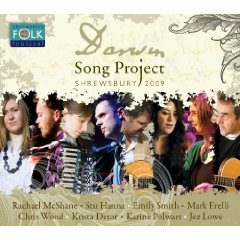
Song projects featuring an assemblage of individually talented singer-songwriters have a bit of a chequered history, some amounting to nothing more than a thinly-veiled personal showcase for the artists that's at best tenuously connected to the project's theme.
The Darwin Project, however, is an honourable exception, for it displays a spirit of genuine artistic collaboration between the contributors, a special alchemy that I'm guessing is attributable to the good sense and vision of its director Neil Pearson in bringing together an ideal mix of participants who between them encompass a wide range of songwriting experience and styles: established masters Chris Wood and Jez Lowe; veterans of similar exercises Karine Polwart and Emily Smith; acclaimed American artists Mark Erelli and Krista Detor; and rising younger stars Rachael McShane and Stu Hanna. It's even more of an achievement when you consider that most of the eight participants hadn't even met beforehand, and that extraordinarily, they managed to get all the songs written during one week-long songwriting retreat in early March of this year and ready for performance at a public concert less than a fortnight later – an occasion that provides the source recording for this disc, which has been brilliantly mastered by Stu Hanna himself. The Project has already been the subject of features on BBC Radios 2 and 4, and the songs are due to be further aired at this year's Shrewsbury Folk Festival.
This 72-minute CD succeeds in capturing the magic of the occasion, and features 17 of the 19 songs performed at the concert. The eight artists each appear in both lead and supporting roles (there being no purely solo outings), and the instrumental settings actually feel spontaneously conceived, almost semi-improvised and coming together in performance stage rather than being consciously pre-arranged.
The songwriters' brief was to create new works that have a "resonance and relevance" to Charles Robert Darwin (naturalist and "father of modern evolutionary theory"), who was born in Shrewsbury two hundred years ago (in February 1809). Darwin's great-great-grandson, Randal Keynes, addressed the writers at the start of the week, furnishing them with unique insights and eloquent anecdotes which clearly much inspired the resultant songs, which surely do Darwin's memory proud.
The first few songs portray snapshots from Darwin's life; intriguingly, he sets sail on the Beagle to the tune of one of his great-nephew Vaughan Williams's folksong settings! On Rachael's reflective Heavy In My Hand, Darwin ponders his initial decision to decline the offer of the trip, after which on Chris's masterly Turtle Soup he relishes the exotic adventures to come and portrays them with a keen sense of wonder before darker overtones and realisations creep in. Jez's tale of Jemmy Button examines the familiar theme of the return of the native, while reactions to Darwin's theories come from the confused man-in-the-street (Stu's The Merchant's Question) and an indignant American (Krista's Emma Brawley), finally being summarised in Jez's fond jolly-jape pastiche outlaw-ballad We'll Hunt Him Down.
The grandeur of the miracle of life itself is conveyed by Mark's Dylanesque Mother Of Mysteries (with beautiful harmonies by Karine) and the Boyesen-poem-inspired Mother Of My Soul, while other songs intelligently address the central theme and conundrum, the conflict between faith and science, which so preoccupied Emma, Darwin's cousin (later to become his wife). Emma's personal feelings and worries regarding the gulf between these two belief-systems, and their effect on Charles, are explored on the powerful trio-song Will You Be Waiting?, while Save A Place (sung by Emily) is a tender personal entreaty by Emma for Charles to remember her while at work. The sheer cruelty of natural selection is brought home to Charles by the death of his daughter Annie at age 10, conveyed extremely poignantly in the pair of songs at the core of the set – Emma's Lullaby (sung by Krista) and the especially moving We're All Leaving (sung by Karine) – having been also eerily alluded to in Mark's earlier Kingdom Come. Then, two songs towards the end of the set muse on the implications of Darwin's theory: Krista's soulful-gospel Clock Of The World and the concluding rousing acappella of Chris's sacred-harp-like hymn You May Stand Mute, an exhortation to us all to lay aside our opposing factions and unite in love and humanity.
Each of the songs is strong enough to stand alone outside the context of the project, although the performances on this disc will always be special. The digipack presentation is exemplary too, with booklet containing full lyrics and background notes. The project can be judged both a resounding artistic success – a massive credit to all concerned – and a fitting celebration of one of Shrewsbury's most famous sons.
David Kidman August 2009
Musically, its territory encompasses the blues, roots, country and old school r&b while the tasters are a mix of covers and originals. Of the former, veteran Lavelle White scores high with her versions of Box Tops classic Soul Deep and Oh Happy Day, though Livin' For The City feels a bit of a slog.
Tastes will differ, but I'll put my money down for Barton's cover of Naomi Neville (Allen Toussaint) classic It's Raining, Strehli's boozy barroom swaying It Hurts Me Too, Candye Kane's boogie woogie swing Babylon Boogie and mariachi honkytonker She Wore a Red Carnation. Arguably the best of the bunch of is the Texas country of Toni Price, which may explain why she gets almost twice as many tracks as the others, including a goodtime version of Butch Hancock's Bluebird and a bluesy swing through Dylan's Obviously 5 Believers.
The final dozen tracks are a straight reissue of the hard to find Dreams Come True, a 1990 trio album from Ball, Barton and Strehli that features covers and self-penned numbers alongside guest appearances by Dr John and Jimmie Vaughan.
Mike Davies October 2009
Various Artists - Deep River Of Song: Louisiana (Rounder)
The continuing Deep River Of Song series, which brings into the CD age selected archive recordings collected by Alan Lomax in the 30s and 40s, now moves on into the state of Louisiana. On the face of it, then, you might well expect just a collection of ancient cajun recordings, but the 23 tracks assembled here range extremely wide to illustrate the cultural richness and diversity of the state's varied population and geography. Alongside field recordings of work songs, ring-shouts and some intriguing French- and English-speaking juré (music based on old-time French-Acadian folk-songs), there's some (for the area) uncharacteristic string band music, an unusual (for the time) example of topical song (John Bray's Trench Blues), and even a couple of performances each by Jelly Roll Morton and Leadbelly. In hearing all these different musics side by side, some interesting cross-connections emerge between the black Creole and the Cajun communities, and we're made aware of some more purely musicological factors such as the possible association or evolution of ring-shout tempos and rhythms into a primitive form of zydeco. On several of the musical examples, too, there are appended spoken sections giving brief and often fascinating insights into the music and culture; one of these is an interview which among other things discusses how a 19th century quadrille was transformed into Tiger Rag! It's a bit unfortunate in the end that despite the welcome diversity of the musical selections the whole CD comes across as a bit too much of a ragbag, but such is the nature of any archive collection, so it's inevitably best dipped into piecemeal. Aside from two examples of prime zydeco recorded in Houston, Texas in 1980 (huh?), the recordings on this collection were all made by Lomax between 1934 and 1940, and thus can be rather variable in sound quality, with a number of unavoidable imperfections, although the remastering process has been carried out with due sensitivity. There's a typically chunky booklet too, with extensive notes and references.
David Kidman
Ever since the first tentative UK based incursions, the numbers of acts playing Americana music in its varied hues has grown on an annual basis. Sometimes it's hard to keep track and artists richly deserving of attention can slip through the cracks, languishing in cult obscurity. This compilation of both established and up and coming names provides a useful showcase for aural window shoppers, and even those who consider themselves well versed in the field might find someone new here to investigate. Of the 15 acts selected representing a broad span of the country spectrum, from rowdy rocking alt country to moodier Wilco-esque influences, you should be familiar with the likes of Alan Tyler, The Barker Band, Redlands Palomino Company and Two Fingers Of Firewater, all of whom are represented by cuts from their most recent albums.
I confess that Southern Tenant Folk Union were unknown to me, but listening to their opening track, the dusty backwoods gospel-folk sounding Let Me Wipe The Tears From You Eyes I'm keen to hear the full album.
There's new material too from a clutch of emerging names. I'm particularly taken by Liverpool's Sparkwood & 21 whose mandolin jogging If Only Forever (taken from their By The Water's Edge debut) brings together touches of Gram Parsons and early REM. Likewise Dusty And The Dreaming Spires whose jangling cover of Dylan's Girl From The North Country prompted further investigation, revealing they were formed from the ashes of late lamented Oxford underachievers, Goldrush.
Doubtless, others acts, Wild Pines, The Epstein, Treecreeper and Roseville Grand among them, will find their own new audiences through the compilation and full marks to the label for spreading the word.
Mike Davies March 2010
The Coens liked the music of O Brother, Where Art Thou? so much they decided to do the concert. So on May 24 last year, the artists from the movie all gathered at the Ryman Auditorium in Nashville for what was clearly a magical evening of traditional American mountain music and work songs. With no monitors and no electric instruments, the only things plugged in where the three microphones. That and the magic. Holly Hunter, who co-starred in the film, introduces proceeding and we're off with gospel harmony legends The Fairfield Four recreating chain gang wood chopping work song Po'Lazarus. Sadly the late John Hartford (he died earlier this year) doesn't reprise his soundtrack contribution of Man Of Constant Sorrow but does a fine job on Big Rock Candy Mountain, heard in the film courtesy of Harry McClintock's 1928 recording and, of course, best (if bizarrely) known as the Burl Ives children's favourite.
Union Station band member Dan Tyminski, who figured as George Clooney's singing voice on the Soggy Bottom version of Constant Sorrow, joins forces with his day job boss bluegrass queen Alison Krauss harmonising on the murder ballad Wild Bill Jones and sharing vocals for Bill Monroe's Blue and Lonesome. Krauss returns later for their soundtrack highlight version of I'll Fly Away, Welch herself, teamed with co- writer and partner David Rawlings contributing two further tracks, not trad numbers but, at the Coens' request, self-penned but vintage sounding originals My Dear Someone, a lilting 'parlor song', and the wittily ironic gospel I Want To Sing That Rock and Roll. The other featured original number, John Law Burned Down The Liquor Store, lets writer Chris Thomas (who played bluesman Tommy in the film) King and Canadian slide man Colin Linden do their blues thing.
Old time gospel returns courtesy of The Cox Family, five string banjo a go go for the evergreen Will There Be Any Stars as well as the sentimental death farewell I Am Weary. Family connections return with The Whites, mandolin player Buck joined by daughters Sharon and Cheryl whooping it up for an adaptation of fiddle tune Sandy Land. Which leaves the best known name of the evening, Emmylou Harris to take the stage with Welch and Rawlings and, providing dobro, Jerry Douglas, for a stirring uplifting version of Green Pastures. Disappointingly, although Welch (accompanied by Harris and Krauss as in the movie) sang the beguiling siren song Didn't Leave Nobody But The Baby and Ralph Carter was on hand to repeat his soundtrack recording of O Death, neither they nor the Peasall Sisters make it on to the concert CD. The good news is that they will be featured in the accompany documentary, filmed by the legendary DA Pennebaker. Well worth sparing a dime or two for, brother.
http://www.losthighwayrecords.com
Mike Davies
This is a cool collection of recordings from the Devon-based independent label Drift, whose name doesn't quite aptly conjure the ethos and spirit of the music but makes a partial fit. It can probably be characterised as floaty, often determinedly lo-fi nu-folk, some of it with a slightly ambient bias but all of it evoking a strangely strange but oddly normal other-world of bygone primitivism that er, drifts compellingly in and out of your consciousness. It would seem that all eleven of the acts represented are signed to the label (even though there's a small overlap of personnel on three of them), but so far I've only encountered full-length records by four of them (Mary Hampton, Thirty Pounds Of Bone, Birdengine and The R.G. Morrison), and the others are still very much worth investigating. Outside of the performer credits for individual tracks, there's no background info available on any of the acts; some appear to be solo artists hiding beneath a pseudonym (no criticism intended, just fact) or are they all pseudonyms for members of a central Collective, I wonder? Either way, Drift have certainly picked up on some satisfyingly idiosyncratic talents. Birdengine's scratchy antique-curio I, Dancing Bear makes a suitably enigmatic opening gambit, and things don't get much weirder except perhaps on Cottonmouth Rocks' phantasmal sprechstimme Racetrack (which may or may not be the brainchild of Sally Megee and Jack Cooper). The disc's standout is Eros by Mary Hampton, a sumptuous chamber-lied which I believe predates her wonderful album-of-my-year My Mother's Children. I also loved Matt Eaton's sepulchrally-delivered nugget of truth Too Scared To Fly (which recalled the Handsome Family), Thirty Pounds Of Bone's atmospheric In Search Of Oil and Monk Jack Deer's doleful uke-driven Handsome Friends, while Gale Fingers' Moving Home Is Never Easy is rather redolent of early Kevin Ayers. The one item which seems out of place here is Nada's slice of coy disco-poptronica More Custard, which outstays its welcome for me even at just under four minutes. Otherwise, Drift is stuffed full of utterly beguiling, if mildly cultish gems..
David Kidman February 2009
Dual - the perfect title for this CD, for, in its exciting collaborative exploration of traditional Scottish and Irish music by four gifted young exponents of those traditions, it embraces that word’s dual meaning: in both Scottish Gaelic and Irish, dual means to twine, braid, interlace or coil, but it also means one’s inheritance – symbolising the long-time historical links between the two communities and their cultures. It’s a joyously equal-handed collaboration too, with each “contingent” happily revelling in a dual musical personality and thoroughly enjoying playing each other’s music, like a bunch of close friends intimately living and breathing it you might say.
Muireann (probably best known from her tenure in the band Danú) is regarded as one of the foremost Irish-language singers around today, and Julie (of Dochas, also with a multi-award-winning solo presence in her own right) has comparable stature on the Scottish Gaelic scene; each of them is a singer of real character and interpretive flair, but each is also a skilled instrumentalist, and no gemstone amongst either lady’s array of talents is left unturned for this Dual album. Their two companions are among the finest of young musicians on the Celtic scene too: Julie’s husband Éamon (also a key figure in the Danú lineup) is a more than capable fiddler as well as a superlative bouzoukist, while Ross Martin is a gifted and versatile guitarist whose enviable economy of gesture and deftness of rhythm are qualities that speak volumes.
Altogether, Dual is a very natural-sounding record, with abundantly fresh and vital performances all round and plenty of variety in pace, mood and texture in its dozen tracks, which brilliantly intersperse and interweave Irish and Scottish source material and include a generous helping of scintillating tune-sets as well as songs – mouth music being but one of the essential bridges between the two. The instrumental complement extends beyond the expected whistle, flute, bouzouki and guitar to include pipes, melodeon, fiddle and very occasional keyboard (sensitively applied here on the love song Pé In Éirinn Í) and bodhrán.
The fact that all the singing is in Gaelic proves no barrier whatsoever; nor does the fact that virtually all of the music here is relatively or even totally unfamiliar. OK, so a couple of the tunes will strike a chord or two (a variant of Rocky Road To Dublin crops up for the delectable An Bairille set for instance; the melody of the regal Culloden song A Ríogain Uasail has cropped up elsewhere I’m sure; and I remember The Walls Of Liscarroll from an early Chieftains LP), but many of the less familiar ones prove equally memorable. The four musicians have a great gift for the creative combining of material too, and nowhere does any individual medley (or element within it) outstay its welcome, each sequence flowing absolutely naturally.
Standout tracks for me are the towering pair of lays (track 8) which reach right back into the ancient common tradition, Muireann’s show-stopping rendition (on flute) of the slow air Gol Na mBan San Ár, and at the other end of the emotional scale track 5 shows the influence of Scottish music on that of West Kerry in a radiantly joyful set that moves easily from strathspey to song and polka.
In spite of the similarity in the two lasses’ upbringing (each a native Gaelic speaker in a remote locality), the contrast in vocal timbre between Julie (sweet and pure) and Muireann (deeper and more earthy) is quite marked, and yet how very wonderfully they’re heard to complement each other (they give us some spine-tingling harmonies too); in addition, how well each of them draws the listener in with her superbly nimble phrasing, impeccable and nigh effortless control. Their exemplary control of breathing extends to instrumental expertise: I was particularly impressed with Julie’s stirring playing of both Highland and smallpipes on this occasion, and Muireann’s whistle and flute work is also astonishingly fine. That’s not to play down the ever-sparkling and finely-judged contributions of Ross or Éamon, I hasten to add, nor the excellent, clear and sympathetically balanced recording.
Dual has got to be one of the finest discs of its kind, whether considered as a boundary-straddling or boundary-crossing exercise – I’d prefer to view it as a real object lesson, the most persuasive demonstration of a common cultural heritage, this further reinforced by the disc’s exceptionally high standard of presentation (giving us full texts with translations as well as commendably detailed booklet notes). It’s a compelling musical statement that demands frequent revisits, and I honestly can’t find any fault with it.
David Kidman January 2010
Modern day rappers may think that they have got a monopoly on innuendo and smutty lyrics, but, as is shown on this collection of bawdy blues from the 1940s and 1950s with one each from the 60s and 70s, nothing in this world is new. This album has twenty eight tracks of the most suggestive, and sometimes outright filthy, lyrics that the blues has to offer. Starting with 1945s I Want A Man (Who's Gonna Do Right) by Annisteen Allen and Her Home Town Boys, a tale of a girl who wants her man to stand up all night we are taken on a journey with more double entendre than the entire series of Carry On films. Dirty Red's Mother Fuyer has slurred lyrics to give the effect of swearing at the appropriate times and is of a high standard musically with some great piano playing. Dinah Washington is one of the more famous names on the album and the first of her two contributions, Long John Blues, is a tale of dentistry. This has been a favourite theme for innuendo for some time and Dinah fills this standard jazzy blues with references to drilling and filling cavities. Tom Archia and His All Stars give us Fishin' Pole and there's no need to explain what the suggestion is here. Weddin' Day Blues by Cousin Joe with Pete Brown's Brooklyn Blue Blowers is one of the upfront songs - there's no hiding here on this speakeasy song. Another of the more famous contributors is Amos Milburn. His input is Hard Driving Blues, a standard blues but it is, after all, from one of the greats and he stamps his earthy personality all over it. The quaintly named Crown Prince Waterford offers up Move Your Hand Baby, a classy boogie-woogie with an energetic vocal. The standard of Julia Lee & Her Boyfriends' Don't Come Too Soon is very high even if the lyrics are a bit tame by today's standards. Wynonie Harris is another of the albums luminaries and his I Like My Baby's Pudding is a jazzy blues with a gritty vocal. By now I'm wondering just how many euphemisms you can get into one album! Some artists take their song seriously but that can't be said of The Dominoes. Their Doo-Wop, Sixty Minute Man, has an exceptionally silly lead vocal and is on the album for novelty value only. Moose Jackson (Bullmoose Jackson) joins up with Tiny Bradshaw's Orchestra for Big Ten Inch Record. This has a great use of a pause and shows that you can be frivolous and good. The Clovers give us Rotten Cocksuckers Ball, barbershop as you've never heard before. I'll say no more! Chuck Berry had a number 1 with My Ding-A-Ling but Dave Bartholomew's version pre-dates it by a number of years. I think that I prefer this big band, bluesy version. There are a number of styles on the album and The Treniers give us some post-war jump blues on Poon-Tang!
Jesse Powell & His Orchestra contribute The Walkin' Blues (Walk Right In, Walk Right Out) and this big band style is the most prevalent on the album. He leaves it to your imagination to make up the rhymes and this is probably the best way to deliver this type of song. The wordy, The '5' Royales with Charlie 'Little Jazz' Ferguson & His Orchestra provide Laundromat Blues - you shouldn't have to think too much to guess what this one is about. Wynonie Harris returns, this time with Todd Rhodes' Orchestra, for Keep On Churnin' - so filthy yet so innocent. Dinah Washington also makes a return with Big Long Slidin' Thing and, as I've said before, some are less obvious than others. This one is about a trombone, wink wink. There are some things that you don't expect to hear and The Blenders' Don't Fuck Around With Love in a Doo-Wop style is one of them. I suppose it's the contradiction that makes it attractive. Dorothy Ellis' Drill Daddy Drill is a return to the often covered theme and is an energetic blues with all of the compulsory innuendo. The Royals Work With Me Annie is not a blues as such but leans more toward R&B/Doo-Wop and falls into the less in your face category. The Toppers' I Love To Play Your Piano (Let Me Bang Your Box) is about playing the piano, apparently. One person that I did not expect to hear on this album was Jackie Wilson but he appears with LaVern Baker on Think Twice (Version X). You can hear LaVern giggle all the way through this as they put just about every swear word known to man. They have great rhythm though, no matter what. Snatch & The Poontangs featuring The Mouth on vocal throw up Two Time Slim, a true talking blues. This is how rap stars would play the blues and the Delta guitar in the background is sheer bliss. Chuck Willis' Stoop Down Baby is tame compared to some of the others but it makes up for it by being one of the best musically. We're treated to some Cajun by Boozoo Chavis who gives us LA Women Love Uncle Bud. This is another strong song musically and it's helping to give the album a powerful finish. Screamin' Jay Hawkins was never one to hide his light under a bushel and Bite It just confirms that. The album finishes with The Fred Wolff Combo and Somebody Else Was Suckin' My Dick Tonight. Growling vocal, short and not so sweet, what else can I say?
Bear Family Records has also included a wonderfully informative booklet which includes the offending lyrics.
David Blue January 2007
Naxos, a fine and upstanding classical music label, has ventured forth into the field of World Music. A move that sounds like it has the real potential for a 'fish out of water' result. Yet, 'Electric Highlife' is a fine catch for anyone who has tired of some of the over produced African records that have emerged in recent years. The thirteen tracks on this CD were recorded between 1982 and 1985 and have been extracted from the vaults of the Bokoor Studios in Ghana. Many of the names are unfamiliar to me with such as The Happy Boys, Beach Scorpions and Guyoyo amongst the outfits featured over the seventy-three minutes of this CD. Despite their low profiles, the tight economics involved in running the studio necessitate that these bands are hot. Indeed, there is not a poor track on this CD of vibrant Highlife music with some frantic but superb guitar work found all over the place. If you've tired of the modern day electric African music and don't much go for the current acoustic trend which has been the main backlash to the former, dipping into the past with this record is just the job. With brilliant playing and barely an overdub in sight, it may not be classical but it's classic.
Steve Henderson
This handsome three-disc set forms the second part of the planned trilogy that copiously celebrates concertina music from all corners of the music world. Its predecessor, 2005's Anglo International, won deserved plaudits for its exhaustiveness and meticulous research, and it swiftly gained wide appeal outwith the anorak brigade of the concertina fraternity as an enjoyable and highly musical collection in its own right. Now it's the turn of English International to showcase the English system of playing, which, in the words of the succinct booklet introduction, broadly speaking differs from the (German) Anglo system in that "all the buttons giving the same note are played on the push and pull".
Compiler Graham Bradshaw has painstakingly assembled no less than 39 different performers (mostly soloists) to illustrate the breadth of styles and musics that lie within the capabilities of the instrument. Several of the tracks are archive recordings (some from the personal archives of the performers themselves), others are culled from obscure records, but plenty have been specially recorded for the set. It all makes for another heady parade, moving nimbly, and at times quite breathlessly, from classical recital and concerto pieces through light-classical, novelty numbers, variety and the popular music-hall to dance music (mostly Irish) and finally on to song accompaniment – although each of the three discs is also sensibly sequenced for maximum listener enjoyment. It must be pointed out, though, that the English concertina seems more to be represented playing in classical or light-virtuoso style than as a folk instrument per se (many of the players you'll hear on the set having developed their skills in terms of technical virtuosity rather than specifically musical interest). Accompanying the concertina itself we hear a variety of different instruments and textures, from piano to guitar to harp and even a string orchestra (the final movement, Rondo, from James Cohn's Concerto – and I wouldn't mind hearing the rest of that work some time!).
Happily the folk scene isn't forgotten, with famous folk names represented including Alistair Anderson, Alf Edwards, Lea Nicholson, Ian Robb, Dave Townsend, Robert Harbron and Bernard Wrigley. Even so, I might have expected a greater concentration on the instrument's special strength in the field of song accompaniment, where it can play a key role; for instance, whereas Damien Barber is rightly included here, Steve Turner and Mary Humphreys (two other important practitioners) are not. But Damien's affectionate tribute to the late Tony Rose (Lovely Nancy, aka April Morning) proves a definite set highlight.
The purely instrumental selections do make up the bulk of the set, however, and there's some inspirational playing from a host of obscure unknowns (some of whom defeated even Graham's exhaustive efforts to unearth any biographical detail at all). There are some fabulous archive recordings too, which have been immaculately restored (in one case from two separate pieces of a fractured original rare disc!). They transport you back to another era entirely: for instance, just marvel at the bold energy displayed by competition bands like The Heywood (Manchester) Concertina Band (run on similar lines to those in the brass-band arena) - what a magnificent sound! The booklet contains lots of detail about the performers and their recordings, but in the majority of instances falls short of providing actual dates for the various recordings used - a curious omission in view of the high level of useful information provided generally. (It is, however, an improvement on that for Anglo International, which contained several unforgivable editorial glitches.)
Summing up - English International, like its predecessor, proves a commendably - and consistently - enjoyable set, with delightful surprises round every corner. Volume Three will give us the Duet Concertina in due course.
David Kidman February 2009
Various Artists - Everwood (Nettwerk)
Unless you happen to live Stateside or watch the Living TV channel in the UK, chances are you've never hear of this presumably 70s set TV family drama. I've certainly no idea what it's about those the photo of assorted characters in denims, check shirts and homespun haircuts on the back of the sleeve offers some clues.
The soundtrack though certainly puts it up in the Dawson's Creek league, a clutch of contemporary names revisiting and reworking 'hits' from the 70s. Cat Stevens looms large in the writing credits with impeccable covers of Father And Son by breathy voiced Leigh Nash, a tinkling Don't Be Shy from Travis that actually manages to sound like Stevens himself, and a stripped back acoustic cover of Trouble that's totally owned by Kristin Hersh.
Elsewhere Jars of Clay take on Lonely People, Griffin House (?) handle These Days, Guster turn Jimmy Cliff's Harder They Come into American guitar rock and whoever Toby Lightman is she does a fine, piano accompanied weary number of Jim Croce's Operator.
Breaking time stamp format, Jump Little Children's Cathedrals is a bit of a string arranged emotional soarer that apparently accompanied a particularly poignant episode while series star Treat Williams is included with his dreamy acoustic take on Kenny Loggins' Love Song Best by far though are three rather stunning arrangements. Who'd have expected to hear Stereophonics tear the heart out of The First Time Ever I Saw Your Face with such an ache or to find Jason Mraz take the Isleys' Summer Breeze and invests it with shades of bluegrass soul? But the one I keep coming back to is David Mead who underlines that magnificent voice and those Art Garfunkel comparisons with his utterly gorgeous version of Simon's Only Living Boy In New York.
I don't know how long the series has been running, but if it keeps turning out collections like this then let's hope the ratings continue to thrive.
Mike Davies
David Kidman
This is an ambitious project masterminded by Folk South West (the folk development agency for the South West of England), who last year were able to obtain a special grant from South West Arts to commission a new piece of music. The seed of the idea for this piece had originally come from Gina Le Faux a year earlier, but the process began in earnest with the selection by Eddie Upton of six traditional songs which had been collected in the region; the songs were passed to Gina, who wrote tunes to link them together into a continuous piece of music, and finally it fell to John Kirkpatrick to arrange and orchestrate the whole piece. The result (the Fanfare For The South West Suite, which takes up tracks 1-12 of this disc) is a gloriously dramatic and invigorating musical (and theatrical) experience, an occasional piece in the best tradition of such pieces, which alternates fulsomely scored ensemble passages with more sparingly scored sections. In these respects it reminded me of the Albions/Home Service theatre pieces but with occasional hints of a Vaughan Williams cantata, but the end effect is overwhelmingly joyful and celebratory, happy and unpretentious in its sense of real communal music-making. The large instrumental ensemble comprises many and sundry squeezeboxes of all denominations, guitars, fiddles, bouzoukis, recorders and bassoon, and includes within its ranks the excellent musicianship of "name" soloists like Tim Van Eyken, Robert Harbron, John & Benji Kirkpatrick, Gina Le Faux and Paul Burgess; the vocal contributions come from soloists Philippa Toulson and Eddie Upton and the "Stanchester Quire" contribute the forthright massed choir passages at an impressively high standard. It's all very enjoyable indeed, not in the least stagey, and certainly satisfying enough an experience for listening again beyond the "occasion" that such pieces normally command. After the Suite itself, the final 18 minutes of the CD comprises a miscellany interspersing full choral arrangements of songs (too heavily-scored, formal and stiff in comparison with those in the Suite, I found) with lively, well-sprung chamber-folk-style renditions of some dance tunes found in George Till's manuscript (the set of Schottisches could almost have been an outtake from Vivaldi's Spring concerto - only joking of course! - and I'm sure James Higgins' Jig hints at Barford Green…) done with panache and energy, making them a worthwhile fillup to the main item on the disc's menu.
David Kidman
This beautifully coordinated two-disc set forms an inevitable, but entirely welcome tribute to all the soldiers who fought and suffered together in the "Great War" and in particular all those who died. It also has a distinct Scottish perspective, which is only fair and appropriate when you consider that Scotland suffered the most soldiers killed per head of population. Actually, I'd consider the set one of the finest of the similarly themed collections ever to have been produced - and yes, I know this is a very crowded market.
One of the great things about the set is its sheer variety of tone and content. It encompasses the whole gamut of emotion that such a life-changing experience as a major war can inflict on man: poignant homage, sober reflection, pointed and caustic commentary, grim and dark humour, and so forth. We're presented with laments both military and civilian, soldiers' songs from the trenches, pipe tunes associated with the regiments, music-hall songs, and modern-day songs written in commemoration of specific people, places or events or else having a strong WWI resonance or connection (absolutely nothing remotely tenuous here). And all performed without a trace of undue sentimentality or mawkishness, and assembled into a powerful and credible sequence across the two hours or so of music on these two discs.
A good many of the recordings collected herein have been made specially for the set too, notably the extensive sequence of 27 trench songs and five music-hall songs which together make up the bulk of Disc 1: these are sung with feeling and passionate dedication by the "Scottish Pals" Singers company (assembled just for this project, and consisting of Ian Bruce, Fiona Forbes, Stephen Quigg, Nick Keir, Ian McCalman, Tich Frier and Hamish Bayne), individually and collectively. I've so often viewed much of this material as misplaced jingoism and found it really uncomfortable to listen to, but the performances on this set have gone a long way towards rehabilitating it for me (in some measure), so persuasively is the whole exercise carried out and so credibly is it put into due perspective. Disc 1 ends with a vintage Harry Lauder recording, followed poignantly by two instrumental reflections of the fatal outcome of soldiery, Flowers Of The Forest and The Last Post. After which, Disc 2 then takes us from the second of two brief poems (readings by Iain Anderson) through a sequence of modern-day commemorative songs. These include tracks licensed from existing releases: perhaps predictably (but reasonably enough), there's The Corries' rendition of Green Fields Of France, Dick Gaughan's Why Old Men Cry, Eric Bogle's Band Played Waltzing Matilda and As If He Knows, The McCalmans' spirited treatment of Judy Small's Mothers, Daughters, Wives... But the cuts from Malinky, Jim Malcolm, Sheena Wellington & Karine Polwart (Hallowe'en) and Alan Bell are no less welcome. The real gems of the disc, however, come with the recordings made specially for the project, standouts among these being Gaelic singer Donnie M. MacLeod's acappella singing of Donald MacDonald's epic war memoir An Eala Bhan (The White Swan) and new (to me) young songwriter Steven Palmer's chilling composition Black Is The Sun - these are worth the price of the set on their own! Also newly recorded for this release are tracks by Robin Laing (Geordie McCrae) and The McCalmans (Only Remembered).
All of which actually adds up (especially Disc 2) to a remarkably intense and emotional listening experience for anyone with a shred of humanity and conscience left in their soul - whatever his or her views on the wider issues of war, its principles and its celebration. And presentation-wise, Greentrax have excelled even their own lavish standards, for sleeve notes are supremely informative, discographical and other details copious, and artwork immensely attractive and entirely complementary. This release is a landmark in its field, and one that's not likely to be bettered.
David Kidman November 2008
"the song was more important than the singer"
So said the late Jack Hardy in the comprehensive sleeve notes for this extraordinary collection of songs recorded between 1982 & 1997 for his not for profit Fast Folk magazine. Each issue included an album showcasing singer-songwriters on the hugely influential New York scene. Staffed by enthusiasts, largely the musicians themselves, Fast Folk became the hub of the Greenwich Village songwriter's community, organising gigs, forming a musician's cooperative, publishing songbooks, etc.
The tracks on this 2 CD set were chosen by Hardy, fellow editor Richard Meyer & scene stalwart Jeff Place from over 100 editions of Fast Folk & it must have been a tough job. The collection has sleeve notes which should be the benchmark for other compilation albums, giving details of the scene, suggested further listening & information on each performer plus discography, website addresses, etc.
It's hard to give an objective review of 33 different artists. A handful of names you will know: Suzanne Vega, Steve Forbert, Shawn Colvin, Lucy Kaplansky, John Gorka, Richard Shindell & these give a clue to the exceptional standard of songwriting & performance throughout. All the recordings benefit from being either from a live show or largely one-take studio performance devoid of production 'polish' to cloud the impact of the songs.
Maybe if the UK had a publication & community of this nature at the same time, some of this country's exceptional contemporary songwriters would have a deservedly higher media profile today?
www.folkways.si.edu/catalog/40135.htm
www.si.edu/folkways
James Hibbins 2002
This new compilation is subtitled "Other worldly folk music gems and psychedelics", which makes it sound very desirable! It's the brainchild of well-respected cross-genre (ambient, techno, broken beat) producer Mark Pritchard (Troubleman, Global Communication, Harmonic 33) who every now and then finds himself encountering a certain style of folk that "gives him the chills". As represented herein, much of it - certainly virtually the entire first half of the CD - is almost exclusively of the free-flowing, groovy, light-textured, cool acoustic jazz variety rather than strictly folk as we might understand it, also not exactly acid-folk or psychedelic as I'd understand the terms. Things get a bit funkier thereafter, with Donovan's Get Thy Bearings (vintage 1968) and Christine Harwood's cover of CSN's Wooden Ships, following which the selections get more musically satisfying. Bonnie Dobson (writer of the oft-covered Morning Dew) pitches in with a sombre, sitar-laden Winter's Going that's worth resurrecting, and even Karen Beth's curiously stilted Something To Believe In has considerable charms; as does the willowy delicacy of Linda Perhacs' Chimacum Rain, whereas Spleen's Along Came Sam turns out to be an intriguing cacophony, after which even Kathy Smith's six-minute epic End Of The World seems a mite unfocussed. As a general observation, it's interesting that a significant majority of the tracks chosen for this compilation feature female vocalists, which perhaps gives a misleading impression that acid-folk was exclusively their province. And there's no indication of the temporal provenance of the tracks (though it's audibly very obvious that many of the tracks have been sourced from vinyl, and the sound quality is generally acceptable or rather better); yet again, as with another current chill-folk compilation Garden Of Delights, there's an infuriating total lack of discographical information with the package, which rather inhibits punters from investigating either the original albums or other sources. There's some good music here, sure, but any serious fan is likely to demand to know more. And as for the anticipated question "is it folk?", we're exhorted in the press release to "feel the spirit and do it anyway" - fair comment, but a bit of a cop-out I reckon!
David Kidman, July 2006
Festival In The Desert (Wrasse Records DVD)
The 2003 Festival In The Desert of Essakane was organised by the EFES Association with the help and support of the Malian Ministry of Culture and in partnership with the Malian Ministry of Crafts and Tourism. This DVD brings together an all-too-short 52-minute film of that amazing festival, an interview segment (with Issa Dicko) and photos. Brevity, however, is more than compensated for by quality and heady atmosphere. The sheer scale of the incredibly remote location (a part of Mali populated only by nomadic Tuareg tribesmen) and the trek just to get there, the mammoth preparations for the concert, then the performances of the musicians themselves, all against a dune-laden landscape that's other-worldly. The performances are mesmerising! Featured artistes include famous African names such as Oumou Sangare and Ali Farka Touré, while our own Robert Plant (collaborating with guitarist Justin Adams and a couple of other musicians) contributes a throbbing Win My Train Fare Home (out-of-place tho' that image might seem in that desert land!), and French band Lo'jo delight with their vibrant slice of fusion Jah Kas Cool Boy. Then there's the local Tuareg musicians Tinariwen, who deliver a thrilling, captivating and yes, intense form of what I can only describe as desert-blues. A remarkable record of a remarkable event.
www.triban-union.com
www.wrasserecords.com
David Kidman
The Fife Traditional Singing Weekend brings traditional singers together in an informal setting to give traditional song enthusiasts a chance to meet and hear other exponents of their art (for art it most certainly is!); most of the attendees are themselves singers, in fact. This delightful 72-minute CD selects just 20 performances from recordings made at the first and second Weekends (held in May of 2003 and 2004). Many, but not all, of these are given by the event's "booked guests", among whom you'll find many names you'll recognise like Alison McMorland, Arthur Watson, Jock Duncan, Sheila Stewart, Elizabeth Stewart and Duncan Williamson (appropriately including representatives of the travellers' tradition, as you can see), but even the unknown names (audience members) clearly relish singing and give their all in performances of quality and stature. The singers aren't quite exclusively Scottish either (for Roisin White gives us two songs), but so what, for it's the songs, and the quality of the singing, that matters. The songs performed may well contain some well-loved items (Bonnie Lass O' Fyvie, The Jolly Beggar, Sir Patrick Spens, Sae Will We Yet, Maids When You're Young, Bonnie Bessie Logan, The Parting Glass etc.), but these renditions are superb, among the most spirited available on disc, and added interest is provided since some use slightly different variants than we're used to. There's an unusually rollicking version of Bonnie House O' Airlie given by Stanley Robertson, for instance. Both serious and comic songs are represented; indeed the balance probably tips in favour of the lighter side of the song repertoire with delicious items like The Muckin' O' Geordie's Byre and Ye Canna Pit It On Tae Sandy. Whatever the song, though, the booklet notes are most helpful, concisely giving maximum information on the sources used and biographical detail on the singers too. This really is a wonderful collection, one that so well conveys what it's like to be there at the gathering. The cover photo montage says it all! For supremely strong indeed is the convivial atmosphere of like minds (and voices!) thoroughly enjoying themselves; it's so infectious that you just can't resist joining in!
David Kidman, July 2006
This is a 2 CD showcase of CoraZong's current catalogue and has artists such as Peter Cooper, Krista Detor, Kim Carnes, Alastair Moock and Last Train Home displaying their wares. CoraZong is well-known for their commitment to artists that are just on the edge of genres such as Americana, Folk, Blues and Country.
JP Den Tex gives us the sedate MOR The Lights Of Phoenix and ups the stakes with a tortured vocal on the piano ballad, Looking For Rosie. Alastair Moock has his usual quirky vocal on the standout live version of My Creole Belle. He exudes an old style class with excellent playing all around. He also contributes God Saw Fit To Make Tears, which is a gentle Americana with weary vocal.
The Mercy Brothers' I Believe I'll Make A Change tips its hat to Woody Guthrie whereas Waiting For A Better Day shows their country blues side. Peter Cooper shows he is a star on Wine and he has that great American voice so suited for the gentle country of Gospel Song.
Jeff Talmadge is on the gentle country trail with Wrong Train. He also gives us a live version of Wild And Precious Thing which shows him to be a most accomplished singer songwriter. Krista Detor's dark Go Ahead & Wait has silver linings if you wait and More Than I Dare Say has more of her silky voice.
John Coinman throws in some Tex-Mex on Down In Nogales and a very good example it is too. However, he also gives us the strange You And Me, Oui which doesn't really work. Inneke 23 & The Lipstick Painters gives us the topical Christmas Song. Also here is Elephant Crossing, a quirky song with bouncy fiddle and banjo.
Kim Carnes has the gentle brilliance of Goodnight Angel on which she has a great vocal partnership with her backing singer. She still has that husky voice from Bette Davis Eyes and she unleashes it on Still Warmed By The Thrill (live). However, this is so different from what she is known for as it is slow and acoustic. The excellent Last Train Home contributes Flood which is strong, moody country tinged rock. They also supply (Say) Won't You Be Mine which has tremendous guitar and pedal steel with an old style country/bluegrass feel.
Patricia Vonne is raucous and rebellious on Rebel Bride (live in New York City). She also gives us some classic Americana on Joe's Gone Ridin' and this shows her strong voice and a top backing band. Jean Paul Rena & Terrawheel provide some heavy guitar R&R. It's raw and just about ok but they show their blues and roots side on the acoustic demo of Blue Son.
As a sampler for CoraZong's eclectic style of music, this could not be any better. I defy you not to find something that you like.
David Blue November 2008
Leigh Folk Festival, the uniquely free festival that commands a fiercely loyal following, continually presents a refreshingly different lineup that confirms the healthily diverse state of folk music as the broadest of all possible churches. It also continually rings the changes and challenges the punters, just as much so now in its 20th year, a milestone which this veritable treasure-trove, the fourth in its series of limited-edition festival souvenir CDs, celebrates in style.
As the liner-note proudly proclaims, "LFF is always different, always the same", with all contributions – whether from "big-hitters" or little-knowns, whether professionally recorded or defiantly lo-fi – being of unquestioned high artistic quality. Fire, Feathers… certainly continues in the tradition established thus far on the previous three years' CDs, and presents 74 minutes' worth of unreservedly excellent music courtesy of artists appearing at this year's (2011) festival. It might at first seem as though the disc is predominantly (though not exclusively) couched in what might now be termed the present-day English nu-folk and psych-folk traditions. Well, the prevailing mood of its first half, at any rate, is that of slightly gloomy English balladry, which takes us from Philip Henry & Hannah Martin's instrumental introit (a brace of fine old tunes beautifully arranged for dobro and fiddle) through Pamela Wyn Shannon's inventive reworking of a Child Ballad (Cold Blows The Wind) to an ultra-atmospheric retelling of another Child Ballad (Riddles) by the Anglo-Ukrainian duo Dark Patrick. Other standout tracks on this new collection include an idiosyncratic slice of pared-down electric-folk from the enigmatic Phillious Williams, a brilliantly vital treatment of Nottamun Town from the Straw Bear Band, a compelling "child's version of the seven wonders of the world" from Cass Meurig & Nial Cain, and a brand new Kittiwakes song-voyage (William And The Boat); while Nancy Wallace & Jason Steel have donated an intimate and strangely satisfying new song, Windows, and there's an intriguing, if left-field guitar-dominated experimental poetry-to-music venture from the duo Bones & The Aft (John Bently and Ian McKean).
No fewer than six of the disc's 17 musical selections are (like the majority of those already mentioned, in fact) previously unreleased, and an equivalent number of tracks turn out to be drawn from fairly obscure EPs or otherwise-not-easily-available releases. Only the tracks by Martin Carthy (the later, 2004, of his recordings of his signature epic Famous Flower Of Serving Men), Emily Portman (the ominous lullaby Fine Silica) and O'Hooley & Tidow (the incomparable Flight Of The Petrel) could be said to be readily accessible via conventional outlets. The "wild-card" world-music entries, included to demonstrate the festival's diversity, comprise some straight-ahead klezmer from Klezmer Klub, an authentic one-step from crack cajun combo Acadian Driftwood and the title track of Madagascan star Modeste's most recent album. The whole sequence is given a powerful sense of place by the interpolation of four brief snippets of "Avian Sonic Detritus", in other words vintage recordings of bird life that can be found in the region (although on the sample labelled as Redshank a prominent drumming Snipe should really be given equal billing!).
Once again, those responsible should be congratulated on producing a highly desirable artefact that serves the dual purpose of keepable festival souvenir and repeatably listenable cumulative musical experience; as ever, this festival can be relied upon to produce something reassuringly different and continually stimulating. And once again, the CD retails at just £5, with all profits going to support the running of the free event (which is still entirely organised by volunteers), representing unrivalled value and a role-model to which all festival souvenir disc should aspire.
David Kidman June 2011
Various Artists - First Person Singular: A Woman's Voice (Topic Records)
Recently, I read some comments about the wealth of the female talent in the folk world compared with the male equivalent. Sexist, maybe, but Ill take a side step on that one. However, even a casual listen to First Person Singular will convince you about the former statement of wealth. Most of the tracks have been taken form the Topic treasure trove with songs from June Tabor, Norma Waterson, Anne Briggs, Eliza Carthy, Shirley Collins, etc. Cleverly, Topic hasnt settled for any filler material on this 17 track compilation. Instead, they have licensed material from other labels to maintain the high quality standard. Indeed, their choices of the likes of Julie Murphy, Kathryn Williams and Charlotte Greig are excellent in recognising contemporary talent. Arguments rage in some quarters about the value of these compilations and their potential watering down of individual artists/genres, repetition of well known tracks, etc, etc. Sure, any fan of the female voice performed against a sparse musical backdrop will have music from at least one of these artists. However, this is a top-notch collection that I would bet will contain one or two surprises for most listeners and for relative newcomers will provide a very happy hunting ground.
Steve Henderson

The insinuation tactics of the BNP need no introduction to readers, and their notorious efforts to infiltrate the British folk scene have been widely vilified by all right-minded music fans. Folk Against Fascism has been created to take a stand against the BNP's nefarious tactics; like the UK folk scene itself, it is genuinely inclusive, welcoming into its fold "any and all of us who want to make ourselves aware of the BNP's bigoted view of our history and culture, and who want to do something about it".
So, here demonstrating their anger through their willing donation of their music on this truly magnificent two-disc set (lovingly and informatively compiled by Tom Rose) we find an extensive selection of the great and the good of British folk music, with a total of 31 representative tracks which have mostly been culled from existing available album releases. Show Of Hands' Roots and Chumbawamba's Dance, Idiot, Dance are self-evident inclusions, tracks that would have chosen themselves, but these are almost the only overtly political statements on the set; OK, there are contributions from Ray Hearne, John Tams and Roy Bailey (tho' perhaps I'm a touch surprised to find Robb Johnson's name absent from the roster), and there's John McCusker's Under One Sky...
But the bulk of the remainder of the tracks appear to have been sensibly chosen for their folk-musical value and significance rather than out of any purely political stance they might've been construed to adopt. Particularly welcome are such as the Unthanks' gorgeously plaintive Nobody Knew She Was There, June Tabor's peerless cover of Lester Simpson's Standing In Line and Eliza Carthy's Like I Care, while among other maybe less expected inclusions we find a Shirley & Dolly Collins "Coppersong", Kate Rusby's High On A Hill and Ruth Notman's Holding On. Oh, and happily there are well-chosen tracks from all the "usual suspects" from Tom's Reveal and Navigator labels (Chris Wood, Jon Boden, Bellowhead, Heidi Talbot, Kris Drever, Lau).
Even those completists who already have the majority of the above tracks in their collections need not despair, however, for a select few are either more obscure in origin or (in one case) otherwise unavailable: Laura Veirs' simply charming rendition of the Carter Family classic Wildwood Flower is taken from her Two Beers Veirs EP, Christy Moore's Pink Triangle comes from his own "personal collection", and the Imagined Village track (which principally features Carthy and Bragg) is culled from the project's inaugural limited-edition EP release. Not every folk music fan will have the tracks by Damien Dempsey (the epic seven-minute Colony), Duotone (alias Barney Morse-Brown) and Justin Adams & Juldeh Camara (a track from their Soul Science album). Or indeed (yet) the Bevvy Sisters' fine album (only just released by Shoogle). And usefully, the Andy Cutting track Edges/Thin Waltz forms a generous preview for his forthcoming solo album (due for release in early July). So, not only does this exceptional compilation truly have something for everyone, and is a great listen from end to end, but it also persuasively demonstrates how broad a church folk music already is and that it has absolutely no need of espousal by those who are committed only to their own narrow-minded political extremist ends. You can support Folk Against Fascism by buying this set pronto - for yourself and also your friends (it would be the one exception to my rule of never considering buying Christmas presents before November!)...
David Kidman May 2010
Another year another set of Radio 2 Folk Awards. Not that the last twelve months seems to have a huge impact on the nominations. Obligingly, Martin Simpson, Lau and Show Of Hands got below the radar and don't make the usual appearances, but otherwise it's hard to escape a feeling of deja vu when you see last year's winner Jon Boden up again for Folk Singer of the Year alongside 2009 champ Chris Wood, While and Matthews and Megson once more in the Best Duo slot, and Bellowhead making their annual appearances for Best Group and Best Live Act (alongside fellow regular nominees The Demon Barbers and The Unthanks) as well as figuring in various other categories populated by such frequent nominees as Coope Boyes & Simpson, Richard Thompson, Andy Cutting, Kerr & Fagen, Michael McGoldrick and Waterson Carthy, albeit this year Eliza rather than Martin.
Now, this is in no way intended to decry the talents or worthiness of the nominees( who could not but praise things like Bellowhead's New York Girls, Megson's Working Town or Because He Was A Bonny Lad by The Unthanks, all included here) , but it does rather underscore the entrenched and rather narrow field of vision among those who select them.
The sleeve notes make a point of flagging up the 'fresh faces', and certainly it's great to see recognition for Fay Field, Ewan McLennan, Johnny Kearney & Lucy Farrell and Emily Portman as rising stars in the Horizon Awards. However, I'd also point out that all of them are pretty much within the trad field and only one of them, Portman, is nominated in another category with the slightly unrepresentative Stick Stock contending for Best Original Song.
It's this category that features the Awards' biggest surprise with the first time inclusion of indie artist Laura Marling (twice nominated for the Mercury Music Prize I should mention) for Rambling Man. The fact that it's the only one of the nominated songs not to appear on the CD (which claims to include all 28 nominees) should give a good idea of her chances.
The only other real breath of fresh air is to find relative newcomer (a mere four solo album) Heidi Talbot as the sole female nominee for Folk Singer of the Year alongside Boden, Wood and Kris Drever, though it's probably also indicative of the thinking that she's also nominated for Best Traditional Track (Willie Taylor, taken from The Last Star) rather than one of her own songs.
There are, of course, 'fresh faces' in the live performances by the Young Folk Award semi-finalists, this time scattered across the two CDs rather than on a bonus disc; harpist sisters Mairi & Steaphanaidh Chaimbeul (not that fresh as they were nominated last year), David Gibb & Elly Lucas, instrumentalists and hornpipe specialists Moore, Moss, Rutter, and soloist Andy Holmes. But, outside of the Horizon Award, the only new name here is Fishermen's Friends, the Port Isaac sea shanty singers; and they've been going 15 years.
Where then are nominations for such exciting new arrivals on the folk scene as Trembling Bells, Mumford & Sons, O'Hooley & Tidow, Shady Bard, The Destroyers (surely a best live act if ever there was one), Red Shoes, Johnny Flynn, Stornoway, or Smoke Fairies? The Awards are well respected in the folk world. If they're to remain so, perhaps they and the expert panelists who decide the winners need to more reflect the new blood that keeps it alive.
www.bbc.co.uk/radio2/events/folk-awards-2011
Mike Davies January 2011
Another year, another BBC Radio 2 Folk Awards and another box set with 2 discs featuring the nominees with, as ever, several in the running for more than one category. The awards take place on Feb 1, so it may all be over by the time you actually read this and I'm not going out on a limb to make predictions that almost invariably will have no relation to the actual winners.
However, the compilation exists as more than a checklist and is a more than useful thumbnail reference work for the current health of British folk music. Much of the featured music here is of a traditional bent, embracing as it does current material from such names as Cara Dillon, Mawkin:Causley, Jon Boden, Damien Barber & Mike Wilson, Jackie Oates, Bellowhead and Martin Simpson. The latter's the only artist to get two tracks on the compilation, both taken from True Stories, but then he's also not only nominated in five different categories but is nominated twice for Best Original Song!
Like Simpson, there's several well established names on the list, with accordion maestro John Kirkpatrick, folk-reggae fusioneers Edward II, Belshazzar's Feast and Show Of Hands (up against Simpson in the song race) all sporting long service medals while relative newcomers include The Unthanks, the bluegrass influenced Megson, instrumental duo Maclaine Colston & Saul Rose (both former Young Tradition finalists with Saul up for Best Musician) and, looking to make it a Best Group hat trick, Lau.
Nominated in the Musician of the Year category, curiously John McCusker's represented on the compilation not by a track from his recent vocal and instrumental suite, Under One Sky, but by one from Before The Ruin, his 2008 collaboration with Kris Drever and Roddy Woomble. Still, given that it's The Poorest Company, it seems churlish to quibble over the selection process.
As ever, The Horizon Award puts the spotlight on acts who have either increased their profile or debuted on the scene during 2009. Sometime Memory Band/Owl Service singer Nancy Wallace earns her place by way of full length solo debut Old Stories though, given the compilation's trad bias, it might have been better to feature one of her own songs rather than I Live Not Where I Love.
A runner up in my best of the year list, it's good to see Sam Carter represented with debut album Keepsakes, joined by Hannah James & Sam Sweeney who made their duo debut last year after serving time together in Kerfuffle and, separately, as members of The Demon Barber Roadshow and Bellowhead. Rounding out the nominees are two more names branching out from their day jobs into duo territory, Tiny Tin Lady fiddle player Katriona Gilmore and, yet another Kerfuffle graduate, Jamie Roberts.
Finally among the nominees, in what can sometimes seem a rather po-faced genre, it's good to find rowdy punk into folk alchemists The Bad Shepherds in the running for Best Live Act, here to be heard transforming Down In The Tube Station At Midnight.
As ever there's also a bonus third CD featuring the six finalists - all of a trad persuasion - for the BBC Radio 2 Young Folk Award. The results were announced last December with Dorset's James Findlay walking away with the trophy, featured here singing British Man Of War, with the other finalists lining up as 15 year old Celtic Folk singer and bodhran player Niamh Boadle, Irish instrumental sextet Cinnte, Skye sisters Maire & Steaphanaidh Chaimbeul, Scottish button accordionist Chris Keatinge and, another sibling duo, bluegrass influenced Devonian twins The Carrivick Sisters.
www.bbc.co.uk/radio2/events/folk-awards-2010
Mike Davies January 2010
This is the latest in the tried and tested series of great-value two-disc boxes sampling the recorded (and reasonably easily available) wares of artists nominated for this year's BBC Radio 2 Folk Awards (Lau, Jim Moray, Julie Fowlis, Bellowhead, Karine Polwart, Chris Wood, Tom McConville, Phil Beer, Jackie Oates et al all putting in an appearance). The chief attraction for many diehard folk fans, though, will be the bonus (third) disc spotlighting the six "acts to watch" (ie the Young Folk Award finalists). Of these, Lucy Ward's stunningly theatrical yet totally believable acappella rendition of Stitch In Time is worth the price of the set alone, and Maz O'Connor's take on The Cruel Mother runs it very close. The Jaywalkers provide some reliable oldtime, but I wouldn't agree with the judges over the merits of one or two of the other finalists I'm afraid, they just don't stand out from the crowd. But all in all, non-converts should prepare to be converted by the excellent selection of music on display on these discs, which demonstrate that the folk scene is still alive and very well thankyou.
David Kidman April 2009
As claimed by BBC Radio 2 folk producer John Leonard in his fulsome booklet-note to this equally fulsome three-disc compilation-cum-taster, folk music is again in a healthy state, and indeed in the ascendant. That can never be a bad thing, of course; but as we all know, the BBC Radio 2 Folk Awards are only part of the success story - and a selective one at that. Laying that observation aside, and concentrating on the musical content of this release: well, if you want a no-nonsense overview of the sheer breadth of talent of the award nominees, and you want to hear what all the fuss is about with artistes you've never heard of, then fine, you really can't go wrong.
The first two discs present one track apiece representing 22 of the specific nominations (although - curiously, in view of all the stir it caused - not Seth Lakeman's "is-it-trad-or-is-it-not?" White Hare!). It's a lineup that guarantees listening pleasure and top quality music, with the inevitable sprinkling of the "bigger folk names" (Show Of Hands, Swarbrick, Carthy, Watersons, Spiers & Boden, Bellowhead, Martin Simpson, Nic Jones, Vin Garbutt) nestling easily alongside the now established (John McCusker, Karine Polwart, Kerr & Fagan) and the quickly-getting-established (Seth Lakeman, Devil's Interval, Kris Drever, Shona Kipling & Damien O'Kane, Martha Tilston, Julie Fowlis). Some of whom, of course, many potential listeners will still be unaware of. Oh, and Eliza Carthy gets another bite at the cherry, in the capacity of guest vocalist on the Salsa Celtica track... All of the selections bar one are taken from existing album releases (and all of these, if I'm not mistaken, are distributed by Proper); the exception is a gutsy live (Cambridge Folk Festival) recording of Vulcan/Steelo from Messrs Tams and Coope.
Perhaps the most interesting part of the set for those already converted to the folk cause, however, is Disc 3, which gathers together performances from six of the 2007 BBC Young Folk Awards finalists, which demonstrate beyond all doubt that there's plenty more upcoming talent which should see an assured future for folk. Although I hope it's not indicative of a trend that only one of the six finalists feature song (the rest are exclusively instrumental, judging from the tracks sampled here, although they span the gamut from session tunes to country blues and guitar wizardry), the continued spirit and verve of the music-making is never in question. So - a good-value set, with stuff therein to entice most categories of folkie: first-timer, part-timer, talent-spotter and more hardened enthusiast; can't say fairer than that.
bbc.co.uk/radio2/events/folkawards2007/index.shtml
David Kidman 2007
Various Artists - The Folk Awards 2005 (Proper)
This nice-price two-disc set conveniently collects together a generally representative track from each and every artist nominated for this year's prestigious BBC Radio 2 Folk Awards. The more cynical among you may feel that there's little merit in this compilation – unless it's going to be bought by someone with very little knowledge or experience of the current folk scene outside of an occasional listen to the Cowshed Hour on Radio 2 while they're doing the ironing… But that's missing the point of the exercise, and the wholly laudable rationale that everyone has to start somewhere, for folk fans aren't all lucky enough to have been born into the scene (or inbred!). Anyway, many of the acts nominated can easily blow a newcomer off their feet, as anyone who's seen the likes of The Big Session or Bellowhead would immediately testify. If important talents like Spiers & Boden, Kirsty McGee, Karine Polwart, Show Of Hands, Andrew Cronshaw, Martin Simpson, and Whapweasel are just names to you (and obscure ones at that), and you'd like a fairly painless way of introducing them all into your collection, then this is a fine sampler. And the Martin Carthy track chosen (Famous Flower Of Serving Men) is truly the pearl of his latest album - bravo! Beware then - all this music is highly addictive, and it may start you off on a frenzy of retail therapy! But so it should… (Footnote for the curious: this sampler is also a Rusby-free zone – hey, is this a first for Radio 2?!)
David Kidman
Folk Awards - Compiled by John Leonard (Topic Records)
A year or so ago, somebody had the good idea to give folk music the same boost everyone else was giving themselves by having their own award ceremony. It is a good marketing ploy on the whole, despite the plethora of cringe-inducing ceremonies available by the yard on late and not so late TV. Why shouldn't "folk" shoot its own mouth off a bit; quite right.
These awards were not on TV of course. As yet, the clout available to the organisers restricts this celebration of the broad church of folk music to a slot on its own BBC Radio 2 Mike Harding Show where, unfortunately perhaps, the word "folk" has itself been omitted for the last few years. And this is the dilemma of the Folk Awards themselves. What was the marketing strategy behind this idea?
This is not the kind of album to promote "folk music" across cultural boundaries into the mainstream which, presumably, is one part of the notion. It is, more or less, preaching to the converted, the ones who may or may not be tuning in to Mike Harding already.
Make no mistake, everyone featured on this album deserves to be there. John Leonard's compilation is a proud statement that "this is folk music". At least, it is whilst he's talking to the people who already know that. Given another couple of years down the line, once the obvious names have all got their awards, it can branch out a bit in the accessibility stakes and not worry that some unknown (Bill Jones and Danu apart) gets an award over the head of a folk icon. It's not really to do with the artists included so much as the promotional attitude it conveys. It all needs more bollocks.
To be fair to them, I'm sure the organisers wish this themselves. Fighting mammon and the multiplicity of the non-mainstream music industry is a long haul and at least they've got off their arses and are up and running. The awards themselves, confidently presented in the West End ambience of the Cumberland Hotel, were suitably "up-stream". It was like the Motor Show with beards and a confirmation that folk artists can wear suits and drink wine with the best of them. The Awards and the album are a success and a bloody good job. However, it is frustratingly, a limited success.
There are bound to be arguments like who voted for these people and who chose the tracks but that's what awards are good for. The album starts brightly enough with Niamh Parsons followed by Lifetime Achiever, Bert Jansch (if anyone deserved this award it was Bert). There will be arguments over traditional versus contemporary choices. It's all jolly good grist to the mill of "categorization". My own personal opinion is that John Tams, for instance, is nowhere near as contemporary as Catriona MacDonald - and here's one gripe, I'm not at all familiar with her music and I was itching to know who was playing piano on her 'Shetland Reel' tribute to Gibby Gray. I'd have liked to have been able to read on the sleeve notes who was playing what.
And another thing, I'm not having a go at John Tams, honest, but I have to question whether 'Harry Stone' is the Best Original Song. It is, to quote the PR, "a vivid, if melancholy, narrative depicting the decline of the mining industry" Yes, fine, it's a good song alright but "the best"? No, it's not. Neither is a song about the decline of the mining industry likely to bridge the yawning gap between general public and "folk". The same applies to the splendid Norma Waterson (no stranger to mainstream fraternisation) when within twenty seconds of the start of 'Flower Of Sweet Strabane' we've had the phrases "As I roved out" and "the month of May".
No, no. All the tracks are excellently performed and produced and most of them come from comparatively successful albums for the artists concerned but whether they help achieve the target of bridge-building is another question. Ultimately, it's the "Smashy and Niceys" who control our listening pleasure. Proud though the assertion "this is folk" may be, such bridges as are needed in this diverse musical world have to be a little more cunningly built.
There's the problem. There's tracks I really like: Michael McGoldrick's 'Lough Mountain' has a smile on its face and so does Chris While and Julie Matthews 'The Light In My Mother's Eye' (it's a wonderful song). Chris's daughter Kellie sings her plaintive best over a cooking rhythm track from E2K, 'The Water Is Wide'. Vin Garbutt's 'City Of Angels' is a memorable song and I do like the Catriona MacDonald. I'm not over impressed with the chosen track from Bill Jones, I'll have to listen to some more. But there's plenty here for the folk enthusiast (and beyond if they were ever to hear it) including Kate Rusby, Taj Mahal and Toumani Diabate and, of course, The Copper Family (although I was brought up on John Martyn's version of 'Spencer The Rover'.)
I know, philistine I may be, and one man's folk is another man's "singer-songwritery" to quote the editor of Folk Roots but you'll probably find a more cohesive collection of "marketable" material on the Folk Roots CDs than here. And when it comes to "folk" programming on Radio 2 you'll probably find more of it on Bob Harris than Mike Harding. I asked someone on my table at the awards if Radio 2 played any folk music and this was overheard by a lady opposite. "Yes!" she said. But I wonder if she was telling fibs really.
David Hughes
Various Artists - Folk Festival (Gott Discs)
A handsomely-presented double CD housed in a long-box with 28-page booklet. All becomes abundantly clear when you see the subtitle – "a celebration of music recorded at the Sidmouth International Festival. Of course, it can't even begin to pretend to be a comprehensive history of the full 50 years of this illustrious festival (yes, it does merit the full Free Reed treatment one day!), but it gives us some great performances over a significantly wide musical spectrum that embraces the bulk of folk music as we know it, Jim. It's all very much representative of a typical top-of-the-range folk festival, in fact, as opposed to aiming at a presentation of Sidmouth itself as a festival with its own particular flavour. This impression is reinforced by the apparent concentration on the more obviously "star" names (I don't think it's just a sales ploy!), but I don't think anyone would complain when the selections are as good as these. Being an audio record, Sidmouth's strong dance contingent has had to be largely sidestepped here, but this can only be a representative selection taken from concert situations after all, and within the various constraints (just two extremely well-filled discs, not to mention licensing, legal and permissive considerations) compiler David Suff has done a pretty fine job I reckon.
The earliest recording here is of the (missable!) Yetties in 1974, the latest of Coope, Boyes & Simpson in 2002, between which we are regaled with (among many others) Martin Carthy, John Kirkpatrick, June Tabor, Kate Rusby, Vin Garbutt, Danú, Flook, Kevin Mitchell, Roy Harris, Ray Fisher, Eric Bibb, and the famous Ralph McTell moment from 2000 on which he was joined by Show Of Hands and While & Matthews in a spellbinding – and unrehearsed! - acapella rendition of Streets Of London. My personal favourites from the set are the three Nic Jones tracks, Peter Bellamy's all-too-brief 1977 Parson's Peaches, the Watersons' 1990 revisit of Dido, Bendigo and John Tams' new Scarecrow (compare and contrast with the "original" versions!) and Shirley & Dolly Collins' All Things Are Quite Silent (from 1979).
A small handful of the selections could, I suppose, be classed as efficient rather than outstanding performances, but they're suitably indicative and more than acceptable in the festival context. The true festival experience isn't quite faithfully reproduced, as there's often little sense of a live audience presence or atmosphere, but that's not necessarily a problem when the actual performances are captured so faithfully in the main. Maybe I felt that some of the artists deserved better representation than a mere 2-3 minutes (Pete Morton's John Barleycorn for instance), especially when others get more than one track, and I thought the scrawny recording for the Home Service track rather diluted the impact of that mighty ensemble, but otherwise the majority of the recordings really do communicate the essence of the performers, whether on an intimate or larger-scale canvas. This set is exactly as described, then - "an impressive cornucopia of magical live performances" from the archives; all except the Wood & Cutting track turn out to be previously unreleased too!
David Kidman
Last year, in celebration of the enormous amount of new talent on the UK folk scene, Proper Distribution released a compilation Folk Rising, which gathered together a large number of the up-and-coming acts for our delectation and as a mechanism for us to sample many whom we might not otherwise get the chance to hear - including as it did several artists who don't tend to get granted the radio airplay that's seemingly automatically accorded to the Rusbys, Carthys and now Bellowheads of the folk world (not that they don't deserve their success, but…). When the time came for a sequel this year, it proved impossible for the compilers to shoehorn all the exciting new talents onto just one CD – hence this double-disc set. It's an enterprising selection that programmes some already well-heralded names-to-watch like Ruth Notman and Mawkin: Causley with some altogether more obscure names definitely deserving of wider exposure. The omission of some key names is an inevitable consequence of the distributor's own list, not an artistic judgement in any way of course. But there is no weak link, and several really strong ones, on this sampler. Even though I'm well acquainted with many of the artists represented (well, their music!), this sampler introduced me to at least half a dozen completely new names, all but one of which I've determined to investigate further, and very soon (even that exception being of top quality but not quite as much to my personal taste). The actual choice of tracks from within CDs I already know is very apt, especially those from Ember, Mary Hampton, Bella Hardy, Kate Doubleday and Pillowfish; but I wouldn't take issue with any of the choices among the 23 on offer. Many are sourced from albums that are quite literally hot off the press, one or two even from forthcoming releases. The balance of material between traditional and self-penned is healthy; even so, such is the expertise and understanding of the contemporary writers that the boundaries get easily blurred - and let's face it, today's newly-composed may yet become tomorrow's tradition. The common factors in all of the chosen tracks are energy in performance and commitment to the music. There's technical virtuosity, sure, and classy singing and playing, but also depth of response and understanding, and intense creativity too, across a mastery of different styles that inform the interpretations and make them relevant to today's listeners without compromising expression or ideals. So the bottom line is that this collection is for you (a) if you're looking for something different, (b) if you're seeking new and stimulating musical experiences from within the folk scene, or (c) just want to hear what some of these "mere names" sound like (in which case you'll be knocked out, I bet, by some of the talents on display). Oh, and (d) if you're looking for an imaginative pressie for someone you love, or for a fellow music fan who thinks they've heard all there is to hear that's worthwhile. And it won't cost you an arm and a leg either.
David Kidman August 2008
This well-planned new compilation brings together in the space of just a minute under an hour some of the UK's finest folk exponents who all happen to be aged under 30, ostensibly as a taster for the current summer festival season - where the majority of them will be performing live. These are talented and charismatic artists at the forefront of what's being seen as a new wave of revival in interest in folk music. Bold and innovative takes on traditional song are provided by Tim Van Eyken, Devil's Interval and Jackie Oates, complemented by examples of the contemporary side of folk song activity courtesy of young songwriters Jenna and Ella Edmondson and that captivating duo (Stu Hanna and Debbie Palmer, aka) Megson. The tune contingent is represented by some stunning instrumentalists: fiddler Lauren MacColl and harpists Rachel Hair and Gwenan Gibbard, expert duo Shona Kipling & Damien O' Kane and abundantly energetic bands Kerfuffle, Mawkin and Téada giving a parade of contrasting musical styles. It all makes for an interesting and imaginative cross-section, neatly sidestepping the "usual suspects" and giving welcome exposure to less well-known (but no less worthy) acts. The vast majority of the tracks chosen for this compilation are taken from existing releases: all but one, in fact - that exception being a live track by the somewhat extraordinary nu-folk guitarist and singer John Smith. One track (Megson's Follow It On) is presented in a different mix from the album version, while Ella Edmondson's song Breathe is taken from her debut EP of that name (which, rather interestingly, features Kate Rusby on backing vocal). Folk Rising is an enterprising and valuable disc which, as well as introducing existing folkies to some new names, will surely encourage others (particularly younger listeners, I suspect) to go and experience these and other "cool" young "rising stars of folk" in a live setting. That's all very laudable, but in order to gain maximum advantage from the festival season the disc really ought to have been released a month or two earlier at least...
David Kidman June 2007
A quality-assured compilation that's intelligently co-ordinated for maximum interest both musical and thematic, which gives you plenty to think about while you're secure in the knowledge that you've made a worthwhile contribution. This tremendous collection contains 22 tracks which within the space of a whirlwind 79 minutes demonstrate (QED!) the sheer stunning breadth of UK folk and roots music, with well-selected tracks from key recordings by excellent folk, real mainstays of the scene like Pete Morton, the Watersons, Pete Coe, Roger Wilson, Jon Harvison, Janet Russell, Gordon Tyrrall, Geoff Higginbottom, Sally Barker, Bram Taylor, Jo Freya and Brian Peters, with ostensibly lesser-known (except to connoisseurs) names like Jim Eldon, Claire Mooney, and Striding Edge (featuring Mike Willoughby), with fine up-and-comingers like J. P. Slidewell and Harriet Bartlett and those arguably more locally-celebrated talents John & Ailsa Booth, Jill Fielding, Dave Camlin and Pete Ryder. The actual choice of material is really canny too, with welcome - and salutary - reminders of just how good these artistes are: it's great to hear again stuff like Janet's priceless Childminder's Song and Brian's fresh take on All Around My Hat, for instance. The high and consistent standard of the remastering across the board is another notable feature of this release, and is borne out by the quality of the remix carried out on an old Attic track by Debbie Scott with Willie Johnson. You really can't put a foot wrong with this CD, and even if you already have some of the tracks I bet you won't have all of them in your collection already! (Available at any of the series of STC benefit gigs being held during November and early December; for details see website.)
www.myspace.com/jpslidewell.com
David Kidman August 2006
This Hampshire-based label is doing a splendid job in issuing (or in this case reissuing) recordings of traditional song from its home county, and this latest is a handsomely-presented release indeed. It is likely to be eagerly received, no doubt already being long awaited by those who remember (and/or wish they had copies of) the original issues (two separate LPs which came out in 1974 and 1975 respectively). However, it is likely to be of way more than mere historico-nostalgic interest, for it will also appeal to those more recent converts to the world of traditional song and be of immense value particularly to those seeking to investigate the rich heritage and repertoire of these two counties. The raison d'être for the present reissue is to commemorate the achievements of Dr. George Gardiner (in Hampshire) and Henry & Robert Hammond (in Dorset) in marking the centenary of the first folksongs they collected; the songs performed on the two discs are taken from the four books assembled by Frank Purslow from the Hammond and Gardiner manuscripts (Marrowbones, The Wanton Seed, The Constant Lovers and The Foggy Dew, all criminally now out of print).
The singers chosen were all well-known on the local folk scene in the 1970s and associated with the Fo'c'sle Folk Music Club in Southampton; each one, enterprisingly, was keen to learn the then-only-recently-republished local versions of songs and quickly assimilated them into their repertoire. Singers include some whose own CDs have appeared more recently and been well received by connoisseurs of traditional songs and singing – a fairly large share of the load being borne by those excellent singers Steve Jordan and Tim Radford. Other, less frequent (though just as notable) contributors are Geoff Jerram, Gwilym (and Carol) Davies, Cheryl Jordan, Sarah Morgan, Ron Coe, Dave Williams, Paul Marsh and the band Commoner's Muck (featuring Jon Witcher). A healthy majority of the songs are performed unaccompanied, but there are also some delightful ad-hoc-sounding instrumental embellishments, as on The Female Drummer. Whatever, the performances of all the singers prove solid, sincere and committed, never less than very likeable and often very fine indeed, and at once scholarly and fully approachable; any very occasional quaintness in execution (as perhaps in the "lute-song" styling of Sylvia and Bill Rogers) being entirely forgivable and on its own terms not in the least unattractive. In a nutshell, the performances are both distinctly of their time and as timeless as the songs themselves in their appeal, interest and relevance – having said which, the recently-recorded bonus tracks suffer not a jot in comparison either. There's no space here for any kind of in-depth song-by-song assessment, but suffice to say that there are no disappointments and quite a few standout renditions, with delights aplenty, and even surprises, in store for those who think they know some of the songs all too well!
The LPs retain their original running-order and have been faithfully transferred in their entirety (excepting for one song on the Hampshire collection, which has, at the singer's request, been replaced by another he recorded at the same time); each LP is supplemented by nine or ten bonus tracks, recorded in early 2005 by present-day exponents whom you might describe as counterparts of those on the original LPs (though there's true continuity too in the shape of Steve, Tim and Geoff, all of whom are still singing strongly – fascinating to compare those same voices in recordings almost exactly thirty years apart!). There's a slightly dry acoustic to the tracks taken from the original LP issues, but this poses no problem and you soon get used to it, while the recent recordings are just fine. The bonus tracks do include a few curiosities: on the Hampshire disc there are two wonderful contributions by assembled choirs (the Andover Museum Loft Singers' performance of The Wild Rover, with Paul Sartin taking the solo part, is a real tonic and aeons away from the hackneyed pub-folk version we all know and hate), while the Dorset disc contains two "mildly electric folk" tracks by Helen Woodall and the Old Push & Pull Band. The original liner notes have been both reproduced and updated, and expanded into a magnificent, highly informative 32-page booklet, and the whole package is attractively and practically managed. As a celebration of the work of the two folksong collectors and a persuasive record of the vibrant local interest in traditional song and sources and the enormously high standard of singing thereabouts, this is a unique and immensely valuable release which I'd imagine will have great appeal outwith purist folk specialists and archivists.
David Kidman, July 2006
Tradition Records was America's premier folk label in the 50s and 60s, compiling a vast amount of folk music from around the world. It released some important debuts, encompassing a wide variety of musics that were hitherto unavailable on record and eagerly prized by folk enthusiasts of the 50s - not only exposing them to the delights of Appalachian music, and "world" or ethnic sounds, but giving early exposure to home-grown talents such as Odetta (her very first album was released on Tradition in 1956), the Clancy Brothers and Ewan MacColl. The extensive catalogue of Tradition contains some very important source recordings, and much of it is currently enjoying a new lease of life through the enterprise of Empire Musicwerks (distributed by Universal), and I'll be covering as many of these reissues as I can as it's a most worthwhile venture. All of them reproduce (where relevant) the original sleeve artwork and reprint the original liner notes in full - excellent!
In the early 60s, Tradition released two compilation LPs, Tradition Folk Sampler and The Folk Song Tradition; these are neatly collected together onto this one 69- minute CD, which is a bit like that glorious John Peel's Archive Things album that the BBC Records put out in around 1970. The Folk Song Tradition samples everything from the Irish rebel song O'Donnell Aboo to The Keel Row (Isla Cameron), via Etta Baker's Appalachian guitar and Seamus Ennis's piping, rough flamenco from El Niño De Ronda, an Israeli song and some Italian village brass band music. Sea shanties from Bert Lloyd and Paul Clayton, traditional ballads from Mary O'Hara and Jean Ritchie, the spectral singing of John Jacob Niles, and a few real curiosities including a Lomax-recorded prison worksong, another worksong sung by Lomax himself with guitar, and - best of all - the deliciously morbid Hearse Song, rendered suitably lugubriously by Colyn Davies (I do hope that original LP gets reissued soon!). One or two of the performances are a little polite, even quaint, but the majority still sound great and come in the gold-dust category for sure. A fascinating collection from one of the most intriguing roots archives, and a great place to start your exploration.
David Kidman January 2007
This collection of tracks represents the first five years of releases by the Glasgow-based Vertical Records label. It was initially launched as a vehicle for cutting-edge traditional music, but has latterly evolved into as much a home for musicians who have some kind of "Celtic" connection (whether it be musical, geographical or genealogical). The label has a fine roster, and these 17 tracks together represent great value – especially if you just want to dip your toes into the best of the crop. I've already reviewed, for this site, at least half of the albums from which these tracks are taken, so you'll know my high opinion of the label's output. Suffice to say that any compilation that brings together Michael McGoldrick, Karen Matheson, Shooglenifty, Karan Casey and Capercaillie with even-more-worth-investigating maybe-to-you-unknowns of the calibre of Alyth McCormack, Mairead Nesbitt, Sunhoney and Mystery Juice, the scintillating duo of Rory Campbell and Malcolm Stitt, the astounding voice of Monica Queen, singer-songwriters Dean Owens, Andrew White and James Grant, and the quirky folksters Harem Scarem (whose new CD has just arrived for review – watch this space!). There's also a track from the little-known Celtic TV sampler Ceol Tacsi, which features the late and much missed Martyn Bennett. All of which adds up to an excellent introduction to the delights of the Vertical label.
David Kidman
It's hard to believe that Seafest (founded in the year 2000 to celebrate Scarborough's connection with the fishing industry and its long maritime heritage) has now reached that all-important milestone, yet although at times it's seemed like a bit of a best-kept secret it certainly now has attained the status among many of its followers of being the north-east's answer to Lancaster's long-running Maritime Festival (which is sadly now defunct due to lack of funding - a fate which, happily, Seafest's indefatigable supremo Richard Grainger has thus far avoided due to the continued sterling support of Scarborough Council).
So, a cause for celebration then, and this well-filled commemorative CD is as much a tribute to the good Mr Grainger's enterprise as a platform for the many and varied artists who have appeared at the event over the past ten years. Naturally enough, RG himself gets a decent share of the music, with two of his own solo performances (Scarborough Fisherman and Ramblin' Sailor), participation in the Endeavour Shantymen's track, and one of his own songs (Death Of Nelson, performed and arranged by the doughty crew Kimber's Men), but the remainder of the 73-minute disc is shared out equably between established performers (Hughie Jones, Dick Miles) and younger names or those new to the maritime scene, UK stalwarts (Stormalong John, Monkeys Fist) and visiting crews from abroad (The Holdstocks, Armstrongs Patent and Les Pirates), along with the winners from the last two years of the popular Song For The Sea competition held at Seafest each year.
There are appetite-whetting tracks from existing (or upcoming CD releases) by Tom & Barbara Brown, Debra Cowan, Anna Shannon, Wendy Arrowsmith and Bob Fortune (several of these, of course, being proudly-nurtured local-grown talents!), and most fittingly Richard has included a track by the late, great Matt Armour as a memorial; and no Seafest compilation would be complete without an audio sample of the inimitable Adrian O. Just three of the 20 tracks (including those by festival stalwarts Jim Radford and Bernard Davies) are sourced from private recordings.
Maybe I'd quibble a bit with the selection of material, in the sense that some of the performances don't necessarily represent the artists concerned at their best or most persuasive, that some key performers/supporters of the festival have been omitted (Steve Dawes & Helen Pitt, for instance, or The Young Uns), and that of the total repertoire on the disc there's an extremely low shanty quotient. And the liner credits perpetuate the usual error of listing William Delf's Three Score And Ten as traditional (oops!), but in almost every other important regard the compiler has achieved a well-balanced collection that's both sequentially sensible and amenable and listenable for the non-maritime-specialist punter who's probably just dipping his toes in the water (so to speak). No complaints there, then!
David Kidman July 2009
Various - Forever Young: A British Folk Tribute To Bob Dylan (Delta Records)
From the same label that gave you Show of Hands 'No Song To Sing' comes this unusual and mystifying tribute album. Why? Because this is the year of Dylan's 60th birthday. But where and when? There is no word of explanation or information on the sleeve notes, simply the track listing:
The GP's (a rare track featuring Richard Thompson, Ralph McTeIl, Dave Mattacks and Dave Pegg) and a 1969 recording of 'Dear Landlord' by Fairport Convention, with Sandy Denny, are amongst the songs, many of which are obviously captured live from gigs over the years, probably performed as an 'encore'! It will provide an intriguing topic for discussion by folk rock musicologists and completists for months to come.
Sue Cavendish
This release is one of the two latest in the ongoing series The Alan Lomax Collection, here bringing us excerpts from the recordings made on Alan's visits to the Hebrides and the Highlands of Scotland in 1951. On the face of it, the disc is arguably one of limited appeal and surely one of the more esoteric in the series, although on the other hand it's fair to say that interest in the original sources has been enlivened of late by the incorporation of traditional Gaelic mouth-music and work-songs into the repertoires of modern-day Scottish traditional bands like Dòchas and several contemporary roots-folk-fusion acts. Lomax was struck by the contrast between the Gaels' material poverty and their cultural richness, and was keen to document as fully as possible a way of life which he knew would quickly disappear; he recorded over 250 songs within just a few days! The selections for this disc have been made by no less an authority than Margaret Bennett, who has also contributed the voluminous and learnèd notes that make up the text of the 40-page booklet. The CD presents in total 28 songs (together with ten brief explanatory "discussion" - ie speech - tracks); these are helpfully divided into three sections, each of which is associated with a specific work-task (the shieling and the milking; the wool spinning; and the wool waulking respectively). These prove often hypnotic and quite fascinating listening, with a curiously satisfying onomatopoeic appeal. While there's no denying the importance of these source recordings (which sound remarkably good and clear considering their age), this disc is, however, not exactly one that you're likely to want to listen to all in one sitting. I haven't time or space to compare this CD directly with other discs of similar repertoire (on Greentrax or other labels), but suffice to say that these Lomax field recordings are historic and self-evidently unique to this issue, so those interested in this genre of music are still likely to find it a useful addition to their reference library.
www.rounder.com
www.alan-lomax.com
David Kidman
So folk is now cool! This new compilation, masterminded by Peter Lawrence and AJ of The Big Chill, may at first appear to be a cynical cash-in on that trend, yet you'll notice immediately that it achieves the requisite folk-cred by drawing most of its contents from the archives of the Transatlantic label of the 60s and 70s, which itself was a serious trendsetter and taste-former in its day (here forming a canny parallel with the independent spirit of The Big Chill). The 21 tracks presented here form an impressive roll-call that, if at times in somewhat unfathomable sequencing, parades some of the great folk innovators (Davy Graham, Pentangle, Dave Swarbrick, Dransfield, Shirley Collins with the Albion Country Band, June Tabor & the Oyster Band) in tandem with some intriguing experimentalists (Gryphon, Mr Fox), with interjections from sundry oddities, mavericks and individuals (Trader Horne, Shelagh McDonald, Donovan, Duncan Browne); and tucked in at the end you'll even find a 70s novelty or two (Prelude's After The Goldrush, and that brass-band chart-topping Floral Dance!). The "odd-men-out" are tracks by Caravan (the band's inferior 1997 remake of In The Land Of Grey And Pink) and Spiro (a Bristol band whom I'd not come across before). All in all it's a stimulating collection, though it's probably aimed principally at the new converts to the folk faith (since I suspect that most existing folk fans are already likely to have the majority of these cuts in their collections, perhaps several times over in some cases). It's an attractive and well-designed package too, but somewhat irritatingly the booklet doesn't give any of the necessary discographical source details which might best enable those aforementioned converts to follow up their discoveries with further purchases.
David Kidman, July 2006
Subtitled British Acid Folk Underground, this generous 75-minute anthology promises much, delivers quite a lot, but in the end barely scratches the surface of the unjustly maligned genre of post-psychedelic folk. In other words, the deeper you delve into this treasure trove the more you'll want to delve I'm sure. Sure, this sub-genre had its embarrassing moments, but this anthology contains less of those than you might expect, and generally the musical interest is maintained at a high level. And aside from the obvious omission of those veritable guvnors of wyrd-folk the Incredible String Band, connoisseurs of the genre won't complain. Inevitably perhaps, there are a few well-known names here (Pentangle, Bert Jansch, Sandy Denny), but the bulk of the collection brings tantalising glimpses of the output of performers that to many are little more than exotic footnotes in the history of progressive-folk. Names like Vashti Bunyan, Shelagh MacDonald, Lesley Duncan and Al Jones. Bands like the wondrous Forest, Spirogyra (Barbara Gaskin's first group outing), Trader Horne (the short-lived duo comprising Judy Dyble, on the rebound from Fairport, and Jackie McAuley), and the crazily named Fresh Maggots. There's a typical cut from the partially twee Sallyangie, and on the other hand a totally unrepresentative track from Scottish prog-psych rockers Writing On The Wall. And to close the anthology, what better than an extended (12-minute) track from Roger Wootton's unarguably strange band Comus?! St. Etienne's Bob Stanley has written the booklet notes to put it all into context, which is fine as far as it goes but in the end proves intermittently annoying (insufficiently detailed) and some careless proofreading doesn't help. That aside though, this is actually a very good collection, with a healthy quotient of rarities, and it's a useful introduction to this defiantly oddball but often highly inspirational genre..
David Kidman
Geantraí is a TV programme on Irish channel TG4, which presents plenty of typically "lively music" (that's how the title translates) culled from recordings of pub sessions throughout Ireland (and also England, Scotland and the US). It's a hugely popular programme, and the sense of atmosphere it conveys is really special; you get this coming through from the outset on this CD, which gathers together in 19 tracks on this hour-long CD (and companion DVD which contains the exact-same selection of music) a representative cross-section of the types of music and regional performance style showcased on the programme, recorded at various times over the past six or seven years. The DVD, naturally, gives it all an extra dimension - well, two (if you see what I mean!), and English subtitles are provided for those allergic to the Irish language! What of the music contained herein, then? Well it ranges as you'd expect with a good session, from unbridledly lively small-session-ensembles (the most "noisy", tho' not necessarily the largest, being the celebrated At The Racket, with their sax, banjo, keyboard and guitar) -foursomes, trios and duos -through to solo uilleann pipes (Gay McKeon) and singer with guitar (John Spillane, Séamus Ó Beaglaoich) or entirely unaccompanied (Bríd Ní Mhaoilchiaráin); most of these are given the undivided attention of their listeners, only a few incidental whoops distracting the attentive listener on the first of the songs. There's a generous sprinkling of names well-respected in Irish music circles (it's not quite a who's-who, but it comes close at times! -and we even get the five-piece Boys Of The Lough on a brief set of hornpipes), and even where other performers are relatively unknown the standard is still very high. Whoever is playing, though, that all-important sense of fun in getting together to play is so potent and tangible. I specially enjoyed Joe Burke and Matt Molloy on a sparkling set of reels, the New-York-recorded twin-fiddling of Dana Lyn and Patrick Ourceau, a set of three highlands played by the three fiddler Campbells in Co Donegal, and the Galway recording of two slip-jigs played on pipes and fiddle by Ronan Browne and Peter O'Loughlin. Some of the individual items (eg John McSherry's At First Light) may be familiar from recent recordings, but these session renditions exude that extra level of continual freshness and vibrancy. Considering their varied provenance in terms of timeframe and location, the recordings collected here embrace a remarkable sense of unity in their excellent sound-quality as well as a unity of purpose, and fully convey the timeless joy of the session experience in these brilliant and exciting one-off performances. It's the closest to actually being there! The booklet notes give plenty of useful background both to the performers and their material, making this a well-presented release that should return much pleasure.
www.gaellinn.com
www.copperplatedistribution.com
David Kidman April 2007
Various Artists - Gentre Giants: A Celebration Of The ClydesdaleHorse In Song (Greentrax)
A beautifully produced theme album, this latest in Greentrax's ongoing series of specialist projects was masterminded by songwriter Robin Laing. The project was created in partnership with the New Makars Trust, whose aim is to promote songwriting about life in communities in Scotland.
Basically, the album is a tribute to those broad-backed "gentle giants" the Clydesdales, farm horses who originated in the valley of the river Clyde bearing that name (essentially, the old name for Lanarkshire) and played a significant role in the development of Scottish community life and history before being replaced with the coming of the internal combustion engine. I'd no idea there'd been so many songs written about the Clydesdales, but each one's a gem of observation and many are potently nostalgic too (if maybe a mite sentimental on occasion).
The jewel in the crown of the collection is perhaps inevitably the most well-known of the compositions, logically chosen for the album's opening track: Davy Steele's Last Trip Home, given here in the 1999 recording he made with the Battlefield Band - a wonderful recording of a tremendous song, and no wonder that the song was played at Davy's funeral in 2001… Last Trip Home is just one of the seven tracks on the album which are taken from existing available records (though not all of these are easy to come by it must be admitted); others worthy of special mention come from Matt Armour (the optimistic The Day When The Horses Come Back), Jock Duncan (the virtuoso, brilliantly characterised, hilarious tale of The Ploo'in' Match), Bothy Ballad king Tam Reid (Princie And Jean) and Isla St. Clair (a lovely rendition of The Dying Ploughboy). The remaining ten tracks have been specially commissioned for the album, and they showcase a wide variety of styles and settings although the new recordings were all produced by David Scott at East Kilbride Arts Centre.
Instrumentalists featured include David himself (piano, bass, guitar), Robin Laing (guitar) with Wendy Weatherby (cello) and Derek Star and Jim Gash (percussion). Many of the new songs concern actual named horses of their time: Robin Laing's own family story David And Goliath, Alan Reid's Hector And Bessie and Chris Rogers' exceptional Samson's Dream are three particularly fine examples. Then there's the cautionary/allegorical treatment, represented by John Malcolm with his Boxer's Story, while Dave Gibb's The Last Of Your Line was inspired by the sight of a work-bred foal in show-regalia and Tom Clelland's What's Waiting For You deals lightly but sensitively with the fate of the more fortunate of the horses who were put out to pasture after a lifetime of heavy labour.
On an album like this with such a diversity of singing styles and treatments, there are bound to be one or two tracks that don't appeal to every single listener; in my case, I could probably have done without the rather sentimental Gone Are The Strong Ones, or the closing primary school kids' chorus number, yet even the latter is nothing like as cringe-inducing as it might have been and there are more than enough priceless songs and performances here to make the CD a very worthwhile investment. And the presentation is of the very finest too, with a wonderful booklet containing an abundance of pertinent historical information and archive photographs as well as the expected detailed notes on the songs and performers. Hearty congratulations to Robin Laing, then, on the resulting concept album (he's really strong on thematic projects - check out his delectable whisky-themed albums and book some time…).
David Kidman
In the late 60s and early 70s, well before the terms "alt-folk" and "acid-folk" had been invented, a whole host of talented musicians active in the UK were busy writing and recording, often in determined obscurity. The Clifton area of Bristol was a particular hotbed of such creativity, with many nationally-renowned artists also basing themselves there, and it provided the locale for arguably the most notable of a number of small "cottage industry" record labels, Village Thing, from whose couple of dozen or so LP releases is drawn this musically exceptional (and exceptionally musical) compilation. Omitting only the non-s/s oddballs of the label's roster (Pigsty Hill Light Orchestra, Fred Wedlock), Ghosts From The Basement is a superbly comprehensive aural document that I'd imagine would richly complement Mark Jones's recent book Bristol Folk (sadly not received for review). It's also been the raison-d'être of a sellout concert at CSH… testament to the ongoing latter-day influence of the music it spawned.
For those not in the know, the collection helpfully bears the subtitle "Lost songs, dreams and folkadelia from the vaults of Village Thing 1970-74". Listening afresh to these recordings today, I'm gobsmacked at the sheer amount and level of talent, the seriously accomplished musicianship on ready display. And although many of the individual tracks reek so much of their time, they're also deliciously un-dated in their impact and each and every one of the artists is heard to possess their own identity, writing and singing with their own voice.
Starting with the more familiar names, who are allocated two titles apiece. There's a well-chosen and contrasted pair of tracks by Wizz Jones (both of his VT albums, recorded three years apart, are available on Sunbeam); Steve Tilston is represented first by a track from his LP An Acoustic Confusion, then second by another song emanating from the same sessions but sourced from the only existing copy of a vinyl test pressing (now there's rarity for you!); label founder Ian A. Anderson's vulturic bent surfaces on Time Is Ripe and a glorious, previously unreleased Hot Vultures demo Marie Celeste On Down (now that's what we call psych-folk!); Al Jones (shortly to be celebrated with a proper expanded reissue of his Jonesville LP) also supplies a fine demo track to contrast with the wry humour of Get Out Of My Car; banjo man Derroll Adams, one of only three non-Brit acts in the package, enthrals with his wonderful deep tones; another of the "visitors" turns out to be Tucker Zimmerman, whose album was recorded at his home in Belgium!
The label's real discoveries also included Dave Evans (who had a penchant for unusual guitar tunings), Chris Thompson (whose mildly epic tabla-infused guitar-raga Her Hair Was Long is like a Himalayan peak towering aloft amidst the disc's impressive mountain-range) and unprepossessingly-named Dave Mudge (whose distinctly idiosyncratic Memory Book prompts extreme regret that his home-recorded album never saw completion in the label's final throes).
Other VT artists accorded a single track apiece include the charming Cardiff-based Sun Also Rises (check out their eponymous album, now reissued on Saydisc), stalwarts Hunt and Turner (ditto), country-blues guru Dave Peabody, and the third element of the overseas contingent Lackey & Sweeney, who combined graceful autoharp textures with some intriguing vocal work (kindof Sandy Denny crossbred with Grace Slick!) – and their album's another highly desirable artefact, judging by the quality of this one selection.
What more can I say? The whole package is totally self-recommending, the friendly and well-designed digipack is brilliant and the remastered sound quality is absolutely superb, a model of sharp definition and clarity (even the ultra-obscure home recordings). And it presents the finest possible case for the re-release of more VT original albums (those by Derroll Adams and Chris Thompson for starters); on this evidence these are simply crying out, nay loudly clamouring, for reissue.
David Kidman October 2010
Give US Your Poor is a US fundraising CD created by Appleseed Recordings and the national Give US Your Poor Organisation at UMass, Boston. It brings together established musicians, socially committed actors and currently or previously homeless musicians, in a collection of mostly exclusive new recordings that address the ongoing crisis of homelessness in America. As with any such enterprise, its laudable aims are tempered somewhat by the inevitable musical unevenness of the contributions, but there's still much to enjoy here. There's a fine, dignified Springsteen/Seeger rendition of Hobo's Lullaby, for instance, and a chillingly percipient rendition of Leadbelly's Boll Weevil from 11-year-old Kyla Middleton with minimal rustic accompaniment by Dan Zanes. And the CD's various other collaborations between established artists and homeless musicians are shot through with an immediacy that can be most powerful: Keb' Mo's Baby Don't Let Me Go Homeless and Natalie Merchant's There Is No Good Reason especially so in this regard, where the soulful musical settings work with and for the sentiment rather than diluting it. There's also a sparky, rollicking take on the Rufus Thomas classic Walkin' The Dog by Bonnie Raitt with octogenarian Boston blues legend Weepin' Willie Robinson, while I also really liked Madeleine Peyroux's deliciously well-considered take on Randy Newman's I Think It's Going To Rain Today. Del Goldfarb, heard with John Sebastian in tow on his own composition Portable Man, is pretty persuasive, as in its own way is the cut by 90s indie-rockers Buffalo Tom, while the contributions by Sweet Honey In The Rock and singer-songwriters Michelle Shocked and Sonya Kitchell are suitably thoughtful and certainly worth keeping in the collection. The fine Mark Erelli track Here And Now (taken from his latest CD Hope And Other Casualties) should serve to bring his writing to a wider public. And even the licensed album track from Jewel (1000 Miles Away, written while she herself was homeless) has considerable contextual merit. But one or two of the other tracks are likely to be found musically outwith most NetRhythms readers' own personal tolerance field, and me I just can't get off on Jon Bon Jovi's posturing arena-rock, or the opera singer Mario Frangoulis (here singing another Randy Newman composition), or for that matter the "audio documentary set to music" track that opens the record (though I can appreciate the artistic endeavour involved in this and its companion tracks, a play excerpt by Tim Robbins and spoken statements by Danny Glover, but they may not all stand up to repeated listening). But you can't argue with the integrity and commitment of the whole enterprise, or the astounding achievement it represents in getting it all together, while its uniformly excellent recording quality is never a matter for debate.
David Kidman October 2007
35 years of the Glastonbury Festival are celebrated with a collection of archive and contemporary footage using news reports, audience videos and material shot during last year's event, intercut with clips from performances by the likes of Melanie, Pulp, Bjork, Radiohead, and Faithless. There's plenty of oddball fringe artists, eccentric punters, the changing face of Michael Eavis, footage of the 1990 riots when security and travellers clashed and, of course, the mud.
In 1971, young teenager Julien Temple bunked off from school to go to the Glastonbury Fayre free festival where some 12,000 like-minded free spirits would be woken at 5am to the sound of David Bowie. He's been a regular over the years and, between quaint old local TV reports (the usual 'they smell, you know' stuff), his own footage and some 900 hours worth of material provided by other festival goers, he's put together a record of Glastonbury's changing face but constant vibe.
Originally run by Andrew Kerr and Arabella Churchill (Eavis organised 1970's Pilton Pop Festival but didn't get fully involved with Glastonbury until 1978), the debut fest was documented in 1973's curiously X rated Glastonbury Fayre (with a film crew that included Nic Roeg and David Puttnam) while 1995's Glastonbury The Movie focused on the 90s.
Temple takes a wider panorama, his subtext being a reflection on the changing face of 'Avalon' then and now, from a festival celebrating utopian hippie and anarchist ideals and causes (1981 promoted CND) to one run very much as a commercial enterprise (though donations still go to Greenpeace, Oxfam, etc) surrounded by a 20ft high fence (designed ,some would say, to protect the middle-class audience and Eavis's profits from the great unwashed gatecrashers) and CCTV. He even films the perimeter security patrols in surveillance camera black and white to make his point.
But he's too much in love with Glastonbury to be overly critical. Or, disciplined. Meanderingly unstructured, the film's barely on nodding terms with chronology so that years, audiences and cultural shifts meld into one colourful grainy stream-of-consciousness blur with no indication of who or when. It's designed to reflect the experience, but unless you're a music buff and a cultural historian, it's also extremely frustrating.
The double disc DVD comes with a whole bunch of extras that includes a shuffle track that enables you to substitute in alternative performances throughout the film if you get bored with the one you're watching. There's also a dozen additional live numbers that include Foo Fighters, Kaiser Chiefs, White Stripes, Beck, REM, Oasis, Nick Cave, Radiohead and Paul McCartney plus 20 minutes of celebrity interviews, including the late John Peel and, for those who feel it could do with more chat from festival goers, or that there's insufficient weird flashbacks and just not enough Michael Eavis you get 35 minutes worth of deleted and extended scenes.
Those who've never sat through a Van Morrison set may find it numbingly overlong, but there's some fascinating moments among the fuzzy home videos and stoned ramblings, not least the late Joe Strummer venting his anger at the CCTV cameras that have sprouted up on site only to have one of his flunkies apologise on his behalf the next day, a moment that somehow seems to embody the whole Glastonbury arc from activists to ATM machines.
However, anyone with nightmare memories of the Glasto toilets might want to look away when the local sewage team come to suck out the sludge.
www.glastonburyfestivals.co.uk
Mike Davies, July 2006
[Ed: Nice price 2006 www.amazon.co.uk
This rather offputtingly-titled compilation turns out to be quite a useful 2-disc set (playing for just over 80 minutes, so it could even more usefully have been condensed onto one disc) that trawls world music sources for examples of what might loosely be termed bagpipe music. Simplistic though that may sound, the task has been achieved with a reasonable degree of intelligence, with informative and quite comprehensive insert notes delineating the technical differences between the various instruments. It's a fairly credible attempt if taken in the spirit of an overview rather than a detailed survey, although to be fair there are very few examples from outside the Eastern European and Celtic pipe traditions (which probably explains why the inlay states "File Under Celtic/Bagpipes").
Of course, anyone having more than a passing familiarity with the various indigenous pipe repertoires will find aspects of this collection less than satisfactory, especially the Scottish portion, where choices are extremely illogical and unrepresentative - pipes and drums but no pibroch, for instance, and a Bulgarian tune played on small pipes with prominent electric guitar accompaniment (hardly the "Clan Sutherland Pipe Band" mentioned in the insert note?), and the use of a Welsh recording of a Welsh tune to illustrate Scottish Lowland pipes. But as a starter/primer it has its uses, and 80 minutes of piping isn't unduly taxing to the ear unless you're incurably allergic to pipes.
David Kidman
This vibrant budget-priced compilation showcases the talents hosted by the excellent Scottish label Footstompin'. Primarily (though not exclusively) instrumentally-based and always of interest, and usually featuring young players from the thriving Scottish traditional scene, the 14 tracks here are all taken from available Footstompin' catalogue issues. They range from albums which have already achieved a healthy degree of acclaim (from the likes of Martyn Bennett, Corrina Hewat, Back Of The Moon and Emily Smith) to (so far) less heralded but no less worthwhile releases, to more recent issues like those from Filska, Anna Massie and the Finlay MacDonald Band (all on the reviewer's pile for consideration shortly). If you haven't yet discovered this enterprising label, then this compilation is a grand place to start, and as a bonus it makes for a good listening sequence in its own right.
David Kidman
Not another tribute album with royalties bound for a worthy cause, I hear you say, and it features songs from a 'singer's singer' (or a 'songwriter's songwriter' to be more accurate), whose name is hardly a byword in the UK.
Well, no, not exactly. Although the above statement is true up to a point, this new release is a breathtakingly beautiful introduction to the world of Iowan roots writer and performer Greg Brown for those of us new to his intricate and skilfully woven portraits of 21st Century humanity. If you are familiar with Greg's considerably prolific work already, then be prepared to be entranced by the performances included here.
All the artists were approached by Red House Records, the label which first launched Greg Brown's recordings over twenty years ago, to contribute a song of their choice for this tribute. All are women who have, in their own very different ways, made significant contributions in the fields of folk, country, roots and rock music within the USA and Worldwide. These include Lucinda Williams, Gillian Welch, Eliza Gilkyson, Iris Dement, Lucy Kaplanski, Ani DiFranco, Shawn Colvin, Victoria Williams and Mary Chapin Carpenter. Other less familiar names contributing to the project are Ferron, Karen Savoca, Robin Lee Berry and Leandra Peak. The songs come from eight different Greg Brown albums from the period 1981 to 2000.
The result is a startlingly beautiful set of performances that do more than justice to the sensitive and keen imagery contained in Greg's lyrics and enhance his already fine and memorable melodies. Each track is performed with the minimum of, for the most part, acoustic Instrumentation. Subtle changes in atmosphere are added, for example, via touches of electric cello, as in Ferron's bluesy interpretation of Where Is Maria?, and the addition of harmonium and banjo that highlight Victoria Williams joyous rendering of Early, a song originally from one of Greg Brown's first recordings.
Standout tracks for me include Lucinda William's opener, Lately, a starkly simple, pared down and brooding performance, featuring (and co-produced by) Bo Ramsey on electric guitar and Weissenborn. Eliza Gilkyson gives us a beautiful version of Sleeper, on which she provides her own harmony vocals to the narrative song with some excellent lead guitar support from Robert McEntee. Gillian Welch's clear, traditional simplicity brings out all the sun-drenched beauty in Summer Evening, supported as ever by the dexterous lap steel and backing vocals of Dave Rawlings. Karen Savoca, together with her guitarist partner Pete Heitzman, produces a funky, syncopated version of Two Little Feet that utilises her expertise with conga and percussion to great effect. There are so many good things to listen out for on this quality album.
Perhaps the most poignant and delightful offering of all comes from Pieta, Zoe and Constie Brown who are none other than Greg's own 28, 21 and 18 year old daughters. Their voices blend beautifully, reminiscent of the McGarrigle Sisters or even the more recent Be Good Tanyas. The song they have chosen to perform is particularly heartfelt as it was written by their father about his grandmother - the charismatic Ella Mae.
All in all this is a magnificent release. All royalties go to The Breast Cancer Fund of San Francisco and the album has been personally dedicated to Greg Brown's close friend Widdie Hall who died from the disease in 1988. Widdie had been a strong support to, and influence on, the US folk music scene during the 1970s and 1980s.
Yes, this is another tribute album but one of great sweetness and substance. It is quite simply a painstakingly beautiful set that stands head and shoulders above some of the hastily produced and ill-conceived projects that have, from time to time, given the phrase 'tribute album' a bad name. This fine collection can do nothing but good for Greg Brown's future, his fans and those who have yet to discover his work. Its a distilled gem.
www.gregbrown.org
www.redhouserecords.com
Simon Beards
Here's another 2-disc collection with an admirable premise that by and large it manages to live up to - licensing restrictions considered. Its subtitle is "an anthology of the British singer-songwriter genre 1965-1974" - a broad remit certainly, but here we get an exhaustive examination of the phenomenon with a soundtrack culled from the outputs of labels both major and minor. Maybe the first disc gets off to an unadventurous start with Donovan's Catch The Wind and Bert Jansch's Needle Of Death (both already extensively anthologised elsewhere), and ends up with Ralph McTell's Streets Of London (any such compilation couldn't really miss that one out could it?), but many of the cuts in between are well worth exhumation from the vaults. The first disc tends to focus on the folkier performers, from the acoustic troubadours to the "Dylan acolytes", and its roster includes a welcome - and sizeable - contingent of (wilful?) obscurities (Bob Bunting and Dyon Parker, anyone?). The second disc takes the story forward into the 70s with Keith Christmas, Marc Ellington, Richard Digance and, enterprisingly, an early Steve Tilston track (the sublime Reaching Out), while also branching out into the more pop-influenced meanderings of Mike D'Abo, Tony Hazzard, Junior Campbell and Alan Price. The anthology also contains less-frequently-collected early examples from the prolific pens of Harvey Andrews, pre-Moodies Justin Hayward, John Kongos, Alan Hull and the pre-Tyrannosaurus-Rex Marc Bolan, together with characteristically sensitive fare from Billy Connolly and Gerry Rafferty (separately). Add in some genuine mavericks and otherwise unclassifiables like Barry Booth, Mike Cooper and Marc Brierley, and what you have is a pretty comprehensive 2½-hour overview of the birth, growth and tangential development of an uncommonly productive era of British independent music-making.
David Kidman
This is one hell of a compilation! It's being rush-released for mid-month in order to "reveal" (sorry! I mean promote) the stunning array and breadth of talent already signed to the excellent Derby-based Navigator and Reveal labels. Of its 17 tracks, eleven are taken from albums currently (or in one case, imminently) available on those two labels; of the rest, one (by Mary Hampton) is readily available through the auspices of the label while the remaining der are taken from forthcoming label releases and form a juicy incentive to buy those as soon as they appear. In category one come the "big names", folk supergroups like Lau, Faustus, Mawkin: Causley, Spiers & Boden and Bellowhead, with tracks that ideally represent just what they're about and why they draw such huge audiences for their live gigs. Also in category one we encounter a track from the brilliant Drever/McCusker/Woomble collaboration Beyond The Ruin (recently reviewed here too), and several items (ostensibly) by solo artists: reliable names like (again) Kris Drever and John McCusker (a track from his re-released Goodnight Ginger album) and Boo Hewerdine, alongside newer, less heralded (well, at the moment that is!) talents like Heidi Talbot and Dean Owens. Mary Hampton's track is a true delight, and anyone hearing it for the first time will I'm sure be tempted to go straight out and buy the album from which it comes. The so-far-unreleased tracks attain a very high standard too, and come from forthcoming albums by Rachael McShane, Aidan O'Rourke, Alyth, Sandy Wright and the Angel Brothers: like the rest of the label's output, it's not an automatic assumption that the idiom is strictly folk as we know it, Jim, but there's a lot of good music here, plenty of stimulating ideas and consistently top-quality musicianship from all concerned. What an impressive roster! This compilation retails at a maximum price of £3.99, but according to the publicity it's absolutely free to purchasers of either the Bellowhead or Drever/McCusker/Woomble albums before the end of September (check out the label's website for exact details and qualifications).
David Kidman September 2008
Various Artists - The Free Reed Revival Re:Masters - Series Three (Free Reed)
As you'll know, the admirable Free Reed label has at long last brought back into circulation (in celebration of its 30th anniversary) its own 1970s LP releases of classic British folk revival material. Having now reviewed the first and second of the three batches of six discs, it's time to appraise the final "Series" of six discs, which contains a further generous helping of goodies and associated bonus material.
As you'd expect, Series Three contains at least two specific direct connections with the discs in Series Two. The first of these is Old Swan Brand, the title that formed the Old Swan Band's second LP offering in 1978, just a year on from the band's debut LP No Reels. Unlike that debut, Old Swan Brand was neither an "as live" recording (some multi-tracking was used), nor a purely instrumental album (five of the twelve tracks were songs rather than tune-sets), and the lineup had gained an additional member (Mel Dean on concertina and trombone). However, the trademark Old Swan vitality and its consummate individual and collective musicianship were still there in droves – as was that omnipresent sense of abundant enjoyment – on a selection of pieces which (just like those on No Reels) have become staples of today's session and concert repertoires. The OSB Speed The Plough is even prefaced by a "field recording" of an early incarnation of the band playing for Bampton Morris. The songs in particular add a convincing new dimension to the band's profile, with inventive arrangements to showcase the considerable vocal talents various band members had hitherto been hiding away under their not inconsiderable instrumental prowess. The perspective-granting booklet essay, by the uniquely qualified Dan Quinn, is reprinted from that supplied with No Reels, while sadly also – and unlike the Second Series re:Master of No Reels – this Third Series re:Master issue of Old Swan Brand has yielded no bonus tracks, and its original 46 minutes stands alone and complete (albeit gloriously so).
Old Swan Brand connects not at all tenuously with the second disc of Series Three, the equally classic (in its own way) Bees On Horseback by the London-based ensemble Flowers And Frolics. F&F were the "other band" in the frame, out of whose gleeful experiments (and earlier joint sessions with OSB musicians down in Sidmouth) the influential "new energy" English dance music of the mid-to-late-70s arose. The outfit melded morris and English country dance with outback songs and tunes (courtesy of Australian melodeonist Graeme Smith, who re-emigrated before the Bees LP was made) and a sprinkling of the delights of the music-hall. At times their multi-faceted approach, with its significantly relaxed sense of fun and at times quite scrumptious deep-brass bass lines, could almost seem to conjure a missing link between Old Swan, the Bonzos and Bellowhead, whereas . Bees On Horseback was F&F's 1977 debut album, on which the band members (Mike Bettison, Roger Digby, Dan Quinn, Alex West, Bob King and Ted Stevens) were joined by illustrious guest vocalists Bob Davenport and (for one song only) June Tabor. The original Bees On Horseback album is generously supplemented by no less than eight bonus tracks. These include an outtake from the Bees sessions, a previously unissued private recording from 1975 of Graeme, Roger and Mike, and an unissued 2007 anglo-and-piano duet (Roger with Gerry Paci). There's also a medley of two pop classics (By The Time I Get To Phoenix and Dock Of The Bay) performed by Bob and Roger, recorded I suspect at the same session as their contributions to Folksound's lavish 2005 Anglo International sampler, and finally two tracks from F&F's 2000 "comeback" CD Reformed Characters.
The third disc in Series Three, although not strictly a CD reissue of one of the original Free Reed vinyl albums, is nevertheless perhaps the most straightforward of all, in that it's a simple repackaging exercise. Informatively titled The Transports – 1977, it forms the latest CD edition of the "original cast" recording of the seminal ballad-opera of that name which was masterminded by Peter Bellamy. Featuring many legendary performers giving equally legendary performances (alongside Peter himself), this recording of The Transports was originally released as a double LP, then reissued by Topic on a single 75-minute CD and subsequently by Free Reed themselves as part of The Silver Edition (2004) box-set celebrating the piece's 25th anniversary, with significantly improved sound-quality and superbly annotated. It's now available separately from the box-set as a single disc within the third and final series of re:Masters discs, topped up with Fairport Convention's more recent runthrough of The Convicts' Wedding as a bonus track.
Disc Four is a further contribution to Free Reed's evangelising of the concertina: Northumbrian maestro and High Level Ranter Alistair Anderson's brilliantly listenable Concertina Workshop album, which first appeared on vinyl on the Topic label in 1974. The philosophy behind the release was to present a record for listening enjoyment that was also capable of taking further, i.e. into the realm of learning to play the pieces therein on the English system concertina, by means of a companion tutorial book (which is, we're given to understand, now available on-line, although – in an unusual lapse of the customary Free Reed informativeness – the booklet doesn't specify the relevant link). Yes, it remains a very entertaining record, with Alistair's nimble concertina playing every bit as consummate and astoundingly musical now as it was when the record first appeared. He's accompanied mostly by Tich Richardson (guitar), with additional contributions from Dave Richardson (mandolin, banjo, hammered dulcimer) on five tracks, Geoff Harris (guitar on one track), and Graham Pirt (vocal on the two songs included in the programme). The original sleeve notes by Alistair with Bert Lloyd have been reproduced in full too; the disc's only downside is its brevity (barely 37 minutes), for its delights are over all too soon.
Disc Five returns to the theme of masters of Irish folk, with a whole album devoted to traditional music of west Clare, for which we are in the expert hands of Micho Russell, celebrated flute and whistle virtuoso from Doolin. Recorded in 1975 and released by Free Reed the following year, this album follows effortlessly on from the classic 1974 Topic LP which Free Reed had released as part of the Clare Set box of early Clare concertina recordings, on which Micho had been joined by his brothers Pakie and Gus. On this re:Masters series LP Traditional Country Music Of Co. Clare, on the other hand, Micho is performing entirely in a solo capacity. His typically warm and relaxed playing style has won him many admirers over the years, and those qualities extend to the recording itself, which is very persuasive indeed, as is Micho's excellent selection of tunes (he also gives us three songs into the bargain, all of which are well worth hearing: I found the rare ditty The Well Of Spring Water, which Micho learned from Tom Lenahan, particularly delightful). One curious point, though, is that the present edition of this disc is described as an enhanced CD, but the accompanying booklet doesn't specify in exactly what respect it's "enhanced": an uncharacteristic blemish in the otherwise exemplary presentation of this original LP.
The final disc of Series Three represents the second (remastered) appearance on CD for 2004's significantly expanded edition of the 1980 debut LP by the distinctive and underrated singer-songwriter Bernie Parry. It features the songs which have proved arguably his "greatest hits", Man Of The Earth and Davy, alongside a number of equally impressive compositions. The now-familiar Bernie Parry hallmarks – the intriguing melodic lines with their wide range and the accompanying intricate, deft guitar work – are already well in place on this early offering, and this is a good place to start in exploring his œuvre. With some excellent instrumental support from John Kirkpatrick, Tom McConville, Bob Fox and Allan Taylor, this album quite rightly captivated those who heard it at the time of its first appearance, but it only received what's described as a "limited initial release" at the time and thus, despite a healthy measure of contemporary critical acclaim, didn't get the wider profile it so richly deserved. The original album's nine tracks run the lyric gamut from folkloric, Celtic-inspired balladry to poignant social commentary and observation, and they're supplemented by eight previously unreleased bonus cuts from the same era (1978/79) – among which are seven more fine songs, including Bernie's own take on The Ballad Of Louis Collins (the Mississippi John Hurt song which he readily acknowledges as a crucial inspiration and the defining point which enabled him to develop his own variant of the clawhammer playing style). The eighth bonus track is a discovery from the Free Reed archive in the form of a brief instrumental showcasing Bernie's rather individual guitar work. If you've not heard Bernie before, then this latest reissue provides an ideal (and inexpensive) means of investigation of this multi-talented performer whose music remains timeless.
So here we come to the end of Free Reed's exhaustive and many-times welcome 30th anniversary reissue programme. A veritable cornucopia of the best of British folk music of the late 70s, they contain some great music, to be sure, and I feel sure that any self-respecting folk fan will want to own quite a few of these well-presented reissues – and not only in order to retire his or her time-worn vinyl copies! Hats off to Neil Wayne and his massive achievement, then, and (though it may sound like a well-worn cliché) here's to the next 30 years!
David Kidman January 2009
Various Artists - The Free Reed Revival Re:Masters - Series Two (Free Reed)
A few months back, I reviewed the first of the three batches ("Series") of six discs each, which brought back into circulation at long last some of the best of British folk revival releases of the late 1970s which had originally been issued by the Free Reed label, now celebrating its 30th anniversary. Series One contained some tasty goodies, sure enough, and Series Two is if anything even finer.
Series Two carries on where Series One left off, naturally enough: firstly it continues the John Kirkpatrick story with his at times quite iconoclastic album Going Spare, which has been unavailable for some years. It was recorded in 1978 and outed as Free Reed's final release in vinyl format. Musically, it reflected the time John spent after the Plain Capers LP in bands such as Steeleye Span and Umps & Dumps in parallel with his further exploration of the morris tradition. It interspersed delicious, lively and creative arrangements of various freshly composed tunes with a clutch of spanking new songs also from John's own pen. There's the thoughtful portrait of Dan The Dustman (which features some stunning session-bottleneck playing by Bill Caddick by the way), comic masterpieces such as the epic tale of Eddie Baker's Muckspreader and the manic over-the-top music-hall charge of What Do Doggies Do..., the original version of Saint George (subsequently revamped for last year's Make No Bones CD), and the heavy rough-house folk-punk of What Do You Do In The Day? (with Pork Dukes accompaniment), all balanced by the atmospheric poignancy of As The Sun Was Setting. The original 11-track LP is expanded for this re:Masters issue by the addition of both sides of 1980's Christmas non-hit-single (the snappier "three minute and bright" take of Jogging Along With Me Reindeer).
The second disc in Series Two is No Reels, the debut LP by The Old Swan Band; this release brought a new energy (or as Dan Quinn memorably said, a "good kick up the arse") to the revival of southern English rural dance music. Slightly perversely (i.e. contrary to its title), it does in fact contain a reel or two, but the remainder of the menu consists of polkas, schottisches and hornpipes with the occasional set of jigs. A healthy majority of these tunes (which the musicians learnt directly "at the feet" of source musicians such as Scan Tester, Oscar Woods and Bob Cann) are staples of English music sessions today, which only goes to show the enormous influence this record has had since it first came out in 1977. Here the OSB was recorded "as live", and the disc unerringly captures the essential exuberance and immediacy of the unit, with its distinctively jaunty gait and that "strong, measured and tuneful spirit" for which it became known. The classic OSB lineup is all present and correct: Rod and Danny Stradling, Fi and Jo Fraser, Martin Brinsford and Ron Field, proudly and unashamedly purveying their distinctive, attractively chunky blend of melodeon/s, fiddle, whistle, banjo, gob-iron and rumbustious percussion. And joy - as well as the original No Reels LP, this re:Master also contains three bonus tracks recorded at those sessions together with a ten-minute video track from the Plain Capers documentary. Essential, I say.
Disc 3 is the important Robin & Barry Dransfield release Popular To Contrary Belief (1976), which continued seamlessly from their pair of seminal albums for Leader/Trailer of six and seven years earlier (Rout Of The Blues and Lord Of All I Behold) in presenting an uncomplicated approach to interpreting traditional songs and tunes while everyone else around them was indulging in folk-rockery or prog-experimentalism. And as we now realise, the Dransfields' unflinching commitment to the tradition and their honest and straightforward mode of expression were to prove a great influence on the ongoing folk revival. This excellent-value 78-minute disc contains the entire contents of the Popular To Contrary Belief LP, along with seven fine bonus tracks (out-takes, demos and radio archive sessions) taken from the two-disc retrospective Up To Now which Free Reed issued eleven years ago. Note that particular set is no longer available (due to the recent withdrawal of permission to use some of the early tracks), and therefore this Revival Masters reissue restores the five tracks of the original LP which Up To Now had omitted.
The fourth disc of the Series Two batch is probably best described as a true connoisseur's issue, but it's one which I'm really glad to see available again. Collectively titled Ballads, Fiddle Tunes And Songs Of The North Of Ireland, it brings together the complete contents of two 1976 LPs featuring 1975 recordings by Neil Wayne and Lyn Murfin of three veteran North Derry tradition-bearers. Eddie Butcher's LP I Once Was A Daysman was recorded when the singer was in his mid-70s yet still in good voice, and captures his typically vital presence on twelve songs including the sprightly Heather Down The Moor which has been taken as source for several recent versions including that by Ruth Notman. The complementary collection by Joe Holmes & Len Graham, entitled Chaste Muses, Bards And Sages, is if anything even more delightful: the two men, although a generation apart, sing well together, the younger (Len) clearly taking his inspiration from the elder (Joe), and their repertoire ranges from classic balladry (Bonny Brown Jane) to spicy lilting (Wellington's Medal and Merrily Kiss The Quaker). As well as the duets, each man gets to perform a couple of solos too.
Disc number five, The Ballads Of Peter Bellamy, is another essential acquisition, and yet a noteworthy release on its own terms (it might even strictly speaking be considered to be outwith the premise of the Re:Masters series). It forms both a single-disc tribute to Peter's memory and a timely part-reworking of the lavish Wake The Vaulted Echoes set of 1999 (a reworking occasioned, like that of the Dransfields set referred to above, by "the recent denial of use of some Leader tracks"). Neatly subtitled Ballads: Big, Broadside And Barrack-Room, this disc effectively supplements Wake The Vaulted Echoes; it contains17 tracks in all, of which just five key recordings are drawn from Echoes itself and a further three from other CD releases (two from EFDSS' no-longer-available Second Wind, and one from Fellside's Fair Annie). To the deep joy of Bellamy aficionados, two-thirds of the remainder would appear to be previously unreleased: three are live recordings, and three more come from the redoubtable Schofield Archive. The former include The Trees They Do Grow High - "an unusual version, in that it includes a chorus" recorded barely a month before Peter's death, while in the latter camp there's a fascinating studio recording of Steve Tilston's Slip Jigs And Reels made even before Steve himself had got the chance to commit it to disc! The disc's one slightly ambiguous "curio" is The Old Songs, which uses the basic track Peter was working on at the time of his death and "completes" it by adding a chorus recorded last year by the Copper Family.
Series Two proves that Free Reed's catalogue was (and is) nothing if not highly varied, for its final disc is a two-on-one reissue of a pair of contemporaneous LPs that each in its own way gave a kick up the backside to jaded late-70s folk. The stuff of legend, Derbyshire trio Roaring Jelly released their debut LP Golden Grates in 1977, and while much of it still manages to raise a good laugh today with its hilarious routines it also has a certain self-conscious quality that dates some of its humour. Nevertheless it's worth having, especially to grant some perspective on the recent revival of RJ in the guise of the Omega 3. The second LP on this disc is an oddity, and one which perhaps doesn't quite belong with Roaring Jelly - but it still has much to commend it, in a quirky sort of way. It's The Rampin' Cat, a jolly outing by self-confessed pub-muso (from the Wallingford pub of that name) Michael Hebbert: an album whose chief claim to fame was its status as the first ever to feature the Jeffries duet concertina - an instrument whose rich sound has been compared to a fairground organ! Michael's repertoire was determinedly eclectic (at times, I thought, almost a cross between John Kirkpatrick and Lea Nicholson); he would unashamedly tackle anything from polkas, waltzes and hornpipes to Icicle Joe The Eskimo and Eric Coates' Dambusters' March. On this recording he's joined for a couple of sets by instrumentalists Rod and Danny Stradling, Steve Bentley and John Tams, and for three items by the slightly mannered vocalisations of Andrew Frank (taking both Allan Water and I Do Like To Be Beside The Seaside in his stride!). An uneven but sufficiently entertaining set.
David Kidman December 2008
The mighty independent label Free Reed is these days widely acknowledged as THE label for celebratory box-sets, having so far produced in their Revival Masters series definitive and excellent-value editions featuring (among others) Fairport Convention, Martin Carthy, Ashley Hutchings, Richard Thompson and Steve Tilston. Some 20 years prior to this series of box-sets, though, Free Reed was responsible for issuing some 25 vinyl LPs which arguably represent some of the finest recorded examples of the seminal period of the late-70s British folk revival. Now, to celebrate the considerable achievement of having survived 30 years as a leading independent folk label, Free Reed is reissuing all of those vinyl LPs in CD format, each one freshly remastered and in virtually all instances now coming in significantly expanded editions with a number of bonus tracks (often taken from the original sessions and previously unreleased). The whole set, comprising 18 individual CDs in all, is being brought out in three batches ("Series"), the first of which came out at the end of last summer, the second appeared late last month and the third is due out later this month. The whole reissue project provides a bit of a nightmare both for the intending purchaser and the assiduous reviewer, since any review needs to use a disproportionate amount of wordage in delineating actual contents and artists represented within each disc of the series: a certain amount of ploughing through is therefore unavoidable, for which I apologise up front. One other important discographical point for the prospective purchaser to bear in mind is the need to also own Free Reed's earlier (25-year) three-disc retrospective anthology This Label Is Not Removable, at least for completeness' sake (see reviews of the individual discs below).
So, then, to Series One, which, sensibly enough, is headed by Free Reed's very first release, John Kirkpatrick's classic album Plain Capers, which was recorded in 1976. With that album, John was making a statement that, notwithstanding his enthusiastic participation in the folk-rock experiments of Morris On, the music of morris was sufficiently exciting in itself without the electric trappings. Plain Capers consists of 27 morris dance tunes from a wide range of Cotswold traditions, using entirely traditional, entirely acoustic instrumentation. For the record, John assembled a band including musicians with whom he'd recently worked within the Albion Country Band - Martin Carthy, Sue Harris, Martin Brinsford and Fi Fraser - all of whom he considered had a decent understanding and appreciation of what good dance music needs to be. So Plain Capers was a fitting label launcher, full of brilliance, gutsy energy and excellent tunes. It's also one of the few early Free Reed LPs that did achieve a CD re-release (albeit on Topic in 1992), but the new Free Reed issue is proudly definitive, with expanded and updated notes, one bonus track (John's 1991 contribution to the EFDSS Kimber tribute album) and a ten-minute video extract from the 1998 film documentary in the form of a brief exposition by JK of the background to the project.
The second of the six CDs making up Series One is a two-on-one of a pair of classic LPs: Sue Harris' Hammers And Tongues and Tufty Swift's How To Make A Bakewell Tart. Sue, of course, had been heavily involved in the Plain Capers set, and her trademark oboe and hammer-dulcimer playing was a key feature of this ostensibly solo album too. The LP presented vivacious and authentic performances of songs (both from the tradition and from the music-hall) and tunes, and alongside Sue herself could be heard the singing voice of Jeannie Harris as well as Tufty Swift (melodeon), Alan Harris (banjo and guitar) and Plain Capers veterans Kirkpatrick and Brinsford. The LP by that "pillar of Derbyshire's folk music community", Tufty Swift (a fellow-founder of Umps And Dumps with Mr Kirkpatrick), is a totally delightful set of mostly tunes (played on the four-stop one-row melodeon), which includes some rarely heard material, and all supremely tastefully managed; this LP also features Sue and Alan (with whom Tufty subsequently formed a working trio called Hammers And Tongs!). In order to fit both LPs onto one 79-minute CD, two tracks from Bakewell Tart and one from Hammers And Tongues have had to be omitted, and these are only available on the aforementioned This Label anthology.
The melodeon is to the fore again on the third disc in the series, Fieldvole Music by larger-than-life maestro Tony Hall, on which he gains some vibrant instrumental support from Nic Jones and Johnny Moynihan. It's a great selection of classic tunes and songs, many of a maritime bent; one highlight is a classy, and quite moving, rendition of Just As The Tide Was Flowing, but in all honesty there are several items you'd be hard pressed to find performed better elsewhere among the countless alternative versions - that's how good this album is! And it comes with no fewer than seven bonus tracks recorded at the album sessions. Totally recommendable.
Disc four is a slightly abridged condensation of the original double LP of the ambitious multi-artist project The Tale Of Ale: The Story Of The English And Their Beer, masterminded by Vic Gammon and featuring among its near-four-dozen songs performances from legends of the 70s folk scene including Peter Bellamy, Roy Harris, the Dransfields and Peter Wood – and some suitably characterised readings from Willie Rushton. It's a landmark release, presenting a fascinating, marvellously entertaining and entirely plausible lesson in English social history: a concept album in the true sense, and an absolute gem from start to finish. In its historical perspective it takes in every style from early music through Elizabethan part-songs, broadside ballads, songs from the pub and music-hall, and even temperance tracts and cautionary tales: each item performed consistently idiomatically. No wonder its original release was prominently endorsed by CAMRA! This latest CD reissue follows that of 1993 in that a couple of tracks (There's Comfort In A Drop Of Gin and John Barleycorn) have had to be omitted due to space considerations; but these are still available (only) on the This Label... set referred to earlier.
Next up in Series 1 is its "wild-card", the 1978 debut on record of the surreal Lancashire folk poet Les Barker (and his terrier): the original appearance of his beloved Mrs Ackroyd - Superstar!, an album which brought Les's work to the attention of the wider world. It features, as well as prime early examples of Les's own (even then inimitable) spoken-word delivery, appearances by guest artists from the folk world - a winning mix that has continued into many of Les's albums to this day. Although some of the tracks are already available on CD on This Label, it's good to hear them in context - and individual items such as Vin Garbutt's rendition of Vincent (no, not the Don McLean number!) will always be regarded as priceless. Some tracks are recorded live, demonstrating that even then Les knew how to hold a captive audience! The nine bonus tracks (should that be bone-us?!) include two unreleased items from the album sessions and some choice cuts from more recent CDs issued by Les's Mrs Ackroyd Records label.
The final release of Series 1 is another concertina-centred disc, and showcases two key Masters Of The Concertina whose music most influenced label boss Neil Wayne's move towards LP releases. The Free Reed imprint name stems directly from Neil's unbridled long-term enthusiasm for the concertina, and his plan to immortalise the instrument and its exponents in modern recordings was a natural step from activities such as organising Concertina Conventions and producing The Concertina Newsletter. Both men were attendees of the Conventions and Wheatstone system concertina specialists: Gordon Cutty, a Co. Durham miner, was an exponent of the English concertina, whereas Tommy Williams was a Londoner who brought the huge duet concertina into prominence. Their pair of albums are brought together on this one CD, and provide contrasting and entertaining listening that may well appeal to a wider faction than hardcore concertina buffs, partly due to the diverting nature of the repertoire and partly due to the enthusiasm and unassuming virtuosity of the players, both of whom are aptly described as "grand old-fashioned musicians" of the self-taught working-class variety and whose repertoire reflected these origins. Pieces learnt from sheet music, ie. material from the more "serious" classical traditions of brass-band and opera/operetta (as opposed to the folk or dance tradition), were grist to the mill of these players, and so we encounter on this disc some really delectable performances of what might be termed "popular classics", polkas, waltzes and marches (often using techniques and effects used in brass-band playing) alongside some hymn tunes (notably on the richer organ-like tones of the duet concertina). The disc also contains two bonus mp3 tracks of interviews with the players. An education!
David Kidman May 2008
Good evening and welcome to the John Lee Hooker Memorial Home for Ageing Rockers and Bluesers. Currently in residence we have such names from the past as Jack Bruce, Gary Moore, Ric Lee, Leo Lyons, Tony (TS) McPhee, Gary Brooker, Mick Taylor, Dick Heckstall-Smith, Clem Clempson and Jeff Beck. Some, naturally, are feeling the ravages of the rock'n'roll lifestyle a little more than others and may not be quite as lithe and lively as they once were. But, bless 'em, they've strapped on their axes, dusted off the vocal chords and plugged in their curly leads to pay homage to the man regarded by many as the greatest of the Delta bluesmen, the late John Lee Hooker.
As with most collections of this ilk, the contributions vary in quality from those that are "OK, but . . ." to the surprisingly inspired. Things get off to the swingingest of starts with I want to hug you, sung by John Lee's daughter Zakiya, ably backed by the dancing piano of Johnnie Johnson and guitar of Bobby Murray. The archetypal 12 bars of I'm in the mood is given a dark and slightly menacing reading by the voice and deep, deep bass of Jack Bruce, helped by Gary Moore's guitar doing what Gary Moore's guitar does best - pickin' dem blooze - and the drums of Gary Husband.
Possibly the standout track of the album is Will the circle be unbroken featuring wonderfully uplifting vocals from the Kingdom Choir and great guitar and piano from Jeff Beck and Dave Moore respectively. Baby Lee is given a sprightly work-out with the quality you'd expect from a four-piece comprising Gary Brooker on vocals and keys, Andy Fairweather-Low on guitar, Matt Pegg on bass and Henry Spinetti on drums. And the foursome follow that with a more than creditable job on Little wheel with Fairweather-Low, in particular, shining. McPhee and Heckstall-Smith are paired for two songs; let's just say that this version of Groundhog blues is not the best that McPhee's ever recorded - the guitar is way too imprecise and Heckstall-Smith's sax is little more than an annoying distraction. On the other hand, for I'm leaving, the two are joined by Clem Clempson on guitar and the drums and bass of Jeff Allen and David Hadley and a much more enjoyable romp ensues with the sax ducking and diving at will around the melody. Beck sparkles again on Hobo blues when his atmospheric and inventive playing almost have you believing you're riding a freight train through the southern states. The Moore/Bruce/Husband trio dig a deep and satisfying blues furrow on Serve me right to suffer, the song John Lee Hooker said was the reason he started wearing shades "to keep people from seeing me crying". The gem of this collection, however, is a previously unreleased version of Red house, recorded in 1989 by Hooker on guitar and vocals and backed by the impressive quartet of Randy California, Booker T Jones, Phil Chen and Bruce Gary - no slouches there! Hooker sings and directs and plays some nice lead over the mid-paced working of the Jimi Hendrix blues.
This is the only tribute album to receive the blessing of Hooker's family and is the first of a two-part salute to the passing of the great man. For the most part, it works and three or four of the tracks leave you thinking: "Ooh, that's a really good'un". Whether it'll appeal to non-blues fans is another thing but, for all us ageing rockers and bluesers, it hits the spot.
Fred Hall
Various - From Hell To Breakfast (Sugar Hill)
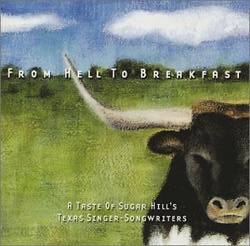
Subtitled A Taste of Sugar Hill's Texas Singer-Songwriters, this 15 track compilation is a useful introduction to the label's roster of lone star state artists living and dead, dipping into the catalogue to bring together showcase numbers from familiar names such as Terry Allen, Guy Clark, Townes Van Zandt, Robert Earl Keen and Rodney Crowell as well as lesser known luminaries Lee Roy Parnell, James McMurtry, The Gourds, Bad Livers and the Austin Lounge Lizards. A fair representation of acoustic laments and uptempo bar room rocking n blues, inevitable stand outs include TVZ's For The Sake of the Song, Allen's Amarillo Highway and Keen's The Road Goes On Forever, while Lump, Beanpole & Dirt ensures the Bad Livers remain a definite acquired taste. One thing you do have to note though is the complete absence of women, and we all know Texas has more than its fair share of female singer-songwriters. Maybe the A&R department should get out more.
Mike Davies
The original Morris On album, released all of 30 years ago and just reissued on Fledg'ling, has been rightly hailed as a groundbreaking classic, and its sequel Son Of proved no letdown. Both being hard - some might say impossible - acts to follow, but Grandson, unbelievably, is a more than credible sequel. Another distinctly Hutchings production, whose fine supporting cast comprises present-day Albionites Ken Nicol and Neil Marshall, with Simon Care, Phil Beer, Jon Moore, Chris Leslie, Ric Sanders, Martin Brinsford and sundry morris representatives, performing a selection of trad arr, trad inspired and original compositions with plenty of style and flair, and often also a surprising degree of delicacy.
A perfect updating of the original concept, then, and in every respect a worthy sequel, even though it mostly doesn't have anything new to say or display any fresh insights (bearing in mind the amount of water that has flown under the folk-rock bridge in the past 30 years). But so what? I did particularly like the thoughtful reinterpretation of the Bob Pegg/Mr. Fox classic Mr. Trill's Song, while the inclusion of the Little Johnny England playground rhyme and morris tune was inevitable I suppose! Encased in a box sporting a wonderfully fun cover pic too, this is a very entertaining issue. I'll not spoil the fun - instead I'll leave you to discover its delights for yourself…
http://www.artist-shop.com/talkingelephant
David Kidman
The German label SPV's ongoing Roots 'n' Blues series of relicensed and repackaged compilations (originally issued by Columbia/Sony in the 1990s) continues apace with a further set of titles covering different facets of the blues heritage on record. And considering their single-disc brief, they do this pretty comprehensively, with good and representative offerings from the temporal spectrum of historic blues recordings (roughly 20s to 40s) and credibly sequenced to boot. Sadly, I've only been able to source four of the dozen or so titles issued so far, but if these are typical of the remainder then at their bargain price they're a done deal! If my memory isn't playing tricks (and I don't have the original Columbia discs to hand), each of these new reissued discs contains a couple of extra tracks that didn't appear on the earlier issues (these are identified as "bonus tracks", and that makes them even better value I'd say). The latest editions contain intelligent, and brand new, notes by Neil Slaven, and the appended discographical details are generally up to the task, while the sound quality is just fine.
Taking these discs individually, then: Great Blues Guitarists presents a perfectly reasonable selection of performers which nobody could dispute having a claim to greatness, even if there are bound to be omissions from one's personal wish-list and restrictions on availability of further likely contenders due to licensing constraints. But any disc which manages to house Johnson & Lang, those other Johnsons Lonnie, Robert and Blind Willie, as well as Messrs. Broonzy and Jefferson, Josh White and Sylvester Weaver all under one roof can't be at all bad. Good Time Blues gathers together an assortment of jookery, juggery, harpery and washboardery, with a few cowbells and kazoos thrown in for good measure. The Mississippi Jook Band and Memphis Jug Band head the roster, with contributions from Charlie Burse, the Georgia Cotton Pickers and Peter Chatman bringing up the rear; there's also a Sonny Terry & Jordan Webb duet that I'd not heard before. Booze And The Blues does pretty much what it says on the bottle really, with a few artists from the other discs cropping up again (Broonzy, Robert Johnson, Josh White, Charlie Burse) alongside Leadbelly, Memphis Minnie, the State Street Swingers, Marline Johnson, the Rev. W.M. Mosley and the Mississippi Sheiks: a suitably boozy seventy minutes. Finally, News And The Blues tells it like it is (well, was), with topical fare from Bessie Smith, Blind Boy Fuller, Charlie Patton, Mississippi John Hurt, Bukka White, Sister O.M. Terrell and Victoria Spivey, and Homer Harris' Atomic Bomb Blues one of the several lesser-known curios on this well-filled disc.
Overall verdict: well, the discs represent a good entry-point for those new to the field, even if (inevitably) the selection of tracks will hold few surprises for the enthusiast who will already have the vast majority of the tracks elsewhere.
David Kidman June 2008
I know what you are thinking - how could they get enough tracks to make up a volume 2? You would think that that would be the case but they've obviously held over a few top tracks to whet the appetite. Whichever way you think about Skiffle you have to agree that it does have a vital place in British Rock history. There is good and bad and this album has both. From the better Gospel based tracks such as Glory Road by The Vipers (one of the best known bands), Bob Cort's It Takes A Worried Man To Sing A Worried Song and The City Ramblers Skiffle Group's Down By The Riverside to the less well performed Toll The Bell Easy from Les Hobeaux Skiffle Group (a very British executed song) and Delta Skiffle Group's repetitive and second rate Ain't You Glad, all standards are here. There were many influences on Skiffle and the better tacks include Johnny Duncan's bluegrass offering, Ella Speed, the Blues of Ken Colyer's Midnight Hour Blues (just add a washboard and you have Skiffle), Rock n Roll in the form of Dickie Bishop's No Other Baby, the Country tones of Careless Love by The City Ramblers Skiffle Group, folk from 2.19 Skiffle Group on Texas Lady, boogie-woogie in the form of Bearcat Crawl from Chris Barber and Jazz from Tony Donegan on Yes Suh although the last of these is of particularly poor recording quality.
The one true giant of British Skiffle was, of course, Lonnie Donegan and he has three tracks on offer. He shows us that he was the boss on Midnight Special and Jesse James. However, he is a bit sedate on Stackolee which is Stagolee under a different guise. There are other tracks more associated with Donegan such as Cumberland Gap (The Vipers) and Don't You Rock Me (Bob Cort) that don't measure up to his standard. Skiffle influenced many future artists and those include John Lennon who couldn't have failed to be affected by The Vipers' Railroad Steamboat, Steamline Train, Hey Lily Lily Lo and Maggie May, part of which ended up on the Let It Be album.
Famous songs include Last Train To San Fernando from Johnny Duncan, New Orleans (House Of The Rising Sun) & The Cotton Song (Cotton Fields), they pronounced their T's in those days, by Chas McDevitt and Bob Cort's 6.5 Special. You have to suspend belief at times such as when a very posh British female sings "I was born in East Virginy" on Chas McDevitt's Green Back Dollar - yeah right! Jimmy Miller tries too hard to be American on Sizzling Hot. All the familiar themes are there including trains in the form of Chas McDevitt's Freight Train, Sonny Stewarts's The Northern Line and Railroad Bill by Lea Valley Skiffle Group.
One thing about Skiffle singers was that piercing tone just under the sound barrier that they had and shining examples of that are Johnny Duncan's Footprints In The Snow and Sonny Stewart's Black Jack. Ken Colyer's piano led instrumental, House Rent Stomp has a homemade feel and that, in essence, is what Skiffle was all about. British blues giant Alexis Korner sounds positively amateurish on Roadhouse Stomp but, again it was that which made the genre so widespread. Skiffle really harks back to a previous time and Soho Skiffle's Give Me A Big Fat Woman would have today's PC brigade up in arms. Jimmy Jackson's California Zephyr gives me my biggest problem and, after listening to it a number of times, I am convinced that it reminds me of another, more popular song. Can someone please put me out of my misery?
There is no mistaking the influence that Skiffle had on the musical forms that came after it. This album features some of the best but Frog Island Skiffle Group sum things up on Hand Me Down My Walking Cane. They've got the repetition, they've got the tone, they've got Skiffle!
David Blue August 2008
Hard on the heels of Great Skiffle Volume 2, here is the Rockabilly version. Some people might find that the two genres often overlap and they would not be wrong. One came from the other and artists tended to change genres like their socks, although Rockabilly tended not to appeal so much to the mass market. There are, of course, elements of Rock N Roll and Country in here too and it is sometimes impossible to distinguish what is what. As with the other albums in this series there is a wide spectrum of artists and standards on offer but the album does show that Rockabilly holds a firm space in the music firmament.
Some of the songs should be taken for what they are - great songs. Danny Wolfe contributes Let's Flat Get It and the good vocal harmonies and guitar work makes it a top tune. Warner Mack gives us Roc-A-Chicka and if you ignore the novelty parts and concentrate on what is essentially a rocking good song then you have it. Jimmy Lloyd gives us the mid-paced Where The Rio De Rosa Flows and although this is not like the general Rockabilly genre at all, it is very very good and Sid King gives us Good Rockin' Baby - slow and classy.
As I have said, Country music features highly in the Rockabilly make-up. Bob Luman sings on the Country side both vocally and musically on Make Your Mind Up Baby. But he also contributes Red Hot which is all Rockabilly. Dennis Herrold is heard on the Country influenced Hip Hip Baby – good chorus. Another strong song from Herrold is Make With The Lovin'. Autry Inman's It Would Be A Doggone Lie is also from the Country side and a good example. Johnny Cash is about as big a name as you can get and Mean Eyed Cat is more Country than Rockabilly. A class act however. Hey Porter is also included but again, why here? Rock N Roll is also represented and Janis Martin is one of the few women included but Drugstore Rock N Roll is, as the title suggests, more Rock N Roll than rockabilly. Jack Scott contributes Two Timin' Woman which is a Rock N Roll crossover but it has that Rockabilly essence. Mac Curtis throws in If I Had Me A Woman which is a good crossover from Rock n Roll to Rockabilly. Sleepy LaBeef is another big name and has a deep vocal on the cusp of Rock n Roll with I'm Through whereas Carl Mann is earthy and has the feel on Gonna Rock N Roll Tonight.
Rockabilly is all about energy and defiance so the sheer energy on Bobby Lee Trammell's Shirley Lee will knock you out. Johnny Carroll has Wild Wild Women which has plenty of whoops and hollers in a great rockabilly style whilst Kenny Parchman shows vitality on Tennessee Zip. Rudy Grayzell's Ducktail is more like the rockabilly that is well loved by many - a screaming vocal and manic guitar are the main components. Jimmy Edwards Love Bug Crawl is surely Jerry Lee Lewis inspired and Ray Harris gives us a version of Greenback Dollar, Watch & Chain in which he certainly has the Rockabilly warble. Curtis Johnson gives us Baby Baby and this has all of the components for a top Rockabilly song. Roz Larne also provides a fine example of the genre on Baby Take Me Back. Wayne Williams has the required energy on Red Hot Mama. Jackie Lee Cochran gives us a classic Rockabilly on Hip Shakin' Mama and Corky Jones' Hot Dog has that garage made feel to it.
Some of the biggest names of Rock N Roll and Country are here; Marty Robbins is one of those big names and Long Tall Sally is a big song to go with it. It's not as energetic as Little Richard but who was? Carl Perkins is perhaps the biggest name in Rockabilly and he shows he is the daddy on Put Your Cat Clothes On - class does show. He also contributes Dixiefried, which is a mid-paced Rockabilly classic. Gene Vincent is one of the greats and Woman Love is trademark Vincent. The voice is there on Gonna Back Up Baby and The Bluecats also start to show signs of their class. Buddy Holly gives us I'm Changing All Those Changes and this indicates what was to come from the great man. His other contribution, Rock Around With Ollie Vee is early but his class shines through. Less famous is Billy Barrix who provides a stuttering delivery, no doubt modelled on Holly, on Cool Off Baby. Charlie Feathers delivers another stuttering vocal on Everybody's Loving My Baby. Ricky Nelson gives us the blues side of Rockabilly on If You Can't Rock Me. He also has Boppin' The Blues but should this really be included on an album of Rockabilly songs? Eddie Cochran is one of the biggest names of them all and 20 Flight Rock was one song that crossed over into popular areas. He gives an understated performance here. Roy Orbison is not a name that you would expect to see here but he turns in a great performance on Mean Little Mama. He also gives us (A Cat Called) Domino but this is not so good. Elvis Presley contributes My Baby Left Me and this is pure class from the first note. He also is included with I'm Left, You're Right, She's Gone and although it's not Rockabilly as such, it does show where his roots were. Johnny Burnette is one of the giants of the genre and Rockabilly Boogie is good but not any better than the best of the others. Also gives us Lonesome Train and he is back on form with just enough emotion in the voice. Billy Lee Riley is one of the best known artists and Pearley Lee has just enough defiance in the voice. One of the first Rockabilly songs that I ever heard was his Flying Saucer Rock - a classic from a master.
There is, of course, a down side and Bobby Sisco is too proper and not nearly wild enough on Go Go Go. Al Ferrier's Hey Baby is tame and Roy Moss sounds like Vic Reeves' Shooting Stars pub singer on You're My Big Baby Now. Billy Wallace is docile on Burning The Wind. Wanda Jackson was one of the few women to make the grade but I Gotta Know flits between country and Rockabilly and really there should be no place for this on this album. Hot Dog That Made Him Mad is poor. Collins Kids - Hop, Skip & Jump is not for me. George & Earl - Done Gone is not defiant enough in the vocal. Sammy Masters performs and energetic Pink Cadillac but it is too clean overall. Jay Chevalier is all over the place on Rock N Roll Angel. Narvel Felts is poor on Cry Baby Cry. Buzz Busby puts it all in for the performance on Rock N Roll Fever but he still doesn't come up to the standards of some of the others. However, the biggest crime of all is Curtis Gordon's take on Sitting On Top Of The World and shame on him for taking this blues classic and turning it into a circus.
All things considered there are more plus' than minus' and it will be a good addition to the audiophile library.
David Blue September 2008
This is the first of a series of four double CDs from Dutch oldies label Smith & Co covering Rockabilly, Skiffle and Rock N Roll. George Jones opens the 64-track marathon from 1955-1956 with the energetic Rock It. You expect energy from Rockabilly and you can also hear blues influences on this. Johnny Carroll contributes the frenetic Wild Wild Women and Crazy Crazy Lovin' from 1956 but the latter is so fresh and it could have been far younger. He also gives us some good fun on Hot Rock as does Eddie Bond on Flip Flop Mama. Bond also gives us Boppin' Bonnie and, although the lyrics were never the best, the beat is as good as ever. The enthusiastic Joe Clay gives us Sixteen Chicks and Ducktail and he shows just how much the Rockabilly artists enjoyed what they were doing. Clay is one of many subsequent artists to follow a formula and he does it very well. Curtis Gordon also found the formula but the addition of steel guitar on Mobile Alabama keeps it on the Country side of Rockabilly. Others who veer to that side of the genre are Jack Earl with Slow Down and Sid King with When My Baby Left Me. The anarchic Marvin Rainwater chips in with Hot And Cold and the classic early Rockabilly of Mr Blues. Skeets McDonald sings Heartbreakin' Mama and You Oughta See Grandma Rock in what became Lonnie Donegan's style. There are some good and some not so good and the uninspired Rockin' Rollin' Stone from Andy Starr falls firmly into the latter category. Another one for the not so good group is Sanford Clark with Lonesome For A Letter. The vocal has no excitement and it feels like he was just going through the motions. Unfortunately, his second offering, The Fool also lacks the passion required. Tommy Spurlin's Hang Loose is only marginally better.
The rockabilly artists would sing about virtually anything and Charlie Feathers' Bottle To The Baby is a good example. This is basic and raw but that's what is was all supposed to be about. Feathers also contributes One Hard Love, which keeps him in the zone. One of the genre's giants, Johnny Burnette, provides a rip snorter in the form of Tear It Up and provides one of the albums highlights on Train Kept A Rollin'. Sleepy LaBeef is another heavyweight who delivers a powerful performance in a Presley style on All The Time. Warren Smith's Rock N Roll Baby rolls along well and Curtis Gordon is so energetic on Draggin'. Smith also contributes Ubangi Stomp, which has novelty value that thankfully doesn't hide the very good song underneath. Roy Orbison makes a few incursions into the album and although Rockhouse is obviously an early recording, you can hear the voice coming through – not a great song though. Another of Orbison's is You're My Baby and this only has slight hints of the star to come. It does, however, build up into a great Rockabilly song. The third of Orbison's trio of songs is the inanely titled Ooby Dooby which is actually a good song but is spoiled by the stupid chorus. His quartet is finished off by the energetic Go Go Go. It is strange why the compilers of the CD decided to give Roy Orbison more tracks than any other artist.
George 'Thumper' Jones gives us a rendition of the now famous Heartbreak Hotel and I'm about to commit a sacrilege by saying that this is every bit as good as the Elvis version. I've only got three words to say about Jones' other contribution, How Come It, -- this is Rockabilly! Another famous song is Bird Dog and Don Woody's version has one foot firmly in the Country genre. Another one from Woody is Barking Up The Wrong Tree and this is what Rockabilly is all about – energy and fun. Ronnie Self contributes Pretty Bad Blues and it's obvious that he modelled himself on Elvis Presley although the song itself is pretty standard stuff. The great man, Gene Vincent, throws in Woman Love and this is trademark Vincent, mean & moody, showing that class always shines through. The class also shines through on I Flipped although it is difficult to pick out Vincent. CD 1 is finished by Be-Bop-A-Lula, another of the generations defining tracks. Roy Hall's All By Myself only skirts around the edges of Rockabilly but Malcolm Yelvington really bops on the classy Rockin' With My Baby. Yelvington also has Yakety Yak on the album but this is a country song and not a cover of the more famous song of the dame name. Jimmy & Johnny give us Sweet Love On My Mind, a country based tune with good harmonies.
The biggest Rockabilly star, in the opinion of many, is Carl Perkins and his contributions are Dixiefried, Boppin' The Blues and the ubiquitous Blue Suede Shoes. He is a giant of the genre, performs to the highest standard and has the voice of an angel. Ray Harris gives us the energetic Come On Little Mama and it sounds like his guitarist's hand is near to falling off. Where'd You Stay Last Nite is another good performance from Harris. The man who is widely credited as the person who started off the whole genre, Elvis Presley, has two tracks. He is unmistakeable on Baby Let's Play House and throws in the bluesy, classy Mystery Train to finish of the second CD for good measure. He was what the others could only aspire to. Janis Martin is the only female to make it on to this compilation and although Let's Elope Baby is pleasant enough, is it good enough for Rockabilly? I don't think so. Maybelline with acoustic guitar is different but Marty Robbins version is not a patch on the Chuck Berry original or the scorching version by Pat Travers. Roy Duke's Behave Be Quiet Or Be Gone has a country style title and is a country style song, complete with yodelling. There is a formula to this style of music and these early pioneers soon set the standard and Webb Pierce's Teenage Boogie is an example of the formula. Mac Curtis chips in with the pretty standard Grandaddy's Rockin' and Billy Lee Riley gives us the equally standard Rock With Me Baby. However, Curtis shows that he is one of the better vocalists on That Ain't Nothing But Right. Sonny West's Rock-Ola Ruby is one of the better tracks but I don't find it menacing enough -- there should be that edge. Buddy Holly is totally unrecognisable on Midnight Shift. Buck Griffiths' Stutterin' Papa is very rough but is nothing out of the ordinary. Country giant Johnny Cash also makes an appearance with Get Rhythm and this is sheer class. It shows Johnny making the bridge between country and rock n roll. Also included is So Doggone Lonesome which is instantly recognisable as Cash but hardly Rockabilly. Slim Rhodes is just not up to the task on Do What I Do but that is countered by Sonny Fisher's Rockin' Daddy, a fine example of how the genre came into being.
This is an important introduction to the birth of a musical genre but remember, you have to take the rough with the smooth.
David Blue April 2007
Martin Simpson
So let's take a brief look at the individual DVDs now. No 1 presents just over 2 hours spent in the persuasive company of Martin Simpson. This is probably the series' most exhaustive exploration of one musician's art, with the interview itself delving quite deeply into not only Martin's biography and CV, his extensive experience and mastery of many different playing styles (all stemming from the tradition, as he quickly points out) but also several aspects (technical and practical) of the various tunings he uses and the instruments he plays (and their ancillary technical accoutrements such as slides and pickups). As well as a fine selection of additional tracks giving a sensibly representative cross-section of Martin's repertoire (traditional folksong and tune, contemporary song, blues), this DVD contains a sizeable and generous bonus section which includes a performance using not guitar but banjo (House Carpenter), a demonstration of Martin's ritual string-changing procedure and a brief guided visit to Michael Sobell's workshop where Martin's guitars are made.
Michael Messer
No 2 presents Michael Messer, the Kent-born blueser whose CDs have been (rightly) so enthusiastically reviewed on this site. The DVD's 95 minutes kicks off with an interview in which Michael personably introduces us to the various instruments (National, Hawaiian, dobro) he uses as well as discussing his formative years and his major inspirations. Although Michael admits his main influences are the delta blues greats and classic Chicago blues, he's also an innovator, and what comes across strongly is his appealing open-mindedness and willingness to embrace other influences while remaining absolutely true to those basic blues roots. The interview provides insights into the origins and mechanics of "locally amplified" guitars, with much fascinating detail, and he also spends time describing the various accoutrements (slides, bottlenecks, etc) he uses. Highlights among Michael's 15 performances include the superbly poised Luna Hula and a magisterial Shine On. On some of the numbers, Michael's accompanied by regular musical partner Ed Genis.
Big Jim Sullivan
No 3 presents Big Jim Sullivan, that massively legendary session guitarist whose CV has got to be the most exhaustive of the lot, having played on literally thousands of chart records as well as almost as many album tracks. Big Jim describes himself - with impeccable modesty - as "first and foremost a musician", with no pretensions to stardom. During his 50-year career, he's worked with Marty Wilde and Eddie Cochran and Cilla Black, and been a 17-year-old mentor to a 14-year-old Ritchie Blackmore and a good friend to Elvis (Presley); lively anecdotes from these and other encounters liberally spice the interview here, as do snippets of classic solos as well as full-length performances of jazz and other standards throughout the DVD's well-filled 125 minutes. Playing an arch-top acoustic model, in conventional tuning, Big Jim nowadays (and here) plays predominantly in the jazz idiom, though he doesn't class himself a jazz guitarist! During the course of the interview he discusses ancillary topics ranging from his admiration for John McLaughlin to acrylic nails (!) and the psychology of playing guitar. The fun bonus section contains a "Big Jim's birdseye view" of him performing Bye Bye Blues (which is incorrectly credited as Cannonball Rag, by the way).
Steve Tilston
No 4 presents Steve Tilston, who differs from the preceding three Maestros in that he's equally revered as a songwriter as well as an expert guitarist. Quite casually, Steve is seen to largely (albeit not exclusively) eschew the multi-tunings of other maestros in this series, content to work mostly within standard tuning. During the course of the interview Steve enlightens us on juicy details of his "story so far", points out the unique design of his guitar (a walnut instrument, with 12 frets and a slope-away body), and plays and sings some of his most famous compositions (and even a brand new one, Archipelago) along with a few of his incisive arrangements of traditional songs. Steve is very upfront, honest and eloquent, with extra immediacy in the interview section particularly, although I do rather feel that his renditions of some of the selections have gotten faster over the years! On the additional tracks, Steve's sensitively accompanied by Chris Parkinson on accordion or harmonica. This DVD really does give the measure of the man.
Clive Carroll
No 5 presents a real connoisseur's musician, the young Clive Carroll. Not only is he one of the most self-effacing and personable of the six interviewees, but his performances are a triumph of astounding technique and intelligent musicality. All this comes despite his being the only one of the six to have undergone formal training (he's a composition graduate of London's Trinity College). Clive is totally at ease expounding the specifications and virtues of his instrument (a shorter-necked Triple O), as well as displaying his qualities as a highly consummate musician and composer. The 15 exceptional performances on this DVD, of mostly his own compositions (the exceptions being arrangements of the classic Albéniz piece Asturias and Willie Brown's Mississippi Blues), are absolutely jaw-dropping - almost literally in the case of the closing piece, Aerial Discoveries, which Clive plays standing up!; his technique is both incredibly sensitive and outstandingly proficient, and he possesses an effortless ability to move between styles and nuances within any given piece. Clive's equally in tune with, and adept at conveying the essence of, Irish traditional music and any degree of folk, blues, classical and ragtime stylings. His often quite impressionistic sound-world is very attractive indeed, though it arguably requires a greater concentration on the music's intricacies than with some of the more straightforward material performed by the other guitarists featured here (that's no reflection on their talents or tastes, incidentally!). In a nutshell, with Clive the very act of playing the guitar seems to come as naturally as breathing. I found this DVD the most musically stimulating of the series so far, with performances that I will wish to return to often I'm sure.
Wizz Jones
Finally, No 6 presents Wizz Jones. This DVD differs from the above five principally in that the interview element is conducted by Martin Carthy, but I'd emphasise that this departure from the "house-style" of the first five DVDs is not the reason for my considering this to be the least satisfying of the six, and even in some ways mildly disappointing. Firstly, the guitarist-purchasers are likely to be miffed that there's no discussion of Wizz's playing technique or any information about the instrument he uses, or of how he's considered to be an influential guitarist. Secondly, the interview does little more than reminisce (if appealingly so), and I learnt little I didn't already know about either Wizz the man or Wizz the musician. Sure, there will be folks who will find this a useful introduction to Wizz, and the 14 songs he performs (and in some cases also introduces) here are all proven classics of his broad repertoire. One other feature about the Wizz Jones interview segment where it differs from the previous five DVDs in the series, is the interpolation of archive photos during his performances - although this doesn't prove a distraction. On the "additional tracks" section of the disc, Wizz is accompanied by his son Simeon. Whatever this disc's comparative shortcomings, though, Wizz's renowned "gifted busking troubadour" character shines through, to demonstrate his wholly admirable dictum: "I'm not sure what it is I'm playing, but I'm going to go for it". Right-on!
As befits the professional standing of both the originating company and each of the individual musicians portrayed, the DVDs are produced to a high standard, with excellent sound quality and generally faultless editing. Access to individual sections and/or tracks is easy and well organised. The camerawork is clear and undistracting, happily gimmick-free, although there were occasions when I felt I really needed to see the guitar itself (or at least fingers on the frets) rather than the performer's face (the opening section of Can't Keep From Crying Sometimes on the Martin Simpson release is one instance that springs to mind, and there are a few moments on the Steve Tilston too); also, I felt that at times the camera lingered a little too long on interviewer Trevor Dann's eagerly beaming visage. There were occasions when I felt that carefully chosen archive clips of the musicians' special inspirations might have enhanced or illuminated the points made in the interviews, but I can understand the potential logistical difficulties (not to mention licensing restrictions) of any such provision. And in any case, in the overall scheme of things none of the above observations is a serious drawback, and each one of the six DVDs has much to commend it. I'm really looking forward to the next six issues in the series!
David Kidman, June 2006
The house full notices were up weeks in advance and a sell out crowd paid £20 a head to be there. During his 12 year tenure at the Half Moon, Michael had turned the pub into London's # 1 music venue. Michael's first wife, Bridie had died of Cancer, so every year Michael would persuade top draw acts to perform during a week of gigs in aid of Cancer Research.
Michael was from Clonmel, in County Tipperary, and was a much loved and outgoing person, and great friend to many musicians and promoters. A larger than life character; he engendered so much good will that the Half Moon was the first calling place for musicians from all over the world.
So firstly to honour our old friend and his memory the concert was planned, main man behind the project was Mick's good friend and regular patron Ralph McTell, who had no problem finding musicians and staff to co-operate, in fact he is worried that he may have upset some musicians by turning down their offers of help. He was determined that it didn't turn into a procession of acts with no-one getting enough time to do them selves justice. So three main acts and not too many stage and sound problems, it was also important that the evening was pleasurable to artist and audience alike. The show was relayed to the large crowd in the bar via large screens, and full sound through the speakers, so a great time was had by those who had to be refused entry.
The evening was introduced by long term compere, Johnny Jones who after a few words introduced Ralph McTell who gave a brief outline of the night and a pen picture of the man we were remembering with some witty memories of Mick outside the pub, like at soccer and rugby matches also his annual trip to Cheltenham.
A special welcome was afforded to Michael's wife, Marian and his sisters and son, John, and many other members of the O'Mahony family who had come over from Ireland for the evening.
The Dylan Project, Steve Gibbons and guitar/ steel wizard, PJ Wright were accompanied by the Fairport rhythm section and got the evening off to a rocking start with wonderful versions of Bob Dylan's back pages, "Absolutely Sweet Marie" and "Just Like A Woman", with Gibbo sounding better that his Bobness himself, all leading up to the rockin'est version I have ever heard of the classic, Highway 61.
Without a break Gibbo introduced Ralph McTell who started with a very apt song from his vast back catalogue, "You Weather The Storm" which got the audience singing along. He also included his much loved Irish composition. "From Clare to Here" to please the large Irish contingent in the crowd. He dedicated his classic "Streets of London" to the Michael's, wife Marion and the many members of the O'Mahony family present and with the audience singing along, there was many a wet eye in the crowd. Ralph also read out moving testimonials to Michael and his memory from his pals, Christy Moore and from New Zealand, Billy Connolly, who added that "if Fairport were ever looking for a banjo player, they could never afford him"!!!
Ralph introduced Fairport Convention who lashed into "Walk Awhile" and soon had the fans dancing their shoes off, mention must be made to Simon Nichol's introduction and heart wrenching vocal on "Who Knows Where The Time Goes", recalling the late and much missed Sandy Denny who also passed away, nearby, almost 25 years ago to the day.
Fairport invited Steve Gibbon's and PJ to join them or the final knock, Ralph pulled out "Zimmerman Blues", then it was time to close with the perfect closer, "never a chore, always a pleasure to sing", to quote Simon; the whole house sang their heads and hearts out with "Meet On The Ledge", a song over 35 years old but still as pertinent today with it's refrain, "if you really mean it, it all comes round again".
After the music there was plenty of time for the fans to meet and mingle with the musicians, there was many musical friends of Michael's in the house including all the old crew, Big Pete, LHM and H. There was also a reunion of the Home Service and the members of the old pub football team, The Blue Moon All Stars, whose feats have become the stuff of which legends are made. So an evening of much love and good will came to an end with much goodwill engendered and some funds raised for a good cause.
Mention should be made in dispatches should go to soundmen for the evening, Doon and Rob Braviner, the wonderful Gerry Conway, who spent most of the night behind his drum kit. Also James and Carrie who donated the premises and their very professional talents and staff, to ensure they evening went well. Aces all round to all involved.
A small amount of the profits have gone toward a bench in Richmond Park which Mick loved so much and where he could often be seen cycling or jogging around in better days. It is near the Ponds in the middle of the park and it is hoped that it will become a place for quiet reflection on a great friend and great friend.
I harbour a secret hope that this evening could become an annual event to raise much-needed funds for Cancer Research and to recall our great pal and his memory.
Alan O'Leary © May 2003
[caption: Steve Gibbons, PJ Wright's shoulder, Simon Nicol, Dave Pegg & Chris Leslie]
The playing on this CD "represents modern Southern English playing at its best", the liner note oh so modestly claims, and I'd not disagree, for it's charming, robust, sparkling, full of joie-de-vivre with delight in the bumptious rhythms and, importantly, all the playing displays a key understanding of both the idiom and the purpose of the music. Musicians involved are almost a who's-who of the Southern dance scene and the WildGoose house roster: Paul Sartin of Bellowhead, Belshazzar's Feast and Faustus directs the project and plays oboe and fiddle, while the lineup is completed by Saul Rose, Will Duke & Dan Quinn, Tim Laycock, Colin Thompson, Mat Green, Andy Turner, the Bursledon Village Band, Roger Watson and Bob Shatwell. The instrumentation rings the changes between tracks, with specific permutations of the above musicians duetting or whatever to keep the textures lively and listener interest keen. Particularly enjoyable are the various sets that bring together Mat Green with Andy Turner (of the Geckoes), and the fuller rumbustious tones of the Village Band, but Saul also excels himself on these recordings and in truth there's no musician puts a foot wrong in his dance steps. The tunes themselves originate from a manuscript book (the "Pyle family manuscript" of 1822) kept in the Hampshire Records Library in Winchester: tunes written down by the son of a gentleman farmer in Nether Wallop (honestly!), tunes that were popular around those parts in the early years of the 19th century. The only possible drawback of this CD for non-dance-specialists is perhaps that although listening to individual tracks or groups of tracks will definitely lift the spirits, and although the complement of musicians is used sufficiently ingeniously to provide maximum contrast, in the end listening to more than a few tunes or groups of tunes at one sitting can prove a little counter-productive since the mood is predominantly bright-and-breezy. But that's the nature of the beast, so to speak, so it's not to be taken as a criticism of this well-presented disc per se.
David Kidman May 2007
Various - Hands Across The Water (Compass)

Songwriter Darren Scott kicks things off, linking up with Danu's Oisin McAuley and Muireann Nic Amhlaoibh for his own new number This Beggar's Heart, a haunting piece of romantic melancholy with a melody ironically evocative of The Water Is Wide. Things progress in impressive form with tracks that bring together Jon Randall, Mairtin O'Connor and Alison Brown (Get Through It), Capercaillie's Karen Matheson and The Duhks (a lovely cover of Robbie Burns' Ae Fond Kiss), Tim O'Brien and Lunasa (the trad Fair & Tender Ladies, Solas and Mindy Smith (Reasonland) and John Prine and wife Fiona for a rare duet on 'Til A Tear Becomes A Rose to which an accordion track by Altan's Dermot Byrne has been added.
Only one track is either not new or not in some shape augmented with additional recrding, that being Sharon Shannon and Jackson Browne's version of A Man Of Constant Sorrow. But then, why mess with perfection.
It's a superb collection with not a weak number amongst them, but I'd be neglectful if I didn't single some particularly exceptional highlights. Paul Brady takes on Johnny Cash's 40 Shades of Green in company with added vocals from Rodney Crowell, Let's Heal sees Vince Gill taking on an English rework of a trad Irish number in company with Altan, Cerys Matthews sings in Welsh for the trad An Occasional Song while Jim Lauderdale and Maura O'Connell provide shivers on his specifically commissioned This World's Family. And, arguably the finest moment and the first to be recorded for the project Be Still My Soul is Beth Nielsen Chapman's arrangement of music by Sibelius and words by Katheryn von Schlegel, her moving vocals beautifully complemented by Michael McGoldrick and Donald Shaw on whistle and accordion with Bonnie Raitt providing harmonies. A great cause and a wonderful album.
Mike Davies
Hard-Headed Woman - A Celebration of Wanda Jackson (Bloodshot Compilations)
Whether my enjoyment of this compilation would have have been increased, had I known anything about its subject is debatable but somehow I doubt it. What it did do though was send me scurrying to the web, to find out more about the woman who caused a host of artists to reach such heights.
As far as I can tell, Wanda Jackson began her recording career in 1954 and is still going strong. In case your arithmetic is as good as mine, that's 50 years in which she has recorded more than an album a year. In 1956 a young singer by the name of Elvis Presley encouraged her to try her hand at rock n roll, good advice which she took. She became known as the First Lady Of Rockabilly, which gives a huge hint as to the musical direction of the compilation.
Maybe the only drawback for a novice like me is that I'm not quite sure what it is we're celebrating. It always helps to hear the songs in their original form before you judge how good the tribute is. Obviously those in the know will be able to make their own assessment.
What I can say with a degree of certainty is that if Wanda Jackson injects the same life and passion into her music as the contributors on Hard-Headed Woman do, then she must be a fantastic artist.
It matters not one jot that some of the names are not particularly 'household'. In fact it's a strength, instead of the music being tailored to fit some 'star' and being relegated to the role of vehicle, here the songs are king and the artists performing them give it everything they've got. Among the better known names are Laura Cantrell, Neko Case, Jesse Sykes and The Bottle Rockets but its the community spirit that really lifts the album, all the musicians share a common cause.
In this cynical world, we automatically look for the ulterior motive, the 'what's in it for me factor' and maybe the likes of Kim Lenz, Trailer Bride and Kelly Hogan et al will get some much deserved exposure but God knows they've earned it.
As a tribute it will be for others to judge, however for a generation of artists to invest so much of themselves in the music of another generation, speaks volumes for the respect in which Wanda Jackson is held. As an album in its own right it's a wonderful celebration of music.
Michael Mee
Various Artists - Hard-Headed Woman: A Celebration of Wanda Jackson (Bloodshot)
Wanda Jackson's career started out over 50 years ago, with the ascendancy of rockabilly (hey there, just cast your minds back to that unforgettable clip of Wanda in a white-fringed frock belting out Hard-headed Woman in around 1959 – wow factor in overdrive…); and – incredibly – she's still performing today. She's helped stake out a direct route from the feral origins of rock through to the punks, riot grrrls and psychobilly boundary-busters of subsequent years (and generations). The uncompromising approach and fiercely independent spirit of the maverick lady known to many as the Queen of Rockabilly is evoked so true-heartedly on this equally boundary-busting collection of 21 songs associated with her. The performers of these songs – in the main Bloodshot labelmates – all turn out to be true descendants of the original hard-headed woman, for they embody and display upfront the self-same rebel qualities that mark out Wanda herself. This superlative tribute album summons up a great selection of songs that Wanda made her own, several of them (like Right Or Wrong, In The Middle Of A Heartache and Cool Love) being her own compositions; tho' it's weird that the expected title track ain't here! But there's still plenty of excellent stuff, covering a stylistic range that totally reflects Wanda's own unique ways with a song that enable her to lay claim to the material, from barn-burners and raveups to songs of heartbreak and pathos. Here, Wayne Hancock's serious R'n'R wildness on Let's Have A Party contrasts with the Doors-like organ-suffused dark-toned strangeness that Trailer Bride bring to their recast of Fujiyama Mama, and Laura Cantrell's gorgeous rockin' take on Wasted proves every bit as compelling as Jane Baxter Miller's sparse and lazy One Day At A Time. Elsewhere, female rebel stars like Neko Case, Kristi Rose and blues diva Candye Kane are possessed with just that powerhouse combination of pure country and raucous energy in their singing, and "rockabilly filly" Rosie Flores (here revisiting In The Middle Of A Heartache) is but one of those who openly claim Wanda as a formative influence on their own performance style and repertoire. The hillbilly noir of the Asylum Street Spankers' decidedly Handsome Family-like weirdness turns out just right for Funnel Of Love, and Anna Fermin's Box It Came In is a delicious chunk of home-grown "trigger-gospel". Add to these some determinedly spicy and hard-hittin' contributions from the Bottle Rockets, the Ranch Girls, Jesse Sykes and Nora O'Connor, to name but four, and you've a real winner of a release that sure proves the truth of co-producer Holly-George Warren's claim that "there's nothing like a bunch of renegades paying tribute to a renegade", renegades who throughout their own careers have followed their own musical vision outside of mainstream country and rock.
David Kidman
Subtitled "Songs Of The Coalminer's Struggle", this abundantly satisfying 70-minute compilation gathers together tracks from two earlier Rounder LP collections Come All You Coal Miners and They'll Never Keep Us Down: Women's Coal Mining Songs, (eleven of which had subsequently appeared on the Rounder CD compilation Coal Mining Women), along with isolated cuts from various other Rounder releases, all carefully selected for their relevance.
A number of the songs were featured in Barbara Kopple's 1976 film Harlan County, USA, which documented the 13-month 1973 strike in an area with a long and darkly-shadowed history; the film was a powerful portrait of the United Mine Workers' struggles, impotence and resistance, and highlighted the central role of women in this. One of the film's most dramatically wrenching moments, Florence Reece's rendition of Which Side Are You On? (performed with all the intensity of lived personal experience), is included on this CD, along with other notable calls for solidarity.
The selections actually cover a wide spectrum of Appalachian musical styles, from the plaintive traditional idiom to the latter-day protest song, yet the overall impression is of a potent timelessness. The list of performers is very impressive, and could not have been more wisely chosen. Hazel Dickens, one of the most prolific of the contemporary activist songwriters as well as an influential bluegrass and old-time performer in her own right, is given due prominence, being represented by no fewer than seven tracks here including the incredibly powerful acappella Black Lung, Coal Tattoo and Mannington Mine Disaster; her contributions serve as a kind of thread binding the album together, in fact. Sarah Ogan Gunning's two tracks (one previously unissued) go for maximum acappella impact too, while elsewhere Phyllis Boyens also turns in two tracks including a spirited and passionate rendition of Si Kahn's Lawrence Jones. Male performers aren't entirely neglected though: Merle Travis contributes his famous Dark As A Dungeon (from a 1959 live album), Norman Blake the beautiful Last Train From Poor Valley, Jim Garland his ballad The Death Of Harry Simms, and the obscure Nimrod Workman (himself a miner for over 40 years) his own Coal Black Mining Blues. Then there's Doc Watson's sparse, bleak And Am I Born To Die? (to the accompaniment of Gaither Carlton's lonesome fiddle), whereas the Johnson Mountain Boys' Blue Diamond Mines is probably one of the most well-known songs here.
This splendid, most useful compilation is a good example of thematically creative recycling.
David Kidman, July 2006
A plethora of harmonica players are on offer here, beginning with Willie 'Big Eyes' Smith. He opens with the Little Walter song, Blues With A Feelin'. This is very powerful opener, both vocally and musically, and it's interesting to know that he was part of Muddy Waters' band for two decades - as a drummer!! However, harmonica is his first instrument and it's not hard to understand why on this performance. Smith goes back to his former boss for Read Way Back and turns in another strong performance. He has five tracks on this album and he chooses a different composer for each. Junior Wells' classic Hoodoo Man Blues is given a good treatment as songs from his list of heroes continues. Jimmy Rogers' You're The One is well executed and his final song, Sugar Mama, by John Lee Williamson is slower than the rest but just as good and his backing band show up very well. The second artist, Martin Lang, has four tracks and although he is the youngest of the quartet on show he offers up classic Chicago blues in the form of Martin Jumps In. Sad Sad Day follows and this is, like its predecessor, self-penned. This is slower but has a harp that wails. Lang's third track is Pulaski Stomp and is another fine example of good plain old harp music. The genre is in good hands, as shown by his final track, Ten Hole Blues. This is slowed down to the extreme and, like the others, is an instrumental that shows a high level of technique.
Little Arthur Duncan only gets three tracks but that doesn't detract from his overall input. Leavin' In The Morning is a fast paced Little Walter song that is matched by lightning harmonica and piercing vocal. Pretty Thing is a Jimmy Reed song but this is just a standard performance by a man who is a top level performer. Duncan's last offering is the Willie Dixon/Muddy Waters song, Young Fashioned Ways. I recently reviewed a version of this by Wallace Coleman and although Duncan's version is more earthy, I don't think that it's any better. Easy Baby (Alec Randle) is the last of the artists to be given their chance. The first of his four songs is Room 39, a self-penned song on which he serves up some silky harmonica. The vocal is virtually spoken and Eddie Guitar Jnr is excellent on guitar, as he is on a number of other tracks. Crazy Mixed Up World is a Little Walter song and if you are familiar with the work of that particular genius then there will be no surprises here. Easy Baby comes up with another original in Willie Mae. This is very strong and compares very well with anything else produced here. Randle ties up the album with the traditional This Little Light Of Mine. This is, as you would expect, a piano led Gospel tune - simple and extremely heart warming. For those of you who like harmonica blues this is as good a place to start as anywhere.
David Blue Sept 2006
How could anybody fail to be impressed by this album? It features 25 tracks by some of the most gifted songwriters and musicians currently treading the country's (indeed, the world's) boards. It' s a double CD selling at the bargain price of only £18. And, as though those weren't reasons enough, all the proceeds go to the Teenage Cancer Trust. Sufficiently compelling reasons for anybody, surely. This second volume comes almost exactly two years after the release of the first. Volume one succeeded in raising more than £11,000 for the charity, which provides the sort of facilities for teenage cancer patients that are all too sadly lacking in hospitals. Every track here is either live or specially recorded and, as with the first, it's the generosity of all the artists that has made it possible.
So, to the music - well, it encompasses every colour, and some, of the folk-rock spectrum, from the unaccompanied voices of Phil Beer and Deb Sandland on The lady of the well; the sheer melodic beauty of the instrumental My heart's in New South Wales from the fiddle of the mighty Dave Swarbrick and guitar of Kevin Dempsey; solo singer/songwriters are represented by Ralph McTell, Vikki Clayton and Steve Tilston; there's the grand orchestral sweep of For the children by Peter Knight and Tom Leary; and, if you like the emphasis on the second element of folk-rock, there are contributions from the Andy Guttridge Band, Little Johnny England, The Albion Band and even a metal(ish) reading of Matty Groves by Fairport Convention with a telling flute contribution from Jethro Tull's Ian Anderson.
One of the genuine surprises to sneak up on the listener is a fantastic, sensitive reading of Jimi Hendrix's Little wing by the Ric Sanders Group with guest Rick Wakeman sitting in on keys. Other highlights include songs by Show of Hands, Waterson:Carthy, e2K, Richard Thompson and Chris While & Julie Matthews - but everybody who chipped in is a star and there really isn't a bad track on the album.
I'd recommend no hesitation in buying an outstanding collection of great songs and great playing that really does have its heart in the right place. Compilation album of the year by a clear country (or folk!) mile.
Fred Hall
Here, long and eagerly awaited, is the superb second - and last - of the Heart Of England albums, put together by that grand team of Steve Sheldon and Stevie Horton to raise money for the Teenage Cancer Trust. Apparently, performers were queuing up to get involved with this project, and you can easily understand why if you caught any of the incredible buzz that the original Heart Of England release generated. Broadly speaking, the artists represented on volume 2 comprise a complete roll-call of the Oxfordshire mafia, its satellites and sundry other worthies. That alone is an indication of the sheer quality of the contributions, which are no mere cutting-room-floor rejects but a cluster of live, specially recorded and/or (all but four) previously unreleased performances that virtually wipe the proverbial floor with some of the stuff that gets "proper" release out there in the music mainstream. (I suppose you could argue that artists like Fairport, Albions, While & Matthews, Show Of Hands are "mainstream" in terms of folk/roots performers, certainly in terms of following and accessibility, but I won't enter that arena!)
Volume 2, a double CD, is a really fine collection, sensibly-sequenced and consistently mastered (especially considering the varied provenance of the recordings themselves). It's a collection that's shot through with a defiantly good-time feel, though without the throwaway quotient such a tag might imply. Indeed, some of these performances are among the very best the artists concerned have committed to disc - Fairport's Tullish Matty Groves (with Ian Anderson guesting), e2K really cookin' on their 6-minute set of reels, and singer-songwriters Mike Silver, Steve Tilston and Andy Guttridge all on very good form. Relatively newly-fledged combos Colvin-Quarmby and Bob Fox & The Hush acquit themselves memorably too. I thought CD1 was damned good, but CD2 goes into overdrive! Particular highlights for me were Ralph McTell's closing Ferryman, Richard Thompson's driving, gutsy Sights And Sounds Of London Town, a glorious quasi-classical Peter Knight & Tom Leary fiddle duet, an equally glorious a-capella Lady Of The Well by Phil Beer and his band cohort Deb Sandland, a quite sublime Little Wing from Ric Sanders (and that's coming from someone who's never been a massive RS fan!) and a very fine Black Muddy River from the combined Waterson-Carthy forces and Tim Van Eyken. The only omission from this exceedingly appealing package is mention of the actual recording dates, which would have been useful. But whatever, £18's a small price to pay for the immense benefit you'll get from this release, not to mention the satisfaction that your contribution to TCT funds will be put to good use.
David Kidman
Various - Heart Of England Vol 2 (Teenage Cancer Trust)
Yes I know this double CD compilation has already been reviewed on the site not once but twice (by Fred Hall and David Kidman), but I simply have to add my voice to the swell of praise for its gathering of previously unreleased live or rare ltd edition recordings from the cream of the folk community in aid of the TCT charity.
It's an eclectic kaleidescope of stylings, ranging as it does from Rick Wakeman sitting in with the Ric Sanders Group for an atmospheric reading of Hendrix's Little Wing and Waterson:Carthy reinterpeting The Grateful Dead's Black Muddy River as a trad English folk tune through Mike Silver's bluesy Road Dog to Phil Beer and Deb Sandland's transfixing unaccompanied The Lady of the Well and a heavy metal folk assault on Matty Groves from The Fairports with Ian Anderson on flute.
With contributions from names such as Mundy-Turner, Ralph McTell, Show of Hands, the Albion Band, While & Matthews (who also turn up as part of St Agnes Fountain with their medieval Christmassy Masters In This Hall) and Richard Thompson (in fine fettle rattling through a live Sights And Sounds of London Town, his fingers practically smoking from the friction on those guitar strings), there's no arguing that at £18 this is incredible value for money. What makes it even more so in my books are three particular knockout numbers. John Tams' impassioned All Clouds The Sky, the gorgeous faux classical For The Children duet from Peter Knight and Tom Leary and a live (and due to appear on their next studio album) recording of the bouncingly infectious and wry Bone In A Dinosaur from the impossibly talented Colvin Quarmby.
The only bad news about the whole thing is that they don't plan on making a Vol 3.
Mike Davies
Heart Of England - Various (TCT)
Yep, yet another charity ceedee. This time though, there is a difference. Originally conceived with the aid of a lot of alcohol at a particularly good party, the intention was to feature musicians associated with the Midlands; however, by the time everyone sobered up, a whole load of musicians from across the country wanted to take part. And so the focus changed, ever so slightly.
'Heart Of England' is an English album. To quote the sleeve notes, the 'singer/songwriters, traditional musicians, bands and songs....are....quintessentially English'. Quite so. The notes go on to assert that the connection alluded to might not be obvious at first glance, but is there nevertheless. The sixteen songs in the collection are from some of the finest performers one could hope to see within these English shores. Not only that, some of these performers have been going for more than 30 years and some for barely one. We have, at the one end, the likes of Fairport Convention and Richard Thompson (both stemming from the English tradition known as Muswell Hill in North London) and don't forget Martin Carthy and Dave Swarbrick - two of the finest 'folkies' in the business - who've been going for even longer. At the other end, Colvin Quarmby have been working for a couple of years, slightly older than the simply awesome Little Johnny England - a mere baby of just 17 months since their first live appearance.
Mixed in between are Show Of Hands - youngsters at some 10 years, the wonderful Chris While and Julie Matthews (younger still), Mike Silver, Vikki Clayton and the Joyce Gang. And two more stalwarts of the genre in Ralph McTell and the ever-young Albion Band. Throw in Kevin Dempsey, and Sandland, Beer & McAuley - you have a veritable 'who's who' of the cutting edge of English roots music in this day and age.
Turning to the music for a moment - possibly the point in buying the CD? - five of the songs will be in most discerning collectors collections already, in some form or other, and most of the rest are previously unreleased versions of old favourites. Two numbers are so new that they were in fact specially recorded for this CD; both are performed by Andy Guttridge. 'Bliss' is an Andy original and quite possibly heralds the birth of a new band, featuring Roger Inniss (of the Steve Gibbons Band) on bass and Toby Bennett (from the Unprofessionals) on drums. The final member of the band is Andy's usual live partner, (Spank The Monkey's) Martin Green, who has produced what can only be described as the most mature electric solo that these ears have heard for a long time. Restrained, yet soaring, this is a solo to send shivers down along the spine. The second song from Andy was written by a youngster whose tragic death was one of the inspirations for the CD. Lee Fawcett ('a young man from Yorkshire who has left his heart in Warwickshire') has written a beautiful song and Andy more than does it justice, using the same performers and including Lee's girlfriend Karen Horton on piano.
Do not, for a moment, allow the enthusiasm displayed for Andy Guttridge detract from the remainder of the collection. The joy that is 'Heart Of England' is the release of the many previously unreleased tracks - Vikki Clayton, Swarbrick & Dempsey etc. - all of which do stand so well against those obtainable from your nearest HMV or Our Price. Quite simply, this is a CD that demands space on the shelf and (with all the production costs paid for) guarantees that all proceeds will go to the charity for whom it was produced - Teenage Cancer Trust.
www.musikfolk.com
www.shogem.co.uk
Dennis Bird
Various Artists - Heartworn Highways (Loose)
There are two ways of skinning this particular cat; the anthropological way and the musical way. That's to say you can reference the original movie - recently reissued on DVD - or you can take the 26 track audio as is. At least that's the proposition because, without delving too deeply into sources and choices you do have to ask why music by Larry Jon Wilson, David Allan Coe and Gamble Rogers, all stylistically at odds with the bulk of the album, made the cut when otherwise unreleased performances by Richard Dobson, Guy Clarke, Steve Earle and Rodney Crowell are rejected.
Being committed NetRhythms readers you won't need me to tell you that Heartworn Highways, filmed around Nashville and Austin towards the end of 1975, tells the tale of a (then) new breed of writers and singers just about to have a seismic effect on country music. The essence of this is perfectly captured in Guy Clark's opening statement, LA Freeway, a song that deftly chronicles his response to life as a songwriter in seventies Los Angeles. If anyone is the star of the Movie / CD it must be Clark whose debut album had at the time made made waves and his performances of Desperados Waiting For A Train, Texas Cookin' and more make a sound case for that pre- eminence. That said the whiskey marinaded Townes Van Zandt runs him close with a beautiful, heartbreaking Waitin' Round To Die and a fine performance of his classic Pancho And Lefty.
Of the others, Steve Young offers two songs that make you wonder why he never quite made the premiership; Steve Earle is young, raw and clearly talented and Rodney Crowell's Bluebird Wine is so good he never got to cut it himself. And John Hiatt's One For The One For Me (to give the song the proper title the sleeve fails to do) is a low key gem. But there's more to this than music. The recording is almost lo-fi, verging on reportage which combined with the sensible decision to keep odd flecks of dialogue present gives the album a sense of occasion, makes it a snapshot in time. And what a remarkable time it must have been for these compadres, working closely enough to be able to bounce songs off one another, honing their craft alongside peers of a caliber that rises so infrequently, creating music that we, three decades on, are still eager to hear.
The final song here is Silent Night; lead by Rodney Crowell with a chorus of everyone else mentioned here (barring Townes, John Hiatt and the old guard) sitting, drinking, eating and swapping songs around Guy Clark's table. Oh to have been a fly on that wall.Steve Morris, June 2006
Where would the music labels be without their 'back catalogue' and how wonderful for us that still more classic gems are resurfacing from the vaults as they dig deeper to find more product. Go to the Amazons and look for your favourite 70's vinyl - ten to one you'll find it digitised and re-mastered, and repackaged for another generation. The latest 'must haves' are the DVDs - often visual time-capsules of maverick musicians in their prime whose songwriting (and often life-styles) influenced ten thousand more roots rockers, troubled troubadours and winsome wordsmiths.
The latest of these due to be released July 2003 is the highly-acclaimed Heartworn Highways (Catfish Entertainment), the cult 1975 music documentary featuring Towns Van Zandt, Guy Clark, Charlie Daniels, Steve Earl, Rodney Crowell and more - immortalised and now colour corrected, re-edited, mastered for 5.1 sound and released with additional footage. It's a beautifully filmed slice of Americana and captures with rare warmth the music in the margins of mid-70s Austin and Nashville. There're friends jamming in kitchens, prison concerts, miles of two-lane highway, farm animals and mud, memories and tears (some of them mine) and lots of sippin' whiskey. The film feels so real you can almost smell the Jack Daniels! Your may order the former from Amazon.
Sue Cavendish
Various Artists - Heel And Toe (Veteran)
This latest fascinating release in Veteran's archive series presents recordings of songs, tunes and stepdances from the collection of Fenland resident and folk enthusiast Sam Steele. These were made between 1959 and 1962 in Norfolk, as well as in the neighbouring counties of Cambridgeshire and Essex, and here prove to be of surprisingly good quality considering their provenance (amateur recordings in not always ideal conditions, often beset with inveterate coughers and sometimes clipping the last words or notes of songs or tunes) and the inevitable age-deterioration factor. And, as the booklet note patiently explains, even the famous CEDAR noise reduction process was not able to eliminate all the different frequencies of unwanted hum that were discovered during the remastering process. But in the end the importance of the recordings transcends these technical considerations, and there are some delightful erformances collected here.
Singers represented include Reg Bacon of Saffron Walden, Cambridgeshire men Arthur Pate of Witcham and Billy Rash of West Wratting, "fen tiger" Charlie Giddings, and Arthur "Hockey" Feltwell of Southery, Norfolk (whose singing of Four Horses appears on volume 5 of Topic's Voice Of The People set). Hockey's performances of The Outlandish Knight and (eapecially) the comparatively rarely-heard Lamkin ballad (Child 93) are masterly, although several other songs here are of broadside or music-hall origin, and pick of these probably belong to Reg (a deliciously extended Barley Mow and the equally fun Nothing To Do With Me, variants of which have since cropped up all over the place). But each one of these singers is worth hearing.
The roster of musicians brings us the wonderfully boisterous hammer-dulcimer playing of Billy Cooper, sometimes accompanied by Walter and Daisy Bulwer and Edna Wortley (these recordings complement Topic's fine English Country Music compilation, which features their recordings made just a few years later for Bill Leader); he played his party-piece Dulcie Bell with his finger-nails! Also heard individually are melodeonists George Green and Percy Brown (Percy also crops up on VOTP and other Veteran releases), and just a couple of tracks also feature stepdancing.
Although this is a typically well-presented release of some hitherto infrequently-heard performers, I feel sure that with a total playing-time of just 55 minutes room could have still been found for some more of the items mentioned in the notes as also existing in the Steele collection (like the few remaining songs by Charlie, Billy and Alan), since (unless I'm mistaken in my reading of the booklet) there doesn't quite seem enough left for a second CD. But what we do have on this CD is still a very welcome addition to the Veteran catalogue. And full texts are available on the label's website as usual.
David Kidman
Charity albums for causes de jour tend to be quickly slung together affairs, usually comprising tracks from already available albums with perhaps a couple of things unreleased numbers that artists had got lying around the studio because they weren't up to B side standard. If you're lucky someone, usually whoever's behind the project, will have knocked off a new tune. In order to catch the wave of concern for whatever the cause may be, commitment generally tends to outweigh the content. Not so though with this, put together by the Daily Mirror and War Child to raise money for, as it says on the sleeve, the 13 million children of Iraq, caught up in a humanitarian disaster brought about by Saddam's regime, 12 years of sanctions and the effects of the recent war and its aftermath.
Yes there's a couple of remixes, Bowie's Everyone Says Hi and Spiritualized's piercingly fragile, achingly poignant Hold On, but the remaining 15 tracks are all new and exclusive to this compilation. And, while they may not all appeal to everyone, there's not a slacker amongst them. Fran Healy gets the ball rolling wearing his opinions on his sleeve for Travis's The Beautiful Occupation, an ironically titled acoustic number written in response to the conflict and featuring the chorus line "you don't need an invitation to drop in upon a nation."
Then, you might flinch to find Avril Lavigne taking on Dylan's Knockin' On Heaven's Door, but armed with just an acoustic guitar and tambourine, echo on the voice, her sparse recording is actually very good. Up next, recorded during rehearsals for his tour, McCartney struts his stuff with a folksy waltzing new fuller arranged version of Calico Skies (listen and you'll hear the anti-war connection) that now comes with added drums and accordion. Wonderful stuff.
So too is one of the album's major surprises as George Michael puts his funk n soul smoothness to one side for a stunningly beautiful and resonant cover of Don McLean's strikingly apposite The Grave, recorded live and accompanied by understated keyboards it puts his voice dead centre in a reminder of what great singer he can be when he puts his mind to it. Time for some folk clubs George. Also recorded live, at Top of the Pops, Ronan Keating sings Elvis hit In The Ghetto, a little overwrought to my ears but rather him than Gareth Gates. You'd be prepared to skip past Blue's Lee Ryan on his solo self-penned Stand Up As People, but as we're all one people boy band ballads go, it turns out to be one of the best things here and shorn of the band Ryan's revealed to sound not unlike, well George Michael.
Not wishing to turn this into a total blow by blow account, suffice to say that you also get Beverley Knight on fine form with Stevie Wonder's Love's In Need Of Love Today, Moby being tripgospel for Nearer, New Order chirping through Jimmy Cliff's Vietnam, reggae star Yellowman joining forces with Basement Jaxx for an interesting cocktail of toast and techno on the anti-war Love Is The Answer, and The Charlatans coming over all falsetto on, it must be said, a not entirely successful baggy groove version of Curtis Mayfield's We Gotta Have Peace.
Then come the final four. Backed by Wurlitzer, bass and guitar Beth Orton is on peak form sounding strangely not unlike Melanie with a wearily optimistic cover of the 5 Stairsteps classic Ooh Child. A mournfully abrasive Billy Bragg (how could the album not have him) contributes the brand new The Wolf Covers His Tracks, essentially an update of Dylan's With God On Our Side (which it references), Bragg's typically trenchant lyrics addressing the innocent victims. Although critically feted, Tom McRae is probably the least well known name here, but if he carries on writing songs like Border Song and singing them in such a sweet but bruised voice, it can only be a matter of time before universes fall at his feet.
And then finally, the real knockout as the former Cat Stevens now Yusuf Islam not only brings a Muslim voice to the table but makes his first English language recording in 25 years, revisiting his own past for a new version of Peace Train, recorded in Johannesburg with backing by South African choir Incwenga. Were the charity not enough motivation, the album would be worth buying for this alone. Of course what you really ought to do is get hold of the Canadian companion version too, a double CD which includes not only many of these but also tracks from Costello, Bryan Adams, Bruce Cockburn, Chantal Kreviazuk and David Usher's cover of the Manics' If You Tolerate This.
Mike Davies
This fabulous new CD features 21 performers appearing at the 2010 incarnation of this festival, the most important date in the mudflat calendar and generally reckoned to be the largest free event of this type in the country. Sadly (tho' I'm sure through no fault of the organisers!), it arrived here too late for reviewing in time for the festival itself, but if the previous two years' festival-tie-in CDs are anything to go by this latest edition will have a shelf-life and sales potential way outlasting the physical time boundaries of the event itself, for it proves a highly desirable artefact on its own musical terms, definitely one for the permanent collection of any serious folk fan.
Artistically, I think this year's edition outstrips even last year's excellent CD, with a gloriously eclectic array of music that covers every imaginable point of the potential and actual folk spectrum (and one or two you probably couldn't imagine!). Perhaps the best-known names here are Jackie Oates, Alasdair Roberts and the now-Essex-based duo Megson, with Cath & Phil Tyler arguably not far behind in the wider recognition stakes, while the increasingly vital nu-folk contingent is represented by the critically acclaimed Nancy Wallace, Jason Steel and The Owl Service, and revival-medievalism by the marvellous Horses Brawl. And as before, the plethora of even more obscure names provides a wealth of serendipitous discovery, from the Breton gurdy-ism of Drohne to some ornate Turkish klezmer from the She'koyokh Ensemble) and some stirring Bulgarian acappella singing from The Honeygales. Welsh-Iranian singer Roshi (who also appeared on 2009's sampler) contributes a slightly weird electronically-treated folksong that's listed as popular from Turkey through to Iraq.
The potential diversity of purely traditional singing styles is well demonstrated by Kiti Theobald (a captivating rendition of Alan Bell's portrait of Alice White) to Lucy Farrell (the fragmentary Small Birds Whistle), the Tylers of course, also the duo Corncrow's treatment of The Cutty Wren, while Jason Steel's plaintive take on Adieu False Heart is nothing short of inspired. Quality local songwriting is represented by festival mainstay Phil Burdett, and the generous western swing vibe of Leigh's own Fargo well complements the seriously spooked eccentricity of Men Diamler. Woodburner's Craftwork Plainsong is clearly inspired by Dr Strangely Strange, while The Owl Service's Spring Strathspey is very probably one of the most enchanting things they've ever recorded, and features some honeyed yet chillingly beautiful harmonies from Jo and Naomy.
The latter is just one of the 11 previously unreleased tracks on this disc, another being a cavernously atmospheric Alasdair Roberts live recording of Bonnie Banks O' Airdrie backed by a jouhikko (Finnish bowed lyre). Of the remainder, four are taken from fairly widely available CDs, five from rather more obscure discs and one from a limited-edition vinyl release, while three very brief snippets of "sonic detritus" (location recordings from last year's festival itself) are creatively interspersed. The liner-note documentation is as ever pretty comprehensive and accurate (aside from the reference to the Megson track as coming from their latest album, which it doesn't).
But I'd have no hesitation in snapping this CD up for the meagre £5 asking-price (all profits go to the running of the festival by its charitable trust). It joins the previous two years' LFF discs as simply one of the very best-value (and most satisfying) sampler-cum-tasters around, and not only knocks all other festival-promotion-cum-souvenir discs into oblivion but represents exceptional value in anyone's book; I can't praise it highly enough.
www.leighfolkfestival.com
www.myspace.com/leighfolkfestival
David Kidman July 2010
David Kidman
I first encountered Aztec Two Step back in 1972 with their self-titled album, inspired by a line in Ferlinghetti poem, and the single, The Persecution & Restoration of Dean Moriarty (On The Road), the first to be written about Jack Kerouac's novel. I vaguely recall a second album, but after that nothing. I assumed they've disappeared into obscurity long ago, but it turns out they're still going strong with a further 11 albums to their name.
Now co-founder Rex Fowler joins forces with Devonsquare's Tom Dean for this acoustic tribute to the murdered Beatle. Any such project is a risky proposition where you can stand accused of being either unfaithful to the source or too reverential, of honouring or desecrating the memory.
Joined by an assortment of backing musicians with Alana MacDonald on backing vocals, the duo certainly don't mess around with the basics. The melodies are intact, simply pared down to what you might get from someone picking up a guitar at a party or round a campfire and running through the songbook. Some of it doesn't work, I Am The Walrus sounding particularly resistant to being horned inside a dobro backed blusy roots version of Come Together. And Lucy In The Sky might have benefited from not sticking to the psychedelic template.
However, accompanied by violin, the medley of I'll Get You and Imagine survives advance reservations, I'll Cry Instead becomes a solid blues folk shuffle while, folk songs to start with, Girl, You've Got To Hide Your Love Away, Norwegian Wood, and Rain all stand tall. Help!'s easily recast in similar colours while Julia is given an almost chamber folk treatment with strings and harmonica and You Can't Do That's fingerpicked rhythm sounds as though it's been filtered through Nilsson's Coconut.
There's one non-cover, Fowler's Johnny's An Angel, a rather dubiously sentimental 1986 song cast in Midnight Cowboy colours and Paul Simon vocals, that would certainly not have pleased the man himself. As an album it's pleasant enough listening and, at times, actually quite lovely, but nothing you'd actively seek out.
Mike Davies November 2010
An intriguing folk 'supergroup', spearheaded by Afro Cely System's Simon Emmerson, the project initially developed as a loose collective of musicians, launching at Womad 2007 and releasing a debut album on Peter Gabriel's Real World label, featuring a variety of guest singers. Since that time the personnel has stabilised with a line up of Martin and Eliza Carthy, Chris Wood, Andy Gangadeen (drums), Emmerson (cittern), Simon Richmond (keyboards), Ali Friend (bass), Sheema Mukherjee (sitar), Barney More Brown (cello) and Johnny Kalsi (dhol, tabla).
As the instrumentation would suggest, this isn't your usual folk ensemble but that's all part and parcel of their manifesto to interpret traditional folk material in non-traditional, world music, beats friendly fashion.
They lay their cards on the table with an impressive six minute reworking of My Son John which lays tabla and sitar over puts a crunching marching rhythm and timely updates the song's Napoleonic setting to the present day war in Afghanistan and Iraq, swapping cannon balls for landmines.
Close on eight minutes, Sweet Jane follows, an adaptation of a Wood song blended with a Mukherjee sitar line that quickly sets and sustains a steady rhythmic drive that billows around a 60s psychedelic vibe. That's also true of their reimagining of their treatment of Scarborough Fair (sung here by Wood but, of course, first featured on Carthy's 1965 debut) which, floating on the back of sitar clouds, sounds as though it might have come from a trip folk remake of Zabriskie Point.
A similar cosmic vibe informs the quirky Space Girl, a Ewan McColl curio about intergalactic miscegenation on which Eliza Carthy takes lead to a backdrop of bleeps, clanks, Ottoman market fiddle and snake charmer sway.
If all this has the Arran sweater brigade breaking out in hives, they'll be relieved to hear a relatively conservative reading of Byker Hill with Martin Carthy leading it through the hiccuping rhythm. Of course it does erupt mid-section into a goblin rave with fiddle and percussion frenzy and an extract from Coal Not Dole, an 80s song written by Kent miner's wife Kay Sutcliffe.
And, other than, the tabla drone and hand percussion, The Handweaver And The Factory Maid is reassuringly unlikely to give traditionalists too many palpitations. Likewise Lark In The Morning on which, the only guest vocalist, Jackie Oates harmonises with Eliza Carthy against salt air tanged fiddle and percussion and electronica that pair aural images of bird calls and the sea crashing over rocks.
Segueing out of the darkly sung Rosebuds In June, they'll also be pleased to discover that Mrs Preston's Hornpipe shows that some folk forms brook no tinkering. On the other hand, traditional jig Mermaid lopes along sounding remarkably like Eliza Carthy had a copy of Stackridge's clumpfest Slark to hand when she was doing the arranging.
Scarborough Fair gets a six minute album closing reprise, this time shorn of the Asian spices and replaced with dark rumbling strings, but not before Carthy Snr deconstructs Slade's Cum On Feel The Noize, reinventing it as a slow, world weary lament that could have come from a broken down music hall. You'll never hear the song the same way again, but then that's true of pretty much everything they touch.
www.myspace.com/theimaginedvillage
Mike Davies January 2010
Founded by Don Imus and his wife Deirdre, the Imus Ranch is a charitable working cattle ranch in New Mexico which is dedicated to building self-confidence and a sense of accomplishment in children suffering from cancer. Supervised by full medical staff, each child spends an all-expenses-paid week on the ranch taking part in real ranch and cowboy activities. To help raise funds, Don hit on the idea of putting together a compilation album featuring a range of country stars doing their versions of Imus selected classics that (save for Vince Gill's aching cover of Satisfied Mind, recorded just hours after he sang it at Porter Wagoner's funeral) he personally matched to the artists.
As such, it would be churlish to throw any negative spanners into the works, but fortunately, while some tracks work better than others, this earns praise on its own merits rather than simply a good cause. Patty Loveless gets the ball rolling with a crystal stream clear cover of Stevie Nicks' Silver Springs before Delbert McClinton moves on in with a snake-hipped shuffle through Clapton's Lay Down Sally and Lucinda Williams take hold of Mamas Don't Let Your Babies Grow Up To Be Cowboys and turns the tempo down to transform it into a slow waltzing world weary country blues.
Talking of Willie, the man himself is here too, lazing back through his first ever recording of the standard What A Difference A Day Makes. That's not the only departure from the country song list. John Hiatt takes Welfare Music by St Louis' Bottle Rockets and recasts it in the mood of Neil Young's Dance Dance Dance, Levon Helm brings a border cantina flavour to Arthur Alexander's You Better Move On and, most strikingly, Big & Rich inject good ol' boy bluegrass banjo rocking into the Beastie Boys' Fight For Your Right To Party.
Elsewhere Little Richard fires up the barrelhouse for Webb Pierce's I Ain't Never, Randy Travis smokily smoothes through Dean Martin hit I Don't See Me In Your Eyes Anymore, Raul Malo gets bluesy for Life Has Its Little Ups and Downs, Bekka Bramlett shines on What Happened? and, while Imus might have moaned that it didn't hew to the Uncle Tupelo original that he wanted, Dwight Yoakam's Give Back The Key to My Heart is a damn fine version. Buy a copy, it'll make you feel good, in more ways than one.
Mike Davies October 2008
And a second review of The Imus Ranch Record - from Michael Mee
It's only human nature that charity records are viewed slightly differently from strictly commercial releases. The 'cause' is the reason the artists gave their time so any musical blemishes' are rightly 'glossed' over.
However, there's no need for any turning of blind eyes (or ears) with the Imus Ranch Record, a look down the cast list tells you everything you need to know. Patty Loveless, Delbert McClinton, Lucinda Williams, Levon Helm, Raul Malo, Little Richard, Randy Travis, Big and Rich, Willie Nelson, Dwight Yoakam, Bekka Bramlett, John Hiatt and Vince Gill are not the kind of artists to compromise. They may be there for the 'cause', but they show the same pride on performance that earned them their esteemed reputations in the first place.
The 'cause' in question is the 4,000 acre working cattle ranch established by talk show host Don Imus and his wife Deidre in New Mexico. The ranch provides a cowboy experience to children suffering from cancer, blood disorders or who have lost siblings to Sudden Infant Death Syndrome. A worthwhile cause and one worthy of the immense talents gathered together by Don Imus.
But the really clever twist is that the song choice wasn't left entirely to the artists, instead Imus pulled together a list of tracks he'd like to hear and what a list it is. He is also a man with a sense of humour and an imaginative ear, how else do you explain Big and Rich being given the Beastie Boys' Fight For Your Right To Party and absolutely nailing it. This is now a country song that can never return home.
While some of the other pairings are a little more understandable, they are just as inspired. Willie Nelson takes What A Difference A Day Makes gently by the scruff of the neck – is there a song written that this man can't make his own?
What the pairings offer is sight and sound of true legends being stretched, Little Richard is a revelation, performing I Ain't Never he is shorn of the 'circus' that comes with being Little Richard and returns to being just a great singer. It may be a long time since he's sounded better. Likewise, John Hiatt reveals a deeper understanding of what makes a country song touch the soul than might be expected.
But this an album that is full of memorable musical moments, from Patty Loveless taking on Stevie Nicks's Silver Springs to Americana's first lady, Lucinda Williams doing wonderful things with Mama Don't Let Your Babies Grow Up to Be Cowboys, it's one delight after another.
But the last word has to go to Levon Helm - and not just because he was a member of the greatest country rock outfit of all time – as he puts his inimitable footprint all over You Better Move On, the realization dawns that, cause or not, this is a very special album.
Michael Mee October 2008
It Came From Memphis - Various (Manteca)
Way back in the early '60s Memphis meant one thing: Chuck Berry. Maybe, if you ran with a really hip crowd, you could add bluesman Slim to that very short list. See, back then rock and roll didn't demand a geographical analysis; we didn't need contextualisation, categorisation or any other ism or schism. Sure Elvis was from Memphis but then compared to everything else around, when Elvis arrived he might just as well been from another planet!
Times soon changed however; we started reading the small print on record labels and soon a map opened in 7" segments. We knew that Motown was Detroit, that Philles was Los Angeles and that pop's Brill Building altar was in New York. Soon, courtesy of Johnnie Walker, Emperor Rosko and Radio Caroline South we knew that the hottest of 'em was Stax in Memphis. Hearing Otis, Wilson Pickett, Booker T & The MGs, Eddie Floyd, Sam & Dave and the rest was a revelation. What we were hearing was indeed the sound of a particular city refracted through a music. Stax Records house band, the band churning out the hottest (black) soul was actually 50/50 black / white and as conversant with pop and country as it was with soul and blues. It wasn't just commercial moves that lead The MGs to cover the whole of The Beatles Abbey Road (as MacLemore Avenue, the address of Stax' studio), it was just natural.
As was the sound. Seems that Stax Studios were in an old cinema and as Dave's ex partner Sam Moore once told me, the unique quality of the sound was simply that the recording was done on the old tiered floor of the ex movie house and mixed using the old movie speakers as new ones were beyond the pocket of owner Jim Stewart.
And if you're ready to put it down to soul, think again. I interviewed Al Green's fabled producer some time back and couched certain questions in terms of soul to which he replied, "Hell no, we (he and the Revd. Al) were trying to make great country records!"
This double CD explores those strands and more. In to the weave it brings Howlin Wolf, Jerry Lee Lewis and The Million Dollar Quartet from Sam Phillips' Sun Studios (remember Sam's famous pre Elvis dictum that if you find a good lookin' white boy with a black voice ...); the fractured and hugely influential pop of Big Star and their frontman Alex Chilton; the wayward blues of North Mississippi All Stars; the Bible Blues of Elder Rock and last, though certainly not least, the symphonic soul genius of Isaac Hayes.
Now if you want to know the whys and wherefores I suggest you pick up Robert Gordon's like titled book 'cos for me, simple minded tho' it may be, I just love the sound of Memphis then and now and this amazing document of the intertwining of that city's musical cross fertilising roots and branches speaks volumes enough.
Steve Morris
Steve Morris of The Beat internet magazine and Roots & Branches, on Wolverhampton Campus Radio (and the entire world via the internet), now opens his weekly Roots & Branches 3-Hours * with a tribute to champion John Peel with the latter's show opener from the good old days, (Grinderswitch's Pickin' The Blues) before taking us along on a magical mystery tour from (for example) Fairport to Little Feat and a thousand other Roots & Branches along the way
This fine collection of field/source recordings of English traditional folk singers is the sequel to volume 1, which appeared last year, being a further celebration of English unaccompanied singers and their songs drawn from recordings in the extensive Veteran archive which were first issued by that company on cassette some years ago. If anything it's even more delicious than volume 1 to my mind! It includes spirited and abundantly entertaining performances from a total of 17 solo singers and one family group (the Cantwells), all recorded on their respective home territory by either Mike Yates or John Howson variously between 1975 and 1992, in (mostly) excellent transfers full of presence. There's four apiece from Northamptonshire's Jeff Wesley and Sussex man Bob Lewis, three from Derbyshire's George Fradley, two apiece from Oxfordshire's Francis Shergold and Holme Valley stalwart Will Noble, and one apiece from Walter Pardon, Johnny Doughty, Lucy Woodall, George Townshend, Frank Hinchliffe, Ted Chaplin, Ivor Hill, Freda Palmer, Charlie Bridger, Walt Stevens, Charlie Hancy and Ray Hartland. Several of the above are so infrequently recorded, and I particularly appreciated the chance to hear Messrs Hinchliffe, Shergold and Noble, while the singing of both Jeff Wesley and George Fradley prove a constant source of delight for me. Repertoire is, as to be expected, drawn mostly from the acknowledged tradition, but with the occasional music-hall song thrown in (for instance, Mr Fradley turns in a virtuoso rendition of Rhubbub, first popularised by Ernie Mayne); there's even a place for Victorian moralising, with Charlie Hancy's gloriously intoned rendition of The Volunteer Organist (though it's a mite spoilt by the recording quality which here is uncharacteristically fluttery). As a whole this collection should have a wide appeal, since it contains some infrequently-heard gems of song to entice the aficionado and practising singer alike, alongside some virtually matchless renditions of more-often-essayed club fare like Life Of A Man, Derby Ram and The Ploughboy's Joy. It's hard - and possibly less than fair - to single out highlights, but myself I particularly enjoyed Francis's Needlecases, Will's Poor Weaver's Daughter, Jeff's May Song, Bob's Stormy Winds Do Blow and Last Valentine's Day, and the Cantwell Family's Yorkshire Blinder. This is the kind of collection that provides a most persuasive advocate for the joys of (both the listening to and the performance of) authentic untutored unaccompanied singing and song, and it's presented with all Veteran's usual loving attention to detail; full texts available, as always, at www.veteran.co.uk.
David Kidman
Various - Johnny's Blues: A Tribute To Johnny Cash (Northern Blues)
Just the name is enough to send a shiver down your spine. Johnny Cash is woven through the fabric of modern music, pick him out and the whole thing unravels.
But he's a country and western singer isn't he? A Boy Named Sue was the anthem for 'a man's gotta do, what a man's gotta do'. Here though Cash's deeply felt love affair with the blues is explored.
Thankfully none of the songs come close to being 'in the style of' to do that would be both ludicrous and insulting. Instead some wonderful artists have been handed some wonderful material and told to 'do their thing'.
The best known of the tracks is surely I Walk The Line closely followed by Rock Island Line (a hit over here for the criminally underrated Lonnie Donegan).
Let's get the album's disappointment out of the way first, Clarence 'Gatemouth' Brown's version of Get Rhythm was a little superficial, his heart didn't really seem to be in it.
But that is soon just a memory as Maria Muldaur raises the temperature with Walking The Blues. There is almost a subconscious urge to brush away the flies that buzz around on a hot day as Muldaur just slides through the track.
Then it's the turn of the aforementioned 'famous two', if this was a run of the mill tribute then Rock Island Line would be the highlight but it isn't, so it has to take its place alongside I Walk The Line suffers slightly from being so inextricably linked to the man himself but it is still hugely enjoyable.
How could you not enjoy Sleepy Labeef singing Frankie's Man Johnny, so deep a voice it sounds as if he's singing from the bottom of a well. It may be heresy but it makes Cash's voice sound like that of a crooner.
But the album's emotional zenith is reached with Mavis Staples' rendition of Will The Circle Be Unbroken, this is the reason why people love gospel music.
Michael Mee
Various - Johnny's Blues: A Tribute To Johnny Cash (Northern Blues)
Not just any Cash tribute - God knows there's been plenty of them - but one that puts a blues spin on songs by or associated with the man in black. Released by the fledgling Canadian label and featuring new recordings by a star studded line up of American blues artists it embraces amped up slide guitar gutbucket like Blackie and the Rodeo King's rowdy version of Folsom Prison Blues and producer Colin Linden's Southern honky tonk boogie Big River as comfortably as it does the back porch pickin' of Alvin Youngblood Hart with a spare Sunday Mornin' Comin' Down. Sleepy LaBeef and Garland Jeffreys probably stick closest to the Cash chug with respectively Frankie's Man Johnny and I Walk The Line (albeit replacing harmonica with squeeze box) while the most radical departure has to be Corey Harris with his lurching guitar and percussion Redemption which puts its gospel through a blender of Marley, Negro spiritual and Native American. And there's the totally instrumental take on Send A Picture of Mother by Norah Jones's guitarist Kevin Breit who takes the tune through jazzy Hawaiian steel patterings into a full out drunken Texicali sway with brass and mandolin orchestra.
Elsewhere contributions come from Clarence Gatemouth Brown (a juke joint jumping Get Rhythm), Paul Reddick (a mouth harp chugging Train Of Love), and Mavis Staples (a strangely understated Will The Circle Be Unbroken) but for my money, the cash on the barrelhead has to be Oh Brother star Chris Thomas King's talking blues Rock Island Line, Maria Muldaur with a version of Walking The Blues that sounds like it was lifted from the Smithsonian archives and had its scratches removes, and, the simplest but best, Harry Manx strumming National Steel with a dusty, achingly mournful stripped down Long Black Veil that, when the back up choir come in, is a working definition of sublime.
Mike Davies
Some of us with arcane tastes and long memories will recall the priceless anthology John Peel's Archive Things which was released in 1970 on the BBC's own record label. It contained a real treasure trove of snippets of decidedly obscure examples of what we now bracket as "world music", and formed my own introduction to some bewitchingly weird and wonderful sounds, spurring me on to further eager investigation over the subsequent years. I make that unusually lengthy discourse since Archive Things probably did for me what the tracks on this new anthology might have done for John and Sheila - although I realise that the parallel isn't quite comparable in that the 24 examples on this CD will have been drawn from 78 rpm records collected by the pair over a period of time rather than being presented to them en-masse as a ready-made compilation. Whatever, there's a similarly broad compass of musical experiences on display here, although the emphasis is less on a panoply of world/ethnic musics than on a fabulously broad cross-section of (predominantly western and much of it intrinsically British) culture as we know it in all its delightful forms. And of course, our exposure to all manner of musics since 1970 has blunted or reduced the potential surprise element or impact of many of the genres paraded for our delectation here. But if ever any possible selection of music from 78s could reflect the personality of its presenter, then this here CD is Peel, absolutely! Both great fun to listen to and a gently edifying experience. Where else might you find side by side Lightnin' Hopkins, Peanuts Wilson, Sonny Terry and Earl Bostic on one hand, the legendary Tom Hark by Elias and his Zigzag Jive Flutes, honkytonk ivory-tickler Winifred Atwell and yodelling whistler Ronnie Ronalde on the other?! Not to mention two hilarious 1931 sides by "singing comedian" Albert Whelan: one's the original of the Bonzos classic My Brother Makes The Noises For The Talkies, the other's a decidedly silly football-obsessed novelty (Pass! Shoot! Goal!). Most of the cuts are of notable brevity, though room just had to be found for Clapham & Dwyer's little skit on late-20s broadcasting and, arguably weirdest of all, six minutes of Freddy Dosh doing his utterly bizarre party-piece impressions! Instrumental oddities like a 1916 banjo rendition of The Jovial Huntsman and an unusually execrably surface-noise-ridden brass-band piece complete an absolutely fascinating compilation. Trikont's presentation is fantastic: two companion booklets with notes in English and German respectively but each graced by a different selection of archive photos, mainly of John and Sheila - all of which is housed in a sturdy, chunky digipack. John's importance as a taste-forming iconoclast is affectionately and honestly explored in the introductory essay. I do hope that in using the title of Beginner's Guide for this CD Trikont mean that it's but the prelude to further volumes of gems exhumed from the Peel Collection of 78s.
David Kidman January 2007
Just Because I'm A Woman:Songs of Dolly Parton - Various (Sugar Hill)
Another month, another country tribute album where assorted artists sing the songs of their chosen icon. Marking the 35th anniversary of her solo debut of the same name, Dolly's worth the honour more than most, and the assembled roll of honour here is as diverse as it is impressively star-studded. Alison Krauss gets the ball rolling with a slowed down bluesy swagger 9 to 5 that sets the pattern of individual interpretations rather than mere covers. You know you can relax safe in the knowledge that Nashville glitter's not going to get a look in when Melissa Etheridge reclaims I Will Always Love You from Whitneydom with an earthy, bruised and battered fist of passion and Me'Shell N'Degeocello grabs Two Doors Down by the scruff of the neck, injects it with dirty beats and techno and mutates it into a slinky dance groove.Between times Norah Jones strips The Grass Is Blue back to simple piano ballad gospel, Joan Osborne pours a jug of mountain water through Do I Ever Cross Your Mind and Shelby Lynne heads on down to the riverside to baptise The Seeker with jazzy gospel while Sinead O'Connor hushes into bluegrass trad for Dagger Through The Heart and Kasey Chambers heads into coalminer's daughter territory for Little Sparrow.
Some of it doesn't quite work, Mindy Smith's ghostly blues Jolene for example, and while Emmylou's For Daddy and Shania Twain's collaboration with Krauss on Coat of Many Colours are as quivery pure as you'd expect they're hardly stretching artist or song. Overall though, this is a solid testament to Parton's ability as a songwriter and her enduring presence in a genre where she's a unique talent. And yes, as seems to be obligatory with these things, she's there at the end to celebrate herself too with an r&b flavoured re-recording of the title song. She does herself proud too.
Mike Davies
This new compilation would seem to rather cleverly combine strategies by attempting to satisfy two potential niche markets - the folk enthusiast and the tourist. That it succeeds is a tribute to Greentrax's ability to creatively select both from their own catalogue and from other available recordings. The album's chronologically presented as a veritable historical travelogue, embracing songs that illustrate a variety of different viewpoints reflecting the complexity of a period of Scottish history too often seen as simply a romantic but doomed attempt to take on the "auld enemy". Many of the songs are by now rather well-travelled (Parcel Of Rogues, Ye Jacobites By Name, Cam' Ye Ower Frae France?), but they're presented here in typically characterful versions, always stirring and often exuberant, and by and large they can be regarded as pretty much definitive. In fact, some (like Heather Heywood's My Bonnie Moorhen) are among the best of the many versions currently available. It's also good to have included examples of fine modern songwriting like Robin Laing's Summer Of '46. It's a pity that to get the Corries' celebrated Killiecrankie on this album Greentrax had to make do with a thunderously "clappy" live recording, and I'll admit that the novelty appeal of the film-soundtrack-style opening track by the Drambuie Kirkliston Pipe Band quickly wore off for me, but otherwise this is an admirable compilation that should appeal widely - whatever your views on the political situations and characters depicted or the occasional (unavoidable) sentimental or jingoistic aspects of the songs themselves, all of which you can manage to leave aside in your enjoyment of the music.
David Kidman
This is a tribute to the memory of Cyril Davies, widely recognised as one of the fathers of British blues, and the opening track, Send For Me, is fittingly one of his compositions. This version is from Jack Bruce and is a classic British Blues sung by one of the best in the business. Bruce's vocal is more than complimented by his lung bursting harmonica breaks (bet there's a few out there that didn't know he played harmonica as well). Clem Clempson also has a high profile on guitar. Georgie Fame is up next with If You Live, the Mose Allison song. This is a silky, jazzy blues given Fame's renowned panache. Go Down, Sunshine is a traditional acoustic blues with the smokey voice of Duffy Power. Lonnie Johnson's Rocketeer Blues is sung by Chris Jagger, with able backing from his brother, Mick. This acoustic stroller is great stuff. Pete Brown, Phil Ryan and Dick Heckstall-Smith join forces for Rocks In My Bed. This Leroy Carr tune is given the British treatment and builds up very well. I must have a special mention for Les Davidson here on guitar. The much recorded Don't Let Me Be Misunderstood is hardly a blues song but it is very welcome on this selection. Performed, solo, by Miller Anderson who provides an emotion laden vocal. Big Jim Sullivan and Maggie Bell give us Blind Man. They are two of the UK's best blues exponents and Sullivan's guitar work is masterful. To compliment this, Bell's voice has that gritty quality that makes for a great blues singer.
Travelling Riverside Blues is one of the classics of the genre and Peter Green is one of the few who can carry it off, even though this was not recorded in his heyday. Backed by Nigel Watson they both simply play guitar and sing, giving it a natural feel. TS McPhee plays Drop Down Mama, the Sleepy John Estes song, in a gritty, punchy manner before Clem Clempson and Jack Bruce join forces for I've Got News For You. This is a slow, powerful Chicago blues to match the best from the USA with Clempson in particularly good form. Nine Below Zero play the Sonny Boy Williamson song from which they took their name. They were always a popular band, if commercially unsuccessful to a degree, and their powerful harp player, Billy, nails this dirty, gritty blues. 60s favourites The Pretty Things contribute Judgement Day and they capture the essence of the blues with novel use of John Povey's harmonica. Paul Jones & Otis Grand throw in Play On Little Girl/T Bone Shuffle and this gives Jones the opportunity to show how good he is on the harmonica. It plods along very nicely until the T Bone Shuffle where Grand takes over and the blues come alive. James Cotton's One More Mile is a bit uninspired given the calibre of the artists, Mick Clarke & Lou Martin. The set closes with Mick Taylor and Max Middleton with the Willie Dixon & JB Lenoir song, You Shook Me. I was expecting big things of this but its ponderous treatment only leaves the slide guitar as the main point of interest. It's a shame that it's a little disappointing at the end but overall, this is a good representation of British blues and a fine dedication to Cyril Davies.
David Blue July 2007
This exceptional-value (three crammed-full CDs for the price of one!) compilation is in itself a landmark in the history of the compilation, let alone a monumental achievement for what in the larger scheme of things may by those not in the know be perceived as but a small folk label - tho' we know better, for in stature it's undeniably one of the "big fish" within that pond wherein swim the various independent folk labels. Fellside's proprietors Paul & Linda Adams, themselves passionate about traditional folk music and no mean performers in their own right, have right from the start been guided by the entirely laudable principle of supportiveness (ignored by so many others), whereby consideration should always be given to how the artist would want to be treated; this in turn has always enabled the artists to give of their best (too obvious innit?!). In their hands (and remember that they started their label within the unfashionable musical climate of 1976) Fellside has provided a platform on which tradition has been able to perform, flourish and develop - and their enthusiastic nurturing and recording of local talent became (though at first steadily) the catalyst for an emergence, nay influx of talented artists who were to become key players in the "new wave" rising tide of folk performers. Paul and Linda have always brought a high degree of committed professionalism to their endeavours, and this has been reflected in the quality and consistency of the label's output, which is I'm sure the envy of many a major label and something those majors will never be able to match in my opinion. Indeed, one of the salutary reminders that this new set brings is of just how very fine their recordings are; for while these three discs do contain an element of "pick of the bunch", which is inevitable, the focus is as much on providing a comprehensive and genuinely representative cross-section of the considerable achievements of the label and on evangelising (and why not?) for some of Paul's own favourite recordings, many of which have never quite gained the attention they've deserved while others have even languished unheard except by a dedicated few. Hopefully the release of this set will prompt a demand for reissue of some of those original long-deleted LPs now (my personal wish-list would start at Anonyma and Linda Adams, followed by Steve Turner, Threeway Street, the Teesside Fettlers and more of the Tradition back-catalogue… !).
Clearly, Paul and Linda have given as much thought to Landmarks' defining principles of presentation and disc-division as to the actual content. Disc 1, Signposts, "delineates the thoughts and desires guiding the label". With not a throwaway track in sight, the disc moves effortlessly and wholly naturally from a track from one of Fellside's very earliest releases, a set of reels performed by fiddler Geoff Purvis, through tracks by Martyn Wyndham-Read, Roy Harris, Cockersdale, Hughie Jones and Bram Taylor to John Kirkpatrick and Peter Bellamy, then artists like Martin Carthy, Maddy Prior and Nic Jones (whose recordings for the label were a rarity), and finishing the disc with Fellside's most recent signing The Queensberry Rules. Disc 2, Starting Points, chronicles "the evolution and development of the label" by means of tracks that take us from Terry Docherty (on the label's première release), through Steve Turner, Jez Lowe & the Bad Pennies, Sara Grey, Marilyn Middleton-Pollock and Lucky Bags, and right on up to the present day with 422, Kerr & Fagan, Dr Faustus, Spiers & Boden and Maddie Southorn.
Finally there's Disc 3, enticingly titled Wayside Views, which presents a delightfully serendipitous collection of what are described with typical modesty and an almost coy sense of defensive justification as "oddities, out-takes and curios that have a sentimental appeal for Adams (yet which) are just as much part of the Fellside tale". Which, aside from the fact that I couldn't find any out-takes therein, is a very fair assessment, for which no special pleading need be made. For, fittingly leading off the third CD's happy "miscellany" is Linda Adams herself with a very fine rendition of Witch Of The Westmorlands, yet if the majority of the remainder of the artists on Disc 3 appear to have been unearthed from the more obscure corners of the Fellside back-catalogue, then the musical quality is absolutely none the worse for that. There's even a juicy little Ken Colyer track sneaked in on disc 2, to represent Fellside's jazz label (Lake Records)! ... for I suspect that even for listeners who already own many Fellside issues, there will be discoveries aplenty among the treasures displayed on these three discs. And a more than incidental glory of the set is its artful sequencing, which ensures that you can happily play through all three discs in one sitting (I did!) without feeling the need to skip any tracks either because they're below-par (there aren't any!) or else not to your taste, or because you already have them in your collection. Having said that, it's likely that for established collectors, the real gems of the set will be the previously unissued material - actually only one track, more's the pity, even when it's as tremendous as this lusty knock-yer-socks-off Swan Arcade track Further Along (Disc 1) - and those tracks which even they will have probably missed out on first time round (for me, those by Edgerton Layhe, Ian Walker, Mark T. and Colin Thompson have proved significant discoveries). To sum up, I'd say that the whole set is less of a "cook's tour" and more the sumptuous feast itself!
Really, I can't find anything to grumble about; OK, there are some notable omissions (I know, entirely necessary if avoiding the logistical nightmare of a 100-CD box-set!): admirable folks like Grace Notes, Keith Kendrick, Phil Hare, Steve Tilston, Altar/Native, Tryckster and Ed Rennie, but the first two named are at least excusable on the grounds that they already appear on tracks by other artists (Grace Notes are in strong voice on Gordon Tyrrall's track, Keith Kendrick plays on the John Conolly track)! And the only serious glitches I could find in the otherwise exemplary presentation were (on the rear box-cover): the omission of track 7 (Brian Peters) from Disc 2's track-list, and the incorrect title for Kieron Means' track (item 20 on the same disc).
To my mind, Landmarks could well also have been aptly subtitled "Contrast with Continuity", for this twin theme runs right through the label's output like a motif through a stick of Lakeland Rock. Paul and Linda's total commitment to Fellside "has made it a viable, commercial entity without sacrificing any of the ideals along the way", thus a shining example to any aspiring label owner. This set proves beyond a shadow of doubt the truth of the old adage that small is indeed beautiful ...
David Kidman, July 2006
Based on the largo from Dvorak's New World Symphony (as constantly abused by advertisers and known to a certain generation as Smokey Blues Away by A New Generation - the nascent Sutherland Brothers, fact fans), Largo is the brainchild of under-rated Hooters Rick Chertoff and Rob Hyman - fellow bandsman Eric Bazilian also features heavily - and adapts the vision of the famous symphony by expanding on Dvorak's key inspiration; the melting pot of America's multi-cultural folk music tradition.
So we lead in with The Chieftains playing a Celtic arrangement of Dvorak's inspirational largo which leads to Taj Mahal offering a train song that blends to a Cyndi Lauper fronted song that interpolates Native American Chants. Is the picture staring to unfurl? Other featured players include Joan Osborne, Levon Helm and Willie Nile performing songs from the pen of Rob Hyman (in association with Bazilian, Chertoff and others) that explore the new world. The Disorient Express, for example, details a train ride from East to West sketching the passing cultural motifs whilst White Man's Melody cleverly decodes the soup of modern music.
The largo returns throughout by Rob Hyman as Vishnu Largo and in an inspired Garth Largo take courtesy of the genius of The Band's Mr. Hudson before The Chieftain's reprise leads into Little Isidore's soul reggae Before The Mountains which puts the ribbon on what I consider to be one of the great lost albums of recent times. A quick check, at the time of writing, finds that Amazon have a handful of copies at under a fiver. You'd be mad not to click right now.
Steve Morris
This is a straight reissue (albeit "sonically cleansed and digitally remastered") of a fabulous collection subtitled Songs And Dances From The Irish Countryside, which was first issued on the tradition label in the late 1950s. Though meant as just "a glimpse into the rich tradition of Irish folk music", it's actually of immense historical and musical interest; dating from 1955, the recordings therein (made in Ireland by the American folksong collector Diane Hamilton) present vintage recordings of three important musical families: the Tunneys in Co Fermanagh, the Clancys in Co Tipperary and the Makems in Co Armagh. Among these are the very first recordings of the legendary Liam Clancy and Tommy Makem, who it turns out were signed to the Tradition label long before their appearance on the Ed Sullivan Show instigated a major recording contract with CBS. The Lark In The Morning is a delight from start to finish, presenting all the musicians and singers at their unadulterated and charming best, taking their place naturally among family and friends (these include Paddy Tunney, Joan Clancy, Sarah Makem, Dennis Murphy and the shortly-to-be-famous fiddler Padraig O'Keefe). The LP contains superbly definitive renditions of songs, many of which have since become staples of the revival singer's repertoire (Paddy's Rockin' The Cradle, Sarah's In The Month Of January and Tommy's The Cobbler, to name but three), some as solos and some as duet performances, interspersed with fresh, unadorned playthroughs of sundry jigs, hornpipes and reels. These recordings come from a more "innocent" time, to be sure, but they are captivating and attractive in their own simple way, with plenty of presence and no need for any studio enhancement or artifice. Indeed, Liam has admitted that it was during the process of assisting Diane with making the recordings that he "found both Tommy Makem and the songs that became the cornerstone of (his) career": enough said! By the way, this disc was last reissued three or four years ago as part of a bargain three-disc box The Best Of The Irish Tradition Volume 1; no subsequent volumes have appeared however, and neither have the second and third discs appeared again separately (yet).
David Kidman March 2007
The prospect of a hefty package of ten new releases from Australia's premier alt.country (and pop) label proved too much to resist after the favourable impression created by the Mark Lucas and Lisa Richards albums I'd reviewed a few weeks back, and I wondered if the high standard could be maintained. No worries here – there's more gold in that thar outback, even if you most likely won't yet have heard of most of the artists!
First, the stetson alert! Kim Cheshire's Rocking Horse To Mars proves a very durable collection though, with a dozen mostly self-penned songs of real country-cred stature and a healthy stylistic variety. A characterful singer with a keen sense of idiom, Kim fronted award-winning band The Wheel before launching out on his own; his compositions are largely in the melodic mainstream country mode with occasional incursions into rocky or funky grooves, and his instrumental backings are nicely basic with a great feel for internal balance and no hint of overkill; there's harmony vocals by Kasey Chambers on a cover of Jerry Garcia's Ship Of Fools, by the way (and the connection's cemented by Kim using members of her backing band here)!
A glance at the cover of John Kennedy's Inner West sparked off a second stetson alert, but again no worries for this is a fine collection refreshingly devoid of genre clichés though still unafraid to occasionally utilise trademark country elements such as twang guitar. John's pedigree ranges through a lively succession of quirkily-named 80s and 90s bands (JFK & The Cuban Crisis, John Kennedy's Love Gone Wrong and John Kennedy And The Honeymooners). Inner West is a compilation of John's self-styled "Urban And Western" hits that wears the various influences easily and unashamedly. It starts off with a sequence of tracks very much in third-album Elvis Costello/Attractions style before moving into the 90s with a convincingly Roy Orbison-soundalike Way We Make A Broken Heart and a compelling, searching acoustic ballad By The Light Of Day, finally returning to the golden 80s for the final handful of cuts, including a decidedly raw, Buzzcocks-inspired Headline Romance. John's got a strong, rich voice that carries his material very well, and his songs skilfully develop their country themes with urban insights. It's good then to have all these tracks available on a good-value retrospective CD such as this, as they certainly don't deserve to languish in the vaults.
Jack Nolan's Dreams Of Flying proves to be less alt.country, more indie – at the risk of sounding like I'm damning with faint praise, Jack's, his second full-length offering, is a much more than pleasant album containing ten well-crafted, pop-influenced self-penned songs, catchy but not twee, sporting some nicely varied accompaniments; the album certainly grows on repeated plays and is really worth hearing, specially if you respond to quality reflective power-pop.
The enigmatically-named Hitchcock's Regret is a four-piece from New South Wales that specialises in an appealing kind of late-Beatles-style post-psychedelia Britpop – atmospheric and melodic, with mature, deep and dreamy lyrics, beset with vocals that have a (yes!) regretful tinge that's at times as (oddly) reminiscent of Sting as anything else. Their first album Regretfulness is good stuff indeed, and here gets a "proper" release after quickly selling out its initial Australian pressing, and it's the best possible news to learn that a follow-up is already scheduled for 2003.
Melbourne outfit Splurge's Heavy Weather, their second release, is anything but heavy going, although its upfront, bright, fresh-sounding high-jangle-quotient guitar-laden garage sound is probably nothing new (pretty redolent of Travis, it would seem, with distinct shades of Teenage Fan Club too, especially early on in the album, while Greg's vocals often display a distinct Liam Gallagher inflection), it still sounds great. There are gentler moments too, which provide the necessary contrast without letting the album's coherence down in the slightest. Two tracks also benefit from the use of a three-piece brass section. Heavy Weather includes five tracks from the band's début album as a sizeable bonus; these demonstrate just how far they've come since then, especially in terms of production-savvy. Power-pop at its best.
Jack Howard's Secrets And White Lies is the latest solo release from former Hunters And Collectors hornsmith and backing-vocalist. It's certainly a very strong and varied collection which embraces both Jack's trademark trumpet playing and all-out brassy swagger (as on Break Your Spell), set against some neatly straightforward (if angular) guitar riffing, through to real high spots like the gorgeously cool, reined-in power of Restlessness and the lush moodiness of Sail Upon Her Smile. It's superior chill-out music with passion, for Jack's well-controlled vocal delivery allied to introspective lyrics full of melancholy melody makes for a strangely logical and yes, pretty dynamic combination. He's backed here by his new band The Long Lost Brothers, which features some of Melbourne's best indie musicians, but if you ever rated H&C, then this fine hour-long set, which is topped up with three of the best tracks from Jack's first solo CD (originally released in 2000), sure won't disappoint you.
Last Train Home is a nine-piece combo originally from Washington DC, and the attractively-packaged Travelogue compiles tracks from their two existing albums along with a sought-after track that had first appeared on a Blasters tribute CD. Stylistically, therefore, it proves a slightly inconsistent collection; the best tracks, like My Sally, Sugar and the gently shimmering Loving Arms, are excellent, kinda traditional-country-meets-NRPS-era-country-rock, while some others (Never Been To Memphis) could almost be Los Lobos outtakes, and there's an appealing Bushburys feel to the cheeky Long Time Gone, whereas the forced ersatz-mex-cowboy-jazz of Doughnut Girl just doesn't ring true. But the band's arranging skills are never in doubt, and many of their songs are up there with the best, so I'll be keen to hear their next album, due out quite soon (also on Laughing Outlaw).
Sydney-based three-piece Knievel's third album release, the inordinately-cryptically-titled The Name Rings A Bell That Drowns Out Your Voice, is an interesting and appealing example of well-written and acutely expressive, if slightly unsettling indie-rock, with fluid, ringing guitar cadences that mingle with some glowering keyboard work that strongly recalls early Simple Minds or the more commercial offerings of Wire perhaps if you're seeking reference points. On the other hand, there are quite a few tracks (like Thoughts In A Pattern, Need To Know Basis and Chance Meeting) which come complete with an insistent guitar riff that just can't escape a blatant Joy Division comparison. Perhaps by the end of the album's 47 minutes this feature outstays its welcome a bit; however, despite that, and the densely-packed (and thus almost unreadable) lyric sheet being buried in the insert, this is still a release worth seeking out.
The final pair of releases is linked by the name of Jason Walker, author of that grand new biography of Gram Parsons (God's Own Singer). His solo album Stranger To Someone makes an interesting comparison with Provenance, the latest offering from Golden Rough, the band in which up to 18 months ago Jason was lead guitarist. Taking Stranger first, this is a refreshingly unsophisticated and non-routine set that ranges, uncannily Ryan-Adams-like, from indie-guitar-pop (The Lucky One) to Byrdsy jangle (Gram's How Much I've Lied) to overtly Parsons-style steel-soaked forlorn barroom country (Apartment #9 and Streets Of Baltimore) and beyond. A third of the album's 13 cuts are original compositions, which sit well alongside covers of material as diverse as Tom Waits (Up Shit Creek Again) and Springsteen (I Wish I Were Blind). Jason is very ably served by his production and musical support team, notably bassist/drummer/engineer Michael Carpenter, respected Sydney pedal-steel merchant Graham Griffith and country singer Audrey Auld (who backs Jason on no less than five of the cuts). Golden Rough's latest album, on the other hand, is mellow, melodic and laid-back pop characterised by graceful guitar and keyboard figures, breathy and intimate vocals and literate lyrics. The band's now a four-piece following the departure of Jason, and this has allowed them to concentrate more on David Orwell's songwriting skills, also as a by-product refining the group sound somewhat. It's arguably more orthodox, even verging on mainstream, than any of the other albums I've considered here, but no less likeable for all that.
David Kidman
You can't go wrong with this fine release, which is a compilation from the existing releases of the roster of the enterprising Scottish label Footstompin' Records, in the forefront of promoting the bright young stars of Scottish traditional music in often innovative musical settings. I've reviewed many of these releases in their own right, and I can honestly say that there's not a duff or even slightly dubious track among them. As a sampler it's well nigh unrivalled, with each of the selections being truly representative of the album from which it is taken. That is, apart from the tune-set from Keep It Up, which is billed as a future release… What you get here, anyway, is a prime collection of invigorating music from "names to watch", some of whom have already received considerable acclaim outside of the confines of Celtic Connections - solo performers Emily Smith, Claire Mann, Gillian Frame and Corrina Hewat, the duo Simon Thoumire & David Milligan, the two Bennetts (wonderful singer Margaret and striking innovator Martyn), and the fresh approaches of young bands Cantrip, Croft No Five and the Scottish Stepdance Company. Fiddlers, pipers, harpers, flautists - no talents are sidelined. Together, all these strands showcase a thriving culture and rich musical heritage, which cannot - and should not - be ignored.
David Kidman
The Cedar, a Cultural Centre based in an old theatre building in Minneapolis, has for the past 13-14 years under the direction of Bill Kubeczko been proudly following its stated mission "to support the preservation of cultural diversity by promoting and presenting traditional music and dance of many cultures". Somehow, miraculously and against all the odds, this non-profit-making venue has managed to stage between 150 and 200 gigs per year, and all the artists who play there have commented on the unique intimacy and excellent natural acoustics of the concert room of the building. Wholly natural, then, that a CD be produced as a fundraiser, giving a sizeable hint at least of the amazing variety of music that's been heard there and to enshrine for posterity some of its magic and unrepeatable musical moments. All told, it's probably the most eclectic collection you'll hear outside of a fRoots covermount CD, and surely of greater collectable value (not least because some of the artists are no longer with us). Where else might you find gathered under one roof live recordings - all previously unissued - by rootsers Doc Watson, Dave Van Ronk, Gillian Welch & David Rawlings, Greg Brown, and a song from a reunion gig of Koerner, Ray & Glover, right next to mavericks Ani Di Franco and Loudon Wainwright III, and key figures on the world music stage Ali Farka Toure, Baaba Maal (playing acoustic, glory be!), Mari Boine, La Bottine Souriante and Cesaria Evora, and folk luminaries Liam O'Flynn & Arty McGlynn? There's also a fabulous extended workout from Bill Frisell to close the disc. The only unknown quantity for me was Martin Sexton and his anthem Love Keep Us Together, which didn't light my candle I'm afraid (tho' the audience seems to have enjoyed his performance right enough). That last instance aside, the 15 individual recordings are of consistently excellent quality, especially considering their timespan (the earliest from 1993, the latest captured only last year). It would be nice to think that it's but the first of a projected series. The disc works equally well as a dip-in and as a coherent sequence. All proceeds for royalties go directly to The Cedar too; it's distributed in the UK by Cube Roots: go treat yourself!
www.thecedar.org
www.cuberoots.com
David Kidman July 2007
Various Artists - Live At The Talbot (Red Kite)
It's an out of the way pub in a small town of Tregaron in mid Wales. It also happens to be something of a mecca for roots based music. Put together by Celf Cambrian Arts, a collective of local residents with shared musical interests who promote some thirty shows a year, this compiles a dozen performances from those who've trod its boards and graced its bar.
It's as impressive at it is eclectic, ranging as it does from folk-blues singer-songwriters Jeffrey Foucault, Eric Taylor, and Pete Mulvey to the Brit blues barrellhousing of Todd Sharpville, Albert Lee's country trails, the swampy two stepping Soileau Zydeco and, dropping by from Zimbabwe, the a cappela sounds of Imbizo.
There's also such obscure delights as former sailor and teacher turned country-blues player Kreg Viesselman making his UK debut and Alabama blues songstress Lisa Mills to be found alongside female folk supergroup Faire Winds (Bill Jones, Anne Hills, Aoife Clancy) and Strawbs veteran Brian Willoughby teamed with sassy voiced Cathryn Craig for a fine version of The Snake where you can almost hear the audience's hushed rapture. And, just to add a proper homegrown flavour, sixtysomething Meic Stevens, the Welsh equivalent of Bob Dylan, contributes in native tongue with Ysbryd Solva.
Served up with an excellent booklet detailing notes on the gigs from which each track was taken, complete with line-up and artist web site, it's a superb testament to the great work that's gone in to making the Talbot such an essential stop-over and, with the list of other artists who played there including the likes of Gary US Bonds, The Good Sons, Steve Young and Oh Susanna, hopefully just the start of an ongoing series.
www.redkiterecords.co.uk
www.cambriaarts.co.uk
Mike Davies
Various Artists - LIVE! AT THE TALBOT (Red Kite Records)
The Talbot Hotel in Tregaron is hailed as one of Wales' best music venues; I've not been there, but on the evidence of the truly exceptional talents showcased on this CD it'll certainly be on my itinerary for any future visit to within driving distance of that picturesque part of mid-Wales, the Cambrian Uplands. Red Kite country, indeed, and with music that's every bit as important for us to ensure is preserved as those stunning raptors. This beautifully-packaged CD (complete with a superb-quality 20-page booklet) presents but an hour of highlights from the exceedingly enterprising menu of music comprising "roots off the beaten track", with one sample apiece from thirteen of the acts that have performed at the Talbot of late, largely during 2003 alone - and what a lineup, what a range of music! A mouth-watering selection of singer-songwriters (Eric Taylor, Jeffrey Foucault, Peter Mulvey, Kris Delmhorst – those alone'd be enough to make me take out a subscription! - and not to mention the unknown-even-to-me Kreg Viesselman…), some blues (from the acoustic setting of the remarkable Lisa Mills to the full-on swagger of Todd Sharpville), some local Welsh folk-rock talent (Meic Stevens A'R Band), some world roots music (the ten-piece Imbizo from Matabeleland), some "nouveau zydeco" (Keith Frank & Soileau Zydeco). As if that weren't enough, there's Cathryn Craig & Brian Willoughby, the trio Faire Winds (featuring the combined talents of Bill Jones, Aoife Clancy and Anne Hills), and Albert Lee with his Hogan's Heroes band. What a roster – and as I said, that's just over the space of one year. Wow! Sure, we're fortunate to get this sampler of the tremendous live performances at the Talbot, but it's frustrating in that it could so easily have been a double CD! Whatever, it's the perfect marketing tool for Celf Cambria Arts, the voluntary organisation that is responsible for the organisation and promotion of live music at the venue (among many other activities, as the booklet points out) - I'm sure folks will be queuing even further round the proverbial block now!
www.redkiterecords.co.uk
www.cambriaarts.co.uk
David Kidman
The first Wildlife Album, "a celebration of nature in music", was released in 2004, and proved such a success that a followup was inevitable. That release did in fact achieve more than just success in raising money for the World Wildlife Fund and the Ulster Wildlife Trust, presenting as it did an eclectic procession of choice cuts from all manner of artists. I did feel at the time, however, that some of the individual selections didn't quite fit, or else perhaps as a whole the collection was a little too diverse for its own good. The strange thing is that I find this followup more satisfying as a total listen, even though the track selection is equally eclectic. And the thematic or titular "nature" connections for each track don't ever outweigh its purely musical credibility or just feel like a mere contrivance just for the purpose of fulfilling a Marketing Objective. Several cuts have been specially recorded for this project (although less than on volume 1, it turns out): these include brand new pieces from Janet Holmes and Jan Akkerman and fine fresh recordings (of older songs) by Andy Roberts (The Raven) and Martyn Joseph (Dolphins Make Me Cry). An advance hearing of an achingly beautiful Karine Polwart track (Follow The Heron, from her forthcoming album) is another welcome inclusion and begs repeated, repeated play before you can allow yourself to move on to track 3! Some relative obscurities are unearthed, nay salvaged, for inclusion here too - a track from a 1979 Bert Jansch charity single, an unusual Roxy Music instrumental (a non-album B-side from 1980), a Robin Lent album track from 1971 and Duffy Power's uncharacteristically lush 1973 single The River - all of which are well worth an airing. I also liked the kickstart album opener, a 1971 Aussie hit by Daddy Cool (Eagle Rock) that's currently enjoying a new lease of life on the Wolf Creek movie soundtrack. There's a track from Shaun Davey's landmark 1994 album The Pilgrim (with Liam O'Flynn's marvellous piping well to the fore), and a real curiosity in the form of State River Widening's Lowlands (which features the sampled voice of Anne Briggs). OK, so I already have around a third of the 19 tracks in my collection (including Lal Waterson's Flight Of The Pelican, Jethro Tull's One Brown Mouse, Mahavishnu Orchestra's Open Country Joy and Richard Thompson's Summer Is Icumen In) proves virtually irrelevant as it doesn't diminish my listening pleasure one jot, and to get that with any compilation is always a healthy sign. And OK, one or two of the tracks don't do much for me (Steve Hackett's mushy orchestral piece Song To Nature for instance), but this is an enterprising and (by and large) immensely satisfying collection, giving us not only over 76 minutes of music in total but also sporting some particularly attractive artwork (incorporating Larry Chandler's lovely painting of the ivory-billed woodpecker) and admirably informative notes and packaging.
David Kidman
If the music business rewarded sheer effort, the Hope Street Music team would even now be lounging by the pool in an exclusive beach resort, with a private jet on standby to bring them delicate morsels from around the world. If you don't live in Cambridge, you probably won't have heard of them; if you do, you owe it to them that your town has any sort of a music scene. The fruits of their labours have included a series of ambitious and well-staged showcase gigs at the Junction, the sprawling Cambridgebands.com web site, and major promotional pushes for some of the town's more promising bands, but the jewel in their crown is probably The Living Room. Once a fortnight, they take over the dingy basement of the CB2 cafe and transform it into a truly intimate venue for acoustic music. It's always a sell-out, and as well as putting on most of the local folk acts that are worth putting on, they've also persuaded a number of decidedly non-folk bands to leave their amplifiers at home for unplugged sets.
As the name suggests, the Living Room... Live CD collects together 18 performances from acts that have graced the Living Room stage, bookended by some well-chosen words from the evening's inimitable host Lord Bridge. With the exception of Californian Anton Barbeau, who seems to have adopted Cambridge as his second home, all the acts on show here are local. It's a pity there's nothing here from Paul Goodwin or Ecki, but other than that, it's a pretty fair representation of what the city has to offer. Sunday Driver and Moe Foe are two of the most individual bands around, The Shivers strut their Rolling-Stones-circa-1963 rock'n'roll thang, and there are some nice solo acoustic tracks from the likes of Barbeau, David Darg and Bachelor Jack. Of course, this sort of compilation is always a mixed bag, and some of the other material is less impressive, but everyone is sure to find something they like. And as ever, Hope Street Music have gone the extra mile to ensure that it is nicely recorded and beautifully presented.
www.livingroom.cambridgebands.com
Sam Inglis, June 2006
In 2004, two actors/bike fanatics Ewan McGregor and Charley Boorman travelled the world on their bikes for an epic TV series Long Way Round; however, they couldn't shake the bug, so underwent a further trip, Long Way Down, earlier this year. This second trip, from John O'Groats to Cape Town, employed a route which passed through many places with which RealWorld enjoys musical links, so it was only natural that they should work together on a soundtrack, and this double CD (and accompanying DVD, which I've not received for review) is the result.
Stereophonics specially recorded the theme tune for the series, and it kick-starts the first disc pleasingly before we get to traversing the musical world in earnest. The music in the series has been carefully chosen to conjure up a lot of the emotions felt by the team on their adventure, as well as reflecting the inspirational nature of the lands through which they passed on that journey. Inspirational both musically and culturally, and mirroring the character of those lands. RealWorld supremo Peter Gabriel says in his liner note: "Any project that can link Martyn Bennett, Abdelli, Sasha & BT, Hukwe Zawose and Maryam Mursal is alright by me" - and I couldn't agree more.
The breadth of musical expression within the two-hours-plus of music on this pair of CDs is as staggering as the variety within the physical landscape of "the real Africa" through which the men journey. I could, however, take issue with the actual presentation of the 30 individual tracks, in two rather basic respects: firstly, they're not sequenced chronologically with the actual journey, or anything like it; and secondly, the listener coming fresh to these glorious and bewildering musics who has little or no previous knowledge of the geographical or musical context of each track would I'm sure have appreciated at the very least a bare delineation of the country of origin, if not one further brief explanatory sentence alongside the impersonal discographical credits. A number of the individual tracks were unfamiliar to me, and I'd certainly have liked more information as a pointer to further listening.
But back to the positives - of which there are many. The music is certainly a vital, appealing and evocative selection - there are two tracks apiece from Spaccanapoli, Abdelli, Maryam Mursal and Afro Celt Sound System, and three from Geoffrey Oryema, while Hukwe Zawose delivers cuts from both his acclaimed Chibite CD and his joint album with Michael Brook (Assembly). Also represented are Sheila Chandra, Dub Colossus, Joseph Arthur, Ghorwane, Adrian Sherwood, Bernard Kabanda and Thomas Mapfumo, while the soundtrack takes this crafty marketing opportunity to introduce significant preview tracks from Ben Onono's debut album (due out later this year), and forthcoming releases from The Boxer Rebellion, Big Blue Ball and Sasha & BT.
www.realworldrecords.com/longwaydown
David Kidman January 2008
This is a gently insightful, and sensibly-lower-mid-price, collection of some of the best of this country's (nu-)folk singer-songwriters. It's intended as the first of a series, and if subsequent volumes are as consistent as this - well we're in for a treat. It intersperses some names that are well-known to most of us - Lou Rhodes, Karine Polwart, Ed Harcourt, Martha Tilston - with new kids on the block like 2007 Brit Award nominee Nerina Pallot. Although the majority of the selections comprise soft-tinged medium-paced or slower-tempo compositions, there's no sense of saminess or stupor, for it's the unity of the whole anthology that wins out. Musically and artistically, that is: there's no weak link really among the 15 tracks, and contributions from Ben Christophers, Helen Boulding and the idiosyncratic Francis Dunnery were but three of the unexpected discoveries I made here. However, what I found infuriating about this otherwise excellent release is the (surely unforgivable?) total lack of background information in the booklet-less package - no details of track sources (whether they emanate from available recordings or not), no pointers to artists' websites, no biographical detail, just some minimalist doodly artwork and a bald tracklisting on the back. So yes, Lost And Found is an accurate title I suppose, in that the listener will have found some really good music but lost any opportunity to capitalise on it simply because the record label can't be bothered to provide the information necessary to spur further investigation.
David Kidman January 2008
This album, dubbed "gathering of the finest female artists", was first released by Gael Linn in 1984. Subtitled Mná Na hÉireann (after the famous song composed by Seán Ó Riada, the melody of which you'll remember was played by the Chieftains on the Barry Lyndon film soundtrack) this disc is a collection of songs and tunes which celebrates a musical adventure that began in Dublin on 8th March of that year (International Women's Day), when 23 women came together, calling themselves collectively Macalla, to express their music and creativity as a group; it was the first time in the history of Irish traditional music that such a group came into existence. Although all the women were based in Dublin, they brought with them to the gathering music from all parts of Ireland, adding considerable richness and interest to the overall sound of the band. Many of the women were not especially well known back then, but have since carved a name for themselves on the traditional music scene - for instance Altan's Maireád Ní Mhaonaigh, Reeltime's Maureen Fahy and the Temple House Ceili Band's Mary Corcoran (to name but three out of the ten fiddlers here!) and concertina player Mary MacNamara. Macalla also included no less than three flute players including Catherine McEvoy, also a piano player (Patsy Broderick), harpist Siobhán Breathnach and bodhrán player Maireád Ní Ghallchóir, as well as six singers (not counting the three who doubled up as instrumentalists). There's an delicious and nigh unstoppable vitality to the twelve tracks recorded for this album, which range from supremely fiery fiddle-consort renditions of reels and jigs and occasionally hornpipes to five vocal numbers which are performed in ensemble (one or two of these, like An Cailín Aerach and Eibhlín Gheal Chiúin, can seem just a little stilted, even academic, by comparison with the instrumental sets). Tracks 2, 4 and 9 are probably the pick of the instrumental tracks, whereas on track 3 the title song gets a definitive performance both solo (by Josephine Begley) then by the full group. But the lasses are all having a great time with their music-making, that shows, and so will you listening to the album; you'll surely wish its 35 minutes was twice that length!
David Kidman
Various Artists - McCalman Singular (Greentrax)
Ian McCalman founded the McCalmans in 1964, and has written an incredible number of songs over the years, of which over 50 have been recorded to date by other artists. Although - somewhat typically - Ian considers his impressive track record as a songwriter to be no special achievement, everyone else evidently thinks otherwise, for when Greentrax's MD Ian Green suggested producing a whole album of cover versions of Ian's songs, the level of enthusiasm was great. The sheer scope of Ian's songwriting is staggering, and apt to be underestimated - until you hear this album, that is. There's songs of longing and homesickness (Greenland, emotionally sung by Barbara Dickson, opens the CD, then later Isla St. Clair takes the Shian Road and Ian's sister Janet sings the lovely daydream Highlands Tomorrow), contrasting with a thought-provoking song about the Bosnian conflict (War Outside, sung typically uncompromisingly by Dick Gaughan). Ian's grand sense of humour shines through in a variety of songs – the political irony of WMD, the booze-sodden Wrecked Again (superbly characterised in weary Tom-Waits-fashion by Allan Taylor), the tongue-in-cheek Sidmouth Folk Festival Blues (great tongue-in-cheek performance by bluesman Mike Whellans) and two songs poking gentle fun at the "hame country" - Wha's Like Us (well sung by Jim Malcolm) and a paean to the notorious A830 road (excitedly sung by Sheena Wellington). There's also the pre-devolution anthem Scotland, given a stirring acappella performance by Sangsters, and even an instrumental set performed by Aly Bain and Phil Cunningham. Ian himself was persuaded to sing two songs - Edinburgh (a song of homecoming), and Strange Dawn, a tremendously sad opus written as therapy and "never intended for the outside world", in response to the untimely death from cancer of Ian's fellow-founder of the McCalmans Derek Moffat. Derek's posthumous contribution to this CD, by the way, is a recording taken from the 1980 McCalmans Live album, the exceptional Seagull Cry. And for a finale, nothing could be more appropriate than Bound To Go, here resurrected in a performance by the late Davy Steele with Drinkers' Drouth taken straight from the original vinyl LP of the same name… The standard of musicianship on this CD is uniformly high too, with eager contributors including Maartin Allcock and Andrew Talbot. Songs By Ian, Sung By Friends (to give the CD its full subtitle) is a very fine tribute to one of the scene's most unjustly self-deprecating yet most talented songwriters.
David Kidman
Talking Elephant's enterprising test-the-water compilation The Magic Of Morris appeared in summer 2005, and here's its sequel. Of course you'll say it's inevitably more of the same, and of course you'll be right - but as always with these things there's lots more to it. The earlier album was notable for its wide trawl through the various time-zones and styles, giving a bit of an ear-opener to those who would readily write morris off as nowt but a loud rum-ti-tum squeezebox and clapping sticks and bells. It also gave the non-initiate a degree of insight into the different morris traditions and was a persuasive advocate for keeping alive each regional variation, while acknowledging that morris, like the folk process in song, must also allow for development and change. Continuity and unity is provided whereby just a handful of the acts on volume 1 (Newcastle Morris Men's Jim Catterall and the wonderfully primeval Silurian Border Morris side) recur on this sequel. Several tracks on this second volume are taken from the famous, quite hard-to-get-hold-of Morris Ring tape, while the "usual suspects" are well represented by the Morris On Band (no less than three tracks from the fairly recent Talking Elephant release Morris On The Road) and a selection from Ashley Hutchings' Cecil Sharp Centenary Collective project. Sheffield's Crucible and Hekety, also the Ravensbourne Morris Men, Mendip Morris Men, the Ripley Morris Men and the various Oxfordshire musicians under the Lost Morris umbrella, all appear on tracks taken from their respective album releases (though only the first two named are easily available outside of this compilation). The remaining recordings on this two-hour, two-disc set I'd have assumed to be location recordings made specially for this set - that is, but for a reference in the liner note apologising for the varying sound quality "due to the age of some of the recordings", but to be honest this isn't a worry, and any minor lapses in sound quality are more than compensated for by the sense of atmosphere in those cases. Once again, the selections embody a broad cross-section of morris styles, with an Appalachian banjo not quite drowning out the massed feet of Rochester-based dance side Tap Roots, a guitar lending a mellow and attractively rounded edge to the Mendip side's contributions, a wheezing hurdy gurdy adding spice and richness to the instrumental complement of the brilliantly vigorous Nottingham women's side Mortimer's Morris, and (probably controversially) the set even includes two tracks from the UK's premier sand-dance act The Fabulous Fezheads. I will say, though, that I find myself missing the visual element more this time round: not that the music doesn't stand up on its own, but some morris sides like the gloriously pagan Witchmen and Maidstone's raucous stomping Loose Women tribe (and of course the aforementioned Fezheads!) just have to be seen to be believed, for the total entertainment "package" they present is so integral a part of the way these acts embrace and carry on the tradition. The liner notes imply hopefully that there may well be many more volumes of The Magic Of Morris to follow; so perhaps Talking Elephant might consider making volume 3 a combined CD-and-DVD set? But meanwhile, volume 2 is greatly enjoyable and more than just fine to be going on with.
www.talkingelephant.comDavid Kidman August 2007
Various Artists - The Magic Of Morris (Talking Elephant)
"What's that going on over there?" - "Oh, that's Morris dancing." - "Mm yes, I've been a little worried about Morris!" … thus runs the old joke cliché (here taken from a vintage 1966 episode of I'm Sorry I'll Read That Again!). But there's no need to be worried about Morris, for he's in a state of rude good health. Now that Morris is well cool again, we can admit that the music played to accompany it is immensely enjoyable too - magic indeed.
This two-disc compilation is billed as "a wonderful insight into the world of Morris music", and it definitely lives up to that tag. Around 2½ hours of Morris music in fact, gleaned from recordings of all manner of musicians and time-zones (as ancient as William Kimber and as modern as Great-Grandson Of Morris On) - recordings often so abjectly and wilfully obscure even by incurable-closet-folkie-standards! There's plenty of lusty squeezebox work, as you'd expect, and a plethora of jangly bells strapped to the legs, naturally (or unnaturally, depending on your viewpoint!), but rather strangely the set opens with birdsong introducing an Appalachian banjo on the first of two curious tracks supplied by one of the most colourful of contemporary Morris sides, Black Pig Border Morris. Thereafter the first disc goes on its merry way to the strains of solo melodeon, massed melodeons, melodeon ensembles … no, only joking - for there's heaps of variety in the musical expression of The Magic Of Morris. I loved the four tracks from the Silurian Morris Men, purveying their primeval brand of Morris in all its galumphing glory with bouncy oompah tubas in the sunlight, and the mid-CD moment of relative repose where Jake Walker picks up his fiddle for a haunting solo rendition of the Abbots Bromley Horn Dance. After which squeezer Jim Catterall takes to the streets of Thaxted to vigorously pump out his tunes for the Newcastle Morris Men, with percussive rhythms eerily provided by passing vehicles (in Morris-Minor key, you might well say!). Several Morris sides are represented in the rich parade that comprises these two discs, and Disc 2 includes a couple of album tracks apiece from crack young Sheffield band Crucible and Fairport fiddle ace Chris Leslie alongside a significant number of Hutchings-masterminded offshoots and branches from the Morris On tree including two live tracks taken from tapes of the 2004 Morris On show at Huntingdon Hall (one of these, Postman's Knock Polka, boasts a distinctly lacklustre, nay virtually silent audience-participation section that's almost embarrassing!).
On balance, Disc 1 proves a more satisfying sequence than Disc 2, but both discs make for invigorating and cheering listening and the whole set contains so many previously undiscovered gems that I quickly lost count, instead busily noting down details of the original recordings in case they might still be available. I was a little less happy about some of the rather lax attention to detail in the otherwise attractively-designed booklet, which tries hard (a little too hard, perhaps) to fit mini-pen-portraits of all the featured acts onto just four pages. But at the expense of correcting telling details; for instance, the four-piece Crucible are listed as having just three members (in spite of the adjacent photo clearly showing four people!), and the photo accompanying the William Kimber biog snippet is (I think) Cecil Sharp or George Butterworth (rather than Kimber) doing a Morris dance… hmm, are we really meant to think that all Morris dancers look the same?! But let's not moan overmuch - this is a very imaginative compilation, one of Talking Elephant's best, and should certainly make my short-list for best compilations of 2005.
David Kidman
Rather than a thoughtless, needless cash-in, these twin double-disc sets turn out to be two of the most essential compilations of their kind on the market. Typically for them, Sanctuary once again plunder the exhaustive back-catalogues of UK labels (in the main Pye and its subsidiaries, admittedly), endlessly recycling and repackaging yet continually unearthing plenty of hitherto buried treasure amongst "the usual suspects" in a genuinely imaginative and all-embracing approach.
These two latest collections are wholly complementary: Merseybeat charts the rise and fall of the Liverpool sound during that crucial period when Liverpool was the "unlikely epicentre of the worldwide music scene", with everything on the set (aside from a 1959 Billy Fury demo, The Three Bells' Steady Date from 1960 and the Beatles cut kinda-referred to below) emanating from that incredibly prolific and swift-moving period between 1963 and mid-1966. Inevitably the focus is on the major players to some extent (although the Beatles can only ever be represented on such compilations by their inferior pre-Parlophone material, presumably due to permanent licensing restrictions). The Searchers, Gerry & the Pacemakers and The Swinging Blue Jeans all put in an appearance (or three or four), as you'd expect, but there are plenty of good examples from The Chants, The Trends, The Koobas and other local worthies too, covering the whole hectic gamut from girl groups to mod-beat to white-soul. A sprinkling of well-loved cuts such as The Searchers' Needles And Pins and The Merseys' Sorrow are cleverly juxtaposed with a host of more obscure but grandiose gems like the Cryin' Shames' Please Stay and Nobody Waved Goodbye, Jeannie & The Big Guys' I Want You, The Breakaways' beefy He Doesn't Love Me, The 5 A.M. Event's superlative slice of angry thrash-beat Hungry and Tony Jackson & The Vibrations' distinctly garage-like Fortune Teller, not to mention some then-curiosities of repertoire like Greta Ann's weird and wistful baroque Sadness Hides The Sun (an unlikely combination of Meek-style heavenly voices, massed strings and clanking banjo!), also Sally, Go Round The Roses (recorded as a single in 1964, years before the landmark Pentangle version) and The Wild Side Of Life - both recorded by The Remo Four - and the wonderfully frantic Meek-produced 1966 cover of Singing The Blues by Jason Eddie & The Centremen (whose lineup included Billy Fury's younger brother, incidentally!).
Brumbeat collects together an equally representative cross-section of West Midlands-originated bands, focusing on the local acts as well as a handful of more nationally successful names. Sufficiently removed from both London and Liverpool to be able to boast its own scene and stars, Birmingham was a hotbed of musical interest and excellence and "Brumbeat" (a convenient label coined by Norrie Paramor!) was to prove less of a clanky derivative of Merseybeat than an entirely viable answer to the challenge thrown down by that scene. So amongst the "hip and happening" sounds on this pair of CDs, ranging from mid-to-late 1964 through to well into 1969, we find The Rockin' Berries, The Spencer Davis Group, The Moody Blues and The Move the most well-known amongst a clutch of vibrant groups whose musical influences stretched way beyond the boundaries of pure beat out into the then-upcoming San Francisco and folk-pop scenes. There was the fiery Montanas, The Brand with their Stones-style raunchy R&B, The Hellions (who included within their ranks Messrs Mason and Capaldi pre-Traffic) with their wistful folk-pop, Bob Holt's band The Wolves with their equally wistful Hugo-Montenegro-mood of Journey Into Dreams, Steve Gibbons' band The Ugly's with their ambitious early protest-psych epic Wake Up My Mind and their Bowie-soundalike I've Seen The Light (just two of the four varied Ugly's cuts here), Jeff Lynne's excellent pop-conscious band The Idle Race (inexplicably bereft of the commercial success they deserved), and Cozy Powell's Young Blood with their strange cod-Hammer-Horror Don't Leave Me In The Dark - real discoveries one and all. I could also single out curiosities like My Colour Is Blue (from "Tipton's answer to Elvis", Nicky James), the (nominally folkie) Ian Campbell Group's wilful shuffle through Doctor Junk and classy psych-era nuggets like Velvet Fogg's Wizard Of Gobsolod and William Chalker's Time Machine from The Lemon Tree. Even more so than on the Merseybeat set, Brumbeat proves that there's heaps of serendipity and genuinely worthwhile music lurking amongst the archives. Anyone interested in the byways of 60s British pop will have a real field-day with this fine pair of releases.
David Kidman
Another lavish box from Free Reed, but this one is different, since it focuses on a theme rather than on any single artiste or "family tree" (or even musical sub-genre). Loosely speaking, its overall subtitle "The folk music of Christmas and the Turning of the Year" is perfectly accurate as far as the music within is concerned, but the box contains so much more than that: it's a veritable cornucopia. It's an authoritative, copiously (musically and visually) illustrated exploration-of-cum-treatise-on the subject that would put many a specialist academic study to shame. Yes, it's seasonal, but this proves another excellent example of a seasonal set that isn't just for Christmas - it will definitely prove a joy all year round. And not a trace of sickly sentimentality or commercialised tackiness. It explores in an enthralling, and intelligently planned and executed, sequence of music and readings the various midwinter traditions, stretching in time from hundreds of years before the birth of Jesus right up to the present day, encompassing practices both pious and pagan. Its four CDs present, over the course of a few minutes more than five hours, no fewer than 115 individual recordings covering an astounding range of (mostly traditional) genres (and not all of them quite folk as we know it, Jim! - but hey, does that matter? Not a jot). For the first time on a Free Reed set, licences have been obtained to include performances by American performers (including some pretty big "names") alongside the "usual suspects" and British folk artistes. Suffice to say, the cast-list ranges far and wide, with British source singers Phil Tanner and Fred Whiting alongside famed American performers (eg. Joan Baez, Mahalia Jackson, Leadbelly and John Fahey). Not to mention a host of top-drawer British folk talents including sundry Fairporters, Carthys and Watersons, Steeleye, Bellamy, Thompson, Prior, Denny, Kirkpatrick, CB&S, McCalmans (the list is nigh endless!), alongside some who may be nationally less wellknown but are certainly well-blessed in terms of talent (eg. Mike Hockenhull, Bernie Parry, Tim Moon, Kevin Loughran), both of the latter categories including some "blasts from the past" who aren't just nostalgia peddlers!
The four themed CDs make a really satisfying year-round listen, with excellent sequencing and (in the vast majority of cases) fine-quality or well-remastered sound. And " deep joy! " there's loads of previously unreleased or exceedingly rare material herein for you to feast your ears on, the former category including ten out of the 94 music tracks (and eleven short recitations) which were specially or newly recorded for the set. And as well as the usual, straightforward presentation of individual items as separate banded tracks, there are several "creative artistic juxtapositions" whereby songs or musical pieces are combined with - or segued from, over or into - recitations or spoken-word archive recordings, generally with a healthy degree of success (though I'll admit there were one or two instances where I felt I'd prefer to permanently excise the voiceover after, say, second playthrough). Many of the spoken-word selections are mere snippets, but are steeped in atmosphere; for instance, once heard, it's impossible to forget the magisterial, frost-crisp tones of T.S. Eliot in his 1947 reading from Journey Of The Magi.
I've not the space to go through the four discs track by track, but I can't resist pointing out some especially felicitous choices and highlights, if only to tempt you even further into purchasing the set! So, starting at Disc 1 which explores Ancient Cultures To Advent Calendars. An extract of Phil Tanner's famous recording of The Gower Wassail (which will be reprised close to the end of the whole set) fittingly leads us into the fray and sets us off to experience winter customs in various geographical locations. The glories of Disc 1 begin almost at once, with a brand new recording of A-Roving On A Winter's Night which reunites Steve Tilston and Maggie Boyle specially for this occasion (magic!), closely followed by Steve Ashley's "also-ran" from the Stroll On cycle The Spirit Of Christmas (the obvious and unomittable choice Fire And Wine, from the same source, appears here as the lead track of Disc 3, you'll be glad to hear). Elsewhere on Disc 1, Grace Notes sing Joni Mitchell, Richard Fariña (backed by "Blind Boy Grunt" aka Bob Dylan!) visits Christmas Island, and Jean Ritchie's Wintergrace so beautifully evokes the seasonal ambience of Kentucky. John Kirkpatrick and sundry friends make a jolly, rowdy clattering processional Wassail that's guaranteed to raise any spirits. Delving in to the radio archives, there's a late Peter Bellamy rarity (Song To Mithras) and a Shirley Collins extract from a 1957 BBC Home Service broadcast. And glory be, here's the original 1934 field recording of Sound, Sound Your Instruments Of Joy (by the choir of Mabe in Cornwall) which the Watersons sourced for their own 1977 version. Enoch Kent's sly 1962 take on the commercialism of Christmas is revived, and tracks by Ewan MacColl, Nic Jones, CB&S and Jeff Warner are also included in the disc's impressive roster; the disc closes with an example of a carol from the Sheffield tradition. OK, so the Albion Band's live recording of Snow Falls is rather fluttery, but virtually everything else on the disc has come up sparkling in its remastered sound.
Moving on to Disc 2 now, which explores The Nativity In Folk And The Tradition. This presents us with some wonderful archive recordings (eg Scan Tester, Bob & Ron Copper), while along the way it contrasts Sherburne from the Sacred Harp Hymnal with a contemporaneous Sheffield carol, and the irresistible Baccapella take on The First Nowell. Whereas Martyn Wyndham-Read's simple, uncloying, unaffected version of Once In Royal David's City is the first (and will very probably be the only) one I can actually bear listening to! Other artistes appearing on Disc 2 include the Young Tradition, Shirley Collins, Debra Cowan, Johnny Coppin, the New Scorpion Band, the St Agnes' Fountain collaboration and the less frequently heard New-England-based quartet Nowell Sing We Clear. However, it's Maggie Boyle's stunning new rendition of the Wexford Carol that's easily the disc's standout track for me (with Maggie's Follow The Star, accompanied by jazz guitarist Gary Boyle, not far behind in the desirability stakes!).
Turning to Disc 3, this brings Peace And Goodwill – The Message Of Midwinter, with musical illustrations of how folks spend their Christmas. There's plenty from the "usual suspects" (Ashley, Kirkpatrick, CB&S), alongside Loudon Wainwright III's Christmas Morning and Mike Harding's poignant Christmas 1914 (though John McCutcheon's Christmas In The Trenches would I think have slotted in here even better), with archive delights from Kentucky Baptist minister Buell Kazee and Muckram Wakes. For me, the high point of Disc 3 comes early on, with Laura Hockenhull's singing of Janis Ian's In The Winter (tasteful accompaniment from John Dipper here too). But it's also good to hear again Tim Moon's excellent composition of continuing relevance Christmas Isn't What It Used To Be. The rousing Wassail track Chariots is followed by Kevin Loughran's fine cover of Remember Bethlehem (a tribute to Jake Thackray, who died at Christmas 2002), which brings the disc to a close. I'll admit I find Disc 3 the most uneven generally (it doesn't quite hang together as a sequence in the way the other three discs do), and it's the one to which I've returned least often; nevertheless, the quality of the individual selections isn't in doubt and it's probably just a matter of personal taste.
Finally there's Disc 4, The Old And The New - One Year To The Next; this again is most fruitfully listened to in conjunction with a thorough reading of the book's mini-dissertation on the days of the midwinter calendar - a real feast of information. The music moves from an undeservedly obscure but invigorating Old Christmas (one of a pair of tracks by Nowell Sing We Clear) through two spirited wassails courtesy of the Watersons and an Albion Christmas combo, to radio/live tracks by Sandy Denny and Richard Thompson and a brace of contributions from Maddy Prior and the Carnival Band. The Teesside Fettlers' lusty Boar's Head Carol proves worth reviving, and there's a triptych of songs dealing with the midwinter practice of "wren-hunting". The chiming, ringing dulcimers of the Jean Ritchie folk-rock epic None But One usher in yet another of those glorious discoveries this set brings, rather like the wonderful present concealed in your stocking (something you never knew existed but would definitely have wanted in your collection anyway!). Artisan's sensitive rendition of Stan Rogers' First Christmas Away From Home would probably have fitted better on Disc 3, and it's a shame that Alan Rose's version of We Sing Hallelujah is inexplicably shorn of its third verse, but these are minor quibbles on an otherwise most satisfying disc. Disc 4 contains some especially appealing music in its closing selections: Johnny Collins' delightful take on the Plough Monday custom (Oxplough Song), and the epic Steve Tilston medley Three Ships Suite (culled from an obscure Shanachie concept-album) which showcases his arranging skills as much as his superb guitar playing. Finally, after Phil Tanner has retreated into the snowscape and the midnight chimes have fallen silent, Martin Carthy provides an encore, coming round again in the form of The January Man (a live version from 1973).
Inevitably, in any discussion of the purely musical contents of a set such as this, the more seasoned (sorry!) listener will have minor disagreements with the decisions and choices of the compiler, so I won't labour the point. But for me, the season is never complete without hearing something from the Ryburn 3-Step "collective", which makes the absence of something representative from Pete and/or Chris Coe in particular a mite disappointing. But as ample compensation, refreshingly unfamiliar choices abound: for instance, with Jethro Tull we get not the "hits" (A Christmas Song or Ring Out, Solstice Bells) but First Snow In Brooklyn instead, and the Dave Pegg version of Jack Frost And The Hooded Crow. Typical of unexpected and enterprising choices away from the norm, which match the enterprise of all the hard work undertaken in putting not just the music but the book together; and of course reflecting the wide listening experience and excellent taste of the compiler Nigel Schofield. And the various freshly recorded tracks add so much to the experience too.
As I've already hinted, the accompanying book is much more than an adjunct to the CDs in presenting a mere overview of the various themes and traditions of the midwinter months; it does that admirably, almost incidentally, but its scope is considerably broader. Over its course, each track is described discographically, then the tradition or event which is being depicted is outlined too, giving an encyclopaedic reference point; sometimes, too, a tangential reference is followed up and on into a mini-entry of its own. It's a shame that the presentation is undermined or compromised by one or two unfortunate should-have-known-better slips (eg the English composer Gustav Holtz - sic - aagh!); but maybe these have been corrected in the final printed version. Generally however, the set's erudition and credibility remains unimpinged and unchallenged, the whole exercise entertaining and informative with a very readable feel to Nigel's prose. I guess you could say that this marvellous, and marvellously researched, compendium of folklore is almost too comprehensive to be claimed as an all-time definitive reference tool for the multifarious customs and traditions that together jumble together to form mankind's midwinter. But I'd guarantee you won't find anything better, and it's definitely well worth the retail price of £54.99. To sum up: with the Midwinter box-set, Free Reed have bestowed on us the ideal seasonal gift: a present for Christmas-present that presents the season past and present, one which will satisfy well beyond that present and into the future.
David Kidman March 2007
The genesis of this project is explained in the sleevenote by Charlotte Greig, the Cardiff-based singer/songwriter who (when working as a music journalist) was so taken with Lal's 1996 album Once In A Blue Moon that she sought her out to be interviewed for The Independent newspaper, gradually thereafter getting to learn more about this essentially very private person. Over the years since Lal's untimely and premature death from cancer, Charlotte, together with her husband (John Williams), had invited musicians - mostly from the contemporary acoustic scene - to contribute to a projected tribute album that would reflect how far Lal's influence has spread; Migrating Bird, recorded over a period of three years, is the result. It was released almost simultaneously with Jo Freya's Lal Waterson Project CD (already reviewed), which contained some very fine things but didn't completely convey Lal's essentially enigmatic nature and artistic personality (for how could it? - or any other tribute for that matter?). Migrating Bird, though also taking its inspiration directly from Lal's music, is an experience altogether more diverse and - might I venture - more experimental even. Six of the songs (the five original Lal compositions Migrating Bird, Stumbling On, The Bird, Song For Thirza and Wilson's Arms, and her adaptation of a Rimbaud poem - Dazed) are common to both discs, but in most cases the actual reinterpretations could not be more different from each other in character and execution - and healthily so. I was not surprised to find on the roster several names that were new to me, but although one or two seem relatively muted and colourless that's a matter of personal performance style I suspect rather than any lack of feeling for Lal's writing.
Particular successes for me? Well the opener for a start: the sinister merry-go-round of swirling nu-psych undercurrents on King Creosote's Fine Horseman. And Victoria Williams' fractured, almost painful, worn-down-by-drink - and so very accurately uncompromising - rendition of Red Wine And Promises. And Danny & The Champions Of The World's insistently pub-thumping visit to Wilson's Arms punching out that "little white tooth" from right under your pillow. Elsewhere, Jeb Loy Nichols does a John Martyn/Kelly Jo Phelps-style rootsy bluesy take on Stumbling On, while Sabbath Folk bring their own special nu-folk skills to bear on Dazed, and Charlotte Greig and her trusty harmonium present a striking, minimalist rendition of Her White Gown. The scary soundscape of Song For Thirza by Lindsey Woolsey (aka Elle Osborne and chum) is strangely effective at conveying the sometimes intensely unsettling and disturbing nature of Lal's art, but the ensuing Welcome Sailor (an "arrangement" by Richard Youngs of the traditional folksong often associated with Lal) borders on cacophony. Lavinia Blackwell and Alex Neilson find bold weirdness in So Strange Is Man, Michael Hurley bravely reinterprets How Can I Leave? (transporting Charlie Chaplin to the dustbowl), and Alastair Roberts and his gnomic piano chordings penetrate right to the mournful heart of The Bird. Later, The Memory Band contribute a hypnotic To Make You Stay that does just that for its comparatively lengthy span, and Vashti Bunyan has just the right combination of sweetness and fragility to convey the essence of the title song (a similar blend on the Nancy Elizabeth rendition of Cornfield, however, is less successful at capturing Lal's vision). Finally, the second non-Lal-penned item on the disc is Mark Olson's strangely subdued drawl through Sydney Carter's normally rousing anthem John Ball.
Whatever, any inevitable inconsistency in the 19 performances on the CD is well offset by the obvious degree of inspiration and the responsive integrity of the artists involved, and - always notwithstanding the sheer (understandable) irreplaceability of Lal's own voice in interpretation of her songs - Migrating Bird is every bit as valid as Jo Freya's in terms of it being both a triumph of reinterpretation and a loving tribute to Lal's memory, one that in Charlotte's words is "a small offering to remember her by, made out of love, respect and admiration".
David Kidman December 2007
Earlier this year, a series of concerts was staged across Derbyshire as part of the county's Literature Festival, celebrating the county's historical past through song. A collaboration between Fleet Arts and Derbyshire Cultural & Community Services, Mills And Chimneys was coordinated by local singer/songwriter David Gibb and featured the combined talents of local performers Sarah Matthews, Lucy Ward, Julian Butt, Elly Lucas and Mike Smith, who, together with David himself, were working together for the first time as an ensemble. The vibrancy and excitement of this grouping is well captured in this excellent recording of seven songs from the project, which are given a variety of imaginative and thoroughly credible acoustic-based musical treatments ranging from folk to contemporary pop.
The songs were mostly "written by committee" but don't lack unity in any way; they boldly and evocatively tackle subjects as diverse as working in the Derwent Valley's cotton mills to local customs and characters, via a telling narrative of a workhouse girl (Alice In The Bacon Box, brilliantly characterised by Lucy). Two songs, The Hartington Hawker and William Slack, derive from the winning entries in a Derbyshire Libraries socio-historical lyric-writing competition, but these are virtually indistinguishable from the rest in terms of the skill and craft with which they've been put together. Of the rest, the rousing Well Dressing Song is worthy of an Albion Band opus, while Sanctuary poignantly examines the alienation that industry brings to a community and the quality of its personal life and Cotton Dust makes good use of the familiar Beggarman tune.
The musical settings are both intelligent and beautifully coordinated, as are the actual performances. The quality of the writing and performing is so good that I'm wishing that time and resources had permitted a fuller exploration in song of Derbyshire's social and industrial past; if that ever comes to pass, then these musicians will be the ideal team to undertake the project.
www.myspace.com/millsandchimneys
David Kidman November 2010
"A tribute to the star that never was" it says on the sleeve, tongue firmly in cheek as it details how the underground folk country star, a seminal influence on English country blues, died when his pick-up left the road near Newbury, leaving behind only a rare collection of demos and old reel-to-reel tapes. The web site even has a nice picture of the tribute ceramic teapot to go with the CD box set.
It's an amusing wind up, but there a serious backdrop. All the lyrics to which the fifteen artists have set to music to honour their lost colleague are written by freelance journo Shaun Belcher whose father suffers from cancer and a minimum £4 from each sale is going to Cancer Research UK.
He's an impressive and authentically steeped writer and deservedly gets an equally impressive if largely little known roster of contributors to interpret his material. Anglo-American duo Cicero Buck, who run the label and whose singer Kris Wilkinson was instrumental in getting the project together, offer the sunny leaving song November Morning Sun while other familiar names include Lambchop's Deanna Varagona (a dusty acoustic blues Bled Dry), Terry Clarke (armed with 12 string for art meets history in a metaphor number Donati's Comet) and Bob Cheevers (doing his Willie Nelson meets Townes on Wishing Field's tale of a failing farm).
But the lesser known names are no less wonderful. James McSweeney's country blues My Little Town sounds not unlike Stan Rogers, Brian Lillie gets blues swampy (you can even hear the water sloshing) on the moody Drowning Moon while Ronny Elliott sounds uncannily like Johnny Cash on the magnificent Devil's Address, a song that should indeed have found its way to the Man in Black's door.
Elswhere I'd make note of Diana Darby's spooked Desert Dust, Kevin Meisel's Prine-like The Lynton Flood, Jim Roll's jaunty Jonathon Richmanesque Clown's Car and the closing English Country Heart 12 string dobro instrumental by guitar virtuoso Ian Kearney, but there's nothing here to have you press the skip button and several warrant hefty use of the repeat. Old Trailer would have been darn proud.
Mike Davies
Various Artists (Assembled By Andy Kershaw) - More Great Moments Of Vinyl History (Wrasse Records WRASS122)
Combine a penchant for behaving like some sort of musical ferret with a personality that oozes enthusiasm and there he is, Andy Kershaw. Sorry, Dr Andy Kershaw as he is now titled. His enthusiasm is such that, when he plays 'Ghana' to Dorothy Masuka, she cannot remember recording it but he recalls the grateful listener who sent the record to him after finding it on Camden Market. It is such minor - I hesitate to use this word - classics which make up a further 'Great Moments' collection to follow its predecessor of 17 years. Clearly, Andy's enthusiasm doesn't stretch as far as the music industry itself - who can blame him?
So what has he trawled this time? It is the sort of eclectic mix which listeners to Kershaw's radio shows will know well. You'll find the earliest Joe Strummer on record with 'Motor Boys Motor' by The 101ers jockeying for position alongside other long-time Kershaw favourites such as honky-tonker Dale Watson's cover of Merle Haggard's 'Mama Tried'. Soul obscurities that even the most knowledgeable fan would consider a find such as Stanley Winston's 'No More Ghettos in America' mix with more widely recognised names like John Martyn who contributes the reggae standard 'Johnny Too Bad'. Jim Eldon, a folk flavoured fiddler who works the Bridlington ferries delivers his own take on Springsteen's 'Dancing In The Dark' whilst the Jan and Dean fan from Kershaw's Leeds days, Surfin Dave, gives us 'Grey Skies'. Lest the latter leaves you with the impression that this is an old pals act, rest assured that each one has provided something worthy to the ever-expanding world of music. With 20 tracks from never to be found again sources at a mid-price, you can hardly argue with the good folks at Wrasse Records. Let' s be frank, we would be left with a musical diet of boy bands and similar tripe if it weren't for the Kershaws of this world. Long may he run.
www.wrasserecords.com/albums/111.html
Dr Steve Henderson
The I -10 Chronicles - Various Artists (Back Porch/Virgin)
The I -10 Chronicles/2 - One More For The Road - Various Artists (Back
Porch/Virgin)
Little gems come along and tend to get overlooked because they don't exactly fit 'in the box', either because of their musical diversity or the variety of artists involved. The I-10 Chronicles 1 & 2 are two such. Here we have something special in the Compilation/Concept Album genre - a musical journey from California and the Pacific to Florida and the Atlantic - along the highway named Interstate 10.
The journey works as postcards along the way - musical snapshots of America's South. They amble along, taking their time, telling their stories and probably stopping off at the odd cantina, motel, bar room and jail house along the way... it's a long and winding road rather than a 'pedal to the metal', 'life in the fast lane', highway trip through the Southern States of the USA.
Adam Duritz, Joe Ely, Flaco Jimenez, Charlie Musselwhite, Willie Nelson, Bill & Bonnie Hearne, Eliades Ochoa and others make the California, Arizona, New Mexico, Texas journey. Number Two takes to the road in Texas and continues through Louisiana, Mississippi, Alabama and ends in Florida. Dave Alvin, Steve Forbert (look out for his version of Dylan's 'Watching The River Flow'), Amy Correia, Chris Hillman & Herb Pederson, John Hammond, The Blind Boys Of Alabama, Jim White and more take us to journey's end.
It's a wonderful soundtrack without the movie. It's a warm, southern holiday without the need to fly. Close your eyes and you'll be there!
Sue Cavendish
Actress Maggie Gyllenaal makes her recording debut for the soundtrack of upcoming Don Roos film in which she plays a karoake-singing seductress. On paper that might not sound too promising, but in front of a microphone she proves to have a fine set of country-torch pipes and if I Can't Wait is something of a non-event song both the chiming 60s girl group pop How Lucky Am I and her smoky reading of Billy Joel's Just The Way You Are are rather good indeed.
Added incentive comes in the shape of three tracks from the inestimable Calexico, in fine border country mood with the instrumentals Over Your Shoulder and an accordion led Old Man Waltz, while electronica's Greyboy and the haunting desert flamenco sounds of The Black Heart Procession round out the collection. No idea what the film's like, but if it matches up to the soundtrack it should be well worth a look
arecordcommotion.com/releases_happy_endings
Mike Davies, February 2006
Taj Mahal is on the board of directors of the Music Maker Relief Foundation and he joins up with some of the Foundations recipients to produce a diverse album of Southern music. The album opens with Etta Baker & Taj on Goin' Down The Road Feelin' Bad, a gentle country blues instrumental as it is followed by more of the same on Railroad Bill. Taj Mahal backs everyone on the album before signing off with two tracks of his own. John Dee Holman is the next up. He gives us Mistreated Blues and One Black Rat. The former has barrelhouse piano and acoustic slide guitar alongside the first vocal of the set. The latter is authentic country blues with both artists on dobro.
Neal Pattman offers Catfish Blues and Disco Twist. Catfish Blues is earthy and from the earliest of times. Pattman and Mahal are so laid back that they are horizontal. Harmonica is introduced on the strangely titled Disco Twist and I have so much respect for the stamina of harp players. I tip my hat again to this vibrant and bouncy offering. Cootie Stark brings us Keep On Walkin', a world weary slow blues played on the banjo and High Yellow which brings us back to acoustic guitar. This is more up-tempo and it sounds like someone is slapping their leg for the beat. Stark is a good singer and the guitar work is uncomplicated. Dave McGrew only gets one song, Gambler's Prayer, and the folk/western tale is a bit out of synch with the rest of the album. After having said that, I have to say that this is a very, very good song.
Lightnin' Wells is the next one up. His first song is I Mean It's Just Too Bad which is an old style, good time feel good rag. His second song is Black & White Rag and this sounds a little like the theme for Pot Black (for all you old timers). The last three artists get one song each, Cool John Ferguson, Mr. Frank Edwards and Algia May Hinton. Ferguson is very modern, on Song For Brenda, compared to the rest of the tracks and the jazz guitar is very silky. Edwards gives us electric blues in the shape of Chicken Raid and this lets us hear an artist who is assured with his talent – just listen to the audience at the end and you'll know how good this guy is. Hinton gives us classy acoustic blues and I Ain't The One You Love reminds me very much of the style of Sonny Terry and Brownie McGhee.
Taj Mahal wraps up the album with Spike Driver Blues and Fishin' Blues and gives us a new take on both with the former having an almost completely spoken vocal and the latter showing a new grittiness in his delivery. This album is very enjoyable and will be an excellent addition to any blues/roots collection.
David Blue
The arrival of this 10th anniversary sampler is a good excuse for me to plug a label which has been knocking out great compilations over recent years. As I glance across at my shelves, I can spot five or six that have brightened my days. Their sensible pricing allows anyone with a passing interest in World Music to sample something without breaking the bank. This sampler of their catalogue includes material from the more obvious choices of Ladysmith Black Mambazo and Nusrat Fateh Ali Khan. Perhaps, less obvious is the inclusion of the 'World Music' of Capercaille from their 'Roots, Reels and Rhythms' CD. However, what makes Nascente Records really great is that the CDs are compiled with great care and lesser known names get a look in. The opening track by Soukous Stars being a typical example of this. With its mixture of styles from Cuba to Bulgaria, this record isn't about the listener enjoying every track unless their musical taste is already very broad. In which case, you'd know a lot of this stuff. It is meant to be a sampler in the true sense of the word and the inclusion of an informative booklet about the catalogue completes the job. I'll be astonished if you don't find something that catches the ear or eye.
Steve Henderson
I've always found that sampler albums can be hit and miss but it's a good way to hear a labels roster in one fell swoop. Fortunately, Network Pacific's blues sampler falls on the hit side as Dmitri Resnick's opener Fast Track exemplifies. This is a fast paced, as the title suggests, R&B instrumental from Resnick's first album. He has a big sound and stinging guitar. Resnick's other offering is Got No Time For Taking Numbers and he turns to acoustic slide this time. This is an authentic blues from the internationally acclaimed Resnick and allows him to show his diversity and his clear, world weary voice. The Clint Warner Band is allowed two tracks as well and Don't You Raise No Fuss is a swing blues released for the first time although it's already a live favourite. Warner and harp player Ron Perry exchange licks whilst Rick Nelson gives his all on keyboards. The band is cut to a duo for Pain In My Heart as Chris Matheos on upright bass joins Warner on guitar/vocals. This is a slow blues but has so much power, especially from Warners voice. Two from The Kane Daily Band follow in the form of Too Hot Mama and Dangerous Thing. The former features electric slide guitar from erstwhile Michael Falzarano (Hot Tuna) sidekick Daily and his drawled vocal on this R&B rocker compliments his excellent slide. Kane goes solo for Dangerous Thing and this is the better of the tracks. He goes back to mean and moody basics with great success. The songs keep coming in pairs and Smokin' Todd Sorensen &The Real Deal are up next with Dirty Martini and If This Was The Last Time. They are reckoned to be one of the up and coming bands on the Pacific Northwest and it's hard to disagree on these performances. Dirty Martini is a slick jazz club blues with a sleazy vocal and If This Was The Last Time confirms that Sorenson can make the grade on guitar. His voice suits this song to a tee and cements his reputation as a star of the future.
Bobby Radcliff is a regular visitor to Europe and recently starred with Bob Margolin's All Stars. His contributions are Lovers Death Zone and Downstroke. The former highlights his distinctive staccato guitar style and the latter, a guitar-led instrumental, harks back to the heyday of guitar instrumentals. The last of the paired songs are from up and coming Italians Robi Zonca & His Band. Nothing is a slick electric blues that showcases Robi's guitar but his voice is a bit strained at times. Just A Little Bit is a shuffling blues and it rocks. Zonca shows us how good a guitarist he is and this style of song suits his voice so much better. Sister Blue Band gets one song to impress and Get Over It achieves its objective. This jaunty, down to earth blues is from her latest album Lust Pain And Other Temptations and her backing band provide a tight accompaniment. Losin' You from Fingers Farrell with Andy Just serves up some classy harp from the aforementioned Mr Just who normally performs with Robben Ford and Etta James. I've listened to a number of harmonica men recently and Just is up there with the best of them. John Wedemayer of the Charlie Musselwhite Band adds a storming guitar solo and Farrell tops it all with thumping bass and great vocal harmonies. One of the stars of the album is The Sarah Ayres Band and Body Says Yes will blow you away. Guitarist Greg Lipsky is a star on this blues/rock of the highest standard. The album finishes with the UK's Storm Warning. They give us Whisky Blues (spelled correctly, good boys) and they get my vote straight away. The song is slow and ponderous but that's not a bad thing. I've not heard of the boys before but on the evidence of this I'm off to find out more. There's some sultry harp, the vocals are rough in the right places and guitar work to make the hairs stand up on the back of your neck.
David Blue August 2006
A cute and sensible, but in the end over-disparate collection of what the liner (loosely) describes as "grown-up songs for grown-up people". The problem with this set can also be viewed as a selling-point - basically, that I can't imagine any one listener (even those with widest sensibilities and/or tolerance) is likely to connect completely with every one of the nine artists represented on this album, they're simply too diverse. The "usual suspects" put in an appearance, naturally. There's Robb Johnson with two neatly contrasted songs - the blunt Respectable Europa and the masterly, poignant Big Wheel- and Leon Rosselson with a typically well-crafted pair (Strange The Things We Don't Remember and the previously-released Soldiering On).
You'd expect the wonderful Barb Jungr, too, in any such collection, and her two contributions are expectedly scintillating and decidedly classy, as are those of leading cabaret-chansonnier Des De Moor, although I still find his work more of an acquired taste. And Pete Atkin, the "king at nightfall" himself, now welcomed back to the scene at last. And the veteran chanson-writer Harvey Andrews, who here is saddled with over-sickly keyboard accompaniments that seriously get in the way of my appreciating the songs. Then come the renegades - Alan Clayson (yes, he of the Argonauts!), who even recruits Wreckless Eric on a gloriously cultish tribute to Screaming Lord Sutch, and one Philip Jeays, self-styled Brel-wannabee whose charms I remain resistant to just at the moment. Last but not least, there's the wonderfully eccentric Kath Tait, "singer/songwriter and professional liar", by turns outrageous, profound and humorous, whose work I definitely want to hear more of. So there you have it - you certainly can't fault any of the participants for lack of integrity or commitment, but stylistically some just don't convince. The CD's still worth having for the high proportion of real good stuff though.
David Kidman
The Northern Meeting piping competition, held annually in Inverness, is counted among the world's most prestigious. The Meeting itself originated back in 1788, with the idea of reconciling differences and bringing together prominent families of the northern Highlands for a week of "pleasure and innocent amusement", to which social activities was later added (in 1841) piping. The competition accommodates all the "standard" recognised categories of pipe music, from classic piobaireachd through to march, strathspey & reel and hornpipe & jig, all but the last-named of which are represented on this exceptionally listenable double CD (lasting a generous 147 minutes in total), which provides an excellent and reliable record of some tremendously compelling performances from the decade 1995 to 2004 that should for once and for all give the lie to anyone who thinks that all pipe music sounds the same! The sense of momentum in the performances is strong, and stems almost as much from a realistic perspective to the actual recording (including the physical movement of the players across the stage) as from the rhythmic impetus of the playing itself. Even the casual listener will be impressed by the standard of the playing and overall musicianship, which is indeed breathtaking, and it's not easy to single out any individual performances (in any case, each time I listen I find fresh subtleties). It's worth noting, though, that of the ten individual pipers recorded here, three are allotted more than one track (Alasdair Gillies and Angus MacColl two apiece, and Gordon Walker three), demonstrating their versatility and virtuosity across the musical sub-genres. The spread of these is more or less equal across the fourteen selections, each disc presenting four March, Strathspey & Reel sets to balance the three lengthier piobearachd whose apparent lack of thematic development and hypnotic, though ostensibly static nature is truly deceptive and to which concentrated listening definitely repays your time and effort. A fine collection of performances, very decently recorded - I can't imagine a more persuasive advocate for the Meeting.
David Kidman December 2006
David Kidman
Not In Our Name is a very fine hour-long compilation CD of songs addressing the important questions about the wars in Iraq and Afghanistan, performed by some of the most committed folk artists from the UK, USA and Australia. It only costs a tenner (plus postage), and contains some fabulous music. Do you need any more persuasion to buy it? Oh alright, I'd better tell you who's on it... all the admirable folks you'd expect to find in such company, those of full integrity and known deep and right-on political conscience like Roy Bailey, Dick Gaughan, Robb Johnson, Jez Lowe, Leon Rosselson, Jim Page, David Rovics and the Seize The Day collective, along with a goodly selection of artistes who have no less a commitment to the cause but who may be less often associated with political song per se (Eliza Gilkyson, Rory McLeod and Mark Erelli, for instance). There's also a sprinkling of names that were new to me (always a good sign!): Amy Martin, David Ferrard, Emma's Revolution and José - the latter two Australian in origin. Each act gets allocated one track, but Jim Page gets an extra bite at the cherry with two items that were specially recorded for the album: the first of his own performance of When Johnny Comes Marching Home Again and the second is of Roy Bailey and Martin Simpson performing his brilliant song Collateral Damage. The poignant David Ferrard track (Hills Of Virginia) is also unavailable elsewhere, by the way, and the Jez Lowe (Dover, Delaware) is a live version from 2004 rather than the usual studio one. My only tiny quibble is with the Seize The Day track - I'd have thought the band's somewhat punchier acappella version of United States might have been a better choice for inclusion. But even so, this really is a superb collection of songs that sing out seriously appropriate sentiments, and a more persuasive one I couldn't imagine; it's impeccably presented too, with all the lyrics included in the booklet so that you can sing along!
www.songsforchange.com
www.stopwarorg.uk
David Kidman January 2008
Various Artists – Nothing Left To Lose: A Tribute To Kris Kristofferson (Incidental Music)
I always get mixed signals from tribute albums, not least because such projects can through self-indulgence by the participants all too easily lose sight of the objective, which in turn can lead to a lack of musical and artistic cohesion. I'm glad that this collection doesn't fall into that trap, although I'd guess that its own special quality of consistency – its stylistic quirkiness – might well initially seem at odds with the populist conception of Kristofferson's songs, at least to folks familiar with the more standardised, often somewhat bland cover versions (and let's face it, there've been rather a lot of those!).
Basically, the artists contributing to this collection, all from the defiantly alt. country end of the spectrum, prove the ideal vehicle for re-establishing Kristofferson's "hipster credentials". His own songs, particularly those written during the years approaching his mid-30s, could be said to have paved the way unapologetically for the "alt." strain of Americana, yet this aspect has largely gone unrecognised, so the approach taken by the artists here forms the most appropriate kind of tribute to Kris's artistic achievement. There's none of the sanitised, easy-listenin' country comfort here; it all presents, through a uniformly downbeat (though necessarily so) aura of melancholy, a deliberate but highly truthful contrast to the "good-timey outlaw-playboy persona" of the movie-star Kristofferson.
The concept central to his unabashedly renegade songwriting, that of the ambiguities of freedom, not least its dichotomy of independence and loneliness, is mirrored in the non-conformist stance of the arrangements and musical treatments here, giving his tales an often profoundly disturbing, fractured demeanour. None better than the Handsome Family, then, to lead off the album, with a suitably gothic rendition of Sunday Mornin' Comin' Down (though even this doesn't quite achieve the dismally ironic sparsity of the version by British duo Reuben's Train). Diana Darby's delicately eerie take on Jesus Was A Capricorn pierces right to the heart of your consciousness, as does Howe Gelb's version of The Pilgrim (Chapter 33), where the desperate maturity of its cracked introduction puts Kris's worldview into perspective. Then again, Zmrzlina w. Milk Chopper chew up Me & Bobby McGee with samples and scratching and spit it out the other side of the tracks entirely, light years away from the landscape we're familiar with. Other contributors to this collection include Calexico (a creepy Casey's Last Ride), Deanna Varagona (Burden Of Freedom), Califone and the Radar Brothers, and, strange though some of the renditions might at first seem, none, I feel, misses the point.
While pointing up the connections with other seminal idiosyncratic country legends such as Johnny Cash and Townes Van Zandt, this collection sure gives me the impetus to revisit the original songs and yes, to re-evaluate Kristofferson as a gifted (and yes, literate) writer of authentic, often stark vignettes from the very heartland of desolation row, a man who, like the characters who peopled those songs, genuinely had nothing left to lose. And neither do you in acquiring this superb CD.
David Kidman
This indispensable and groundbreaking 1972 anthology presented "original artyfacts from the first psychedelic era, 1965-1968". In other words, it chronicled (and very well too) a highly significant transition period in American rock music, one in which musical and artistic developments flashed by so fast it was hard to keep pace: the mid-60s English invasion not only reacquainted American bands with formative influences but also opened their minds to folk, jazz and more exotic ethnic musics as well as the influences of psychedelic drugs. Most of the music on this set thus emanates from wilfully obscure bands who never made it into the pop charts but beavered away equally obscurely in garages and backlots making wildly experimental, often decidedly anti-social but abundantly creative sounds. Sounds that while heavily redolent of their era, have a lasting appeal that way transcends nostalgia as well as what we can with hindsight view as a seminal influence on future music/s on both sides of the Atlantic. The roster places the weird and wonderful Electric Prunes, Count Five, Nazz, Sagittarius and the Seeds alongside the arguably more orthodox but suitably spunky Mouse, Chocolate Watch Band, Standells and Shadows Of Knight. Every single selection is a classic of its own kind, a nugget indeed without question; the music's disturbingly good! But the collection's reappearance this month (its fourth on CD, if I remember rightly), again in the form of a single CD, prompts closer examination of the rationale behind its re-release. Why should anyone be tempted to purchase this new edition? - for after all, surely anyone who wants this material will already have bought either the première CD issue or the lavishly expanded four-disc-box edition that came out in 1998? Serious collectors have argued that anything other than the original compilation can be seen as mere extraneous padding (tho' I happen to disagree, for the expanded box unearthed some priceless stuff...). But to be fair, this nicely-digipackaged new edition is selling for an attractively low price; it contains all 27 tracks that appeared on the original double album, in excellent sound and with original booklet note faithfully reproduced along with all due relevant historic-photographic content. So if you don't have it already, then go get, no further recommendation necessary!
David Kidman, July 2006
Various Artists - Old Uncle Tom Cobleigh And All (Veteran)
This is a compilation made up from recordings originally available on Veteran Tapes cassettes of folk songs sung in the West Country. Appearing in these field recordings we find four different singers, each of great character – Bob Cann from Dartmoor, Somerset's George Withers, Padstow's Tommy Morrissey and Charlie Pitman from North Cornwall; aside from one track (a duo version of Pleasant And Delightful by Tommy & Charlie), all are solo performances. Both George and Bob are captured in what sound like fairly recent (70s or 80s?) studio recordings, whereas all but one of the tracks featuring Tommy or Charlie were recorded at one night's "sing" in the Ship, Wadebridge (there's no disputing that these singers could be heard at their best in the bar-room!). Of the four singers, George is the only one still living, and he gets the lion's share of tracks on this CD (10 out of 25); his sense of unbridled enjoyment in singing those old songs is abundantly apparent. Although Bob was best known for his melodeon playing, he was a fine singer too, as his four contributions here demonstrate; they include versions of Tavistock Goosey Fair and Widdecombe Fair, both of which he learnt from his grandfather. Fine though the performances by George and Bob are, it's inevitable that the tracks featuring Charlie or Tommy are the most lively, with plenty of audience participation and a real sense of atmosphere; there are some glorious songs here that are worth reviving; several of these may be more familiar to us hereabouts in versions emanating from more northerly parts of this country. The CD package omits only the song texts, but these are available on Veteran's excellent new website (url below). Anyone who believes that 75 minutes of unaccompanied singing is boring should be chained to their seat and made to listen to this deliciously enjoyable CD!
David Kidman
Founded in 1957, the Old Town School Of Folk Music plays a unique role in Chicago's cultural community, being the only organisation in that city dedicated to teaching and fostering traditional music and cultures from around the world. So the School's Songbook, as represented here on these four discs (and a brilliant-value 77+138+79 minutes of playing-time), provides an aural overview of over eighty of the archetypal songs that have thrived in the oral traditions of English-language American folk cultures: ballads, narrative songs, lyrical songs, blues, worksongs, sacred, topical and protest songs and even folk-processed versions of Tin Pan Alley compositions.
The songs are almost without exception extremely well-known, standard fare that's become embedded in the repertoire of countless floor-singers and many a professional folk or Americana artiste. Just run your eye down the tracklisting - Shady Grove, Worried Man Blues, I Know You Rider, Cripple Creek, Salty Dog Blues, St James Infirmary, Wabash Cannonball, Goodnight Irene... and that's just volume 1! Later volumes continue in the same vein, with Hard Times, John Henry, Mary Don't You Weep, Water Is Wide, Scarborough Fair, Home On The Range, Stealin', I'll Fly Away, Hobo's Lullaby, even Careless Love! By now you'll get the range and overall eclectic picture, which takes us from hard-core tradition through to contemporary songwriter material. What ain't so well-known is the roster of performers, which tho' it includes Bloodshot recording artists Robbie Fulks, Nora O'Connor and Mekon Jon Langford, and others known to Americana devotees (such as Alice Peacock, Mark Dvorak, Rick Sherry, Freakwater's Janet Bean, Bad Livers' Danny Barnes), most of the rest (at any rate on volumes 1 thru' 3 - the star names are brought out for volume 4) aren't really too well known outside of the States, and it turns out that the majority are instructors at the School itself. Whatever, they perform this music with due authority (mostly in orthodox but simple and tasty acoustic settings with banjos, mandolins, guitars, fiddles etc) and lots of evangelical enthusiasm, the standard ranging from (at worst) proficient or better folk-club or festival-tent floor-spot to (at best) very good indeed, with the majority trending towards the latter rather than the former and a healthy number of the individual treatments being both stimulating and refreshingly different from the routine, some even transplanting the songs into musically unexpected or altogether more ambitious territory. Some of these experiments work really well, others misfire, but almost all are fascinating as exercises in reinterpretation if nothing else.
For me, the high points of volume 1 come with Amazing Grace (delicately sung by Rob Anderlik and Erin Flynn), Wayfaring Stranger (a haunting rendition by Wilco's John Stirratt), Midnight Special (done by Steve Levitt as a wonderfully lazy jazzy shuffle) and a decidedly weird take on Drunken Sailor by Dan Zanes and his band. Volume 2, which is sold inextricably harnessed to volume 3 in a two-disc package, kicks off in style with Tangleweed's rather neat old-timey canter through the shanty South Australia, and goes on to feature plenty of enthusiastic music-making, I thought even better than volume 1, including an interestingly different take on Last Thing On My Mind from Kelly Hogan and Scott Ligon, Sunnyside Up's bluegrass-waltz Wild Rover, and a curious ambient-electronica version of Simple Gifts by The Zincs. Volume 3 attracted me slightly less overall (possibly due to the actual choice of songs including some of my personal least-favourites!), but the standard doesn't let up and I really enjoyed Wildwood Flower (by Folk Uke, a duo comprising Amy and Cathy, descendants of Willie Nelson and Arlo Guthrie) in particular. Volume 4 includes three songs definitively performed by their composers: The Dutchman by Michael Smith, City Of New Orleans by Steve Goodman and an uncredited banjoist (in a slightly noisy live recording) and Paradise by John Prine. That same volume also contains a freewheeling, virile and funky take on Lay Me Down A Pallet from Casey Driessen and a sparse (and similarly free) but tasty John-Martyn-like soulful-jazzy treatment of Rivers Of Babylon from Typhanie Monique. There's also a primitive charm to Barbara Barrow's My Home's Across The Smoky Mountains and a suitably quirky homespun quality to Andrew Bird's I Shall Not be Moved, but generally speaking the interpretations on this final volume are more orthodox, safer and less challenging and take less chances - and are consequently marginally less interesting. Old School founder Frank Hamilton's affecting rendition of Simple Gifts contrasts with Tom Paxton's blander singalong rendition of So Long, It's Been Good To Know You, which really outstays its welcome at over five minutes, while FreezeDried's over-enthusiastic mardigras-zydeco trot through the shanty Pay Me My Money Down doesn't really hit the spot. On the other hand, sure, scattered about the first and third discs in particular there's a few performances that smack a little too much of the campfire or amateur-hour hootenanny and these perhaps don't bear too frequent repetition, but that all goes with the territory I guess, and there's ample compensation both in the affectionate quality of the performances and in the more enterprising selections, of which there are many.
The release of the four volumes comprising this series has been staggered over the past 18 months: volume 1appeared in October 2006, volumes 2 and 3 were issued in July last year, and the final volume came out just a month or two back. Overall, it's been a very worthy enterprise, for, the music aside, one particularly satisfying aspect of this series of discs is the attention to detail in the comprehensive booklet-notes (by folklorist Paul Tyler), which give a hefty amount of factual information on the history of each and every song, so that many misconceptions and blatant miscredits are definitively laid to rest. Full performer credits are also provided (although just a little background on some of the artists themselves might also have been useful on occasion). This well-presented series of discs may be a bit of a lucky-dip musically, but a good time is virtually guaranteed and there's plenty to enjoy repeatedly in here.
David Kidman April 2008
Earlier this year saw the publication of The Folk Handbook, which republished the texts and melodies of a number of traditional songs and set them into the context of their history and meaning (I'm hoping to be able to review this book in due course). Although The Folk Handbook included a CD of 14 unaccompanied songs taken from historic field recordings, Old Wine/New Skins is now intended as a further aural companion to that book, presenting as it does a series of contrasted contemporary interpretations of 17 of the songs to be found within. The press release claims that all the contributors have been drawn to traditional music during a surge of interest that "extends beyond the boundaries that usually contain it", but in many cases the surge of interest is virtually permanent in nature I'd say. Having said that, many of the artistes represented aren't necessarily viewed as exclusively "folk" artistes (the principal exception being Shirley Collins, whose contribution takes the form of an archive performance of Adieu To Old England). In any case, this is a musically fine (and surprisingly consistent) and artistically thought-provoking collection (although there's nothing you might call frighteningly radical here). Seven of the seventeen tracks have been specially recorded, while not all of the remainder are all that easily available.
Taking the new recordings first, these have an admirably wide stylistic range: the CD opens with the stunning acappella voice of Lucy Wainwright-Roche (daughter of Suzzy Roche and Loudon Wainwright III) on a captivating version of Barbara Allen, and moves on bravely through the attractive electro-acoustic jangle of Sabbath Folk's Bonny Labouring Boy, and Serafina Steer's decidedly weird, ultra-minimalist take on Come Write Me Down. There's also a very convincing (quite scary in fact) early (and hitherto unreleased) interpretation of The Unquiet Grave by folk-psych "medieval pretenders" Circulus. Elsewhere, Robin & Bina Williamson's rendition of The Little Gypsy Girl is affectionate and enjoyable, and Tom Paxton turns in an appealing Banks Of The Sweet Primroses, but Michael Weston King's somewhat countrified take on What's The Life Of A Man takes rather a long while to get used to and Noel Harrison's strangely-phrased Pleasant And Delightful is a bit of a curio at best. The already-available-elsewhere cuts have been well chosen too, however, and they include recordings by Barry Dransfield, Julie Murphy, James Yorkston & The Athletes, The Devil's Interval, and Jacqui McShee's Pentangle - a fascinating and apt selection that (Shirley Collins' 1974 recording aside) together spans the years 1994 to 2006. The most "orthodox" treatment among these comes from James Raynard (The Outlandish Knight), the most beguiling from Lisa Knapp (the Youth remix of A Blacksmith Courted Me). Finally, a mention for the fine standard of presentation of this release.
The booklet notes, by Mark Brend (the chap behind The Folk Handbook) briefly trace the background to each song before obtaining from the individual participants a statement of what the song means to them. Here, "the 17 performers take brief custody of the songs, filtering them through their own experiences, styles, talents and traditions, and making something new out of the old." And to paraphrase Mark further: the songs may be traditional in the sense that they've grown from the past, but they're also very much contemporary in the sense that they speak to us now about the very stuff of life (eg. love, the seasons, death) ... Quite! For these contemporary interpretations genuinely and lovingly convey to the listener the tradition and its songs, in a manner that accurately mirrors the stuff of life which they celebrate.
David Kidman October 2007
Ah, the confusion. Blip Hop? Mouse On Mars, Schneider tm, To Rococo Rot? Electronica? Hey, this is Netrhythms, right. Mission statement "home to the best roots music - Folk, Blues, Americana, World, Alt.Country, Songwriters and more - if we don't like it, you won't see it on these pages . . . Mmm, well ultimately it's the last bit that counts, isn't it, you know the liking bit and hell, even Joe Ely made a computer driven album - the infuriatingly unobtainable Hi Tech.
So . . . well let me start by admitting that I'm not totally averse to machine made music. I was there when Tangerine Dream toured the nation's holy places way back when, and I can tell you that sitting in a damnably cold York Minster watching no more than the occasional flicker of a primitive Moog LED pretty much guarantees your techno spurs. Moreover a quick flip through the CD racks will reveal such gems as Tonto's Expanding Headband, Terry Riley's Rainbow In Curved Air and even some (well hidden) Tomita (look the pro logic versions make fine dinner party fodder if the wine's flowing freely!). If there's anyone who can get down with Blip Hop it's . . . erm, not really me.
This compilation may well be masterminded by David Byrne and may, according to the highly entertaining tongue in cheek sleeve essay, share the 'herky jerky' rhythms that hallmarked his alma mater, Talking Heads, but it's what it doesn't share that dooms it. The Heads had (naive) melody, a certain lyrical substance and whilst the rhythms might have far from predictable, they generally maintained a danceable fluidity. Sure there's a shared humour with some of the cuts here; Mental Overdrive's Gravity Sucks, Maan and Doctor Rockit's Male James Bonding suggest that not all is to be taken seriously and there are plenty of playful moments in the music. It's just that the melodies are far too vaguely sketched for my tastes and the rhythms simply to tortuous for me to navigate without recourse to an osteopath.
I've tried, I've played and played this collection; indeed I've had housemates getting down suitcases and threatening to pack if I didn't don headphones before continuing the quest for Blip Hop enlightenment. It simply didn't happen.
Steve Morris
[Ed: "If we don't like it you won't see it on these pages"! Sometimes one just has to break ones rules when a review arrives from Steve (Mr Roots & Branches) Morris - thoroughly excellent chap and writer of great reviews. Who am I to deprive you of his thoughts on this weird blippy stuff? Thousands will agree with him. Inexplicalby the strange and squiggly rhythms resonated with me in a most unexpected way and left me in rather a good mood - but who knows? I could have been under the influence of something other than the music ...
Various Artists - O Mickey, Where Art Thou? (Walt Disney)
The O Brother bandwagon's been getting overcrowded with passengers of late, but it really should make room for this lot. Perhaps inspired by the recent album setting ZZ Top to bluegrass, this pulls together a bunch of favourite Disney songs and lets banjos and fiddles loose on them.
Interpolating Will The Circle Be Unbroken, Collin Raye kicks it all off with a rousing rework of Circle of Life from The Lion King and the album then proceeds with immense charm through such captivating interpretations as Elizabeth Cook's dreamy paddling in the creek Zip-A-Dee-Doo-Dah, a banjo breakdown Supercalifragilisiticexpialidocious, Stonewall Jackson's Bare Necessities (a song that was pretty much bluegrass in waiting anyway), Robbie Fulk's easy croon When I See An Elephant Fly (one of a brace of Dumbo songs) and Ronnie Milsap's home on the range cowboy hued When You Wish Upon A Star.
Randy Newman's Toy Story double act provides no less than three numbers, Sonya Isaacs' When She Loved Me and Amanda Martin and Lyle Goodman's cover of the hot club You've Got A Friend In Me not too removed from the originals while the veteran Charlie Louvin brings a marvellously poignant cracked world weariness to I Will Go Sailing No More. And, it must be said, that Kevin Montgomery's uptempo jaunt through You'll Be In My Heart even manages to strip away the memory of Phil Collin's sugar coated bombast. Trivial stuff, but great fun.
Mike Davies
For its third release, the new compilation label Psychic Circle ventures off the beaten track into vintage instrumentals and mood pictures from the 60s, with a collection of 20 previously-uncomped gems that operated right "on the brink" of Swinging London's radar screen. Well I say gems, for there are several tracks here that come into the "you'll either love'em-or-hate'em" category that tends to be the case with instrumentals, right?! Me, I loved the tentative, sitar-led exoticism of The Jim Sullivan Sound on their 1966 take on She Walks Through The Fair (well it actually sounds more like a sarod but who's complainin'!), and Brian Bennett's Tricycle (where Big Jim and his sitar crop up again), and the overblown brassy beefiness of the Les Reed Orchestra's Big Drum (from 1969). Then there's that archetypal phased organ solo lending a "whiter shade" to David Smith's See Me, and some really evil fuzz guitar on The Shock Absorbers' It's Your Thing (another '69 classic). Many of these cuts were originally B-sides, and it's not hard to see why for, like B-sides of the time, they could be an acquired taste, non-commercially viable, either experimental nuggets or downright embarrassing turkeys; luckily there's none of the latter here, although it's hard to take Rita's Sexologie seriously even if you bear in mind its genesis as an antidote to her notorious Erotica (sadly not included here)! Many of the cuts are a real find though, and all but unknown even to hardcore collectors of instrumentals. Mexican Flier (a 1966 album track by Ken Woodman's Piccadilly Brass) is a brilliant James Bond theme that never was, while John Schroeder's Nightrider is a gutsy alternate-Batman workout and Trax Four's Moanin' swings along stylishly. Of course these outings were the province of stalwart session musos, but there's some great playing tucked in among the necessarily heavy-duty arrangements and sometimes all-too-predictable chord sequences. Anonymity desperately cloaks the final track, the pretentiously-named Organ Fantasia In D Major, a decidedly heavy piece from the soundtrack of the obscure movie Take A Girl Like You (apparently, it may well have featured The Foundations moonlighting!). But what an imaginative collection this is, well sequenced and definitely worth your attention - warts and all - and with decent notes too.
David Kidman, July 2007
Various Artists - Ordinary Angel (Macmeanmna)
This collection is a truly multi-purpose release: it gathers together many of Scotland's finest performers both traditional and contemporary to raise funds for the Liver Unit in Edinburgh's Royal Infirmary, but also serves as a taster for each individual performer's music, while as a further bonus a good majority of the tracks are unavailable elsewhere. There's an immense variety of styles and approaches on display here too; the vocal tracks range from the gruff, wayward yet compelling singing of Michael Marra (who kicks the disc off with an uncompromising yet powerfully emotional rendition of Johnny Duhan's Voyage, and contributes two further tracks) through to a more traditionally-inclined Burns song (Flow Gently Sweet Afton) from Rod Paterson. There's also a majestic track by Donnie Munro taken from his well-regarded Gaelic Heart album. The instrumental selections encompass a lively set of strict-tempo jigs performed by the Jennifer Forrest Dance Band and a glorious, specially recorded groove by Skye's Peatbog Faeries. Other highlights of this enthralling and delightful pick'n'mix include Eilidh Mackenzie's An Ath-Dhoras (which echoes, and then incorporates, phrases from Fields Of Gold), and Mòd winner (and label boss) Arthur Cormack's rendition of the Gaelic narrative song Calum Sgàire, while there are also some well-judged contributions from Trotternish-based Gaelic singer Anne Martin, ex-Runrig musician Blair Douglas, piping champion Dr. Angus Macdonald, and the husband-and-wife team of multi-instrumentalist Iain MacFarlane and clarsach virtuoso Ingrid Henderson. But perhaps the most poignant item on the disc is the tune Dr. Stephen & Mrs Sheila McCabe, composed by Jennifer Forrest for the couple whose plight provided the initial impetus for this fund-raising project (even more poignant when we learn from the CD booklet that Sheila finally died from the liver cancer earlier this year).David Kidman
Various Artists - O Sister Where Art Thou? (Warner Strategic Marketing)
It had to happen I suppose. Shamelessly hitching a ride aboard the O Brother bandwagon, this double CD gathers together a collection of distaff recordings from the folk, country and bluegrass catalogue.
Still, as cash ins go, it's pretty darn good value for your dollar with 40 tracks that ride the rails from the old tyme trad of the Cox Family and When God Dips His Pen Of Love In My Heart to the Nashville machine tooled Love Can Build A Bridge from The Judds.
The usual suspects - Dolly, Emmylou, Griffith, Ronstadt - are here obviously, and I'm afraid you will have to reach for the skip button when Wynonna rolls around, but you also get the cutting edge of today's revivalists; Gillian Welch, Alison Moorer, Laura Cantrell, Be Good Tanyas, Lynn Miles, Oh Susanna, and, naturally, bluegrass queen Hazel Dickens. Though what prompted them to include Alison Krauss's lumbering version of Baby Now That I've Found You rather than one of her own gems is hard to explain. There again next to Reba McEntire's overwrought cover of Cathy's Clown it's positively inspired.
It's great to hear again things like Bonnie Raitt's take on Love Has No Pride, and Maria McKee tearing out her soul on a devastating Wayfarin' Stranger, while Mandy Barnett, Suzanne Thomas and Chalee Tennison are enticing new discoveries to these ears. A pity though that rather than explore her repertoire they decided to repeat Maria Muldaur's Tennessee Mountain Home which has already turned up this year on the same label's other O brother inspired bluegrass collection of the same title.
Reviews of such compilations usually devolve into lists, so in an effort to avoid that can I just say that any collection that includes Beth Nielsen Chapman's Sand And Water, The Forester Sisters' bluegrass cover of I've Just Seen A Face and anything by Iris DeMent (in this case When My Morning Comes Around) has to be worth the investment. And yes, obviously, Man Of Constant Sorrow does make the obligatory appearance, this time courtesy of Sharon Shannon.
Mike Davies
These days it feels you can't turn a corner without bumping into yet another compilation, cobbled together under some spurious title. In truth, most are little more than an excuse to squeeze the last cent out of a listening public whose attention span can't last two tracks never mind a whole album.
But if there is a reason for the compilation, The Other Side has found it. Instead of a rest home for grasping record labels, these two discs provide you with a key to a magical musical kingdom of what can accurately be described as the very best of alt country, country and country rock. It's a land where the music is king and amongst the population are some Americana favourites and some new seeds ready to flourish. If you love music prepare to be delighted. If you love great Americana then be ready for an unforgettable experience, it just doesn't get any better than this.
The great thing is not everyone's 'old friend' will be the same. While there will not be many who haven't heard Todd Snider who, in my humble opinion quite rightly, opens and closes the album. The previously unreleased Some Things Are gets things off to a cracking start while From A Rooftop, composed specifically for this compilation, leaves you wanting much, much more. Likewise Thad Cockrell, Kieran Kane and Garrison Starr are likely to be familiar to most and , as appetizers, they would whet the most discerning palate.There will also be those who are well acquainted with the brilliant Amelia White, who will break your heart with Black Doves (If this compilation inspires you to buy and it will, then start with White's album of the same name) but for many this will be a glorious introduction to the likes of Tim Carroll and Meghan Hayes.
In case you have beamed down from some far flung galaxy and been given the impression that Americana is merely a branch of the 'twang thang', then the poetry (that's right poem) of Jon Langford and the song that follows it from Paul Burch - both titled John Peel and both fitting tributes to a true pioneer - will be happy to shatter your illusions. Neither would fit easily into any particular category but both sit easily alongside the out and out country of Elizabeth's Cook Don't Bother Me and the bouncing rock 'n' roll of Dave Coleman's Closing Door. If it's good , it's in.
And so it goes on over two discs and 31 tracks that show that there's a whole world beyond Nashville. Obviously the compilers have never heard of the practice of including the odd makeweight to make the good stuff seem better because every moment of The Other Side is a gem.
It is impossible to pick out favourites because all share the same passion. It would appear that the only criteria for inclusion is that the musicians care deeply about what they do. The only criteria for enjoying The Other Side's magic is to appreciate just how good those musicians are.
redbeetrecords.com
cdbaby.com/cd/tosmfen
Michael Mee April 2007
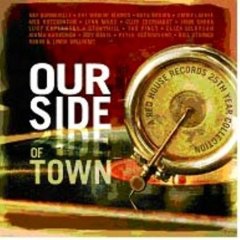
Celebrating 25 years of this premier roots-Americana label, here's just over an hour's worth of fine tracks culled from releases issued by Red House over the past couple of years. It's a good opportunity to catch up with a whole clutch of releases that (aside from those by Lucy Kaplansky, Eliza Gilkyson, Guy Davis, the Wailin' Jennys and Meg Hutchinson) for some unfathomable reason hadn't been received here for review. The standard's consistently satisfying, with representations from the cream of contemporary Americana that range through the sub-genres and include some of the foremost - and long-standing - songwriters of our day. There's John Gorka, Cliff Eberhardt and Bill Staines, veterans all still going strong after many years and the gritty (and unbelievably prolific) Greg Brown. There's also the genre-defying magic of world-class mandolinist and fiddler Peter Ostroushko and legendary Jefferson Airplane/Hot Tuna guitarist Jorma Kaukonen. Two interesting new duos recently taken up and recorded by Red House, Storyhill and The Pines, also see some welcome exposure on this compilation, as do some refugees from other labels who've now found sanctuary on Red House (the wonderful Lynn Miles and stalwarts Robin & Linda Williams who straddle the boundaries between country, folk and oldtime, and blueser Ray Bonneville). A nice collection and a great taster.
www.redhouserecords.com
www.myspace.com/redhouserecords
David Kidman March 2008
Paisley Pop Artists - A Mess Of Our Favourites, Volume 2 (Paisley Pop)
A great compilation culled from the under-heralded riches of the Paisley Pop label. Almost guaranteed that you'll not have heard of hardly any of the artists involved, unless you're a power-pop specialist (and even then!), but the quality is mostly tops. It's equal parts most pop sub-genres, from straight power-pop to punk to indie to alt-country. There's bands with names to conjure with (well, if you're an evil magician maybe!) - the Saving Graces, the Quags, Brown Mountain Lights, the French Broads, the Windbreakers (that outfit obviously has farto go!)… OK, some names promise more than they deliver but what the heck? never mind the nomenclature, feel the width of their inspiration, drawing into the melting pot any and every fabulous underground reference you could dream up and more. The collection really gets into its stride from track 3 (Sex & Reverb's supremely garage/Velvets Live Wire), but the highlights are scattered through the whole 50 minutes of this CD - well, I got off on the shimmering lustre of How To Do Everything Right by Girls Say Yes, a case of Younger-Than-esterday-era Byrds colliding heads-on with 80s indie-pop, the would-be-Burrito steel-soaked burnish of the Lonesome Brothers, the tasty melodic Americana of Brown Mountain Lights, the Steve-Earle-influenced Tim Lee (who appears on three different tracks under three different handles!), and the honky sax-led curiosity Glory Of The Sun by Crack City Rockers (a culture-Clash if ever there was one!). Probably a quarter of the cuts could best be termed efficient rather than exciting, but their heart's in the right place, and the very best examples on this collection are prime cuts indeed, and just refuse to let go of you.
David Kidman
This brand new great-value compilation, released in celebration of Homecoming Scotland 2009, is produced in association with Shona McMillan's exhibition of the same title, which is being staged in venues along the Firth of Forth (until October) then moves to Eyemouth and Duns. The atmospheric music and stunning photography (old images and freshly taken images alike) all combine to give an authentic reflection of life past and present in the fishing communities of the Firth of Forth.
As is always the case with a Greentrax compilation, this exercise has been carried out with exemplary taste and insight: each and every track is both thematically relevant and ideally performed, and the whole disc is superbly sequenced for maximum interest and listenability, balancing smaller with larger canvases, male with female performers, soloists with group performances yet retaining the flow and argument of the theme all the way through the disc's 72-minute timespan.
Opening in epic style with Davy Steele's benchmark Ceolbeg recording of his own composition Farewell Tae The Haven, the disc then brings us a thought-provoking programme of songs giving the human perspective on the fishing industry, the livelihood of the men and the many lives lost in pursuit of that livelihood. And every single one is presented in a matchless performance that ranks among the very best available in an often crowded field. The two tracks bearing an identical title (The Fisherman's Wife) are completely different songs: Heather Heywood's is a brilliant live rendition of the Ewan MacColl song, while Janet Russell and Christine Kydd's contribution is traditional in origin. The Cast's powerful Song For Cove chronicles Scotland's worst ever fishing disaster (1881), and on The Cruel And Hungry Sea Davie Robertson muses on the wrecks of old fishing boats at his native Longniddry. Black Eyed Biddy's lusty rendition of Bonnie Ship The Diamond, definitely one of the finest available, comes from a very early Greentrax album that's well worth revisiting, while Isla St. Clair's intense, affecting tribute to the RNLI is itself taken from the early Greentrax compilation Scenes Of Scotland. Following straight on from Isla in a masterstroke of programming, the late Davy Steele reappears with his second Prestonpans song Wha'll Dreg A Buckie, couched in the tremendous harmony arrangement of Drinkers' Drouth (now there's another record demanding reissue!).
Discographically, it's worth noting that Greentrax have (as usual) been typically enterprising both within and outwith their own exhaustive back-catalogue. Only ten of the disc's 21 tracks are drawn from existing Greentrax releases (and it's unlikely that even the most avid fan will have all of them!). Of the remainder, two tracks by the Harbour Lights choir and two by Cilla Fisher (including, most appropriately, her celebrated recording of John Watt's account of the Eyemouth Disaster), together with those by The Corries, excellent guitarist John Carnie and the aforementioned Drinkers' Drouth, have been licensed from other labels. In addition, no fewer than four tracks were recorded specially for this album: two (Fisherrow and Come All Ye Fisher Lassies) by Shona McMillan herself, the Gaelic air The Herring Boats by Co. Louth fiddler Gerry O'Connor, and the disc's closing hymn Will Your Anchor Hold by the Fisher Folk Choir.
Uniformly excellent though the quality of music and performances on the disc may be, the richest of icing is provided by the beautifully presented accompanying booklet, which reproduces some of Shona's photographs and provides fullest possible background context for the individual songs. Without doubt Greentrax's People And Songs Of The Sea is one of the very finest Scottish thematic celebration-compilations on the market.
David Kidman September 2009
Various Artists - People On The Highway: a Bert Jansch enconium (Market Square)
This one's subtitled "a Bert Jansch encomium" – now, that'll have y'all reachin' for a dictionary, so I'll save you the bother: it basically means "an expression of praise"! But this wondrous two-disc set is much more than that – it's a very sincere tribute to an arguably still underrated songwriter, from a varied selection of his fellow musicians. It's been a source of puzzlement to many of Bert's admirers that relatively few of his songs have ever been covered by other artists – allegedly, not due to any deficiency in their intrinsic merit, but because his songs were considered by many admirers to be unsingable by anyone but Bert himself! Well, this album sure lays that theory to rest! It's not the blatant cash-in that can be typical of many so-called tributes, but instead it's shot through with an artistic integrity reflecting the man himself. This permeates right through to the care that's been lavished to the booklet notes, with comments from the artists appearing, information on song sources and an essay by Bert's biographer Colin Harper.
All the performances were recorded specially over the space of just one year at the tail-end of the 90s, and quite honestly every single one has something to commend it, although (inevitably) some stand out. One of the finest singers in the land, Maggie Boyle, turns in a surely unsurpassable version of Bird Song accompanied by Steve Anstee's cello, then just four tracks later there's her erstwhile musical partner Steve Tilston with the remarkable, beautifully dark folk-baroque Moonshine, accompanied by his typically excellent guitar and arpeggione playing. Another (incidental) benefit of this encomium is that I've also discovered one or two of Bert's songs for the first time myself, these coming from Jansch albums I still don't own (and I'd call myself an admirer!) - like When I Get Home, performed here by Bernard Butler. Fellow-collaborator on Bert's Crimson Moon album, Johnny Hodge, makes a fine job of Step Back (with production and percussion by Bert himself). It's also enlighteningly different to hear a piano backing for a Jansch song on two contributions here – that from Bert's son Adam, also Yola lass Eleanor McEvoy's intense solo rendering of Where Did My Life Go? which serves as a simultaneous tribute to Sandy Denny (now known to be the actual subject of the song). There are also no fewer than two great versions of Blackwaterside, which could not be more different – Polly Bolton's magisterial reading with Kevin Dempsey, and Kelly Joe Phelps' stunning take that transcends even his own usual superlatives. Steve Ashley's inspired, perky string-quartet arrangement for It Don't Bother Me deserves a more than honourable mention too. Chris Smither "climbs all over" Strolling Down The Highway before Roy Harper tackles Needle Of Death, while Al Stewart revisits Soho; there's also Ralph McTell, Rod Clements, Martin Jenkins …… so many highlights! (I must stop!)
David Kidman
The Pigeon On The Gate is a wide-ranging, satisfyingly copious survey of melodeon players from East Anglia, spread over two generously-filled discs and encompassing a staggering total of 111 recordings made over a span of close on thirty years (1959 to 1987). Admittedly many of these are short or quite fragmentary, but even in the space of forty or fifty seconds you can get a good measure of the intensity and commitment of the player and go some way to comparing his or her technique, attack or approach to phrasing or timing, with the others on display. This CD release is, it turns out, a reissue of the 1997 double-cassette of the same name, on which were gathered representative items from the repertoires of players from (predominantly) Suffolk and Norfolk, with a small handful from Cambridgeshire and Essex. It forms a neat supplement to three previous Veteran releases that have featured East Anglian melodeonists (Who Owns The Game?, Heel & Toe and, most recently, Good Hearted Fellows), although - unlike the majority of the present issue - these earlier discs also featured performances of songs alongside the tunes in the programme. On The Pigeon On The Gate, the one-row Hohner model would seem to predominate, but interestingly the lion's share of the playing-time is accorded to two individual musicians: Norfolk's Percy Brown (pictured playing a two-row model) and Suffolk's Oscar Woods, ostensibly because their repertoires were more varied than most other players (in that they not only played for pub step-dancing, with staple hornpipes, polkas and waltzes, but also made creative arrangements of popular tunes and music-hall items - in fact, anything that might serve their purpose, whatever its origin. Next to the above two players, George Craske from Norfolk is the most well-represented, with nine selections, while Harry Cox (better known now as a singer perhaps) has seven. There's some audible stepping on some tracks, and some very occasional snatches of song within the playing (that of John Woodrow for instance), but the set is almost exclusively an instrumental showcase - and nothing wrong with that! Although this is definitely a release for the specialist, and at over 70 minutes per disc the whole stretch may prove too much of a good thing at times even for the hardened melodeon buff, there's much to be gained from dipping in and out of the set selectively and on a good day I even found myself becoming strangely addicted to somewhat lengthier sessions of exposure…
David Kidman November 2008
This release is built around an interesting premise – to bring together in one concert several pipers all playing pipes made by the same makers (the versatile father-and-son firm of Hamish and Fin Moore, which to date has manufactured Border Pipes, Scottish Small Pipes, Highland Reel Pipes and Highland Pipes). There's unity and contrast aplenty, therefore, in this recital, and judging from the reaction of the audience the atmosphere at the Halloween 2003 concert was electric. The performances exude the commitment and distinction you'd expect from master pipers of championship standard; these include, in addition to the makers themselves, such luminaries as Gordon Duncan, Malcolm Robertson, Iain MacInnes, Graham Mulholland, Gary West, Iain MacDonald (here heard in duet with guitarist Malcolm Stitt), Angus MacKenzie (accompanied by fiddler Gabe McVarish), and Anna Murray. Anna's track combines her piping with her equally excellent singing on a set of songs learned from Mary Smith. Surprisingly, there are two more vocal tracks here: Allan MacDonald turns in a characterful performance of a song about Culloden Day (Òran Air Là Chulodair), while the third is the CD's final selection, the title track, which is a song written in tribute to Hamish Moore by Dave Francis and sung by Mairi Campbell (also playing fiddle) to Hamish's own accompaniment on Highland Reel Pipes. The only disappointment on this magical CD is that all too tragically, Martyn Bennett was not well enough to take part in the concert, so his two tracks here are taken from Greentrax's previous release The Grand Concert Of Scottish Piping. But the whole CD is a true distillation of all that's best in solo piping, and the variety in tone among the different types of pipes on display makes for a delightful listen (I use the word "distillation" advisedly, for the whole concert was recorded at Pitlochry on the eve of the Glenfiddich Championships and sponsored by Edradour Distillery…!).
David Kidman
This is a very strange project. First staged in Margate last autumn in association with the organisation Artangel (as part of its "guerrilla program of sparking contemporary debate on modern culture"), and later filmed for Channel 4, its core is a sequence of songs which, in effect, recreate (portray or meditate on) the ten Biblical plagues that take place in the Book Of Exodus. These songs have been contributed by a fascinatingly diverse array of musical talents, and the end-product is a concept-album that's maddeningly inconsistent both stylistically and artistically. As with all such projects, there's flashes of compelling brilliance alongside items that don't do much for me musically yet remain appropriate for, and properly in accord with, their subject matter and purpose. Just a glance at the roll-call will illustrate this disparity: where else might you find such a gathering under the same umbrella? Rufus Wainwright's Katonah (Death of the Firstborn), which he sings with Lucy Roche, is interestingly jazzy, while Laurie Anderson's ominous, brilliantly minimal Fifth Plague (Death Of Livestock) and Brian Eno & Robert Wyatt's sensual depiction of Flies are both disc highlights in their own peculiar way, while there's a surprisingly effective contribution from Scott Walker: a decidedly theatrical Darkness complete with shouting, stabbing choral interjections. The Tiger Lilies' Hailstones sounds a little sweet for its topic, but Imogen Heap's Glittering Cloud (or Locusts) hits the spot more with its treated-samples setting, and even Klashnekoff's in-yer-face hip-hop Blood has much to commend it. Magnetic Fields' Stephin Merritt's The Meaning Of Lice provides a more satisfying wordplay in its title than its electropop setting, however, and I was disappointed with King Creosote's Relate The Tale, while Cody ChesnuTT's Boils is too brief for its viscerality to make maximum impact. Yes, a strange collection, although the performances lack nothing in commitment. (I gather that an even more intriguing-sounding version of this song-cycle has since been performed at the Barbican Hall, London, featuring some new songs and some different artistes including the Handsome Family, June Tabor and Sandy Dillon: now that would've been worth hearing - I wonder whether a CD is in the offing?...)
David Kidman November 2007
Various Artists - Poet: A tribute to Townes Van Zandt (Freefalls Entertainment)
David Kidman
Various Artists - Poet, a tribute to Townes Van Zandt (Catfish)
What it says on the box. A tribute to the songwriting genius of one of the most influential names in American folk since Woody and Hank. A wanderer, haunted by his personal spiritual and emotional demons, Van Zandt was touched by the spirit of the tumbleweed dust, penning stories of outlaws and dreamers, of lovers and losers, reaching into the very darkness of his soul to pluck these desert baked tales. Steeped in a melancholy that would ultimately drive him to the arms of the alcoholism that killed him, he was blessed with a brilliant mind that found its expression in songs hewn from both his own sadness and pain but also his open embracing of life in all its highs and lows. As he said himself, to live is to fly - and he soared like few others knowing that touching the sun was worth crashing back into the earth.And so to this album, 15 songs, some well known, others less so, faithful or interpreted versions from the cream of Americana's own veterans, all of whom owe a debt of influence to the man. Guy Clarke kicks things off with To Live's To Fly, his own dust grained throat capturing Townes' own aching timbre, and, while Delbert McLinton's cover of Pancho and Lefty isn't going to replace Willie Nelson's in my book and Billy Joe Shaver's rip it up White Freightliner Blues stands out like a sore thumb among the otherwise reflective mood, things never dip below the level of intoxicating. Cowboy Junkies provide a typically brooding Highway Kind, Emmylou gives a sparse southern gothic bluegrass tone to Snake Song echoed by Lucinda Williams' stripped back spooked Nothin', while Steve Earle twangs up the guitar and harp for Two Girls and Robert Earl Keen brings a slower reading to enigmatic poker game parable that is Mr Mudd & Mr Gold..
Nanci Griffith, John Prine, Willie Nelson, the reformed Flatlanders and Ray Benson (a sublime yearning If I Needed You) complete the list of old hands while Kentucky newcomer Pat Haney ably holds his own with a claw hammer banjo take of Waitin' 'Round To Die and, just to bring the legacy full circle, Townes's son John T rounds things off with a stark My Proud Mountains, the ghost of his father clearly heard in his voice. A pity someone couldn't have found room to do For The Sake of the Song, but maybe that'll keep for when the new alt-country generation of his disciples get round to providing a follow-up.
Mike Davies
Another of those you'd-be-mad-not-to buy compilations from Proper that'll have at least one track worth the super-bargain price-tag (£1.99) all on its own - and most probably several more. It collects together 15 tracks from recent Proper releases, mostly new material as opposed to back-catalogue (and even the two exceptions are from newly-released collections). Riding the rootsy gamut from country through folk and gospel to modern rock, to say you can't go wrong is an understatement when there's such classy music on offer as this selection of tracks from Joan Baez, Ruthie Foster, Diana Jones and Mary Gauthier (the women), Little Feat and The Blind Boys Of Alabama (the bands) and Tim O'Brien, Richard Thompson, Ian McLagan, Andy Fairweather-Low and Drumbo (the men). Not to mention two tracks from Nick Lowe (one from last year's At My Age, the other from the freshly resurrected and expanded Jesus Of Cool), a new Art Garfunkel track that also features James Taylor and a choice cut from Sonny Landreth's latest CD that also features Eric Clapton. The Diana Jones and Drumbo tracks, two of the best on the disc, are taken from forthcoming albums, but the rest are all now readily available. The disc's both a tasty appetiser and an equally tasty feast if taken on its own.
David Kidman September 2008
The six 2006 Radio Ballads, which were broadcast on BBC Radio 2 back in February and March, have now appeared on CD at last. A full year in the making, these programmes were conceived as latter-day successors (while also paying direct homage) to the original series of eight groundbreaking documentaries by Ewan MacColl and Charles Parker which were commissioned and broadcast by the BBC well over 40 years ago (between 1958 and 1964). John Leonard, producer of the 2006 Ballads, engaged Vince Hunt and Sara Parker (Charles's daughter) to carry out the interviews and to gather location atmosphere recordings for the new set, which can, like the original eight, equally be regarded as the soundtrack to an age, aspects of our culture and/or a period in history. Once again they deal powerfully with a variety of current social and political issues, using the technique of weaving speech (the voices of interviewees) and sound with specially-composed songs. However, just as with the originals, whilst we acknowledge the continued importance of the Radio Ballad as a social document, any commentary must also be tempered with a measure of critical perspective in order to be able to appraise them artistically. The original Radio Ballads were described by Ewan MacColl and Peggy Seeger as "the work of a team of singers, songwriters, technicians, instrumentalists and others who were consciously attempting to apply the techniques of folk creation to one part of the mass media - radio." For what we nowadays take for granted in radio documentaries - the incorporation of the voices of "real people" (as opposed to actors) - was viewed as a fairly radical idea at the time, when we were suddenly being presented in each Ballad with the Voice of the People, within a framework consciously created to tell the story of a defined community or sub-set of society. There is no escaping the impact of those programmes, nor the staying-power of many of the original songs which MacColl wrote for them (a good number of which have since passed into the repertoire as folk standards, some having even been misrepresented as traditional!). Listening to the eight Radio Ballads of the original series in sequence provided a fascinating insight into the (then ongoing) development of the form, whereas the new set has less a sense of pioneering or of progress through the series than a definitive technical consistency arising from that of contemporary radio programme standards. Replacing the necessarily primitive cut-and-paste editing techniques of the original Ballads with sophisticated modern studio expertise inevitably imbues the new Ballads with a different kind, and level, of fluency (and naturally, today's sound quality is expectedly first-class throughout). The team making the new Ballads has adopted the guiding principles used on the originals, and the subjects and interviewees are presented with an equitable mixture of objectivity and sympathy, being permitted to show their humanity while expressing their views and making their points with all due measured perspective for presenting both sides of an argument. But somehow (and equally inevitably) the new Ballads don't quite have the startling impact of the original series; admittedly, they couldn't ever hope to recreate that sense of momentousness, for there just isn't the "shock of the new" any more, in an age where we're saturated with similarly-assembled hi-tech soundbite-rich docu-dramas. Nor is there now the same taboo attached nowadays to discussing sensitive matters like afflictions - listening to The Body Blow (which dealt with the pain experienced by polio sufferers) was a genuinely harrowing experience that the HIV/AIDS-centred The Enemy That Lives Within can't match, however intense the basic source material (and in the latter case I found my attention wandering somewhat with the frequent repetition of much of this) and however potent the associated newly-composed songs.
Specific generic and thematic parallels can be drawn between several of the original Radio Ballads and their 2006 counterparts: for instance, the very first of the new series, The Song Of Steel, is cast in the tried-and-tested mould (sic!) of an industrial Ballad containing powerful first-hand evocations of a vanished livelihood (that of steelworkers in the Don Valley in South Yorkshire). The method of presentation here is indicative of the 2006 Ballads, where, generally speaking, the commentary sections and soundbites are lengthier, no doubt befitting the increasingly aware and informed status (and loquaciousness) of the interviewees and those directly involved as participants, as much as the arguably greater complexity of the issues themselves in this day and age. Similarly, the fourth and sixth instalments of the 2006 series, Swings And Roundabouts (stories told by the showmen and women who run Britain's fairgrounds) and The Ballad Of The Big Ships (stories of the shipbuilders of the Tyne and Clyde) respectively, which both aim to present, much in the manner of the original Ballads, what MacColl termed "a unique picture of a way of life, told in words which themselves were charged with the special kind of vitality which derives from involvement with a work process ...": the occupations and activities still embrace real "characters", even though the language they speak may not always be quite as colourful as 40 years ago. Since the original Ballads were about "the way we live now" (=then), it was difficult to avoid a certain elegiac tone, as they attempted to "make the everyday significant"; yet the underlying brief, and the resultant mood, has to a considerable extent been authentically carried over into the 2006 Ballads.
Now I come to the "odd-one-out" in the 2006 Ballads. Rather than outlining the effects of an industrial landscape or way of life on an area's inhabitants, Thirty Years Of Conflict, which deals with the sectarian conflict in Northern Ireland, presents direct recounted experiences of the difficulty, and sheer volatility, of the situation of just trying to live an ordinary life in the Province. This topic could so easily have been insensitively handled, but it's symptomatic that possibly two of the finest songs in the whole series occur in this Ballad: the chilling Tommy Sands composition Troubles, and Jez's Miami which views the Troubles from the perspective of the community of musicians who've kept the spirit going throughout. Generally, the Ballads avoid making any kind of partisan statement, letting the participants speak for themselves and the listener draw his or her own informed conclusion, but in the case of this Ballad we're steered to the spiritually uplifting message that is in the music: the music which has no agenda other than that of bringing the people together. We're left with this lasting message of hope to complement the "fragile peace" that is the 1998 Good Friday agreement.
As for the music per se, in the original Radio Ballads this functioned both as a narrative device and a tension builder, MacColl's songs both commenting on and extending the speech and "actuality" recordings. I'm not sure that this happens to quite the same extent or potency with the new Ballads, for although the songs comment creatively on the vox-populis or reportage or else poignantly reflect the situation being described, there are occasions when a song takes on more of the role of classy incidental music. However, one other important aspect of the original Ballads has been strongly carried through into the new series: while each Ballad inhabits its own particular cultural (and musical) environment to a greater or lesser extent, the use of many of the same musicians and singers throughout the series brings more than a house style, it ensures a conformity. Here, then, the distinctive attitude, musico-cultural vision and writing styles of John Tams (Musical Director of the new series) and Jez Lowe, who between them provide the lion's share of the new songs, give a contemporary consistency to the whole project, even though a large number of other top-drawer folk songwriters and performers have also been involved in the enterprise (some, like Karine Polwart, Chris While, Julie Matthews, Bob Fox, Barry Coope, Jim Boyes & Lester Simpson, quite extensively, while others like Cara Dillon, Kellie While, Tommy Sands, Keith Kendrick, Kate Rusby and Martin Simpson only for a small handful of specific renditions or even - in the case of the latter two named - isolated cameo appearances).
The quality of the songwriting and performances on the new Ballads is second-to-none, and memorably strong throughout, but those which I feel worthy of extra-special note amongst that impressive roster are the contributions of Karine Polwart (who has written and performed some truly outstanding songs here encompassing a wide emotional range across all six Ballads) and Bob Fox (who's probably never sung better - though sadly he loses out on credit due to a couple of blatant, if uncharacteristic, booklet howlers involving Bother At The Hoppings (from Swings And Roundabouts) and Taking On Men (from The Ballad Of The Big Ships), both of which are wrongly listed as being sung by their writer, Jez Lowe!). Incidentally, the maddeningly prolific Jez had written as many as 20 songs for the new Ballads, not all of which ended up being used in the final programmes (you can hear The Waltzer, one of the "also-rans" from Swings And Roundabouts, performed by Kate Bramley on her brilliant CD Little Canaan). In addition to the specially-composed songs, the third of the new Ballads, The Horn Of The Hunter (which chronicles the end of hunting with hounds) fittingly employs three adaptations of traditional material: Keith Kendrick performs Hounds Of The Meynall and Dido, Bendigo, while Martin Simpson performs the tune of The Green Hare.
Finally, in assessing these discs, which present the six 2006 Radio Ballads in their entirety, exactly as heard on BBC Radio 2, it's worth pointing out that however compelling the total Radio Ballad experience may often be, it's not necessarily one to which every listener will want to return all that often, and especially bearing in mind the significantly high quality of these new songs, many might well prefer to have recordings of these in their entirety on a separate set of discs (a selection of these songs is due to be issued next month, although it's not clear whether this is to be the first of a series). I certainly found myself after a couple of playthroughs yearning to hear many (if not all) of the songs in their full glory and uninterrupted continuity (if anything, even more so than with those featured on the MacColl Radio Ballads). But having said that, I'm still (unexpectedly) finding myself returning to these complete recordings of the 2006 Ballads (when I can set aside the relevant continuous chunks of time and undivided attention, that is), and I definitely wouldn't want to be without these in my collection.
David Kidman December 2006
Subtitled A Cornucopia of British Psychedelia 1965-1970, this 4 CD box set may not be quite the definitive statement on home made lysergic pop (no Kaleidoscope or Tomorrow for starters) but spread across 99 tracks it's an undeniably comprehensive collection tracing the progression from art school folkie and r&b through flower power to the advent of progrock.
To enumerate everything here would require a small essay, but suffice to say it embraces both well known names such as the Kinks, Quo (yes, Matchstick Men again), Donovan, the Nice, Small Faces and Bolan, cult artists like The Smoke (My Friend Jack, obviously, but the original demo version plus the unissued Utterly Simple), The Deviants, The Tickle, The Uglys and Skip Bifferty and the genuinely obscure in the form of The Turnstyle, Our Plastic Dream, Anan, Paper Blitz Tissue and, an early incarnation of 10cc founders Godley and Creme, The Yellow Bellow Room Boom!.
Some inclusions may surprise, after all who would have thought Brum harmony pop outfit The Rockin' Berries would have recorded something like Yellow Rainbow or expected Harmony Grass to colour their Beach Boys pop with traces of acid. And yes, that really is Gilbert O'Sullivan sounding like a Northern vaudeville version of Kevin Coyne on Disappear.
But then clearly a lot of time, thought and archive searching has gone into putting this together, generally avoiding obvious track choices or offering rare alternate takes such as the no brass version of Fire, the radically different US version of Episode Six's Love, Hate, Revenge) and the previously unheard original version of Note Is A-Coming by Warm Sounds.
As detailed in the exhaustively brilliant booklet notes by album compiler David Wells, there's also a wealth of names here who would surface in different, better known guises later in their careers. Timon is in fact Tymon Dogg, the folkie violinist who would become a Clash collaborator, Floribunda Rose conceals a young John Kongos while Grapefruit guitarist John Perry would one day wind up in new wave popsters The Only Ones.
There's much more but I'll let you enjoy discovering which of the underachievers and no hopers featured Yes member to be Tony Kaye, provided the title for a Deep Purple album, featured three future Purple players as session men, and spawned Verve arranger Wil Malone. Marvellous mind-bending stuff, man.
Mike Davies July 2007
This 2CD set is a celebration of the music written by and covered by the genius that is Peter Green. Some of the planets best guitarists gather here to pay homage and offer their versions of some of the best known Green tracks. Black Magic Woman is performed by Larry McCray with scorching guitar and smooth voice and much different from both the original and Santana's most famous version. Dave Peverett & Rod Price produce a soulful rendition of Love That Burns with free-flowing guitar and a big horn compliment. They also contribute If You Be My Baby, which stays relatively faithful to the original and has stinging guitar from Price. Savoy Brown gives Stop Messin' Around a jazzy, acoustic feel and Snowy White changes Looking For Somebody completely. Luther Grosvenor, Ariel Bender in his Mott The Hoople days, chips in with Cryin' Won't Bring You Back and turns in a slinky blues with grungy lead guitar. The only downside is the extended, repetitive ending. He also plays Merry Go Round in a sultry, ragged manner. Peter Green's writing allied to Rory Gallagher's class conjures up a classic in Leaving Town Blues – the addition of mandolin is more than justified. Gallagher is also included with his archetypal style on Showbiz Blues. Harvey Mandell & Wilbur Boscomb play Ramblin' Pony at breakneck speed and create a great version of one of Green's best songs. They also contribute Long Grey Mare and funk it up big time – top performance from Bascomb on bass. The task of re-creating The Green Manalishi falls to Arthur Brown and he provides an anarchic performance, as you would expect, that oozes with energy. It's not all Peter Green originals here as it is meant to be a representation of the music played by him. So, the inclusion of Ken Hensley on Hellhounds On My Trail is not too much of a surprise. This Robert Johnson song is essentially turned into a piano blues with a little acoustic slide guitar thrown in for good measure. A cranked up I Loved Another Woman is from Larry Mitchell & Jay Aston and keeps up the high standard. This is turning out to be a fine collection. Mick Abrahams keeps faithful to the original on The Same Way and Top Topham & Jim McCarty turn in a relaxed version of Drifting. Clas Yngstrom churns out a storming version of The Supernatural and Ian Anderson gives us his obligatory flute on Man Of The World, which is almost Oriental in its execution.
The second CD begins in barnstorming style with Billy Sheehan's version of Oh Well. This is a fantastic 7 minutes of guitar playing, both electric and acoustic. Vince Converse's Rattlesnake Shake is competent enough and the guitar pyrotechnics at the end are well worth waiting for. There's a whirlwind performance of Fleetwood Mac from Stu Harman and his blazing fingers produce a heavy rock blues that Green would be proud of. Zoot Money & Bobby Trench give us a soulful rendition of Watcha Gonna Do. Perhaps Green's most famous song is Albatross and it is a little strange that it is Paul Jones' harmonica that is chosen to take the place of the guitar. It is pretty unique although I can't say that I'm impressed too much and I feel that it loses too much of its impact. I've never heard of Naked Blue, who gives us Closing My Eyes. The female vocal is different but I think that overall it is another strange inclusion. Ray Gomez contributes a raunchy Evil Woman Blues and Troy Turner revs up the pace with neat guitar work and a solid vocal on Lazy Poker Blues. Harvey Mandel features again, this time with Jon Paris on Watch Out, a shuffling blues that drifts into cabaret at times. Kim Lembo plays A Fool No More and his smokey voice makes this sultry blues. Although a slow song, this is a powerful performance and Mark Doyle's guitar playing is as good as anywhere else on this double set. Southside Johnny closes out the album with Baby When The Sun Goes Down, an appropriate track to finish with. This has a big brass backing from The Uptown Horns and the overall feel is one of a Springsteen song – great finish. The excellent sleeve notes from Jim Kozlowski (Viceroy Music) and Pete Brown are a good addition and gives us an insight into how the album was put together.
David Blue August 2007
The Reel & Soul Association (Flying Sparks)
Reinterpreting the music of one genre with the tools of another is nothing new; one thinks of Big Daddy who made a whole career of reinterpreting others' hits in different idioms or of the recent bluegrass version of ZZ Top hits. However, this album is an intriguing concept in that by applying English folk treatments to American soul classics it's essentially bringing this back home since much of old school American R&B has its roots in the folk traditions that informed the original sources from which it's derived.
It's an impressive collection that includes producer Nigel Stonier, Maartin Allcock. Simon Swarbrick, Robbie McIntosh, John Kirkpatrick, Paul Burgess and, sharing lead vocals, Kellie While and the magnificent Thea Gilmore. They jump right in toom While taking lead on a chugging Inner City Blues that introduces bodhran, banjo and fiddle to Marvin Gaye's socio-political statement without diluting the rage in the slightest. Curtis Mayfield's Move On Up opens up on Burgess's clattering drums before getting down to an urgent groove that marries Scottish reel and beats to the sort of burning effect assayed by Shooglenifty while Steve Wonder's Higher Ground is fed through an English folk ballad mood with percussion and guitar circling like birds of prey. I'm not totally convinced by a somewhat rushed Get Ready that just doesn't seem to have had the necessary time spent on the arrangement nor by the squeeze box and banjo rework of Green Onions which, transposed to the cider barn, lacks all of the original's urban edginess.
However, elsewhere things work magnificently, While pouring her heart into Ann Peebles' ballad One Way Street, wearing her soul on her sleeve with the Isley's Harvest For The World and, soaring over the notes in a reverie of dreamy passion, quite frankly making Ain't No Sunshine her own with the help of Michael McGoldrick's whistle.But, while I may be biased simply because I reckon she's one of the finest female vocalists to emerge from the country in the past decade and responsible for a string of breathtaking self-penned albums, it's the tracks on which Gilmore take the spotlight that shine brightest. A duet with While on a linked arms accordion swaying When Something Is Wrong With My Baby, her world weary dark voiced Lean On Me that evokes the very best of Linda Thompson and, shaping up to be one of my favourite recordings of the year, a simple but quite stunning version of Percy Sledge's Warm And Tender Love, uillean pipes bringing a tang of the salty Gaelic mists to complement Gilmore seductive earthiness and guaranteed to reduce grown men to a quivering mess. Don't wait til the midnight hour, let its love come tumbling down right now.
Mike Davies
The URL is not up and running yet - however the album can be purchased from Amazon.co.uk - and for further information about the artists mentioned please go to their own websites from our alphabetical REVIEW links
Respond II is a follow up to 1999's five-star-rated Respond album of songs from Boston area femaile songwriters in aid of Respond Inc. and the Family Violence Prevention Fund, two groups devoted to ending domestic violence. A worthy cause indeed and one which united in 2002 a second host of female talent including 15 Grammy niminees - folk focused but taking in an eclectic range of artists and musical styles including rock, punk, blues, gospel, jazz, alt.country and roots music.
Those who donated songs for this 32-track double-album include Joan Baez, Indigo Girls, Ani DiFranco, Patty Griffin, Susan Tedeschi, Tanya Donnelly, Suzanne Vega, Sarah McLachlan, Neko Case, Dolly Parton, Julie Miller, Odetta, Tracy Bonham, and Sweet Honey In The Rock. Most tracks are culled from the artists' own albums but there are some new tracks such as Julie Miller's Too Many Troubles, Tracy Bonham's I'm No Giant, and the Indigo Girls' acoustic She's Saving Me.
It's a classy collection of singer-songwriters you'll know and a 'taster' for those you may not have heard before - it's a confirmation and celebration of all that is glorious about the female voice - and, importantly, it's a project which will benefit a cause close to the heart of those participating. It's available from both Amazons and the links below.
www.respondproject.org
www.signaturesounds.com
www.milesofmusic.com
Sue Cavendish
Swedish roots label Dusty have a knack of unearthing new talent and this series of albums allows them to showcase some of those artists. This volume opens with new band, Blue Sky Forever who gives us the rootsy Last Man On Earth. The vocalist has a deep voiced Kenny Rogers kind of thing going on. US singer Lazy Ike provides I'll Be Damned, a jaunty, old style country song. Next up is the Rock 'N' Roll Torpedoes with Get A Move On Baby. This is a bit of boogie with horns in full flow. The vocalist may not be up to scratch but the chorus is good - short and sweet. Gary Cooper, no not him, gives us Troubles, quite literally. He has a strange vocal delivery and not the best on offer. He doesn't do himself any favours on his other contribution, King. The faraway voice just doesn't sell the song. Why they gave him two songs I don't know. Alt. Country gets a chance with Tattoo by American band, High Cotton. Although it is fine the vocalist is just a little too American, if that could be possible. Their other effort, Dollar Store, which finishes the album is slightly humorous but does little. Lee Marvelous contributes the wonderfully titled Right Now Is The Time To Fall Apart. This is in the Country field again and he has a good band backing him with the pedal steel guitar in particular. He also has Jack And Joanne on the album. He treats this as Country verging into Rockabilly and has such an exaggerated vocal that you will want to listen again and again. English group Sadler Dale provides some energetic punk Country on Fingers In A Pie and give us a surprise hit in the process. They also deliver I'm A Lover Now in a jug band, Country Rock style, much akin to early Dr. Hook and very reminiscent of the Pub Rock era. This cements them as one of the best bands on offer. The Howard Way gives us modern Americana on Chantal Lane and there are those that may hear the influence of Steve Earle in there. Swedes, The Stu are another Country band and another good one at that. They could easily slip into the USA and pass for one of their own and their forthcoming debut album should be well worth hearing. I've reviewed Svensson & Dafgard's album, Rootation, and consider them to be the class act on offer. Their contribution, Take Me As I Am, is rootsy and very catchy. Linus Johnson & Stillhouse conjure up images of Appalachian life on Miner's Blues and this Americana is a favourite of mine. Contemporary Country is also featured and erstwhile Blue Sky Forever member Tomas Larsson's other band Larsson's Fly is well sung and has some classy mandolin playing. Back to classic Country for Irishman Jim Cahill's House For Sale but it also reminds me of a slowed down I Knew The Bride by Dave Edmunds. Moonlight Wranglers contribute 77, a good example of energetic Country Rock. Broken Records offering is The Silver Plate and it harks back to the classic Country Rock of the 70s. This is a harmony-laden highlight. Wasted Away by The Turnpikes is another is the same vein but with a world weary vocal. They lose it a bit at the chorus but that doesn't detract too much from their performance. All in all, a very good sample of what is going on in the roots capital of Sweden.
David Blue April 2007
David Kidman
Don't laugh - elieve it or not, the basic idea for this unusual project came from Johnny Depp and his director Gore Verbinski while they were filming their epic movie Pirates Of The Caribbean. They broached music producer Hal Willner, who readily bought into the suggestion of imagining artists that he listened to and respected doing their own take on the age-old songs of the sea. And before long, no fewer than 60 songs were recorded, of which 43 appear on this lavishly-presented two-disc set. It could all have been a whacking great white elephant (or should I say albatross?!) -but in truth the majority of these reworked opuses have a uniformly crazed quality that's perversely appealing.
The partially-pressganged motley crew of scurvy seadogs assembled here includes some illustrious names indeed, and they certainly acquit themselves honourably enough to avoid inciting any cries of "walk the plank" from the spectators' gallery. Inevitably there are just a few miscalculations, and one or two somewhat prim and polite renditions of the more bawdy-lingo moments, but let's dwell on the successes. Early on, the jewel-like repose of Richard Thompson's Mingulay Boat Song forms a brilliant contrast from the preceding gravel-voiced Baby Gramps' Cape Cod Girls (shades of Joseph Spence there, I thought!), while Three Pruned Men's deliriously gnarled Bully In The Alley, David Thomas's cryptic What Shall We Do With A Drunken Sailor? and Martin Carthy's energetic Hog Eye Man, despite their vastly different approaches, strangely and unexpectedly complement each other.
I also loved Eliza Carthy's take on Rolling Sea. Some artists (John C. Reilly, Nick Cave, Baby Gramps, David Thomas, Sting, Bryan Ferry, Martin Carthy and Loudon Wainwright III) are granted two bites at the ship's biscuit, and (for the most part) deservedly so. There's also quite a bit of overlap elsewhere with performers like Val McCallum, Richard Greene, Ed Harcourt, Rory McFarlane, Kate St. John and Michael Thompson appearing on several items -in fact, almost amounting to a "house band". Bob Neuwirth's rough-hewn Haul On The Bowline, although instrumentally enriched, adheres well to the authentic spirit and rhythm of the chantey as a worksong. Bono's drone-laden "dying sailor ballad" is unexpectedly haunting, as is Bryan Ferry's take on Lowlands Low (a duet with Antony Hegarty).
For all the arranging and studio skills brought to bear on these reinterpretations, there are also some really good pared-down renditions here, like Martin Carthy's spirited The Mermaid (backed only by a chorus and a drumbeat), Andrea Corr's charming acappella tale of Caroline And Her Young Sailor Bold, Jolie Holland's melancholy Texan-gospel rendition of Grey Funnel Line, and Long Time Ago by White Magic (an ensemble featuring Mira Billotte and Joan As Police Woman). I really didn't recognise Sting's voice at first on his rousing version of Blood Red Roses, but it all sounds sufficiently lusty, especially with its LA backing chorus. Nick Cave's Fire Down Below is suitably twisted, and Ed Harcourt's Farewell Nancy eerily understated, while Akron Family's gentle treatment of One Spring Morning also works well, if against the odds perhaps. Also appearing on the set, and to be commended, are Rufus Wainwright, Kate McGarrigle, Van Dyke Parks, Lou Reed and Jarvis Cocker (whose epic, brooding Brit-grunge account of A Drop Of Nelson's Blood is quite amazing!).
I was also intrigued by Mary Margaret O'Hara's setting of Harry Kemp's The Cry Of Man, where the keening nature of her vocal line mimics the musical saw in the backing. Finally, turning to the arguably less inspired of the experiments here, Robin Holcomb's Dead Horse turns out rather tame, Lucinda Williams sounds a mite uncomfortable with the Celtic-style decorations of Bonnie Portmore, and the received-pron accent Sting adopts for Shallow Brown is totally naff, while the purely instrumental tracks -Bill Frisell's Spanish Ladies and Richard Greene's Shenandoah – seem little more than pleasant fillers, and the humorous Little Boy Billee (recounted by Ralph Steadman) is too idiosyncratically exaggerated for its own good. But in way of compensation there's an abundance of priceless booty within this well-stocked treasure chest, so come and rummage for a couple of hours and you're bound to find plenty to your liking.
David Kidman July 2008
Various - Roots Music: An American Journey (Rounder)
The title says it all really, a 68 track four disc set that charts the evolution and context of Americana folk music, not as a museum piece but a living tradition that reflects the landscape and lives of its multicultural nation, its influences still active among today's players.
Arriving at a time when interest in the musical past and a revival of its forms is at a peak thanks partly to the success of Oh Brother but also to America's spiritual and moral crisis of identity, it's an inevitably sprawling collection that casts its net across a wide range of genres.
Since contributions are restricted to releases by Rounder and any licensed subsidiaries, there's inevitably some obvious missing names, no Woody, no Hank, no Muddy and no Cash or Carters for a start, but then the point of the compilation is the music not the artists. Thus the importance lies in the inclusion of examples of Cajun and Kletzmer, bluegrass and Czech polka, cowboy songs and R&B rather than who's performing them. Which usefully also means it can avoid using scratchy old archive recordings and still get the point across.
The first two discs are oriented to hard-core tradition with such notable names as Joe Thompson, one of the last African-American fiddle players still scraping the bow down South, gospel veteran Bessie Jones, 60s folk icon Dave Von Ronk, New Orleans piano professor Tuts Washington, bluesman Mississippi Fred McDowell and Cajun and rockabilly legends D L Menard and Sleepy La Beef. It's here you'll find things like 1880s cowboy ballad Texas Cowboy as performed by genuine cattleman Glenn Ohrlin, a New Orleans funeral hymn courtesy the Rebirth Brass Band, a whole clutch of zydeco and Mexican conjuntas jarochos, and, a personal favourite, the lilting Mai Kai No Kauai performed by Hawaii's Tau Moe Family just the way it would have been 60 years earlier.
The second set of discs puts the emphasis on roots derived music and interpreters of the traditions, and it's here you find the likes of Alison Krauss, Ray Wylie Hubbard, jazzman Bela Fleck, Cajun dance outfit Beausoleil, Tish Hinojosa, Jimmie Dale Gilmore, Joe Ely and such newcomers as Slaid Cleaves, Natalie McMaster and The Cash Brothers (represented by their wonderful Nebraska) performing both self-penned material and interpretations of such evergreens as Black Dog, Swing Low Sweet Chariot (magnificently essayed by IIIrd Time Out) and, yes, Man Of Constant Sorrow (this time in the hands of Tony Furtado and Tim O'Brien).
Rounding proceedings off with Fiddle Fever's version of Ashokan Farewell, the theme tune for the American Civil War documentary series, although one might argue that there could have been more gospel or work song examples, there's something for all shades and colours of American roots music fans on this lovingly compiled journey through the past and on into a continuing future. Informative track notes and artists web sites are included in the accompanying brochure.
Mike Davies
There have been many, many collections of blues guitar over the decades, and not a few of these have concentrated on, or at least heavily featured, the lonesome, mesmerising bottleneck playing style that's so characteristic of much blues. It's often been thought that its ascendance arose as a result of bluesmen hearing the "weird", sliding cadences of the Hawaiian steel guitar, yet it's equally apparent that many bluesmen could not have been aware of Hawaiian music at that time. Whatever, the bottleneck method, whereby the wonderfully evocative effect is created by sliding a small cylinder (usually of glass or metal) across the strings, is largely used by acoustic practitioners of the blues, and very much a hallmark of the "classic" original blues masters, most of whom are represented on this excellent new Rough Guide. Kicking off with Sylvester Weaver's celebrated Guitar Rag, the disc then moves on through Fred McDowell, Blind Willie Johnson, Son House, Robert Johnson, Charley Patton and Bukka White to more recent practitioners of the bottleneck art such as Stefan Grossman, Martin Simpson and - hurrah! - John Fahey, and the more experimental side of modern bottleneck playing is represented by a superb and wildly innovative track from Bob Brozman. The only strictly non-bottleneck cut is the St. Louis Blues of Jim & Bob (aka The Genial Hawaiians), which has obviously been included to give perspective on the possible influence or origin issue alluded to above. Anyway, the disc in its well-stocked 69 minutes presents a very persuasive selection, and no really significant names are omitted, although one or two examples of electric bottleneck might usefully have been included too perhaps. Discographical information is good, and it's interesting to note that, while tracks have by and large been sourced from the best available remasterings, the disc's final track, Dan Pickett's Baby How Long, has been freshly transferred straight from the original 78 - and sounds great too! Sadly, however, the notes don't give recording dates for the majority of the tracks - a curious omission, given the attention to detail elsewhere on this issue. Another useful thing about the collection, though, is that the listener shouldn't really get tired of the sound of the bottleneck, as there's heaps more variety in the 22 tracks than the non-blueser might reasonably expect. Ace!
David Kidman
David Kidman
Various Artists - The Rough Guide To Hungarian Music (World Music Network)
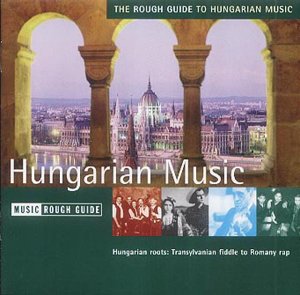
Another of the excellent Rough Guides, containing some supremely entertaining music as you'd expect. The boundaries of Hungary are stretched a little for the purposes of this collection, which incorporates music from some of the minority groups like the South Slavs who have been living in Hungary for generations. The sound-world of the opening track, though, comes as a surprise in any context, with its chiming, ringing accompaniment carrying definite echoes of the Balinese gamelan. No Hungarian sampler collection would be complete without at least one track from Márta Sebestyén and her group Muzsikás, who are possibly the best-known of Hungary's present-day musicians performing in the authentic traditional idiom – the stately, slow Morning Song (taken from a Hungaroton release) is a perfect example. Tracks from the Vujicsics Ensemble and Zsigmond Székely provide us with some of that characteristic, often frenzied and intriguingly polyrhythmic dance music. Elsewhere, "the Transylvanians" give us a glorious thrusting modern-day power-punk take on a traditional couple-dance (shades of Kleenex maybe?), before the album returns to more obviously indigenous fare with a typically deliciously rough-and-tumble Verbunk dance recorded by the Sebó Ensemble in the late 70s, then a set of Jumping Dances performed by the Bogyiszlo Orchestra from southern Hungary. Although it's always good to hear the authentic traditional playing and singing styles being carried on – and there are plenty of excellent examples here of course – much of the interest on this new compilation centres round the latter-day treatments of traditional material. Paralleling similar fusions on the contemporary Scottish folk scene, perhaps, there's some typically wild and maverick experiments here, notably from musicians of the new Budapest generation. Dance remix techniques, incorporation of beats and samples, distorted electric-driven grooves abound in the tracks showcasing the gypsy group Romano Drom. The more widely-accepted café-gypsy style, with its trademark florid violin measures and clanking cimbalom, is represented in all its charming (if sentimental) lyricism by Ferenc Sánta and his band, whereas the more overtly seductive gypsy vocalising of Kalyi Jag also has a place here with a performance of Song Of Mercy. The acclaimed Hannibal release The Bartók Album is – inevitably – represented here, though by a brief set of shepherd's dances played on the long flute. Then for contrast there's the more out-and-out rock stylings of the group Kampec Dolores (with its prominent violin and slight psychedelic/Eastern noodlings it's rather reminiscent of nascent UK prog acts like East Of Eden – who after all were heavily influenced by Hungarian music – what goes around comes around….!), and a brief, strangely scratchy, rappy track from Fekete Vonat. An exciting and very useful release, which skilfully portrays the wealth and breadth of music thriving within what is after all only a relatively small geographical area (population a mere ten million) – with, as the booklet states, "a musical impact far in excess of its size".
David Kidman
Rough Guide To Music Of Louisiana (World Music Network)
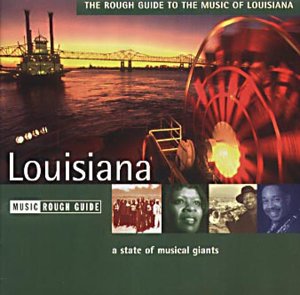
I've praised this 'Rough Guide' series before on these pages. They are a neat way to find out something about a musical genre and pick up pointers for future listening. This is just as intended by World Music Network. However, when you take on Louisiana as the subject, you really are selecting an area that is awash with musical styles and influences. As the cover says, it's 'a state of musical giants'. Amongst the various artists, there's Dr.John, Champion Jack Dupree, Buckwheat Zydeco, Irma Thomas and, as if this wasn't a mix enough, there is Cubanismo featuring John Boutte And The Yockamo All-Stars. You'll gather from this list that we can swing from jazz to blues, through zydeco back to cajun round the back of swamp and down to r'n'b. The mix of African, French, Spanish, Caribbean and indigenous Acadian influences provides a rare old feast. To be honest, not every one of these styles is going to suit unless your taste is very wide. If that's true, you'll hardly pick up a 'Rough Guide'. So, in the end, this becomes a guide for the beginner only. A starting point but that's all.
Steve Henderson
The sleeve note writer for this spirited compilation quite correctly feels it necessary to clear two common misconceptions - ie "zydeco is not cajun music, nor is it native to New Orleans". Sure, zydeco has in common with cajun that it is often accordion-driven, and sure it is promoted in New Orleans, but that's probably about it. It's heavily influenced by R&B and soul, and more recently by funk and hip-hop, and these influences are represented fairly on this Rough Guide in tandem with the more obviously Creole-rooted stylings of Canray Fontenot (whose juicy Allons Danser is no different than basic electrified cajun) and original zydeco merchants like Clifton Chenier (whose Calinda weighs in at track 5) with an example of the rootsy jive of Geno Delafose (love it!). The most elderly of the recordings is a gutsy 1934 cut Amédé Ardoin from Les Blues De Crowley, Whatever your definition or preference within the broad church of zydeco, there's no denying that there's a hell of a lot of seriously tasty music here, most of it fair guaranteed to get you up onto the dance floor. Moving out from the mainstream success story of Buckwheat Zydeco and the doowop of Nathan & the Zydeco Cha-Chas to the rock-a-boogie of Beau Jocque, the slow-soulful groove of Rosie Ledet and the funky reggae/ska hybrid of J. Paul Jr & the Zydeco Nubreedz and Keith Frank, there's something to suit all tastes, with representation both from elder statesmen of the genre and its younger practitioners. Perhaps the only useful omission from the discographical tracklist is the dates of the actual recordings, for it's a bit difficult to get a feel for the chronology of zydeco. The notes that start so promisingly with the definitions just stop then and there without developing the theme, and it's none too clear how the genre evolved out of Chenier straight into what in many cases is fully-fledged pop-soul that just happens to feature an accordion alongside the electric guitars and saxes. But when zydeco convinces, it's a force to be reckoned with, as this compilation goes a long way towards proving.
David Kidman
Dan Tyminski - Wheels: The film that launched Bluegrass music to a wider world was O Brother, Where Art Thou? Two wonderful voices captured our hearts, Alison Krauss, of course, and her Union Station sidesman, thirteen-time Grammy winner Dan Tyminski. It was Tyminski's vocals on the "Soggy Bottom Boys"' I Am A Man Of Constant Sorrow (not George Clooney who lipsynched it for the soundtrack) which is now legend. This is Tyminski's first album for Rounder and although there isn't the dynamite of I Am A Man Of ... , take pleasure in the outstanding playing of Tyminski the master, his band (Adam Steffey-Mandolin, Ron Stewart-Banjo, Justin Moses-Fiddle, Barry Bales-Bass) and an album of perfect Bluegrass Americana. Vince Gill, Ron Block, and Cheryl and Sharon White guest.
Sierra Hull - Secrets: Sweet-voiced, mandolin-picking prodigy Sierra may be only 16 years old however her debut CD for Rounder is a bluegrass stormer of versatility and Alison Krauss-like charm and talent. Co-produced by Krauss and Ron Block this is no speedy "sign and release" album. Word has it that Rounder signed her at 13 years of age but allowed her to grow musically at her own speed. And it's this Tennesee girl's dream band - session musicians include Nashville heroes Jerry Douglas on Dobro, flat-picker Tony Rice, Dan Tyminski and the afore mentioned Block on banjo and guitar - but nowhere do they diminish her musical gifts which shines throughout. Listen for another prodigy in the band, 17-year old banjo player Cory Walker.
The Grascals - Keep On Walking: Here are both traditional and contemporary Bluegrass songs - with fine vocal harmonies from Grascals's Terry Eldredge, Jamie Johnson and Terry Smith. Mandolin fiddle and banjo driving numbers like the well-known traditional Rolling in My Sweet Baby's Arms and the slow-tempo, Merle Haggard tear-jerker Today I Started Loving You Again, sit happily with new material. Tight musicianship from Aaron McDaris on banjo, Danny Roberts on mandolin and (for those who collect such snippets of information) there's a guest appearance credit for the legendary keyboard session man "Pig" Robbins - immortalised but never seen in Robert Altman's film "Nashville".
www.myspace.com/dantyminski
www.myspace.com/sierrahull
www.myspace.com/thegrascals
www.myspace.com/roundereurope
Sue Cavendish September 2008
This is one of those sets that'll be self-recommending right away, even to those of you who already have a large number of Rounder releases in your collection. During the course of four fabulously well-filled discs, you'll be guided through the history of this important label by means of 87 perfectly chosen examples from the label's increasingly wide-ranging output. As Geoffrey Himes' brilliantly informative and detailed liner note essays tell us, Rounder was started in 1970 as a boundary-expanding mainly-bluegrass label by two teenagers, Ken Irwin and Bill Nowlin, who'd first met eight years earlier through their shared passion for folk music, delighting in particular in loudly playing bluegrass records like the Greenbriar Boys' debut album "just to annoy people" in their dorm! The music they championed on their label, though deeply based on tradition, would invariably be edgy and confrontational too, and played and sung with a true and unwavering commitment by all classes of folks. That credo has remained through the label's 40-year (so far) history, with expansions into the worlds of old-time, country, Americana, cajun, R&B, rock'n'roll, blues, contemporary songwriting – you name it, any style of roots music, and not to mention key historical series like those drawn from the Lomax recordings and Scottish tradition.
Each of the set's four discs takes on an overview of the products of a single decade of the label's history, and for many the first disc will be the most revealing, if not the most musically satisfying. For even then, the label was pushing the envelope of its signings and coverage; starting with the iconic "Rounder 0044" (the eponymous album by J.D. Crowe & The New South, which featured J.D.'s band consisting of three then-unknown musicians Ricky Skaggs, Tony Rice and Jerry Douglas!), and moving on through George Pegram's delectable slice of old-timey hokum Johnson's Old Gray Mule (recorded in 1970, and the earliest sample track from the Rounder catalogue). Other outright classics featured on Disc One include Killing The Blues by the Woodstock Mountains collective Mud Acres, the Balfa Frères' unrivalled Parlez-Nous À Boire (which was actually recorded in 1965), a Scott Skinner strathspey played by Joe Cormier, an early excursion into Gambian kora music (Alhaji Bai Konte), a choice cut by the wild, idiosyncratic Holy Modal Rounders (Sweet Lucy), and a vibrant breakdown by the sextet Country Cooking (which included among its ranks a young Russ Barenberg). It's also great to hear again tracks by Hazel Dickens & Alice Gerrard, Ola Belle Reed (High On A Mountain, of course), Norman Blake (the glistening Down Home Summertime Blues), the Highwoods String Band (the rousing Who Broke The Lock) and Tony Trischka, and yes the disc also includes an early Jerry Douglas solo cut before closing by looking forward with a harbinger of the label's expansion into electric blues with George Thorogood & The Destroyers.
Disc Two concentrates on the 1980s, continuing to champion the talented eccentrics, mavericks like the landmark discoveries Ted Hawkins, Jonathan Richman and Sleepy LaBeef, all the while continuing to nurture the developing talents of folks like Rice, Douglas et al who had been recording in the ranks of groups on the label roster. Additionally Rounder kept its commitment to preserving its newgrass and bluegrass roots (Tony Rice, Béla Fleck) and latter-day acoustic blues (Rory Block) alongside the then-innovative introduction of reggae (Culture), klezmer, zydeco, tex-mex (Flaco Jimenez), New Orleans mardi-gras (Professor Longhair) and the ongoing exposure and exploration of quality contemporary folk-cum-country songwriting (Nanci Griffith, John McCutcheon). Listening to this particular disc is rather like tuning in to a Charlie Gillett radio show, I thought.
Disc Three moves naturally into the 90s, with the advent of stars like Alison Krauss, Jimmie Dale Gilmore, Carrie Newcomer and Tish Hinojosa, all of whom have gone on to provide a string of fine records for the label and who are ably represented by a track apiece here (in the case of Krauss, adding a collaboration with the Cox Family too for good measure, though I'd prefer to view the latter as necessary compensation for the curiously unsatisfactory adoption of the rather less typical Baby Now That I've Found You as the primary choice on this CD). The disc also contains some classy soul (Wilson Pickett), cajun (Eddie Lejeune) and zydeco (Beau Jocque and his Zydeco Hi-Rollers).
Finally, Disc Four brings us into the decade just ended with an even more eclectic parade that takes us from chanteuse Madeleine Peyroux and alt-country specialists Son Volt through to established names like Earl Scruggs and Willie Nelson, oddball success stories like Steve Martin (the dab hand at the banjo), long-term stadium fillers Blue Highway, gospel stars Dailey & Vincent, classic singer-songwriters like Mary Chapin Carpenter, the essential comeback album by Linda Thompson, the ever-intriguing Cowboy Junkies, and two tracks featuring Robert Plant (one from his award-winning Raising Sand collaboration with Alison Krauss, the other from the Band Of Joy album), bringing the story bang up to date.
Of course, in any set of this laudably comprehensive, nay gargantuan scope, there are bound to be regrettable omissions – one of my own most serious carps would be the exclusion of the magnificent SteelDrivers from the final disc, and I could also legitimately bemoan the lack of cuts from some more of my personal label highlights like the Tarbox Ramblers, Si Kahn, and yes several of those aforementioned Lomax collections (though I can appreciate that the latter won't qualify since these were not original Rounder studio recordings).
In short, no serious student of roots music, nor any music fan looking for an excellent overview of the massive achievements of this continually enterprising small label, will need to look any further than this superlative four-disc commemorative box – which as I've already said comes with a 100-page collection of equally superlative, brilliantly authoritative booklet essays by informed Washington Post journo Geoff Himes that put the musical achievements into due perspective in thoroughly readable style. Congratulations all around.
David Kidman January 2011
Unusually, this CD's grand title does not give the most accurate picture of its contents, for it flatters to deceive – and deceives in its flattery. The fact that it contains some great music is a given, but such a prestigious label as Rounder (which can be justifiably proud of having risen so far from its humble founding by three visionary college friends back in 1970) should, I believe, be more careful…
It's actually a compilation of music from four different concert events, although the lion's share of the performances were given at a multi-artist extravaganza at the Grand Ole Opry House in 2009. These feature a typically wide range of artists, as befits the label's roster, and since this CD is a bit of a cherrypicking exercise in essence the whole 75-minute span will necessarily come across a bit disjointed, with the main gig's undisputed sense of occasion (and it's a great live recording by the way) compromised by a certain distinct lack of time-frame continuity – and that despite best sequencing efforts. The disc therefore moves on swiftly through the label's paces, starting out credibly enough with Minnie Driver and proceeding on through zydeco (the redoubtable Nathan and his Cha Chas) then some gospel-soul (Irma Thomas), but interrupted by an envelope-pushing Plant-Krauss collaboration (Rich Woman) taken from an entirely different show (recorded two years earlier for CMT's Crossroads series).
The next non-Opry sequence, a pair of tracks culled from Madeleine Peyroux's 2009 LA Tour DVD, ushers in a pair of sublime Krauss numbers with Union Station and Jerry Douglas, after which we get two all-too-brief segments of ace banjo-man Steve Martin, with the Steep Canyon Rangers in tow, recorded at the Ryman Auditorium in October 2009, before returning to the Opry gig for the disc's undisputed highlight, the magisterial sophistication of Béla Fleck on two stunning duet pieces, in tandem first with Abigail Washburn (on an intense, revelatory improvisational rendition of Keys To The Kingdom) and then Jerry Douglas (the rippling dobro breakdown Another Morning).
After which there's a genial Mary Chapin Carpenter interlude before we embark on the concert's Grand Finale, a sufficiently forgivable five-minute gospel medley of "occasional" significance featuring the assembled cast of not-quite-thousands. The Opry performances are classy and accomplished, especially remarkably so when you consider that there was very little rehearsal time for anyone; but together they well summarise the breadth of talent that characterises the label's output.
"Also-available", according to the booklet note, is a companion DVD, which is described as comprising the entire contents of the TV special from which the Opry performances were taken, along with additional footage which didn't fit onto the audio CD (I can't comment on this, since I wasn't sent a copy).
David Kidman June 2010
Forty years on from the original Beatles album Rubber Soul, Mike Harding and his production team have gathered together a host of present-day British folk artistes to record their own versions of the songs - I mean one song each. The tracks were broadcast on BBC Radio 2 last year, and now at last we have a permanent record of the sessions. Mike was trying to prove that a great song is always a great song, and most great music is in some way folk music, and for the most part his thesis survives the exercise. Part of the success of the project is indisputably due to the high standard of musicianship on display, not to mention the lively and fertile imaginations of the various participants. Equally inevitably though, the project spawned its share of comparative turkeys, of which the CD's opener, Drive My Car, is a prime example - two minutes of dire Jerry-Lee-style rock-bash through what I've always regarded as a lesser creation on the original album; still, someone had to do it I suppose! Things improve immediately, however, with the combined might of the Watersons and an Eleanor-Rigby-style string section (Norwegian Wood) and Paul Brady (an attractive Latin-inflected take on You Won't See Me). Actually, there isn't really a weak track thereafter, although one or two of the reinterpretations are decidedly oddball. John Tams' Harry-Lime-style saunter through Girl is one of those "hear-it-once for surprise effect, but palls on repetition" moments, for instance. But June Tabor's beautifully-considered, penetrating unaccompanied rendition of In My Life is a spine-tingling high-point, possessing an intimacy closely matched by Boo Hewerdine and Eddi Reader floating airily through What Goes On (and vastly improving on Ringo's original in the process!). Chris While does a really lovely, plaintive makeover on Nowhere Man, and Show Of Hands bring a spicy eastern air to If I Needed Someone (to which we'd already "borne witness" when previewed on their latest CD, of course). Coope, Boyes & Simpson come up trumps with an imaginative take on Think For Yourself, Johnny Dickinson proves a natural choice to take on the twelve-bar creation The Word, and Ralph McTell brings an appealing Parisian-café feel to Michelle.("Mc-Telle, my belle", anyone?!). Neither Cara Dillon's Wait (with Sam Lakeman in tow) nor Martin Simpson's I'm Looking Through You let the side down, and Spiers & Boden's stomping take on Run For Your Life makes for an unexpectedly effective "that's the end" conclusion to the project. Now me, I've always liked Beatles For Sale ... (don't tempt fate!).
David Kidman, October 2006
Forming volume 10 of the excellent ongoing Celtic Collections series, this disc is a straight but extremely welcome CD reissue of a celebrated 1977 LP first released on Alba Records (and subsequently re-released on Greentrax in 1988). "Sandy Bell's Bar" (proper name The Forrest Hill Bar) was then (and indeed, is still, I suspect - at any rate for sessioners) one of the first ports of call for any folk singers or musicians visiting Edinburgh, and a venue with a unique and timeless atmosphere. This LP presents eleven performances from artistes who were regulars at Sandy Bell's at that time, just under half recorded live in situ and the remainder recorded in an Edinburgh studio that same year. The intention of the album is that together these performances capture the atmosphere of the famous venue at that period, and certainly that's the case with the most obviously atmospheric tracks, especially those bookending the disc which feature the crew of local musicians (Bell's Big Ceilidh Band). There's also a couple of tracks featuring those who regularly broke into song at the Bar (aka Bell's Chorus), and a singalong led by Liz & Maggie Cruickshank. As for the contemporary studio offerings: although these are lacking the requisite live ambience, well who can complain when the featured "regulars" include such luminaries as Aly Bain, the McCalmans, Dick Gaughan and Chorda: and each of those acts is allocated two tracks apiece. In summary then, although the good-time live tracks epitomise time well spent at Sandy Bell's, the studio tracks are still well worth having on your shelves - as is the whole set, a convivial and exhilarating collection.
David Kidman July 2007
Various Artists - Seoltai Seidte (Gael Linn)
This handsomely presented two-disc set is nothing less than an immensely valuable historical collection of 43 performances which originally featured on some twenty 78 rpm records first issued by Gael Linn between 1957 and 1961. These were in fact among the very first releases to be issued by the label, and – at any rate initially – were aimed specifically and directly at the Gaeltacht areas (housing the native Gaelic-speaking population), where wind-up gramophones were still in use.
The current release marks the first time that all twenty 78s have been compiled together (a selection of just fifteen tracks was brought out on an LP in 1979), and it therefore celebrates Gael Linn's 50th anniversary in appropriate style. The label's ambitious mission was "to record every outstanding musician 'in the old style' in the country, solo and unaccompanied". So here is a veritable treasure trove of source recordings, ranging from singers (both male and female) to solo musicians. The original format, whereby a singer took up the 78's "A-side" and an instrumentalist the "B-side", has been conveyed here by presenting the releases in chronological order and thus (in the main) alternating singer with instrumentalist. The singers, mostly from the Connemara or Donegal sean-nós traditions, include Seán'ac Dhonncha, Áine Ní Ghalllchobhair and Seosamh Ó hÉanaí, and all sing in Gaelic. The musicians seem to have been chosen to give a wide spread of regional styles; they mostly comprise fiddlers (and include illustrious names such as Tipperary's Sean Ryan, Kerry's Denis Murphy, Clare's Paddy Canny and Armagh's Joe Devlin) or exponents of the uilleann pipes (Willie Clancy, whose performance of the air Na Connerys is a highlight of the set, to be sure, and Tommy Reck), while there's just the one flute player (Vincent Broderick) and the accordion is represented by a pair of early sides by Joe Burke.
It's easy in this day and age, where so much archive music is readily available, to underestimate the importance of these pioneering recordings in handing on to latter generations the true essence of the tradition. So, with their generally splendid sound quality (expert remastering by Harry Bradshaw) and a superb presentation package (complete with 96-page booklet giving song texts, other notes on sources, thumbnail biographical sketches and introductory essays, all both in Gaelic and translated into readable English), this is a very desirable reissue indeed.
www.gaellinn.com
www.copperplateconsultants.com
David Kidman
This is the result and, with the exception of three new numbers from themselves (Oars In The Water especially good) and their additions to three Mission songs (including Tower of Strength) reworked by Hussey at his home in Brazil, the artists are all unknowns.
Well perhaps not all of them. If the dark, growly throaty tones of Dirty Ray who provides the opener The Waiting Song, The Rain Song and The Mermaid's Song, sound familiar, it's because he's actually Kevin Weatherill, lead singer with the criminally underrated Immaculate Fools and currently open mic host at The Horseshoe Pub.
Hunt's fellow Stourbridgean, Timothy Parkes regularly opens for the duo's acoustic shows and gets his own three track turn in the spotlight here with Witchcraft, featuring Nockalls on fiddle, particularly persuasive.
Soft voiced Scottish born Rob Dunsford cites Thompson and Martyn as prime influences and writes playful confessional songs that underline his traditional folk and blues inclinations, Don't Go To The Other Side of the World revealing a spry sense of humour and Dashboard Therapy borrowing its tune from Froggy Went A'Courting.
The final 'newcomer' is Matthew Derrick, a South Wales based Bristolian who plays nifty guitar and whose three contributions, You're My Heaven especially, bear spookily close witness to the fact he's a big fan of Hunt and the Stuffies.
Intended as an ongoing recording and performance project, on the showing so far Volume 2 should be eagerly awaited.
www.myspace.com/sharedevent
www.myspace.com/theactualmileshunt
www.myspace.com/ericanockalls
www.myspace.com/robdunsford
www.myspace.com/dirtyrayweatherill
www.myspace.com/timothyparkesmusic
www.myspace.com/matthewallanderrick
www.myspace.com/waynehussey
Mike Davies September 2009
www.shindig-magazine.com
www.sanctuaryrecordsgroup.co.uk
David Kidman
Various Artists - Shining Bright, The Songs of Lal & Mike Waterson (Topic)
When Lal Waterson died in 1998, two years after the release of her marvellous Once In A Blue Moon album, it marked the end of an era in the history of the British folk revival and the passing of one of the great voices of the genre. But her place in musical history was already set in stone, etched indelibly in 1972 when she and Mike released Bright Phoebus on the Trailer label. An album of original material (the only self-penned material to feature on their albums) in the English folk song tradition, its tales peopled with striking characters, it has long been regarded as the best folk albums ever made. Now, in tribute to it and them, although several of the songs have been covered before (Maddy prior and June Tabor come to mind), a collection of folk luminaries young and old (many of whom played on the original) have revisited it for a new 15 track recording, drawing not only eight from the original twelve songs but six from a further dozen from the same period but never previously recorded. Those of a mathematical bent will realise that the numbers don't add up, but only because there's two versions of the title track, a stomping good time instrumental by John Pashley's Phoenix New Orleans Parade Band and the other, a voice and guitar singalong by Blue Murder that includes Mike himself contributing to the vocals.
Of the reworked material, notable highlights have to surely include Dick Gaughan's evocative take on Scarecrow, Maddy Prior (with Rosie and Rick Kemp) with Winifer Odd, a song that surely owes a nod to Eleanor Rigby, Eliza Thompson and her band's Child Among The Weeds, Richard Thompson's anguished solo acoustic reading of Red Wine Promises (the linking 'and' seems to have vanished in the process) and Billy Bragg and the Blokes mixing breeze and brood for Danny Rose.
Perhaps though it's the unheard stuff that strikes most. Linda and Teddy Thompson's acoustic back porch blues Evona Darling with Van Dyke Parks on accordion, Norma Waterson bringing her lived in weary and warm vocal to the memory haunted Song For Thirza, a gorgeous tinkling sun-soaked English summer Shine courtesy Helen Watson and Heather Greenbank, a cracked and sad One Of Those Days duet between Kate Brislin and Jody Stecher and, Lal's son Oliver Knight joining forces with the inestimable Christine Collister for the shiveringly soulful Marvellous Companions.
We may never hear Waterson's like again, but she lives on in the songs and hearts that keep English folk music beating.
Mike Davies
Last year, I received a copy of an excellent compilation-cum-taster CD with the intriguing title of Moonshine, Murder, Mountains & Mudflats, produced by the organisers of the long-running, commendably free-and-open Leigh Folk Festival (that's Leigh-on-Sea in Essex). Unfortunately it reached me too late for timely inclusion on this site, the festival being held towards the end of June, but this year's counterpart has arrived at a more sensible time (albeit by a circuitous route!).
Like last year's disc, it gathers together recordings from acts appearing (or scheduled to appear) at the relevant year's festival, its 18 tracks forming a cross-section of the 80+ acts concerned. Also like last year's disc, all tracks have been generously donated by the artists themselves and contain a healthy proportion of previously unreleased recordings. This year, only eight of the eighteen tracks have been previously released in any form (and two of those only in limited-edition single or EP format); some were specially recorded for the collection. Additionally, several of the acts are currently unsigned to any label at all (which should be taken as no negative indicator as regards quality, I hasten to add…) and just four of the acts (Vicki Swan & Jonny Dyer, The Kittiwakes, Rachel Harrington and local celebs The Owl Service) are familiar from last year's disc. So much for the statistics: and no worries about the music either, with not an ounce of dross or filler here. The disc's determinedly eclectic mix embraces all manner of folk in its widest possible sense, from deeply traditional (Nancy Wallace, Jason Steel, Kiti Theobald) to creative trad-arr (Emily Portman, Faustus) and trad-inspired (Swan & Dyer, Shona Kipling & Damien O'Kane), from the distinctly left-field (Kelli Ali, Isnaj Dui), often eccentric psych-folk (Smoke Fairies, The Owl Service, The Straw Bear Band) to Americana (Rachel Harrington), while along the weird and wonderful way taking in dashes of reggae (Goldmaster All-Stars), jazz improv (a lengthy track from Peter Knight and Trevor Watts) and other world musics (the Hungaro-inspired Pálinka and the Welsh-Iranian singer Roshi).
This is a fabulous and well-sequenced collection which (unlike some festival-originated promotional or souvenir discs) really does inspire a visit to the festival it's promoting - and it's well worth buying for its own sake too. Retailing for a mere fiver, it's available from the festival website, local outlets and venues at the festival itself.
David Kidman June 2009
Various - Sick, Sober & Sorry: Great Country Hits of the 1950s (Indigo)
The first of a new series of box sets, a companion piece to the label's R&B hits, licensing minefields inevitably mean this isn't going to be anywhere near definitive in living up to its title, Cash, Jones and Cline just three notable omissions from its version of country's antecedents. But with 84 tracks encompassing most of the decade's major country & western hits it's hard to grumble.
The familiar names are well represented with classic from such then already established legends as Hanks Snow, Locklin, Thompson and Williams, Ernest Tubb, Eddy Arnold, Tex Ritter, Lefty Frizell, Marty Robbins, Tennessee Ernie Ford and Cowboy Copas as well as emergent newcomers like Kitty Wells (her great version of Honky Tonk Angels), Jim Reeves Slim Whitman and Ray Price.
Of even more interest are the obscure nuggets that lurk between the chestnuts from such mostly forgotten artists as one hit wonder Slim Willett (the song, Don't Let The Stars Get In Your Eyes, lives on), Goldie Hill (who recorded No 1 answer song I Let The Stars Get in My Eyes), George Morgan, Johnny Bond (whose hit provides the collection's title), The Carlisles (who featured a young Chet Atkins), Arkie Shibley whose Hot Rod Race spawned a whole deluge of car chase songs and Darrell Glenn who's original version of Elvis hit Crying In The Chapel was actually written by his dad, swing veteran Artie Glenn.
Documenting to evolution of the Nashville sound from hillbilly and swing to more mainstream country, rockabilly and honky-tonk, it's a fabulously indispensable acquisition for anyone remotely interested in the history of country music.
Mike Davies
The Signature Sounds 10th Anniversary Collection - Various Artists (Signature Sounds)
Be warned, not only will this be one of the best musical investments you're ever likely to make, you might want to increase your credit card limit. Any of the artists featured on this collection you haven't already got, you will.
If you were selecting an all-star alt. country/Americana line up, at least 8 of these artists would be automatic choices. When you think of the great albums of 2004 then Jeffrey Foucault's Stripping Cane and Josh Ritter's Hello Starling are two that have been battling it out for stop spot. Pearl Handled Pistol from Stripping Cane and and Kathleen from Hello Starling, showcase two heavyweight musicians at the very peak of their powers. Thankfully music doesn't require an undisputed champion, there is room for both. When you add in that the Signature Sounds stable also includes Kris Delmhorst, Mark Erelli, Amy Rigby, Lori McKenna and Mary Gauthier then it's not difficult to conclude that this is no ordinary compilation. But, roling alongside that wave of talent come the likes of Salamander Crossing, the delightful 5 Days In May and Dave Carter and Tracey Grammer whose rendition of Gentle Arms of Eden seems to take on a life of its own. The only drawback is that anyone even remotely interested in this kind of music will already be well acquainted with these artists.
The pull of disc 1 is having such a tasty selection in one place. But the treats don't end there because if disc 1 is a treasure trove then Off The Record - the title of disc 2 - is the musical equivalent of a newly-discovered shangri-la. It's music that for one reason or another hasn't been released. Now normally, that phrase is enough to chill the blood but in this case it simply refers mainly to songs from sessions or live recordings. A CD of their own is the only suitable place to house such treasures. But, gathered in one place, the poetic beauty of Ritter's Don't Wake Juniper, should fight for space with the vibrancy of Richard Shindell's Shades Of Black, Shades Of Grey and the rawness of Ignorance from Lori McKenna, incidentally Ignorance was written by another wonderful artist worth checking out Kasey Chambers. But these are all seasoned artists, so Kris Delmhorst and the Rebel Chickens' soul-saving gospel song Ain't No Grave, sits quite happily alongside the open wound of Louise Taylor's Amnesia Of The Heart.
What compilations lose in their disjointed nature, they can compensate for in the sheer class of the participants. Perhaps the biggest surprise comes with a cover of the best known song on the album. Mark Erelli's take on Orbison's Crying will surely be one of the least theatrical but most poignant of versions heard in many a day. That moment alone is worth the price but it is just a moment among equals.
Raise a glass to the label that was founded because a Calvin Kelin store manager had good taste and wish them many more years.
Michael Mee, Editor, The Hawick News
Bruce "Utah" Phillips, who died of congestive heart failure last May at the age of 73, was by any standards an important figure in American folk culture. He described himself as the Golden Voice Of The Great Southwest, and, following the example of country singer T. Texas Tyler, took the sobriquet of the state where he eventually found salvation after early post-teenage years during which he'd drifted into homelessness, destitution and alcohol abuse. He's perhaps best known as a singer and songwriter, sure (by the 1960s he'd supplemented his repertoire of traditional songs of the labour movement with his own compositions), as well as, latterly, storyteller and companionable radio show host, but in all honesty he was a true eclectic, being at various times also archivist, oral historian, activist, philosopher, hobo and everything in between, often all at once!
It was barely a year ago, at a gathering of folk musicians in Maine, when, through a simple desire to help Utah through his own hard times, that Dan Schatz mooted the idea of producing a CD as a humble homegrown fundraiser which would celebrate Utah's life and music; such was the regard in which Utah was held that within weeks a large number of musicians had embraced the cause and offered either to donate relevant tracks or make special recordings for the project: so many had volunteered, in fact, that it rapidly became obvious that no less than a two-disc set would suffice. Sadly, the project was destined to become a memorial, as Utah himself died a matter of weeks later.
The 39 songs on this double-album reflect the music that Utah sang and loved: of these, 28 are Utah's own compositions (five of which use his own words in settings by other musicians). Some of the songs haven't even been recorded before - the title track, for instance, which was written as recently as 2003, can be seen as epitomising Utah's whole philosophy and life's work. All but ten of the recordings are brand new, and several among those ten are rare in themselves. The most recent of the ten, taken from the Pete Seeger At 89 Appleseed release, embodies the very spirit of wistful and affectionate homage that pervades the new recordings. There are some glorious renditions of Utah's own songs scattered through the set: for me, two immediate standouts are the poignant He Comes Like Rain (performed by Canadian trio Finest Kind) and the beautiful Hymn Song (performed by Emma's Revolution). But Will Brown's rendition of Going Away (with Cindy Kallet and Grey Larsen), with its interpolated snatch of a Kate Wolf melody, comes pretty close to those. And then the reviewer's ensuing, necessary but pleasurable cherrypicking process will yield at the very least I Remember Loving You (Tom Paxton with Cathy Fink); Jesse's Corrido (Elizabeth LaPrelle); The Faded Roses Of December (Kat Logan); Queen Of The Rails (Dan Schatz); Kid's Liberation (Judy Cook); and Old Buddy, Goodnight (Pop & Bodie Wagner with Dakota Dave Hull). And Paddy Welcome Back, one Utah song I'd not previously come across (turns out it'd not been recorded before), here performed by Utah's son Brendan with his band Fast Rattler in tow. Rosalie Sorrels contributes a keen rendition of The Soldier's Return – a song which she didn't tackle on her recent Red House tribute CD Strangers In Another Country (which inexplicably seems not to've been licensed for the UK). There's also a tender new Jacqui and Kendall Morse performance of The Miner's Lullaby (tho' it doesn't quite surpass the wonderful Jody Stecher & Kate Brislin treatment on their album Heartsongs, itself a tribute to Utah). Among the not-specially-recorded cuts, a highlight is the heart-stopping duet performance of The Green Rolling Hills Of West Virginia by Emmylou Harris and Mary Black, taken from the classic 1996 Transatlantic Sessions series. Finally, one curiosity: the tracklisting also includes an Ani DiFranco rendition of The Internationale, but this track was mysteriously absent from my promo copy of the discs.
The handsome accompanying booklet is both copious and ultra-informative, giving personnel credits, artist biographies and brief song commentaries (although these stop short of giving composition dates, which would have been useful): lyrics aren't included in the package either, but hey, you can't have everything!
Even though several of the participating artists aren't especially well-known names (even within the folk fraternity), the quality of the music-making is uniformly excellent, and this enterprising collection is likely to become regarded as a fine example of the art of the well-conceived and well-made tribute album. If nothing else, it makes you realise just how many great songs Utah wrote during his 40-odd-year songwriting career, and what a varied corpus of experiences and emotions he was able to draw from first-hand and convey with such credibility. The issue is an intense and heartfelt labour-of-love, and this quality shines through every aspect of its production, planning, design and execution. And what's more, all proceeds from the sale of the set go to support Utah's family, which is absolutely as it should be.
David Kidman March 2009
Note: It seems a couple of the UK promo copies were made from a reference CD that didn't yet have that track added in, rather than the actual master. All the actual copies for sale have the complete program.
This is an exceptional compilation - and not just due to the abundant excellence of all of the music contained within. It's a prime 79-minute showcase for Rounder Records, the imprint that stakes a justified claim to being "America's premier indie label since 1970", which has been involved with virtually every significant development in roots music over that past 30-odd years, choosing to espouse great talents that the major labels have basically chosen to ignore or sideline. Although Sinner's Prayer totally appropriately kicks off with the classic Slaid Cleaves track of that name (from his Wishbones album), it then proceeds proudly and extensively through the label's impressive gamut, casting the net far and wide and drawing in bluegrass-driven roots (the Steeldrivers, Uncle Earl, Blue Highway, Alison Krauss) as well as the more traditional end of bluegrass (Rowan & Rice, Béla Fleck), country-gospel (The Cox Family), deep soul (Solomon Burke), country-meets-folk s/s (Kathleen Edwards), modern country-blues (Kelly Joe Phelps), country-rock (Ron Block), cajun (Steve Riley & the Mamou Playboys) and contemporary indie-rock (Vienna Teng). One particular glory of this compilation is that a considerable number of its tracks were new to me too, and the albums they come from will soon be up there on my to-investigate list: Irma Thomas' wonderfully bluesy-soulful Another Train and Madeleine Peyroux's delicious Weary Blues both really captivated me. Another glory is the inclusion of three new tracks (presumably taken from forthcoming releases) - true nuggets from Dan Tyminski, Sierra Hull and Sam Roberts (whose take on modern electric rockabilly, Love At The End Of The World, I really rated). There are some unexpected discoveries too, including a Loudon Wainwright III cut (the title track from his all-but-forgotten mid-80s album I'm Alright). Good to see Linda Thompson and Cherish The Ladies here, and altho' if pushed I'd probably have tried to find room for The Magnolia Sisters or Amanda Shaw, or the recent landmark Plant & Krauss, or maybe Nanci Griffith or Si Kahn from the erstwhile Philo stable, but hey, I really reckon the compilers have done a splendid job shoehorning the cream of Rounder's massive output onto just one abundantly-generously-filled disc. I'd expect the finished product to include all the relevant discographical details, dates and credits, certainly for identifying the new or unknown items properly (the promo disc didn't!) - but that's the only thing that spoilt my own unbridled enjoyment of this brilliant collection, which would be my choice for an early Xmas cracker for your bestest friend!
David Kidman September 2008
Smart Choice Music is The UK's Famous Americana Record Store, no doubt about it (check out that website of theirs without delay for some real bargains!), and this, their second sampler CD, is produced in association with Maverick magazine. It presents a healthy and pretty comprehensive hour-long selection of quality contemporary roots-Americana, all taken from existing available releases but none the worse for that! The roster features male and female artists on an almost equal basis, and you can't go wrong with talent like Gretchen Peters and Gina Villalobos on one hand and Eric Taylor and Wayne Hancock, while other well-loved names cropping up include Kevin Montgomery, Will Kimbrough and Paul Burch, and the collection's rounded off with a George Jones & Merle Haggard duo offering from their Takin' Out The Footlights... Again set. Bands like Loomer and the Bittersweets provide further contrast, and it's good to be able to sample the music of arguably lesser-known names like Angela Easterling, Emily Barker, Elizabeth Cook and Idgy Vaughan. I'll sure be investigating some of these myself! The slim cardboard sleeve doesn't allow room for any liner notes, however, so for biog or other info you'll have to google thru for the artists' websites I guess. Now although the stylistic disparity's not over-wide or in any way offputting, it's fair to say that not every artist will "connect" for every listener, but I could almost guarantee a well-above-average hit-rate, and there's a consistency and logic to this selection that demonstrates the compilers really do know their Americana. And hey, if it turns even a handful of fans on to any of the artists represented here, those less well-known especially, then it's done its job - and I'm convinced it will meet that target without much difficulty.
David Kidman September 2007
Songbirds: The Essential Album (Manteca)
You'll always be able to pick out omissions from compilations such as this - Sinead Lohan, Gillian Welch and Lucinda Williams come immediately to mind - but as a collection of 'the finest female singer songwriters of our time' this certainly pulls out the stops to represent the spectrum of folk-roots based artists. There's some borderline entries that rather stretch the concept. Sharon Shannon is after all primarily known as an instrumentalist and her track Libertango is actually a vocal showcase for Kirsty MacColl, herself represented by They Don't Know while Christine Collister, although Waiting For My Prayer is her own song, is better known as an intepreter of others. And, if we're going to be picky on that subject surely the definition of singer songwriter is that they write and perform their own material, in which case why feature Emmylou Harris doing Neil Young's Wrecking Ball rather than one of her own splendid compositions, a trad number by Kate Rusby or Eva Cassidy's versions of Sting's Fields of Gold and Paul Simon's Kathy's Song, neither of whom were female last time I looked. Such semantic quibbles aside though, there's nothing you wouldn't actually want removed from the double CD which ranges from the household name level of Joan Armatrading (It Could Have Been Better), Nanci Griffith (The Wing & The Wheel) and Sinead O'Connor to (relative) newcomers such as the brilliant Thea Gilmore (Holding Your Hand), Oh Susanna (Forever At Your Feet), Mary Gauthier (Slip of the Tongue), Cara Dillon (He's Young But He's Growing), and Beth Orton (She Cries Your Name). There's a reminder of some often overlooked or forgotten names such as Lisa Loeb (Stay), Edie Brickell (Circle), Rory Block (Holdin' On). Lynn Miles (You Don't Love Me Anymore) and, with the oldest number featured, Love Song, the classic 1971 song from the sadly now retired Lesley Duncan (shades of Marianne Faithful) who never found the success she deserved. Even more commendable is the showcase inclusion of a couple of unknowns; Holdin' On from pure voiced bluegrass singer Rhonda Vincent who started her career age 5 and actually has 19 albums to her credit (both in her own right and as part of her family's Sally Mountain Show band) and erstwhile Les Mis member and Kate Bush/Tori Amos tribute act Jemima Price who takes the old Blondie hit Denis and transforms it into a plaintive acoustic folksy pop love song. Credit too for, in the most part (Lene Marlin, Sarah McLachlan, Shawn Colvin and MacColl the exceptions) not going for the obvious hits or signature tunes, but affording the chance to discover great songs and performances with which you might be unfamiliar. Forced to nominate a personal favourite track, I guess it'd have to be Gilmore's but everything here is in the top league.
Mike Davies
This handsomely-presented double CD, housed within a heavy-duty presentation case including a really neat CD-sized 75-page hard-cover booklet, is subtitled A Celebration of English Traditional Songs and their Australian Variants. The Song Links project has been masterminded, instigated and co-ordinated by Martyn Wyndham-Read - and a more appropriate choice could not be imagined, for Martyn has long been recognised as one of the world's finest exponents of the traditional songs of both countries. Martyn's guiding hand has inspired a number of highly regarded performers to take part in the project, performers ranging from respected song revival pioneers right through to the new wave of young artists. Cross-links and connections abound, as much in the roster of performers as in the songs themselves - best exemplified, perhaps, by the partnership of Nancy Kerr and James Fagan (in origin, English and Australian respectively) who contribute to both discs.
This is a really fascinating and immensely rewarding package. The format of the discs themselves is helpful too - the first CD gives seventeen English traditional songs, while the second gives what might be regarded as their closest Australian counterparts. All the performances have been specially recorded for the project; the first CD features Tony Rose, The Copper Family, John Kirkpatrick, Louis Killen, Bill Whaley & Dave Fletcher, Shirley Collins, Martin Carthy, Norma Waterson and Kerr & Fagan, whereas the second presents an almost entirely different complement (aside from Kerr & Fagan); this disc is shared between Martyn himself, Kate Burke & Ruth Hazleton, Cathie O'Sullivan, Danny Spooner and Dave de Hugard, all significant revivalists and modern-day folk artists with a healthy reputation.
Without exception, the performances throughout both discs are passionate and communicate the songs unerringly, Martyn's own contributions being standouts, but for me the revelation was the second disc - although it must be recognised that these seventeen songs are but the tip of an enormous iceberg (originating as they do mainly from one segment of the country itself); it must also be remembered that the practice of song collecting in Australia is a relatively recent phenomenon, and so it can be seen that the potential for other such projects is similarly enormous. The sheer amount of research undertaken for the project even thus far is obvious from the lovingly-produced booklet, which provides clear and readable short paragraphs detailing the songs' sources and also includes full song texts, glossaries and performer credits with web-links. Exemplary is the word that springs to mind, and no exaggeration.
My only slight puzzlement is that the sequence of the songs and their counterparts is not identical on each disc, though this is not a major problem in the overall scheme of things on what is undoubtedly a major achievement for all concerned and almost certainly one of the most important folk releases of 2003.
David Kidman
Song Links 2 Launch Concert @ Cecil Sharp House, London, Sunday 17th April 2005
I never could understand why the original, initial phase of the Song Links project received so little publicity or press back in 2003, not only since it produced one of the finest CD releases of that year. Sure, Stirrings magazine did its bit with a splendidly appreciative review, and I all too briefly appraised the lavish book-and-two-CDs-set for NetRhythms, but major approbation was curiously conspicuous by its absence elsewhere in the folk media. However, hopefully by now the world will have woken up to the importance of the project, which has now spawned a sequel in the form of Song Links 2. Whilst the original Song Links (let's call it Phase 1) drew fascinating parallels between the English and Australian variants of traditional songs, Song Links 2 compares and contrasts English songs with versions that have travelled over the Atlantic and been sung (and further developed) in North America.
For this second phase of the project (as with Phase 1), its instigator and driving force, the magnificent Martyn Wyndham-Read, has gathered together from each side of the pond a truly handsome roster of folk performers representing the cream of singers specialising in traditional songs from their own country. Most of these artistes, having already recorded their contributions in the Fellside studios, were able to participate in the grand CD launch concert down at CSH; the exigencies of touring schedules for several of the American artistes who'd provided recordings for the CD itself entailed a few substitutions, but these were managed expertly and in the end all but one of the 18 pairs of songs from the CDs were able to be performed on the afternoon. That meant a total of 34 songs - which, plus the necessary introductory exposition/s, amounted to a very long concert. But it was a glorious one - and an equally glorious day outside for that "other" Marathon, since the sun shone like I've never known in London… - and the estimated two-hour launch window swiftly expanded to nearer four (including the interval break and the various formal presentations and thanks which followed the actual concert).
But I've known few concerts that have slid by so effortlessly yet left such a mark in the memory; it was a tremendously uplifting occasion. That shining, life-affirming quality completely reflected the sheer amount of dedication, research, attention to detail, commitment and expertise and musicianship of every one of the participants, but even more palpably a reflection of those very qualities being present in those with the vision, the project's "A-Team" (Martyn Wyndham-Read, his wife Dan and Fellside Records' supremo Paul Adams) who were truly leading by example in this stunning achievement (and let's not forget the generosity of the many "Dan Plan" sponsors too). For a start, the roster of artistes was one to die for: the English contingent comprised Martyn himself, John Kirkpatrick, the Copper Family, Mary Humphreys & Anahata ("why can I never see them performing without a fixed smile descending on my face?" remarked George who sat next to me, and I know exactly what he means, their music-making just makes you feel so good!), Bill Whaley & Dave Fletcher, and four representatives of the upcoming generation of excellent younger performers (Jim Causley, Lauren McCormick, Emily Portman and John K's son Benji), whereas the American contingent was represented on this occasion by Jeff Davis, Sara Grey and her son Kieron Means, and a three-piece harmony group Southern Brew who include among their ranks talented young singer Cassie Franklin. OK, so it was a shame that (in particular) Jean Ritchie, Jody Stecher, Tim Eriksen and Bruce Molsky weren't able to make it over, but as I said above the surplus songload was shared out very appropriately, several extra songs being taken on by Sara and/or Kieron. So all this added up to a really special event, with many tremendous individual performances and some really heart-stopping moments. It kicked off in enchantingly ramshackle but entirely likeable fashion, as the incoming audience were greeted to an intriguing sight (the 22 - count 'em! - performers crowded slightly uncomfortably onto the stage) and an enticing sound (a set of session-tunes being enthusiastically squeezed, bowed and strummed by those assembled thereon). Then came the concert itself, which was "presented" (ie the songs were introduced and set into context) by Shirley Collins, who warmly and entertainingly conveyed an enormous amount of information (her credentials are impeccable of course, for she'd accompanied Alan Lomax on his song-collecting tour of the States some 40 years ago, and latterly authored the comprehensive notes for the CDs' booklet).
Now comes the next impossible task - to give you anything other than a list of highlights is just not practical! So here goes! Martyn has chosen so wisely, from among the very finest English performers of traditional song today. Who else to communicate the vitality and multi-layered richness of the material but artistes with not only superb vocal and instrumental talents so ideally suited to the task but also the right attitude to match. John Kirkpatrick was his usual fount of boundless stomping energy, as he turned in a highly ebullient rendition of Bow Down To The Bonny Broom. Mary and Anahata excelled with a jaw-droppingly intense reading of Barb'rie Allen (Mary's singing is a real miracle of expressive interpretation, and I think every time I hear her perform this classic ballad I'm convinced it's even better than the last!), as well as a sprightly May Carol. Bill & Dave proved themselves the very embodiment of all that's good and solid and characterful about traditional music and its effective performance. The two versions of Locks And Bolts were absolutely outstanding: Martyn's wonderfully mellow and well controlled vocal expressiveness was uncannily matched by the meltingly beautiful accompaniment of John Dipper (violin) and Iris Bishop (accordion), while Sara Grey gave the finest of her many performances of the afternoon yet so late on into the programme. (I must mention here that Sara had been suffering from a chesty cough for several days prior to the concert, but you'd barely have noticed as her singing throughout was as captivating as ever and she proved herself a real trouper by taking on the additional songs!) Jeff Davis turned in a superb and fascinating rendition of the American variant of Rose Of Allendale to counterpoint the Copper Family's more wellknown version (though it still got everyone singing along!). Kieron Means shone whenever he appeared, but when singing with his mother the closeness of their almost identical vibratos highlighted the familial relationship in a most uncanny way. Which leads me on to observe that maybe the real-est stars of the show were the younger performers, especially perhaps Jim Causley whose vocal talent is a revelation (his rendition of Young Man Cut Down In His Prime was a real show-stopper) and whose grand showmanlike sense of humour enabled him to rise above a radical "fluff", a miscount of which verse he was at during Pricklie Bush (mind you, it's so easy to lose track in this song, where most of the verses are so similar!). Not forgetting Lauren McCormick (who, sadly, didn't get any solo songs) and Emily Portman (who'd found herself "depping" for Jean Ritchie at the very last minute to perform the American May Carol, and did a splendid job!) - although together making light work (so to speak!) of Tarry Trowsers and Polly Oliver, their contributions in tandem with Jim (as The Devil's Interval) were unbelievably fine, supremely confident and assured. My only slight reservation came with the selections performed by Southern Brew, whose exceedingly close harmony arrangements (though surely and finely executed) seemed to rob the texts of some of their impact or meaning (the line sung by the high-tenor of their male singer Dennis George at times being virtually indistinguishable from the ladies'). The Coppers - just the three "principals" on this occasion - delighted with their "extra" contribution, Birds In The Spring, which was slotted in after the cuckoo…!
But at the risk of omitting other key performers from this roundup, suffice to say that the whole concert was magic, the organisers' hospitality second to none, and everybody was going around beaming with joy, a state of euphoria from which it proved impossible to come down for a very very long time afterwards (even whilst battling with the post-Marathon traffic jams coming north through Finchley later that evening!). One hell of an achievement, and my heartfelt thanks to all those involved. My goodness, to think there's likely to be a Songlinks 3 in two years' time - mmm, better start booking now!!!
www.fellside.com
/www.martynwyndhamread.com/songlinks/sl_current.htm
David Kidman
Massive in scope and ambition (and nine years in the making), this three-disc set purports to tell the history of the United States through song, from 1492 through to modern times. It's a joint venture between Split Rock Records and 31 Tigers, for which its instigators, former US Attorney General Janet Reno and artist/producer Ed Pettersen, have been able to call on an impressive array of musical talent in order to offer listeners a way to connect or reconnect with America's vast musical and cultural heritage.
For however much we on this side of the pond identify with many aspects of a country with whom we share a common language, there are so many more aspects which intrigue, baffle or perplex us: quite simply, there's so much to America! And in its sheer vastness, this sprawling four-hour set so perfectly mirrors America, its diversity, its history. It's a land of extremes, and a place of paradoxes: strangeness and familiarity, intense beauty and equally intense ugliness (and so forth).
Just like the music it spawns and has spawned, certainly as represented here. Alongside real air-punching triumphs like Del McCoury's version of The Times They Are A-Changin', and quieter successes like Beth Nielsen Chapman's superb rendition of Sometimes I Feel Like A Motherless Child, Janis Ian's acappella Johnny I Hardly Knew Ye and Tim O'Brien's Thousands Are Sailing To Amerikay (those four almost worth the price of admission alone), there's two fine Springsteen covers (Bettye LaVette's Streets Of Philadelphia and Matthew Ryan's Youngstown) and Martha Wainwright gives us her updated take on I Am Woman.
But there's a fair helping of comparative artistic misjudgements and admittedly slightly drossier fare. Even so, at no stage can the set be considered an artistic write-off, for America's a nation of oddballs too, and oddballs can inspire as well as infuriate, as John Wesley Harding's brazen, brassy God Save The King, Jake Shimabukuro's virtuoso ukulele solo rendition of Stars & Stripes Forever and Andrew Bird's wistful How Ya Gonna Keep 'Em Down On The Farm almost effortlessly prove.
It's hard also not to respond to the disturbing, freaky strangeness of Judith Edelman & Neilson Hubbard's Sleep My Child. Contributions from the likes of BR-549, Kim Richey, Jim Lauderdale, the Fisk Jubilee Singers, Blind Boys Of Alabama and "Folk Family Robinson" ((the Black Crowes siblings with father Stan) are worth repeated exposure, as are Thad Cockrell's dreamy take on Dixie's Land (with the Mavericks in tow) and Suzy Boguss's jitterbugging Rosie The Riveter, while curiosities such as Danielson's teen-punk Happy Days Are Here Again, Take 6's glee-club acappella Star Spangled Banner and Devendra Banhart's ticky-tacky Little Boxes are still worth hearing once at least. For such is the diversity of musical idiom even within the broad-brush tag of Americana, that every listener will find something to hate as well as love within the set's 50 tracks (my own "hate" is Karen Parks' overblown operatic Lift Every Voice And Sing, and I've never gotten on with that Grandmaster rap The Message!).
The set's divided chronologically, with Disc 1 taking us from 1492 to 1860, disc 2 through to 1945 via the Civil War, immigration, the Great Depression and world war, and disc 3 covering post-war vacillation between optimism and desperation, protest and universal tragedy. The set's presentation is suitably lavish and high-quality, with full track-by-track personnel credits and historical perspective essays. Really, you can't ignore this release.
David Kidman May 2008
David Kidman August 2007
The double 39 cut soundtrack from the recently finished TV exploration of black popular music which apart from offering up a wealth of inspiring performances opens a debate that's perhaps more me than them and more TV than CD.
See, I'm a little confused as to why 'The Story Of Black Popular Music' should be automatically labelled 'Soul' in the same way as I would be if the story of white pop music were automatically called rock. (And for the moment can we leave aside the notion that without black music there'd be no white pop / rock music anyway!)
The argument seems to run that soul (as we understand it) grew directly from the secularisation of gospel music which lead to black pop. That's undoubtedly true but (here I have to point out that I missed the TV series so I could be well off course, though the CDs content persuades me otherwise) what about the blues? Surely there was soul in the sound of the miserable existence of both the delta farmhands and later the ghetto living factory hands in Chicago / Detroit. And what of jazz? Didn't Armstrong, Ellington, Basie and more add to the lexicon of black pop?
That said, the journey mapped on these discs from the opening salvo of The Bar Kays Soul Finger through Louis Jordan's perty pieces Let The Good Times Roll and Caldonia, Sam Cooke's gospel era (though oddly no Cooke hits like Cupid or Another Saturday Night which surely exemplified 60s black pop), Fats Domino's New Orleans twist and on to a generous helping of familiar Motown sides, James Brown hits and a leavening of gems from The Impressions, James Carr, Sly Stone and George Clinton's Parliament.
So, musically, the tale is both familiar and unsurpassable but, and given that it constitutes the soundtrack to an important series, it's all too brief and riddled with omissions. There's no Otis, no Drifters, no Barry White, no Donna Summer no . . .
Better in many ways is the Soul Train 25th Anniversary Hall of Fame Box Set which you can still pick up on Amazon and tells the tail in maybe a not so academic manner but certainly in a more all encompassing way. Or try Rhino's excellent Beg, Scream & Shout!: The Big Ol' Box Of 60's Soul which (appropriately for pop) traces the same history through a pile of (fabulously remastered original mono) 45s.
If I seem to have damned this release with feint praise it's because I genuinely love the great era of black pop / soul that the title focusses on but believe that it should have been done so much better. Final point; if you get this set and place it in your cars changer - which is exactly where my copy is destined - then be prepared for more points as the soul beat gets you pumping gas just a little too eagerly!
Steve Morris
Rather misleadingly, this release has been hailed in some quarters variously as the album containing all the songs from the recent series of six Radio Ballads (which formed the contemporary, ie. 2006, equivalent of the groundbreaking radio programmes produced by Ewan MacColl and Charles Parker), or else as a sampler for the series. Neither, of course, is true. For, given that over sixty original songs were written for the Ballads, not all of which were used even, it's immediately apparent that one single disc could never accommodate even half of them in full. But, bearing in mind that limitation, the need to whittle such a large number of extremely high-quality compositions down to a mere nineteen (I say nineteen because track 20 is a John Tams adaptation of part of Only Remembered, which is cheating somewhat!), the hard choices have been made very well I believe. The exercise also rather begs that a second disc be made, possibly even a third! And I know I made clear my wish for uninterrupted recordings of the songs alone when I reviewed the six discs of the entire Ballads as broadcast. But it's pointless to criticise the present disc for what it doesn't contain, so let's consider it for what it does: four songs apiece from The Song Of Steel and Ballad Of The Big Ships, and three from each of the remaining four Ballads. The majority of the songs are actually quite short in duration, which for some reason surprised me - when all have the virtue of great succinctness, economy of purpose and expression. There really is some outstanding songwriting here; it would be invidious to single any one song out for special attention, and I've not the space to essay a detailed commentary - just take my word for it. And importantly, all of them, without exception, stand alone outside the context of the soundbites with which they are interwoven, and to the content of which they are linked, on the actual Ballads broadcasts. From each Ballad the compilers have chosen a decently representative selection, with a good spread of moods and voices – and writers. Performers include John Tams (three), Bob Fox (four), Chris While, Karine Polwart and Cara Dillon (two apiece), with Kellie While, Kate Rusby, Julie Matthews, Lester Simpson, Barry Coope, Tommy Sands and Jez Lowe getting one each. (In that respect, perhaps I could quibble that Jez is under-represented, especially in terms of the overall proportion of songs he contributed to the series.) And in any case, not all of the songs chosen are performed directly by their composers... But there's no quibble whatsoever about the quality of the performances. In the final analysis, this disc is emphatically not to be viewed as a lazy or cheap option for those folks unwilling to fork out for the complete set of the Ballads: not only do they provide completely different aural experiences, but the two are wholly complementary, since this new disc makes for a pleasing sequence in its own right, showcasing a collection of well-crafted and continuingly relevant contemporary folk songs with satisfying resonances from the tradition. Oh, and glory be - the booklet contains full lyrics for the songs too.
David Kidman March 2007
Appleseed Records was launched in 1997; its stated manifesto was "to explore the roots and branches of folk and world music and sow the seeds of social justice through music", and this is exactly what the label has done throughout its first ten years. In doing so, it has produced some wonderful releases (85 in all), a large number of which are sampled here on this fantastic anniversary two-disc, 37-track compilation.
All the label's key artists are represented I think, and most sensibly too with regard to choice of material: Eric Andersen, Peggy Seeger, Pete Seeger, Lizzie West, Sharon Katz, Aoife Clancy, Pat Humphries and John Stewart all make an appearance. Some artists - eg Tommy Sands, Tom Paxton and Tom Pacheco - only made one record (or maybe two) for Appleseed, whereas others (Jackson Browne, Joan Baez, Billy Bragg, Judy Collins, Bruce Cockburn and Tim Robbins) made cameo, but vital contributions to important multi-artist projects such as the ongoing Songs Of Pete Seeger tribute series.
The second of the two CDs presents the broadest possible cross-section of themes and musical styles appearing on the label, with tracks from Roger McGuinn, Dick Gaughan, the ebullient Kennedys, and veteran rootsers Rambling Jack Elliott and David Bromberg; and I'm really glad to see the proud inclusion of a track from the eponymous CD by the arch-traditional Tim Eriksen (one of the label's finest releases ever, IMHO). And there's also a track from a recent Al Stewart album (A Beach Full Of Shells) which never managed to get released in the UK for some reason. Sadly, many of the Appleseed recording artists are underappreciated even within the roots music community, and this selection can only do their cause - and that of the label itself - a power of good.
The actual running order adopted also proves a significant contributory factor in the overall success of this anniversary compilation, I find: take the first CD in particular, with its 9/11 sequence (songs by Tom Paxton and Lizzie West) at its heart, followed by a supremely passionate new opus Walking Down Death Row from Pete Seeger. And, like all good compilations, there's also a sizeable "carrot" in the shape of nine exclusive tracks specially recorded for this anniversary issue: these are by Pete Seeger (six tracks - one's a Springsteen Sessions outtake, whilst another, The Emperor Is Naked Today-O, is a biting indictment of the Bush regime), Donovan (a chirpy Universal Soldier) and Ani DiFranco (a superb, blistering cover of Waist Deep In The Big Muddy), and finally a really cool Freedom Song from Appleseed recording artists Kim & Reggie Harris.
One final feature of this issue worth highlighting, aside from the consistently excellent recording quality, is the exemplary 28-page booklet, which is packed with information, insight and useful background detail. Whether or not you already have some Appleseed CDs in your collection, this is a truly exceptional compilation, and is self-recommending on every count.
David Kidman
David Kidman
The estimable Sugar Hill label seems to be holding back on new releases lately and giving more prominence to a series of loosely thematic budget-priced sampler albums that range widely over their sizeable (and previously under-promoted) back-catalogue. Musically they can't be faulted (though there will inevitably be differences of opinion over isolated selections!), and given the generic parameters they're intelligently compiled with a good feel for the strengths of the artists and their repertoire, serving as sensible primers for those who've thus far missed out on the considerable store of riches within that back-catalogue.
The other good thing about these compilations is that even the more experienced listener, who's not new to the Sugar Hill repertoire, is still likely to find something of interest that will spark off a further purchase! Cool Blue Rocks, subtitled "Rock 'n' Roll In The Bluegrass Tradition", presents the likes of Jerry Douglas, Tim O'Brien, Sam Bush and Psychograss cutting a swathe through compositions ranging from Robert Johnson, Dylan, Hendrix, Knopfler and Bono to Lowell George and Bob Marley – certainly the less usual suspects as regards repertoire (tho' arguably, not strictly rock 'n' roll), and rather a stimulating listen.
Cool Blue And Lonesome, subtitled "Bluegrass For The Broken-hearted", is more of a conventional starter pack, albeit a superior example of such; it parades the invocation of lonesome blues in the bluegrass tradition, transforming the music of sorrow into a joyous experience, here through the medium of true bluegrass – those cryin' fiddles, poignant voices, wailin' dobro, in recordings by Peter Rowan, Ricky Skaggs and Tony Rice, Dudley Connell, Don Rigsby, Kathy Kallick and (again) Jerry Douglas and Tim O'Brien.
From Hell To Breakfast brings "A Taste Of Sugar Hill's Texas Singer-Songwriters" –i.e., prime cuts from Guy Clark, Terry Allen, Townes Van Zandt, James McMurtry and Robert Earl Keen bolstered up by samples of those maverick bands The Gourds, Bad Livers and Austin Lounge Lizards. As well as the fine music, this great collection includes full lyrics and some neatly informative biographical notes.
The collection wordily titled Mother… could easily have proved a yukkily sentimental trawl thru' the ol' archive in search of "Songs Inspired By Mom", but it actually proves a reasonable – if for me marginally less inspiring – listen; the sources straddle the boundaries of standard bluegrass and singer-songwriter genres, so this release easily complements the previous three in the series.
The final sampler under review here is the first in a projected series compiled in partnership with the AMA (Americana Music Association), offering new audiences a way in to a musical genre that has only relatively recently been so tagged, largely as a result of the O Brother phenomenon. As an entrée, you could do much worse, for this release gathers together 16 representative tracks from fairly recent Sugar Hill releases – Rodney Crowell, Railroad Earth, The Gourds, Robin & Linda Williams, Doc Watson, James McMurtry, Nickel Creek's Sean Watkins and (this last perhaps uncharacteristically for the artist) Maura O'Connell. I felt that this collection lacked the artistic unity of the other four under review, but it's a useful enough sampler for those interested in exploring the more recent, new-style Sugar Hill output without risking more than dipping toes in the water.
David Kidman
Well, if you've been closely following the fortunes of the Park record label over its 15 years so far, you'll almost certainly not need this compilation, for all its tracks come from existing releases. If, however, you've only managed to buy a very few of the label's 60 or so albums, then this is a very useful sampler celebrating the diversity and quality of its output over that 15-year span. The word "span", naturally, is the connecting thread of much of the material collected here - three by Steeleye itself and four by Maddy (including one with The Girls and one with the Carnival Band). Then there's one from Rose Kemp, two from Abbie Lathe's current offering, two by Rock Salt And Nails, and one apiece by Lindisfarne, Kathryn Tickell, Jacqui Mc Shee's Pentangle and the aforementioned Carnival Band. No quibbles about the quality or consistency of the tracks presented here, so if you need a sampler that fills in some of the gaps in your collection you needn't hesitate.
David Kidman
David Kidman
Volume 1 which came out a couple of years ago, presented a diverse array of artistes and musics, and succeeded both as a primer and a taster for the range of sounds that come under today's wide folk umbrella, almost incidentally showcasing the delights of the Terra Nova and Osmosys labels. Their boss Richard Ellin has been quick to assemble a second volume, which if anything casts its net even wider. There are the names with plenty of folk-cred, this time not all of them from the rosters of the two aforementioned labels: pick of the bunch musically is a generous Robin Williamson & Mike Heron track culled from the Incredible String Band's Bloomsbury 1997 set (is it really all of ten years ago?!), and there are sensible sample tracks from Dougie MacLean, Ken Nicol and Hank Wangford. The arguably more overtly specialist sounds of duo Alison O'Donnell & Isabel Ni Chuireain and the new-deal ceilidh band Stömp provide good contrast, whereas the soft-toned and pure (if over-mannered) classicism of And Did Those Feet is likely to waft past most ears inoffensively. For fun, Roger Lloyd Pack reads the immortal Les Barker's equally immortal Non Sequiturs, and Paddyrasta's Fair Trade Bananas sounds almost exactly what it seems to imply on the label! But it's arguably the "mostly unheard yet emerging" contingent of Ravi, Cutlog 61 and Logan Wilson who provide the best value in the way of stimulating new musical experiences. The final selection, a specially recorded spoken-word piece by Judith Pocock, though beautifully managed, doesn't quite sit with the rest of the music on the CD, although it's a heartening piece of gentle propaganda on behalf of the Ruby Care Foundation (of which Judith is president and founder). Again retailing at a ridiculously low price, this CD contains an abundance of affordable discoveries indeed.
David Kidman March 2007
Various Artists - Strange Coincidences In Speciality Tea Trading (Osmosys)
Deftly brushing aside for a moment this super-bargain-price disc's unofficial-but-boring subtitle "A Brief History Of Osmosys Records", to reveal its official, and infinitely more interesting, counterpart (the somewhat tortuous, and tortured, explanation for which may or may not be apparent when you finally get to read the booklet note!), the deliberately bizarre title conceals an artfully compiled collection of performances from the catalogue of the Osmosys label - not, it must be admitted, one of the labels that readily come to mind or crop up often in conversation or reviews, but one which has always proved worth investigating, if at times its output has proved uneven in quality or interest. As this representative sample demonstrates. The curate's egg principle is in full swing here, and I'd definitely jettison one or two of the selections, but overall the disc's 69 minutes contain more than enough decent music from what label boss Richard Ellin rightly terms "hardly household names". In other words, the likes of Tanteeka, Vulcheva-Jenkins Incident, Anthony John Clarke, Celtarabia and Tony Hall - alongside more widely famed names like Dougie Maclean, Blowzabella, Maddy Prior and Mike Heron (who sneaks in twice, with a 70s solo track and an ISB reunion track licensed from Unique Gravity). And for light relief there's Brian Perkins' performance of Les Barker's Shipping Forecast. Now I wouldn't wish to make even mildly extravagant claims that any of the music here is a revelation, but at the same time it exemplifies the principles of a successful sampler in that I've been introduced to some good stuff that had slipped past first time round, like Emma Heath's rather interesting treatment of The Blacksmith (now why haven't I heard the whole album?!) Campbell/Roberts/Maclean track Les A Lurighan (from the uncryptically titled Crm release, which from its catalogue number I'd take to be quite a new one). Now, in the knowledge that Osmosys had, according to the booklet note, "risen out of the Plant Life label", this begs the question of whether at least some of the latter's "really interesting catalogue" might be reissued on CD some time? - after all, stranger coincidences have occurred!
David Kidman
Subtitled "a joyful celebration of the morris", this is yet another in the series of useful morris-themed compilations drawn from the Talking Elephant back-catalogue, produced sans-doute with the aim of persuading us of the merits of morris. The sequence guides us with musical logic rather than chronological sense, from the starting point of Great Grandson and Grandson of Morris On (see what I mean?) and on through choice cuts from Tickled Pink, the Albion Band and Dance Band and Chris Leslie, all of which is topped off with four tracks from the less-widely-available release that sported a "miscellany of songs, dance and music from Northamptonshire", Cobbled Together. Some judicious vocal tracks are interspersed for variety, naturally. Not a lot more need be said, other than to state the obvious: that for those who don't already have the individual discs, Sweeps is a perfectly reasonable collection that can't really be faulted, and it even possesses a peculiar unity outside of the self-evident morris concept. And yes, it's suitably joyful too - so get those white hankies out and surrender to its charms!
David Kidman October 2010
Various - Tennessee Mountain Home (Warner Strategic Marketing)
And so the bluegrass bandwagon rolls along, picking up more passengers inspired to take the ride after discovering the Oh Brother soundtrack. This is a more than useful compilation spanning as it does both such old schoolers as the Everlys (back to the roots 60s recording I'm On My Way Home Again featuring Gene Parsons and Clarence White), the dillards (Somebody Touched Me) and Ricky Scaggs (Cry Cry Darlin) with more contemporary practitioners and revivalists as Dwight Yoakam (Traveller's Prayer), The McCarters (Mountain Memories) and Joni Harms (Catolog Dreams).
There's some obvious suspects included among the 23 tracks, Emmylou obviously (Roses In The Snow), Gene Parsons (Drunkard's Dream) and naturally Duelling Banjos from Weissberg and Mandel. And while Dolly Parrton doesn't get her own track, she does appear on the Linda Ronstadt duet My Blue Tears. And just to link back to the Coens movie, there's a track from The Cox Family featuring Alison Krauss (Love Of A Lifetime). The quality though is defined by the more obscure names and archive plundering. Thus Maria Muldaur's version of the title track more normally associated with Ms P, the Charles Rose River Valley Boys giving it some fun for a version of the Beatles Baby's In Black (The Forester Sisters continue the theme with I've Just A Face), the almost never heard Emmylou protégé Delia Bell singing Weary Heart and, revisiting his own past as a Monkees songwriter, Michael Martin Murphey kicking up his heels with What Am I Doin' Hangin' Round and a cover of the Grateful Dead's Dark Hollow from the one-off 70s obscurity Muleskinner, an album by assorted Bill Monroe's Blue Grass Boys alumni that included Peter Rowan, David Grisman and the late Clarence White. Nice too to hear John Prine's a capella Diamonds In The Rough represented too while John Hartford's Late Last Night My Willie Came Home blissfully demonstrates the genre's innocence and lack of sexual innuendo irony. Good sleeve notes too.
Mike Davies
The Captain Cook Festival is an annual celebration of the maritime heritage of Whitby and the Yorkshire Coast and the tradition of sea music and shanties; the singers and musicians appearing on this generous 78-minute compilation (assembled by festival supremo Richard Grainger) all appeared at the 2006 tenth anniversary of the Festival. Naturally it's a curate's egg, with a wide assortment of performers of varying abilities giving a persuasive indication of the breadth of material and styles that together under the umbrella term of maritime music. First and foremost, though, there's an excellent representation of the sheer strength of the local-grown Teesside talent in the form of the Endeavour Shantymen, Richard G himself, and those ever-reliable duos Helen Pitt & Steve Dawes (not Pitt as the tracklist claims!) and Dogwatch (alias John & Joy Rennie), not to mention the mighty Keelers - all most welcome inclusions on any bill. Yorkshire is also represented by Monkey's Fist and Whitby's own Coblers Monday, while from further afield come everybody's favourite Hughie Jones, also Liverpool's Bernard Davis and Andy Kenna. Then again, Wales's Mick Tems, Oxfordshire's Short Drag Roger and Dick Miles (all the way from Ireland) had even farther to travel! The odd-act-out is Dyframix, a didgeridoo-playing duo from Bridlington who just don't seem to fit in with the rest I'm afraid: their minimalist trance-music is most likely best experienced live, but on disc here it just seems tedious, irrelevant and out of place (not helped by them being allocated two comparatively lengthy tracks). If the criterion for inclusion was that the artists had appeared at 2006's festival, then I can't complain - but the list of performers from previous years is even more impressive and the inclusion of a few more of these would have made a really splendid disc and a top recommendation. As it is, several (though not all) of this disc's selections are taken from existing available recordings, and generally speaking the choice of tracks by the artistes concerned is well chosen and representative of their best, both in terms of actual repertoire and standard of performance. And Richard Grainger's two compositions – the Sunderland Press Gang and the epic tale of George Vancouver - are both first-class. The whole disc is great value and gives a good taste of the unique flavour of the festival. So when might we get volume 2 then?
www.richardgrainger.co.ukDavid Kidman February 2007
The Terrestrial Extra is Rainbow George (George Weiss), an eccentric and mystic who tried for election to the Northern Ireland Assembly earlier this year. This album features new and established artists, some of whom are, or were, George's friends. Ian Dury opens proceedings with Rainbow Land, a recital of a poem with Utopian ideas and most certainly not the Ian Dury that we were all used to. John Otway, Sid Wishes & Friends provide Please Wish Us Well. Former anarchic front man Otway is less so on this but the sentiment is good - get rid of politicians. Chorus is ok. Ben Reel, a new voice on the Irish music scene, gives us Cosmic Shifting and it is the first piece of 'real' music. This hippy rock has a floating feel and the distorted guitar adds to the overall experience. Phil Saatchi contributes Another Revolution which is pretty standard fare and the ponderous Rise And Fall which misses the point to a certain degree. He does, however, strike it third time lucky with Dream In Colour, an acoustic folk/rock song that is very good indeed. Ben Reel returns with Lebab for the reggae beats of U People. He certainly gets into a groove on this one and the added saxophone helps make this the best song so far. Sid Wishes has a solo effort with Oh No America which is pleasant enough and builds well. This is one of the better tracks on offer although it is the general message of the complete album is what counts. He also goes solo on the sleepy When We Give Our Love. Although this is extremely easy to listen to it is not at all challenging but that may be what we need sometimes. Anna Jacyszyn gives us Captain Rainbow Fever - sedate, clean sounding and country tinged. Hiroki Okama chips in with No Gimmicks, which is folksy and rootsy. Instruments for all over the world used and these make it one of the best. The album finishes with world renowned jazz musician and former Blockhead, Gilad Atzmon with Lebab. They give us Beyond Belief, which is silky lounge room jazz with dual sax of a high standard.
I don't know if George's campaign sunk without trace but I hope that he can continue to provide his eccentric spin on the music scene and give new artists a chance to shine on his label.
David Blue June 2007
This is a collection of songs popularised by Hank Williams, reinterpreted by a diverse selection of contemporary artists. Even though the line-up's completely different for every track, there's a musical and artistic consistency about this album that makes it rather special (unlike the lacklustre Hank tribute album Hillbilly Shakespeare that Bap Kennedy issued last year). And some of the individual performances are really outstanding, really penetrating to the soul of the originals – I particularly appreciated the contributions from Lucinda Williams (an intense Cold Cold Heart), Emmylou Harris (Alone And Forsaken), Tom Petty (You're Gonna Change) and Mark Knopfler (Lost On The River), and Bob Dylan's opening choice gets things off to a rollin' uptempo start, while I'll admit to being very agreeably surprised by Beck's unique take on Your Cheatin' Heart , Ryan Adams' Lovesick Blues (that sounds like it was recorded inside his suitcase!) and Sheryl Crow's Long Gone Lonesome Blues.
Even those cuts which are comparatively less satisfying from a purely musical standpoint have something to commend them, precisely because the artists treat the songs with true respect. The only disaster for me was the doleful sentimentality of Johnny Cash's (largely spoken) closing track, which proved impossible to sit through again.
David Kidman
Here's an obscenely low-priced 13-track compilation that showcases some of today's headliners in the folk firmament, all of whose discs illustrated being distributed by Proper. I suspect it's aimed mostly at the relative newcomer to folk music as we know it, who may only have heard the names, have liked what little of the music they've heard but have been a little wary of dipping more than their toes in the water so to speak. In which case what better way to investigate further? With a fabulous lineup comprising Eliza Carthy, Martin Simpson, Lau, Bellowhead, the Drever, McCusker, Woomble collaboration, Karine Polwart and Cara Dillon, not to mention Kathryn Williams & Neill MacColl, Mary Gauthier, the Waifs, Luka Bloom, Sharon Shannon and Athena, there's not much chance of going wrong - even though a couple of the choices (like Sharon Shannon's Galway Girl) are a mite curious in context. For diehard fans of the artists, well there are carrots in the form of what are claimed to be exclusive tracks: the Bellowhead selection's a gutsy live medley, the Drever et al. is described as an exclusive version, the Eliza a monitor mix version, and the Martin Simpson cut is taken from a DVD and not otherwise released on CD. So this turns out to be an excellent bargain in anyone's book - you could even buy up a handful of copies and they'd make great birthday or Christmas presents...
David Kidman August 2008
But there's much more where that chestnut came from, as the indefatigable Steve Dawson has set out to enlighten us by masterminding this handsome hour-long tribute that "uncovers the songs of the Sheiks". These sons of sharecroppers were purveyors of a diverse repertoire that encompassed country, string-band, ragtime, hokum, Dixie, sanctified spiritual song and delta blues, and provided a kind of random blueprint, a tried-and-tested model, for many acts that were to follow - right down to the 60s and 70s. The songs they performed have, despite their deceptive simplicity, well stood both the test of time and the test of reinterpretation, and to the latter end Steve imported a whole host of specially-selected artists whom he just knew could do the material justice. He also set up a house-band to provide a common denominator or core ensemble where needed, this basically comprising Steve himself, Wayne Horvitz, Matt Chamberlain and Keith Lowe, yet although they accompany a number of the artists they don't appear on every track by any means.
The key to the album's success, I feel, is Steve's method, whereby he allows each artist the space to individualise his/her interpretation and let the songs breathe while providing just enough of a guiding hand (or instrumental support) where it feels right to do so; his keen judgement is pretty much infallible in this respect. The choice of artists is significantly inspired too, with important figures from the worlds of blues-roots and left-field Americana giving us some very tasty takes on the material.
Especially fruitful instances being Suzie Ungerleider's delicious "noble bird" rendition of Bootlegger's Blues (with a creative string arrangement by Van Dyke Parks), the Carolina Chocolate Drops' characterful take on Sittin'... (one of the finest available in an overcrowded field), Ndidi Onukwulu's biting yet beautifully controlled version of Things About Comin' My Way, Madeleine Peyroux's sublimely sensual exploration of Please Baby, Danny Barnes' scat-rich old-world take on Too Long, and Robin Holcomb's brave and radical cover of the unusually desperate I've Got Blood In My Eyes For You. Some tremendous solo performances by Kellie Joe Phelps, Bob Brozman and John Hammond come close to perfection. But not to forget the performer with the closest links to the Sheiks: Del Rey, who actually learnt to play the blues from Sam Chatmon. She turns in a joyous, exhilarating tribute with the aid of a veritable mini-clarinet section.
So here we are - a generous 17 tracks giving the fullest flavour of the diversity and influence of the Sheiks: a visionary tribute, one long overdue, and one unlikely to be bettered.
www.blackhenmusic.com
www.stevedawson.ca
David Kidman December 2009
In a way, this wonderful release belies its title - maybe it implies something like the massed pipes and drums of some ceremonial band or other, whereas actually it consists of a succession of excellent duets (with three purely solo performances to finish off) that demonstrate the versatility and diversity of the contemporary piping repertoire as well as the astounding expertise of the individual players. Moreover, other instruments than pipes are involved, so the aural tapestry is varied and colourful. This is in fact the third release in the Lothian & Border Pipers' Society Series of live concerts recorded by Greentrax (I'm wishing I'd received the two earlier ones for review too!). Most of the selections on the current CD are taken from a concert in Edinburgh Academy during November 2002. Each of the individual musicians has an impressive pedigree already, but these duet performances sparkle anew, with a scintillating blend of tension and empathy. The CD kicks off with Finlay MacDonald and Fraser Fifield (both at some time members of Old Blind Dogs) in tandem, on a varied programme (three reels, a psalm and winding up with an eclectic Glen Kabul Set on which Fraser switches to sax - very tasty indeed). Then there's the duo Misericordia (Anne Marie Summers - she of the wondrous Magpiety - and Stephen Tyler), who bring a spicy hurdy gurdy counterpoint to the accomplished pipe work. Third on the bill is a duo drawn from the ranks of Asturian band Llan De Cubel; Xuan Muñiz and Simon Bradley, on Asturian bagpipes (gaita asturiana) and fiddle respectively, together make a distinctive sound that, although appreciably thinner than the other permutations on this disc, has its own special subtleties and nuances. Next onstage are Rory Campbell and Malcolm Stitt, veterans of Deaf Shepherd (not to mention countless other outfits), who present just one brief pipes-and-guitar duet. Finally, to close the CD, Rory is heard playing the Highland bagpipe unaccompanied on three short sets; these were recorded three years earlier than the rest of the selections on this CD.
David Kidman
There are rarities galore, and plenty of previously unissued out-takes, field recordings and so forth - to do this wondrous set justice would take up half this magazine, so you'll have to be content with a taster in the form of mention of some choice highlights. These include some gems from the decidedly 'fun' side of the labels output as well as those of more obviously musical interest - well, how else would you classify Bernard Wrigley and Les Barker?!. Take Joe Holmes & Len Graham's delectable, restrained though rumbustious lilt through Tumbling Through The Hay and Tony Hall's version of the Captain Pugwash theme (both on Disc 1), or Eddie Butcher's superb Down The Moor, June Tabor's appearance singing a music-hall favourite with the Flowers and Frolics band, and the two Tale Of Ale cuts omitted from the double set's CD reissue (all on Disc 2), or the three Bernie Parry tracks (Man Of The Earth, Davy and its sequel) (all on Disc 3).
It also proves most interesting to compare different versions of the same song (Kipling's Mandalay crops up in three different arrangements for example). And of course there's plenty of squeezebox playing, in accordance with the labels name. Aside from a few tracks from The Transports, virtually every track on this set is otherwise unavailable on CD. So this is a veritable feast, although but the tip of the iceberg (apparently, the entire Free Reed archive, newly-remastered, is now available for research purposes - now there's a temptation!). The 80-page booklet is packed full of fascinating reminiscences and photos, and has already given me hours of pleasure (I still haven't finished it!); it also includes a definitive discography. A great set.
David Kidman
These days Woody Guthrie has graced a US stamp and This Land Is My Land blares out over Disneyland. His assimilation in to the American mainstream makes it easy to forget that back in the 50s and 60s he was a thorn in the side of the government, a radical activist protest singer whose anti-racist and sexual equality songs challenged the political climate.
Recorded in 96 at Cleveland's Severance Hall, this concert was intended as a celebration of his music and a reminder of his articulate contribution to music as a tool of social and political protest, a tribute to his legacy from those who carry the torch. It's taken years to negotiate the rights from the labels whose artists were involved, but finally Ani DiFranco, whose solo set opened the evening has pulled it off, releasing it through her own label - which put up the money to pay all legal fees - with net proceeds being split between the Rock & Roll Hall of Fame Museum and the Woody Guthrie Archives.
So much for the preamble announcement, but what do you get? Well, intercut with readings and comments from the likes of Country Joe McDonald, Tim Robbins (an extract from Pastures of Plenty) and Arlo Guthrie, there's interpretations of Woody's songs (the well known and the the more obscure) from such names as Billy Bragg, Soul Asylum's David Pirner, Arlo, DiFranco, Springsteen and the veteran Ramblin' Jack Elliott. It's almost impossible to single out individual performances, but if you twist the arm then I'd make special mention of DiFranco's sparse and moody blues interpretation of Do Re Mi, Billy Bragg (who has himself released two album's worth of previously unrecorded Guthrie material) with Against The Law, Ramblin's Talking Dust Bowl Blues and Springsteen's expressive Plane Wreck at Los Gatos. Winding things up with an everyone on stage (and that includes Joe Ely, Susan Sarandon, Syd Straw, John Wesley Harding, Country Joe and Susan Sarandon) knees up of This Land over which is narrated the story behind the album's title, it would, of course, have been even better to have the whole two hours on disc or video, but even a small sample of what must have been a great night is a priceless memento.
Mike Davies
The BL have collaborated with Topic Records to release two more collections of treasures from their catalogue of nearly two and a half million recordings.
'Black British Swing' (The African Diaspora's contribution to England's Jazz in the 30's & 40's) is an all black big-band collection of obscure gems which should now have a wider audience. Ken 'Snakehips' Johnson and his West Indian Dance Band, Cyril Blake and his Jigs Club Band, Leslie 'Jiver' Hutchinson and his Coloured Orchestra are featured on this album of rarities which will have you wishing you were quickstepping and fox-trotting across the dance floor.
'Carrying The Torch' (The evolution of the Torch Song in popular music) is a seventy-two minute time-capsule of an age (before and during the war) when bands were big, band leaders powerful and singers of the calibre of Peggy Lee, Judy Garland, Frank Sinatra and Billy Eckstine delivered the songs in evening dress and 24-carat style!
The sleeve notes are collectors' items in their own right - full of valuable information and illustrations (black and white, of course) by Andrew Simons, the Jazz Curator of the BL's National Sound Archive.
The Jazz section of the British Library National Sound Archive holds recordings spanning the earliest recorded jazz to the most modern free improvisation, from ragtime to 'no time'. These are their first jazz collections (four previous Topic/BL collaborations focused on World Music and the BL itself has its own label with largely spoken and wild life material!)
Topic and the BL are to be congratulated. These jazz albums are not simply reference collections for students and researchers, they are a slice of history you'd love to find in your Christmas stocking, but why wait?
http://www.topicrecords.co.uk.
http://www.bl.uk/collections/sound-archive/jazz.html.
Sue Cavendish
Various Artists - The Voice Of The People (Sampler) (Topic)
This single-disc sampler, a "selection from the series of anthologies" is almost (but infuriatingly perhaps, not quite, for there's no way it can be!) the perfect answer for those who simply can't afford to invest in all 20 discs of the complete set. Basically, it gives us just one representative track from each disc – no complaints of course, and taken together the whole paints a reliable picture as well as whetting the appetite considerably with the end result that you might well be tempted to purchase some of the individual volumes (which – praise be! – are all available separately). You need to be aware at the outset that the vast majority of the tracks on this sampler CD are of unaccompanied solo singing; that fact alone will probably be a big turn-off for many potential listeners, but it really shouldn't be, for tedious it ain't, and if you give it all a chance you'll find that every individual singer here is utterly distinctive, and the incredible diversity of voices and styles you'll encounter is more than compensation for any lack of instrumental colour.
In fact, this sampler, like the whole set, convincingly demonstrates how to effectively raise the profile of a type of musical performance which is so very important in the context of Britain's folk tradition, but which, being tagged with the pejorative 'purist' epithet, tends to get ignored or glossed over by those seeking more overt thrills or by those more concerned with making an impact with modernist fusion and/or stylised re-creation; this music will often be denied us precisely because it is deemed insufficiently 'exciting', and tends therefore to get marginalised into esoteric obscurity. Since the performers included here are 'common working people' rather than professional singers/musicians, there are inevitably more than a few rough edges, and the performances are often far from perfect on a purely technical level. However, this perceived deficiency is more than offset by the vital immediacy of the performances (perhaps paradoxically, in their very sparseness lies their richness), with sheer intensity arising from a characteristically passionate conviction and in many cases from direct personal experience. Of course, any collection that gathers together performances from Paddy Tunney, Fred Jordan, Sam Larner, Belle Stewart, Phil Tanner, Joe Heaney, Joseph Taylor, Jeannie Robertson and Walter Pardon (to name but a handful) is bound to be worth your time, and likely as not you'll be converted to the cause in some measure. So this sampler does its job, right?!
David Kidman
Topic's 60th birthday, in 1999, was celebrated by the release of the magnificent Voice Of The People, a fabulous 20-disc compendium of source singers and musicians; ten years on, its counterpart Three Score And Ten is subtitled A Voice To The People, very cleverly reflecting the label's mission statement - i.e. to endeavour to "publish classic and definitive recordings from all different kinds of folk". It started out, though, as more of a mouthpiece for the music of the labour movement, with its very first release (issued on mail-order for the Workers' Educational Association at the dawning of the Second World War) coupling a communal recording of The Internationale (by the Topic Singers & Band) with the pseudonymous presence of "Paddy Ryan" singing the priceless ditty The Man That Waters The Workers' Beer. Naturally enough, both of these sides are included within this celebratory set - on disc 6, which concentrates on Topic recordings of specific political content and/or historical significance.
This prompts me to mention at the outset the approach taken by the compilers (the estimable David Suff and Topic label MD Tony Engle) to track arrangement and sequencing. The recordings are presented not in any semblance of chronological order but instead as a thematic dissertation in sound that makes for a fascinatingly eclectic - and above all, thoroughly entertaining - listening experience. This is an important point for potential purchasers, as may also be the bald but necessary statistic that somewhere between half and two-thirds of the set's 144 tracks are unavailable in CD format (an entirely accurate statement of the total count is not readily discernible, however, since each individual track's discographical source-note quotes only its original catalogue number, with detail of subsequent and/or currently available CD reissues or repackages or appearances on other compilations not therein appended - although admittedly this information can mostly be gleaned by further careful scrutiny of the appended catalogue listing). In any case, it's extremely unlikely that even the most avid collector will already own all of the items which are currently available on CD, let alone any large number of the origjnal vinyl releases - so I would definitely say that the set will, at the exceedingly reasonable retail price of £40 (or rather less in some quarters, I hear), represent a massive bargain in anyone's book, and even the seasoned folk music enthusiast will, I'd bet, make new discoveries aplenty over the course of these seven discs.
To many listeners, the Topic imprint has become synonymous with the high-quality presentation of authentic traditional music - source singers and musicians of the British Isles first and foremost, but also (as five items on the set's seventh disc remind us) music from other parts of the world. And of course, Topic (sometimes in collaboration with other ventures or new imprints like Free Reed or Special Delivery) has always been revered for being at the forefront of revival activity (from Bert Lloyd through to English country dance music). Furthermore, as a healthy number of tracks demonstrate, Topic recording artists have also championed contemporary folksong writers. Disc 5 of this set is entirely devoted to The Singer And The Song, and includes such persuasive examples as Ron Kavana's Reconciliation, Ian Campbell's The Sun Is Burning, John Tams' Unity, Steve Ashley's Ships Of Shame and Martin Simpson's award-winning Never Any Good, together with other fine and distinctive material from Ewan MacColl, Vin Garbutt, Lal Waterson, Dick Gaughan, Bill Caddick and Bob Davenport. Scattered throughout remaining discs in the set we find further choice compositions: June Tabor's celebrated recording of Maggie Holland's A Place Called England crops up entirely naturally during the course of disc 2, while Messrs Swarbrick & Carthy's take on the same writer's stunning Perfumes Of Arabia occurs, keeping good company with Richard Thompson's Time To Ring Some Changes (taken from the undeservedly obscure Hard Cash album) and Martin Simpson's rendition of Dylan's Masters Of War, on disc 6.
So, time to give you more of a swift lowdown on the contents of the seven discs. Discs 1 and 7 provide stout bookends for the set, each presenting what is very modestly described as "a selection of treasures from the Topic catalogue". Beautifully eclectic, and every track a gem (and I do mean that!). The set kicks off by giving pole position to two famously influential recordings - Nic Jones' version of The Humpback Whale, from the truly seminal Penguin Eggs, followed by Davy Graham's equally indispensible Angi. After which there's a glorious procession parading past our ears, one for which the word cornucopia might have been invented! As well as choosing recordings with proven, known-classic status (like Mike Waterson's stupendous Tam-Lyn, Patrick Street's Music For A Found Harmonium and items from source singers Harry Cox and Joseph Taylor), some "deep Lancashire" from Lea Nicholson and the Oldham Tinkers and John Tams' brilliant, comparatively recent take on Bitter Withy, the compilers have also sprung some truly delightful surprises in including a reel played by John Wright on the jew's harp (from the small-is-beautiful Lark In The Clear Air disc) and a playful Andrew Cronshaw track that I'd not previously come across.
Discs 2, 3 and 4 then take the form of more specialised collections, anthologies if you like, which concentrate on the traditional musics of England, Ireland and Scotland respectively. The English disc strikes a particularly effective balance between source singers and revival artists, setting the scene with the Bacup Coconut Dance and two of the Copper Family singing Spencer The Rover before treating us to prime examples of the artistry of (among others) Shirley Collins, Anne Briggs, Frankie Armstrong, Roy Harris, Peter Bellamy, The Watersons, Oak, Fred Jordan, Phoebe Smith, Tom Willett and Walter Pardon.
The Irish disc perhaps inevitably, includes proportionally more in the way of purely instrumental selections (just over half of its 24 tracks in fact), but these are well varied in terms of instrumentation and approach. We're afforded some canny comparisons too, as between the piping styles of Willie Clancy and Seamus Ennis (the latter performs a slow air which is mysteriously uncredited, prefacing The Blackbird). John Rea's transposition onto hammer dulcimer of The Belfast Hornpipe is an intriguing novelty, while it's impossible not to enjoy the vital Paddy In The Smoke twin-fiddle shenanigans of Sean O'Shea and Bobby Casey! Even so, many of the disc's star turns for me are vocal items: the sensitive and gorgeous McPeake Family rendition of Slieve Gallon Brae, Len Graham's commanding take on The Knight Templar's Dream and the songs performed by Margaret Barry, Frank Harte, Paddy Tunney, Sarah Makem and Joe Heaney. There's a spirited example of New York "stage-Oirish" music-hall from the Flanagan Brothers, and of course, given Topic's political lineage, Dominic Behan's 1959 recording of The Patriot Game could be termed a mandatory inclusion.
Moving on to the Scottish disc: as with the Irish disc I found a number of treasures from the archives that I'd not encountered before (mea culpa I suspect, for I'd guess that's more a case of exposing gaps in my own collection!). Disc 4 contains plenty of choice unaccompanied vocal items, the pick of which for me are Jeannie Robertson's matchless rendition of MacCrimmon's Lament (no collection should be without that one!), Davie Stewart's inimitable Boulavogue (recorded by Hamish Henderson over 50 years ago), Gordeanna McCulloch's Dowie Dens Of Yarrow, Cilla Fisher's classic Blue Bleezin' Blind Drunk, Norman Kennedy's Wi' My Rovin' Eye, and of course Bella Stewart's Queen Among The Heather. Among the more recent revival acts represented on this disc include the Battlefield Band, Jock Tamson's Bairns and the excellent Kentigern, while Dick Gaughan gets another look-in with his landmark Handful Of Earth take on Erin Go Bragh and the disc closes with an all-too-brief example of classic highland piping from John Burgess.
Having discussed Disc 5 above, I'll now move on to Disc 6, subtitled The People's Flag, wherein we find tucked away a host of marvellous examples of Topic's celebrated political bent. As well as the more overtly politico-trad-folk choices (Blackleg Miners, Rigs Of The Time, To The Begging I Will Go, The Handloom Weaver's Lament, We Poor Labouring Men), there's Bob Smith's Ideal Band performing The Red Flag in 1931, and a typical Billy Bennett patter-monologue from the music-hall. Not to mention Pete Seeger singing Woody Guthrie, Paul Robeson singing Joe Hill, the Watersons singing the set's title track, and Ewan MacColl's stentorian, if decidedly idiosyncratic, 1956 rendition of Sixteen Tons.
Finally, to round off the whole collection, Disc 7's ultra-eclectic parade brings us the most varied menu of the entire set, with more tracks from Nic Jones, John Tams, June Tabor and Eliza Carthy sitting comfortably alongside a clutch of splendidly virtuoso world-music tracks from Yugoslavia, Albania, Bulgaria and Norway (while I'd also defy anyone to correctly blind-guess the ethnic origin of track 19!). And what better way to close the collection than with No One Stands Alone by the 2002 incarnation of that folk-supergroup Blue Murder. Other hidden gems of this final disc are the tracks by Tom Paley & Peggy Seeger, Alison McMorland & Peta Webb, Ramblin' Jack Elliott, Scan Tester and Hedy West – these alone would serve to exemplify the level of ingenious enterprise and loving, painstaking care with which the task of compiling the whole set has been undertaken. Those phrases can be taken as given with any project carried out by the aforementioned Mr Suff, but he's excelled even his own high standards here I feel, producing an anniversary collection of which any label would be mightily proud.
The collection emphasises Topic's unwavering basic integrity in its coverage of much-maligned or blatantly ignored branches of folk culture, also its high degree of artistic credibility and consistency over an astonishing number of years; and by the by, in doing all this, it proves so much more than a historical document, valuable though that aspect of its presentation is. (It also heralds a small but important batch of single-disc reissues of Topic catalogue items, which I'll be reviewing separately in due course, and I do hope that this exercise proves the catalyst for a more extensive reissue programme, for this collection yields some enticing riches that just do not deserve to languish in the vaults.)
Hopefully this review will, while not giving too much of the game away, have nevertheless whetted your appetite sufficiently to make purchase of the set an early priority. It really is worth making the effort - even if you already own CDs that include some of the tracks; you will be so glad you made the acquaintance of these recordings, and serendipity is such a wonderful thing too. Yes, in a soundbite, Three Score And Ten is truly a labour of love that reflects the label's love of labour - but it's also very much more, as you will discover should you invest the entirely modest asking-price.
David Kidman September 2009
So just who was Johnny Paycheck then? According to the booklet essay by David Cantwell, Johnny, born Donald Lytle in Ohio, was "a study in perpetual dissatisfaction", changing his name pretty often even by music biz standards! Erstwhile member of George Jones's band in the early 60s, Paycheck (named when he teamed up with Aubrey Mayhew) finally hit paydirt with a series of somewhat deranged, cartoonishly anguished songs that pushed the envelope of acceptable subject-matter and treatment and "walked the thin line between tragedy and comedy". That sometimes uneasily double-edged quality gave his work as a performer and writer a bit of a love-or-hate reputation, and I'll admit I do find a number of his songs hard to get on with, and others plain uncomfortable to listen through. Amongst the oddities of Johnny's songwriting output, though, were some enduring classic country sides, of which Apartment No.9 and Touch My Heart (both covered here on this tribute album) were possibly the best-loved, and some solid country-soul performances, of which probably around half of the selections on this CD give a piquant flavour. All of which hopefully will explain why I don't altogether enjoy everything on this disc - even though it does succeed in conveying accurately the sheer bravado, cheek and daring of Paycheck the man. And not only so by the choice of artistes - though I rated several of the cuts for that reason alone rather than necessarily for the material being sung. Neko Case is ideal for If I'm Gonna Sink, and Mavis Staples for the title number, while there's a top-saddle version of George J's own Shakin' The Blues from Gail Davies with Robbie Fulks (the man responsible for both the idea and realisation of this CD). Others appearing on this tribute set span both the young mavericks and established veterans of country, and the roster readily encompasses Al Anderson, Bobby Bare, Larry Cordle, George Jones, Buck Owens, Mike Ireland, Jim Lauderdale, Hank Williams III, Marshall Crenshaw and Dallas Wayne, so you can take it that true-grit redneck crankiness ain't in short supply, no sir.
David Kidman
This is a very special live album - well, to be absolutely correct it's a collection of live performances actually. It's been drawn from 18 months' worth of recent memorable moments at the famous Trades Club ("the greatest little gig venue in the north", located in Hebden Bridge, a small former mill-town in the picturesque West Yorkshire Calder Valley just a few miles west of Halifax). Regular gigs are organised there by that ace songwriter, singer and guitarist (and all-round good guy) Steve Tilston, whose unerring good taste informs the choice of artists you'll hear on this abundantly eclectic and seriously top-flight selection.
It's only fair that Steve himself gets to head off the cavalcade of world-class musicians and singers that comprises many of his own personal musical heroes from both the UK and the US and Canada, artists who have over the years provided Steve himself with so much direct and long-lasting musical inspiration. Needless to say, every single track on this proudly voluminous 78-minute disc is an example of the performer captured at his/her best. Massive highlights include Blood Of The Lamb by that decidedly wiz fingerstyle guitarist Duck Baker, the pair of cuts from the incomparable Chris Smither (one of which is a stunning cover of Dylan's Visions Of Johanna), and two archetypal examples of Robin Williamson's brilliant showmanship and musicality (a tremendous harp-accompanied rendition of the blues standard Going Down Slow and the puckish lilt of For The Loan Of A Glass Of Beer – the latter sadly having to be faded before it transmogrified into one of Robin's fabled twelve-minute stories!). Others turning in typically excellent performances here include Michael Chapman, Wizz Jones, Clive Gregson, Stephen Fearing, Jez Lowe, Pete Morton and Steve Ashley, while not forgetting the ladies (Steve T's daughter Martha even gets a look in here too - and why not?).
This really is one of those "can't put a foot wrong" discs that will give endless pleasure for true music aficionados who appreciate Quality with the capital Q writ in the biggest available font… Go get it before it sells out!
David Kidman September 2009
Right on schedule, and concluding the series of CD releases that began at the start of the year, here's the third instalment that completes the issue on CD of the entire audio soundtrack to Series 4 of the Sessions (including the final three of the DVD's non-transmitted bonus tracks). This disc mops up the remaining item from Programme 4 (Dan Tyminski's Down In The Willow Garden), then moves on to the entire contents of Programmes 5 and 6 (in all, eleven tracks not covered by Volumes 1 and 2 of the audio CDs), while interpolating at strategic points in the running order the remaining three bonus tracks from the DVD (Ronan Browne's beguiling Black Black Black forms the disc's compelling closer).
Again, careful thought has obviously been given to the sequence planning, with moods and colours well juxtaposed and a keen balance maintained between male and female song-leaders, individual and ensemble pieces, vocal and instrumental items. Aside from the non-appearance of Martha Wainwright on this volume (at any rate in a solo/song-leading capacity), most of the other major sub-generic musical strands and artists from Series 4 are represented on this final audio volume.
Picking highlights is the usual gambit for fleshing out a review, so I'll be duly unoriginal here and allow myself the luxury here by turning the spotlight onto TS supremo Aly Bain's beauteous Lily Dale, Emily Smith's interestingly personal take on Caledonia, Russ Barenberg's Pleasant Beggar, Rosanne Cash's Secret Life Of Roses and the two bonus cuts (Karan Casey's Erin's Lovely Home and a sparkling Muireann's Jig featuring Messrs Vallely, Donnelly and McGoldrick).
Of course, no serious TS devotee will need my recommendation to invest in this wonderful release, especially if volumes 1 and 2 are already on the home library shelf. And with the prospect of Series 5 due to begin filming in March next year, and Series 2 due for DVD release next year also, there's plenty more TS to look forward to, I'm glad to say.
David Kidman October 2010
The latest series to arise out of the TS concept has not long since ended transmission on BBC Scotland and BBC4, and here it is already on DVD (and not before time for those of us who are unable to receive those TV channels!…). Critical and viewer reaction has, I understand, been a little mixed, but to my eyes and ears Series 4 is pretty much an unqualified success, for it both celebrates and creatively develops the basic original concept and widens the envelope already proudly stretched during the course of Series 1 through 3.
The bar is raised with each new series, and expectations are high; the house band gets tighter and more accomplished, yet somehow the series' trademark guiding spirit and spontaneity are retained, probably as much due to the enormous respect the musicians have for each other's talents as to the convivial atmosphere of the location (Glen Lyon) both acoustically and scenically. The concept still makes for excellent music-television and is significantly superior to most other programmes in that category, even though there are still instances of (slightly) over-zealous trimming of starts and (more especially) finishes of individual items in order to include scenic snapshots and their accompanying sounds – but that's a very minor point in the scheme of things, for the unerringly high quality of the music-making, the sympathetic and involving camerawork and the above-the-call-of-duty excellence of the sound are what makes TS so very special (still), compulsively watchable and listenable.
So I guess it only remains for me to draw your attention to some of the standout experiences that await you on this well-nigh-impeccably-presented double-disc DVD set (the only glitch I found being a transposition error in the booklet's sequencing credits for the bonus tracks). And what better way to kick off than with a pull-out-all-the-stops fearsome fiddle-foursome-led ensemble piece Fiddle Blast, summing up the whole TS ethos admirably! But thereafter, the mix of music on offer tends to veer a little further from the country/oldtime ambit and steer back closer to Celtic, with dashes of contemporary songwriting. In this regard, and aside from the obvious familial connection with previous TS, I'd not have imagined that Martha Wainwright would fit in with this milieu, but she turns out one of its biggest successes, delivering not only stunning lead performances of two of her own songs (be prepared to be stopped in your tracks by a majestic, towering - sorry! - Tower Song) but also some superb vocal harmonies on several other numbers over the course of the programmes. Rosanne Cash, perhaps an unexpected choice, stylishly recreates both 500 Miles and Motherless Children, refusing to be swamped by the support crew in the largish-group setting, and the pick of Karan Casey's three radiant solo features is an intelligently original approach to Black Is The Colour.
James Taylor's easy command of his art and his ready embrace of the session ethic combine to give outstanding, magical renditions of Belfast To Boston, Copperline and the all-time classic Millworker (as well as an unexpected bonus with a handsome duet with Karan Casey on The King's Shilling). Emily Smith proves more than worth her weight in gold, notably on The Silver Tassie; James Graham's mellifluous tenor is a real delight; while Dan Tyminski's epic rendition of The Boy Who Wouldn't Hoe Corn, attracting some fiery instrumental work, provides another showstopper.
Of the instrumentalists, star turns come from the pipers Allan MacDonald and Ronan Browne (the latter's Black Black Black, one of the bonus tracks, is a wailingly intense goosebump-moment if ever there was one – and the expression on his face at the end says it all!), Stuart Duncan (with two seriously note-spinning mini-extravaganzas), and Jenna Reid (with her gorgeous Bethany's Waltz). And the pared-down trio led by Niall Vallely on his own composition Muireann's Jig (one of the bonus tracks) refreshingly takes us back to intimate session-basics.
But to be fair I should also turn the spotlight on the undersung Russ Barenberg's constant and exceptional playing, and the sensitive contributions of "house band" members Mike McGoldrick and Donald Shaw (has anyone else noticed the strong twin-resemblance between those two in profile?!), while also not forgetting James Mackintosh's well-judged percussion work. My omitting to namecheck any other individual performer should not be taken to imply their contributions were of any less value – whereas the expert guiding hands (or should I say fingers?) and unrivalled musicianship of co-directors Aly Bain and Jerry Douglas run unmistakably right through virtually every bar of the enterprise. Their key enthusiasm (and that of all participants and helpers – an especially honourable mention for engineer Iain Hutchison here) is well communicated in the set's bonus features: a 28-minute "behind-the-scenes" documentary and mini-slide-show. And as I've already hinted, the four bonus tracks from the cutting-room floor deserve far better than their relegation to mere "also-ran" status.
However, I'd be less than honest if I didn't admit having some reservations, moments that I didn't feel quite gelled; Allison Moorer's various contributions (though well up to TS standard and entering into the overall spirit true enough) don't really seem to fit with the rest, and I could've done without Liam Ó Maonlai's tedious Worry Not (even though by contrast his Work Song brings the house down at the close of the final programme). There are instances too where I feel there may be too many musicians in the room (it's a bit like a marginally over-subscribed pub session where you simply can't ideally appreciate every strand of the activity). Finally, the exercise of playing through the entire series in one sitting seemed to emphasise the comparatively lower voltage of programme 2 especially and the more uneven sequencing of a couple of the other shows.
But none of the above comments should be allowed to intrude on, or underplay, the attractiveness of the enterprise or the immense rewards the ongoing TS concept brings; the liner note informs us that a fifth series is already hopefully under consideration if not yet at the planning stage, and it's clear from the health of Series 4 that there's plenty more mileage in the TS brand. And by the time you read this, the dedicated TS website should be up and running too.
David Kidman January 2010
The first of a projected three volumes providing the audio soundtrack to Series 4 of this redoubtable franchise, this disc primarily concentrates on the early part of the series. The entire contents of Programme 1 are included (albeit reshuffled slightly – the running order for the audio disc probably works better), along with all but one item from Programme 2 and one each from the fifth and sixth programmes (of course, that leaves a good spread of highlights to look forward to on volumes 2 and 3).
The stupendous opening all-hands-to-the-bow instrumental Fiddle Blast is nothing less than the archetypal TS experience and serves as a perfect illustration for those listeners who might've been wondering what all the fuss was about, with Jerry Douglas' brilliant Glide later equally persuasively presenting the other side of the tempo-coin. The selection for this first volume from Series 4 also highlights the recent integration of some what might be termed more contemporary artists into the TS arena (notably James Taylor, who contributes Millworker, and Martha Wainwright, whose own song Bleeding All Over You appears here). At the same time, another strand of musical activity that's becoming increasingly prominent of late within TS, that of Gaelic song, is represented by Julie Fowlis, James Graham and Mairéad Ní Mhaonaigh (the latter's Mo Níon Ó is a cool highlight of this disc's selection).
I've already commented on some other individual tracks in my review of the Series 4 (complete) DVD (released concurrently), so won't repeat myself here! So all I can usefully add is that I eagerly forward to the release of volumes 2 and 3. And, doing a swift calculation of the likely playing-time considerations, I sincerely hope that the second and third volumes will manage to find room for the four (non-transmitted) bonus tracks from the aforementioned DVD release, which are far too good to be consigned to also-ran status therein.
David Kidman January 2010
Brief recap… A few months back, we were treated to the long-awaited DVD release of the very first (=Original) Transatlantic Sessions series, together with a selection from that series on audio CD. The latter was labelled Volume 1, and was followed last month with a Volume 2, which further cherrypicked from the programmes. I didn't question the apparently random re-sequencing that had been carried out between DVD and audio CD releases, assuming there to be some listenability-logic in deciding to depart from the sequence of the original transmissions: yes, either approach seemed equally valid.
So now here's Volume 3, which completes the set. Well, if I must be pedantic, not quite - for three tracks are missing from the audio CDs. At the risk of being churlish, this is a real shame, for I'm sorry to be without Emmylou's gorgeous (programme 7) version of Sandy Denny's Old-fashioned Waltz (with Kate & Anna in harmony) and Mairéad Ni Mhaonaigh & Dónal Lunny's fine (and only individual) contribution to the series (from Programme 2), while Savourna Stevenson's Clyde To Sandybank was no also-ran either. If we tot up the playing-time for the three audio discs (60, 58 and 69 minutes respectively), we find that there would definitely have been room for those items - so it's far from clear why, having presumably cleared all the necessary licensing hurdles for the (complete) DVD release, any tracks were then deemed necessary for excision, and if so then by what criteria. One of life's mysteries, I suspect!
Anyway, grumbles aside, and moving on to what we do have on Volume 3, which inevitably feels more like a mopping-up exercise than a third "best of", although there's no skimping on quality and once again the participants all get fair representation. My personal favourites among the 18 tracks have to be Iris DeMent's Our Town, the McGarrigles' Gentle Annie, Martyn Bennett's stunning MacCrimmon's Lament (here, happily, shorn of the intrusive waterfall noise from the TV soundtrack), Russ Barenberg's Big Bug Shuffle, Davy Spillane's tune medley, Guy Clark's Black Diamond Strings and John Martyn's Spencer The Rover. Even my least favourite tracks have plenty to commend them, and the wonderful camaraderie of the sessions is once again palpable, as is the excellent musicianship throughout. Another self-recommending release, and the benchmark for the whole franchise.
David Kidman October 2009
If you can just get round and past the necessarily ungainly title first!… Only a few months ago, we were treated to the long-awaited DVD release of the very first (=Original) Transatlantic Sessions series, together with a selection from that series on audio CD. The latter was labelled Volume 1, and the disc both cherrypicked and randomly represented the multiple glories of that series. And now here comes Volume 2, with Volume 3 already in preparation (and due for release in mid-October). Volume 2 is even finer than Volume 1. So naturally, Volume 2 is self-recommending! And equally naturally, its highlights are the various tracks directly involving the wonderful Emmylou Harris: Wheels Of Love (with Iris DeMent and Mary Black), Green Rolling Hills (with Mary and the TS house band) and Going Back To Harlan (supporting the McGarrigles). Emmylou also appears in the "chorus line" on the tracks by Dick Gaughan and Mary Black, and as part of the glorious ensemble rendition of Hard Times that closes this volume. Lest this review appear like an edition of the Emmylou fanzine, I must also mention further high points of volume 2: the stunningly easy virtuosity of guys like Jay Ungar and Mark O'Connor on the sig tune Scotland and Mark's showpiece Cat In The Bag, Kathy Mattea's limpid take on I Will, John Martyn's cool Don't Want To Know, Iris DeMent's perennial Sweet Is The Melody, and whoa, that tear-inducing Maiden's Prayer from Aly Bain. Hey ho, you really can't go wrong with this disc.
David Kidman September 2009
For the background to the original Transatlantic Sessions of 1995, see the review of Whirlie's long-awaited DVD release of late last year (separate NetRhythms review, archived). Now our prayers have been answered – at least in part – with the soundtrack recordings of Series 1 becoming released on CD in all their glory. (Well, not quite unadulterated – the remastering engineers haven't entirely managed to erase the occasional mildly intrusive "natural soundscape" elements, but they've done their best.) What a combination of artists! Here's volume one of a projected trio of discs, which "mixes and matches" styles and performances in much the same way as the original programmes but in an entirely different sequence (and it does seems a bit weird to kick off with the Far From Home ensemble set that formed one of the episode playouts, for instance). I can't quite fathom the rationale of changing it, but in the end what counts is that it's well enough balanced and musically satisfying a programme for one hour-long CD as well as thoroughly credible from a listener's point of view too. What comes across loud and clear still is the unbridled joy of these sessions, the guys (and gals) were clearly having a ball. So many classic and genre-defining moments are enshrined in the programmes that to list them would take up far too much space. Even suggesting highlights is bound to be a subjective exercise, but I'll indulge for a while and list, from this one CD alone, John Martyn's definitive May You Never (with Kathy Mattea); Mary Black's sublime rendition of Farewell, Farewell; the McGarrigles' eternally tender Mendocino, with Karen Matheson adding her own creamy harmonies; Jerry Douglas' perennially stunning solo showpiece medley; Mark O'Connor's seemingly effortless Grey Eagle bringing even the highly respected house musos down in reverence; Jay Ungar leading the house band and guests in his own Ashokan Farewell, which has since become a repertoire standard. Only one complaint from me: no Emmylou on this disc – but her contributions will come!…The sometimes opaque recorded sound I recall from the TV programmes has been opened out and brightened to enable even more of the detail to be appreciated, without losing the feel and immediacy of the sessions. It really is great to have these performances available for posterity now in CD format: and as I remarked on reviewing the DVD release last year, the music-making really is as good as you remember it, I'm sure even better.
David Kidman April 2009
Away on back in 1995, tucked away almost shamefacedly deep within the schedules of BBC Scotland, was a gem of a series that restored one's faith in the power of music. It's become a hazy legend for many, acquiring mythical status for those who didn't manage to catch anything other than its reputation. The series was the brainchild of Aly Bain, his director Mike Alexander and producer Douglas Eadie, a "lightbulb moment" forming (with hindsight of course) an entirely logical next step after having already travelled widely around the musical roots world for three successive projects (Down Home, Aly Meets The Cajuns and The Shetland Sessions). Transatlantic Sessions' central premise was the gathering-together of a whole host of respected musicians and singers from the folk and roots communities on both sides of the Atlantic, in a convivial location (Mountgreenan Mansion House Hotel in Ayrshire) which would prove to be perfectly conducive to relaxed communal music-making: the ultimate backporch session, in other words backporch-deluxe! Wheels were swiftly set in motion, under the musical co-directorship of Aly and Jay Ungar, and the rest, as they say, is history.
As I recall (though memory may be playing tricks), the series finally got transmitted, in Scotland only, as a set of six half-hour programmes (although seven were made), these only much later graciously accorded an erratic BBC2 repeat of sorts (when nobody was looking!) – which is when I caught most of them. And they really were something very special amidst the musical desert of TV. My memory is definitely not playing tricks there… So a large number of folks – myself included – have been waiting for a very long time for this series to appear in permanently viewable form. We'd almost given up hope, in fact, but it seems that the success of Transatlantic Sessions Series 3 last year acted as a catalyst for the sorting-out once and for all of the licensing difficulties previously thought insurmountable, and now, complete with proud and well-deserved massive fanfare, here it is: the Original Transatlantic Sessions on DVD. All seven programmes, exactly as transmitted.
What a combination of artists! What inspired teaming! What totally inspired performances from all concerned! Several different rooms within the "big hoose" were used for the recordings, from lounge to library, and each finds its own special vibe. These are mixed and matched within each programme to provide a satisfyingly balanced sequence of eight musical items per programme, usually of the ratio of five or six vocal to two or three instrumental items.
The sheer good-time vibe about the sessions is thoroughly infectious, everyone's having tremendous fun and it's obvious at any level (hey, even Iris Dement's furrowed brow shouldn't be taken at face value!). But I guess I should list a few of the series' (for me) unforgettable experiences, those key musical highlights, to whet your appetite. Let's start with those spine-tingling passages where Emmylou Harris is involved, especially those where her voice is harmonised with Kate and Anna McGarrigle (Going Back To Harlan, Old-Fashioned Waltz) or Iris Dement (Our Town). The heart-stopping ensemble singalong of Hard Times. And then there's the pairings that work so well – Karen Matheson with Guy Clark (Dublin Blues), Kathy Mattea with Dougie MacLean for instance. The even-then-wildly impressive Mark O'Connor, who raises the stakes every time he scrapes the bow, whether on swing or old-time. The twin-fiddling of Aly and Jay is a constant delight. The overspilling vitality of the "House Band" session pieces, and the unbridled joy of Simon Thoumire's tune-set recorded in the library, where Jim Sutherland casually takes down a heavy book from the shelves and uses it for percussion! The opportunity to experience something of a permanent memento of the incredible talent of Martyn Bennett, now so cruelly taken from us. Some key musicians are nigh ubiquitous – yet very welcome (Jerry Douglas, Russ Barenberg, Mairéad Ni Mhaonaigh, Molly Mason…), whereas others, like Dick Gaughan and Savourna Stevenson, tend to be more insular. And of course there's the rather not-quite-sure-why-I'm here, bemused presence of John Martyn, who despite turning in a gorgeous May You Never with Kathy Mattea then contributes a dynamic Big Muff (with Danny Thompson) which seems inexplicably almost tacked on at the end of programme five. But the Transatlantic Sessions are invariably noted for their easy interaction between performers from all walks of music, American and Celtic – all naturally exploring and celebrating their common musical heritage in a way that since has become a bit of a benchmark. There genuinely is not a dull moment.
The performances are filmed intimately but unfussily, and really do convey the warm atmosphere of the collaborations; I've nothing but praise for these aspects. The quality of the recorded sound is generally pretty good and the internal balance credible, although some individual items seemed a little dull or opaque and/or seemed to have been recorded at a touch too low a level (this may just be my TV set, which is not the most state-of-the-art I'll admit!). And remembering that sound recording technology has moved on at such a pace even in the 13 short years since these programmes were made… Anyway, what we do have preserved here is most treasurable, of that make no mistake. I do find one or two post-production touches a tad annoying, however. The occasional insertion of "landscape film" cameos, although brief, is rarely appropriate I feel, with over-use of some stock images of awesomely beautiful mountain panoramas (the Glencoe area in particular – tho' hardly the Green Rolling Hills Of West Virginia we hear on the soundtrack at that point!!!). One or two of the individual items (eg Turning Away) employ an unnecessary fade-out. Most seriously, perhaps, the overdubbing of natural sounds (eg lapping or rushing water), even though it's quite selectively done, audibly intrudes on the flow and ambience – and crucially, the sound – of the music itself, irritating even more on repetition (for instance, on MacCrimmon's Lament the actual idea of matching the tempo and images is both inventive and artistically sound, but I believe the musicians' performances should have been left to speak for themselves). I could also nitpick about some of the end-credits being a bit at odds with the actual lineup for the programme concerned. But the comparative misjudgements are in a minority, and the music itself is, as a matter of rule, gloriously uninterrupted.
So, is it really as good as you remember in the rosy-tinted glow? You bet – and even better!… Ecstasy, Bruce; ecstasy!… This DVD might be considered the ultimate gift: for the discerning music fan, for the one you love and for the music fan you wish to convert to the cause alike. It really is that special.
David Kidman February 2009
Various Artists - Transatlantic Sessions 3, Volume 2 (Whirlie)
Transatlantic Sessions 3, you'll remember, formed a significant part of BBC Scotland's commitment to Highland 2007 (a year-long celebration of Highland culture). It was a cause for much rejoicing that it was announced that the whole series was to be released on DVD and CD. Following fairly closely on the heels of Volume 1 (but taking rather longer to reach me!), here's the final instalment of the audio-only soundtrack of Series 3. After that first volume, it might smack of underselling (not to mention mildly unkind) to merely label volume 2 as more of the same, but these performances can be judged pretty special by any standard.
So here's 78 minutes of glorious music, recorded, like volume 1, at Strathgarry House near Killiecrankie in Spring 2007. Now that the double-DVD set of the entire Series 3 is available too, I can confirm that the volume 2 CD (like its sister volume in fact) doesn't conform to the sequence of the performances as shown on the TV series, but that its running order follows its own perfectly acceptable logic and provides another well-balanced stand-alone listening feast (for those who haven't yet bought, or who've decided not to invest in, the DVDs).
Excellence is the watchword, and highlights on volume 2 are scattered throughout the disc. My favourites this time seem to reside mainly within the vocal tracks: Iris DeMent's He Reached Down, Joan Osborne's Holy Waters, Darrell Scott's intense You'll Never Leave Harlan Alive and Eddi Reader's Aye Wauken-O, while on the instrumental side I specially liked Eleanor Of Usen by Phil Cunningham and Aly Bain (a beautiful performance which didn't feature in the TV programmes themselves as transmitted but which was included on the DVD release as one of its three bonus tracks) and Bruce Molsky's joyous reel Half Past Four - but then, I could listen to Bruce all night!… (In fact, it's a bit of a coincidence that most of my above cherrypicks feature an almost identical combination of musicians!) If really pushed, I think I might've substituted Cara Dillon's P Stands For Paddy for her lovely rendition of Dougie MacLean's Garden Valley, but otherwise I've no quibbles with the selection of tracks, and any amateur mathematician would tell you there would never have been quite enough playing-time to include all 42 tracks from the series on two CDs, however exceptionally well-filled.
I imagine that volume 2 will sell well outwith the double-DVD of the complete series for, together with volume 1, it complements that DVD better than any glancing impression of superfluity might lead one to suspect.
David Kidman December 2008
The Transatlantic Sessions concept started off quite a few years back; I'm not sure of its exact provenance, but I do remember the involvement of Aly Bain and several of my most favourite performers from folk, bluegrass and country appearing in a joyous coming-together of musicians and singers in a convivial location, in a series of six wonderful half-hour shows that were tucked away on BBC Scotland (and thus unviewable in England), then repeated on BBC2 in a frustrating, wilfully erratic time-slot. Not having even a VCR at the time, I only ever managed to get access to indifferent copies of some of the programmes via a relative, but what did survive has been treasured for many years, and I've always regretted the continued non-availability of those shows on CD or DVD for - unless it's a case of rosy-tinted memory - there was a tremendous buzz, a real sense of atmosphere of joyful discovery about those early sessions.
Then, a few years later, came a Series 2, which again presented the cream of musicians and singers from Nashville, Ireland and Scotland, which actually got issued on CD by Iona in the end. Series 2, despite some grand individual moments, never for me could eclipse what I did see of Series 1, but I was still glad to have the music on record. Then last autumn, as part of BBC Scotland's commitment to Highland 2007 (a year-long celebration of Highland culture), along came Series 3, which brought more of the same in that it reaffirmed the earlier series' staked claim to being "the greatest backporch shows ever", with this time if anything an even greater diversity of talents being showcased and combined.
The "dream" Transatlantic House Band, led by the show's musical directors Aly Bain and Jerry Douglas, included within its ranks many fine musicians who are renowned soloists in their own right with, alongside established names like Dónal Lunny, Sharon Shannon and Paul Brady, representatives of the vital crop of established younger performers like Michael McGoldrick, Jenna Reid and Catriona Mackay. I miss folks like Emmylou and the McGarrigles who were so crucial to Series 1, but hey, we've still got Iris DeMent, and now those Celtic superstars Julie Fowlis and Karen Matheson, and Eddi Reader too.
Otherwise, what's the best way to give you an idea of the sheer desirability of this release, which is but the first volume (and a well-stocked one at that - a full 80 minutes! bravo!) of the soundtrack to Series 3 (volume 2 is to follow soon, we hear)? To cherrypick some highlights, I guess... the two selections led by the amazing Bruce Molsky, Russ Barenberg's Drummers Of England, Jerry D's four minutes of virtuoso dobro magic, songs led by Tim O'Brien and Darrell Scott, and Cara Dillon duetting with Sam Lakeman on The Streets Of Derry, and a predictably gorgeous Three-Step led by Phil Cunningham. An embarrassment of riches.
Although I haven't seen the actual TV programmes, on just hearing the music here Transatlantic Sessions 3 surpasses TS2 for me, in that it recaptures some of the excitement I first experienced with TS1, while retaining the comforting familiarity of rekindling old friendships and the frisson and congeniality of the craic that have characterised the series as a whole from the very beginning. Whirlie have also issued a double-DVD of the entire TS3 series, I gather, but sadly (and despite repeated attempts) this hasn't been sent for review (I can only hope that it's on the way as I speak...).
David Kidman April 2008
A few words of explanation first: The Transports was an ambitious project masterminded by Peter Bellamy, one of this country's major folk performers from the 1960s through to his untimely death in 1991. A full-scale folk ballad-opera recounting the epic story of a Norfolk couple transported to Australia as convicts in the late 18th century, The Transports utilised the talents of singers from the front rank of the 1970s English folksong revival, and its original recorded incarnation (a Free Reed double album) was voted Folk LP Of The Year in 1977. By any standards, The Transports was a considerable (and unique) achievement; Peter single-handedly developed the concept, wrote the libretto and music and produced the recording. His pivotal role as catalyst was to set a benchmark for the genre. More than 25 years on, the tale itself has taken on new resonances in the contemporary world, and so the time is absolutely right for this new remastered edition of the original recording, which definitely supersedes the previous Topic CD transfer in terms of sound fidelity, addressing the minor imperfections of balance and occasional opacity which dogged parts of that issue. As well as engaging Peter himself (in the "linking" role of The Ballad Singer), the 1977 Transports provided character roles for the Watersons, June Tabor, Martin Carthy, Cyril Tawney, Nic Jones and Bert Lloyd; for their contributions alone it's a vital historical document, but its defining coup-de-maître is probably its high-profile chamber-scale "baroque-medieval" musical setting, expertly arranged by Dolly Collins and executed by a consort consisting of well-regarded musicians, many specialising in the field of early music.
So, what we get here with the Silver Edition of The Transports is a robust wide box containing (among other things) two discs. The first of these is taken up with the newly remastered edition of the 1977 recording. Not to be outdone, the second disc then presents a set of what are for the most part brand new recordings of "songs from the show" undertaken by performer friends and admirers of Peter in tribute to the enterprise and spirit of the original work of genius – providing ample proof that it does indeed continue to inspire, challenge and delight to this day, with a large number of the songs surviving well outside of their original setting and context. The counterpart singers and musicians involved in this 2004 "revisit" by and large chose their own contributions; sadly, though, not all of those planned proved possible in the end (Carthy & Swarbrick were preparing for an epic reading of the linking Ballad when Swarb again became ill last year). But the new readings are all imbued with a positive character and a genuine feel for the songs. Just two (the Witches Of Elswick's I Once Lived In Service and Kimber's Men's Roll Down) are taken from existing available releases – well, three if you count Cockersdale's late-80s reading of Black And Bitter Night, which opens the disc as an introductory bonus (the song also recurs in its rightful place in the sequence later on the disc in a (perhaps unexpectedly sprightly) new recording by Damien Barber and John Kirkpatrick, with the massed voices of the Wilsons and Grace Notes). Personal taste is likely to determine preferences of course, but two of my favourite songs in both versions are The Leaves In The Woodland (June Tabor/Grace Notes) and The Green Fields Of England (the Watersons with Peter & Anthea Bellamy/Coope, Boyes & Simpson). Steve Tilston's fresh new interpretation of The Still And Silent Ocean (a surprisingly under-covered song within the Transports canon) superbly conveys the breeze of optimism that blows into the protagonists' tale at this point. Bert Lloyd's Abe Carman will obviously always prove a hard act to follow, however authoritative Joel Griffiths' reading may be, but elsewhere Chris Sugden imbues the inmate of Norwich Gaol with a gloriously Kipperesque mien and Martin Carthy's Humane Turnkey is admirably re-characterised by Baccateer Mal Jardine. The second disc is completed by a further two bonus items: Tim Moon's finely-crafted Bellamy tribute song Black Concertina (as first performed, memorably, at the launch of the Wake The Vaulted Echoes CD-set) and then the disc finally fades away into the ether with an excerpt from Roll Down, performed by Peter himself as an encore to his last ever concert performance (at St. Louis, on either 8th or 10th August 1991 – this apparent discrepancy being one of the accompanying booklet's very few glitches…). What a shame that Peter's final rendition of this song (which he himself only rarely performed) could not have been included here in its entirety (or is the only-recently-discovered complete tape of this concert destined for CD release some time in the future?).
Finally, as if the two well-filled discs aren't enough, no Free Reed set would be complete without a well nigh exemplary fat (136 pages in this instance) companion book. This one reinstates the song-cycle's entire libretto and historical notes as presented with its initial vinyl release (a pity, though, that opportunity was not taken to correct the omission from the printed libretto of the text of the fourth verse of Black And Bitter Night – which, interestingly, all later recorded versions also omit; perhaps there's a perfectly reasonable explanation for this of which I am unaware?). The book also features a wealth of new "Transportation and First Fleet" tales, convict history and artist biographies as well as an archive of photographs taken at the 1977 recording sessions, notes of subsequent performances of the whole cycle and a great track-by-track commentary embracing a fine attention to detail and sensible use of cross-references and other cultural, discographical and historical associations and correspondences. This handsomely-presented set forms the finest possible tribute to Peter Bellamy's epic creation, placing it firmly at its proper place at the forefront of our folk-musical heritage.
www.free-reed.co.uk
www.thetransports.com
David Kidman
A Tribute To Billy Joe Shaver - Various Artists (Compadre Records)
It's always a bit tricky reviewing a tribute album, particularly a live one. Criticise the guests or even worse the birthday boy himself and it's a bit like blowing out the candles before the man of the hour has had a chance to make a wish. The occasion this time was the 65th birthday of the legendary Billy Joe Shaver and thankfully it's an A list party.
Billy Joe Shaver is hewn from the same stone as Hank Williams and Woody Guthrie. The songs he sings are etched from the life he's led, sometimes rough, often tender and full of heartache, not least Live Forever, a song he wrote with his son Eddy before Eddy's tragic death.
But, like any other birthday party, success or failure depends on the quality of the guests and it's a measure of the respect in which Shaver is held that musicians of the quality of Guy Clark, Jimmie Dale Gilmore, Robert Earl Keen and Todd Snider all turned up to play. However these were not just guests but long time friends as well.
Naturally this is just a touch more congratulatory than your normal live album, all the guests vie with each other for the best 'me and Billy Joe' story. The winner? Guy Clark hands down. But none of that detracts from this as a wonderful country music album. The poetry of Randall Knife by Clark, the poignant beauty of Hearts-A-Bustin by Jimmie Dale and Colin Gilmore and the sheer delight of Bad Rock 'n' Roll from the Geezinlaws, not forgetting the great man himself, all add up to one hell of an album, birthday or no birthday.
Michael Mee, Editor The Hawick News
You'd expect a tribute to the iconoclastic Shel Silverstein (real name Sheldon Allan Silverstein), who died just over ten years ago, to be every bit as wildly disparate, nay inconsistent, both musically and idiomatically, as the man himself and his songs. (I won't go into his "other hats" – for he was a truly gifted cartoonist as well as a prolific songwriter.)
Shel's best known for his writing for Dr Hook and Bobby Bare, for whom he provided numerous hits, but there was also some arguably quite dubious material, numbers like 25 Minutes To Go (the Death Row Song) and the VD-themed Don't Give A Dose To The One You Love – neither of which, mercifully, are represented on this current disc. For odds are that even if you openly admit to loving Shel and his crazy creations, you'll still draw the line at some of them, whether on the grounds of musical (or personal) taste or some other definable or undefinable reason. With me, it's a bit much love-or-hate; I might fall about helpless with sympathetic laughter at some of the satirical gems, or else cringe at the sentimentality of others. In the end, whether it's a case of "getting it" or "not getting it" I dunno, but it's that way…
But I just love Queen Of The Silver Dollar, and Sarah Jarosz's new take with Black Prairie runs the glorious 70s Emmylou version pretty close in my book, whereas Lucinda Williams does a great job on The Ballad Of Lucy Jordan, investing the tale with real poignancy. Other successes on this latest tribute disc include Andrew Bird's appealingly eccentric cover of the most recent Shel work (The Twistable Turnable Man Returns), John Prine's truthful account of This Guitar Is For Sale and Kris Kristofferson's acutely realised characterisation of The Winner. Black Francis' take on The Cover Of The Rolling Stone is an acceptable transformation, while Todd Snider turns in a sufficiently strait-laced performance of the iconic A Boy Named Sue (with a crack team of musos in tow and, appropriately, John Carter Cash at the production helm) and Bobby Bare Sr. (a self-confessed Shel expert and personal friend) presents The Living Legend with knowing credibility. And My Morning Jacket's bookending pair of contributions can't fail to please, even if the one-liner joke of 26-Second Song inevitably soon wears thin. However, and rather curiously, The Boxmasters' altogether chirpier uptempo arrangement of the erstwhile unduly lachrymose Sylvia's Mother does somehow manage to redeem the song a touch for me.
But, even considering Nanci Griffith's genial rendition of The Giving Tree, I really can't cope with the kids' stuff – the must-skip tracks here being the unmitigatedly sickly Daddy What If (Bobby Bare Jr.) in particular, and the clever-clever, overly effects-swamped portrait of The Unicorn (Dr. Dog). My opening comment sums it all up nicely: a fitting tribute to Shel's maverick, and distinctly wayward, creativity (tho', unlike many commentators, I'd hesitate to use the epithet genius). Yet I can't quite fathom the omission of We're All Gonna Die.
David Kidman June 2011
Various - The Unbroken Circle: The Musical Heritage Of The Carter Family (Dualtone)
Anyone with even a fleeting interest in music will surely be aware of the Carter Family - with Alvin Pleasant Carter and his wife Sarah - they laid the foundations on which much of today's Americana/country music is built. The reason is clear on this beautifully crafted tribute, the songs are as fresh and alive today as they were in the 20s, 30s and 40s. They are songs that give hope during hard times, some things never change.
The hardest part about the compilation is to know where to start. Engine One-Forty-Three is delivered in inimitable rugged style by Johnny Cash, whose wife June Carter Cash - Maybelle's daughter - weighs in with Hold Fast To The Right, their daughter Roseanne contributes The Winding Stream whilst Janette and Joe, AP and Sarah's children give us Little Moses. All wonderful and all show that the bloodline is strong.
But the family ties are no stronger than the bond of affection forged by John Prine, Willie Nelson or Emmylou Harris. The truly great know where their loyalties lie and have no problem acknowledging a debt.
But even in the hands of such musicians, and you can add Ricky Skaggs, The Del McCoury Band, Kris Kristofferson and Earl and Randy Scruggs to the list, it's the music of The Carter Family that is point. Followers often embellish but here it all sounds as if it just stepped off the Appalachian hills.
The Carter Family's place in history is secure and well-deserved. This heartfelt tribute should open a place for them in every listener's heart.
Michael Mee
As any musicologist will tell you, in the 60s Greenwich Village, New York, was the epicentre of the burgeoning folk movement, a hive of both political and musical activity, often embodies in the same artists. Drawn to the area's history as the home of the beat movement and names like Kerouac, Ginsberg, and Burroughs, it was here that the young Dylan first made his name, where the seeds of the Mamas and Papas were laid and to where musicians such as Tim Buckley, Joni Mitchell, Joan Baez, Phil Ochs, Richard Farina, Tom Rush, John Sebastian, Peter, Paul & Mary and Fred Neil came to hone their craft and hang out with like-minded singers and songwriters.
So, presented with an tribute album that declares itself A Celebration Of The Music Of Greenwich Village, you'd anticipate a rich and diverse collection of the songs and writers that helped forge its reputation. However, as the first three numbers illustrate, this is a considerable missed opportunity to both celebrate those contributions and introduce a new generation to artists with whom they may not be familiar.
The album kicks off with Rickie Lee Jones giving Subterranean Homesick Blues a stoner fuelled woozy groove, then The Duhks strip It's All Right Ma I'm Only Bleeding down to a fiddle scraped backwoods blues before Lucinda Williams delivers Positively 4th Street like she's leaning on a barroom table clutching her third bottle of bourbon.
Now, these are undeniably strong covers, but three Dylan songs in a row does rather suggest a certain bias. And it doesn't end there. Shelby Lynne drawls her way through Don't Think Twice It's Alright and Rocco DeLuca closes up proceedings with a spare, gospel-blues infused The Ballad Of Hollis Brown with flashes of bottleneck slide.
So that's five Dylan songs out of 13 tracks. And while John Oates' folk blues finger picking version of He Was A Friend Of Mine nods to Dave Van Ronk, you can be pretty sure the compilers were aware that when the song was included on the Brokeback Mountain soundtrack it was credited with the 1962 arrangement by, yes, Bob Dylan.
Sure Dylan was the first to bring the music being made in the Village to the attention of a wider audience, but a little more balance wouldn't have gone amiss.
So, other than Mr Zimmerman, who else is represented here? Village denizens Baez, Buckley and Peter, Paul & Mary are among the myriad of folk names who've recorded the traditional Wayfaring Stranger, now given a moodily electrified individual stamp by Sixpence None The Richer.
Buckley himself is represented by a typically hushed and faithful rendition of Once I Was by The Cowboy Junkies, Eric Andersen's achingly beautiful Violets Of Dawn is tenderly handled by Mary Chapin Carpenter. Rachael Yamagata represents Mitchell with an emotional weary, slow march version of Both Sides Now (even if it does overlook the original's breezy ironic joy) and, one of the standouts, Amos Lee turns in a soulful performance of Fred Neil's Little Bit Of Rain that conjures comparisons to Aaron Neville.
Already one of the Village's folk revival leading lights when the new breed started to make waves, it seems an odd choice to celebrate Pete Seeger with a cover of a song he didn't even write, though mercifully, at least Los Lobos' version of Guantanamera doesn't take its cue from that by The Sandpipers.
I also have to ask what those behind the project were thinking of when they decided to include Bruce Hornsby's live recording of Sebastian's Darlin' Be Home Soon. One of the greatest songs The Lovin' Spoonful ever recorded, the emotionally naked original version can reduce grown men to tears. Hornsby's flat, note strangling and droningly monotonous version may do likewise, but not for the same reason. "Tom Jones I'm not", he says on the introduction. Nor John Sebastian either.
Hornby aside, this is a solid set of sometimes inspired recordings that bear repeated listens, but, by putting the emphasis on Dylan and either reducing his peers to footnotes or, in the case of Ochs and Farina, ignoring them entirely makes the album subtitle something of a mockery. The album credits make reference to 'bonus tracks', and maybe these afford a wider perspective, but none are included on this release and there's no indication of where to find them. Perhaps a special edition or Vol II will rectify matters.
Oh, I almost forgot. Just to add a little icing to the Dylan cake, the sleevenotes are written from first hand experience by Suze Rotolo, author of A Freewheelin' Time: A Memoir of Greenwich Village in the Sixties and, as I'm sure you know, Bob's former girlfriend photographed hanging on to his arm on the cover of Freewheelin'.
www.429records.com
www.thevillager.com/villager_347/timeschange
www.suzerotolo.com
Mike Davies February 2010
I must admit to being somewhat gobsmacked when this album - reduced from original 1975 12" rolling table size to envelope friendly CD proportions courtesy of a biz aimed howitzer better known to us as a CD burner - slid out of a Christmas card.
But what could be so potent about a home burned copy of a 1975 label sampler that retailed back then at the giveaway price of 59p, slightly less than 20% of a full price release if memory survives. It wasn't the price, tho', imagine any label, any major label, issuing a full album of its major signings at less than the price of a single in 2003. Indeed a tour promo set, which in essence is what this was, would most likely be sprinkled with unreleased / left over tracks and racked at full price having been given dubious collectors status.
No, what hit home was the range of artists on the disc. Remember, this was a tour promo, the acts featured were on tour in the UK together. Imagine; Little Feat, hip, funky and hot. The Doobie Brothers, a pre MacDonald cocktail of hard rock and gospel washed acoustic musings. Graham Central Station, a hard funk amalgam built around Sly And The Family Stone's erstwhile innovative bassman Larry Graham. Tower Of Power, kinda Chicago with balls; funky and jazzy with attitude and charisma. Montrose, shiny metal before the genre was left out to rust and Bonaroo, white bread west coast harmony pop make weights. Think about it; a fistful of genres that spell confusion to 21st century marketeers who could never imagine anyone sitting through Little Feat's Oh Atlanta, Montrose's Bad Motor Scooter and Tower Of Power's Don't Change Horses and yet that's exactly how tracks 3 to 5 run. And remember this is pre CD; no programming out the bummers, that meant getting up and physically making the change inn an age when listening was a more, shall we say, mellow, occupation.
Now I know that some of you may wonder what the hell I'm going on about pointing out quite rightly that such collections as Back To Mine often feature such juxtapositions as Captain Beefheart and St. Germain or King Tubby, but remember that these are celebrity enhancement collections, not mainstream promotions. And they're £12 or more!
My point is simply this, nigh on 30 years back music was allowed to breathe, to coexist, cross pollinate. Audiences were credited with the intelligence to make choices, not assigned a style ghetto. And today those of us that were infected by such callous disregard for the disciplines since learned by record companies, marketing, PR, test marketing and more, are forced to rally round such outposts as Netrhythms where our affliction, known as musicismusic, finds sympathetic treatment. Mind I did pick up a magazine called the Word, recently and I can't for the life of me work out whether it's a beacon of hope, or the final cry of the similarly infected.
Little Feat
Doobie Brothers
Tower Of Power
Montrose
Graham Central Station
Steve Morris
It's over four years since Andrew Calhoun's Waterbug label released its Anthology 8, and there hasn't exactly been a steady stream of new releases from the label during that period either, so this abundantly generous (73-minute) new Anthology 9 is doubly welcome. Especially since it contains a large proportion of previously unreleased performances (nine out of its 20 tracks, in fact); and in any event the majority of the eleven already-available recordings compiled herein haven't exactly proved easy to get hold of (only three of them – those by Drew Nelson, Tom May and Sons Of The Never Wrong – have ever been received for review even!).
Together the Anthology's songs are carefully sequenced in order to present "an urgent meditation on nationhood, family, nature and the open road", but there's no subliminal sermon at work here. For this credo proves but a convenient peg on which to hang artistic excellence; as is the norm with Waterbug, quality is the keynote, and stylistic variety within the songwriter ambit is a constant. Nor is the artistic modus operandi confined to the trusty voice-and-guitar idiom: indeed, the disc contains very few instances of this template, of which Leslie Smith's enigmatic Dark Horses and the nimble, nifty picking of Sam Pacetti provide finely contrasted examples at either end of the disc. On the other hand, Michael Troy's Here I Am and Geoff Bartley's bluesy Goodbye Father are both heard to benefit from a fuller, almost small-combo arrangement.
Highlights of this new Anthology include Jennifer Leonhardt's distanced, desolate America, Gina Forsyth's pointed commentary 4th Of July, Kate MacLeod's understated and quite charming waltz Return To Rawlins, Annie Gallup's clear-sighted and unexpectedly limpid Bird, Cosy Sheridan's pithy, catchy Do You Love The Life You Made?, and – a sure candidate for repeat play – Ben Bedford's supremely evocative chronicle Twenty-One. The fun, tongue-in-cheek side of life is represented by Bob Franke's laconic pastiche drinking song My Next Drink, following on from which label boss Andrew this time yields his customary allotted track to Casey Calhoun (his daughter?). I'm not altogether convinced by the controlled quirkiness of Sons Of The Never Wrong (it might be argued that their track stands less well alone, ie out of the original album context, than the Anthology's other offerings). That aside, I might also need to reserve judgement for the time being on Peter Gallway's Nine Bridges, for although it's beautifully arranged in a jazz-chamber kind of way, I find Peter's vocal a touch mannered and difficult to get to like (so far). And maybe Louis Ledford sounds somewhat uninvolved on Everyone Leaves (a joint composition with Anaïs Mitchell).
But these are small reservations hardly worth mentioning in the overall context of the stunning quality of music on display throughout the Anthology, which represents a bargain at any price (and it even comes free with other purchases from the label, so do go check out the Waterbug website!).
David Kidman December 2010
This was a remarkably consistent collection of tracks drawn both from the output of the Waterbug label itself and from otherwise-independently-released albums by artistes whose talents Andrew considered worthy of championing - the latter category bringing out of the woodwork some real discoveries. And the same applies to the latest instalment, Anthology 8, although inevitably, some of the same artistes (mainly, but not exclusively, those with current Waterbug releases to promote) appear therein, as do some artistes I'd never come across before. Every single one of the twenty artistes is well worth hearing, at the very least, and very many make sufficient impression to warrant further investigation of their oeuvre at an early opportunity.
NetRhythms readers will doubtless already be familiar with some of these - the iconoclastic Annie Gallup (who's recently moved onto Waterbug, and whose latest, Half Of My Crime, I'll be reviewing shortly), the strange yet delightful Devon Sproule (who has a new album due out shortly), the gorgeous Kate MacLeod (whose album Breakfast with the Pancakes I reviewed earlier this year), the intriguing Rachel Ries, and (not least) Waterbug's the prolific label owner himself. And the enigmatic Anaïs Mitchell, here represented by a specially recorded track that doesn't appear on her excellent Hymns For The Exiled album (that's just one of the healthy number of cuts that are unavailable elsewhere, by the way).
Three of the tracks (those by Karen Mal, Kate MacLeod and Sylvia Herold with Euphonia) are arrangements of traditional song, but the remainder are own compositions by the artistes themselves, demonstrating effortlessly the sheer quality - and individuality of character - of contemporary singer-songwriters over on the other side of the pond. It's always invidious to single out any, yet here I particularly responded to Paul Curreri's Hawkmoth, Jack Harris's Girl With A Hayrake, Michael McNevin's Margaret, 1956 and Mark Dvorak's My Rose Of Jericho. But that's this time round, and I may find others coming to the fore next time - for surely there will be many a next time for this eminently satisfying and stimulating anthology.
David Kidman - May 2006
If you're not already aware, Pierce was a founding member of seminal - and self-destructive - 80s American swamp-punk outfit The Gun Club who, after a long history of drug and alcohol abuse, died in March 1996, after suffering a stroke compounded by liver failure.
As this tribute album bears witness, he had a well stacked rolodex of musician friends, many of whom have - along with Pierce fans and former collaborators - stepped up to record his songs.
The project's history dates back some three years to when his old bass payer, Cypress Grove, found a tape of song sketches for an album the pair of them had once attempted to record. He decided to reconstruct three of these and other previously unheard and unfinished numbers with the help of artists with whom Pierce had been involved.
Each of the three songs from that lost tape appears three times with a different line up of players. Fittingly, Nick Cave, an artist on whom Pierce had been a significant influence, opens proceedings in Southern Gothic mode with Ramblin' Mind and, joined by regular sideman Mick Harvey, makes it sound just like, well a Nick Cave song.
As well as being one of several numbers to employ guitar tracks laid down by Pierce, it also features Grove and fellow former Gun Clubber Kid Congo Powers who also both play on a second, stripped down, more Johnny Cash-like folk blues version with Grove handling the preacher man spoken vocals and Cave on backing. The third, a hillbilly folk treatment, comes courtesy of David Eugene Edwards with Grove handling guitars and Jeff Zentner on banjo and mandolin.
The other two songs get the same individual interpretation approach. Mark Lanegan's Constant Waiting gives the prison blues number a mountain music feel with lap steel and banjo while The Sadies tease more of a spooked southern folk vibe and Johnny Dowd turns it inside out as jittery psychobilly punk.
Arguably, Free To Walk receive the most diverse readings. First up, with Grove on acoustic guitar, The Raveonettes provide trademark fuzzed up echoey reverb then Lanegan and Isobel Campbell take it into mandolin flecked country waltz territory while Nick Cave and Debbie Harry mine its seam of melancholy as a lo fi acoustic lament with Harvey picking out the nylon string guitar.
Minus Harvey but with another beyond the grave contribution by Pierce, Gun Club number Lucky Jim becomes a barroom slow waltzing bluesy Harry croon while Harvey gets to take the vocal spotlight on the hauntingly evocative The Snow Country, suggesting he should step out of Cave's shadow more often.
Crippled Black Phoenix contribute two numbers, the desert soaked Bells On The River and, in the same mood but now joined by Edwards, the speak sing Just Like A Mexican Love. Recorded last August, the latter would appear to have been the final session on a project that took some three years to come together, but much of the work dates from May 2009 at London's Kenway studios. Six tracks were given the final touches here, with seven recorded in their entirety, among them three offerings from the idiosyncratic Lydia Lunch, the spare, cracked and croaked When I Get My Cadillac and St Mark's Place, and the final six minute witch queen swamp boogie voodoo stomp Walking Down The Street (Doing My Thing) where she's joined by Dave Alvin on a particularly ju ju lead guitar,
On the booklet notes that include contributions from Wim Wenders and Craig Leon, exec producer Gene Temesy writes that if the album prompts even one listener to explore Pierce's world, then it will have served its purpose. I think he can safely chalk that up as a job well done.
Mike Davies January 2010

Directed by Alex Walker, according to the press notes his grainy, mostly black and white 45 minute documentary about UK Americana offers 'an enthralling insight into the inspirations behind a new breed of British musicians.' If only that were the case.
As it turns it, while there are undeniably some interesting moments, it's something of a wasted opportunity to explore the fascination with American roots music among an ever expanding coterie of British musicians.
One would think, for example, that it would make sense to provide some sort of definition as to what Americana is. And, indeed, Bob Harris is most illuminating and insightful at so doing, pointing out the upsurge of interest since Oh Brother.
However, for reasons best known to Walker and his editor, his comments come not in the main body of the film but as part of the expanded interviews among the bonus features. The interviews too often strike as somewhat arbitrary, sometimes seeming more about who was in the country at the time of filming rather than for any expertise. Case in point being Paul Barrere and Fred Tackett from Little Feat whose contribution is redundant at best. Likewise, Guy Clark, although he does make the salient observation that it's not about whether the musicians are English or American, but whether the music's any good.
There's interesting interviews though with Tom McRae, Willard Grant Conspiracy's Robert Fisher, Mark Rogers from Loose Records (who blames English sniffiness about country on the Barron Knights), a rather bored looking Old Crow Medicine Show, and a particularly passionate Sid Griffin along with contributions from the featured artists. But that raises another quibble. Sure, you can't cover everything and everyone, but while the likes of the Broken Family Band. Kitty, Daisy & Lewis (vainly protesting they're not rockabilly) and the Barker Band make strong, if slightly defensive, cases for their love of the music, the narrow focus excludes Scotland's thriving scene and fails to provide any substantial context or acknowledgement of early Americana pioneers such as Wes McGhee.
And, maybe it's me, but Alabama 3 do come across as smugly studied poseurs of cool without really adding anything substantial to the debate while, possibly because frontman Felix Bechtolsheimer happens to be the film's co-writer and producer, the Hey Negrita segment feels rather like an extended plug for the new album. The fact that talented upcoming but as yet little known bluesman Matthew Ord gets plenty of screen time does, of course, have nothing to do with the fact he's also the band's new member.
If this all sounds overly negative, then I should balance the picture by saying that there are plenty of interesting critiques and perspectives among the interviews and commentary while footage of the acts performing is most welcome, Kitty, Daisy & Lewis particularly invigorating even if they are essentially musical second cousins of the Boothill Foot Tappers. The 125 minutes of bonus features with expanded interviews, a sub-documentary on Austin and further performances add extra value to a film that Americana fans will undoubtedly want to see, even if it leaves wishing they could have seen a bit more.
Mike Davies October 2008
W4Z is a small, sustainable development organisation, formed in Ireland in 2005 and operating in Malawi. It was founded by John and Mary Coyne of Lucan, Co. Dublin, to assist the local population in accessing fresh water; though initially self-funded and operated by the Coynes and their family, it has since gained Irish charitable status, and its scope has widened to encompass many other simple sustainable technologies geared to the growing of food. The purchase of this CD helps to provide funding for future projects. Now to the music therein. Four of the dozen tracks were recorded specially for the project: Karine Polwart heads the disc off with the title song, a charming long-distance duet with Tim O'Brien, and there's a new recording of The Wonderful Sea Voyage by the Alison Brown Quartet with Joe Craven, Eamonn Coyne and John Doyle in tow. I find the other two new recordings less musically convincing though: a well-intentioned but musically unremarkable Sinéad O'Connor track, and an ultimately rather blowsy cover of Annie Lennox's Sisters Are Doing It For Themselves by Maura O'Connell and the Duhks. There's a previously-unreleased demo from Paul Brady (Just In Case Of Accidents) which suffers from an overdose of programming, while This Love Will Carry comes from a Dougie MacLean radio session. The remainder of the Wells For Zoë tracks are all taken from existing releases, courtesy of Salsa Celtica, Crooked Still, Michael McGoldrick, Eamonn Coyne & Kris Drever, Beth Nielsen Chapman and Heidi Talbot. The selections sit together reasonably well, and the cause is worthy, so I guess the disc will serve its purpose right enough.
David Kidman April 2009
The enormous popularity of Pirate Radio during 1965 and 1966 radically altered the face of radio broadcasting in the UK, without a doubt. Much of the initial success of the BBC's "answer", Radio 1, was due to its importing of ex-Pirate DJs and their techniques. (Of course, the Who's Sell Out album had since canonised the Pirate approach through its own sampling of Radio London jingles…) Back to 2004 though, and, subtitled "Charting the Big L Fab 40", this 150-minute, two-disc anthology presents not only 47 "Pirate Hits" in their entirety but also a glorious and truly exhaustive selection of jingles, commercials and station idents from Radio London (aka. Big L) itself. These "extras" take up a good deal of the total playing time on these two CDs, but are worth every minute, some being real discoveries that I'd not heard before (and I was an avid, young and impressionable listener to Pirate Radio!). Many of these jingles were the brainchild of Kenny Everett, and display a level of manic, often Goonish and even subversive invention that really did sum up the often irreverent attitude of the Pirate stations. Others were clearly inspired by examples from American radio stations (from previous decades as well as contemporary times). Entertainment was the keyword though, and any worries about undue trashiness are quickly forgotten in this pell-mell, virtually non-stop, helter-skelter journey through the nostalgia stargate. The purely music tracks, many of which (inevitably) are culled from the Pye-and-associated-labels back-catalogue, range from the oft-anthologised Kinks, Searchers and Donovan classics to items licensed from other labels (Small Faces and Alan Price Set for instance) to notable "also-rans" which made no impression on the "official" national charts but which figured highly on the charts of the Pirates. Therein we find such nuggets as the Sorrows' Take A Heart, the supreme Meek-produced Riot Squad stomper Cry Cry Cry and the early Bowie cut Can't Help Thinking About Me and choice tracks by the Koobas, Twice As Much and Nicky Scott alongside one-off curiosities like the Pirates' anthem (The Roaring 60s' We Love The Pirate Stations) and typically silly period gimmick fodder like Love Ya Illya from Angela & The Fans. This really is an invaluable collection, even though some key jingles were unavailable to the compilers. Perhaps its only significant drawback is that the music tracks aren't separately banded from the jingles, and the jingles themselves aren't itemised or listed anywhere (so how on earth do you remember exactly where a key jingle is for future, deserved repeat listens, then?) - but then you can't have everything, and all things considered this is a brilliant exercise in nostalgia, which complete with consistently informative and highly insightful liner notes makes for one of the best packages of its kind. Whoopee!
David Kidman
Subtitled 'music from and inspired by' the Mel Gibson/Randall Wallace true 'Nam war story salute to both American and VC courage the war's futility, this is rather inevitably a chest swelling collection that sharply reflects and captures the film's mix of stirring patriotism and melancholic sadness. Johnny Cash and Dave Matthews join forces for the 'willing sacrifice' tribute that is For You, it's emotional theme echoed in different musical colours by India.Irie's slow bossa nova-like Good Man. Elsewhere Carolyn Dawn Johnson's Some Mother's Son offers a snapshot of the soldier's child waiting at home, Train bid a this is what I'm fighting for lament to life and lovers left behind on Fall Out, Montgomery Gentry's Didn't I picks up the troops coming home to something less than a hero's reception in changed political climate while Jars Of Clay's The Widowing Field and Steve Curtis Chapman's Soldier are fairly self explanatory. Mary Chapin Carpenter's sublime, aching desolate stand-out My Dear Old Friend movingly evokes pain and loss, but despite the awareness of sacrifices made, although some might well view the mournful bagpipes skirling facing death battle song of Sgt MacKenzie and the choral suite The Mansions of the Lord with cynicism, it's hard not to get so moved as to want to rush out and enlist. Or at least put a wreath on the local war cenotaph.
http://www.weweresoldiers.comMike Davies
When The Sun Goes Down: The Secret History Of Rock 'n' Roll – Volumes 1-9 (Bluebird Jazz)
Volume 1, subtitled Walk Right In, explores in 79 minutes a plethora of early blues styles, ranging from country jug bands like Gus Cannon's Jug Stompers right on through to urban vaudeville acts, sprinkled with touches of gospel (Paul Robeson, here performing Sometimes I Feel Like A Motherless Child) and bluegrass (the Carter Family), with plenty of "true blues" (Robert Petway, Big Joe Williams, Big Bill Broonzy) and examples of curious hybrids like Amédé Ardoin's Blues De Voyage and the 20-piece Hall Johnson Choir's stagey rendition of St. Louis Blues. Like subsequent volumes, Walk Right In scores with an illuminating mix of the familiar and the unfamiliar.
Volume 2, subtitled The First Time I Met The Blues, purports to be a kind of "original greatest hits of the blues", and features the earliest recordings of well-known blues songs, on which fairly obvious choices like Blind Willie McTell's Statesboro' Blues and the Memphis Jug Band's Cocaine Blues sit neatly alongside comparative rarities from the likes of Ishman Bracey, Sleepy John Estes, Mississippi Matilda and Furry Lewis – another winner.
Volume 3 – That's Chicago's South Side – introduces us to the first generation of blues stars from the celebrated blues capital, and includes Roosevelt Sykes, Amos Easton, Leroy Carr, Walter Davis, Tampa Red and Lonnie Johnson within its typically well-filled 76 minutes.
Volume 4, That's All Right, follows the post-Second World War transformation of the blues into modern rock'n'roll and soul, through the music of Big Maceo, Pete Johnson & Albert Ammons, Memphis Slim, Jazz Gillum, Tampa Red (again), Little Richard and (inevitably) Arthur Crudup; no complaints here.
Volume 5 is the series' first to be devoted to one single artist; here Leadbelly. Take This Hammer forms what's described on the box as "the most complete collection of his RCA recordings", and comprises the 26 sides he cut in June 1940, from Pick A Bale Of Cotton, Leavin' Blues and Rock Island Line to Stewball, Worried Blues and Grey Goose (though it's a shame that Midnight Special and Ham An' Eggs turn out to have been unnecessarily duplicated on Volume 1 of this excellent series).
Finally, Volume 6, Poor Man's Heaven, is a real gem, which explores in the songs of the time how the national tragedy of the Great Depression played out across all strata of society and all kinds of music. This is a veritable aural kaleidoscope, bringing together onto one 73-minute CD Eddie Cantor, Frank Crumit, Uncle Dave Macon and Bob Miller, and including all-too-typical selections like Fiddlin' John Carson's Taxes On The Farmer Feeds Us All, Leo Reisman's Brother Can You Spare A Dime?, Harry "Mac" McClintock's Hallelujah I'm A Bum and even Woody Guthrie's Dusty Old Dust (aka. So Long, It's Been Good To Know Yuh). A bit like the early Ry Cooder Songbook, methinks!! How can a poor man stand such times and live? – well, easily when there's so much grand stuff to listen to, and not at all depressing! Get these collections while you can! David Kidman
These three releases comprise volumes 7, 8 and 9 of the continuing series When The Sun Goes Down: the Secret History Of Rock 'n' Roll.
Volume 7 introduces us to the genius of Arthur Crudup, whose records were seldom out of Memphis jukeboxes in the mid- to late-1940s. Not without justification has it been claimed that rock'n'roll started when Elvis Presley saw Crudup "bang his box" down in Tupelo! This handsome 22-track collection of Crudup's recordings ranges from chaotic uptempo rockers That's All Right and My Baby Left Me to a definitive Mean Old 'Frisco Blues to more pacey, smouldering numbers like So Glad You're Mine and Rock Me Mamma, all characterised by Crudup's slightly warped "picked-up" electric guitar and impassioned vocal. Some cuts gain added intensity from the manic driven drumming of Crudup's sidemen Judge Riley or Jump Jackson. Crudup may not technically have been the "father of rock'n'roll", but the often incendiary power of many of these recordings is pretty much unrivalled and it's salutary to note, in context of what else was going on, the early date these recordings were made (1941 through 54). This issue comes complete with an excellent overview booklet essay by Colin Escott, and is highly recommended.
Volume 8 collects together the 25 sides recorded by the original Sonny Boy (born John Lee) Williamson for RCA between 1937 and 1947, most of which were originally issued on the Bluebird label. It's no exaggeration to state that they constitued templates that truly laid the groundwork for the Chicago blues as we know it today, and since his death in 1948 the number of covers of his original opuses is staggering, from latterly established fellow-bluesmen (some of whom were actually younger than Sonny Boy!) onwards. Additionally, his style of harmonica playing has proved a pervasive influence on contemporary blues (that typically seamless interplay with, and extension of, the vocal line). This Bluebird issue is another example of the series' high standard of remastering and presentation, with commendable clarity and insightful notes; if you're looking for a definitive "original Sonny Boy" collection, then at this price especially you can't afford to hesitate. (By the way, don't confuse things with the work of Aleck Miller, who appropriated Sonny Boy's name and enjoyed success in the 50s and 60s - this here Sonny Boy is the real deal!)
Then, sure (as Dylan memorably wrote), "nobody sings the blues like Blind Willie McTell". McTell's claim to lasting fame is arguably his mastery of the twelve-string guitar, for he was a sensitive and creative picker who genuinely took account of the twelve individual strings; didn't just rely on strums and runs for effect, instead connecting with the words and emotions he was expressing vocally. Volume 9 purports to present McTell's Victor recordings, made between 1927 and 1932, "complete for the first time". Confusingly, an earlier (1995) collection from the Indigo label bearing an identical title contains 22 tracks (as opposed to the new one's 17), and in fact only eight of these are duplicated between both releases. The difference in sound quality, though, is noticeable, in that this new Bluebird issue is cleaner and more forward, with better presence. In addition to the truly solo sides, the 17 tracks include a lone alternate take (of Mr. McTell Got The Blues), as well as sides cut with Alfoncy and Bethanea Harris and with Ruby Glaze (as Hot Shot Willie). Another unmissable issue.
Various Artists - East Virginia Blues (When The Sun Goes Down: The Secret History Of Rock 'n' Roll Volume 10) (BMG-Bluebird)
This excellent ongoing series continues apace with an amazingly good 74-minuite anthology of what the box credits describe as "original or very early versions of Appalachian or honky-tonk songs that have become American classics". In other words, much of the contents aren't exactly "blues" as we normally understand the term, and that tag's the only minor quibble I'd have with this tremendous compilation even tho' strictly speaking it's not as much of a misnomer as it sounds 'cos the Carter Family's responsible for its title track (together with the much better-known, nay famed Wildwood Flower). Other well-loved classics here include Will The Circle Be Unbroken? (the Monroe Brothers), Orange Blossom Special (the Rouse Brothers), Tom Dooley (Grayson & Whitter), and Frankie & Johnny (Jimmie Rodgers). However, there are plenty other unusual and invigorating early renditions of now-classic material, like Bill Monroe's fresh-minted take on Jimmie's Mule Skinner Blues and the unknown-to-me Hall Brothers' previously-unreleased and recently unearthed early (1938) essay of (Man Of) Constant Sorrow. Another intriguing obscurity is Roy Shaffer's 1939 Matchbox Blues, whose setting and feel is much closer to Carl Perkins' later (famous) version than the late-20s Blind Lemon Jefferson original. There's some delicious fun here too, as in Riley Puckett's Nobody's Business. In common with earlier volumes in this series, the entire compilation benefits from excellent remastering, and the insert notes (by Colin Escott) are a veritable goldmine of information. Highly recommended, even if you already have one or two of the cuts elsewhere in your collection.
Various Artists - Sacred Roots Of The Blues (When The Sun Goes Down: The Secret History Of Rock 'n' Roll Volume 11) (BMG-Bluebird)
Onto Volume 11 already, the latest issue in this superb series of low-priced anthology CDs brings us 27 tracks exhibiting the Sacred Roots Of The Blues, on recordings dating from 1911 through to the 20s and 30s. After all, the very same sentiments that were captured in early blues had been previously sent on-high via the spirited, emotional language of gospel music, which in turn also affected later R&B, soul and even rock'n'roll. So get set for a deeply sanctified journey through the country of gospel, in the company of individual preachers like the Revs. Gates and Isaiah Shelton and Elder Charles Beck competing with spirited ensembles like the Golden Gate and Fisk University Jubilee Quartets, individual singers like Blind Mamie Forehand, Marian Anderson and even Paul Robeson alongside groups small and large (the Taskiana Four, the Pace Jubilee Singers and the Hall Johnson Negro Choir). All of the artists perform with the commitment and generosity of spirit you'd expect, and this is an invigorating, extensive (and intelligently compiled) introduction to where the modern gospel tradition all began. As far as sound quality goes, the remastering has done its best to eradicate the hiss and surface noise, but hasn't always succeeded ideally - but then again, in many instances the original source recordings used were in all probability inferior to those available for previous volumes in this series.
David Kidman
When The Sun Goes Down: The Secret History Of Rock 'n' Roll , is winner of 2 Living Blues Magazine critic's awards for Best Blues Albums - Best Historical Reissue/Pre-War, and Producer of the Year - Best Historical Reissue. The first four are available as a 4-CD Box Set.www.bluebirdjazz.com/whenthesungoesdown
It's no exaggeration to say that without producer Joe Boyd, the British folk rock scene would have been a less rich scene, its impact on today considerably reduced. But Boyd did more than twiddle studio knobs, during the summer of love he was also running the UFO club in London, the seminal venue for the burgeoning folk and psychedelic underground. Both hats frequently came together when acts that played the club would get Boyd to produce their recordings, or, like Nick Drake, seek him out to listen to demos.
This compilation of Boyd produced 60s sessions is a pretty good sketch of the immense role Boyd played in kickstarting or developing the careers of some of the country's seminal folk, blues and rock legends. Case in point the opening cut, a version of Robert Johnson's Crossroads by Eric Clapton & the Powerhouse, a one off all star blues line up that also featured Paul Jones, Jack Bruce and Steve Winwood, put together for a compilation album. It may have been Boyd's debut as a producer, but he's not too sure whether he'd been to Glasgow and Newcastle for the A Cold Wind Blows folk compilation (represented here by the melodeon playing Geordie Johnny Handle's Because It Wouldn't Pay) the week prior to doing Clapton.
If Boyd's memory's a bit foggy on this one, it's still sharp enough to provide anecdotes and annotations for all the tracks included here. A 23 strong collection, it provides a perfect snapshot of the era as it embraces Pink Floyd's Arnold Layne, the Incredible String Band's Way Back In The 1960s and Chinese White, Shirley Collins (with Robin Williamson and Mike Heron on handclaps), a clutch of Fairport Convention numbers (including If I Had A Ribbon Bow) alongside Sandy Denny's post split project Fotheringay, and, of course, a brace of Nick Drakes with Poor Boy and Way To Blue.
Obvious choices perhaps, but the album also has a good share of lesser compiled names and tracks. There's the sterling combination of Swarbrick, Carthy and Diz Disley with Spanish Ladies Medley from the Rags, Reels & Airs album released on the short-lived mid price Bounty label, Soft Machine's flop psychedelic single She's Gone (featuring, if you listen very closely, a sample of William Burroughs reading the short story from which the band name derived), Afraid from Nico's Desertshore album, Geoff & Maria Muldaur (a lovely bossa nova through Brazil) and the recently rediscovered Vashti Bunyan, backed by Swarbrick and Nicol on Come Wind Come Rain.
And, as an added attraction, there's a couple of previously unreleased cuts here too. The New Nadir were Ed Carter and Mike Kowalski, touring session men for the Beach Boys, who'd stayed over to record their own album. It never surfaced, largely because, according to Boyd, the bulk of the material never lived up to the standout track featured here, the jazzy blues I Don't Mind. The other escapee from the vaults is Church Mouse, recorded with Dudu Pukwana & Spear (featuring drop in guests Richard Thompson and Simon Nicol) for a planned 'rock kwela' project. A version was released in South Africa, but Boyd wasn't happy with it and intended to rework things. However, he left for America with the sessions incomplete, and it's this work in progress that appears here. And, if your appetite's whetted to ponder what sort of partnership Boyd and South African music may have made, you'll be happy to hear that the album does include Andromeda, a lively cut from the Chris McGregor's Brotherhood of Breath big band project, recorded (to take a little licence with the 60s tag) in 1971 with its township jive brass solos played by Mongezi Feza, Pukwana and English trombonist Nick Evans. Oh and yes, The Purple Gang's Granny Takes A Trip is here, How could it not be.
And if any of this makes you curious to learn more, there's an autobiography of the same title published by Serpent's Tail. Now, roll on Vol 2.
www.thebeesknees.com
en.wikipedia.org/wiki/Joe_Boyd
Mike Davies, May 2006
Joe Boyd's book of the same title was released 18th May. The hottest title at the moment, the first edition is just about to sell out and the publishers, Serpent's Tail, say that a second edition is already underway.
This fifth issue from the House Of The Previously Un-Comped gathers together 20 slices of "heavy psych and power fuzz from the USA 1968-72". These come from obscure American bands "moving sideways out of psych into something far heavier", and though they may have their share of decidedly derivative riffing and soundalike-spotters' delights, they almost all have something to commend as individual artefacts. The major inspirations for these unknown American bands were Hendrix, Led Zepp and Cream (the latter especially on Thunder & Roses' album track that gives this comp its title), and (perhaps most evidently) Blue Cheer. Steel Dog Man (by the Bosstown outfit Brother Fox & The Tar Baby) is a cross between Free and Zepp, while Genesis' Angeline is a distinctly Foxy Lady! Detroit outfits figure well: Third Power bring Garage to a new zenith with the mighty Persecution, and The Power Of Zeus (who were originally called Gangrene, we learn!) pack a hefty punch with their album track It Couldn't Be Me. Just a few tracks here (Dimples by The Hook, My Babe by The Uniques and I'm A Man by The Yellow Payges) seem to have been dragged kicking and screaming from the earlier, more primitive blues/R&B-infused era: the rest are forward-looking examples of all-out heavy-guitar-driven psych-rock with stacks of fuzz, wah-wah and phasing and other devices of the time. Mighty satisfying, and definite spurs to investigate the full albums these tracks came from (if they ever get reissued). Having said that, I just realised that Psychic Circle's sister label Fallout has already re-released albums by The Fields and Blue Mountain Eagle that include tracks appearing on this collection, so the "previously uncomped" claim is maybe just a little extravagant. The liner notes provide reasonable-to-good biog detail for acts you probably never thought you'd ever find any info on, but although the catalog numbers and labels of the original releases are listed the actual dates are, frustratingly, omitted.
David Kidman November 2007
This album has been released to celebrate nature and all the profits are going to the World Wildlife Trust and the Ulster Wildlife Trust. Colin Harper has brought together a wide range of musicians and there are many musical genres on offer so there should be something to please everyone. There are newly commissioned songs and revivals of old material.
The first song from Cara Dillon, The Other Side, is a gentle opener and her childlike vocal carries this folk offering. The strangely named The Dennison Quartet Passing Away gives us For The Dodo & The Great Auk. This is laden with strings and, as you might expect, is slow and mournful to note the passing of two species. Helen McGurk/Legends of Tomorrow offer up the folk/rock of My Heart Is Broken and they rock - a highlight.
Martyn Joseph's contribution is Giant Panda's Giant Thoughts. If this were not an album celebrating wildlife then the lyrical content would have to be commented upon but it will make you think in context. Musically, it is very good and exceptionally well played. Duffy Power is up next and he gives us Sweet Again. This is a quirky blues influenced song with a smokey vocal. Leafhound are a band that I hadn't heard of before. They were a prog rock band that was only together from 1970 to 1971. They reformed in 2004 and they serve up some standard fare rock on Sad Road To The Sea.
Catherine Harper/Ensemble De Lassus give us Bon Jour Mon Couer – choral music in French, if you like that sort of thing. There's a certain resemblance to Got To Get You Into My Life on Tina McSherry/The Wildlife Ensemble's Most People I Know Think That I'm Crazy. It's Irish music in the style of The Corrs but what it is really is the first western hemisphere recording of an Australian all-time rock classic, originally recorded by Billy Thorpe & The Aztecs.
The heavyweight performers start to appear now and Jan Akkerman contributes Rain Happens. This is jazz/rock as you would expect from this virtuoso and he has lost none of his impact. Janet Holmes is another Irishwoman and it's good to see the island well represented considering one of the beneficiaries will be The Ulster Wildlife Trust. Holmes has a lovely voice and Long Long Long is a lovely song. Bert Jansch is a name that is synonymous with excellent guitar playing and he manages to do something on Blues For A Green Earth that he's never managed to do before - he won me over! I don't know what it is but up until this song I've never warmed to Jansch, despite his talent on the guitar. I think that it must be his singing because he just gives us his guitar here.
Roy Harper narrates Jabberwocky very well and Steve Ashley gives us some pleasant folk on Say Goodbye. Gordon Giltrap is instantly recognisable on a stunning version of Here Comes The Sun and Rick Monro, Susan Enan and Iain Archer serve up folk/rock verging on the progressive on Be The One. There's a classical/rock/celtic fusion on The Master of Silence (Trip To Ennis) by Martin Hayes/Legends of Tomorrow. Colin Reid offers up a gentle guitar version of the well known Gymnopedie and Andy Irvine & Ian Anderson go unashamedly Celtic on Moreton Bay. The Irish theme continues with Fairport Convention's I'm Already There. This is well sung and is an excellent interlude. Dennis Cahill gives us jazz guitar on Sleepwalk before the album finishes with the hypnotic and extremely soothing Brooks Williams and The Master of Silence (Slight Return).
The album, on the whole, is very listenable and it's for charity so go and get a copy.
www.thewildlifealbum.com
www.theulsterwildlifetrust.org.com
www.wwf.org.uk
David Blue
This great-value super-bargain-priced four-disc box purports unpretentiously to give a potted history of the use of the ukulele (named after the Hawaiian term for "jumping flea" on watching the nifty finger action of a player of the braguinha, apparently) in popular music, country, jazz and Hawaiian music between roughly the 1920s and 1940s. A fairly ambitious brief, considering the instrument's ubiquity during its heyday - and the compilers clearly had no problem finding 104 tracks which feature the instrument in some way. Admittedly, it was sometimes used more for "local colour" than as a solo or virtuoso instrument in its own right, and so this set demonstrates. The first disc, arguably the most interesting, concentrates on Hawaiian hula, with some would-be-exotica from such redoubtable artists as Sol Hoopii, King Nawahi and Andy Iona and less celebrated outfits like Madame Rivière's Hawaiians: distinctly vogue-ish, often great fun and sometimes decidedly silly, this was certainly a golden age for the emerging steel guitar, but the ukulele also had its bit-part to play in the upsurge in popularity of Hawaiian (and cod-Hawaiian) music during the decade or so from the late-20s on. Disc 2 thrusts the spotlight squarely onto Cliff "Ukulele Ike" Edwards, a vaudevillian-turned-filmstar and voice animator whose uke playing graces 18 of the disc's 26 tracks (including the original 1929 "hit" revue version of Singin' In The Rain, incidentally). Radio star Johnny "Ukulele Ace" Marvin provides the clutch of sides that conclude the second disc. Disc 3 is devoted to George Formby, who epitomised the man-in-the-street's profile of the ukulele man throughout the 1930s and 40s (although strictly speaking, his instrument was the banjo-ukulele!) - but there can be no complaints with this single-disc best-of-Formby either in terms of repertoire or bright-toned remastered quality. Finally, Disc 4 presents some jazz sides from Roy Smeck, a dozen examples of the instrument backing "singing brakeman" Jimmie Rodgers, and appearances of the humble uke on records by Louis Armstrong, Bing Crosby and Jimmie Davis, concluding with a pair of 1957 tracks recorded by Lyle Ritz (a session man who was later to play for the Righteous Brothers and on the Beach Boys' Pet Sounds!) which carved a small niche for the ukulele within Verve's jazz catalogue. (Intriguing!) This is a great collection - the compilers get no reb-uke from me, so I could say uke can do no wrong by investing twelve quid in a copy!
David Kidman June 2008
Various Artists - Women Folk / Men Folk / Cutting Edge (Fellside)
These three CDs, scheduled for release at the end of this month, are together to be taken as an introduction to the delights of folk music and as a primer for the riches in the vaults of one of England's premier small labels. The first two are self-explanatory, bringing together performances from the relevant gender while celebrating the wide diversity of styles and approaches to be found within the all-embracing genre tag of folk music. Women Folk featured include Nancy and Sandra Kerr, Maddy Prior, Judy Dinning and Patti Reid, hard-core traditionalists Gordeanna McCulloch, Peta Webb and Frankie Armstrong alongside those glorious ensembles Grace Notes, The Witches Of Elswick and Voice Union, with a healthy sprinkling of lesser-known names from the Fellside vaults, whether within or outside of group settings (Heather Innes, Jackie Barry, Rosie Cross and Amy Stephen); one of my own personal favourites is Val Marsden's superb rendition of her late husband Keith's poignant Morley Main. Moving on to Men Folk, this CD ranges similarly wide, with the highly celebrated (Martin Carthy, John Kirkpatrick), the undisputed excellence of Jez Lowe and Martyn Wyndham-Read, the uptodate brilliancy of Spiers & Boden and expertise of Ed Rennie, some archive gusto from Jolly Jack, then the latterday songsmiths Clive Gregson and Steve Tilston (though Steve isn't performing one of his own songs!), and inevitably a track from the late Peter Bellamy (but hey, why no Keith Marsden?). The third CD is the only one I'd take any issue with, since the term "cutting edge" is normally taken to mean experimental rather than traditionally-inclined, and not a lot of Fellside's output can really be considered experimental. The quality of the music, however, from the label's "new wave" of performers, easily sweeps such nitpickery aside, I'm glad to report, and the selection is as canny as it ought to be, with Trykster, Mad Pudding, Folkestra North and 422 headlining the roster. One or two of the tracks (like the Jon Loomes cut) are taken from not-yet-released albums. Dr Faustus, The Witches Of Elswick and Spiers & Boden make deserved reappearances here, as do Mad Pudding, together with some perhaps less logical bedfellows (at least considering the CD's title) like Kieron Means & Sara Grey, Nancy Kerr & James Fagan and Andy May. I'm surprised too that Altar-Native didn't get a look in here, as their unusual and genuinely experimental brand of folk music would have been a natural choice. But no purchaser expecting a grand parade of top-quality folk performances would be at all disappointed with this, or indeed any of these three sampler CDs. And (on the assumption that you don't already have the albums from which the tracks are taken of course!) they're a real bargain at just £6.99 each disc.
David Kidman
David Kidman
Although this manages to convey the flavour of the occasion, it's inevitable that it still may not quench the demand for a truly complete record of the event. I gather that the original intention was for a something-like-30-disc box gathering together all the recordings made during the weekend, but legal permissions and suchlike got in the way, and I guess six out of 30 potential discs constitutes a reasonable compromise for most music fans. It's fair practice, sure, to include a healthy quota of the onstage announcements, even if most of these are bound to pall with repeated play. And I can't quibble with the remastering, which as far as I can ascertain has brought the best possible result from the variable recordings (most of which were pretty good anyway).
But although my disappointment at certain exclusions will necessarily be excused by the legal/licensing angle (in the unfortunate cases of The Band, Ten Years After and Keef Hartley), I'd honestly dispute some of the other choices made by the compilers. The purely musical attributes of the contributions by Country Joe & The Fish and Melanie, for instance, are somewhat questionable (in anyone's book), while some artists (Arlo Guthrie) are over-represented and others (the Dead, Richie Havens) woefully under-represented. It would have been nice to hear more of Ravi Shankar too. But it's great to get a decent amount of CSN and CSN&Y this time, and the solid Creedence Clearwater, Joan Baez, Janis Joplin, Joe Cocker and Johnny Winter tracks will likely always be regarded as essential inclusions in any Woodstock sample, if not of the awesome, legendary status of the Hendrix Star-Spangled Banner. It's also good to find a brace of energetic bopping tunes by rock'n'roll revivalists Sha Na Na tucked away on the final disc between the sprawling Butterfield Band and the manic Jimi H, while it's interesting to hear some stuff for the very first time (Bert Sommer, Tim Hardin, Quill), and there's an especially mighty We're Not Gonna Take It from the Who, whose set was, luckily, not ruined by the interruption from Abbie Hoffman (tho' we could still have had more from the band's blinding set, I feel).
And the Incredible String Band's set was undeniably more musically interesting than the two tracks included here, while the set's actual true contents seem a matter for continual, ongoing debate on various forums – pace the booklet note!… Which leads me to remark that the press release praises the accompanying booklet for its detailed, complete and accurate listing of the sets performed, but us hapless reviewers aren't afforded the opportunity to test that assertion as we aren't supplied with the booklet itself! (When oh when will record companies get the message that we writers do actually need to experience the whole package in order to review their product fairly and comprehensively??)
All above criticisms notwithstanding, though, in so many ways the release of this set is to be highly commended, and at the very least it's a giant step in the right direction as a lasting audio document celebrating this landmark event.
David Kidman October 2009
Two years ago, the redoubtable Les Worrall (of Faldingworth Live) put together Yellowbellies, a superb charity compilation CD of "songs and tunes from Lincolnshire's finest". Such was its success, both financial and artistic, that he's now masterminded a further collection, this time with all proceeds going to the charity CLIC Sargent which cares for children and young people with cancer and their families. Once again, Les received so many donated tracks from Lincolnshire-based folk artistes that he found himself in the unenviable position of having to turn some down! But quality is again unstintingly high, and once again a good proportion of the tracks are unavailable elsewhere; many of these constitute musical highlights of the collection. Justifiable pride in their county links the contributions of these talented local performers, and many of the songs are on specifically local themes. These couldn't exclude John Blanks' committed performance of the excellent song The Fallen Of Fulstow (co-written with Mark Addison) which won a richly-deserved first prize in last year's BBC Radio Lincolnshire Write A Lincolnshire Folksong competition. Other satisfying and highly enjoyable performances here come from Brian Dawson, Paul Dickinson & Angela King, Dave & Julie Evardson, John Conolly, Bill Whaley & Dave Fletcher, Da Capo, Winter/Wilson, Mike Wray and Mark Campbell & Paul Bellamy. There are some jovial instrumental interludes too, courtesy of Pigeon English, Ploughman's Bunch, Byard's Leap, Cara and the Higgledy-Piggledy Band: all good spirited stuff that complements the more reflective nature of most of the songs. The disc is well sequenced, with particularly effective "bookends" in the form of the Old Parrot Band's Skegness celebration The Jolly Fisherman and Shanty Jack's Sailor's Farewell Hymn (transferred from a 1993 cassette). And a very special mention should go to Helian Keys' moving Take My Hand, which acts as the disc's theme song if you like, since it typifies what CLIC is all about; it was written by Helen and Ian themselves and forms a logical emotional and structural centrepiece to the CD. If pushed, I've just one tiny criticism of the disc in that I'd preferred to have heard a true Lincolnshire song from our good friends Stitherum instead of the Jez Lowe cover they've contributed… but with no fewer than 21 tracks, with a total playing time of over 77 minutes, and all for £10 plus P&P, this is still a must-have CD.
www.aldingworthlive.co.uk/yellowbellis_2_cd.htm
David Kidman May 2007
Various Artists - Yellowbellies (Yellowbellies Records)
This excellent charity CD collection of "songs and tunes from Lincolnshire's finest" is the brainchild of the redoubtable Les Worrall, organiser of Market Rasen Folk Club. All proceeds from the CD are destined for the BBC Radio Lincolnshire Go For Gold appeal (which this year provides for poorly children to visit Lapland to see Father Christmas). This worthy cause attracted donations of recordings from so many of the county's most respected folk artistes that many even had to be missed off! Happily, though, those that didn't get omitted include John Conolly, Miranda Sykes, Bill Whaley & Dave Fletcher, Dave & Julie Evardson, Cara, Colin & Karen Thompson, Akmed's Camel, the Old Parrot Band and Stitherum (all of whom supplied tracks from existing releases). Additionally, tracks have been specially recorded for the CD by Winter/Wilson, Simon Johnson and Liam Robinson, while BBC Radio Lincolnshire has generously provided recordings by Brian Dawson, John Blanks and Kate Abbot and there's an excerpt from last February's Young Tradition Concert in Derby featuring award-winning young musicians Rosie & Lucy Coggle. The whole CD has clearly been assembled by someone with a good ear for programming, and it makes a very credible sequence for continued listening, there being plenty of contrasts of mood, texture and dynamics to keep you interested. Many of the contributions have specific local connections – notably Miranda's lovely Lincolnshire Song (written by her father John), Kate's imposing competition entry Sea Change and Stitherum's Sixteen Miles For Every Acre – but the common link between all the participating artistes is their well-justified pride in their beautiful county, one which has always been at the forefront of folk music right from the days of Percy Grainger and Joseph Taylor. And what's more, the tracks chosen for this CD also represent pretty much the best these artistes have to offer, which is something you don't always get with charity compilations! Your money really couldn't be better spent – it's available for £12 incl. P&P from Maureen Townend at BBC Radio Lincolnshire. PO Box 219, Lincoln LN1 3XY, or else at just £10 from Les at the club.
David Kidman